Dissonant button giesser and soundscapes for Solvejg
Edvard Grieg's incidental music to "Peer Gynt" is better known than Henrik Ibsen's play. The Basel orchestra TriRhenum played it in alternation with Lukas Langlotz' "Rounds", which also traces the "Nordic Faust".




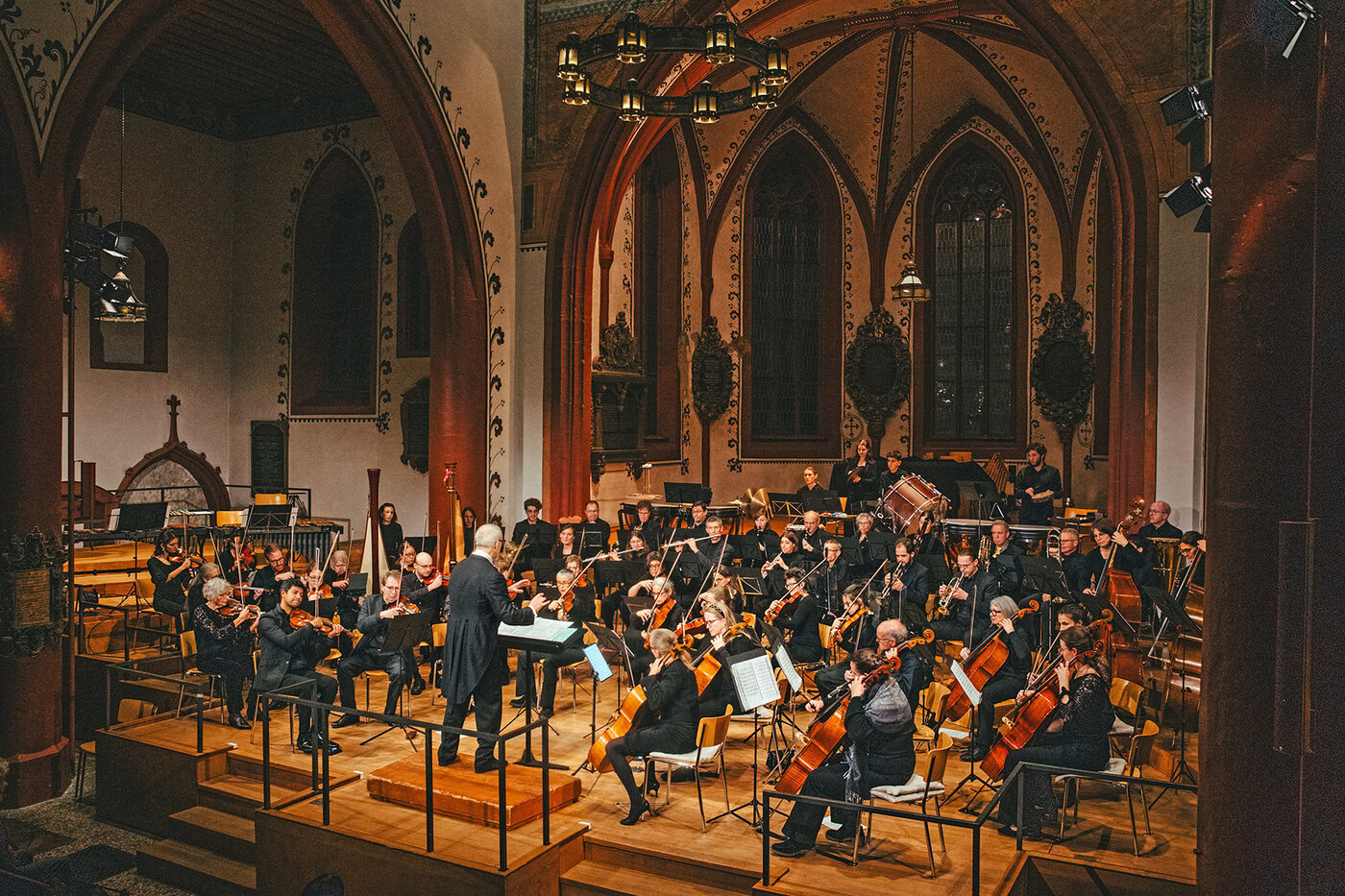
The TriRhenum Symphony Orchestra stands out in the Basel music scene for its often original programs with rarely performed works and commissions to Basel composers. Or through special concert formats such as The Basel Night at the Proms. The ambitious amateur orchestra with members from north-western Switzerland and southern Baden was founded in 1999 by the English-born conductor and horn player Julian Gibbons, who still conducts it today. Two concert programs are developed each year. The most recent, performed in Basel's Martinskirche (with a repeat performance in Reinach BL), was dedicated to the theme of "Peer Gynt". Not only were excerpts from Grieg's incidental music op. 23 and the two orchestral suites op. 46 and op. 55 performed, but also a world premiere by composer Lukas Langlotz, born in 1971: Rounds. Four tableaux for "Peer Gynt". Langlotz is no stranger to Basel, as he teaches composition, music theory, ear training and score playing at the Academy of Music. He studied with Rudolf Kelterborn and Betsy Jolas, among others. His works often have a religious background or refer to historical music.
The concert dramaturgy follows the drama
The decision to perform the works by Grieg and Langlotz interwoven rather than one after the other proved to be a very good one. The narrator Dominique Gisler deepened the understanding with interspersed quotations from the drama. The evening was an excellent motivation to engage with Ibsen's work about his hero's search for and discovery of identity. Peer Gynt, a traveler between dream and reality, the world of mountain spirits and the world of the 19th century, is actually a thoroughly unsympathetic person without empathy, without respect for women, but with megalomaniacal fantasies of world domination. Having become rich as a merchant and slave trader in Africa, he lies to himself about his useless life. Defrauded of all his riches, he returns to Norway as an old man. The "button caster", an angel of death or devil's messenger, predicts his end, but he is saved by Solvejg, who has been waiting for him in a hut all her life and loves him. She is often interpreted as the personification of Peer's soul.
Ibsen's work, sometimes referred to as the "Nordic Faust", is based on fairy tales, but is also a bitter satire of its time. The lyrical and folkloristic music by Grieg, who could not identify with the character of Peer Gynt at all, does not fit the drama particularly well, but is enormously popular with concert audiences. For an amateur orchestra like the TriRhenum Symphony Orchestra, which was obviously well prepared by Julian Gibbons, it is very grateful. We heard some outstanding solo performances (viola, oboe, flute, clarinet) and a very homogeneous string section. Intonation problems in the winds were not too noticeable.
Langlotz' "theater music"
The orchestra also mastered the new work by Lukas Langlotz - in the words of the composer "theater music without a stage" - well. Rounds does without unusual playing techniques, but it is certainly contemporary music, even if not in its most avant-garde form. The first part, which characterizes Peer, could perhaps also have been written by the late Penderecki; the second movement, a scherzo in rondo form, which depicts both the troll world and the atmosphere in the madhouse in Cairo, is in the tradition of Mahler's or Shostakovich's scherzos, but without possessing their bite and grim humour. The "Knopfgiesser" music of the third part - at times very dissonant - is haunting, and the last section, dedicated to Solvejg, contains beautiful soundscapes from which the Whitsun hymn Veni Creator Spiritus appears. It ends with a question mark, so to speak. As in the play, the ending remains open. The audience in the well-attended church was enthusiastic.