Learning to read scores
In his book «Score Reading», Paul Suits manages to convey this complex area in a well-structured and practical way.





In contrast to related areas such as basso continuo, there is hardly any literature on the subject of score playing. This is certainly due to the complexity of the subject matter, which also includes specialist areas such as sight-reading, instrumentation, harmony and stylistics. The didactics are correspondingly difficult to present clearly.
The now out-of-print two volumes are a successful attempt in this respect School of score playing by Günter Fork (published in 1980), which, however, could not prove their worth in the classroom due to their size. The four booklets are still relevant Score playing by Heinrich Creuzburg (published in 1956), in which, however, piano arrangements are proposed that are completely impractical. As far as this aspect is concerned, Alfred Stenger's Score playing, made easy from 2004 is an interesting approach, although the «made easy» is deceptive, because playing scores is not easy!
Comprehensive access, concrete assistance
Now Paul Suits presents a new, cleverly structured book in English and faces up to this fact: «There are artistic fields in which inspiration outweighs perspiration. In score reading the reverse is true [...]» The instructions are concise and the author's many years of teaching experience are evident throughout.
Suits teaches how to read the transposing instruments by learning the so-called «old clefs»: if you replace a marked clef with another one, the reference tone shifts, resulting in a transposition. If you also correct certain transposition signs, a transposing part can be read directly. This is preceded by a useful reading exercise to help learners familiarize themselves with the reference system of each new clef. Excellently selected literature examples are then used to guide you through all clefs and transpositions occurring in the orchestra.
Suits recommends figured bass and absolute chord symbols for grasping harmonic relationships. The chapters «Arranging the Score at the Piano» and «Dealing with unplayable Pieces» are particularly valuable. The methods and examples suggested are practical: reducing an orchestral movement to its harmonic framework and subsequently adding playable parts on the one hand, and regular reading and inner listening without an instrument on the other. Suits understands «score playing» comprehensively and uses the title Score Reading with intention: «In working with my students, techniques of playing, singing, imagining, and analyzing the score are all employed, often alternating in rapid succession.»
This book, full of helpful suggestions, is highly recommended to anyone who wants to tackle the difficult discipline of score reading!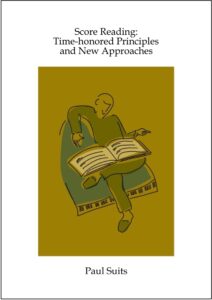
Paul Suits: Score Reading: Time-honored Principles and New Approaches, 124 p., € 37.00, Tredition, Hamburg 2025, ISBN 978-3-384-57748-1