An extensive, little-known body of organ music
Among the composers of the first half of the 20th century, Joseph Jongen is not one of the best known. John Scott Whiteley has now published the Belgian composer’s works for organ and harmonium in three volumes.



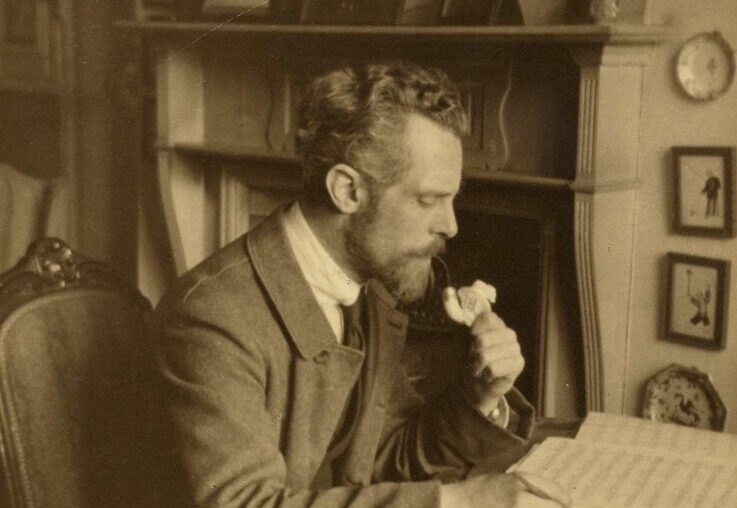
Even though his heavyweight Heroic Sonata (1930) or the Toccata (1937) occasionally appear on organ concert programs, or—with a little luck—one might even hear his Symphonie concertante (1926) for organ and orchestra in a concert hall: The majority of the Belgian composer's works for organ Joseph Jongen (1873–1953) is likely known to only a few specialists. Thanks to this three-volume complete edition, exemplarily edited by Bärenreiter and extensively annotated by John Scott Whiteley, it is now possible to gain a complete overview of Jongen’s organ and harmonium works, which were previously scattered across various publishers (including in the form of reprints or even pirated editions). – The critical introduction provides meticulous information on this.
After excelling in his studies of organ, piano, and composition, Jongen achieved significant success as a composer at an early age (including, in 1897, the Belgian Prix de Rome) and was in contact with many of the great musical figures of his time (including Richard Strauss, with whom he briefly studied composition, as well as Fauré, d’Indy, Arthur Rubinstein, Joseph Joachim, and many others). After initially teaching in Liège, Jongen spent the war years in exile in London and then, beginning in 1920, worked at the Brussels Conservatory, which he later went on to lead as director. His multifaceted compositional output includes a wealth of chamber and orchestral music.
The range of music published in these three volumes is also exceptionally broad: in addition to short verses and préludes (often only a few measures long) and other liturgical pieces, there is a wide variety of character pieces for worship services and concerts at various levels of difficulty, ranging all the way to dazzling virtuosity. While his early works are still stylistically strongly reminiscent of Schumann, Brahms, and, above all, César Franck and his circle, Jongen subsequently develops in a direction that also incorporates influences of Impressionism and ultimately culminates in a musical language that the editor describes in the foreword as «a dreamlike style of abstract, synesthetic color,» to which he has dedicated various publications and about which one would have liked to learn a bit more in this edition as well.
Many of the works include detailed registration instructions and require an organ with the essential timbres of the French Romantic period (strings, voix céleste, hautbois, etc.); the harmonium pieces are registered relatively non-specifically, which allows for easy adaptation to a similar type of organ. Conclusion: Anyone interested in rarely performed organ music from the early 20th century will be delighted by this exemplary complete edition.
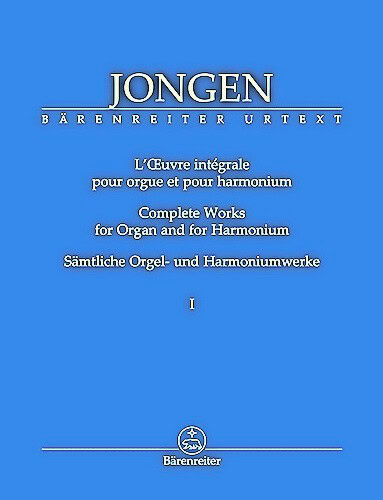
Joseph Jongen: Complete Works for Organ and Harmonium, ed. by John Scott Whiteley, 3 volumes, BA11255–11257, €54.00 each, Bärenreiter, Kassel