The digital recorder

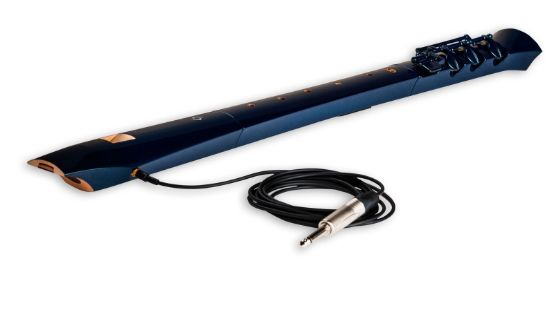
After four years of development, the Elody electric recorder was presented at this year's Musikmesse. Recorder maker Mollenhauer is making the instrument suitable for band playing.

Elody model Undine. Picture: zvg,SMPV

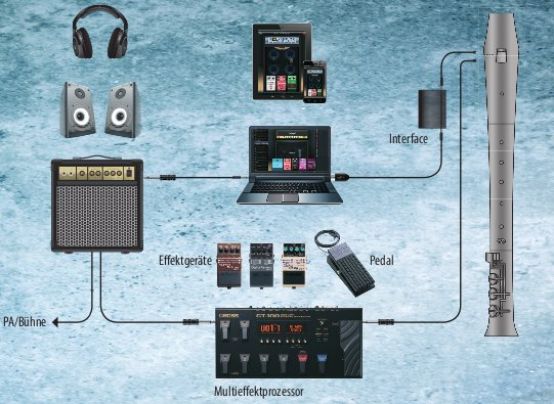
The recorder is still an important entry-level instrument for children. But if they want to play in the school band later on, they have had to change instruments until now. Elody, the electric recorder, which corresponds to an alto recorder in terms of fingering and blowing technique, can now hold its own on rock and pop stages alongside thundering guitars and basses. With a powerful sound and a range of up to three octaves, it can be used in a wide variety of styles - from rock and pop to metal, jazz, blues and folk.

The integrated pickup transforms Elody into an electro-acoustic instrument. Thanks to a specially developed passive cable, it works completely without remote voltage. And the instrument can then be connected to all effect devices and amplifiers via a mono jack plug.
Image

Nik Tarasov, Head of Development at Mollenhauer, emphasizes the user-friendliness and the enormous tonal versatility of the instrument (Sound examplesElody also looks unusual: the atypical, non-round shape is emphasized by various striking metallic designs. Elody costs around 1900 euros. Tarasov comments that they did not want to produce a cheap "gadget", but a high-quality instrument that would be a worthwhile, long-lasting purchase for schools, music schools and bands.

www.elody-flute.com

Loud(r) experiments

The world of sound, its creation, distribution and perception are the focus of the new special exhibition "Worlds of Sound", which opens on April 16, 2014 at the Swiss Science Center Technorama in Winterthur.

Excerpt from the poster for the exhibition,Photo:zvg,SMPV

Over 40 new exhibits, amazing sound spaces, sound sculptures and numerous freehand experiments make the phenomena of sound not only audible. Acoustic vibrations in the air, metal, glass, wood and plastic can also be observed with the eyes and felt as vibrations with the whole body. New sound spaces and unusual sound installations are available.

Image
Klankkaatser

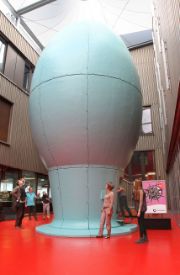
For example, there is the Klankkaatser or sound reverberation chamber by Dutchman Hans van Koolwijk. The ten-metre-high egg-shaped room is astonishing: music seems to emerge from nowhere directly in the heads of the listeners, and anyone who climbs a little way up the ladder inside hears their own voice as full and powerful as never before with a reverberation of over ten seconds!

An audio bar does not serve drinks, but sounds. Here you can listen to music over your own bones, make glasses vibrate, turn the bar furniture into instruments and make fire dance to the rhythm of the music. And because music is often also a social interaction, the bartender invites guests to a spontaneous jam session. Other unusual musical instruments include percussion and pump organs, cogwheel and perforated sirens or a giant xylophone ball track, all of which playfully open up completely different possibilities for sound production.

Even if you don't know anything about bells and whistles, this is the right place for you. You can't go wrong when experimenting in the sound worlds! Each exhibit comes with instructions for experimenting and further information.

The exhibition will run at least until summer 2015: Tue-Sun 10-17 h
Technorama website

Lucerne's head of culture steps down

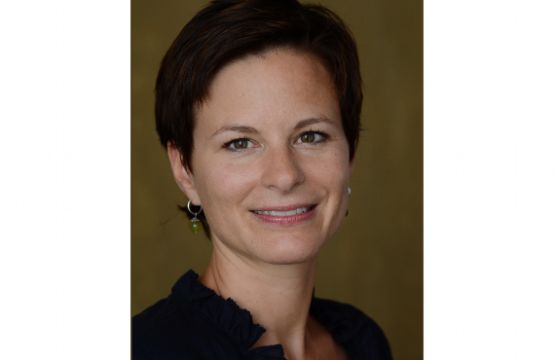
Nathalie Unternährer, Head of Cultural Promotion in the Canton of Lucerne, is stepping down from her position at the end of August 2014 for personal reasons. She will take over as Head of the Culture Department at the Christoph Merian Foundation in Basel.

Photo: zvg

Nathalie Unternährer has headed the Culture Division of the Department of Education and Culture since January 2013. During this time, she initiated the consultation process and the associated revision of the planning report on cultural promotion, which will be discussed in the Lucerne cantonal parliament this summer.

For family reasons, Nathalie Unternährer will be moving to Basel to live and work. Karin Pauleweit, the responsible head of service at the Department of Education and Culture, would like to take this opportunity to thank Nathalie Unternährer for her dedicated commitment to promoting culture in the canton of Lucerne, writes the canton.
 

On paper and digitally

The volume with the chorale preludes has been published by Carus-Verlag's Reger-Werkausgabe.

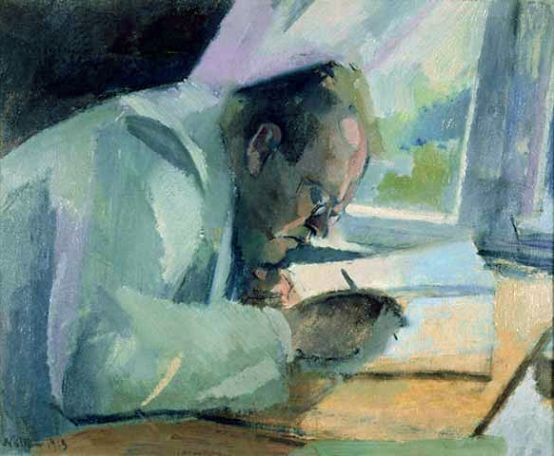
Franz Nölken (1884-1918): Max Reger 1913. image: wikimedia commons

With this volume, Carus-Verlag continues its scholarly-critical edition of Reger's complete works for organ. The source situation for the chorale preludes is not quite as complicated as for the larger organ works. Editions that go back more or less directly to the first edition and have not been distorted by "corrective" editorial interventions are still commercially available; modern Urtext editions of some works also exist. Nevertheless, the new edition also offers a masterly editorial achievement here: in addition to the extraordinarily beautiful volume of music with introductory texts to the works, a DVD is also included, which contains not only the musical text of the edition but also the surviving sketches, any engraver's models, the first print (particularly valuable in the case of the individually surviving chorale preludes - usually magazine supplements) and other sources. This allows textual differences in the sense of the critical report to be traced down to the last detail. In addition, there is a wealth of background information on the works, letters, reviews, lexical information on chorales, publishers, performers and even special features, such as the harmonium arrangement of the 30 Little chorale preludes op.135a.

An edition that should set standards for further major editorial projects; the wealth of material and the quality of the sheet music and DVD naturally also explain the high price.

Image

Max Reger, Works Edition, Volume I/4, Choral Preludes, incl. DVD, CV 52.804, € 188.00, Carus-Verlag, Stuttgart 2013

Jewish and Celtic, but also circus music

Pan-Verlag can look back on 35 years of company history this year. The company was founded in Switzerland and is still based in Basel.

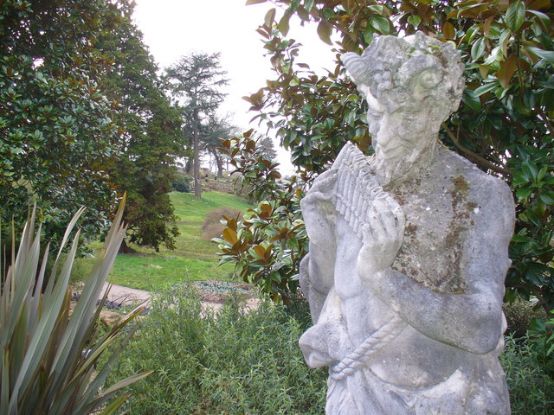
Statue of Pan playing the flute in the gardens of Wisley/GB. Photo: Colin Smith, wikimedia commons,SMPV

In 1979, Walter Keller-Löwy in Zurich gave his new publishing house the name of a dazzling mythical figure: Pan. The Arcadian god of shepherds and hunters was said to have invented the panpipe. An apt choice of name for a publishing house that felt a particular affinity with the various flute instruments. After the death of the founder of the publishing house, the Kassel-based publisher Renate Matthei became aware of the small publishing house and finally took over the company in 2007. In 2008, a branch was added in Kassel, but Pan remained an independent publishing house based in Basel and is an integral part of the Swiss publishing landscape.

The edition series in the choir has a secular and a spiritual offering. There are, for example, songs of Rhaeto-Romanic origin. The arrangers are experienced musicians such as Frédéric Bolli, Rudolf Jaggi and Kit Powell. With the sheet music of the edition series in the ensemble groups with a wide variety of instrumentations can play rousing movements with a folkloristic character. Marie-Louise and Cedric Dumont, Roland Fink and François Lilienfeld guarantee a high musical standard in easy-to-play arrangements.

Folk music from all over the world, e.g. from Central and South America, Ireland, Switzerland, Hungary or some Asian countries, is also the basis for many arrangements for recorder duo or larger recorder groups. Among the most popular editions are the arrangements of tangos by the Argentinian composer Astor Piazzolla for recorder quartet (PAN 768).

Two publication series are dedicated to the musical treasures of Jewish culture: Play, Klesmer, play... and Synagogue and shtetl. The authors are the Swiss klezmer researcher, composer and Chasan François Lilienfeld and Rudolf Jaggi.

In 2010, the publishing house launched the series Sonic Roots - Root sounds. Its author is the composer, teacher and jazz pianist John Wolf Brennan. A lifelong search for Celtic-Helvetian traces in music is reflected here. Four volumes for a wide variety of instrumentations have been published to date (PAN 2000-203, 2007).

A special feature of Pan-Verlag are the arrangements of circus music that Reto Parolari has compiled from his wealth of experience as a conductor at international circus festivals. The collection Circus, Circus (PAN 125) is aimed equally at school and ambitious amateur ensembles.

Publisher's website

Pollock scholarship holder at the German Music Competition

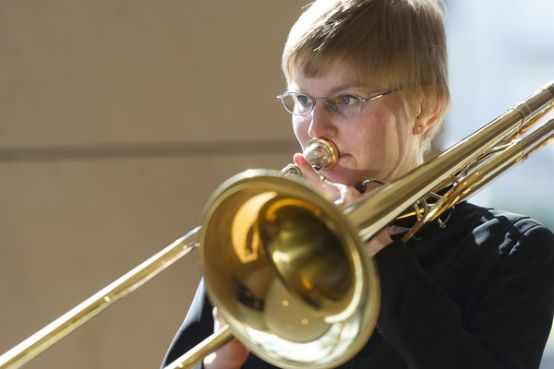
Zurich-born trombonist and Branimir Slokar student Louise Anna Pollock is one of the scholarship holders of the German Music Competition. The winner of the 40th German Music Competition was 22-year-old pianist Frank Dupree.

Photo: German Music Council

Dupree was the only artist to prevail in the final round in Bonn and was awarded the 2014 German Music Competition Prize by the Chairman of the Advisory Board Siegfried Mauser. Twelve other young soloists and chamber music ensembles were awarded a scholarship for their achievements, including trombonist Louise Anna Pollock.

Louise Anna Pollock was born in Switzerland in 1988 and began her trombone studies in 2008 with Branimir Slokar at the Freiburg University of Music in Breisgau. She has been studying with Henning Wiegräbe at the State University of Music and Performing Arts Stuttgart since completing her Bachelor's degree.

Pollock has already won numerous prizes as a soloist and chamber musician, including the Federal President's Scholarship at the Mendelssohn Competition. She has been a trainee with the Stuttgart Philharmonic Orchestra since September 2013.

The sublimity of the art-savvy canary

This book contrasts anecdotes by Handel, Bach, Telemann and Mozart with the concept of the sublime as defined by the philosophers of their time.

Photo: D.aniel - Fotolia.com

Who would have thought that the term "sublimity" could be associated with so many surprising, even serious things when we look at the sublime age, the 18th century, from today's perspective. It is not difficult to associate Handel's imposing figure and his great oratorios with it, or Bach's complex creations with their sophisticated formal language, which was little understood in his day. But the fact that Telemann's oratorio The patient Socrates - which, by the way, lasts more than four hours - is counted among the sublime with the duets between the competing wives Xanthippe and Amitta or its Mourning music of an art-experienced canary with the exhortation "Eat so that your throat swells" immediately makes even someone who is not a fan of Baroque music want to read on. This is all the more true as the writing style of this book, despite the 448 notes that reek of scholarship, seems young and often quite casual, for example when the arguments on the subject of "war and music" are caught up in "a very decisive stop at the filling station of philosophy" or when it is complained that "Bach's cantatas resemble musical catastrophe training".

This makes you curious about the chapter that goes back to the Rococo period, "Mozart on the path to sublimity". But you don't want to miss out on anything that Handel, Bach and Telemann have to offer, because "this book presents for the first time the events and constellations in the lives of these four men that led to their actual sublimity". That is no exaggeration. Sublimity has never been "tackled" in this way before. Who has listened to Milos Forman's "Amadeus" film afterwards and put Mozart's (possible) statement, "people so sublime that they sound as if they are shitting marble", into a closer context? Nevertheless, his last three symphonies are viewed within this striving for sublimity and, albeit formulated in a somewhat more modern way, are also seen in this way by the musical avant-garde of the 20th century.

This leads to the following conclusion in the final chapter "The long path of sublimity - from 1900 to the present day" using a series of examples: "Whereas sublimity used to be an expression of dignity, splendor and moral superiority, modern sublimity has become the endurance of excessive demands and a sense of pleasure that borders on the divine - at least as far as the psychological intensity of the feeling is concerned." Which would restore the seriousness; but the misprint "erst" instead of "ernst" (on page 133) once again calls this into question.

Image

Markus Köhlerschmidt and Stefanie Voigt, With timpani and wigs. The life arts of the illustrious gentlemen Handel, Bach, Telemann and Mozart. 167 p., € 24.90, Verlag Böhlau, Vienna and others 2014, ISBN 978-3-412-21035-9

Coupling the audible with the visible

In her book "Concert Scenes", Christa Brüstle enters largely unexplored terrain where acoustic and visual phenomena overlap.

Photo: Viktor Lugovskoy - Fotolia.com

"The visible, itself the hypostasis of music, was now able to emanate musical emanations." Dieter Schnebel wrote this learned sentence, which leads to the center of Christa Brüstle's investigation. Basically, it is about the inclusion of the visual, far removed from opera or music theater, mind you. Concert scenes, the title of the extensive treatise, is ultimately more of an embarrassing solution. For it is not only Mauricio Kagel's "Instrumental Theater" or Hans-Joachim Hespos' concert rituals that are addressed, but also many visual-acoustic variations away from orchestral or ensemble podiums. Christina Kubisch's installations are discussed, as are body performances by the Australian Stelarc and a performance of George Brecht's "Event-Partitur" that Brüstle witnessed in Berlin backyards Water Yam (1959-63).

It is questionable whether the subject area is not too large, whether it can even find a meaningful place in a book. Brüstle answers the latter in the affirmative and thus expects the reader to take quite a detour. In view of the incompatibility of the phenomena, their chronological presentation is not really suitable. The introduction in particular, which deals with the strictly serial phase of the early 1950s, is unconvincing. The extension of serial parameters to spatial properties does touch on the theme of "movement" hinted at in the book's subtitle. But the avant-garde of the 1950s seems to have (still) wanted little to do with the integration of the visible, which increased explosively in the course of the "fringing of the arts" in the 1960s.

Brüstle gets down to business with Mauricio Kagel's "Instrumental Theater", although there is less need for research here than on "Wandelkonzerte", "Interaktion in Konzert und Klangkunst" or "Musik mit Bild - Videokonzerte", the concluding topics of the presentation. Video concerts alone have gained enormously in importance, especially since the 1990s. Brüstle uses Carola Bauckholt's video for In familiar surroundings III for video, cello and (prepared) piano (1994) demonstrates the diverse combination possibilities of the audible and the visible, which allow visual doublings of the acoustic as well as surrealistic episodes or the friction of music with the visible. Further excursions into the multimedia art of Erwin Stache and Susanne Stelzenbach demonstrate how confused, even diffuse, the relationships can be in video art alone.

Brüstle cannot get to grips with such a thematic proliferation in her fundamental approach. She only deals with many works in broad outline, more descriptive than interpretive. In this respect, the 400-page tome Concert Scenes has become more of an opulent collection of material than a facilitator of access to artistic multimedia. However, Brüstle's courage in venturing into this largely unexplored terrain remains unreserved.

Image

Christa Brüstle: Concert Scenes. Movement, Performance, Media. Musik zwischen performativer Expansion und medialer Integration 1950-2000, (=Beihefte zum Archiv für Musikwissenschaft, Vol. 73), 413 p., € 78.00, Franz Steiner Verlag, Stuttgart 2013, ISBN 978-3-515-10397-8

Spanish trilogy

A remarkable, prize-winning new composition for brass quintet.

Photo: Remarkable / fotolia.com

The brass quintet scene is inundated with new arrangements of popular songs and classical highlights, but if you are looking for new original literature for this instrumentation, you have to dig a little deeper - and once again you will find it with Editions Bim. Spanish Dances was awarded first prize by the select jury of the International Trumpet Guild ITG; Stanley Friedman has once again proven that he can not only play the trumpet, but is also a remarkable composer.

The work is divided into three movements, which are strongly reminiscent of the Spanish coloring in Bizet's Carmen remind us. Right at the beginning of the first movement, the Habanera, the famous accompanying motif can be heard in the tuba, the first trumpet slips into the solo role of Carmen and has its own thoughts about love, repeatedly interrupted by isorhythmic passages in the five brass instruments. The Pavane, the second movement, captivates with its variation form and a continuous accelerando. The concluding Bolero plays with the themes of the first two movements in 7/8 time and brings the Spanish triology to a brilliant and virtuoso conclusion.

Image

Stanley Friedman, Spanish Dances for Brass Quintet, score and parts, ENS 174, Fr. 45.00, Editions Bim, Vuarmarens 2012

Pianistic splendor of color

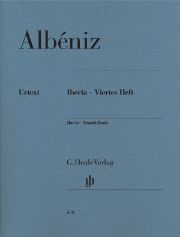
The Henle publishing house concludes Albéniz's piano cycle "Iberia" with the "Fourth Booklet".

Town hall of Málaga, Andalusia. Photo: Olaf Tausch / wikimedia commons

Much of what the Spanish composer Isaac Albéniz wrote for the piano in his relatively short life belongs in the realm of cultivated salon music. Of course, this does not apply to his masterpiece, the Suite Iberia, which was created during the last years of his life in Paris and Nice.

In this homage to his homeland, which he was no longer to see, Albéniz - not least under the influence of his French composer colleagues - unleashes a pianistic blaze of color that is unparalleled in the piano literature. It should be noted that, conversely Iberia has also rubbed off on many a French master: on Debussy, for example, in his Sérénade interrompueor to Messiaen, who considered the suite to be one of the greatest piano works ever written.

With the Fourth issue Henle-Verlag has now also published the last part of the suite, and in an exemplary manner. In the three concluding pieces, Malaga,Jerez and Eritaña, Albéniz once again pulls out all the stops Iberia are so typical: finely stylized Spanish dance rhythms, dazzling harmonies, long organ dots and dynamics that are differentiated to the extreme. The music is correspondingly complex. However, the editor Norbert Gertsch not only succeeds in eradicating the numerous printing errors and mistakes that haunt the older editions, but also in presenting the musical text, which is littered with many annotations by the composer, in an astonishingly lean and clear manner. This even applies to the final piece Eritaña (An inn near Seville), which is a tour de force for any pianist with its breakneck leaps and incessant voice crossings.

Debussy particularly loved this piece: "Jamais une musique n'atteint des impressions aussi différenciées et aussi colorées et les yeux se ferment comme s'ils étaient aveuglés par ces images toutes trop éclatantes."

Image

Isaac Albéniz, Iberia, Viertes Heft, Urtext edited by Norbert Gertsch, HN 650, € 20.00, G. Henle, Munich 2013

Swan song?

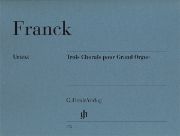
The latest research has been incorporated into this edition of César Franck's "Trois Chorals".

Monument à César Franck de Alfred-Charles Lenoir (1850-1899). Photo: Siren-Com / wikimedia commons

"Je vais m'atteler avec courage à l'orchestration de Ghiselle, tout en faisant aussi autre chose" - with these words, César Franck described his activities in 1890, a sign of his unbroken creativity, despite the late effects of a traffic accident, which would ultimately lead to his death. By "autre chose" he probably meant two cycles of works: a series of over 60 harmonium pieces, published under the title L'Organisteand the Trois Chorals. Even if these - like so many "last works" - are often regarded as the swan song of the suffering composer, who once again soars to the highest compositional perfection and into mystical spheres, it seems to have been a composition commissioned by the publisher Durand, which Franck completed relatively quickly. Autograph fair copies indicate that he was also able to prepare the publication. However, as the first edition only appeared around the turn of the year 1891/92 (i.e. more than a year after Franck's death), it was probably no longer possible for him to correct proofs and supervise the publication.

Friedemann Winklhofer's new edition of the Trois Chorals outlines the genesis of the works in a detailed preface and summarizes the essential findings that Joël-Marie Fauquet compiled in his epochal Franck biography (Fayard, Paris 1999), which unfortunately received relatively little attention in this country. Certain details - some registration issues or the names of the dedicatees, grateful material for the rumor mill - will probably not be conclusively clarified on the basis of the available sources.

For the musical text published here, however, the editor appears to have had access to previously inaccessible autographs of the first and third chorales in addition to the first edition. These allow for various minor additions and corrections to the "known" musical text, such as that presented by Günther Kaunzinger in 1991 for the Vienna Urtext edition (with practically identical pagination, incidentally). For example, the opening semiquaver figures in the A minor chorale are "newly" summarized with legato slurs, which perhaps somewhat relativize the occasionally heard "drumfire" articulation. Further details can be checked with the detailed Critical Report, but do not lead to any really groundbreaking new insights. Interpretative notes, such as a statement on the "eternal" problem of the coupling possibilities of the Récit manual, are only mentioned in the preface, but the actual musical text is then kept neutral and also dispenses with the English registration indications of the first edition or interpretative additions by the editor.

Conclusion: a reliable edition that is up to date with the latest Franck research, with clear and elegant music. And another Franck edition from Bärenreiter has already been announced ...

Image

César Franck, Trois Chorals pour Grand Orgue, edited by Friedemann Winklhofer, HN 975, € 26.00, G. Henle Verlag, Munich 2013

Adapted for women's choir

Great choral works by Vivaldi, Mozart and Pergolesi in versions for equal voices.

Image: semmickphoto / fotolia.com

There is often a lack of male voices in choirs. Conversely, female choirs are looking for new heavyweights in their repertoire. This leads publishers to publish works for mixed choir or soloists in a new form. Here are some examples from Bärenreiter.

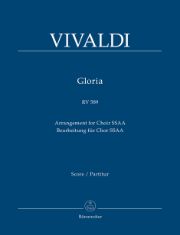
Vivaldi's famous Gloria was composed in 1716 in the Ospedale della Pietà, an orphanage in Venice, where Vivaldi worked as a caregiver and musician. It is therefore reasonable to assume that it was also performed there, and thus exclusively by children's voices. The arrangement by Malcolm Bruno shows that this masterful composition does not suffer any loss of quality even in the version for equal voices.

The Kyrie for two four-part female choirs and two string groups unfolds its own charm in this arrangement. Combined with the Gloria results to a certain extent in a short measurement setting.

Mozart's universally popular Coronation Mass and the Missa brevis in D for three-part female choir. Such adaptations require expertise and musical sensitivity. Heribert Breuer attempts to preserve the substance of the original versions and at the same time gives them a new sound character.

In the performance history of Pergolesi's Stabat mater there are indications that there were earlier choral performances. The new arrangement by Malcolm Bruno mixes solo aria movements with three-part choruses and movements for three individual voices, with the existing musical material forming the basis for the newly added parts. The repertoire for female choir has thus been extended by another famous work.

Image

Antonio Vivaldi, Gloria RV 589, arranged for choir SSAA by Malcolm Bruno, score BA 8953, € 12.95,Bärenreiter, Kassel 2012
id., Kyrie RV 587, BA 8954, € 12.95

Wolfgang Amadeus Mozart, Missa in C KV 317 "Coronation Mass", arranged for female choir SMA by Heribert Breuer, score, BA 5691, € 30.95, Bärenreiter, Kassel 2013
id., Missa brevis in D KV 194, piano reduction, BA 5690-90, € 8.75

Giovanni Battista Pergolesi, Stabat mater, arranged for female choir SMA by Malcolm Bruno, score, BA 5692, € 24.95, Bärenreiter, Kassel 2013

Light and resonance

Hefti's second piano trio "Lichter Hall" demands unusual playing techniques from the strings.

Photo: Petra Dirscherl/pixelio.de

David Philip Hefti composed this work for the Medea Trio, which premiered the composition on October 16, 2012 at the Wigmore Hall in London. It is intended as a compact, single-movement and bright counterpart to the first piano trio Shadow play conceived. Various impulses lead to points of rest - as an echo, as it were - and develop steadily from the initial stagnation to flowing movement. The subsequent Cantabile passage, taken from his orchestral work Moments lucides as an echo, dissolves into a shadowy conclusion.

The strings are challenged in various exotic playing styles: Tapping, scratching, crunching, "iridescent and hissing pizzicato" (fun to try out!) and flageolet shooting stars. They only get a "real" cantabile without double stops in the aforementioned reminiscence from the orchestral piece. Technically, this one-movement, nine-minute piano trio is not too difficult - for professional musicians, of course, and those with a sense for new sounds!

Because the rhythm is practically never audible, the question arises as to whether scores for the strings would not make more sense than the individual parts. The performers of Lights Hall a lot of pencil work ahead!

Image

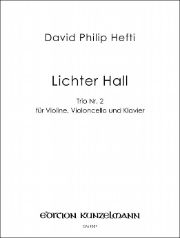
David Philip Hefti, Lichter Hall, Trio No. 2 for violin, violoncello and piano, score and parts, GM 1887, Fr. 36.00, Edition Kunzelmann, Adliswil 2012

Biberach Jazz Prize 2014 goes to Sid

Singer and composer Rea Dubach, drummer Daniel Weber and pianist Luzius Schuler, all graduates of the Bern University of the Arts (HKB), won the 2014 Biberach Jazz Prize with their band SÌd.

Picture: zvg

According to its own description, the Biberach Jazz Prize is "one of the few international prizes for up-and-coming jazz musicians and has become a permanent fixture after more than 20 years". For younger jazz musicians in particular, it offers an alternative to the major national and international competitions.

This year's second prize was won by the group Curious Case, the third by Krassport and the fourth to sixth prizes went to ttrio akk:zent, Turn and No-Look-Pass. A total of almost 50 formations competed for the prizes.

The Bernese-German group Sid, led by singer Rea Dubach, is inspired by the soundscapes of Finland, Sweden, Ireland and Iceland, and sounds "sometimes mystical, dark and shrill", sometimes "very delicate, airy and fragile".


Software-supported analysis of jazz improvisations

As part of a project called "Jazzomat" by Weimar musicologist Martin Pfleiderer, software can be obtained free of charge that can be used as a toolbox for analyzing monophonic melodies, especially jazz improvisations.

Photo: Innovated Captures - Fotolia.com

The so-called MeloSpySuite is a freely available stand-alone software toolkit that includes several command line programs for analyzing monophonic melodies, especially jazz improvisations.

Included is the Weimar Jazz Database, which currently contains more than 100 jazz solos by various musicians and styles. The solos have been annotated by experts in a MIDI-like format, with additional metrical information, chords, form parts and phrase subdivisions as well as comprehensive metadata on style, genre, tempo and rhythmic feel.

The software package also includes a version of the Essen Folk Song Collection with around 8000 folk songs from Central, Western and Eastern Europe. The release of a Jazzomat web application based on the MeloSpySuite is planned for the end of 2014.

Free download: jazzomat.hfm-weimar.de/download/

get_footer();