Why the halving initiative hits Swiss music life to the core

Switzerland is a musical country. Millions sing, play, listen, attend concerts and festivals. But this vibrant musical landscape depends on visibility. With the so-called SRG halving initiative, the very media stage that has carried, documented and made Swiss music accessible to a wide audience for decades is at stake.

Music is not created in a vacuum. It thrives on resonance, on communication, on publicity. In Switzerland, this public is closely linked to the SRG. It makes Swiss music audible via radio, television and digital platforms - across all genres, language regions and generations. Every year, SRG broadcasts over 42,000 hours of Swiss music, produces almost 1,000 hours of live music and documents concerts, festivals, ensembles and orchestras from all over the country.

These services are not a by-product, but part of a cultural-political mission. Private media cannot - and do not want to - take on this role. They are geared towards click figures, advertising markets and internationally exploitable content. Classical music, jazz, folk music, new music or experimental formats would hardly have a place there. Without SRG, a large part of Swiss music creation would disappear from public perception.


A stage for everyone - not just for the mainstream

The consequences would be particularly drastic for up-and-coming artists. Formats such as SRF 3 Best Talent, RTS Radar or Eurovision Young Musicians offer young musicians their first national stage - often the decisive step towards a professional career. These platforms exist because SRG does not operate on the basis of short-term returns, but instead enables long-term cultural development.

SRG is also key for established ensembles, choirs and orchestras. Concert broadcasts, recordings and portraits create reach far beyond the concert hall. They ensure that music is not only present locally, but nationwide - even in regions where there is hardly any private media.


Culture needs remembrance

There is also an aspect that is often overlooked: cultural memory. Hundreds of concert recordings, music documentaries and audiovisual archives are created every year. These recordings are more than just content - they are testimonies to the times. They show what Switzerland sounds like, today and tomorrow. If SRG were halved, this sonic memory would become fragile. Because no one else produces, maintains and makes these collections accessible in comparable breadth and quality.


Film, series - and the music that carries them

The halving initiative would not only affect music directly, but also Swiss filmmaking - and therefore production music. Through the Pacte de l'audiovisuel, SRG invests around CHF 34 million a year in independent Swiss films and series. For composers, sound designers, recording studios and musicians, this means hundreds of commissions every year. If this funding disappears, a central market for applied music will collapse - with serious consequences for the entire value chain.


Halving is not a savings program

SRG is already making massive savings and is undergoing a far-reaching transformation process. Halving the budget would not be a further efficiency step, but a structural cut. Regional studios would have to close, productions would be centralized and regional and cultural diversity would be lost. The Latin language regions and peripheral areas would be particularly affected - and with them those musical voices that are already struggling for visibility.


What is at stake

The halving initiative is therefore much more than a media policy proposal. It is a cultural policy decision. It is about the question of whether Swiss music will continue to have a national stage - or whether it will fall silent in the shadow of international platforms. Anyone who takes Swiss musical life seriously must consider these consequences.


Order campaign material

The Swiss Music Council is campaigning against the SRG halving initiative with the campaign «Where the music plays». Information material, arguments, flyers and stickers can be ordered at: info@musikrat.ch


Further information and many voices from the Swiss music scene: wodiemusikspielt.ch

Cultural winter Arosa

The Kulturwinter Arosa offers a varied program again this year. In addition to lots of music, there are lectures, readings, talks and a film. The flagship events are the two festivals Arosa Sounds and Arosa Klassik.

Arosa Sounds 2026 from January 29 to February 1 is all about the piano - from sensual head cinema to boogie-woogie with heart. With Traffic, Bernese composer Simon Ho and André Dubois present a suite for two pianos inspired by being on the move: Train stations, hotel bars, markets and highways become musical sceneries full of movement and poetry.

The Palestinian pianist and composer Faraj Suleiman, known for his energetic combination of Arabic music and jazz, will delight audiences with works that build bridges between the Orient and the Occident. Frank Muschalle, one of Europe's leading boogie-woogie pianists, will provide pulsating rhythms. The young Swiss pianist Manon Mullener takes the audience on a journey around the world with her album Stories. Each piece tells of people, encounters and emotions - a modern jazz album with Cuban flair and a lot of heart.

With the Bündner Sounds project, Arosa Kultur is bringing the diversity of the local music scene to the stage: from Mel D to Ursina, from Walter Lietha to FROM KID - the quintet around Anna Bläsi, Gianna Lavarini, Sören Dokter, Marc Jenny and Rolf Caflisch lends Graubünden compositions fresh sound colors between pop, minimal and improvisation with new arrangements by Andi Schnoz.

The theme of this year's Arosa Classical Music Festival is "canti d'italia" and will take place from February 27 to March 20. Swiss mezzo-soprano Maria Riccarda Wesseling will sing at the opening. She will take the audience into the little-known world of Italian art songs. She will be accompanied by pianist Kristina Rohn. - Giuseppe Verdi founded the "casa di riposo" in Milan in 1896. With Il bacio di tosca, Swiss director Daniel Schmid created a touching film about the old people's home in 1984. It still provides accommodation for musicians, opera singers... people for whom the big career never happened - and other, successful people whose dream salaries have long since been used up.

The third edition of the travel guide Genoa - La superba has already been published. Graubünden historian Prisca Roth has subtitled her book "Streifzüge durch die Kulturstadt". In her lecture on Genoa, Prisca Roth talks about Genoa's dark labyrinth of alleyways, the industrial port, the polite aloofness of its inhabitants, the colorful robes of the African women, the quiet smiles of the transvestites... She is accompanied by the Genoese cantautore Paolo Gerbella.

The Graubünden orchestra le phénix - specializing in lively interpretations of baroque music - combines original works by Vivaldi with adaptations of this musical style by Rondo Veneziano in its programme. At the Arosa Classical Music Festival, "le phénix" juxtaposes baroque and "modern" live in concert for the first time and travels to Venice in the early 18th century, with original sounds and in the style of the 1980s.

As in previous years, the winners of the Hans Schaeuble Award will give concerts as part of the Arosa Classical Music Festival. In two groups, they will develop concert programs in Arosa which will be performed not only in Arosa but also in Chur, Ilanz, Boswil, Cham and Zurich.

What is Swissmedmusica?

Swissmedmusica has been promoting health and prevention in the music profession since 1997. The association has built up a high-caliber interdisciplinary network of experts for this purpose.

The network includes international professional associations, Swiss music associations, music schools, music academies and orchestras. Together with them, Swissmedmusica ensures that damage caused by poor posture, stress and overloading is avoided throughout the entire life and professional cycle.

Swissmedmusica maintains a national advice center for those seeking advice. This is free of charge and independent of the institutions in the sector. It treats inquiries with absolute confidentiality, does not pass on any data and can also be contacted anonymously. Swissmedmusica is also a competence center for public relations and information exchange for musicians' medicine. This includes an annual industry meeting, a directory of prevention and therapy services and activities on social media platforms.

Among other things, members receive regular information about SMM events, an exclusive newsletter with industry news and literature references, access to the complete list of members, discounts on documentation for SMM symposia (more information can be found in the "Literature" section of the Swissmemdmusica website), discounts on the journal of the German Society for Music Physiology, a platform for their own course offerings and reduced admission to the society's symposia.

Queer music in Switzerland - What does visibility sound like?

Nemo wins the Eurovision Song Contest. A glittery outfit polarizes people and a nationwide discussion about non-binaryity ensues. But Nemo is not the only queer person in the Swiss music business.

The question is much bigger: What does queerness sound like in Switzerland - and how does it influence the musical landscape?

What is celebrated as mainstream today has often developed in queer subcultures. Pop history is hardly conceivable without queer communities. Madonna, ballroom, synthpop - much of what became popular with the masses first emerged in spaces that offered protection for social minorities. And a look at the biographies of classical composers such as Robert Obouissier or Tchaikovsky also shows that queer personalities and music are historically closely interwoven.


Jazz, identity and power structures

Ramón Oliveras studied jazz percussion and composition at the ZHdK. Looking back, he criticizes the male-dominated environment:

"The jazz course was very male-dominated. It was often about technique, about playing as complicated or virtuoso as possible. But music is also about expression, identities and what it wants to convey. These topics were often deliberately ignored."

Today, he openly advocates for queer visibility in the music scene. "Many gay cis men in the industry are privileged. But as soon as you are female, non-white, trans or disabled, there is hardly any sense of inclusivity. That's why the institutions need to change."

For Oliveras, it is clear that the patriarchy also has a strong effect on music. His concerts and coaching sessions should be spaces that are open to everyone. He supports young musicians not only musically - but also in career matters.


Pop, attitude and queer narratives

Jessica Jurassica is an author and part of the eastern Swiss electropop duo CAPSLOCK SUPERSTAR. Together with Mia Nägeli, she combines pop, politics and autotune. Produced on playful technoid beats by Nägeli, Jurassica's lyrics are ironic and revealing. "We deal with queerness in our lyrics. The last album was about our coming-outs, among other things," she says during the interview in the café in Basel. Identity also plays a role in the selection of concerts: "I would like to see more attitude from the industry."

The duo questions power structures, criticizes patriarchal thought patterns [DI1] and is particularly committed to trans visibility. In "Valerie Solanas on a Healing Journey", they not only sing about a trans icon, but also negotiate what being trans and being yourself as an adult means.

Less vulnerable and more accusatory, they sing in the hit song "Helvetia": "Ficke mit de Waffe-Lobby mit em geile Pharmageld. Schubidubidu"

At the same time, the question that concerns many queer artists remains: "Are we booked because we fulfill the diversity factor - or because of our music?"

Nevertheless, Jurassica is grateful for the cultural funding in Eastern Switzerland that has supported her project. While many queer artists move to cities to be visible and safe, it is important for her to remain present in rural areas and help shape the cultural offerings there. This is because she herself found her first connections as a queer person in Frauenfeld's cultural circles.


A small scene with a big attitude

The queer music scene in Switzerland is small, closely networked and very supportive. Exchange and mutual support are key. At the same time, visibility also means vulnerability. Artists such as Jurassica and Oliveras emphasize how important safety concepts are for event organizers - not only for the audience, but also for the performers themselves.


How much does queerness shape artistic creation?

The answer is individual: for some, identity is an artistic resource, theme and attitude. For others, music takes center stage and the private sphere remains private. But together, queer musicians are changing the Swiss music landscape - aesthetically, structurally and culturally.

Queer music in Switzerland doesn't just sound like style - it sounds like courage, change and the demand for spaces in which everyone can be visible.

New editorial team for the Music Dictionary of Switzerland

The Music Dictionary of Switzerland is entering a new phase with a new editorial team and secured funding - for an up-to-date, multilingual and participative reference work on Swiss music history.

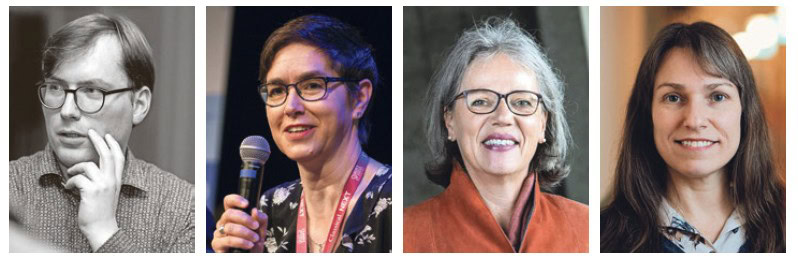
f.l. Cla Mathieu (photo: Jan Hellman), Sandra Tinner (photo: Johan Virt, EMC), Irène Minder-Jeanneret (photo: Béatrice Devènes), Caiti Hauck (photo: Dres Hubacher)

As a reminder, the development of the Music Lexicon of Switzerland (MLS) has a long history that has lasted over ten years. Many hours of voluntary work were put into this project by a small team of musicologists and historians, motivated by the idea that Switzerland finally needs an up-to-date (online) music lexicon. However, it was difficult for a long time to find the necessary funding to offer a user-friendly online platform for the encyclopaedia's users on the one hand and to establish a professional editorial team on the other. Since the beginning of 2025, the MLS has received start-up funding from most of Switzerland's cantons as well as special support from generous sponsors and the Canton of Geneva to finance its own project. The Geneva project is intended to serve as an example and demonstrate how the music lexicon presents the musical history of a region. These contributions have made it possible to recruit staff for a professional editorial team from spring/summer this year: Cla Mathieu for the German-language editorial team; Sandra Tinner for the French-language editorial team; IrèneMinder-Jeanneret for editing the articles of the Geneva project; Caiti Hauck as editorial coordinator.

The MLS is characterized by several special features: It is cross-disciplinary and contains biographical articles about players in musical life such as performers, composers, teachers, patrons, instrument makers and sound engineers as well as factual articles about places and other music-related topics. The aim of the MLS is to offer encyclopedia articles in all national languages and - wherever possible - supplements with sound examples, images and links to existing information.

The MLS also focuses on cultural participation, as it encourages and empowers groups and individuals to write articles by name about people or institutions that the writers (still) knew personally. The editorial team ensures that all writers receive professional support.

The MLS constituted itself as an independent association in 2024 and has been a section of the SMG ever since. Since 2022, the MLS has also been a board of trustees of the Swiss Academy of Humanities and Social Sciences.

If you have any questions about the Swiss Music Lexicon, please contact the President, Pio Pellizzari: pio.pellizzari@outlook.com

Through the eyes of the learner

When I took over the management of the new Master's degree program Music and Scene in Transformation in Basel in 2024, I had been reading the book "Through the Eyes of the Learner" by Catalan philosopher Marina Garcés for a while.

Even the blurb is all about the big picture: what use is knowledge "if we don't know how to live? Why learn if we can't imagine the future?".

Education is the substrate of our coexistence, the battleground where the resource of education is exploited rather than being a playground where new ways of life can be tried out. Garcés, however, envisions a workshop in which lifelong learning is not based on the necessity of being forced to experiment under neoliberal performance imperatives, but rather an invitation. An invitation to "take the risk of learning together, against the forces of one's own time."


Reign of talent and logic of the two

Music academies are places of talent. Places where it is already clarified during the aptitude assessment whether it is worth continuing to follow the rule of talent or whether a different career and an alternative path in life should be advised. With the concept of the dominance of talent, I am referring to the American literary scholar and psychoanalyst Eric L. Santner, who worked out how the perfection of our talents can also harbor the potential for lack of freedom. Music academies are also places of a logic of two. The masters possess something that, in a mostly linear transfer of knowledge, has a historically informed interpreter in mind. In this transfer, we seem to know for whom or what we are educating: for an area of life that we ourselves have already colonized. An area of life that we perhaps even had to fight for ourselves through competitions, prizes and selection processes. Not only in these competitive areas of education, but in society as a whole, there seems to be hardly any room for a workshop in which we can tinker, build, stumble and design together. In the words of Marina Garcés: There is a lack of time in which we can grow slowly, organically. We are nervous and need to learn quickly. Instead of creating a garden in which we combine new plants and herbs, creating a place that is not only cultivated, but a whole archipelago worth living in, the logic of the two can lead to a monoculture. Perhaps even become a reserve in which life forms are to exist separately from one another. If we replace the concept of life forms with artistic disciplines, there is a danger that we will also create artistic disciplines as monocultures.


Polyphonic workshop

However, artistic education is a place of three. Between the teacher and the learner there is a third object, a common question, thesis, conflict or concern that is worth working on together. A third knowledge is created here, radically subjective, but born of a common interest, beyond the naked demands of the market.

This place of a third knowledge is a workshop, not a factory. In Basel, we speak of polyphonic workshops, a term I borrowed from Clemens Risi and David Roesner and developed further with the students. Here we give space to change because it is part of life. In the first year of Music and Scene in Transformation, projects for public spaces, performances on the figure of the witch as a feminist figure and new concert and performance formats in the form of music installations were created in these workshops. We dealt with space-body-time music and initiated a student campus. We have thought about music as a temporary ritual in political contexts, examined music, commemorative culture and the politics of remembrance in the context of 80 years of the end of the war in Europe at the Augsburg Peace Festival and founded a bank robber orchestra as part of the Basel Social Club, which critically contextualized music, which was often used for representational purposes, in an empty bank during Art Basel.


Emancipated interpreters

In recent years, there has been repeated talk of the need for classical music academies to orient their courses towards an increasingly complex and competitive market and to model their courses accordingly. Students should increasingly become decathletes instead of professionalizing in one discipline, or preferably both. More and more tools and additional qualifications are to be acquired so that they can react flexibly to new professional challenges. There seems to be a strange pressure at work here to acquire more of various other disciplines instead of learning with and in them. We cannot have been concerned with this struggle when we wanted to develop artistic-musical teaching in the direction of transdisciplinarity. Rather, the aim must be to provide historically informed interpreters with emancipated interpreters. Not to replace them, but as companions. They are emancipated because, in addition to learning classical repertoire, they are encouraged to research their very own, third knowledge together with fellow students and teachers. This knowledge is important because it allows us to imagine a future - to use Marina Garcés' words again. A common future, beyond the isolation that has crept almost unnoticed into artistic education through the dominance of talent and competition focused on the individual. We have made a start in Basel. Experimental and open to cooperation and at the same time embedded in the university's existing institutes.

In memory of Tomas Dratva

The Board of EPTA Switzerland remembers with gratitude its President, the pianist and piano teacher Tomas Dratva from Basel, who died unexpectedly at the beginning of October at the age of 56. His thoughts are shared here once again.

The following abridged interview was conducted by Nadia Lasserson, Executive Secretary of EPTA International, in 2023. It appeared in English in PianoJournal (No. 129/2023), translated and edited here by Verena Friedrich.


Tomas Dratva, how did it come about that you started playing the piano and eventually became a pianist?

My parents were not musicians - my father is an engineer and my mother a chemist - but music always played a big role in our family. My mother played the piano and my father the violin. My mother's cousins were musicians, one of them a very successful composer and bandleader, so I was exposed to music from an early age. I was taken to concerts and experienced a rich cultural life. I had a piano at home, which I played all the time. My parents quickly realized that I should take lessons and so I had piano lessons, first with my mother and later at the local music school with Verena Haller.

I took part in many competitions and won several prizes. At the age of 13, I gave my first real concert in the concert hall of the radio studio in Basel; I played Mendelssohn's Lieder ohne Worte. In 1991, at the age of 23, I made my debut at the Tonhalle Zurich: Honegger's Concertino is such a humorous and jazzy work with a fine orchestration - that was a wonderful experience for me.


Where did you study piano?

Jean-Jacques Dünki was my piano professor at the conservatory in Basel; I studied with him from 1987 to 1991. I later continued my studies for two years in London with Peter Feuchtwanger and finally graduated in 1995 in Lucerne with the Czech pianist Ivan Klánsky.


Are there any particular aspects that are unique to Swiss pedagogy?

I don't think so. But children are offered many opportunities to make music from a very early age. The first piano lessons are more free and playful than serious.


What do you think about competitions?

As a child, I enjoyed taking part in competitions. Later, during and after my studies, I did take part in some international competitions, but I was not ready to join the international competition circuit. I preferred to prepare concert projects in my early professional career as a concert musician.

As far as my students are concerned, I support them if they want to take part in competitions on their own initiative, but I don't push them to do so. Some regularly take part in competitions because they are very motivated to prepare for them. Others have no interest at all.


Peter Feuchtwanger is a good friend of mine. So I know that you have an excellent piano technique and I assume that you never have any pain when playing and that you know how to avoid it.

Fortunately, I have never had any pain while practicing or performing. One of my most important beliefs at the piano is to master a healthy and relaxed technique. That's what I try to convey. As soon as pain occurs, there must always be a way to change the playing technique to avoid chronic injury. This is a very important task for a teacher.


I know that you have a great fondness for contemporary music. Please tell us more about it.

I have performed a lot of contemporary music as I think it is important to play the music of the present and to see what the language of today has to offer. For example, the Swiss composer Esther Flückiger, who lives in Italy, writes in a free contemporary atonal/tonal style, rich in jazz rhythms and including many aspects of extended piano techniques. I have premiered some of Esther's pieces and released her music in a double album on Pianoversal, my web platform and music label for piano music.


Actually, you founded Pianoversal...

I played in the piano trio Animæ for 17 years, from 1993-2010, with whom we performed over 100 piano trios throughout Europe with the same line-up. We also toured South America several times. Every year we commissioned a new trio. For example, we played an exciting triple concerto that Peter Breiner, a conductor, composer and pianist living in London, had composed especially for us.

Another major project was the posthumous premiere of the piano concerto by the Swiss-Hungarian composer János Tamás with the Basel Chamber Orchestra, a wonderful concerto that was never performed during his lifetime. Tamás died in 1995, and a group of friends took care of his musical legacy. I have recorded all his early piano works as well as an album of chamber music. In fact, a large part of my 20 CD recordings is dedicated to 20th and 21st century music.


I am sure that you share your passion for contemporary music with your students.

I usually teach this music in groups because it is so new, challenging and complex. Students need to contextualize this genre, and together they can better explore and understand the sounds and colors. The group helps them not to feel lost and alone when working with contemporary music. I also teach classical music in groups, as I firmly believe that students benefit greatly from listening to each other. By playing in a group, they motivate each other.

I regularly organize educational projects, such as "Bartók's Echo", which was dedicated to Bartók's music and contemporary composers who emulate Bartók. The last project was called "Schwankende Quinten - Musik von Frauenhand" and dealt with female composers from the Romantic and Impressionist periods as well as contemporary music.


Did you play a lot of classical music, or did you concentrate mainly on the contemporary scene?

I have a passion for discovering new music, regardless of the era, and also for pursuing projects on individual composers. For example, I performed three previously unknown piano concertos by Koželuch after researching in music libraries and studying original manuscripts in Vienna and Paris. I became a specialist in Janáček and played his complete piano works, including the Concertino and Capriccio. Before I recorded all his piano music, I visited the Janáček Archive in Brno and received all the original manuscripts for preparation and study. It was also fascinating that I even played on his piano, a very beautiful Ehrbar concert model from 1876. I was also lucky enough to be able to record Liszt's Années de Pèlerinage on Richard Wagner's piano in Bayreuth: Steinway & Sons from New York had donated it for the first Bayreuth Festival. As it is in a museum, I was only allowed to play and record on the Steinway at night, so I spent the nights in Haus Wahnfried, the Wagner family home. That was a strange but wonderful experience.


Obviously you are also fascinated by old pianos.

That's another one of my passions, the old days of piano making, the ones by Blüthner, Bechstein, Steinway, Gaveau, Erard, Pleyel and others. I love playing these old pianos. The fascinating thing about them is that each piano has its own character, whereas modern pianos are built in a rather uniform way.


You perform a lot, and I wonder if you've ever had that "peak experience" when the music just flows and you're kind of outside of it?

Playing always requires inner and outer control. I don't believe in "forgetting yourself" on stage. On the other hand, I often have this kind of experience when I play the piano at home, especially when I improvise. But I wouldn't call these moments "outside of it", on the contrary, they are rather "inside of it".


May the memory of Tomas and the good he did encourage us to carry on the love of music and its transmission. À Dieu, dear Tomas, we bid you farewell, but we will always remember you with gratitude. We all know what we have lost.

Musicking (M)others

This contribution is based on fragmentary stories and forms of becoming in and with passionately un/planned projects with consequences: un récit de musiciennes mères - three artists talk about their lives as musicians and parents.

Zainab Lascandri aka Signup (Z), is a parent and a Black transdisciplinary artist. Z lives in Zurich and has been part of the electronic pop, punk, rap, techno, new wave music duo " None of Them " since 2012. H spoke to Z by phone. Claire Huguenin (C) and Malcolm Braff (M), jazz musicians, live and work as artists, mother and father, founders and co-founders of the Maison-Matrice, both an associate artistic center and their place of residence, located in the Jura bernois in Crémines. We met C and M with them at the "Maison-Matrice" in Crémines. The following scene takes place on a dark afternoon at the end of the morning, when their children and ours play in front of the old scierie together with other residents of the house.

In front of the old sawmill of the Maison-Matrice :

Enfant : Mamaaaaan j'ai faim

C : alors il faut faire le feu

H : SONART proposed to us to write about a crucial moment in life and career - becoming a parent. An article on the repercussions, the advantages and the disadvantages of having children as musicians... but...

C : HAHA !

M : Vous voulez faire de la musique ? Avez-vous pensé à faire des enfants ?

CMHR : *rigolade

A week earlier entre Bienne et Crémines, avec C on the phone :

C : (takes off.) alors la vie d'artiste... tu vois en ce moment je sutout surtout maman de trois enfants et co-gestionnaire de la Maison-Matrice. I give occasional concerts or recordings, and I see these moments as a respiration in relation to my daily life as a very busy demeurant.

H : Mais avec la Maison-Matrice tu te dévoue à un projet culturel, de partage et d'accueil artistique. And the children are also part of it - that's also what interests us.

Scene from the music video "Hyenas on the Beach" by "None of Them": In the earth-colored room \ a black guitar case upholstered in flesh ochre \ in it a brown sewage pipe phallic \ behind it the black child \ the microphone the umbilical cord the cable \ slides down \ the pipe the opening the hole \ through the case \ a "Hey" \ the person at the end \ of the open sewage pipe\Signup sings into the microphone

Avec Z au Téléphone :

Z : I became a parent when I was 23, in 2004. In many situations - unless someone asked me specifically - I never actually said: I am a parent. There is a risk involved in saying you are a parent. Because the capacities are different, the risks for working together. And also for the image. Especially in the context of performance or music and when you're on stage. So - I don't see it like that anymore - but in a way, your attractiveness is at stake.

C : Is the mother the antinomy of the séduisante woman? I have the memory of a photo on this subject, of an American singer who made voices on the piano and who at the time was sitting in a chaise à bascule, her feet in her belly, a rifle in one hand and a cochonnet in the other. Il y avait clairement une notion de matrone.

Z : This struggle with my (self-)image of the parent read as a mother, and my artistic identity as a musician - that was actually something that accompanied me. This dark side in my music represented an echo of this state. It's also the visual of our music videos that reflects this insecurity with the character of the mother. I couldn't identify with it at all. I decided at some point: ah ok, there are different ways to be a parent.

C : Where certain people have a regulated day - like paper to music - with us, these are especially the major axes that are clear. For example: I am fully available for the family, I watch my children on demand during their first three years. Our presence is therefore maximized at the house, we also go to school at home, and in terms of the precise schedule of the day... well, it's very jazzy, especially with the affairs of the association, which are always disruptive.

Z : And I can go my own way, even if I don't have many role models around me. It was a lonely path.

C : The desire to be a mother was current at the time of the launch of Maison-Matrice, a spontaneous desire to be a mother in an extremely radical way, combined with the desire to be useful, the desire to serve. What I didn't want was to live in a "prototype" apartment with our family, I needed to open up and I had every interest in placing the family home in a place like this.

M : For me, there is a desire not to close the spheres of life. And in fact, sometimes with Claire you find yourself with a baby who's on stage while you're training to do our concert as a duo...

C : Oui or bien je m'arrête au milieu du concert pour allaiter, et je continue de chanter avec bébé dans les bras.

M : Yes, so there is a real need to integrate all aspects of life into a single, multiple reality. And now we are probably in the phase of *cris d'enfants sur baby(tele)phone* ah cette fois il est réveillé ! *pause*

M : I had the phase or the fact of having children was seen as a detriment to my own art and my time of creation. This sentiment for me was really deconstructed when I decided to put my ego into my role as an artist. If everything is deconstructed, it's much less tendu, it's much less in friction - I think.

Z : When I got pregnant I was still living in a shared flat. My idea was always that I could raise my child in this shared flat *laughs* which didn't work out. And then we lived with the father of my children in this small family, cooperative apartment, which didn't make me very happy. But we had a lot of support from his parents, especially his mother, and also from friends. With the first child, I totally used my network *laughs*. I also wanted my child to be raised by different perspectives and people. It then became much more difficult with the second child. And then after the separation - as a romantic relationship, so to speak - we continued to live together as a family for another 6 years. I think it would have been different if I'd had the financial means to do things differently. Most things stand and fall with financial resources. I later moved into a shared flat and was the person who commuted. I was always half in the family home - where my father lived permanently with the children - and half in the shared flat. And we did that until the kids were like: "Hey, it's ok. Just come and cook, you can go home later." By then they were teenagers. And before that, I just slept in one or the other child's bed. So I didn't have my own room. I was always like this: child 1, child 2.

M : And then, with the arrival of the third child, you clearly live a little bit more.


The man in the caravan dazed \ with glasses in virtual worlds \ immersed the mother with cutter \ knife in hand sings \ " I don't know what to do to kiss " \ " I'm like " the hand the knife \ a cut in the stomach the blood \ " A quarter in a quarter in a house \ A small space to here \ And I don't know where to go \ But I don't know where I can lay."


Z : My children's father had a bar. It wasn't so child- and family-friendly. But that's why it worked. Because he was there in the evenings. We still had family ties. And I still have a close relationship with his parents. I think we somehow managed that well *laughs*. Yes, that was what we wanted - or tried - I think.

C : One functions above all with a spontaneous division of roles, in the family as well as in the association. I think there is a deficit at the end where there is sometimes a lack of awareness of the tasks to be carried out, of understanding of the issues and of availability to organize. The means are also limited and the ambition is high, so overwork is really part of the tableau.

Z : Yes, and for me it was like this: my father has lived in Freetown on the west coast of Africa since I was little. And my mother had another child of her own, who is almost the same age as my first child. And she lived in Lausanne - with her family. I lived in Zurich. And yes, she didn't really have the capacity to be a grandmother. And then the question was: when do you get a place in a daycare center? Between six months and a year old, the children had a place in a daycare center and from then on they went for at least three days. And when I was doing a bachelor's degree, they were in nursery for 100 %. I think the good thing was that I was young at the time and had energy. And the children could often spend the night with grandparents or neighbors. It wouldn't have been possible without my partner's grandparents.


In the light of the blue hour \ the black child dressed in white \ the mother on the bed \ the black body under a white sheet \ the child neatly tucked away \ the eight-armed cephalopod octopus \ in the mother's open belly \ the wound the cut \ la césarienne the hole. \ belly with the bostitch \ staples the child with " CLACK CLACK " \ to the reversal of birth \ the blood-red dead mollusk in the belly \ utérus matrice \ the white breast milk cake wafting \ fluidly deforming in the space between.


Outro : Être (m)other et musicienne, c'est composer à plusieurs mains et voix, souvent dans l'improvisation, avec des temporalités et des besoins multiples. But beyond the individual blending of parenthood and artistic practice, these récits invite us to rethink more broadly the conditions of creation: how our worlds make care work un/visible, what structures are missing and emerging, and what new collective forms of making could emerge from this. In other words, il s'agit pas seulement d'une affaire privée, but d'un terrain commun, où se (re-)mix Kunst, Leben, Ökonomie et politique.

Developing as a choir by singing in front of experts

Participating in singing festivals and singing in front of experts is one of the highlights of the choir year for many SCV choirs.

Lukas Bolt, co-responsible for expertise at the SCV, gives an insight into current developments.


Lukas Bolt, why do choirs actually want to sing in front of experts?

II see two main needs. On the one hand, choirs would like to receive a competent external view of their performance and find out what they can work on to make their performances even more successful. On the other hand, there is also the need to compare themselves with other choirs.


How do you deal with these two needs?

The focus of the singing festivals should be on further development. The choir and, in particular, the choir management should take away specific points that they can continue to work on. We would like to satisfy our desire to compare and measure ourselves more and more at choir competitions, which we also organize on a regular basis.


What characterizes an :n expert :in choral singing ?

On the one hand, as a choir director, you need a lot of experience with choirs at different levels, from amateur to (semi-)professional choirs. The second very important aspect is to give the choirs comprehensible and support-oriented feedback. This requires a lot of interpersonal skills. Experts also take part in the regular further training courses we organize in order to keep up to date with the latest technical and pedagogical developments.


How does singing in front of experts actually work, what can a choir that has never done this before imagine?

This currently varies depending on the singing festival. Usually, two experts listen to a performance and one expert gives constructive feedback and, if desired, a grade. We have about a quarter of an hour per choir for this. Half of this is with the entire choir or the board, the other half is with the choir director alone, as this allows us to go into more detail on technical topics. The choir directors also value this outside view from colleagues enormously.


You have made some changes to the expert system in recent months. What specifically?

We used to have a huge Expert :inside list of up to 100 people. However, many of them were never used. We therefore had to reduce the list and will only work with around 50 people in future. For example, it was important to us to have a mix of younger and older experts. To ensure that everyone is regularly deployed, I and the person responsible for French-speaking Switzerland, Caroline Meyer, are in charge of coordination.

The SJMW between anniversary and new beginnings

The SJMW is celebrating its 50th anniversary and is kicking off another exciting year for young talent with the 51st edition of its competition.

50 years of music is much more than a span of time: it forms a melodic arc across generations, a resounding bridge between the past and an already vibrant future. The SJMW celebrated its half-century with an event that will remain a vivid memory for everyone involved. There was palpable enthusiasm in the air in the halls of the Tonhalle Zurich - an echo of stories and successes that have been linked over decades. Two world premieres crowned the celebration: new, specially composed works by Richard Dubugnon and Daniel Schnyder, which paid tribute to the competition and carried its spirit into the future. No less moving was the performance of former prizewinners as soloists. They formed a reunion of musical excellence and impressively demonstrated how the seeds sown 50 years ago continue to sprout today and bear fruit of rare quality.The beginning of a new chapter

But an anniversary, as glamorous as it may be, is not an end point, but a threshold. While the sounds of the celebrations still reverberate, the SJMW opens a new chapter with the 51st edition of its competition and invites young musicians from all over Switzerland to once again contribute to the history of the competition.

In 2026, the competition is divided into three disciplines - Classica, Composition and FreeSpace - and thus offers spaces ranging from interpretation to creativity.

In the solo category, special attention will be paid in 2026 to the rich timbres of string, wind and percussion instruments. Violin, viola, violoncello, double bass, flute, recorder, oboe, clarinet, saxophone, bassoon, harp, accordion, dulcimer, pan flute and classical percussion will all be taking part. This diverse sound palette invites you to explore the most varied musical worlds: from the lyrical intimacy of the violin to the archaic, surprising voice of the dulcimer to the pastoral breath of the pan flute and the rhythmic energy of the saxophone.

In the Composition category, young composers are invited to "paint with sound" so that their ideas and inspirations become living scores - fresh and imaginative.

FreeSpace, on the other hand, is a free terrain, a crossroads for improvisation, electronics, performative arts and experimental formats. Jazz and new technologies are heard here as well as multimedia installations.

What makes this competition unique is, as always, its basic idea of giving young people a stage on which they can showcase their talent and dedication - in a dialog that knows no linguistic or cultural boundaries. Those who take part enter a tradition that has already inspired numerous international careers.

The SJMW knows that each participant brings a unique story: a swinging bow, a breath that becomes a melody, a percussion that marks the pulse of the future. This is why the competition is not just a contest, but also a laboratory for growth and a place of encounter where you learn to listen to others and to yourself. The call is therefore clear: to take part in this musical adventure, to contribute your own sound, your own idea of beauty and your own desire to transcend boundaries.

The new half-century is just around the corner, and the first note is already floating in the air - ready to connect with the sounds of all those who have the courage to lift the bow, elicit a sound from their instrument with their breath and make a young, curious heart resound. Whether experienced performers or creators of new forms - the SJMW awaits everyone.

The 2026 at a glance

Registration for all competitions:
November 1-30, 2025
www.sjmw.ch


Deadline for submission of projects/videos for Composition and FreeSpace:
November 30, 2025


Classica: Entrada competitions:
March 13-15, 2026 in Arbon, Geneva, Lugano, Neuchâtel, Sion, Unterägeri, Winterthur
Final: April 30 to May 2, 2026 in Zurich
Prizewinners' concert on May 3, 2026 in Zurich

Ways to achieve a convincing stage presence

At this year's Swissmedmusica symposium, top-class speakers from England, France, Germany and Switzerland will reveal their recipes for a convincing stage presence

The well-known cellist and psychologist Chiara Samatanga, who holds a doctorate from the University of Bern and offers courses for music students at the Bern University of the Arts on practicing, stress, performance anxiety and the psychology of chamber music, will talk about mental states when practicing and performing. The pianist and clinical psychologist Sara Ascenso, who is developing research projects and new university curricula on the subject of musicians' well-being at the Royal Northern College of Music in Manchester, England, will analyze myths about musicians' well-being with us. She also has some good news.

The German pianist, singer and doctor Pauline Gropp is a lecturer in embodiment and musician's medicine at the Cologne University of Music and Dance. She brings us closer to the personality structure of charismatic stage personalities. The award-winning French vibraphonist, percussionist and mental trainer Sylvie Reynaert teaches at the Strasbourg Conservatory and runs a studio for the mental preparation of musical talents for competitions, exams and auditions, based on the model of mental training for athletes.


November 22, 2025, Farelsaal Biel, simultaneous translation German/French


Info and registration:
swissmedmusica.ch/healthday

Promoting mental health at conservatoires

Resource-oriented training and self-management approaches offer potential for promoting and maintaining psycho-physical health in higher education.

The importance of mental health has increasingly become the focus of public attention in recent years. According to studies, music students experience greater mental stress than the average of their peers. According to the Swiss Health Survey 2022, the number of mental health complaints in the 15-24 age segment is higher than in the population as a whole, at up to 25%. This makes it clear that prevention, early detection and treatment of mental health problems and illnesses is a relevant topic for conservatoire students. According to Horst Hildebrandt, psychosomatic stress is the biggest health problem among music students alongside musculoskeletal complaints. The diagnoses are often complex and frequently require an interdisciplinary approach, as numerous influencing factors are responsible for the development of a complaint. In particular, the quality of teaching, practicing and the level of stage skills appear to be significant influencing factors.Concept of health and resources

According to Health Promotion Switzerland, health is subject to dynamic processes and arises when internal and external resources and stresses are in balance. The interplay between a person's physical, mental and social state plays a central role in this.

Resources are seen as protective factors for health. The individualized development of resources, taking into account the bio-psycho-social model, is therefore of great importance in promoting and maintaining mental health during training.

Resource-oriented approaches aim to develop strategies and patterns of action that can be used for the gradual prevention of psycho-physical stress and illness. The concept of resources varies depending on the theoretical foundation of the approaches. What they all have in common, however, is that they aim to enable the individual, but also institutions, to master everyday training in a self-effective and self-determined manner.

Promoting and maintaining the psycho-physical health of university members can be better supported the broader the range of services on offer. In addition to individual, low-threshold counseling services, curriculum-based courses are important in order to enable the development and expansion of psycho-physical resources as early as possible in training. These include scientifically based and evaluated stress management approaches tailored to the realities of music-making for the stage and everyday student life, mental training, forms of physical training suitable for the stage and the teaching of suitable learning and practice strategies. With a view to prevention, there should also be offers for individual lessons as well as didactic and methodological training in order to train core competencies of a constructive, solution-oriented (self-)instruction style and an appropriate feedback culture.

Research continuously generates new knowledge

There has been an encouraging development in research and teaching on mental health at Swiss music universities. This active role is also reflected in the "Position Paper on Health Education in Tertiary Music Institutions" initiated by Johns Hopkins University. In addition to progress in curriculum development, epidemiological studies and research projects on instrumental and vocal issues as well as on hearing, contributions to stage fright research, for example, should be mentioned, which, in cooperation with universities, are constantly giving new impetus to the promotion of mental health. As a result, resource-oriented training and self-management approaches can be successfully combined with the highly specific requirements of conservatoire training.

Example of a health-promoting network under the umbrella of KMHS:
Swiss University Center for Music Physiology, www.shzm.ch


Example of a health-promoting offer anchored in the curriculum:
www.zhdk.ch/departemente/dmu/musikphysiologie


Note on further training:
Mental training for everyday professional life in music, Basel University of Music,
17.01.2026 with Prof. Horst Hildebrandt and Judith Buchmann

Fit for the stage

At the 21st Swissmedmusica Symposium on November 22 in Biel, a glimpse into the future of mental training for musicians will be offered.

It is now standard in the world of sport and is slowly beginning to catch on in music: mental coaching. One pioneer is the Strasbourg percussionist and mental coach Sylvie Reynaert. She believes that the music stage, like the sports arena, is a competitive environment that demands performance. Stress has to be dealt with on stage. The strategies required are similar to those in the world of sport.

Reynaert bases her work on the Target Method, a recognized guide to mental preparation, as well as on the application of neuroscience. With a systemic approach and the transfer of this knowledge to the artistic field, she offers "action coaching", which originates from top-class sport. Stage presence, a clearly defined strategy and mental work are at the heart of her work. Her coaching is based on "goodwill, listening, availability and practical solutions".

The Swissmedmusica Symposium on November 22, 2025 in Biel offers the opportunity to get to know Reynaert and her way of working in person. Her presentation will be complemented by talks by the cellist and psychologist Chiara Samatanga, who works in Bern, the British music psychologist Sara Ascenso and the German pianist and musicologist Pauline Gropp. A unique opportunity to familiarize yourself with mental training for musicians.

Robert Oboussier to listen to and read

How the idea of reviving a work resulted in professional music recordings and a diverse book publication. They will be presented in the fall.

In March 2021, I came across the story of Robert Oboussier and became curious. The renowned Swiss composer was murdered in 1957. When the circumstances of the murder, his homosexual orientation and the male milieu in Zurich became known, the public was horrified and not only his person but also his work was virtually hushed up from then on. What did his music sound like? I only found a few recordings, including 5 Abbreviationen for piano. I discovered sheet music of the complete piece - 25 abbreviations - in the Zurich Central Library and asked Christian Wernicke to arrange an excerpt for the Zurich Mandolin Orchestra (MOZ).

65 years after Oboussier's work was almost completely silenced, the MOZ performed the Abbreviationen on April 2, 2022 at a festival organized by the Swiss Plucked Music Association. Ramon Bischoff, Swiss composer and sound engineer (www.nomar.ch), also took part in this festival, as his piece "Schwärme" was premiered by the association's orchestra zupf.helvetica. Ramon became aware of the story and was very concerned - then he began to research it.

In the interview, Ramon said that the many gaps he encountered were the main concern at the beginning of the project: there are hardly any photos, almost nothing personal from his life, an incomplete estate, few sound recordings and only a few public writings about the works. Ramon found the discrepancy between the historical appearance of the compositions, which were often premiered to great acclaim in prestigious venues, and their current absence from the repertoires of musicians and concert halls extremely unusual. The idea of finally making Oboussier's music audible again on the 125th anniversary of his birth began to grow.

Ramon selected seven musically significant compositions from 1921 - 1948 and found professional musicians who wanted to bring this music back to life with him. The recordings were made in 6 months with a wide variety of instrumentations - from solo piano to string orchestra. And as a bonus, the excerpts of the abbreviations were also recorded with the MOZ. Most of the selected works are world premiere recordings - in other words, they were recorded for the first time. Parallel to the work in the recording studio, rights had to be clarified, sponsors motivated, foundation applications written and, with NAXOS, a renowned label found to publish the music production.

Ramon originally planned an extensive booklet for the CD in order to do justice to the socio-cultural and historical significance of the work and its concealment. This idea grew into a book publication, which brought with it unexpected dimensions and new challenges in terms of content. The contributions by the seven authors have very different perspectives from the fields of music theory, media, history and sociology. The account of a contemporary witness completes the picture in a very personal way. The bilingual publication (DE/FR) also contains the first complete catalog raisonné.

My aim was to revive a work with the hope that the idea would be carried forward and the music rediscovered. My hopes were more than exceeded.

Ramon writes: "Robert Oboussier's music is an expression of his political, social and humanistic convictions. It is important to me that his works continue to convey the values for which he stood up artistically. [...] On the 125th anniversary of Robert Oboussier's birth, I hope that his music will once again be played and performed more frequently and that it can have a new impact as a symbol of social equality."

In the fall, a series of concerts, panels and readings will take place (see flyer) and the MOZ will also perform at the first two concerts.

So many wonderful and creative people were involved in this project that, in order to do them all justice, I would just like to refer to the homepage (www.oboussier.ch), where all the people and further information can be found in German, French and English.


Information on

project and music streaming: www.oboussier.ch

Music CD: "Robert Oboussier. World Premiere Recordings"; NAXOS label in the Musiques Suisses series (www.naxos.com)

Book publication: "Robert Oboussier. Beiträge zu einem verschwiegenen Opus"; Ramon Bischoff (ed.); Verlag edition clandestin (www.edition-clandestin.ch)

Zurich Mandolin Orchestra: www.mo-zuerich.ch

Promoting young talent in Arosa

For many years, the Arosa Culture Association has been committed to supporting talented children and young people in their musical development. This commitment is demonstrated in a variety of ways - in particular through the Arosa Music Course Weeks.

The Arosa Music Course Weeks take place between June and October with around 1450 participants from Switzerland and abroad. Several courses are specifically dedicated to promoting young talent:

French horn course - for over 30 years under the direction of Stefan Ruf and Heiner Krause. Almost 40 children and young people from the Basel area travel to Arosa every year.

Violin course - For 25 years under the direction of Jens Lohmann with 20-30 young participants every year.

Children's and Youth Orchestra Week - This year it took place for the 20th time under the direction of Verena Zeller. Therese Hauser will take over as artistic director from 2026.

Youth Chamber Music Week - In October under the direction of Katharina Stibal, Noëmi Rueff and Jonas Kreienbühl. Special feature: close cooperation with the Swiss Youth Music Competition (SJMW). Every year, up to ten runners-up in the SJMW take part free of charge.

Children and young people are also welcome in many other of the 132 music course weeks. They benefit from a discount of CHF 100 on the regular course fee; special children's courses are even cheaper. Thanks to the support of various foundations, generous scholarships can also be awarded.

"arosa music academy"

The "arosa music academy" as part of the Arosa music course weeks includes two special master classes at the highest level. The first week under the direction of Prof. Lars Mlekusch is offered for accordion and saxophone and the second week under the direction of Markus Fleck for violin, viola and cello. In addition to daily individual lessons with university lecturers, there are intensive chamber music lessons.

Hans Schaeuble Award

The Hans Schaeuble Foundation Zurich has supported the Arosa Culture Association for many years and also attaches great importance to promoting young musicians and chamber music ensembles. The award and the recognition prizes are presented to outstanding participants of the two "arosa music academy" weeks.

get_footer();