Musical heritage in Swiss music academies
The perspectives of Swiss conservatoire directors show a multi-layered understanding of musical heritage between archive, living practice and institutional responsibility.




What do you mean by «musical heritage» when you run a music academy in Switzerland today? A collection of works that can be passed on like objects? An institutional responsibility? Or a living matter that needs to be shaped and transformed?
At the invitation of the Conference of Swiss Music Universities (KMHS), the Schweizer Musikzeitung (SMZ) interviewed the directors of the country's music universities. Far from a uniform discourse, the answers paint a multi-layered picture, partly consensual, partly controversial, in which the idea of musical heritage itself is questioned, expanded or redefined.
Between tradition and activation: what actually «exists»?
In Zurich, Xavier Dayer (ZHdK) introduces a clear break with the idea of a fixed, stabilized heritage: « Le patrimoine envisagé comme un ensemble stabilisé relève d'une fiction. Nous vivons entourés d'archives : ce qui les rend vivantes, c'est notre regard, notre écoute, notre manière de les interroger.»
In this perspective, musical heritage is not a given quantity, but a relationship. Nothing exists as long as it is not activated.
This idea resonates - without mixing with it - with one of the provocative mirrors held up by musicologist Daniel Leech-Wilkinson. For him, the belief in a stable «work» is a comparatively recent historical construction: it is not the object, but the experience in performance that creates musical value. (Daniel Leech-Wilkinson: Challenging Performance, Chapter 6.17: Works) This reference does not fundamentally question the idea of heritage, but invites us to understand it less as a transferable block than as a moving matter.
A legacy in flux - depending on the institution that receives it
For some institutions, dealing with heritage initially means cultivating a concrete relationship with the materiality of the traces: scores, collections, archives, musical estates, sound objects. In Lucerne, for example, the organ documentation center or the Jazz Helvetica archives bear witness to patient preservation work in which the act of conservation is already an act of mediation. Here, musical heritage begins even before it is heard. In this context, Valentin Gloor, Director of the HSLU, also points out the limits of music academies in passing on musical heritage: «A music academy must therefore always be aware that, due to its culture and context, it can only preserve, explore and pass on a tiny part of this immeasurable musical heritage.»
In contrast, Geneva describes a musical heritage in constant expansion that reaches far beyond the historical walls of the Western canon. Béatrice Zawodnik explains that this involves forgotten scores as well as non-written practices, taught Indian musical traditions or the emergence of an electronic repertoire that now has its own history and codes. The heritage here becomes a space for expansion, in which additions are made visible and repaired.
This contrast highlights a central tension: musical heritage can either be understood as something that needs to be protected - or as something that needs to be opened up, and it is precisely in this intermediate space, between remembrance and expansion, that the Swiss musical landscape moves today.
Mediate ... or experiment?
One question runs through several answers: Is a legacy actually being conveyed - or rather are practices being tested that will only be perceived as legacies in the future?
Xavier Dayer formulates this unequivocally: «I am not certain that we are transferring a heritage. Nous expérimentons, et nous créons les archives de celles et ceux qui nous succéderont.»
In Geneva, too, it is emphasized that students are not only recipients: « Le patrimoine n'est désormais pas seulement reçu but construit activement. [...] Il existait un patrimoine en sommeil que nos étudiant:es et nos enseignant:es s'efformais désormais de mettre en lumière. One can therefore no longer speak only in terms of a small ensemble of finished works written between the end of the XVIIIth century and the beginning of the XXth century.»
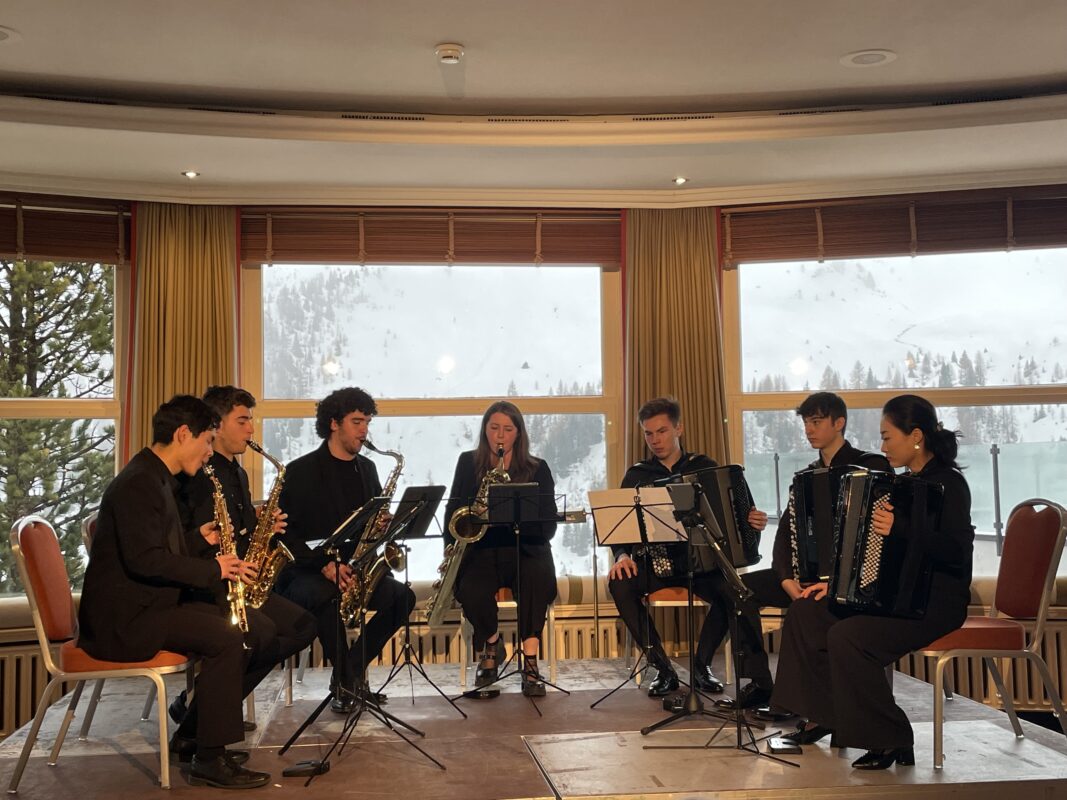
Students become co-producers of an emerging heritage when they participate in projects of rediscovery, research or artistic creation.
In Lausanne (HEMU), Noémie Robidas speaks of a «patrimoine vivant qui s'enrichit au contact des créations contemporaines». But this movement must be thought of in a circular way: contemporary works in turn feed on the past. Heritage is not an arrow pointing from the canon into the future, but a circular breath in which the past feeds the present - and the present redefines what will be considered heritage in the future.
However, this dynamic view must be relativized by a reality that is evident in everyday life: The contemporary does not always assert itself as a matter of course. In practice, an aesthetic comfort zone remains. It is not uncommon to observe that for some students - as well as for some concert audiences - the patrimonial field of imagination remains strongly oriented towards the past. The integration of new aesthetic languages is neither automatic nor uncontroversial. Musical heritage in the making remains a field of tension between institutional aspirations and actual reception.
What to do with Switzerland's musical heritage?
These shifts are also reflected in the pedagogical structures. Noémie Robidas explains that the HEMU (Waadt-Wallis-Freiburg) works with a composer-in-residence every year and thus directly integrates artistic creation into a mediation gesture. Other institutions pursue a more curatorial approach: they first allow works to «mature» before deciding whether they will be performed, studied or included in the curriculum. In this context, Leech-Wilkinson points out that every form of patrimonialization is also an operation of power: it fixes and differentiates what should be preserved, performed, sold and celebrated - and what may be forgotten. In Geneva, for example, Béatrice Zawodnik speaks of selective projects and at the same time emphasizes that there is no systematic instrument for promoting Swiss musical heritage.
Finally, in Bern, Rico Gubler (HKB) points to the responsibility of music academies towards regional composers and the importance of programming repertoire that is less present in the commercial music business: «This is the basis for the respective regional universities to make a special effort for the composers working in their area, because others (have to) do less for various reasons.»
This coexistence of different temporalities creates a very specific Swiss reality: we do not all teach the same futures. Some universities consciously confront students with the new, others first teach a common language before encouraging them to transform it. There is no right or wrong strategy - but different pedagogical ecosystems in which the notion of heritage also shapes the way musicians are educated.
Conclusion
If these positions have a common denominator, it is the insight that musical heritage is not a thing of the past, but a becoming; it is not passed on like a safe, but is created anew day by day - in classrooms, studios, listening practices, reopened archives, in played, discarded and transformed works.
At the Swiss level, therefore, there is no uniform concept of musical heritage, but rather a differentiated, transversal and constantly evolving concept. To the extent that heritage goes hand in hand with a continuous willingness to reflect and an open and flexible attitude on the part of the musicians of tomorrow, this is perhaps the greatest wealth that our conservatoires pass on.