From Parchment to Pixels (and Back)
Digitization does not make source criticism obsolete; rather, it makes it more important. That is the conclusion of the summer school held this year in Rome by the Institute of Musicology at the University of Zurich.


Every year, the Istituto Svizzero in Rome hosts summer schools on its premises. This year, the contract was awarded to the Institute of Musicology at the University of Zurich. From July 19 to 24, Nicolò Ferrari and Inga Mai Groote organized a diverse program spanning musicology, the digital humanities, and performance practice, featuring workshops, lectures, discussions, and a concert. The theme was «From Parchment to Pixel and Back.» The focus was thus on «authentic» manuscripts and their digital copies. For the twelve doctoral students and faculty members from the universities of Zurich, Regensburg, Leuven, and Pavia, it was a challenging and rewarding week.
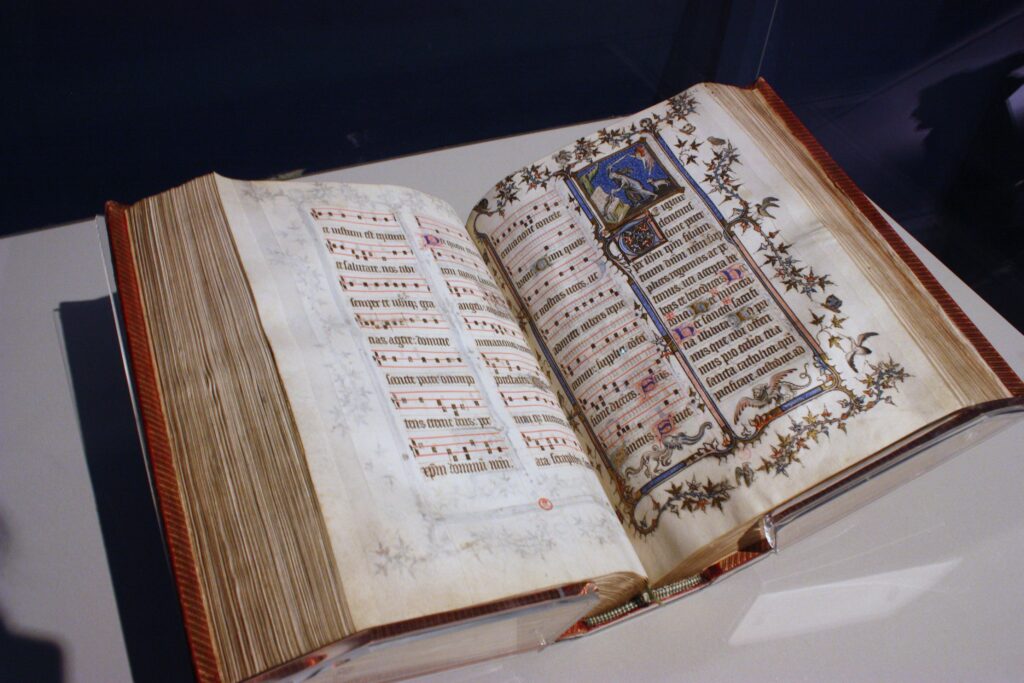
The focus was on a subdiscipline of musicology that is usually seen merely as a means to an end: codicology, that is, the scholarly description of historical manuscripts and printed works. Although «source criticism» is often a required course in musicology programs—after all, sources are at the heart of historical research—it is rare to gain such a clear understanding of the significance of this discipline as one does at this summer school.
Source criticism has demonstrated its full potential in current research: It continues to evolve in practice, influences the digital representation of sources, and has a reciprocal effect on performance practice. On this rich range of topics, the Lamentations of Jeremiah Tomás Luis de Victoria was chosen as the central case study. The idea proved to be an effective «glue» that brought together source research, performance practice, and issues related to digitization.
Codicology: Rome as a Treasure Trove of Sources
As trite as it may sound, the first insight was that sources are physically bound. This has both advantages and disadvantages. Like almost no other city, Rome offers a wealth of musical sources in a small area—not just in a central library, but scattered throughout the city. The presentations by the researchers at the Istituto Svizzero’s villa (Antonio Chemotti, Daniele Sabaino, Katelijne Schiltz, Inga Mai Groote) primarily provided context for the sources, most of which the group «discovered on foot.».
The participants gained practical insights during a visit to the archives at the Spanish National Church, Santa Maria in Monserrato degli Spagnoli—one of the places where Victoria worked (which houses a copy of the printed edition of his Holy Week music). There, Rector Don José Jaime Brosel Gavilá also presented them with the files on Victoria. At the Biblioteca Casanatense, participants were able to experience the physical nature of the musical sources firsthand: original manuscripts from the 16th and 17th centuries—such as a choir book, a cantata manuscript, and a chansonier—offered the opportunity to appreciate their weight, texture, and simply the striking differences in size. (A pleasant side effect of archival research in the summer of 2026: spending time in rooms that are almost always air-conditioned to protect the sources.)
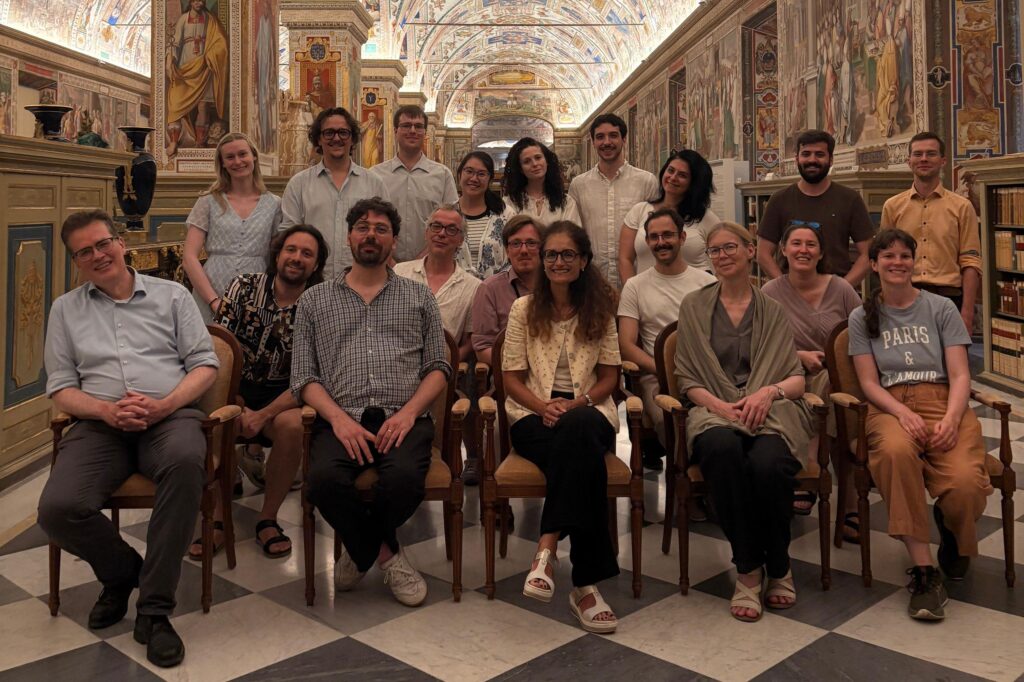
A particular highlight was the exclusive access to the impressive Salone Sistino of the Vatican Library. After a personal welcome from the Prefect of the Library, Don Mauro Mantovani, the participants examined the musical manuscripts of the Cappella Sistina, including a little-known handwritten version of the Lamentationes. They also had the opportunity to view the famous Chigi Codex, one of the most magnificent musical manuscripts of the Renaissance. What could easily have come across as a mere tourist outing turned into an in-depth exploration of the collection—thanks to the explanations provided to the participants by Claudia Montuschi, director of the Vaticana Manuscript Collection, and the editors of the forthcoming Cappella Sistina catalog (Thomas Schmidt, Nicolò Ferrari). A workshop (led by Nicolò Ferrari) at the German Historical Institute offered all participants the opportunity to gain hands-on experience with musical manuscripts from the institute’s collection.
Performance Practice: The Case of Victoria
This work was contrasted with on the sources, with a performance from the sources. The summer school also included a sold-out public concert featuring the Cantoría ensemble, conducted by Jorge Losana, at the Church of Santa Maria in Monserrato. (Sponsored by Spanish cultural institutions and the embassies of Spain and Switzerland to the Holy See.) Victoria’s Tenebrae-The responsories were performed in an atmosphere of deep solemnity, accompanied by the traditional liturgical practice of gradually extinguishing the candles.
The preliminary discussion with the ensemble director in the Sala Dalí at the Instituto Cervantes made it clear that this staged, quasi-liturgical reconstruction had been created in collaboration with theologians and musicologists from various European countries. Losana emphasized, however, that his ensemble was never concerned with a «historically accurate» reconstruction, but rather with an inspired, artistic performance.
The workshop held the next day between the Summer School participants and the ensemble demonstrated just how closely the musical and scholarly examination of the repertoire is intertwined with analytical, historical, and performative arguments. This creates a productive point of tension that benefits both the performance and the scholarly interpretation of the sources. The ensemble sang movements from the Lamentations, comparing the manuscript and printed versions. The discussion that followed highlighted the differences between a more pragmatic style of notation and compositionally more complex variants. The printed version likely documents the «improved» version desired by Victoria.
Digitization: The (In)visibility of Sources
Another aspect was the digitization of the sources and their publication in the digital realm. The focus here was on a hands-on workshop on digital editing (Hein Sauer) and a roundtable discussion with Ángela Núñez Gaitán (Chief Conservator of the Vaticana) and musicologists Antonio Chemotti (KU Leuven) and Hein Sauer. The discussion addressed the central issues of digitization: visibility, accessibility, source preservation, and examples of best and worst practices. For conservator Núñez Gaitán, the preservation of endangered manuscripts through digitization was paramount. For project director Chemotti, the key was collaboration among institutions to facilitate public outreach. According to Sauer’s research findings, the risk of unequal access to the originals—depending on the size and resources of the libraries—remains a pressing problem for archive users.
In the end, one thing was clear: Any digital project or tool only realizes its full potential when it is built on a foundation of knowledge of the sources and a commitment to making those sources truly accessible. A digital edition is only as good as the understanding of the manuscript on which it is based; a database is only useful when accompanied by critical reflection on its own creation. Even seemingly independent things like machine transcriptions are not neutral tools. This is because collections are rarely already suitable for such purposes, and even then, the data often needs to be post-processed to be usable for scholarly purposes. Ultimately, everyone agreed: The guiding principle must be «Good things take time.» It is better to digitize slowly and with high quality than quickly and superficially. Contrary to some opinions, digitization does not render source criticism obsolete; on the contrary, it makes it even more important.
Overall, the multifaceted Summer School placed the «and Back»—that is, a return to the sources—at the forefront, without resorting to a trite «ad fontes» rallying cry. Rather, it offered participants the opportunity to discover the beauty of codicology and its spaces, to become aware of the significance of source work for practical applications, and to take advantage of the benefits of digitization. The importance of visiting archives should not be overlooked, as by no means all sources have been found or analyzed. The Summer School demonstrated that the required course in source criticism can become an elective—and that the combination of traditional source research and digital methods is not only possible but indispensable for the future of musicology and must also be integrated into teaching.