A Wonderful Discovery of Musical Artifacts in the Upper Engadine
The Upper Engadine Cultural Archive in Zuoz houses one of the largest private collections of 18th-century instrumental sheet music in Switzerland. It has since been cataloged for RISM (Répertoire International des Sources Musicales).




In addition to the Chesa Planta in the village center, the Chesa Poult—with its tower-like central section and two side wings—is particularly striking to visitors in Zuoz. The tower house passed into the possession of General Gian Battista Planta in the 18th century, and then, around 1762, into that of Jachem Pult, whose father, Cla, was married to the general’s sister. Both Gian Battista Planta and Cla and Jachem Pult served in the military in the Netherlands, where they held high-ranking positions. There were several reasons for their involvement in the Grisons Companies of the Netherlands, founded in 1693. In addition to religious and political affinities with the Three Leagues, it was above all the colonial trade opportunities offered by the maritime power—centered on port cities such as Amsterdam—that promised the accumulation of considerable wealth.
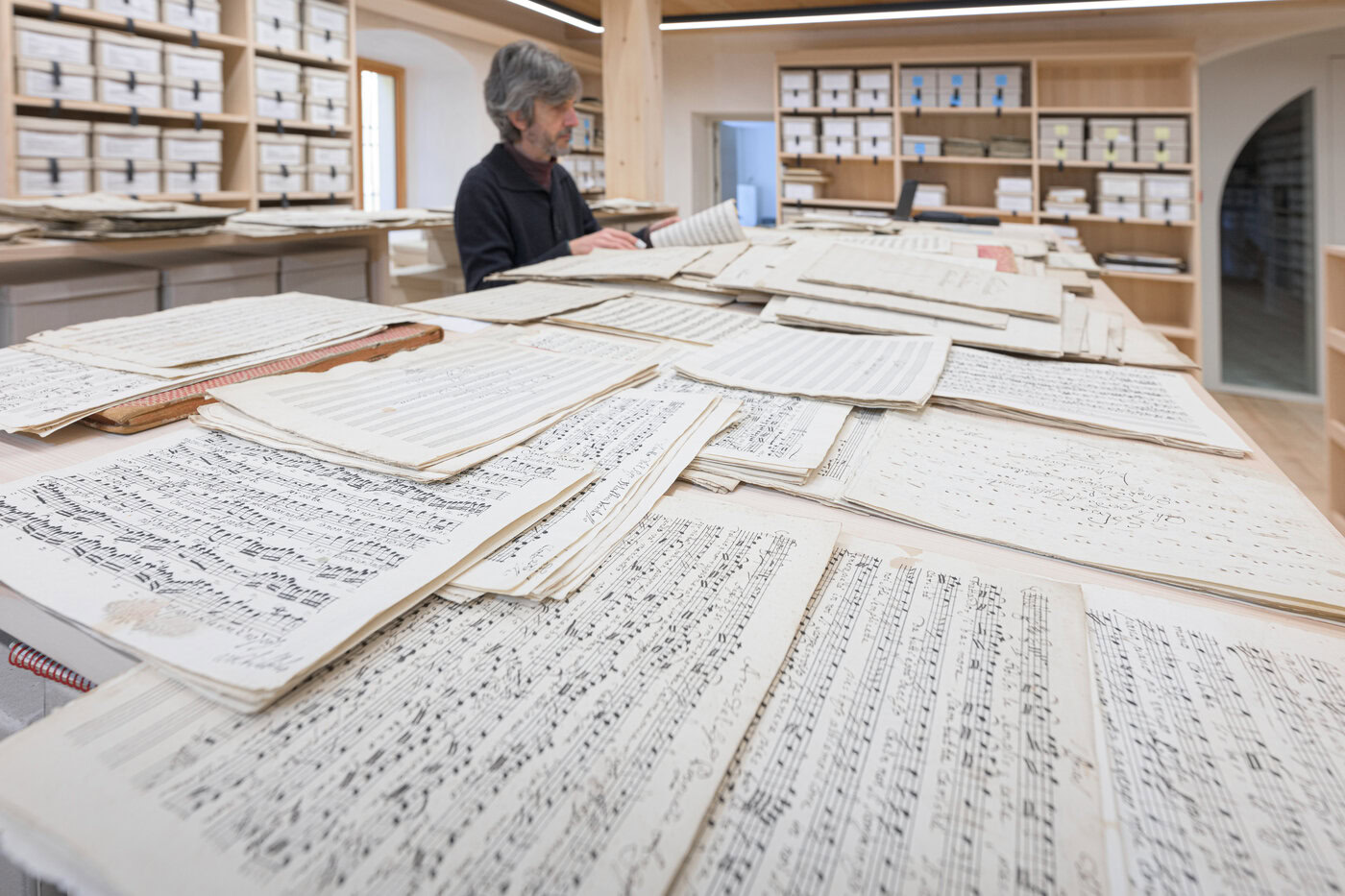
Following the sale and renovation of Chesa Poult, Mathias Gredig and Kurt Gritsch were commissioned in the fall of 2023 to transfer historical written documents to the Upper Engadine Cultural Archive (KAOE). Contrary to expectations, there were only a few written records related to mercenary service in the building. However, numerous sheet music scores from the Pult military family were scattered throughout several rooms and boxes, and together they formed a sizeable music library. Furthermore, an old transverse flute was hidden in the barn beneath pieces of wood and hats.
The music library was organized and cataloged this year by Claudio Bacciagaluppi and is now fully accessible through the RISM and KAOE cataloging systems. With 281 bibliographic entries —with each entry typically comprising a collection of musical works—it ranks among the largest private Swiss music libraries of the 18th to early 19th centuries, alongside that of Lukas Sarasin at the University Library of Basel and that of Queen Hortense de Beauharnais at the Napoleon Museum Arenenberg. However, in terms of its repertoire, its selection of genres and instrumental ensembles, its provenance, and the high number of printed works (66 items) as well as unknown musical pieces, the Zuoz Music Library represents a unique case in the Swiss music landscape.
Music from the Grisons Regiment in Maastricht
Apart from a few collections from the 19th century and the Baroque period, as well as two Romansh psalm songbooks and a fragment of the A Brief Introduction to Music (1554) by Johannes Frisius; the Pultsche music library consists mainly of secular works from the second half of the 18th century: chamber music pieces, dances, symphonies, and concertos, as well as opera arias for soprano and orchestra.
The arias—by composers such as Pasquale Anfossi or Giuseppe Gazzaniga—were copied, presumably in Switzerland or southern Germany, onto paper manufactured in Basel and primarily point to music from Venetian opera. Major Jachem Pult had acquired them, along with numerous duets for two flutes and two violins or for unusual instrumentations such as two bassoons, two clarinets, or cello and bass. Furthermore, Jachem Pult purchased several printed musical works, likely often in the Netherlands itself. This is indicated by works by composers such as Friedrich Schwindl, specific places of publication, or the stamp of a music store in The Hague. In addition, the major appears on a list of subscribers that an organist at the Servaasbasiliek in Maastricht had compiled for the arrangement of a trio collection by Luigi Boccherini. For the officers of the Grisons companies stationed in Maastricht, it was advantageous to continue practicing the violin or flute during the winter break in order to gain easier access to the aristocratic elite through their musical talents.
Music of the Herrnhut Pietists in Neuwied
Nicolo Pult acquired even more musical works than his father, Jachem. In Neuwied, near Koblenz, for example, he apparently purchased in a single transaction a collection of printed and handwritten chamber music from the Mannheim School, as well as from Germany and Bohemia. According to a note on the title page of printed harpsichord sonatas by Johann Christian Bach, Nicolo obtained sheet music from the Moravian Church as early as 1773, when he was eleven years old.
Like other children from the Engadin in the second half of the 18th century—including, not infrequently, those from the so-called nobility (Albertini, Frizzoni, Perini, Planta)—Nicolo was presumably also sent to Neuwied to study German and music. The Herrnhut Pietists were avid practitioners of chamber and orchestral music, and this may also have been connected to the music-loving Bohemian-Moravian diaspora. Another portion of the sheet music collection—mostly arranged for keyboard instruments, though some also for the harp—came from the estate of Uorschla Perini of S-chanf, Nicolo’s third wife.
The Chesa Poult music library contains a surprising number of unknown pieces by well-known and, in some cases, lesser-known composers. These works will be performed for the first time in the summer of 2028 in Zuoz as part of the Engadin Festival.
Mathias Gredig conducts research at the University of Basel and works for the Upper Engadine Cultural Archive in Zuoz. Claudio Bacciagaluppi is a staff member at the RISM Digital Center in Bern.
References:
Bundi, Martin, Grisons Military Service in the Netherlands around 1700: A Study of Relations between the Netherlands and Graubünden from 1693 to 1739, (= Historia retica series, vol. 3), Chur: Calven Verlag 1972.
Finze-Michaelsen, Holger (ed.), Gian Battista Frizzoni (1727–1800). An Engadin pastor and hymn writer during the Age of Pietism. In collaboration with Gion Gaudenz-Ganzoni and Hans-Peter Schreich, Chur: Bündner Monatsblatt Publishing House, 1999.
Kaiser, Dolf, Compatriots in Foreign Lands. A Study of Documentation on Emigration from Graubünden—with Special Reference to the Engadine and Surrounding Areas, Samedan: Stampara engiadinias S.A., 1968.
Kaiser, Dolf, «Genealogia Pult/Poult. Famiglia da Sent, Zuoz branch,» in: Kulturarchiv Oberengadin, ref. 29.9.2017, box 18.
Graubünden Cantonal Office for the Preservation of Historic Monuments (ed.), Zuoz. Inventory of Historic Buildings in the Town Center of Zuoz: From the Early Days to Around 1920, Chur: Graubünden Cantonal Office for the Preservation of Historic Monuments, 1993.
Kopp, Peter, «The Moravian Church and Its Music: From Herrnhut to the World—and Back,» in: herrnhuter. Journal of the Moravian Church in Switzerland 23 (2022), pp. 2–4.
Register of the Names of Military Officers, the Captain General, and the Field Marshal. Generals, Lieutenant Generals, Major Generals, Colonels, Lieutenant Colonels, Majors, Captains, Lieutenants, and Sergeants of the Cavalry, Dragoons, Infantry, Artillery, Engineers, Miners, etc. On the Troops of the United Provinces […] in the Service of Her Highness. Revised and Improved for the Year 1779, Leiden: Hendrik van der Deyster, 1779 [Copy in: Upper Engadine Cultural Archive, ref. no. 30.10.2023].
Planta, Peter Conradin von, Chronicle of the von Planta Family. Along with Various Accounts from the History of Rhaetia, Zurich: Orell Füssli, 1892.
Schmidt, Töna, The Old Women of Sent, Sent: Sent Municipal Archives 1998.