The Almost-Forgotten Soprano Pioneer from Thurgau
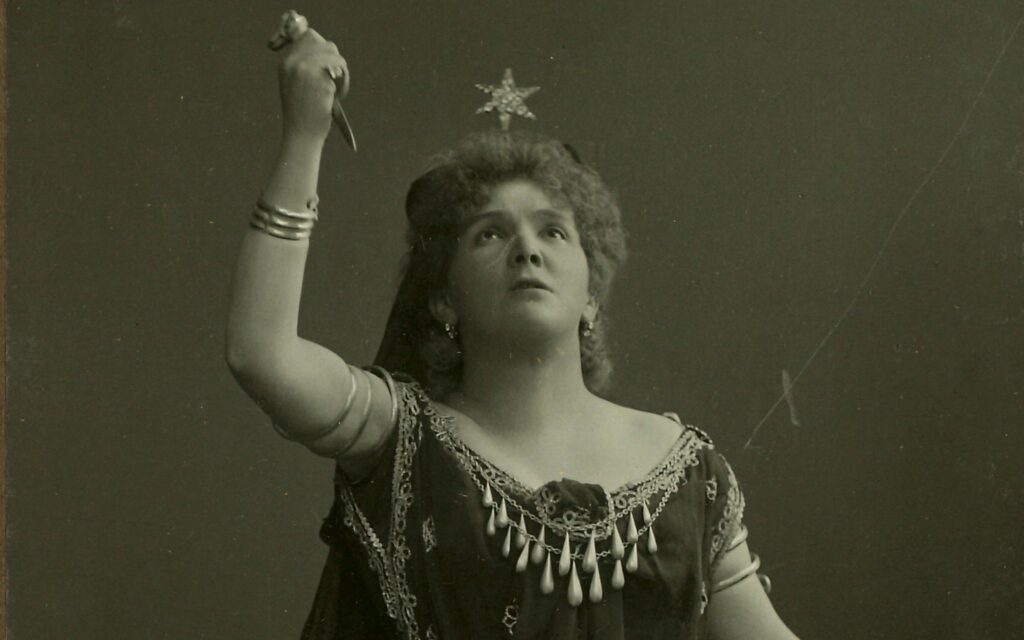
Emilie Herzog from Ermatingen sang at the Berlin Court Opera for 21 years. After more than a century, her estate has resurfaced—and with it, a resource that is virtually unparalleled among singers of her generation.


You can hear them. That's the first thing you need to know.
On a shellac record, recorded in Berlin, a voice rises into the “Aria of Grace” from Meyerbeer’s *Robert the Devil*, and what cuts through the static is not a museum curio, but a soprano with an agility one would not expect. High notes and coloratura delivered effortlessly. The woman singing here was a Royal Prussian Kammersängerin and a member of the Berlin Court Opera ensemble for 21 years. She was born Emilie Herzog; after her marriage to the musicologist Heinrich Welti in 1890, her married name became Welti-Herzog. On theater programs and record labels, however, she remained Emilie Herzog until the very end. Until just a few years ago, hardly anyone—not even in her hometown—remembered her.
She was born on December 17, 1859, in the schoolhouse in Ermatingen on the Untersee; her father was a teacher there and directed the men’s choir. Two years later, the family moved to Diessenhofen, where he found a better job. That little town on the Rhine remained close to her heart throughout her life: «My dear and cozy memories from my childhood and school days are tied to the image of that quiet, old border town on the Rhine, still surrounded by walls and fortified with towers,» she later wrote. At the age of fourteen, she accompanied the Sunday service there on the organ. She had perfect pitch.
The expert concluded: Her voice isn't suited for the stage.
What followed is the most unlikely part of this biography. Emilie Herzog trained as a milliner—a respectable profession for a teacher’s daughter. It wasn’t until she was seventeen that she convinced her parents to let her begin vocal training. She auditioned at the Zurich Conservatory, and the expert’s verdict was: a pretty, high-pitched voice, but very small. Perhaps enough to teach. She wasn’t cut out for the stage.
Things turned out differently. After studying in Zurich and Munich under Adolf Schimon, she made her debut on September 10, 1880, at the Royal Court and National Theater in Munich as Page Urbain in Meyerbeer’s *Les Huguenots*. She remained there for nine seasons, performing in approximately 650 theater performances across more than fifty roles. In 1889, she moved to the Berlin Court Opera, the Royal Opera House on Unter den Linden—and remained there until 1910.
Her signature role was the Queen of the Night; her repertoire ranged from Rosina to Gilda and Micaëla to the Regiment’s Daughter. In 1900, she was named a Royal Prussian Chamber Singer. She sang in Paris, Vienna, London, Brussels, Dresden, Moscow, and St. Petersburg; in May 1896, she performed at the coronation celebrations for Tsar Nicholas II. The awards kept piling up: Mecklenburg-Schwerin in 1895, Bavaria in 1902, Anhalt in 1904, Saxe-Coburg and Gotha in 1905, and, in early 1906, the Silver Cross of Merit for Women from Empress Auguste Victoria.
She remained connected to her homeland. Several times a year, she performed in Zurich, Basel, and St. Gallen, sang at Swiss National Singing Festivals, and in 1898 at the Thurgau Centennial Celebration.
The Husband Who Kept the Books
In 1890, she married Dr. Heinrich Welti, a music historian and music critic from Aargau. What was unusual for the time was not that this marriage was a happy one, but rather how it was structured. Emilie Herzog earned the money. Heinrich Welti organized her concert evenings in Germany and Switzerland, developed the format of «historical recitals» together with her, and took charge of raising their daughter Eva, who later became a concert soprano and voice teacher herself.
Above all, however, he kept records. In leather-bound calendars from Munich, he documented every single one of his wife’s performances: date, location, work, and role. Three volumes, covering 1880 to 1910, with no gaps. For music history, this is a stroke of luck: One can reconstruct this singer’s career night by night. After analyzing the diaries, curator Reto Knöpfel estimates that she performed in over 4,000 opera performances and concerts, 188 of which took place in the canton of Thurgau. In some weeks, she performed at up to four locations spread far apart.
In February 1896, her daughter Eva was born; the diaries indicate that the mother was heavily pregnant until January. In May, she sang in Moscow.
Composers sought her company. The estate includes both booklets of Richard Strauss’s Six Songs, Op. 19, dedicated to her; handwritten scores bearing the names Pfitzner and Humperdinck; Othmar Schoeck’s song albums; and Mahler’s *Des Knaben Wunderhorn*, with an ink dedication by the composer: ’For Kammersängerin Herzog, Berlin, Lützowstrasse 20.«.
The Farewell and the Disappearance
On February 6, 1910, Emilie Herzog bid farewell to Swiss opera audiences in Zurich, playing the role of Marie in Donizetti’s *La figlia del reggimento*. On June 1 of that same year, she appeared on stage for the last time in an opera performance. She then moved to Aarburg, her husband’s hometown, and led master classes at the Zurich Conservatory until 1922—the very place where, a good three decades earlier, she had been told that her voice lacked projection.
She lived through World War I in Switzerland, and it took a heavy toll on her. She donated a large portion of her German pension to soldiers on the front lines and sold jewelry from the Russian imperial collection to benefit the Red Cross. She died in Aarburg on September 16, 1923, three months before her 64th birthday.
After that, she was largely forgotten. There is no single reason for this, but rather several: the war that destroyed the world in which she had been famous; her ties to a Germany that did not have a good reputation in Switzerland after 1918; and the fact that, as far as is known, her name was not associated with any world premieres. Above all, however, female singers of her generation have almost without exception fared worse in the public memory than their male counterparts.
A record at the thrift store
A little over a decade ago, a young singer from Salenstein read in the newspaper about an opera singer from the region; the story was prompted by a shellac record that had turned up in a thrift store. Reto Knöpfel, a trained concert and opera singer, couldn’t get the topic out of his head. When the Vinorama Museum in Ermatingen asked him in 2023 to serve as a volunteer curator, he knew exactly where to start.
The family tree proved to be the breakthrough in his research. Knöpfel came across a great-granddaughter, Silvia Wiesner-Alder, who possessed the entire estate: letters written in Sütterlin script, diaries, order of merit certificates, a lace dress, Emperor Wilhelm’s brooch, albums of shellac records, and a map of Europe with performance venues underlined in red. In the summer of 2023, she handed over the collection.
What is remarkable about Knöpfel’s work is not only what he found, but also what he was able to discard. Almost every reference work states that Emilie Herzog performed at the Metropolitan Opera. That is not true. She does not appear in the Met’s archives. The person who does appear is a Jeannette Herzog, who sang there just once, on November 24, 1904, as a flower girl in *Parsifal*. Over the course of more than a century, this mix-up has turned into an American career, copied from one encyclopedia to the next.
In the end, the voice remains. Fifteen recordings have been documented, made between 1904 and 1907 in Berlin and Vienna for G&T and Columbia, as well as on Edison cylinders; some of them are freely accessible. In addition, there is a sound-and-picture recording from 1908—a four-minute early sound film—in which Emilie Herzog performs the duet of Nedda from Leoncavallo’s *Pagliacci* with baritone Baptist Hoffmann. She is thus one of the few singers of her generation whom we can both see and hear.
Emilie Herzog’s collection was on display at the Vinorama Museum in Ermatingen and at the Museum kunst + wissen in Diessenhofen. On October 25, another exhibition opened at the Aarburg Local History Museum, which will run through March 14, 2027.