Three young conducting talents: each with potential, each completely different
For the first time in a long while, the Concours de Genève has once again hosted a conducting competition. A 27-year-old Swiss man is also among the trio of winners.


Three finalists emerged from a field of 168 applicants. Over the course of a year, they conducted four different orchestras with an incredibly broad repertoire, participated in master classes and workshops, collaborated with composers, and made many new connections.
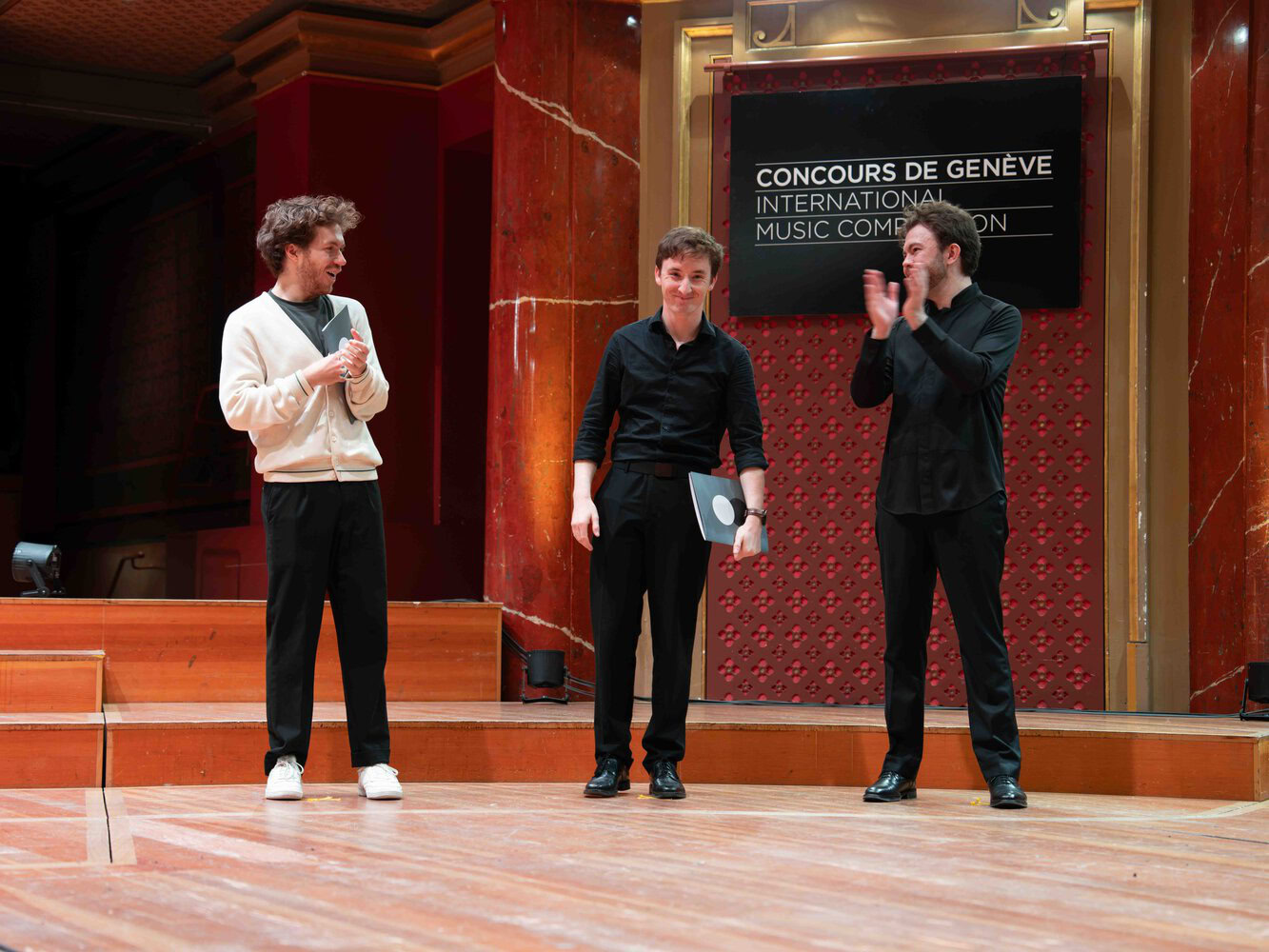
This is the first time since 1994 that a conducting competition has been held as part of the Concours de Genève. On Friday, November 13, Mats Thiersch, Gabriel Pernet, and Jacobus de Jager stand arm in arm at the edge of the stage at Geneva’s Victoria Hall, waiting for the winner to be announced.
In the end, the 12-member jury, chaired by Bertrand de Billy, awarded the first prize—worth 20,000 Swiss francs—to 23-year-old Mats Thiersch from Germany, the youngest contestant. Jacobus de Jager (29) from South Africa receives the second prize of 12,000 Swiss francs, while Gabriel Pernet (27) from Switzerland takes home the third prize and 8,000 Swiss francs. The winners high-five each other on stage and smile for the cameras and cell phones. Their relief is evident—the last four days, with the semifinals and finals, took a toll. «This final showcased three very different personalities, all of whom have great potential,» says Bertrand de Billy.
From a selection of six works, the contestants each had to choose two for the final round. De Billy then made the final selection on behalf of the candidates. In the final, Mats Thiersch will perform Richard Strauss’s symphonic poem Don Juan to do. Thiersch, who—after studying composition with Miroslav Srnka in Cologne and conducting with Alain Altinoglu in Paris—currently works as an assistant to Kirill Petrenko with the Berlin Philharmonic, guides the Orchestre de la Suisse Romande through the score with a smile. His conducting allows for a great deal of freedom without ever becoming imprecise. The rubati are tasteful, and the dramatic outbursts remain rich in tone. He also prepares the many solos with sensitivity, demonstrating a professional confidence and naturalness that are astonishing given his young age.
The Right Facial Expressions for Prokofiev
Jacobus de Jager, who is six years older, conducts from memory like his colleagues, but without a baton. From a purely conducting standpoint, with his hands moving mostly in parallel, he shows little nuance in the excerpts from Prokofiev’s Suite I and II from Romeo and Juliet. But even during the "Dance of the Knights," it becomes clear that—especially in the more extroverted passages, with his expressive facial expressions and high physical tension—he is exactly the right choice for this music.
Gabriel Pernet, on the other hand, relies almost exclusively on his elegant, precise conducting. The suite from Stravinsky's ballet music The Firebird The orchestra premiered the work in 1919 at the same venue, one year after its founding, under Ernest Anserment. Dynamically, Pernet draws out the full range—especially in the pianissimo passages, the orchestra develops a special quality under his baton. But also for the Dance of Hell With a triple forte, Pernet delivers powerful, energetic bursts of energy—and there's a bit of showmanship thrown in as well.
Of the three candidates, Pernet receives the most applause in the finals. Nevertheless, in the end, it’s only enough for third place—but with the Audience Award, the Student Prize, the HEM Orchestra Musicians« Prize, and the Rose-Marie Huguenin Prize (awarded equally to all), Pernet still heads home with a bountiful haul of awards. However, the Swiss conductor can’t rest on his laurels. As he explains in a personal interview, he’s already heading to Taiwan the very next day with the Bavarian Radio Symphony Orchestra as an assistant to Sir Simon Rattle. In addition, Pernet—who had already won the Neeme Järvi Prize from the Gstaad Conducting Academy in 2024—is also serving this season as assistant to Lionel Bringuier with the Orchestre Philharmonique Royal de Liège. Pernet is pleased with the competition: “The Firebird-»Suite is one of the pieces that inspired me to become a conductor. I'm also very excited about my first contact with the Orchestre de la Suisse Romande, which I've been listening to since I was a child."
The Best Composer: A 20-Year-Old South Korean
For the 80th edition of the Concours de Genève, the organizers came up with something special: the conducting competition, which has been reinstated in the program, was combined with the biennial composition competition. In the first round of the finals, which determined the winner of the composition competition, Pernet conducted with great sensitivity the impressionist-inspired piece, which relied entirely on a traditional orchestral sound. "Invention in the Language of a Child," Op. 2No. 2 by Brazilian composer Rafael Marino Arcaro, to whom the jury, chaired by Unsuk Chin, awarded second prize. Third prize went to the piece conducted by Jakobus de Jager Shattered Sky/Remaining Land by 25-year-old Sing-Yat Chen from Hong Kong. The dark tones of the bass clarinet and double basses blend here with fragments of melody and subtle reverberations.
The first prize and all the special prizes were awarded to Hanruij Lee, a 20-year-old from South Korea, for his fascinating work, which oscillates between energetic activity and lyrical moments. Stuff #1. Even with this enormous score—for which the orchestra attendant placed an additional sheet on the conductor's podium—Mats Thiersch maintained a clear overview and close contact with the orchestra. It was a magnificent performance that certainly played a decisive role in his winning first prize in the conducting competition.