Experimental Flute Studies
In the two volumes of his «Flute Expedition,» Gergely Ittzés introduces players to advanced playing techniques and unusual sounds. He also builds a bridge to the traditional repertoire.




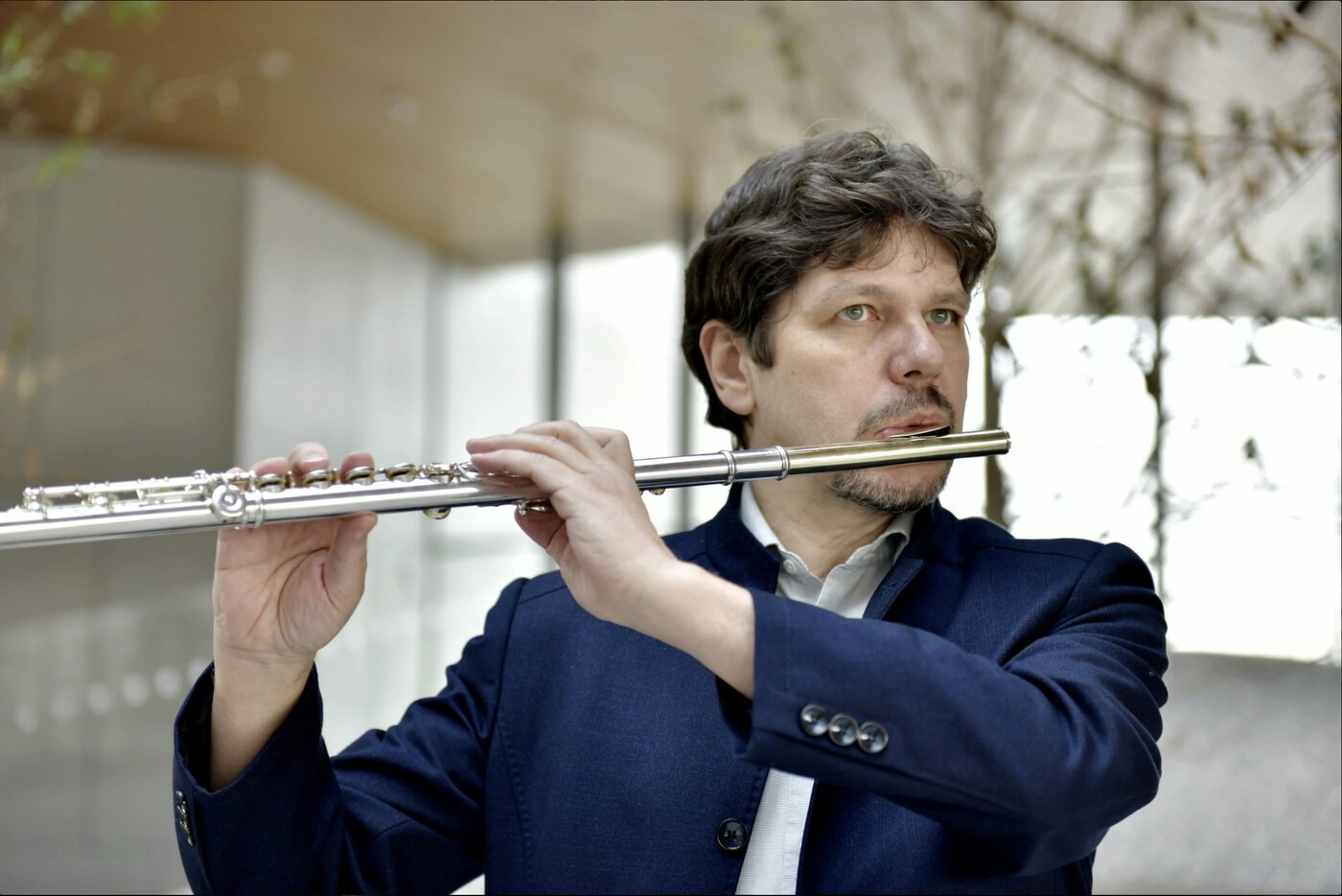
The Flute Expedition by Hungarian flutist Gergely Ittzés contains a collection of contemporary etudes designed to encourage exploratory play on the instrument. Particular attention is paid to sounds and playing techniques that, while not part of classical flute playing, are nonetheless part of the instrument’s overall sonic spectrum. With 42 imaginative miniature studies in two volumes, Ittzés offers a step-by-step introduction to techniques such as multiphonics, special breathing effects, glissandos, microtonality, and unusual timbres that push the boundaries of what is possible on this instrument. Each piece includes detailed explanations and notation notes in a comprehensive key.
Ittzés conceived The Flute Expedition as a bridge between traditional flute technique and modern/experimental playing. As he notes in the preface, thanks to this approach, players also gain knowledge that will benefit them—directly or indirectly—when performing traditional works. Rather than treating «normal» and «extended» sounds separately, the work presents them as part of a unified musical language.
«An unusually large number of moves»
The first volume introduces new playing techniques and includes, for example, No. 2 Overtone Prelude and No. 5 Ear-breaker, that alternate between overtones based on the same or different fundamental tones. No. 24 Elegy in C is also based on overtones—those above low C—and uses only intervals that lie within the harmonic structure. In No. 7 Tapping and Plucking Various flutter and pizzicato effects are used. No. 10 is an interesting combination Gregor's Chorale, where voice and «pseudo-multiphonics» are used in octaves to create polyphonic lines reminiscent of Gregorian chant. No. 28 Tremor is dedicated to timbral trills and makes use of microtonal trills and flutter tonguing, while No. 29 Gills introduces the technique of circular breathing.
The author strongly recommends that players not begin the second volume until they have worked through the first volume, as not all explanations are repeated. The second volume requires a transverse flute with open holes and a B-flat footjoint. As he himself writes, Ittzés uses «an unusually large number of fingerings» and several types of fingering notation: in addition to numerical fingering notation, he also employs acoustic fingering notation and graphic fingering notation. Both volumes are suitable for advanced flutists as well as composers seeking to explore the instrument’s sonic possibilities.
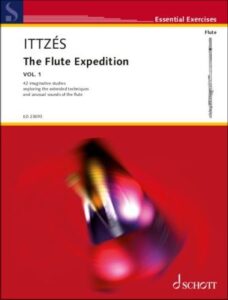
Gergely Ittzes, *The Flute Expedition*, 42 imaginative studies exploring extended techniques and unusual sounds on the flute; Vol. 1, Nos. 1–21, ED 23693; Vol. 2, Nos. 22–42, ED 23843; €29.00 each, Schott, Mainz