

Almost like a world premiere
For over 50 years, Willy Burkhard’s opera «Die schwarze Spinne» had not been performed. Now, the Lucerne University of Applied Sciences and Arts has brought this rare work back to the stage.


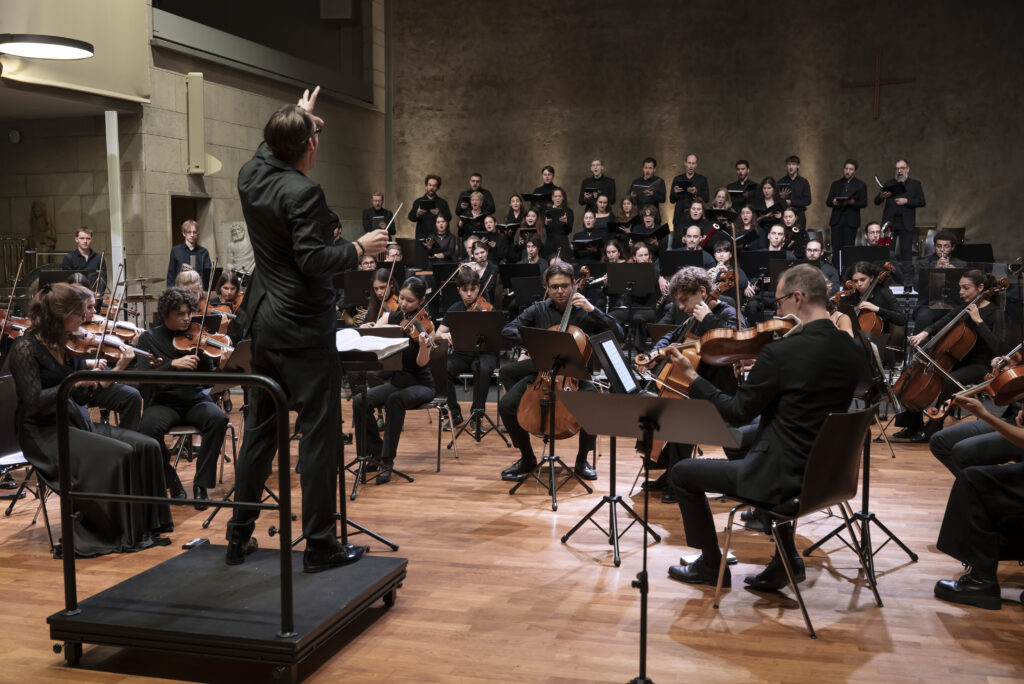
A village makes a pact with the devil to fulfill an impossible task set by the feudal lord. But when the agreed-upon payment—an unbaptized newborn—fails to materialize, disaster strikes: A black spider brings death and destruction upon the community.
To what extent do morality and ethics shape our actions? Should others pay the price for our own prosperity? These are the questions the poet Jeremias Gotthelf posed in his novella, published in 1842 The black spider. About a hundred years later, the Swiss composer Willy Burkhard adapted it into an opera. After more than half a century without a performance, the Lucerne University of Applied Sciences and Arts (HSLU) staged the work again for the first time in Lucerne and Zug in mid-November 2026.
Between Opera and Oratorio
Willy Burkhard is considered one of the most important Swiss composers of the 20th century. He became particularly well known for his church music and oratorios. Also The black spider shows an unusual resemblance to an oratorio. The chorus plays a central role, while the plot is told in two acts, each consisting of seven distinct musical scenes. Burkhard combines various forms of expression: spoken drama, operatic singing, and narrative dance elements. In a later version from 1954, he assigned the framing narrative to a narrator. The HSLU also chose this version for its performances. The concert version focuses on the music and the narrative without requiring an elaborate stage production.
For the Lucerne University of Applied Sciences and Arts, the project posed a particular challenge. Not only is the opera rarely performed, but it has also largely faded from musical memory. There is no recent recording that the performers could have used as a guide. The participants therefore had to explore the work largely on their own. As a result, the preparation process took on almost the character of a world premiere.
«The composition combines a distinctive, expressive musical language with echoes of folk music,» says conductor Clemens Heil, describing the work. As such, it straddles the line between traditional sounds and a musical language that was modern for its time. «An archaic, colorful series of scenes with a gripping story.»
Scholarly Analysis of the Work
The Lucerne University of Applied Sciences and Arts made a conscious decision to perform such a challenging and rarely performed work. According to Heil, this allows students to gain experience with music outside the standard repertoire. «This allowed the HSLU Symphony Orchestra and the HSLU Choir to engage with a work that places special demands on ensemble playing and musical interpretation.»
The accompanying academic symposium also addressed this specialized context. Under the title «Swiss Music Theater in the 20th Century: Developments, Trends, and Perspectives,» researchers from Switzerland, France, and Austria examined the historical and stylistic context of Burkhard’s opera. Other presentations focused on various musical adaptations of Gotthelf’s story, the Swiss literary opera, and the development of musical theater in the 20th century.
Musical Director: Clemens Heil. Chorus Directors: Marco Amherd, Ulrike Grosch. HSLU Symphony Orchestra, HSLU Choir. Priest: Alexandre Beuchat. Young Woman: Serafina Giannoni. Blind Ancestor: Laura Brecht. Woman from Lindau: Judith Schmid. Ruech: Tobias Hächler. Farmer: Flurin Caduff. Farmer’s Wife: Aude Suter. Knight/Voice: Konstantin Wolff. Narrator: Walter Sigi Arnold.


