308 new music students

Of the 711 first-year students at the Zurich University of the Arts (ZHdK), 308 enrolled on a Bachelor's or Master's degree course in music.

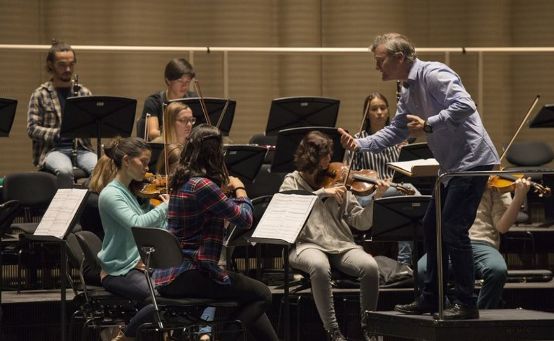
Teaching at the ZHdK (Photo: Regula Bearth/ZHdK)

The 711 students will begin their studies at the ZHdK on Monday, September 16. In addition to the music students, there are 110 enrolled in design, 91 in art and media, 112 in art education and transdisciplinarity and 90 in performing arts and film.

A total of 2,245 people are studying at Zurich University of the Arts. Of these, 1,300 are studying one of the eight Bachelor's degree courses and 945 one of the eleven Master's degree courses. The number of students has remained constant compared to recent years. A numerus clausus applies at the ZHdK; prospective students undergo a strict admission procedure beforehand.

200 years of Clara Schumann

There are several occasions to honor Clara Schumann - at the Beethovenfest Bonn, for example, a tribute to the pianist and composer composed by Bettina Skrzypczak will be heard for the first time.

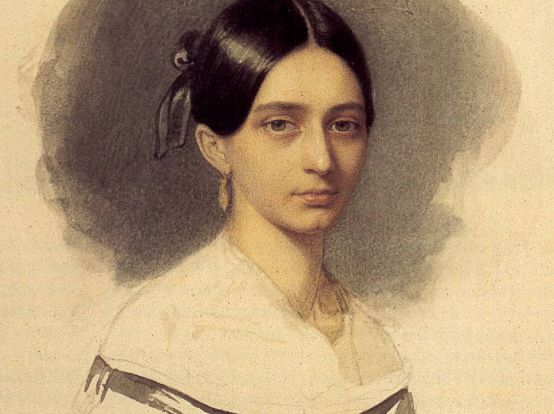
Clara Wieck, 1840, drawing by Johann Heinrich Schramm (1810-1865). Image: WikimediaCommons

The Beethovenfest writes: "On September 13, the 200th birthday of Clara Schumann, the orchestral piece Mouvement fantastique by Bettina Skrzypczak premiered. It was commissioned by the Beethoven Festival and will be performed by the Robert Schumann Philharmonic Orchestra Chemnitz under the direction of Gerrit Prießnitz. (...) In her homage to Clara Schumann, Bettina Skrzypczak refrains from motivic allusions or stylistic quotations. Instead, she cautiously approaches Clara's poetic world, which was also Robert's world, with her own compositional means. What fascinates her are the mysterious ciphers and the signals and reactions that can only be perceived in the medium of sound, in which the affinity between Clara and Robert Schumann was articulated. The piano, which the two used as a medium for their messages, plays a special role in the new work. However, it is not used in a concertante manner, but is part of the orchestra."

City and canton of Lucerne cooperate

Marcel Schwerzmann, the canton's Director of Culture, and Lucerne's Mayor Beat Züsli reaffirm the cooperation for the public financing of major cultural institutions of supra-regional importance.

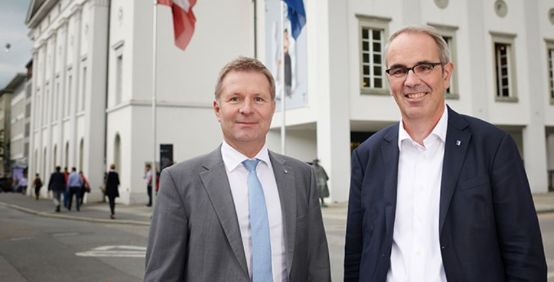
Marcel Schwerzmann and Beat Züsli (Photo: Franca Pedrazzetti/City of Lucerne).

At the same time, the city and canton have regulated the responsibility and financing of upcoming cultural investment projects within the framework of the special-purpose association. In future, investment contributions to institutions will continue to be negotiated on a case-by-case basis. In concrete terms, this means that for the upcoming major cultural projects at the theater and the Museum of Transport, the city will take the lead for the Lucerne Theater and the canton for the Museum of Transport.

The canton will invest around CHF 25 million in the Museum of Transport investment project, while the city will spend an as yet unspecified amount in the high double-digit millions on the Lucerne Theater. The reorganization of the operating contributions will result in an overall financial burden of around 50 percent for the city and around 50 percent for the canton. The new cost-sharing system will be introduced in three stages from 2023.

Winner to Los Angeles

28-year-old Théo Schmitt from Vaud is the best young conductor in Switzerland. He won the Swiss Conducting Competition in Baden thanks to a combination of natural charisma and perfect rehearsal work.

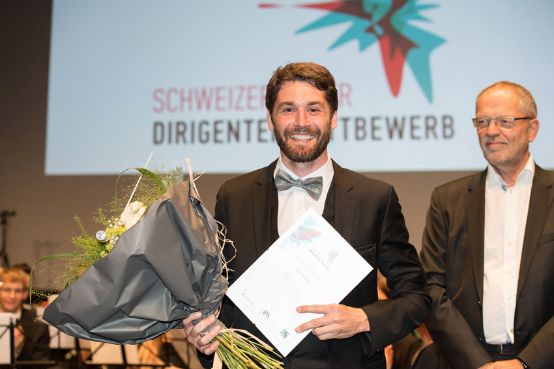
Théo Schmitt wins first prize. Photo: Danielle Liniger

What is a good conductor? Dancer, teacher, therapist, whipper-in, rapper or diva? The drug of making music together is addictive, said the organizers at the final of the 9th Swiss Conducting Competition. The chance of getting into the flow is much greater if the conductor is enthusiastic, charismatic and takes everyone into his world. This promotion of talent is the task of the tried-and-tested event, which took place this week in Baden.

All decisions of the three-member jury were unanimous: The winner of the ninth Swiss Conducting Competition (September 4 to 9, 2019) is Théo Schmitt from Palézieux. The 28-year-old from Vaud impressed the jury with his interpretation of the top-class work "Praise Jerusalem" by Alfred Reed. Raphael Honegger from Aargau came second and Laurent Zufferey from Valais came third.
 

"A convincing conductor"

The prizes are only awarded if the high standards set by the jury (Jan de Haan, Philippe Bach and Carlo Balmelli) are met. This was the case this time, as the overall standard of the 23 participants was exceptionally high. The jury chose Schmitt because he was clearly the best over the whole week, as jury president Jan de Haan explained. The Vaud native rehearsed very well and had an excellent grasp of the score. Despite the pressure of the competition, he performed confidently and convincingly. Thanks to his good charisma and good contact with the orchestras, Schmitt is a convincing winner according to jury president Jan de Haan.

Winner Théo Schmitt struggled to grasp what the victory meant for his career immediately after the announcement. As he will be starting a two-year course in film music in Los Angeles next week, there is a lot going on at the moment anyway. This may have taken the pressure off him. Instead, he was able to enjoy rehearsals and concerts more and more each day. The only thing the Frenchman had worried about beforehand was the language barrier. In the end, however, his lack of German was more of an advantage, as he was able to approach the orchestra in a very personable way and express himself with the means of a conductor rather than with lots of words.
 

The "wrong" work

The same effect then applied to the final: Schmitt was awarded Praise Jerusalem was given the exact piece that he absolutely did not want. He then worked through the whole night between the semi-final and final and in the morning was ultimately very convinced by this composition. That's why Théo Schmitt says: "Winning is not the most important thing in the conducting competition." The focus is on the learning process for and during the event - with this in mind, he is now also looking forward to the upcoming detailed critique by the jury.

The conducting competition enjoys an excellent reputation in the wind music scene. It is a unique platform to compete, face a jury and make music with great orchestras. Former winners are still successful conductors today and enjoy an excellent reputation. This type of promotion of young talent is also extremely interesting for the public. It is rare to be able to compare so directly how conductors behave, what gestures and looks they use to direct the orchestra, whether they manage to create tension, whether their handling of the conductor's baton is appropriate to the work and whether the candidate gives the musicians space to make music.
 

Demanding elimination

23 candidates had originally registered for the 9th Swiss Conducting Competition and had to master a challenging program in a total of four rounds. The twelve people admitted to the Swiss Conducting Competition by the Music Commission had been rehearsing a piece unknown to the orchestra for half an hour with the Baden Wettingen Wind Orchestra since the middle of the week in the preliminary round. In the semi-final on Friday, the candidates were given five minutes to rehearse a composition already known to the Brass Band Emmental or to play strategic passages. The work was then performed. In the final, the three finalists each spent 45 minutes rehearsing a composition known to the Bern Symphony Brass Orchestra (Sibo), which was then performed at the gala concert.

The competition is also a challenge for the orchestras because the candidates interpret the individual passages differently. There are various strategies for preparing a work. For the conductors, the question arises - in addition to the high technical challenges - of how to gain the orchestra's attention. A brief nod for a cue, a smile after a successful solo or a joke before the start show whether a candidate is on top of things.

The ninth edition of the conducting competition was a complete success. For the first time (with the exception of the candidate selection), all competition rounds were open to the public. Everything went smoothly, as the jury, audience and candidates unanimously confirmed. We can only hope that the financial situation of the Swiss Conducting Competition Association will allow it to organize such a platform for young conductors again in three years' time.


Ranking list

1st prize: Théo Schmitt, Palézieux (VD)
2nd prize: Raphael Honegger, Birr (AG)
3rd prize: Laurent Zufferey, Sion (VS).

The semi-finals were contested by these three candidates and Gaudens Bieri (Trimmis, GR), Emilie Chabrol (Basel, BS) and Mathieu Charrière (Saint Gervais, F).
 

Théo Schmitt

Théo Schmitt is 28 years old and comes from Palézieux. He studied orchestral conducting at the Conservatoire and the Lausanne School of Music. He has conducted the Orchestre Quipasseparlà since 2018. He has conducted the orchestras L'Harmonie d'Oron, the Young Guard of the Landwehr de Fribourg and L'Avenir d'Aclens and has taken part in numerous festivals, particularly for young musicians. As a conductor, he wants to inspire the musicians of the orchestra with his passion and gives them everything he has in the moments of playing together. Théo Schmitt has also been composing in various styles since 2012. In the coming week, his musical path will therefore take him out of Switzerland. He will be studying film music composition in Los Angeles. Schmitt conducted in the final of the conducting competition Praise Jerusalem by Alfred Reed.

www.theoschmitt.com
 

Title goes to Austria

The 19th Eastern Switzerland Soloist and Ensemble Competition (OSEW) took place in Sirnach on the weekend of September 7 and 8. The coveted title of solo champion at the important competition for young wind and percussion players was won by Katharina Mätzler from Vorarlberg.

Katharina Mätzler, the new "Eastern Switzerland Solo Champion". Photo: OSEW

The OSEW kicked off on Friday evening with the Swiss Students Competition, a percussion competition for students from Swiss music universities. On Saturday and Sunday, the soloists and ensembles put their musical skills to the test.

Percussion mechanism of the highest precision

The OSEW Swiss Student Competition for university graduates took place for the third time this year. The concept was revised in collaboration with the Swiss universities. Students enrolled at Swiss music universities up to the age of 24 are eligible to take part. The jury was made up of internationally renowned experts Franz Bach, Stuttgart and Roman Brogli, Pugema TI. The competition took place in three parts (1st round: timpani/mallet; 2nd round: set-up/body percussion/music theater; 3rd round: marimba with three finalists). Cédric Gyger from Schönenried, a graduate of the Zurich University of the Arts, took first place with the pieces For Marimba II and Indifférence through. He relegated Farida Hamdar from Rehetobel and Corentin Barro from Mühleturnen to the places of honor.

Over 800 musical talents

The OSEW competitions took place in the Dreitannensaal and in the Grünau school complex. The highlight was the grand final for the Eastern Switzerland Solo Champion on Sunday afternoon. In view of the many outstanding performances, the internationally recognized jury had a difficult task to master. Children and young people born between 1998 and 2012 competed in the slow melody, ensemble and solo competitions, with around 800 young musicians taking part, from clarinets, trumpets and trombones to a wide variety of percussion instruments.

Taking the title abroad for the first time

The five category winners of the weekend qualified for the grand final on Sunday afternoon. Katharina Mätzler (Bregenzerwald Music School) came out on top on her bassoon with her outstanding, virtuoso performance. She was able to convince the jury the most and took the coveted title of "Eastern Switzerland Solo Champion" abroad for the first time. Sven Dahinden, snare drums from the Schüpfheim music school, came second with his performance. Linus Tschopp from the Sulgen Music Society took third place on the euphonium. He was also nominated to take part in the "Prix Musique 2020".

20th anniversary next year

Next year, the competition will take place for the 20th time from September 4 to 6, 2020. The association will certainly come up with something special for the anniversary, promised long-time OSEW Managing Director Verena Fehr, and also revealed that a belated present will then take place in Sirnach in 2021 with the final of the "Prix Musique".

Open letter from Swiss musicians

Today, the revision of copyright law is being debated in the Swiss parliament. Much to the displeasure of the Swiss music scene, a new amendment to the law is planned that would put Swiss authors in a worse position than foreign authors.

Photo: Jonas Zürcher / Unsplash (see below)

A proposal from the National Council's Legal Affairs Committee (RK-N) wants to abolish copyright royalties for TV and radio offerings in hotels, vacation homes, hospitals and prisons. If international law is complied with, the foreign amounts would still have to be paid, only Swiss productions would be worse off.

The remuneration costs hotels less than one franc per room per month, write Swiss music professionals in an open letter to parliament. This is "a miserable joke and an insult to music professionals in Switzerland".

The revision of the CopA was initiated in 2012. According to their own assessment, the music creators "backed a compromise for the revision with major concessions", which contained very little of their original demands. The RK-N's proposal unbalances this compromise and turns the revision against them. The Council of States had understood this and deleted the tourism demand; the RK-N had now reinserted it.

Kühne replaces Nestle as main sponsor in Lucerne

The Kühne Foundation will be the main sponsor of the Lucerne Festival from 2020. The main focus will be on a partnership with the Lucerne Festival Orchestra. The Lucerne classical music event is thus compensating for a reduction in Nestlé's commitment.

Chief conductor Riccardo Chailly, Kühne and Häfliger at the media orientation at the KKL (Image: zvg)

The contract between the Lucerne Festival and the Kühne Foundation will initially run from 2020 to 2022. At a media briefing at Lucerne's KKL, Foundation President Klaus-Mchael Kühne emphasized that the Foundation has no interest in actively marketing the Kühne brand through sponsorship. The commitment therefore appears to have more of a patronage character. Lucerne Festival Director Michael Häfliger did not want to reveal any specific details about the financial scope of the agreement at the orientation.

The non-profit Kühne Foundation, based in Schindellegi, was established by the Kühne family in 1976. It promotes training and further education as well as research and science in the transport industry and logistics. It is involved in allergology research at the Hochgebirgsklinik Davos. The Kühne Foundation also runs the clinic, which focuses on the treatment and rehabilitation of allergies and heart disease. In the cultural field, it supports festivals, opera houses and concert halls in various European countries. It also plays an important role at the Salzburg Festival.

Ping, Pong and the guitar tiger

The new guitar school published by Heinrichshofen & Noetzel focuses on reading music; the one by Doblinger on singing.

Excerpt from the title page of the "Ping-Pong Guitar School"

The most striking feature of the new Ping-Pong Guitar School by Andreas Knoblich and Philippe Loli are the many notes in whose heads the note names are drawn in an irregular distribution. When working on a piece, the teacher should only play the normal, unprepared notes, the pupil only the labeled ones and vice versa - as in ping-pong (the school is also illustrated with two little figures of this name). This enables the pupil to memorize the note names quickly and confidently, and the constantly forced attention - when will it be my turn? - will also quickly become rhythmically proficient.

Based on the chord names, for which it is quite common that the German H through the English B is replaced, the single tone h always as b but, unlike in the English-speaking world, in lower case - except for the note heads, which are in turn in capital letters. A number of editorial carelessnesses spoil what is in itself an interesting didactic concept. For example, the first 22 tracks on the play-along audio app are recorded too low. Preparatory explanations and patterns for the right hand only appear after the corresponding pieces, and the last five somewhat longer numbers are consistently arranged in such a way that you have to scroll through them.

Image

Robert Morandell takes a different approach with his spiral-bound course Guitar tiger. The guitar is sung to right from the start. Notation is not introduced in the first lesson, but gradually; tablature is used for rhythm patterns and finger exercises for the left hand - called "challenges". In solo pieces, abbreviated chord progressions alternate with written-out melody bars. The figure of the tiger, which does not mutate into a cow or bear, but at least into "Mu(h)tiger", "Bärtiger" and "Schmusetiger", leads through the songs.

The author's experience in publishing pedagogical guitar literature is evident in some of the details: alternating tirando or apoyando? The tone d' grip with the 3rd or 4th finger? Morandell tacitly but deliberately leaves such decisions to the teacher. The only drawback is that the tempo of the exercises on the CD provided is too fast for most children.

Image

Andreas Knoblich and Philippe Loli: The Ping-Pong Guitar School. The new guitar method for all ages, Volume 1, N 2770, with practice app, € 19.90, Heinrichshofen & Noetzel, Wilhelmshaven

Robert Morandell: Gitarrentiger. Die tierisch gute Gitarrenschule für Kinder ab 6 Jahren, Vol. 1, D. 35 963, with CD, € 29.90, Doblinger, Vienna

Awards of the Concours Nicati 2019

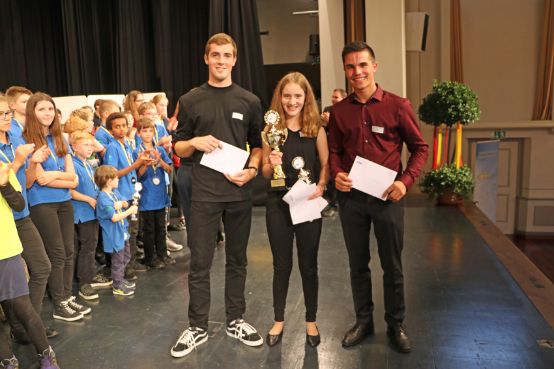
As part of the Concours Nicati, the first prize and the audience prize in the "Interpretation" category were awarded to the Concept Store Quartet, with the second prize going to the duo Klexs. The prize in the new "Open Space" category went to the collective IиTERиATIOиAL Totem. The four prizes are endowed with a total of 45,000 francs.

Concept Store Quartet. Photo: Sabine Burger

The members Alicja Pilarczyk (violin), Pablo González Balaguer (saxophone), Nejc Grm (accordion) and Guillem Serrano (drums) of the Concept Store Quartet have been working together since September 2018 and have made a name for themselves in German-speaking countries in a very short space of time. They commission all the works they create themselves.

Léa Legros-Pontal (viola) and Silke Strahl (saxophone) have dedicated themselves to contemporary and experimental music as the duo Klexs since 2016 and are committed to expanding their repertoire.

The Zurich-based collective IиTERиATIOиAL Totem (Léo Collin, Nuriya Khasenova, Kay Zhang) won the prize of CHF 15,000 in the "Open Space" category, which was held for the first time. Stanislas Pili and the duo Eventuell with Manuela Villiger and Vera Wahl also received a "Mention of the Jury".

The aim of the Concours Nicati is to discover and promote young personalities aged between 18 and 35 who are committed to contemporary music. The competition is organized by the Association du Concours Nicati. It maintains close partnerships with the Fondation Nicati-de Luze and the Music Department of the Bern University of the Arts HKB.


An anthem for the Federal Folk Music Festival

Five young folk musicians met at a composing weekend initiated by SUISA to write an anthem for the 2019 Federal Folk Music Festival under the direction of Dani Häusler.

After the anthem for the Federal Folk Music Festival in Aarau was composed single-handedly by Hanspeter Zehnder in 2015 as a commissioned composition, this year the focus was on young talent. The composing weekend was initiated by SUISA and organized by Markus Brülisauer from the Swiss Folk Music Association (VSV) in collaboration with the organizing committee of the EVMF.

The organizers were responsible for selecting the invited musicians. Care was taken to ensure that the most common folk music instruments were represented. This is how Eva Engler on clarinet, Alessia Heim on hammered dulcimer, Jérôme Kuhn on double bass, Florian Wyrsch on Schwyzerörgeli and Siro Odermatt on accordion came together on a Saturday morning in May 2019 in Crans-Montana.

Apart from Siro Odermatt, who has been a SUISA member since 2017 and has already written several pieces himself, the young musicians did not have much experience in composing. That's why Dani Häusler, an experienced folk musician, was hired to lead the weekend.

The beginning on the white sheet of paper

Before the first notes rang out from the instruments they had brought with them in the seminar room of the "La Prairie" hotel, the group sat down at a table and literally began their work on the white sheet of paper. The first exchange of ideas was characterized by vague notions: A hymn - that's a big word. What should it be? How should it sound? How do we go about it? What type of dance is suitable? How do we find melodies and chords? And will we really be able to finish a piece by tomorrow, Sunday?

The director Dani Häusler provided food for thought, bundled the questions, together they looked for answers, the ideas and thoughts were recorded on paper, the ideas were fleshed out and soon a basis for the piece was defined - still on paper for the time being. After some discussion, the decision was made in favor of a Schottisch. They also wanted to have a text to sing along to.

After that, they played their instruments for the first time: The young people sat down in pairs or threes and collected musical ideas together. What had been worked out in the small groups was then presented to the whole group and supplemented with possible accompaniment parts. After some initial difficulties, the brilliant idea was found during the course of the Saturday afternoon and the framework of the anthem was completed by dinner.

This framework also included the draft lyrics for the piece, from which, in addition to the title-giving exclamation "Ab is Wälschland ...!", a pithy chant line immediately sticks in the mind: "Glich oder glich ned glich." Jérôme Kuhn explained: "There is folk music all over Switzerland, but in many areas there are different styles." Curious listeners can find out whether they are "the same or not the same" at the upcoming Federal Folk Music Festival in Crans-Montana.

The first performance

On Sunday morning, the individual parts of the piece were fine-tuned, particularly with regard to the arrangement. The musicians practiced their individual parts in groups or alone. Around midday, the newly created piece could be heard as a whole for the first time and was constantly refined in further rehearsals.

"The result is a piece that is easy on the ear, has something unique about it and yet is suitable for a large audience," said Siro Odermatt towards the end of the successful composing weekend. The anthem was then professionally recorded in the studio with the musicians and Dani Häusler and can be purchased on CD. All proceeds from the sale will go to the VSV Young Talent Fund.

The 13th Federal Folk Music Festival will take place in Crans-Montana from September 19-22, 2019.

> www.cransmontana2019.ch

Making of video and further information on the SUISA blog:

> www.suisablog.ch

Life story of Debussy's last work

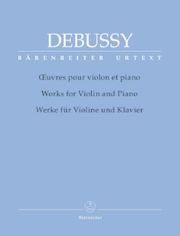
The violin sonata is one of the few works for violin and piano by Claude Debussy. This new publication sheds light on the background to its creation and the various sources.

Birthplace in Saint-Germain-en-Laye and today's Musée Claude Debussy. Photo: Lionel Allorge / wikimedia commons

In his English foreword (translated into French and German), the capable American editor Douglas Woodfull-Harris explains, with many quotations from the time, how Debussy only came up with the idea of composing chamber music at the end of his life: in 1914 he liked arrangements of two of his piano pieces by the Hungarian-American violinist Arthur Hartmann for violin and piano so much that he arranged another piece for this instrumentation - all three are included in this booklet - and gave an enchanting performance with Hartmann. He then planned the series of works Six Sonates pour divers instrumentsfrom which he was able to complete the Cello Sonata (1915), the Sonata for Flute, Viola and Harp (1916) and the Violin Sonata. In 1917, Debussy, who was suffering from cancer, worked on the premiere of the unfinished Violin Sonata with the violinist Gaston Poulet - his last public performance. We hear in detail about the circumstances of later performances and editions.

The sonata is printed here twice, according to the two most important sources. The large slurs of the first version correspond to the composer's phrasing intentions, those of the second to violin-technical requirements. Let us try to realize the first with the help of the second! In the Critical Commentary (English only) one is amazed at where the editor has tracked down sources: in Paris, Winterthur, Washington DC, Geneva. They provide the material for over a hundred annotations; they are valuable details for our own interpretation.

Image

Claude Debussy: Works for violin and piano (Sonata, Minstrels, La fille aux cheveux de lin, Il pleure dans mon coeur), edited by Douglas Woodfull-Harris, BA 9444, € 18.95, Bärenreiter, Kassel

Alban, Helene and the memory

How did the composer's widow Helene Berg influence the memory of Alban Berg? An anthology seeks answers.

Helene Berg, née Nahowski, 1927 Photo: Georg Fayer, Austrian National Library / Wikimedia commons

Ever since Constantin Floros discovered the cryptic clues in the Lyrical Suite of Alban Berg, which document his love affair with Franz Werfel's sister Hanna Fuchs-Robettin, there is no lack of attention for his widow Helene Berg. After all, she survived him for 41 years, described herself as a "composer's widow" under the heading "Profession" in the "Registration form for main (annual and monthly) residential parties" and felt obliged not only to look after the compositional estate, but also to record something of Alban's life: "You must see how Alban lives ..." This is also the headline above Daniel Ender's major contribution in the chapter "Memory Spaces". Since the first edition of the letters was ultimately met with a great deal of mistrust, her work understandably focused on "image" building.

Her efforts to create an active foundation were successful and are also appreciated. However, her way of making the "auto/biographical" part appear as small as possible has again led to critical comments, but has also brought different assessments to light after Helene Berg's death in 1976. The confrontation of academic archival work with the "gender-attributive tasks" of widows as "educators of souls" inherited from the 19th century is addressed in various contributions. The call for a reassessment of Helene Berg's behavior is not only raised by Anna Ricke, but can also be derived from the above-mentioned contribution by Daniel Ender with the subtitle "Berg's living spaces and the staging of the authentic". In his essay on the Alban Berg Complete Edition, Martin Eybl also posed the question of why Helene Berg did not even consider such an edition despite the "broad spectrum of her activities".

The wealth of interesting illustrations and written documents should not go unmentioned.

Image

Stiften Erinnerung - Helene Berg und das Erbe Alban Bergs, edited by Daniel Ender, Martin Eybl and Melanie Unseld, 210 p., € 29.95, Universal Edition and Alban Berg Foundation, Vienna 2018, ISBN 978-3-7024-7574-1

Sound visions for the guitar

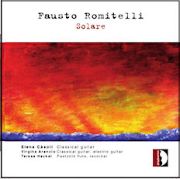
On "Solare", Elena Càsoli, Virginia Arancio and Teresa Hackel have recorded a number of pieces by Fausto Romitelli for the first time.

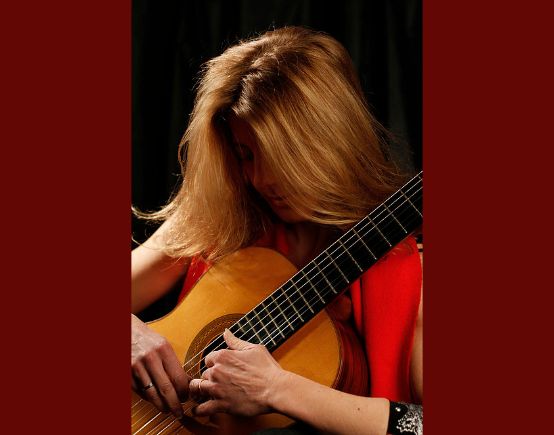
Elena Càsoli. Photo: Vico Chamla

Guitarist Elena Càsoli is always good for surprises. She is at the heart of today's music production and teaches guitar and interpretation of contemporary music at the Bern University of Music. On the Italian label stradivarius, she has already worked with StrongStrangeStrings caused a sensation, followed by Changes Chances with music by Cage, Carter and Riley.

Their latest CD is dedicated to the guitar music of the Italian spectral and computer musician Fausto Romitelli (1963-2004), who died at the age of just 41 after a long illness. Romitelli had studied in Milan and then continued his compositional training with Franco Donatoni. Following his interest in "sound research", he went to Paris in 1991 to come into contact with Hugues Dufourt and Gérard Grisey at IRCAM (Institut de Recherche et Coordination Acoustique/Musique). From 1993 to 1995 he was a "compositeur en recherche" there. As a young composer, he established himself as part of the "sound avant-garde" on the leading European stages for new music in the environment of Ligeti, Scelsi and Grisey and explored unheard-of sound dimensions, whether in the field of instrumental and vocal music or with electronics, live electronics and multimedia,

Elena Càsoli is also able to reveal Romitelli's visionary cosmos in his guitar pieces. Highly musical as she is, she creates the meticulously notated and therefore difficult to decipher scores with dramaturgical finesse and a multi-layered color palette.
Solar (1984) for solo guitar gives the CD its name. Càsoli knows how to make the quiet, shimmering beginning so exciting that you follow along with her with interest: it is a quiet piece full of surprises that unfolds a dramaturgically idiosyncratic and tonally differentiated poetry with few means. Càsoli is familiar with each of its finesses, and towards the end she even ponders the individual notes with a quiet hum.

The CD offers five first recordings, Solar is one of them. For the pieces that require two guitars or an electronic guitar, Càsoli has brought Virginia Arancio on board, as well as recorder player Teresa Hackel. This brings in Seascape (1994) and Simmetria d'oggetti (1987/88) for flute and guitar, Romitelli's imaginative approach to breathing is impressive. - Anyone who begins to listen to this CD will be captivated by the delicate, engaging world of sound.

Image

Fausto Romitelli: Solare. Elena Càsoli, classical guitar; Virginia Arancio, classical guitar, electric guitar; Teresa Hackel, Paetzold flute, recorder. stradivarius STR 37099

Scandals or scandals?

In "Pop and Populism", Jens Balzer analyzes song lyrics, which he finds are becoming more provocative and aggressive in parallel with politics. The reviewer agrees with this analysis only to a limited extent.

Photo: Holger Link / Unsplash

The questions are interesting: How much responsibility does a rock musician have? When does he or she reach the limit where provocation crosses over into taboo zones, into so-called "no-gos"? Rock and pop musicians have always dabbled in precarious areas - be it openly displayed sex fantasies (Rammstein eloquently: Bend over) or dark scenes of violence with references to the Third Reich (Slayer: Angel of Death). But not all the lyrics should be taken at face value. Some things - see Rammstein - are ironically broken, others - see Slayer - are deliberately inscribed with that scandal and are not necessarily politically motivated, but merely sales-promoting. A big outcry is advertising. It arouses interest.

The many pop and rock phenomena can hardly be reduced to a common denominator. In this respect, the author and pop critic Jens Balzer does well to start with a few selected examples. There are, for example, those rappers who have late adolescents in mind. "Young, brutal, good-looking xxx" is the slogan of rappers Kollegah and Farid Bang. Their lyrics are full of sex, violence and even anti-Semitism, which led to the Echo scandal. "My body more defined than by Auschwitz inmates", says the song 0815. Elsewhere they rap: "Make another Holocaust, come on with the Molotov."

Whether something like this can be justified with the concept of artistic freedom remains doubtful. For Balzer, in any case, such misconduct is an indication of the brutalization of morals. He sees clear parallels between music and today's politics, where Syrians, Muslims or Jews find themselves in the verbal crosshairs. For Balzer, pop's responsibility would mean a conscious counter-reaction to the new right in the sense of intelligent lyrics without phrases, without catchphrases à la Kollegah. And also a politically correct language, as he describes it in the case of the English performance artist Planningtorock, which is open to the different, the foreign in the sense of differentiated transgender considerations. "It's about," says Balzer, summing up, "the irreplaceable hope that pop can give us places and spaces, moments and opportunities in which people who are perhaps very different from ourselves meet us not as competitors and opponents, but as friends."

The 200-page book Pop and populism is already thought-provoking. However, it is questionable whether the cloak of silence would not be a better alternative than criticism, which is easy in the case of less intellectual rappers, but ultimately leads nowhere. Pop as a mass phenomenon is usually superficial to highly embarrassing per se. The same applies to right-wing politics. The lyrics there are also "emotional" - but far more dangerous than music for teenagers who just want to be strong.

Image

Jens Balzer: Pop and populism. On responsibility in music, 206 p., € 17.00, Edition Körber, Hamburg 2019, ISBN 978-3-89684-272-5

Long neglected original version

Antonín Dvořák's only piano concerto has long been performed in an edited version or dropped from the repertoire altogether. Wrongly so!

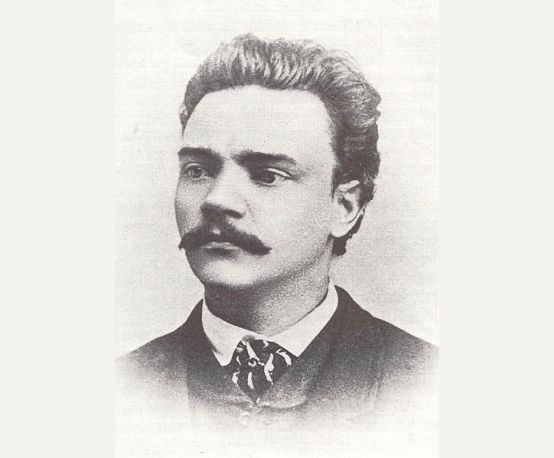
Antonín Dvořák 1868 Photo: Anonymous photo from the Dvořák Museum in Prague / wikimedia commons

When one thinks of Dvořák's solo concertos, it is surely first and foremost his brilliant
Cello Concerto op. 104, "the perfect concerto ever", according to the pianist (!) Rudolf Buchbinder. His only piano concerto in G minor op. 33 is rarely heard in our concert halls. What are the reasons for this?

At the time, Dvořák already had some experience as a composer in the field of chamber music and symphonies. However, his very own tonal language is only partially revealed in the three movements of the work. Borrowings from masters such as Beethoven, Chopin, Wagner and Brahms are still unmistakable. This is particularly the case in the first movement, while the slow second movement already reveals very personal traits. However, what has repeatedly prevented many pianists from including this concerto in their repertoire is probably the unwieldy, uncomfortable piano writing, which sounds enchanting in places but does not allow for virtuoso showmanship.

For this reason, around 100 years ago, the Czech piano teacher Vilém Kurz felt compelled to thoroughly revise the solo part. For decades, only his version seems to have been played. One of the first pianists to champion the original version was none other than Sviatoslav Richter. He played the concerto quite frequently and even recorded it in 1976 with the Bavarian State Orchestra (under Carlos Kleiber!).

Robbert van Steijn recently republished this original version by Bärenreiter-Verlag, both the piano reduction and the score. The preface provides all kinds of enlightening information about the complicated history of the work's reception, and Ivo Kahánek adds some very useful tips on interpretation and fingering.

The growing interest in Dvořák's piano concerto in recent times cannot be overlooked. The new Bärenreiter edition will presumably reinforce this trend. András Schiff is probably not wrong when he says: "Numerous piano concertos of the 19th century, which are part of the repertoire of many pianists - and are played far too often - are no less complicated pianistically, without reaching Dvořák's work in terms of musical expression and compositional skill."

Image

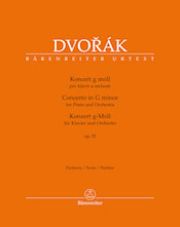
Antonín Dvořák: Concerto in G minor op. 33 for piano and orchestra, Urtext edited by Robbert van Steijn; score, BA 10420, € 59.00; piano reduction, BA 10420-90, € 32.50; Bärenreiter, Prague

get_footer();