It is not possible to pinpoint exactly what happens when music moves and where this can lead. Maxims for good leadership can also set musical organizational structures in motion.
SMZ
(translation: AI)
- 04 Sep 2019
Cover picture: www.neidhart-grafik.ch
It is not possible to pinpoint exactly what happens when music moves and where this can lead. The maxims of good leadership can also set musical organizational structures in motion.
All articles marked in blue can be read directly on the website by clicking on them. All other content can only be found in the printed edition or in the e-paper.
Focus
Music moves-why, we don't know Emotion research is still looking for concrete answers
Il existe une infinité d'émotions possibles Interview avec Didier Grandjean, directeur au NEAD à Genève
When songs make politics Can music influence our attitude, determine our actions?
Le rap d'extrême droite en France Une microscène dynamique et fragile
Good governance for more democracy "Good governance" sets orchestra and association structures in motion
Since January 2017, Michael Kube has always sat down for us on the 9th of the month in row 9 - with serious, thoughtful, but also amusing comments on current developments and the everyday music business.
Here you can download the current issue. Please enter the search term "e-paper" in the print archive. The download is free of charge for subscribers.
All other interested parties will receive the PDF of the current issue (or an earlier issue) by e-mail. Costs: Fr. 8.-. Click here to order the e-paper.
How did the composer's widow Helene Berg influence the memory of Alban Berg? An anthology seeks answers.
Jakob Knaus
(translation: AI)
- 04 Sep 2019
Helene Berg, née Nahowski, 1927 Photo: Georg Fayer, Austrian National Library / Wikimedia commons
Ever since Constantin Floros discovered the cryptic clues in the Lyrical Suite of Alban Berg, which document his love affair with Franz Werfel's sister Hanna Fuchs-Robettin, there is no lack of attention for his widow Helene Berg. After all, she survived him for 41 years, described herself as a "composer's widow" under the heading "Profession" in the "Registration form for main (annual and monthly) residential parties" and felt obliged not only to look after the compositional estate, but also to record something of Alban's life: "You must see how Alban lives ..." This is also the headline above Daniel Ender's major contribution in the chapter "Memory Spaces". Since the first edition of the letters was ultimately met with a great deal of mistrust, her work understandably focused on "image" building.
Her efforts to create an active foundation were successful and are also appreciated. However, her way of making the "auto/biographical" part appear as small as possible has again led to critical comments, but has also brought different assessments to light after Helene Berg's death in 1976. The confrontation of academic archival work with the "gender-attributive tasks" of widows as "educators of souls" inherited from the 19th century is addressed in various contributions. The call for a reassessment of Helene Berg's behavior is not only raised by Anna Ricke, but can also be derived from the above-mentioned contribution by Daniel Ender with the subtitle "Berg's living spaces and the staging of the authentic". In his essay on the Alban Berg Complete Edition, Martin Eybl also posed the question of why Helene Berg did not even consider such an edition despite the "broad spectrum of her activities".
The wealth of interesting illustrations and written documents should not go unmentioned.
Stiften Erinnerung - Helene Berg und das Erbe Alban Bergs, edited by Daniel Ender, Martin Eybl and Melanie Unseld, 210 p., € 29.95, Universal Edition and Alban Berg Foundation, Vienna 2018, ISBN 978-3-7024-7574-1
Roche encourages the next generation of composers
Kirsten Milenko and Alex Vaughan, two young composers from Australia, have been commissioned by the Roche Young Commissions for 2021. They were selected by Wolfgang Rihm, Artistic Director of the Lucerne Festival Academy.
Music newspaper editorial office
(translation: AI)
- Sep 03, 2019
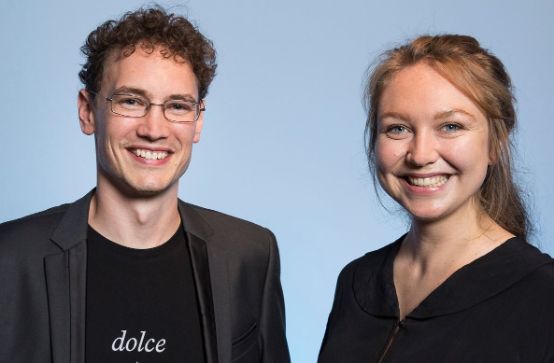
Kirsten Milenko and Alex Vaughan (Image: Nik Hunger)
Born in Australia in 1992, Kirsten Milenko lives and composes in Copenhagen and studies at the Royal Danish Academy of Music with Niels Rosing-Schow and Simon Løffler. She previously studied with Liza Lim, Rosalind Page, Natasha Anderson and Ursula Caporali at the Sydney Conservatorium of Music. She is signed to Australian label Muisti-Records and her debut album Caeli was released in June 2019.
Alex Vaughan, born in Sidney in 1987, began trombone lessons at the age of eight, followed by several years of training in jazz and music theory at the Music Life-School of Performing Arts under the direction of Rory Thomas in Sidney. He studied composition and jazz trombone at the University of New South Wales and then moved to Weimar to continue his studies in Germany. His teachers include Reinhard Wolschina, Jörn Arnecke and Hansjörg Fink.
The Roche Young Commissions were first launched in 2013 as a unique collaboration between Roche, Lucerne Festival and the Lucerne Festival Academy. Since 2003, works have been commissioned from world-renowned composers as part of the Roche Commissions, and the partnership has been expanded with the Roche Young Commissions. The works of the Roche Commissions and the Roche Young Commissions are premiered alternately every two years.
Akiko's piano
"Music for Peace" is an initiative of the Hiroshima Symphony Orchestra, which aims to move the world with the idea of peace and is supported by Martha Argerich.
Max Nyffeler
(translation: AI)
- Sep 03, 2019
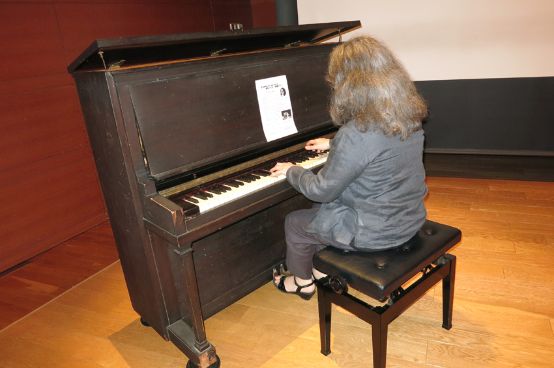
Martha Argerich plays on Akiko's instrument. Photo: by courtesy of Hope Project, Hiroshima
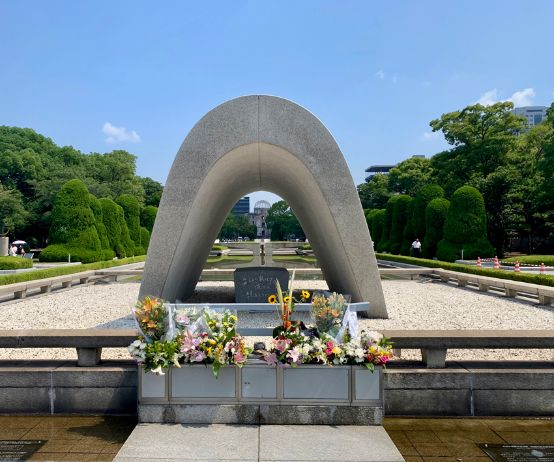
Hiroshima, August 6, 8:15 a.m.: The peace bell is struck seven times. It is the moment in 1945 when an American bomber released the atomic bomb ten kilometers above the city. Tens of thousands died within seconds, and by the end of the year the number of victims had risen to around one hundred and forty thousand as a result of the radioactivity. Every year, the chimes open the memorial ceremony, which is attended by the survivors and their families, high-ranking officials, a large part of the diplomatic corps from Tokyo and thousands of ordinary citizens at ground zero of the explosion, today's Peace Park. A minute's silence is followed by speeches from the Mayor of Hiroshima and the Prime Minister, a flock of doves flies up and two children read out a pledge of peace.
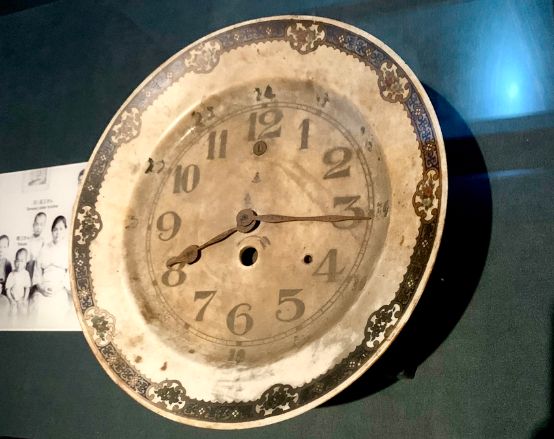
An exhibit at the Hiroshima Peace and Remembrance Museum: the kitchen clock stopped at the moment the bomb exploded. Photo: Max Nyffeler
The short and dignified ceremony is a highly visible part of a carefully cultivated culture of remembrance in the city, which today once again has over one million inhabitants. In addition to various memorials in the park, this includes the ruins of the former Chamber of Commerce and Industry, known worldwide as the "atomic bomb dome", and above all the Peace and Remembrance Museum. It documents the death and mass suffering of the victims in a way that is as factual as it is harrowing and demonstrates the destructive potential of the bomb in an exemplary educational section. It is terrifying to think that something like this could happen again anywhere in the world today.
Point Zero and today's Hiroshima, on the left the monument of the "atomic bomb dome". Photo: Max Nyffeler
"Music for Peace" as an international exchange program
Since 2015, these traditional activities have been complemented by the "Music for Peace" initiative, which focuses on the Hiroshima Symphony Orchestra stands for. It has set itself the task of spreading the idea of peace, which is held in high esteem in this city, throughout the world. Among its supporters, Martha Argerich is at the forefront with the honorary title of peace ambassador for the orchestra. The initiator and driving force is Shoji Sato, whose main job is working for a Tokyo artists' agency, and the symphony orchestra acts as the artistic sponsor. With thematically oriented concert programs and using the global connections in today's music business, it forms the hub of a long-term, international exchange program that not only extends to reciprocal orchestra visits and soloist activities, but also involves orchestra musicians individually or in groups, depending on the project.
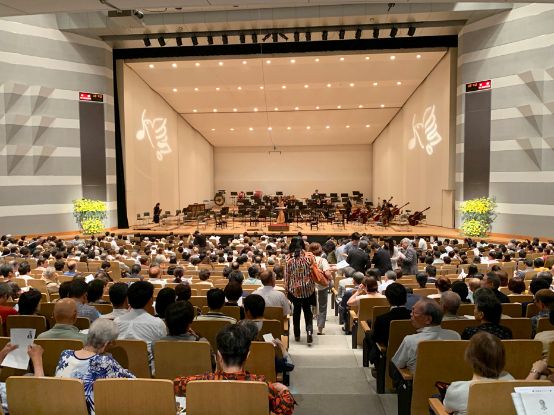
The concert hall in Hiroshima. Photo: Max Nyffeler
The "transplantation" of orchestral musicians is unusual and points to one of the basic ideas behind the initiative. Beyond the legitimate endeavor to better position the orchestra on the international market, the aim is to broaden the background experience of both the individual musicians and the orchestra as a whole and to contribute to understanding across continents, language barriers and cultural peculiarities through human encounters. Orchestral education and peace education complement each other. "'Music for Peace' wants to make people aware of the idea of disarmament," says Sato. It is not surprising that our European classical music serves as a medium for such Japanese peace signals. It has a high status in the Far East, the audience is enthusiastic and, as can be observed in Japan at least, consistently well informed. It is also growing continuously, not least due to the influence of the media, without which nothing would work today.
A world premiere by Toshio Hosokawa
On the eve of this year's memorial day, the Hiroshima Orchestra, under the direction of its permanent guest conductor Christian Arming, gave a concert with a new work by Toshio Hosokawa, the first cello concerto by Dmitri Shostakovich and the first symphony by Gustav Mahler. Hosokawa was born in Hiroshima and is currently the orchestra's composer-in-residence. He learned Western compositional techniques from Klaus Huber in Freiburg, but his musical language is audibly rooted in Asian musical sensibilities. Here, the lively line as a principle of form and vehicle of expression takes the place of a harmonically structured order; the harmonic space is replaced by the spatiality of the gesture, which - analogous to the brushstroke in calligraphy resulting from the movement of the body - begins and ends in nothingness, i.e. in silence.
Hosokawa refers to this parallel in the context of the recently premiered composition Song V there. It is a short, very concentrated concerto for cello and string orchestra with percussion and harp. Characteristic East Asian symbolism is also evident in the formal structure: according to Hosokawa, the solo part represents the voice of man, while the orchestra stands for inner and outer nature. The melodic line is enlarged to gigantic proportions, it spans the entire tonal space, frays and tangles and grows into expressive sound processes - a permanently high-voltage stream of energy that is brought to life with gripping intensity by the English cellist Steven Isserlis. The colorful orchestra provides the appropriate resonance chamber.
The Hiroshima Symphony Orchestra is one of Japan's top orchestras, it is responsive and cultivates a sparklingly transparent sound. The brilliant wind section and the flexible string sound are striking. It was able to make full use of its qualities in the concluding Mahler symphony, where it conjured up something of a Viennese atmosphere on the distant Pacific under Arming's inspiring direction with its collective rubato playing, the little swerves and glissandi, especially in the melancholy slow movement.
Martha Argerich plays contemporary music
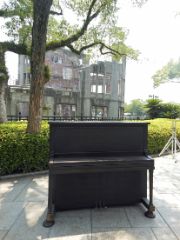
Akiko's piano in front of the "atomic bomb dome". Photo: by courtesy of Hope Project, Hiroshima
The orchestra's initiative has already forged numerous links with Europe and Canada. There is a particularly close relationship with Sinfonia Varsovia; both were founded after the war in a city that had been razed to the ground, and to mark the centenary of diplomatic relations between Japan and Poland, the two orchestras recently performed in Warsaw in a mixed formation, playing Beethoven's Ninth together and Martha Argerich performed Chopin. Krzysztof Penderecki was already a guest in Hiroshima in June. In addition to Beethoven, he conducted his 2009 premiere in Krakow under Valery Gergiev. Prelude for Peace and his second violin concerto; two members of the Danish Radio Symphony Orchestra took part as external orchestral musicians.
But the really big fireworks will take place next August in Hiroshima, when the orchestra will once again perform the Ninth with twenty guest musicians from Poland, Denmark, France, Germany and the USA and choristers from Hanover, Hiroshima's twin city. And the surprise of the evening: Martha Argerich, otherwise not exactly known as a champion of contemporary music, will premiere a new piano concerto. It is called Akiko's PianoThe composer is Dai Fujikura. He is no stranger to Switzerland; in 2004 Pierre Boulez invited him to the first Festival Academy in Lucerne and a year later conducted his orchestral piece Stream State.
The piano concerto ends with a cadenza that evaporates into a triple piano at the end. Martha Argerich will switch from the grand piano to Akiko's piano. Akiko was a nineteen-year-old girl from Hiroshima who died from nuclear radiation the day after the explosion. Her piano, a high-quality instrument made by the American manufacturer Baldwin, survived the apocalypse, was restored and will now be played in public for the first time in this concert, initially in Hiroshima and then in Europe; according to reports, contact is also being made with Lucerne.
The pictures of the dead, the tattered clothes and the everyday objects melted into lumps in the Hiroshima Peace Museum are silent witnesses to the city's downfall. Akiko's piano tells of the horror, but also how to overcome it, in sound.
The Hiroshima Peace and Memorial Park. Photo: Max Nyffeler
Women composers in the 19th century
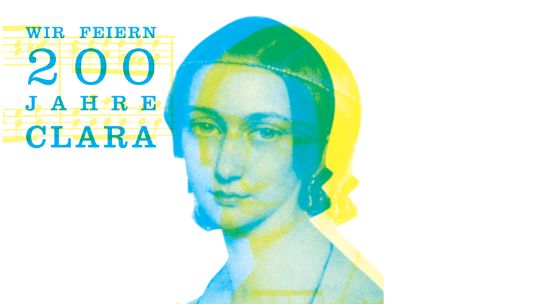
The ensemble Les Métropolitaines presents songs and chamber music by Clara Schumann-Wieck and her circle of musical friends and influences to mark the 200th anniversary of her birth.
Music newspaper editorial office
(translation: AI)
- Sep 03, 2019
"I don't just play the piano ..." was the title of a music program on SWR2 in 2016 that portrayed composing women from different centuries. Playing the piano, which is, so to speak, the basic skill of a daughter from a good family, is usually one of the focal points of female composers in the 19th century. They performed as pianists and gave piano lessons, but not only that, they also composed for this instrument. In addition, they often received singing lessons and then accompanied themselves on the piano. In this way, the second focus of composition, the song, also grew out of this domestic musical tradition.
Many of the female composers we have chosen for our concert in honor of Clara Schumann grew up with female "role models" in their families who performed in public as musicians. Clara Schumann's mother, Marianne Tromlitz, performed as a soloist in the Leipzig Gewandhaus concerts. Clara's friend of many years, Pauline Viardot Garcia, was born to sing, so to speak: Her father is an opera tenor and composer, her mother a singer and actress. After the death of her older sister, the famous singer Maria Malibran, Pauline, who was initially trained as a pianist, followed in her sister's footsteps. Josephine Lang's mother was also a singer. Fanny Hensel and Mary Wurm also had mothers who gave their children lessons themselves and provided them with a solid musical education.
Although familiar with music and closely associated with women who practise their profession as musicians in public, female composers are breaking new ground with their work. Composing is not considered a woman's job. As the critic Hans von Bülow wrote: "Reproductive genius can be attributed to the fair sex, just as productive genius is absolutely to be denied. There will never be a female composer, only a female copyist. I do not believe in the feminine of the term: creator. I also hate to death everything that smacks of female emancipation."
Clara Schumann
Clara Schumann saw herself primarily as a pianist. "I feel called to reproduce beautiful works [...]. The practice of art is a large part of my self, it is the air in which I breathe." She judged some of her own compositions to be less than successful. "[...] of course it always remains women's work, where there is always a lack of strength and here and there a lack of invention." And: "But I can't compose, it makes me quite unhappy at times, but I really can't, I have no talent for it." Her reasoning: "Women as composers can't deny themselves, I accept that from myself as from others." There are also statements that show pleasure in their own compositions: "There's nothing like the pleasure of having composed something yourself and then hearing it."
Robert appreciates Clara's compositions and sometimes admonishes her not to neglect composing. He also regrets that she does not get to compose in addition to her many tasks. "Clara has written a series of smaller pieces that are as delicate and musical in their invention as she had never managed before. But having children and a husband who is always fantasizing and composing do not go together. She lacks sustained practice, and this often moves me, as many an intimate thought is lost that she is unable to carry out." In these lines, Clara appears to be a composer to be taken seriously. However, no solution to the problem is sought. And when the two enter into direct competition, equality is no more. Robert suffers when Clara is the center of attention on concert tours. Robert wants to be depicted above Clara on a double medallion because the productive composer is above the reproducing artist. The fact that a clear hierarchy is concealed behind the superficial equality is also evident in the quote from Franz Liszt: "No happier, no more harmonious union was conceivable in the world of art than that of the inventing man with the performing wife, of the composer representing the idea with the virtuoso representing its realization."
Pauline Viardot
For Pauline Viardot, creative and performing artists are of equal value. " [...] the dramatic artist must constantly create - he must conceive human, living, feeling, passionate, perfect figures, true to nature down to the smallest detail, and present them to the audience. Above all, I admire the creative master, and right next to him the creative artist. Both are inseparable - for each alone remains mute, and together they create the highest and noblest pleasure of man, art." Pauline was able to experience both sides intensively, devoting a long time to her stage career. Her eldest daughter grew up with her mother and her husband often accompanied Pauline on her tours. Then, at the age of 42, she ends her stage career, teaches, composes and only gives a few concerts. Clara Schumann admires the ease with which Pauline accomplishes everything. After the performance of two short operettas by Pauline, she writes: "The skill, subtlety, grace and roundness with which everything is done, often with the most amusing humor, is wonderful! [...] and as soon as she has written it all down, it just plays from sketch sheets! And how she rehearsed it, the children, how enchanting they are [...]! Everywhere in the accompaniment you can hear the instrumentation - in short, I found again confirmed what I have always said, she is the most ingenious woman I have ever met, and when I saw her sitting at the piano like that, conducting everything with the greatest ease, my heart softened [...]."
Fanny Mendelssohn
Although Fanny Mendelssohn received the same musical training as her brother Felix, her situation as a woman made it impossible for her to publish her compositions. Her father wrote to his fifteen-year-old daughter: "What you wrote to me about your musical activities in relation to Felix in one of your earlier letters was as well intended as expressed. Music may become his profession, whereas for you it can and should only ever be an adornment, never the foundation of your being and doing; [...]. Persevere in this attitude and this behavior, they are feminine, and only the feminine adorns women." Later he also admonishes her in this sense, which Fanny comments to a friend as follows: "The fact that one's miserable feminine nature is brought forward every day, at every step of one's life, by the masters of creation, is a point that could infuriate one, and thus deprive one of femininity, if it did not make evil worse."
Felix, who encouraged other female composers such as Josephine Lang and Johanna Kinkel in their compositions, remained dismissive of Fanny's efforts. He writes to his mother: "You praise her new compositions, and that is really not necessary, [...] because I know who they are by. Also [...] that as soon as she decides to publish something, I will give her the opportunity to do so as much as I can and relieve her of all the trouble that can be spared. But persuade I cannot publish anything for her because it is against my views and convictions. [...] I regard publishing as something serious [...] and believe that one should only do it if one wants to appear and stand as an author for the rest of one's life. [...] And Fanny, as I know her, has neither the desire nor the profession to be an author, she is too much of a woman for that, as is right [...]." When Fanny decided to publish her compositions at the age of forty, knowing that her brother would not like it, Felix finally gave her the "blessing of the trade" and wished her much joy.
Johanna Kinkel
Johanna Kinkel seems to have known very early on that she wanted to "make music her business". The family did not think this was appropriate. Her grandmother says: "Thank God we don't need our only child to learn music for her own entertainment". Johanna is therefore sent to a school where she is supposed to learn "housekeeping". But she doesn't like that at all. "Oh, how much better and easier I would have learned basso continuo, because I had already heard somewhere that there was a thing by that name that helped you to compose." "I don't want to be a dilettante, I want to be an artist." She subsequently pursued this goal with great determination. She travelled to Felix Mendelssohn to play for him and then organized her musical training in Berlin. After studying basso continuo, she felt able to put her ideas into practice. "I had felt the urge to compose from a young age, but I didn't want to weaken it by putting a lot of amateurish ideas on paper without knowing the theory, as so often happens. [...] Now that I realized what had previously prevented me from clearly expressing my inner melodic world, I felt as if all my thoughts wanted to bud and blossom into sounds."
Louise Adolpha Le Beau
If one believes the reviewers of the time, none of the women composed as "masculine" as Louise Adolpha Le Beau. "One does not usually expect such solidity of theoretical development, such dexterity in the treatment of form, as in orchestration, from ladies; here we find a masculine, serious spirit, an artistic development on an extremely solid foundation, combined with a fine feeling for beauty of form and sound," said one reviewer in praise of Le Beau. When she approached Rheinberger in Munich to take lessons, he turned her down. He did not want to teach women. After playing her own compositions, she was accepted as "Mr. Colleague", and he attested to the exceptional quality of her Violin Sonata op. 10, saying it was "masculine, not as if composed by a lady". This praise runs like a red thread through the reviews, as in the following comment: "Ms. le Beau is one of the exceptions who make it further; if there weren't many men writing really bad music, then I would express my praise in the words: she composes like a man!" On the one hand, Le Beau seeks recognition as a composer; on the other, she finds herself in competition with her male colleagues. Despite her qualities, she searches in vain for an opera house that will perform her opera, and a professorship for composition in Berlin also remains closed to her. Women are not considered for this position.
Piano works and songs
If you look at the compositions of women from the 19th century, piano works and songs clearly dominate the picture. This is the case with Clara Schumann, Johanna Kinkel, Josephine Lang and largely with Fanny Hensel. However, an overview of Fanny Hensel's compositions is still not available today.
Fanny Hensel describes her difficulty in writing longer works as follows: "It is not so much the manner of writing that is lacking as a certain principle of life, and due to this lack my longer works die of old age in their youth, I lack the strength to hold the thoughts properly, to give them the necessary consistency. That is why I succeed best with songs, which only require a pretty idea without much strength of execution [...]." When women venture into composition, it is in the areas of piano music, song and chamber music. The large forms, oratorio, opera and symphony belong to "male" composition. Mary Wurm and Louise Adolpha Le Beau are active in this area, although not for the most part.
Symphonies
Since Beethoven, the symphony has been the crowning glory of a composer's career, so to speak. Mary Wurm wrote a children's symphony and Louise Le Beau a (single) symphony (op. 41), which earned her admiring reviews: "It is probably the first time that a lady has soared to the pinnacle of instrumental music, and with success. The composer not only knows how to treat the symphonic form masterfully, but also how to unify it with a wealth of musical ideas." And: "It undoubtedly takes a great deal of courage for a lady to write a symphony, both because of the peculiar difficulties of this musical genre and because of the prejudice that is held by the public against a lady's achievement in this field of composition, which was previously reserved exclusively for men. Miss Le Beau was able to draw her courage from the wealth of her musical invention, her phenomenal compositional technique for a lady and her secure mastery of orchestral means of expression. Her Symphony in F major is a musical work which, although not always equal in quality, is captivating and excellently developed in all movements..."
In this respect, only one of the composers we have selected has really reached Olympus. Fortunately, musical quality also exists without a mountain of the gods. This magnificent, diverse world of female composers is well worth a visit, and there is still much to discover.
Concert
Support for Afro-Pfingsten
The Winterthur City Council is applying to conclude a subsidy agreement with the Afro-Pfingsten Festival: The city will contribute 50,000 francs to the festival. In addition, the organizers are to be waived CHF 35,000 in fees.
Music newspaper editorial office
(translation: AI)
- Aug 30, 2019
Excerpt from the program newspaper "Afro-Pfingsten 2019"
The multi-year subsidy will enable greater planning security and ensure equal treatment with other major events, writes the city of Winterthur.
After "organizationally eventful years", the association einewelt.ch has been responsible for running the festival since 2016. Under its aegis, the event has consolidated over the past two years. With the exception of 2016, the city of Winterthur has supported the Afro-Pfingsten event on a project basis in recent years. With the subsidy agreement, the city wants to meet the organizers' wish for more planning security.
The subsidy agreement is limited until December 2022 and can be extended by the City Council for a further two years.
Pereira goes to Florence
Alexander Pereira, who had a lasting influence on the fortunes of the Zurich Opera House for many years as artistic director, is taking over the management of the Florence Opera House after his tenure at La Scala in Milan.
Music newspaper editorial office
(translation: AI)
- Aug 29, 2019
Opera di Firenze, home of the Maggio Musicale Fiorentino opera festival. Proof see below
According to international media reports, the only thing missing for the appointment is the formal approval of the opera's supervisory board. This is to take place at a meeting on September 6. It was announced in June that Pereira's contract in Milan would not be extended. He will be succeeded in Milan by the current Vienna Opera Director Dominique Meyer.
In Florence, Pereira takes over a house in crisis. The previous artistic director Cristiano Chiarot resigned in July in protest against the new Maggio Musicale president Salvatori Nastasi, and the general music director of the Zurich Opera House Fabio Luisi, who also served as music director in Florence, has now also resigned from this position out of displeasure.
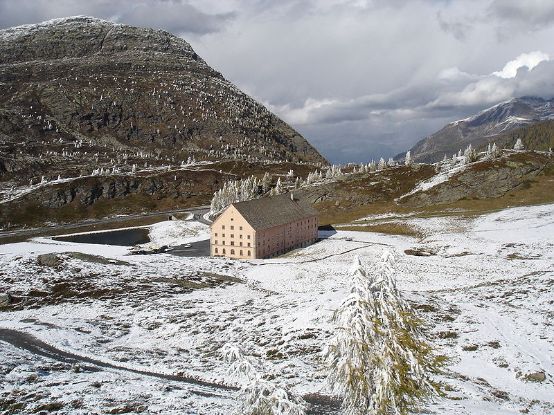
A British family of musicians died in the small plane that crashed near the Simplon Hospice last Sunday.
Music newspaper editorial office
(translation: AI)
- Aug 28, 2019
Surroundings of the Simplon Hospice. Proof see below
According to a statement from international media reports, the dead are the saxophonist Hannah Marcinowicz, the composer Jonathan Goldstein and their seven-month-old daughter.
The cause of the crash is not yet known. The two were apparently flying from London to Troyes and Lausanne, with Italy as their destination.
Goldstein ran a company for advertising jingles and wrote music for theater and film. Hannah Marcinowicz performed as a soloist at the BBC Proms in 2005 and has worked with orchestras such as the London Symphony Orchestra and the Royal Philharmonic Orchestra.
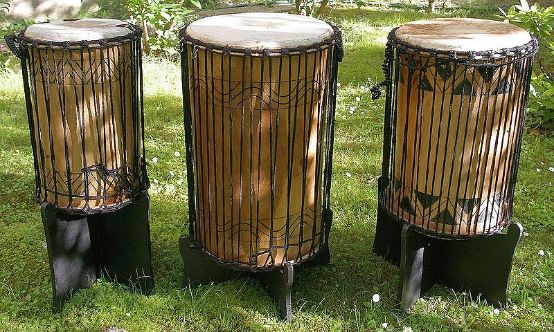
Modern pop songs are based on the musical principles of West African drum rhythms: An exhibition at the Ethnographic Museum of the University of Zurich shows how drummers from Ghana and Nigeria make their instruments speak and thus make themselves heard worldwide.
Music newspaper editorial office
(translation: AI)
- Aug 27, 2019
Set of three African bass drums from left to right: Kenkeni, Dundun, Sangbang. Proof see below
"Speaking with drums", the title of the exhibition, is to be understood literally: Drummers in West Africa use their instruments to imitate the rhythm and melody of spoken language. For example, those of the Yorùbá in southwest Nigeria or those of the Ashanti in Ghana - tonal languages in which the pitch of a syllable determines the meaning of a word.
At political and religious events, the percussionists greet guests of honor with their talking drums and quote their biographies; they recite prayers or proverbs; they talk about past events, take a political stand and thus mediate between current events and history.
Even during the colonial era and at the time of the transatlantic slave trade, drummers raised their voices and combined their music with influences from other musical cultures. This ultimately gave rise to styles such as jazz, soul, reggae and hip hop.
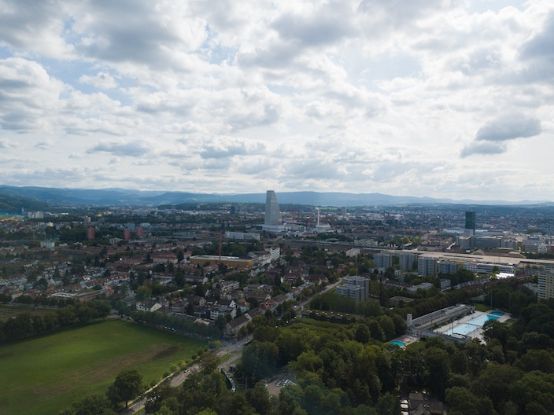
The governments of Basel-Stadt and Basel-Landschaft have referred the new cultural agreement and the parliamentary bills for the cultural partnership from 2022 to the Grand Council and the Landrat. It regulates the compensation paid by the Canton of Basel-Landschaft to the Canton of Basel-Stadt for cultural center services.
Music newspaper editorial office
(translation: AI)
- Aug 26, 2019
Photo: Odin Aerni / Unsplash (see below)
As in the previous cultural contract, the funds from the Canton of Basel-Landschaft are earmarked for cultural center services in the area of professional contemporary cultural creation. In future, the Canton of Basel-Landschaft will pay the compensation to the Canton of Basel-Stadt and no longer to individual institutions. The distribution of funds to the institutions will be carried out by the Canton of Basel-Stadt on the basis of criteria that will be set out in a contract.
Funding for the bi-cantonal specialist committees BS/BL will be based on full parity from 2022. The canton of Basel-Landschaft will increase its contributions to the joint specialist committees for literature, dance and theater as well as music. A newly established regional specialist credit for structural development BS/BL will enable the selective support of institutions, associations and festivals from both cantons for structural and organizational developments.
The German Orchestra Association (DOV) notes a greater potential for visitors and a growing demand for classical music than previously assumed.
Music newspaper editorial office
(translation: AI)
- Aug 22, 2019
Photo: Jonathan Poncelet/Unsplash (see below)
According to Gerald Mertens, Managing Director of the DOV, over 30,000 people are expected to attend the Berlin Philharmonic Orchestra's open-air concert at the Brandenburg Gate on August 24 under its new chief conductor Kirill Petrenko alone.
According to the DOV, 45,000 people attended the Opera for All with the Deutsche Staatsoper and the Staatskapelle Berlin on Bebelplatz in June 2019, 75,000 attended Luitpoldhain in Nuremberg, a further 50,000 attended the Nuremberg Symphony Orchestra in summer 2019 and almost 70,000 people attended Klassik airleben with the Gewandhausorchester Leipzig. 20,000 visitors are expected at today's hr-Sinfonieorchester Open Air in Frankfurt/Main.
However, according to the DOV, these several hundred thousand music lovers have not yet been included in any official attendance statistics, as admission to many large open-air classical music events is free. Even visitors to smaller professional classical music festivals or open-air concerts, concerts at music academies, many chamber music events, concerts in churches or at universities are not recorded statistically, explains Mertens. However, the available open-air attendance figures for this summer definitely show that there is a large potential audience for classical music - even beyond the summer season.
The Gstaad Menuhin Festival is the second largest music festival in Switzerland. Celebrities performed in various formations on the opening weekend.
Georg Rudiger
(translation: AI)
- Aug 21, 2019
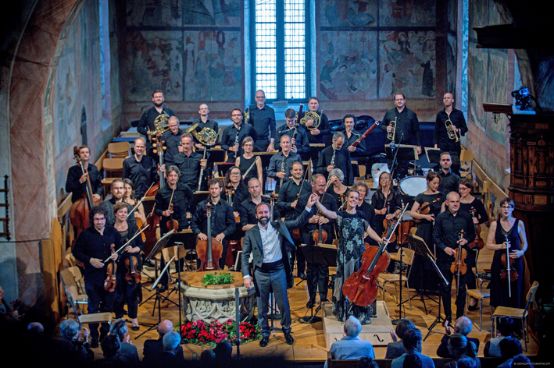
Concert on July 21: Sol Gabetta with Pierre Bleuse and the Basel Chamber Orchestra. Photo: Raphael Faux
The church in Saanen is filled to capacity. Even in the frescoed choir room, where a brown Bösendorfer grand piano stands, the audience is seated. As soon as András Schiff plays the first notes of Johann Sebastian Bach's cycle The well-tempered pianovolume 1, the concert audience becomes a devout congregation. Many of the 750 concertgoers have closed their eyes to listen to the Hungarian pianist's subtle art of interpretation. András Schiff is not someone who reinvents the wheel. He likes nuances more than contrasts, develops one from the other and pays attention to the natural flow of Bach's music. He only hints at the basses in the D major prelude, while he plays the E flat major prelude as freely as a fantasy. The fugues are not spelled out, but always told in a larger context. Schiff also discovers the melody in the counterpoint and maintains the tension in this long journey through the keys until the acclaimed end.
Most of the concerts at the seven-week Gstaad Menuhin Festival take place in the churches of the Saanenland, allowing a special closeness between the performers and the audience. Since Christoph Müller took over the festival founded by Yehudi Menuhin in 2002, audience numbers have tripled. This year, two new halls - the church and the multi-purpose hall in Lenk im Simmental - have been added to the total of eleven concert venues. But the enterprising artistic director has also founded various academies that train young musicians in the fields of singing, piano, strings, baroque performance practice and conducting. The juxtaposition of up-and-coming artists and stars, intimate chamber concerts and large symphonic performances in the Gstaad Festival Tent, which seats 1,800 listeners, is what makes this festival so appealing, according to the director of the second largest in Switzerland, which organizes around 60 concerts and has a budget of 6.7 million francs in 2019.
With only 120 seats, the chapel in Gstaad is a particularly small concert venue. As in the church in Saanen, the acoustics here are transparent and have hardly any reverberation, so that every musical detail can be followed. The hard pews demand a little asceticism from the audience at this one-hour morning concert - but it is rewarded. Franz Schubert's Sonata (Duo) in A major op. 162 is performed by Dmitry Smirnov and Denis Linnik with a simple tone and chamber music density. The two perfectly attuned young musicians lend Béla Bartók's rhythmically intricate first rhapsody the necessary colorfulness. Only in Robert Schumann's first violin sonata does one wish Dmitry Smirnov had a less pressed tone; the pianissimo opening of the second movement lacks mystery. But the weightless way in which the violinist at the top of the bow realizes the semiquavers at the beginning of the finale, with Denis Linnik at the piano following him like a shadow, rightly delights the audience.
Festival motto Paris
The Saturday evening concert on the opening weekend reflects this year's festival motto in its program and line-up. Hervé Niquet has come to Saanen with his original Parisian ensemble Le Concert Spirituel to present music by the baroque composer Marc-Antoine Charpentier. With the festive sounds of the overture to Le Malade imaginaire Niquet begins the well-attended evening before giving a short introduction to the time of the Sun King in French. In German-speaking countries, Charpentier is only known for his Te Deum taken from the Eurovision anthem. When the choir and orchestra, as in the motet In Honorem Sancti Ludovici regis Galliae Canticum in fortissimo, the acoustics in Saanen church, which are ideally suited to chamber music, reach their limits. The brass bangs, the timpani roar. But apart from the overly sharp sound peaks, this predominantly homophonic music unfolds great charm, even if it is hardly dramatic. The many tonal contrasts in the motets and the alternation between the well-balanced choir and the slender vocal solos are well differentiated. The concluding, entirely dance-like Te Deum shows the sensual splendor of the French court.
The following evening, Sol Gabetta will also be performing the second cello concerto by Camille Saint-Saëns, a rarely performed work by a French composer. The Argentinian has been a regular guest in Gstaad since 2003. Her bright, flexible cello tone is well suited to the light solo concerto. The Basel Chamber Orchestra, conducted by Pierre Bleuse, provides attentive and attentive accompaniment. Bruno Soeiro's four-movement composition Sillages, Sons de Parfums unfortunately lacks musical substance. However, it is also due to the lack of sophistication in the interpretation that the clouds of musical fragrance in this world premiere are not seductive. In Georges Bizet's Symphony in C major, on the other hand, the Basel Chamber Orchestra is on familiar ground. The warm string sound is enchanting, the agile woodwinds have grace. And the orchestra turns the virtuoso finale, reminiscent of Mendelssohn, into a real charm offensive.
The 3rd Bern Cultural Forum will take place on Monday, August 26, 2019. It marks the start of the participatory process for developing the 2021-2024 objectives and measures of the city's cultural strategy.
Music newspaper editorial office
(translation: AI)
- Aug 20, 2019
Photo: Mike Petrucci / unsplash (see below)
The 2017-2028 cultural strategy is the result of close collaboration between cultural stakeholders, politicians and the administration, writes the City of Bern. It was developed in a participatory process and, in addition to the concerns of the professional cultural sector, the demands of children and youth culture, cultural mediation, integrative and inclusive culture, the creative industries, neighbourhood organizations, cultural tourism and amateur culture were also taken into account.
In order to implement the strategy, objectives and measures will be developed for four years at a time. The 3rd Bern Cultural Forum marks the start of the participatory development of objectives and measures for the years 2021-2024.
After the forum, interested parties will have the opportunity to submit their concerns and suggestions at "cultural strategy afternoons" on September 16 and October 16 or directly to the administrative offices.
According to Katharina Rosenberger, Professor of Composition at the University of California San Diego, the Swiss composer Dominique Schafer, who lived in the USA, has died following a serious illness
Music newspaper editorial office
(translation: AI)
- Aug 19, 2019
Excerpt from the CD cover "Vers une présence réelle ..." Dominique Schafer, Ensemble Proton Bern
Born in 1967, Dominique Schafer, who has been honored with countless awards, studied composition at Harvard University and the University of California, Los Angeles. He was particularly inspired by Paul Reale, Mario Davidovsky, Bernard Rands, Magnus Lindberg, Julian Anderson, Helmut Lachenmann, Brian Ferneyhough and Chaya Czernowin. He himself taught composition at Harvard University and the University of Rhode Island. Most recently he taught at Chapman University in California.
In Switzerland, Schafer's work is primarily cultivated by the Bernese ensemble Proton. The collaboration began in 2014 with his work "Vers une présence réelle...". The ensemble recorded a portrait CD for the Kairos label. In 2018, Ensemble Proton also realized a portrait concert in his honour.
Four commissioned compositions for a milestone birthday
The aulos Symphonic Wind Orchestra from Switzerland is celebrating its 30th anniversary and is giving itself a special gift: four commissioned compositions. In addition to three works by Swiss composers, the "Aulos Symphony" by José Suñer-Oriola will be premiered in the fall.
Music newspaper editorial office
(translation: AI)
- Aug 17, 2019
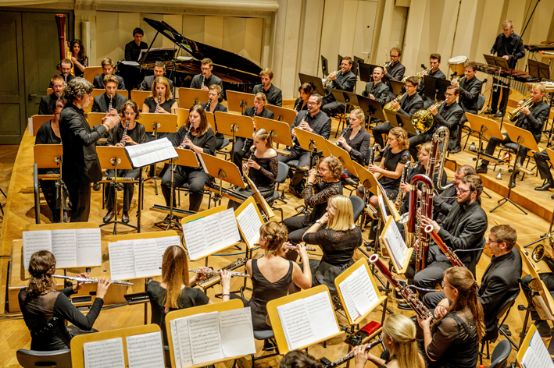
The aulos cast 2018. photo: R. Bollinger, bolliret@bolliret.ch,SMPV
The ensemble has also been well-known in the European wind music scene since the Dutchman Johan de Meij conducted the aulos on its 20th anniversary ten years ago at the latest. In recent years, the orchestra has worked with renowned conductors such as Ivan Meylemans (2017), José Rafael Pascual-Vilaplana (2012 and 2015) and Jan van der Roost (2014) and has regularly premiered works composed especially for the orchestra. Bert Appermont (2011, Symphony No. 2 Golden Age), Thomas Doss (2013, Horn Concerto Gjallarhorn) and Oliver Waespi (2015, Out of Earth) have written for the aulos. After a break of three years since the last commissioned work (Olivier Truan 2016, tuba concerto Second Wind), the aulos management has now commissioned the three Swiss composers Benedikt Hayoz, Daniel Schnyder and Fabian Künzli to each compose a work of around 10 minutes in length. But that's not all. The second part of the concert includes another commissioned work whose title more than does justice to the occasion. The Spaniard José Suñer Oriola has entitled his 4th Symphony quite simply Aulos Symphony baptized.
The creation of an orchestra
José Suñer-Oriola is one of the most promising young Spanish composers. He is a professor at the Valencia Municipal Wind Orchestra and conductor of the Albuixech Wind Orchestra. His compositions are played in many countries in Europe and America as well as in Australia, Japan and China.
As the name suggests, Oriola's 4th Symphony revolves around the aulos - in at least two respects. The main theme is a play on the letters of the word "aulos". Oriola has also based the theme on the orchestra. The first movement is dedicated to the birth and development of the orchestra, while the creative creation of ideas is musically realized in the second movement. After a calm third movement, the final movement is dedicated entirely to the festive occasion for which the symphony was written. As a tribute to the orchestra's origins, the composer has even included a reference to a traditional Swiss song.
The aulos is a project orchestra with around 70 members who come together for an annual concert tour. The semi-professional orchestra consists of around 70% professional musicians and music students. The aulos is only able to cover the large financial outlay for its elaborate projects thanks to the support of its own members and many private and public donors. A crowdfunding campaign was even launched for the anniversary, successfully raising the money for Oriola's symphony. For long-time aulos President Caroline Krattiger, the ensemble is "an affair of the heart", as she says herself. She has been involved in the organization with great dedication for 20 years and has also worked as concertmaster for many years. "I'm really looking forward to the double anniversary and am very proud of the development of the aulos. It's not often that a wind orchestra is allowed to premiere a symphony named after it".
Recycling with a difference
For the aulos music commission, it was important to find a good mix between well-known and unknown composers and between Swiss and foreign composers when selecting the composers for the commissioned works, says Caroline Krattiger. Three local artists were commissioned with shorter works and Oriola with the symphony. Benedikt Hayoz from Fribourg came up with an unusual theme for his composition. In his approximately 10-minute work Recycling as the name suggests, music is recycled. Hayoz uses existing music - music that he likes and inspires him - as material to create something new. The sequences were rearranged and cast in a new musical form. The original is sometimes more recognizable and sometimes less. With this work, the composer wants to show how different musical styles and characters can be brought together to create something new that can also be perceived as a unity. The first of the two movements deals with a highly topical subject: the speed of digitalization. According to Hayoz, the second, calmer movement is a plea for the concerto. Hayoz also plays with tonal effects. For example, he will have several clarinet quartets play a chorale "off-stage" in the concert hall.
Two more Swiss compositions
In addition to Hayoz, the young composer Fabian Künzli and the already internationally renowned Daniel Schnyder have also written a work. The latter has chosen an animal as the model for his commissioned work. The Elephant This is represented by the low instruments. According to the composer, the work is rhythmically very heavy and has Latin American and African roots. The aulos also contains jazzy elements. Schnyder, who has lived in New York for many years, is one of the most frequently performed Swiss composers of his generation. The integration of different musical styles - from jazz to classical and new music - is an important feature of Schnyder's work. In the field of wind instruments, he has written solo concertos for bass trombone and trumpet, among others.
Unknown in comparison to Schnyder, but no less promising is the young composer Fabian Künzli from eastern Switzerland. He has a special connection to the aulos, having been an active orchestral musician himself for several years. In his work Prism he wants to fan out the music, similar to the fragmentation of light in an optical prism. According to the composer, the focus is on transformation, the growth of new ideas from existing ones. Künzli also works with microtonality in his composition.
Under Swiss management
After mostly inviting foreign guest conductors in recent years, this year the aulos is playing under the direction of a Swiss conductor. "This was also a conscious decision by our music committee," says Caroline Krattiger. "After the last ten years with many international conductors, we deliberately wanted to go 'back to the roots' and opted for a Swiss conductor in 2019." And so Blaise Héritier, who conducts the top-class wind orchestra from Siebnen, will be at the conductor's desk for the anniversary. He currently also conducts the Ensemble de Cuivres Jurassien and the Ensemble Vocal EVOCA, a symphonic choir with 80 singers. Héritier is President of the Music Commission of the Swiss Wind Music Association and is dedicated to orchestrating classical and contemporary works for wind instruments and percussion. In 2013, he was even appointed ambassador for the canton of Jura.
This year's soloist David Rufer (trombone) is also from Switzerland. Harvest by American composer John Mackey is the only work in the concert program that will not be premiered, but it is no less worthy of mention. It is performed by a relatively small ensemble and deals with the myths and mysterious rituals surrounding the Greek god of wine, Dionysus. Rufer from Thurgau has been a member of aulos for many years and regularly plays in various Swiss orchestras such as the Bern Chamber Orchestra and the Sinfonietta Schaffhausen. He also played under Pierre Boulez in the orchestra of the Lucerne Festival Academy. After this high-quality concert program in 2019, the scene can look forward to the further development of aulos. According to Krattiger, the aim is to be able to continue commissioning compositions in the future. "This is always a huge financial challenge for us," she says. But the anticipation of unforgettable concert moments makes up for all the work. We can only hope that this drive will remain with the orchestra for the next 30 years and beyond.
The 2019 concert tour
In its anniversary year, the aulos plays four concerts throughout Switzerland.
The concert tour starts at the end of the rehearsal week in Visperterminen VS (multi-purpose hall; Friday, October 4 at 7:30 pm). The orchestra has been a guest in the picturesque Valais mountain village for 25 years.
Further concerts:
St. Gallen SG (Tonhalle; Sunday, October 6 at 5:00 pm),
Solothurn SO (concert hall; Saturday, October 12 at 19:00) and
Emmen LU (Le Théâtre; Sunday, October 13 at 5:00 pm).
Admission to the concert costs CHF 30, CHF 25 for students. Admission is free for concertgoers up to the age of 16.
Advance booking via www.eventfrog.ch will be granted a discount of 5. on the ticket price.