Smartphone replaces CD as sound carrier

One in three people in Switzerland no longer prefer to listen to music in the traditional way. Moreover, nine out of ten users of music streaming services such as Spotify or Internet radio do not pay to listen to music. These are the findings of a representative survey commissioned by comparis.ch.

Photo: Ingo Bartussek - Fotolia.com

In 2013, Swiss people listened to music more often on their smartphone or computer than on a CD player. This was revealed by a survey of around 1,200 internet users conducted by the Link Institute in November among people aged between 15 and 74.

14% of respondents most frequently listen to music on their cell phone or smartphone. Together with computers, MP3 players and tablets, this results in a share of 32%, i.e. a good third of Swiss people. Only 9 percent of respondents listen to music most often on a CD player.

Moreover, users of online services are hardly willing to pay to listen to music. Streaming is always or mainly used by 93% of respondents without paying. The figure for internet radio is 91 percent. Download services are the most likely to be paid for: 45% of users say they pay for them.

However, there are certain question marks over the future viability of this model, says Comparis. Young Swiss people are also not very willing to pay for download services. In the age group up to 29 years, only 25 percent of users of Internet music services always or mainly pay, compared to 56 percent of people aged 30 and over.
 

Jürg Frey's psychological art

These subtle piano sounds, sensitively realized by R. Andrew Lee, bring time to a standstill.

R. Andrew Lee. Photo: zvg

Good musicians know that fast runs or massive chord leaps are not difficult. What is difficult is being discreet and unobtrusive. Jürg Frey from Aargau cultivates both. His carefully selected sounds seem to take on a life of their own without any major intervention by the composer. It sounds highly abstract, perhaps even sterile to some ears. But once you have listened to it, once you have sat down with good headphones and a glass of whiskey, as the booklet author William Robin recommends, you will be rewarded with the highest and most sympathetic art.

The two pieces fill just over an hour. It has been known since Henri Bergson at the latest that time is relative. When Frey in his Piano piece 2 fills the time with the repetition of a fourth in the form of 468 beats, then it sounds as little like avant-garde as it does like special events. But what is special happens in the mind. Karlheinz Stockhausen or Bernd Alois Zimmermann have dealt with questions of time in a very theoretical way. Frey does this in his own way. Undogmatic, straightforward, highly concentrated, time comes to a standstill. The constant coming and going, sounding and fading away is ultimately compositional and psychological art.

Jürg Frey found a congenial partner in the pianist R. Andrew Lee. He combines the highest sensitivity of sound with the necessary balance between freedom and control. This CD, with an excellent (English) booklet and a cover that wonderfully matches the music, is recommended to anyone with good headphones. Because there is one thing this delicate music cannot tolerate: interference from an excessively loud environment.

Image

Jürg Frey: Piano music (Piano piece 2, Les tréfonds inexplorés des signes pour piano 24-35). R. Andrew Lee, piano. Irritable Hedgehog Music IHM 006

Music is good for you

An inspiring overview of early childhood music education, from the first Swiss music daycare center to educational concerts. Report from the Lucerne conference "Learning music from an early age".

© Westend61 - Fotolia.com

How must educational experiences be designed so that children's individual potential can unfold? This is the core question of any educational endeavor, and it was also the core question of the lectures and workshops at the Lucerne symposium Learning music from an early age. Over a hundred instrumental teachers came to expand their knowledge, to get ideas for their daily work or to finally hear how best to work with very young children. Almost all of them - and this was discussed controversially during the coffee breaks - identified deficits in their professional training in this area.
After "jumping into the deep end" of teaching, many of the participating instrumentalists felt the need to deepen their pedagogical knowledge. In contrast to various CAS courses at Swiss universities, the Lucerne conference offered a concentrated, yet extremely broad and time-limited range of approaches, topics and case studies on early childhood music education with lectures and workshops.
The first task was to reflect on the current teaching situation. The Lucerne host Walter Hess noted that children today spend significantly more time in daycare centers than in small families. To what extent this means that there is still room for early childhood instrumental lessons at all or whether instrumental teachers should instead find their way into daycare centers and schools remained an open question.

Babbling ...
Even toddler caregivers can encourage children's natural interest through a conscious approach to music, as Stefanie Stadler Elmer from the Institute of Psychology at the University of Zurich explained. She showed how closely language development and learning to sing are linked. During the first year of life, the two are indistinguishable; the child's vocalization - the typical baby babble - sometimes tends more towards imitation of syllables, sometimes more towards intonation of different pitches and melodic connections. It is not until the second year of life that the child learns to distinguish between the two modalities, whereby imitating melodies is much easier than imitating syllables. The regularity of singing is much more in line with the natural perceptual and production abilities of infants and toddlers. Daycare centers should therefore offer their children a wide range of listening activities and incorporate voice, motor and sensory skills in equal measure. According to Stadler Elmer, even a one-day training course could result in educators becoming much more aware of the songs and musical rituals that can usually already be found in daycare centers. She has made concrete suggestions in her book Child and music which will be published in 2014.

... romp ...
Movement scientist Renate Zimmer emphasized how fundamental it is for children to find access to music through their own bodies. Her book Romping around makes you smart! alludes to the theory repeatedly expressed in the media that music makes you smart. Zimmer used numerous images to show that both stimulate the formation of synapses in children - and thus, to put it casually, make them "smart". Zimmer referred to anthropology, which sees humans as beings who are designed for movement and experience and who require the use of all their senses in order to form an image of the world and themselves. For children, this means that education must be an active process in which the child experiences its own self-efficacy. Self-will and stubbornness shape the child's basic attitude; both must be encouraged and challenged in the educational process. For example, a child should be able to find out for themselves whether they can hit the table with a peach just as sonorously as with a rattle. It is the intensive experience of all the senses that makes for effective learning. Zimmer did not deny that this also requires guidance from adults - after all, education is also a social process. However, awareness of the circumstances is fundamental. She recommended that the instrumental teachers present should not answer the frequently asked question about their profession with: "I teach violin." But rather: "I teach children."

... and play
Madeleine Zulauf from the Musique Recherche Zulauf formation showed how instrumental lessons can be enriched in concrete terms. She noted that the pedagogical use of playing is very widespread in kindergarten, but is hardly ever found in early childhood instrumental lessons in the sixth and seventh years. Even the youngest children learn traditionally how to reproduce given music. The didactics focus strongly on imitation and repetition and neglect the development of skills to develop their own musical language. This is where playful improvisation could be integrated into instrumental lessons. Zulauf showed examples in which young children are encouraged to musically accompany a picture book story with the instrument of their choice. It is important for the child to be provided with different instruments or sound generators and for the adults to appreciate the musical production. Instrumental teachers can then accompany these lessons by recording, listening and self-analysis by the child; they can introduce musical terms on the basis of the improvisation and encourage notation of the improvisation.

Improvisation was also used again and again in the subsequent workshops: be it as a rhythm game in the workshop Interactions of elementary musical experiences through movement in rhythmics by Sabine Hirtler from the Technical University of Kaiserslautern, be it as a musical response to a Ligeti piece in the workshop Between concert and education project: educational concert events with children, young people and a young audience with Barbara Stiller from the University of the Arts Bremen. Andrea Holzer-Rhomberg presented her string school Fiddle Max in which playing with magic sounds, the spirit of the bow and journeys to ear-tip land are elements of holistic learning, and Susan Young from the University of Exeter drew attention to the diverse everyday musical experiences and activities of children.
In the concluding panel discussion, the question was asked how parents could be persuaded to make music in early childhood. In addition to all the scientific studies that have now proven the benefits, Aron Braun, Managing Director of Musikalische KiTa Zimballothe first and so far only music daycare center in Switzerland, explains the reason for his commitment: "Because music is good for you."
 

Mullbau from Lucerne honored

Six productions for young ears received awards at the Gewandhaus in Leipzig on November 21, 2013. Among them in the LabOhr category was "Mullbau" by the Lucerne artists' collective of the same name.

© www.mark-bollhorst.de

In the category Best Practice, Concert was awarded to the Theater Kontra-Punkt from Düsseldorf for its production You are here, you are gone awarded. The contemporary musical theater piece deals with serious themes such as death, grief and jealousy.

Award winner in the category Best practice, participatory project was The Magic Flutean exemplary cooperation project between the Porta Nigra School for pupils with special needs and the Trier Theater.

The category LabEar saw two winners this year: the two nominated projects The listeners by the Theaterwerkstatt Pilkentafel (Flensburg) and Gauze construction by the Lucerne artists' collective of the same name (the SMZ reported) shared the prize. In The listeners sound researchers invade everyday school life and turn the classroom upside down with a surprising eavesdropping attack. The Mullbau is a socio-cultural space for improvisation that has won awards for its children's concert series.

An above-average number of applications were received this year in the Music & Media award. The jury selected the project Tracking 2.0 as the prize winner. This project by the Swabian Education Center Irsee, which took place as part of the 2013 Tonspuren festival, combines young people's fascination with technology with the creative exploration of self-composed sounds and noise collages.

The focus of the young ears award this year was on the category Music & Media. Not only did the specialist conference Perspective: Music and media The following day, the topic was the use of media in music education. A children's jury also met for the first time in the run-up to the award ceremony, awarding its own prize in this category. The unendowed special prize of the children's jury went to What does history sound like? In search of traces in Municha Audio images-project by Bayerischer Rundfunk, the Listening Foundation and the Bavarian State Center for Political Education. Young people explored various topics of the Nazi dictatorship in a journalistic and musical way, for example euthanasia, child transports and displaced persons.
 

Takahiro Sakuma wins the FIMS composition competition

At the 12th composition competition of the International Festival of Sacred Music (FIMS) in Fribourg, the Japanese composer Takahiro Sakuma was awarded a prize, while the Swiss composer Bo Wiget and the Japanese composer Isamu Tachihara received special mentions.

Bo Wiget's composition "Odem" received a "Special Mention". Photo: © www.bowiget.com

The jury was chaired by Thüring Bräm (CH) and included Dieter Ammann (CH), Philippe Ferro (F), Jean-Pierre Chollet (CH) and Akemi Naito (Japan/USA). On November 24, the jury selected the best works from 47 compositions for wind instruments. The prize of CHF 10,000 went to 41-year-old Japanese composer Takahiro Sakuma for his work Asteroid Belt. The play will be performed as part of the 15. FIMS premiered in Fribourg on July 6, 2014 by the HEMU wind orchestra under the direction of Philippe Ferro.

The following works received a "special mention" (honorable mention): A Prayer XXI" by the Japanese artist Isamu Tachihara and Odem from Bo Wigetthe cellist, composer, performer and director, who was born in Wattwil in 1971 and now lives in Berlin.
 

Return of the large forms

At the Donaueschingen Music Festival from October 18 to 20, works were premiered whose common feature is their extended duration.

Rehearsal for «Registre des lumières» by Raphaël Cendo for 19 instrumentalists, live electronics and 30 singers. Photo: Tilman Stamer/SWR

Large-scale form, a favorite phenomenon of the late Romantic music world, was largely rejected by young musicians at the beginning of the 20th century. When musical structures became so complex and fragile with the early twelve-tone technique, for example in Anton Webern's music, the composer settled for pieces lasting a few minutes. In more recent times, pieces of around an hour in length have appeared time and again. Armin Köhler, program director at SWF and in particular for the Donaueschingen Music Days, has been trying for several years to base the programs on a specific theme. This year, it is the new large-scale form, in all parts of the program, including the installations.

Fundamental problems

The problem of the large-scale form: to keep the audience interested again and again and yet to create a uniform large-scale form. This was demonstrated by the two pieces on the first evening with the large SWR Symphony Orchestra Baden-Baden and Freiburg under the joint direction of Pascal Rophé, Wolfgang Lischke and Christopher Sprenger. Bernhard Lang works in his Monadologies - This was about the 13th, called "The Saucy Maid" - with motif repetitions and their changes, in a mechanized structure that quickly becomes boring due to the eternal repetitions. The fact that the second orchestral formation, which is positioned behind the audience, is tuned a quarter tone lower does not help much and is lost in the massive overall sound, where sound surface units are shifted against each other. This is quite different with Walter Zimmermann in his Suavi Mari Magno Clinamen I-VI for six orchestral groups, distributed around the audience and held together by several conductors and TV broadcasts of the main conductor via monitors. Canons are joined together in close proximity, but everything is constantly in motion, with lots of imagination, jumping back and forth.

Fascinating and frightening at the same time Memory for large ensemble (Klangforum Wien) by 44-year-old Sauerland composer Enno Poppe, in which a calm four-four time signature is conducted, but the notes always roll down after the beat, their sequence probably defined by the computer. The composer has the instruments constantly screaming in excessive high registers, for 71 minutes in an unbelievable frenzy, and all with the highest precision, like clockwork. This sound event is fascinating, but at the same time you feel sorry for the musicians who have to play incessant sheaves of notes that simply have to be practiced so that they can be called up without thinking. It seems inhuman what the daggy red-haired composer as conductor can conjure up incessantly, dancing with ease.

Various composition techniques

The Greek composer Georges Aperghis, who lives in France, composes in a comparable way. With him, the cascades of sound begin on the conductor's beat (Emilio Pomàrico conducted the Klangforum Wien this time), often creating almost a sense of meter, and he loosens up the overall flow of the Situations for 23 soloists with children's verses, solo interludes, sound duels between the two pianists etc. and texts of a philosophical nature spoken by one pianist (such as «You make a choice between what can be said and what you keep quiet about forever ...»), whereby some things are lisped in such a way that you deliberately don't understand anything. Consequence: the 54-minute piece is always exciting, but falls apart a little formally.

The 61-year-old Frenchman Philippe Manoury has worked with In Situ for orchestra and ensemble, the fifth comparable large-scale work. Here, the 20-piece Ensemble Modern sits at the front, with the SWR Symphony Orchestra surrounding the audience. Manoury composes in the French tradition, which has roughly the same number of notes per second, but not all at the same time, jumping from formation to formation, also with the conductor (here the house conductor Xavier Roth) on different television monitors. But traditional sound concepts still prevail here, often in small groups of figures separated by pauses (Boulezian fermatas). All five works were of course performed for the first time, and all of them received incredibly precise and well-differentiated performances.

Further options

Of course, the four other compositions were also world premieres, which fell somewhat into the background alongside those mentioned. There was the Registre des lumières by Berlin-based 38-year-old French composer Raphaël Cendo for 19 instrumentalists, live electronics and 30 singers (Ensemble musikFabrik from Cologne, the SWR Vokalensemble Stuttgart and IRCAM Paris) on ancient texts. The work produces exclusively primal hissing and rumbling, completely without beat or meter, with almost exclusively unusual playing styles on the orchestral instruments; the choir never sings, it whispers and murmurs. For the choral sections of the 43-minute performance, it would have been absolutely essential to be able to read along with the text, which was printed in full in the program booklet. This would have required full concert lighting, but in Donaueschingen, unfortunately, a kind of television lighting is always practiced, in which the performers are in the spotlight and the audience sinks into darkness!

Alberto Posadas has worked with Kerguelen created a triple concerto for a trio of amplified woodwind instruments and orchestra. Kerguelen is the name of a small island in the southern Indian Ocean, and the trio of soloists is intended to lie like a «plateau» above the overall sound. Sound surfaces dominate the picture, made possible by constant trills and tremolos, rising and falling. But this alone soon becomes boring, and the trills soon become annoying. And finally, Bruno Mantovani wrote his Cantata No.3 for choir and orchestra on Schiller texts in such a conventional and stale style that massive booing was inevitable. It remains to mention a very beautiful, 18-minute, purely electronic piece by Hèctor Parra, born in Barcelona in 1976. I have come like a butterfly into the hall of human life is very tastefully made, but in the style of the 60s.

Freely accessible

Kirsten Reese and Enrico Stolzenburg created a sound installation together under the title Debate a very long radio play that could be listened to in parts in the town hall. And Georg Nussbaumer took Ring landscape with beer stream takes Wagner's Ring, one of the most famous large-scale forms, for a ride: in the Brauereisaal (Fürstenberg Bier), eight string players with headphones follow the entire Ring (15 ½ hours here) and play out the important themes using piano scores and, as an interlude, they sweep over the whole strings or play slow glissandi. They play high up in the very high hall on tubular scaffolding hung with all kinds of costumes; slides and lots of fog in the room ironically create the right atmosphere: a successful joke. It was very pleasant this year that the program sequences allowed a little more time for reflection, i.e. they were no longer as hectic as usual.

Last year, the state of Baden-Württemberg decided that the SWR Symphony Orchestra Baden-Baden and Freiburg should merge with the Stuttgart Radio Symphony Orchestra by 2016. Of course, this has given rise to much discussion, a protest march through Donaueschingen was organized, buttons were distributed and short speeches were made in the concerts between pieces, but officially there is still no solution to prevent this catastrophic disaster.

Music must shake things up

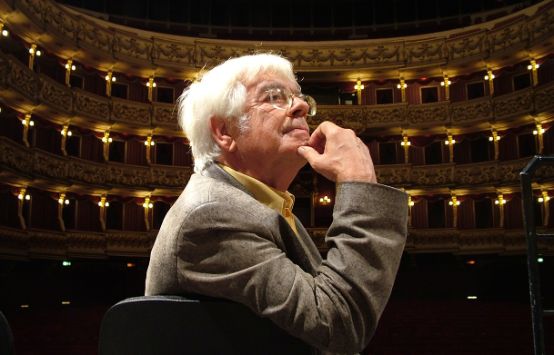
Book review: In sparkling conversations, we gain an insight into the eventful life of the Bach specialist, conductor and music teacher Helmuth Rilling.

Photo: Holger Schneider

Rilling answers the skillful questions of the publicist and dramaturge Hanspeter Krellmann in such a lively and detailed manner that an exciting flow of reading is created, interspersed with photographs. After the introduction to the still active present of the octogenarian and his attitudes towards consistent fidelity to the score and proximity to the audience (Conversation concerts 2013), we learn of courageous decisions and lucky coincidences (Germani, Bernstein) during his student days and of his smooth transition into professional life as organist and director of the Gächinger Kantorei. Thanks to his communicative talent and inspiring initiatives, door after door opened. He escaped the precarious conditions of the post-war period and soon gained influence beyond Stuttgart with his consistent art of leadership, which involved everyone in the music scene.

The result is immense: Performances of all Bach works, concerts by the Bach-Collegium throughout Europe, a nine-page discography, the International Bach Academy in Stuttgart with research, publication and concert activities and one of the best-stocked Bach libraries, Bach festivals created by him worldwide, especially the one in Eugene, Oregon (USA), which has existed since 1970, Oregon (USA), many successful choir conductors who studied with him at the Hochschule in Frankfurt, the international oratorio weeks with young people and the week-long Bach academies around the world (Leipzig, Prague, Moscow - across the Iron Curtain! - Santiago de Compostela, Tokyo, Caracas), oratorios by Penderecki, Sandström, Pärt, Gubaidulina, Tan Dun, Golijov and Rihm, all commissioned by him.

Johann Sebastian Bach is at the center of Rilling's work. Early on, he decided on a self-created middle position for his interpretation between the Romantic style with a large amateur choir and orchestra that has been common since the 19th century and the original sound movement that has been emerging since 1950; his aim is to make the composer's intentions audible, which he explores through intensive score analysis: "Music must never be comfortable, not museum-like, not appeasing. It has to shake people up, reach them, make them think." He also turned his attention to many other composers of all times, but only to works that met these criteria.

The many statements about the working methods at rehearsals, conducting, dealing with the text, the use of women's voices, boys' voices or countertenors, Bach's various creative phases are valuable ... It is hardly possible to list everything one takes in while reading! It's a pity that the appendix lacks subject and composer indexes, because the need to look something up later is great.

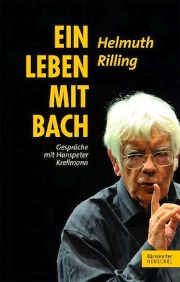
Image

Helmuth Rilling A life with Bach. Conversations with Hanspeter Krellmann, 216 p., € 24.95, Bärenreiter/Henschel, Kassel/Leipzig 2013 ISBN 978-3-7618-2324-8


Highlights and quotes from the book, selected by Walter Amadeus Ammann:

The freedom of the contemporary

Philippe Bach conducts several orchestral formations in Switzerland and Germany. Although he likes to include Beethoven and Brahms in his programs, he is particularly fascinated by the music of the 20th century and today's composers.

Meininger Hofkapelle with GMD Philippe Bach. Photo: Rolf K. Wegst
Die Freiheit des Zeitgenössischen

Philippe Bach conducts several orchestral formations in Switzerland and Germany. Although he likes to include Beethoven and Brahms in his programs, he is particularly fascinated by the music of the 20th century and today's composers.

Philippe Bach was born in Saanen in 1974; he studied orchestral conducting in Zurich and Manchester. He has been General Music Director of the Meininger Hofkapelle and the Südthüringisches Staatstheater Meiningen since 2011. He has also been chief conductor of the Zug Sinfonietta since 2009 and the Bern Chamber Orchestra since 2012. He has made guest appearances at the Teatro Real de Madrid and the Hamburg Opera, as well as with the London Philharmonic Orchestra, the BBC Philharmonic Orchestra, the Helsinki Philharmonic Orchestra and the Royal Scottish National Orchestra.

Laurent Mettraux: The Bern Chamber Orchestra (BKO) regularly commissions compositions and premieres works. How does this benefit the musicians of the orchestra?
Philippe Bach: Performing new music by Swiss composers has been an important part of the BKO's programs from the very beginning. I think this is a wonderful tradition that should definitely be continued. The exchange with living composers is extremely inspiring for me as a conductor and for the orchestra and makes a wonderful change, as we classical musicians mostly have to deal with music by deceased composers. I miss the pride in our composers in Switzerland. Martin, Honegger and Schoeck are held in high esteem all over the world, but very little of their music is played in Switzerland because it is said to be difficult to sell the concerts. But if we don't look after our composers, this won't change. I hope that one day they will be as well established as Sibelius in Finland or Elgar in England.

You have recently been appointed General Music Director in Meiningen. What is it like to hold a post so steeped in tradition? And do you plan to perform pieces that have been written for this orchestra over the course of its 300-year history?
Meiningen is really something special, there is the quote from Mahler: "Normally there is a town with a theater, but Meiningen is a theater with a town." Although the town only has around 25,000 inhabitants, around 160,000 people come to the theater every year, so the town lives from the theater. This positive atmosphere is naturally transferred to all employees and especially to the musicians of the Meininger Hofkapelle, who have a great love of playing. Great conductors have left their mark. Conductors such as Bülow, Strauss, Steinbach, Reger and, more recently, Petrenko, Buribayev and my predecessor Hans Urbanek have done great work. Of course, we regularly play Brahms' Symphony No. 4 and Reger's Mozart Variations, which were premiered in Meiningen, but we also perform works by lesser-known composers such as Wilhelm Berger and Günter Raphael. In addition, we have always cultivated and maintained contact with contemporary composers, especially during the GDR era. History must live on. Both the musicians and the audience are aware of this, which is why we play a relatively large amount of new music compared to other German orchestras.

The works you have conducted reveal a particular interest in the 20th century. What is it that particularly attracts you?
Of course I like conducting Beethoven and Brahms, but I also like Bartók or Adès. I think it's very important that the orchestral musicians are really challenged from time to time, which is not the case with all groups in the classical-romantic repertoire - I'm thinking of the percussionists, for example. I feel very free in this repertoire, because no orchestral musician (or critic) has a preconceived opinion, you are then much less exposed to the various expectations and can let your imagination run wild. I also find it very exciting at the moment, because you can no longer say that this is how people compose today, there are so many different trends in new music.
 

Kategorien

First dissertation of HKB research

The 32-year-old literary scholar Johanne Mohs has completed her doctorate as part of a Swiss National Science Foundation professorship on the subject of intermateriality. This means that UAS research in Bern is also positioning itself in the third cycle of academic education.

Photo: Joachim B. Albers - Fotolia.com

In her dissertation Photographs and attributions - literary modes of writing the photographic act in Flaubert, Proust, Perec and Roche Johanne Mohs has examined literary discussions of photography since its invention by Louis Daguerre in 1839.

Using three examples, she was able to show how in the mid-19th century with Gustave Flaubert, at the beginning of the 20th century with Marcel Proust and in the 1960s and 1970s with Denis Roche and Georges Perec, important representatives of French literary history transferred photographic recording principles to their writing.

As part of the Intermateriality Professorship, which the literary scholar and concert flutist Thomas Strässle brought to Bern University of the Arts (HKB) in 2009, the conference proceedings edited by Strässle, Christoph Kleinschmidt and Johanne Mohs and published by transcript-Verlag have also been published. The interplay of materials in the arts. Theories - Practices - Perspectives published.

Mineral echo

For years, stone was Rudolf Fritsche's working material. He came to elicit sounds from it rather by chance. It was a quest that would not let him go. He built several stone instruments, and his lithophone inspired Pierre Boulez. It has not yet gained a foothold in musical life.

The gramorimba. Photo: Kaspar Ruoff
Mineralischer Widerhall

For years, stone was Rudolf Fritsche's working material. He came to elicit sounds from it rather by chance. It was a quest that would not let him go. He built several stone instruments, and his lithophone inspired Pierre Boulez. It has not yet gained a foothold in musical life.

About twelve years ago Rudolf Fritscheto explore the sound of different types of stone and build his first percussion instrument. His gramorimba is the only lithophone whose plates are tuned to both the fundamental and overtone. He later added a stone gong and a stone egg to his instrumentarium. He is a sound therapist, arranges pieces and plays gramorimba in duo with flute and in trio with flute and cello. This spring, the last composition by the late Gion Antoni Derungs was premiered by the Collegium Musicum Ostschweiz: In the fairytale castleThree scenes for flute, gramorimba and string orchestra, a work commissioned by Rudolf Fritsche.

Read the interview in the printed edition of the SMZ 12/2013.

Image
Rudolf Fritsche at the stone gong
Image
Egg-shaped stone sculpture


Stone gong

Stone egg

Gramorimba

In the fairytale castle by Gion Antoni Derungs

Excerpts from the concert on June 30, 2013 in the Pfalzkeller St. Gallen
Adrian Schilling, gramorimba; Hossein Samieian, flute; Collegium Musicum Ostschweiz, conductor Mario Schwarz


Adagio and Rondo KV 617 by Wolfgang Amadeus Mozart, originally composed for glass harmonica


The jazz musician Wolfgang Lackerschmid from Augsburg is a virtuoso gramorimba player, and he has also composed for the instrument. In his work The sound of stone in a 2000-year-old city three stone instruments are used: gramorimba, stone gong and stone sculpture. It is performed in the spacious rooms of the Roman Museum in Augsburg at the end of the city tours and thus forms a bridge over two thousand years of history.

The sound of stone in a 2000-year-old city by Wolfgang Lackerschmid
Students of the Leopold Mozart Center Augsburg

Kategorien

Speaking-instrumental music-making

Under the direction of Heinrich Mätzener, the "Airs du Mariage de Figaro" by Amand Vanderhagen were republished at the Lucerne School of Music. This was accompanied by an in-depth stylistic examination of the music of the late 18th century.

Le nozze di Figaro, Act 1. Anonymous watercolor from the 19th century, wikimedia commons

Arrangements of well-known operas and symphonies set "in harmony" enjoyed great popularity in the late 18th and early 19th centuries, as did the Airs du Mariage de Figaro (deuxième livraison) by Amand Vanderhagens. An opera arrangement is particularly suitable for a stylistic examination of the music of this period: Performers can use the opera as a basis to align their playing with the dramaturgical events of the plot. They find the key to spoken-instrumental music-making in the vocal score. This corresponds to a central concern that Leopold Mozart expressed in 1756 in his Attempt at a thorough violin school (pp. 108 and 109) formulated: "And who does not know that singing music should always be the focus of all instrumentalists?"

In order to meet this requirement in the performance-oriented new edition and to enable a differentiated performance of the vocal part on the instrument, the libretto texts were integrated into the score and into the part material of Vanderhagen's Figaro-arrangement. The gesture of the Italian language and the emotional content of the arias can thus be directly reflected in the instrumental performance. The technical means used for this, such as differentiated articulations, small-scale dynamics, profiling of rhythmic figures as well as phrasing and agogic shaping, are derived from the linguistic style. In addition, with the kind permission of the Bärenreiter publishing house, the original performance markings (articulation, dynamics, slurs) from the Urtext of the New Mozart Edition have been transferred to Vanderhagen's arrangement and marked in color.

Like Leopold Mozart, Amand Vanderhagen also conveyed the following in his teaching work Méthode nouvelle et raisonnée pour la clarinette (1785) gave advice on a stylistically appropriate realization of the music of the late 18th century. Both teachers discussed questions of articulation, dynamics, voice leading, rhythm and phrasing in detail. In addition to the practically arranged sheet music, the new edition contains a comparison of individual sections of both teaching works. These comparisons confirm that Leopold Mozart's violin school was already regarded as a seminal work for the art of music-making during his lifetime and that it was also incorporated into music pedagogical works of later eras.

AIRS du Mariage de Figaro, Mise en Harmonie par Amand Vanderhagen, for 2 flutes, 2 clarinets, 2 horns and 2 bassoons, new edition by Heinrich Mätzener, Institut für Musikpädagogik, Hochschule Luzern - Musik, 2013
Research report and grade issue


Music must shake things up

Book review: In sparkling conversations, we gain an insight into the eventful life of the Bach specialist, conductor and music teacher Helmuth Rilling.

Helmuth Rilling. Photo: Holger Schneider

Rilling answers the skillful questions of the publicist and dramaturge Hanspeter Krellmann in such a lively and detailed manner that an exciting flow of reading is created, interspersed with photographs. After the introduction to the still active present of the octogenarian and his attitudes towards consistent fidelity to the score and proximity to the audience (Conversation concerts 2013), we learn of courageous decisions and lucky coincidences (Germani, Bernstein) during his student days and of his smooth transition into professional life as organist and director of the Gächinger Kantorei. Thanks to his communicative talent and inspiring initiatives, door after door opened. He escaped the precarious conditions of the post-war period and soon gained influence beyond Stuttgart with his consistent art of leadership, which involved everyone in the music scene.

The result is immense: Performances of all Bach works, concerts by the Bach-Collegium throughout Europe, a nine-page discography, the International Bach Academy in Stuttgart with research, publication and concert activities and one of the best-stocked Bach libraries, Bach festivals created by him worldwide, especially the one in Eugene, Oregon (USA), which has existed since 1970, Oregon (USA), many successful choir conductors who studied with him at the Hochschule in Frankfurt, the international oratorio weeks with young people and the week-long Bach academies around the world (Leipzig, Prague, Moscow - across the Iron Curtain! - Santiago de Compostela, Tokyo, Caracas), oratorios by Penderecki, Sandström, Pärt, Gubaidulina, Tan Dun, Golijov and Rihm, all commissioned by him.

Johann Sebastian Bach is at the center of Rilling's work. Early on, he decided on a self-created middle position for his interpretation between the Romantic style with a large amateur choir and orchestra that has been common since the 19th century and the original sound movement that has been emerging since 1950; his aim is to make the composer's intentions audible, which he explores through intensive score analysis: "Music must never be comfortable, not museum-like, not appeasing. It has to shake people up, reach them, make them think." He also turned his attention to many other composers of all times, but only to works that met these criteria.

The many statements about the working methods at rehearsals, conducting, dealing with the text, the use of women's voices, boys' voices or countertenors, Bach's various creative phases are valuable ... It is hardly possible to list everything one takes in while reading! It's a pity that the appendix lacks subject and composer indexes, because the need to look something up later is great.

Image

Helmuth Rilling A life with Bach. Conversations with Hanspeter Krellmann, 216 p., € 24.95, Bärenreiter/Henschel, Kassel/Leipzig 2013 ISBN 978-3-7618-2324-8


Highlights and quotes from the book, selected by Walter Amadeus Ammann:

Page 12    On repeatedly performing one of the works from his canon of 18th and 19th century oratorios: I go back to my scores and often discover details in them that I hadn't noticed before. For me, it's like: "That's a new piece now."

13    A problem situation can be changed in perspective with composure.

15    Beethoven's 9th Symphony, in the last movement the text disturbs him: its enthusiastic, utopian language conveys a way of thinking that I couldn't understand early on. I'm still open to the hymn, but there are some quasi-recitative passages with the choir that sound too simple to me.

34/35    Due to a lack of certificates from the choir at Stuttgart University, the organist, who practiced diligently, would not have been admitted to the choir conducting course if he had not learned the double bass in two days, which was missing from the orchestra!

45    With the Gächinger Kantorei, I learned for life that the conductor alone, or rather: I as a conductor, can do nothing without the cooperation of many like-minded people.

49    Bernstein's collegiality and friendliness during rehearsals. I remember the timpanist at the time telling him that he couldn't play after his beat. The mood didn't deteriorate, but Lenny (Bernstein) said: "Then I'll do it differently." "Much better", said the timpanist to him in front of the whole orchestra. Bernstein's principle was therefore: "I may be the boss here, but you have to make the music. So we do it together."

54/5    What new things are created when a competent composer chooses a text and translates it into music? Because then a special sonority is created beyond the areas of "vocal" and "instrumental" and through the combination of the two media.

66    The music is experienced in the concert, beforehand we have treated it.

67    The most important educational task of a conductor is to teach the audience to listen to each other.

68    The conductor is ... primarily responsible for the basic balance of the groups: the relationship between singers and instrumentalists and, in the orchestra, between all orchestral groups. The conductor must enforce this balance in rehearsals.

74    What makes Schubert stand out are the emotions that he releases in his masses. They are filled with such fervor that it is difficult to name Protestant composers who would have achieved this in their own way.

81    Choir arrangement in rows produces a mixed sound.

82/3    Conducting from memory: I want to make music with the ensemble. To do this, I not only have to see it in every situation, but I also have to be able to recognize whether the groups and the individual musicians are ready to react to certain musical sequences.

84    I know from a lifetime of experience what you have to do as a conductor in terms of movement in order to achieve certain things in the performance ...

85    I think it's wrong to simply let soloists sing, to just accompany them. I have to lead them and coordinate with the ensemble that accompanies them.

91    On the equal treatment of vocal and instrumental articulation: Bach prescribed a clear articulation for the orchestra (in the Kyrie of the Mass in B minor) ... In the choral parts, although they adopt the identical musical sequence, there are no articulation instructions ... The same musical material - that is one of my basic interpretative attitudes - must always be treated equally.

96     On the original sound: ... We can perhaps reconstruct a performance of Bach's time to some extent ... Today's listener is no longer the right recipient for the musical message of that time ... For me it is important ... to make the meaning of the work clear for today's listener.

97     Articulation is the most important creative element. For example, every time a motif appears ... it must always be articulated in the same way throughout the ensemble ... Over the years, I have increasingly understood that the broad spectrum of articulation possibilities, from legato, non-legato to staccato, has an infinite number of nuances and plays a decisive role in the interpretation of the music and the clarity of an interpretation.

104     Bach is the teacher of all musicians

108/9     Reservations about Handel: Handel's genius arose from the inspiration of the moment ... The melody part is important to him, perhaps also the bass part, but what lies in between is quickly written down and not critically reconsidered.

110     Bach's creative peak in 1723-1730: after that his creativity declines, almost plummets ... All the more significant are the few new pieces from this period - for example in the Mass in B minor, the Et incarnatus, probably his last choral piece ever. Rilling also mentions Kunst der Fuge and Musikalisches Opfer.

111-125    Overview and assessment of the most important oratorio composers. Language problems for German performances by Janáček and Martinů.

128    Dynamic rules are not sufficient even in Romantic scores, because ff is not the same for brass and woodwinds.

180    Bach himself ... is ... the backbone of my entire work. I also wanted to make the language of our time audible. ... I am of the opinion that every person alive today who is a performing musician and does not perform contemporary music should have a very guilty conscience.

181    The Darmstadt School ... didn't convince me. The style of the music was never the most important thing to me. I wanted music to reveal a gesture that expresses something that listeners are also capable of feeling.

184    Regarding recording sessions in the studio: even without a live situation, you have to make sure that not only everything is done correctly, but that the emotional and unique aspects of a performance are preserved.

Measured virtuosity

A comprehensive study is dedicated to the piano etude in the 20th century. It was written as a dissertation. And therein lies the problem for readers.

Excerpt from the book cover

In the first sections, the author gives us a historical overview of the genre of the "etude": What is the difference between an etude and an exercise? What constitutes a salon etude? And how do the concert etudes by Chopin and Liszt fit into this context? The author also has a lot to say about virtuosity in general: How can it be acquired? How are virtuosity and speed connected? Does virtuosity have positive or negative connotations nowadays?
Sandra Simone Strack explains all these aspects in a very differentiated, but at the same time easily readable language. The core of her more than 350-page work then lies in the precise analysis of several piano etudes of the 20th century: works by Scriabin, Ives, Bartók, Messiaen, Wyschnegradsky, Cage, Kagel and Ligeti. Not only are the individual pieces explored down to the most hidden corners, the author also attempts to relate the works to one another using comparative statistics in numerous tables. But what is the point of all these facts and figures? A personal conclusion can hardly be drawn from all these efforts; the answer remains unsatisfactory even for experts on the subject. Perhaps it would have been more enlightening to look for a reference to piano-playing practice and bring in their experience? The author's statement that "a survey of pianists would also only have yielded subjectively colored values" falls somewhat short of the mark. The sense and nonsense of dissertations: A broad field!

Image

Sandra Simone Strack, The piano etude in the 20th century. Virtuoso "finger exercise" for the performer or composer? Analyses of selected examples, 374 p., € 39.95, Tectum Verlag, Marburg 2013, ISBN 978-3-8288-3166-7

Measured virtuosity

A comprehensive study is dedicated to the piano etude in the 20th century. It was written as a dissertation. And therein lies the problem for readers.

In the first sections, the author gives us a historical overview of the genre of the "etude": What is the difference between an etude and an exercise? What constitutes a salon etude? And how do the concert etudes by Chopin and Liszt fit into this context? The author also has a lot to say about virtuosity in general: How can it be acquired? How are virtuosity and speed connected? Does virtuosity have positive or negative connotations nowadays?
Sandra Simone Strack explains all these aspects in a very differentiated, but at the same time easily readable language. The core of her more than 350-page work then lies in the precise analysis of several piano etudes of the 20th century: works by Scriabin, Ives, Bartók, Messiaen, Wyschnegradsky, Cage, Kagel and Ligeti. Not only are the individual pieces explored down to the most hidden corners, the author also attempts to relate the works to one another using comparative statistics in numerous tables. But what is the point of all these facts and figures? A personal conclusion can hardly be drawn from all these efforts; the answer remains unsatisfactory even for experts on the subject. Perhaps it would have been more enlightening to look for a reference to piano-playing practice and bring in their experience? The author's statement that "a survey of pianists would also only have yielded subjectively colored values" falls somewhat short of the mark. The sense and nonsense of dissertations: A broad field!

Image

Sandra Simone Strack, The piano etude in the 20th century. Virtuoso "finger exercise" for the performer or composer? Analyses of selected examples, 374 p., € 39.95, Tectum Verlag, Marburg 2013, ISBN 978-3-8288-3166-7


Free culture to pick up in Lucerne

In the city of Lucerne, the FUKA (Fund for the Promotion and Support of Cultural Activities) kiosk offers free cultural events around every six weeks. This will also be the case on Wednesday, December 11, 2013, 12 to 1 pm.

Photo: Michael Mill - Fotolia.com

With this campaign, the FUKA administration supports "cultural productions and events that are particularly convincing". The offer includes tickets for concerts, theater and dance performances, readings and film screenings as well as publications and CDs.

The detailed offer is published one week before the kiosk opens in the Anzeiger Luzern and on the website www.fuka.stadtluzern.ch announced. The kiosk will be open on Wednesday, December 11, 2013, 12 noon to 1 p.m.

The offers will be handed in at the Heiliggeist Chapel in Stadthauspark. The entrance to the Stadthauspark is located at Hirschengraben 17b. A maximum of one bid per person will be accepted. Orders and reservations are not possible.

get_footer();