Get to know the business too

In addition to raising the artistic profile of young female musicians, the SOFIA funding project also aims to improve their networking and self-marketing. Applications for the first implementation can now be submitted.

Photo: Nick Freund - Fotolia.com

SOFIA (Support Of Female Improvising Artists) takes up an idea from the American support program "Sisters in Jazz", which was set up for the further musical training of female jazz musicians, but adds an important component: In addition to artistic profiling, the aim is to promote the networking and self-marketing of young female musicians.

The initiator of the transnational project (Switzerland, Germany, France) is jazz musician Nicole Johänntgen. Partners in Switzerland are Helvetiarockt, the Office for Gender Equality of the Canton of Zurich, the Office for Gender Equality & Diversity of the Zurich University of the Arts, and Migros Culture Percentage. Private investors from the other two countries and EU cultural funding are also involved. SOFIA will take place for the first time in 2014 and every two years thereafter.

Applications for 2014
Young female musicians (age limit 30 years/completed studies or student status) in the fields of jazz and improvisation from Germany, France and Switzerland should apply by the end of November 2013 online. An international jury will select two students from each country in December. From March 6 to 24, 2014, business courses, music workshops and concerts will then take place in Germany, Switzerland and France. Topics such as booking, PR, music physiology, moderation, label work, copyrights, media training and music physiology will be covered. In addition, the participants will rehearse their own compositions as the SOFIA Band 2014 under the guidance of international jazz musicians, which they will perform at concerts. Participation is free of charge. No fee will be paid to the SOFIA participants for concert performances. Travel, accommodation and catering costs are paid. Registration deadline is November 30, 2013.

www.sofia-musicnetwork.com

Swiss joint stand at Midem

From February 1 to 4, 2014, publishers, labels and other representatives of the music business will meet for the 25th time at the Swiss stand at Midem (Marché international de l'édition musicale) in Cannes. There will be the opportunity to present at a joint stand.

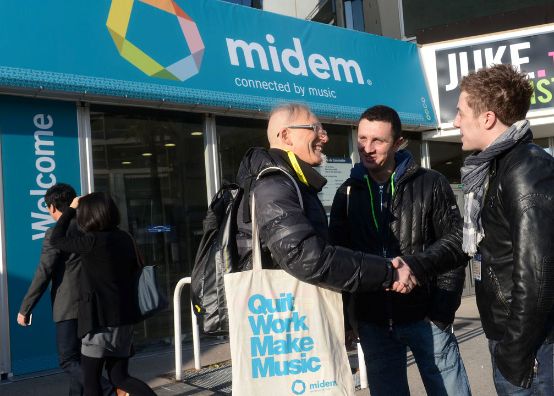
Photo: D'Halloy / Image & Co.,SMPV

The joint stand is organized under the title music made in switzerland The costs for Midem can also be reduced with an "artist discount" for students and members of Swissperform and the Swiss Association of Audio Artists (STV).

Midem has been held annually in Cannes since 1966. It attracts around 10,000 trade visitors every year.

More info: www.fondation-suisa.ch/de/messen-events-im-ausland/midem

New professional vocal ensemble

With BernVocal, conductor Fritz Krämer wants to complement the baroque orchestras anchored in the region. The first performance will take place in the fall.

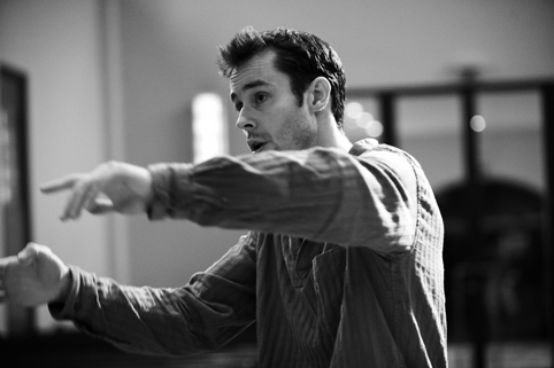
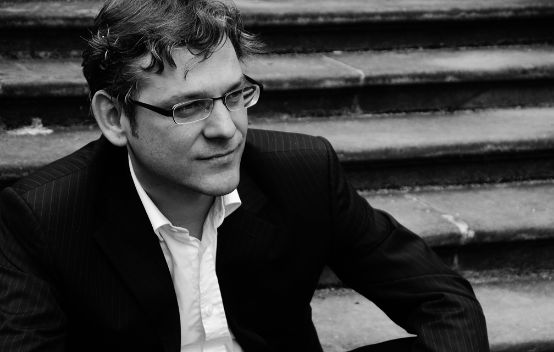
Conductor Fritz Krämer. Photo: Adele Marschner

BernVocal is a chamber choir for early music. It was founded in order to establish a professional vocal ensemble dedicated to historical performance practice alongside the baroque orchestras already firmly established in the concert life of the city and canton. To this end, conductor Fritz Krämer has been able to recruit singers and early music specialists from Bern and the surrounding area. The ensemble will perform Anthems by Henry Purcell on November 9 and 10 in Thun and Bern.

As the choir writes in a press release, talks are already underway with the aforementioned instrumental ensembles, who are interested in joint concerts and collaborations. In the long term, BernVocal would also like to establish itself on a national and international level.

www.bernvocal.ch
 

Historic record covers in the Loeb shop window

The shop windows of the Loeb department store in Bern have been a creative cult for decades. The Bern University of the Arts HKB is now taking advantage of this with an exhibition on the history of record covers and short concerts for passers-by.

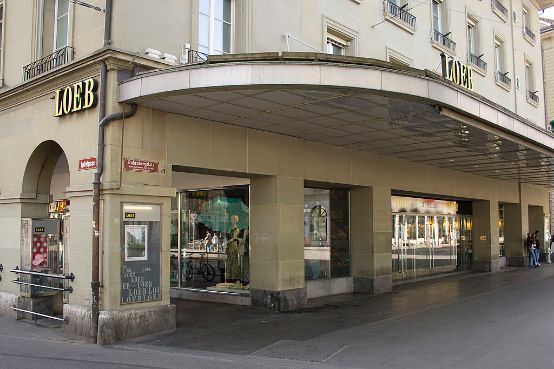
Photo: Mike Lehmann, wikimedia commons

From October 17 to November 3, 2013, the Department of Design and Art at the HKB will be exhibiting record covers from the huge collection of Robert Hasenböhler from Bern. The significance of cover design in the context of art and commerce will be addressed in a supporting program.

In cooperation with the HKB Research Department, jazz will take center stage on October 17: Christian Steulet will show links to the SNSF research project "Growing up - The Emancipation of Jazz in Switzerland 1965-1980" in a performance entitled "Undercover", based on jazz record covers.

Accordionist Hans Hassler will also be giving short concerts in the Schaufenster as a special guest (starting at 5.30pm).

Two duos with a first prize

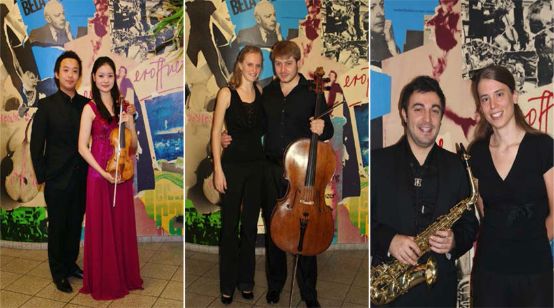
The duo Gregor-Smith - Graf and the duo Liamo convinced the jury under the direction of Thomas Demenga the most.

Since the seventies, Switzerland has been ORPHEUS - Swiss Chamber Music Competition takes place. This competition is intended to support chamber music ensembles at the beginning of their professional careers.

This year's edition took place on the weekend of October 11 and 12 at the Basel University of Music. The five-member jury, headed by Bernese cellist and composer Thomas Demenga, selected six ensembles to take part in the Swiss Chamber Music Festival Adelboden 2014.

The top three winners received two prizes of CHF 4000 and one prize of CHF 2000. In addition, the Swiss Arts Council Pro Helvetia is funding a composition commission for each of them to a young composer. The three works will be performed on Swiss Chamber Music Festival Adelboden 2014 (September 12 to 21) will be premiered.

The award winners:

Two 1st prizes (Fr. 4000.- each)

  • Duo Gregor-Smith - Graf: Benjamin Gregor-Smith (violoncello) and Aglaia Graf (piano)
  • Duo Liamo: Mai Suzuki (violin) and Shintaro Kawahara (piano)

3rd prize (Fr. 2000.-)
Duo Càmara-Köhnken: Pablo Càmara Toldos (saxophone) and Camilla Köhnken (piano)

Other award winners:

  • Duo Astrig & Andriy: Astrig Siranossian (violoncello) and Andriy Dragan (piano)
  • GALAAD QUARTET: Simon Bouveret (violin), Charlotte Magnien (violin), Anais Renard (viola), Raphaël Abeille (violoncello)
  •  Eromea Trio: Tania Ramos Morando (oboe), Yolanda Fernandes Anguita (clarinet), Miguel Angel Pérez Domingo (bassoon).

Concerts of the Donaueschingen Music Days on the radio

The concerts of the Donaueschingen Music Days from October 18 to 20, 2013 are sold out. However, almost all world premieres can be followed on the radio. Performances by Swiss ensembles, including the trio Hans Koch, Martin Schütz and Fredy Studer and the singer Shelley Hirsch, will also be broadcast.

Excerpt from the 2013 poster by Thomas Schütte

In total, the radio station SWR2 will devote around 22 hours of broadcasting time to the festival. The broadcasts will kick off with the music magazine SWR2 Cluster, which will be broadcast live from Donaueschingen for the first time on Friday, October 18 (3 p.m.). In it, Wibke Gerking and festival director Armin Köhler will discuss the program of this year's Musiktage with participating artists: large-scale musical forms in the age of computer aesthetics.

The first highlight will be the broadcast of the opening concert at 8 pm, featuring works by Walter Zimmermann and Bernhard Lang under the direction of Pascal Rophé, Wolfgang Lischke and Christopher Sprenger.

On Saturday, October 19, SWR2 will broadcast the choral ensemble concert with the SWR Vokalensemble Stuttgart, the Ensemble musikFabrik and the Ircam under the direction of Marcus Creed with works by Hèctor Parra and Raphaël Cendo live at 3 pm. At 5 pm, Klangforum Wien under Enno Poppe will present his work Memory. At 8 pm, SWR2 will broadcast the NOWJazz Session with Tobias Delius, the trio Hans Koch, Martin Schütz and Fredy Studer and the singer Shelley Hirsch.

Sunday, October 20, opens on SWR2 at 11 a.m. with a live broadcast of the ensemble concert with Klangforum Wien under Emilio Pomàrico with Situations by Georges Aperghis. At 2 pm, the Karl Sczuka Prize for Radio Drama as Radio Art will be awarded to Oswald Egger and Iris Drögekamp, and Rafael Nassif will receive the sponsorship award.

The final concert with the Wind Trio Recherche, the Ensemble Modern, the SWR Vokalensemble Stuttgart and the SWR Symphony Orchestra Baden-Baden and Freiburg under François-Xavier Roth with works by Alberto Posadas, Bruno Mantovani and Philippe Manoury will be broadcast from 5 pm.

All broadcasts from the Donaueschingen Music Days can be heard as a live stream on SWR2.de. Current daily videos and a blog provide insights into rehearsals, reports and reactions.

More info: www.swr2.de

Spirit of Music in Burgdorf

In today's rationally dominated world, classical musicians who are concerned with spirituality often find themselves alone. The newly founded association Spirit of Music in Burgdorf aims to provide impetus to reconnect classical music and spirituality. The first workshops and concerts will take place at the beginning of December.

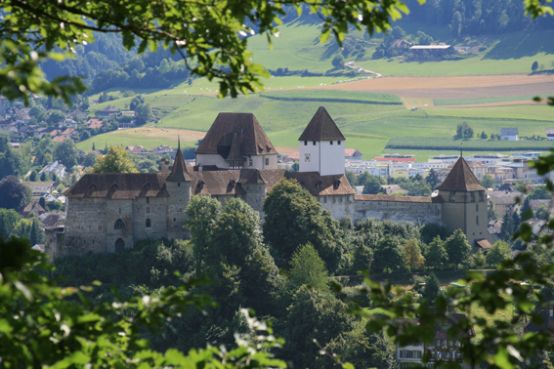
Burgdorf Castle. Photo: Chris ALO/WikiCommons,SMPV

Anyone who has ever been "enchanted" by music, who has forgotten themselves in the experience of music and has emerged deeply moved from this experience, has sensed one of the greatest secrets of music: it has the power to transport us into other dimensions of experience, it can be a key and access to meditative, mystical, spiritual experience.
When we experience the spiritual dimension in music, we discover the trinity of life. Namely the rhythm of life, the melody of life and the harmony of life.
Many Western composers and musicians from the Middle Ages to more recent times were spiritually oriented and have commented on this, for example Ludwig van Beethoven: "Music mediates between the spiritual and the sensory world".

For today's listeners, classical music is first and foremost a wonderful occasion for a sensual experience. That is a good thing. However, we often overlook the fact that the impetus for the creation of many musical works was a spiritual one. Many people today feel a renewed desire for a new spirituality in their lives and often turn to Eastern cultures. But our own culture also carries strong spiritual impulses that simply need to be rediscovered.
We see the task of the Spirit of Music events and concerts in Burgdorf as uncovering these roots and making them accessible to all interested people. At the same time, we would like to present productions that have emerged from the cross-fertilization of spiritual cultures.
The inclusion of the natural rhythms of the seasons, planetary forces and signs of the zodiac was also a matter of course for inspired composers of all eras of Western culture. Each key was recognized as an entity with its own character and specific effect on the human psyche.
We want to make this and much more tangible for everyone with all their senses at the international Spirit of Music in Burgdorf.

You can't touch music, but it touches you!
Since we as persons (personare = to sound through = the one who sounds through) can refine our ability to resonate by training our senses and intuition, we open our perception to the spiritual qualities of music.
It then reveals to us how it can help us to incorporate the harmony of heaven and earth, of spirit and nature, which is expressed in music, into our daily lives.
For all great composers, too, music is first and foremost a praise to God and the fullness of LIFE (capitalized = stands for infinite life). Or as Johann Sebastian Bach put it: "For the glory of God and the permissible delight of the mind".
Nowadays, we have become so far removed from the laws of life that surround us that the American preventive physician and psychiatrist John Diamond, in his book Life energy in music writes: "From the very beginning, the function of music has been the spiritual edification of the listener, the strengthening of his vital energy. We all know that music has this power and yet we rarely think about it when we make music, when we go to a concert or when we buy a CD; or we have forgotten the very reason for the existence of music".
In my professional field as a musician and natural healer, I am always accompanied and supported by Robert Schumann's saying: "Sending light into the depths of the human heart is the artist's profession."
It is well known that music has healing powers and supports healing processes on all levels. Novalis wrote about the healing power of music: "Every illness is a musical problem, the cure a musical resolution."

The statement by the well-known French nuclear physicist Charon also reminds us that everything is animated: "Every atom communicates with every other atom in the universe via the substance of antimatter (spirit)."
Modern physics confirms what the ancient sages, healers and initiates already knew thousands of years ago: everything is one and everything vibrates. And what vibrates sounds, even if we cannot hear it with our material ears.

Finally, Joseph von Eichendorff says: "If a song sleeps in all things that dream on and on, and the world begins to sing, you only hit the magic word."
To experience this and not just know it from books, you need the ability to listen. Active listening to music promotes personal growth and always leads to an expansion of consciousness. We therefore also see the Spirit of Music in Burgdorf as having an educational mission. The Department of Education of the Canton of Berne suggested this a few years ago and now we have the opportunity to do so again with our two creative workshops and the detailed introductory talks to the concerts.

The detailed program (PDF) can be herer can be downloaded.



Leo Hofmann wins Giga-Hertz Production Award

The Giga-Hertz Prizes for electronic music from SWR and the Center for Art and Media (ZKM) Karlsruhe, each endowed with 1000 euros, go to John Chowning and Francis Dhomont. HKB graduate Leo Hofmann receives a production prize worth 8000 euros.

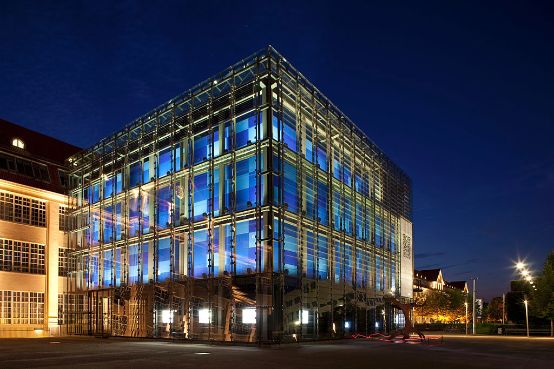
Center for Art and Media Karlsruhe, Image:ONUK/ZKM, wikimedia commons

Leo Hofmann, born in 1986, is a composer, performer and sound artist. He studied Contemporary Art Practice and Composition Théâtre musical at the Bern University of the Arts. Hofmann experiments with the formats of radio plays and concerts.

The other Giga-Hertz production prizes of 8,000 euros each go to Daniel Blinkhorn (* 1973, Sydney), Alexander Schubert (* 1979), Ying Wang (* 1976, Shanghai) and Roque Rivas (* 1975, Santiago, Chile).

Kevin John Edusei with three premieres

Kevin John Edusei will become Principal Guest Conductor at the Konzert Theater Bern for the 2013/14 season. He already impressed here last season.

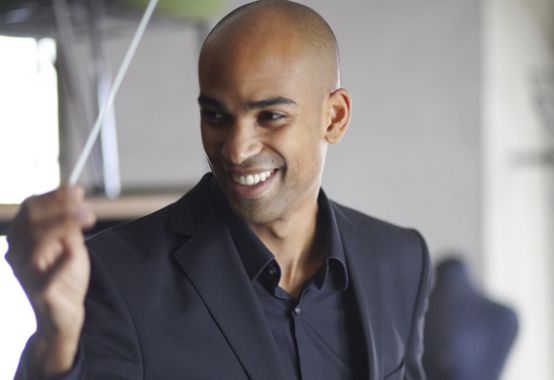
Kevin John Edusei. Picture: zvg

Last season, Edusei performed Mozart's The Abduction from the Seraglio He has impressed critics and audiences alike. In the current season, he will direct Eduard Künneke's The cousin from whatsisname (premiere March 9, 2014), Richard Strauss' Ariadne on Naxos (premiere April 19, 2014) at the Stadttheater and Benjamin Britten's Peter Grimes in the Great Hall of the Reitschule Bern (premiere June 6, 2014).

In a statement from Konzert Theater Bern, Concert and Opera Director Xavier Zuber is delighted about the intensification of the collaboration with the conductor: "Kevin John Edusei embodies the young, up-and-coming generation of conductors and also stands for the musical awakening at Konzert Theater Bern". Kevin John Edusei is similarly enthusiastic: "I already experienced the Konzert Theater Bern as an extremely progressive artistic venue last season. It offers a space in which ideas can emerge and develop. I am very happy that we can now continue our fruitful collaboration with three productions that are as exciting as they are challenging."

Born in Bielefeld, he studied conducting, sound engineering and classical percussion at the Berlin University of the Arts and at the Royal Academy of Music in The Hague in the class of Jac van Steen and Ed Spanjaard.
During his three-month scholarship at the Aspen Music Festival in 2004, David Zinman appointed him Academy Conductor. He received further inspiration from Marc Albrecht, Kurt Masur, Jorma Panula, Sylvain Cambreling and Peter Eötvös.
As one of the three winners of the conducting competition initiated by Pierre Boulez and Peter Eötvös, he conducted Karlheinz Stockhausen's opus magnum at the Lucerne Festival 2007 Groups for three orchestras. In 2008 he won first prize at the Dimitris Mitropoulos Conducting Competition.
Edusei will become chief conductor of the Munich Symphony Orchestra from the 2014/2015 season.


Verona's amphitheater concerts criticized

International concert gigantism seems to be reaching its limits. In Italy, a fierce debate has flared up about the sense and nonsense of misappropriating ancient buildings.

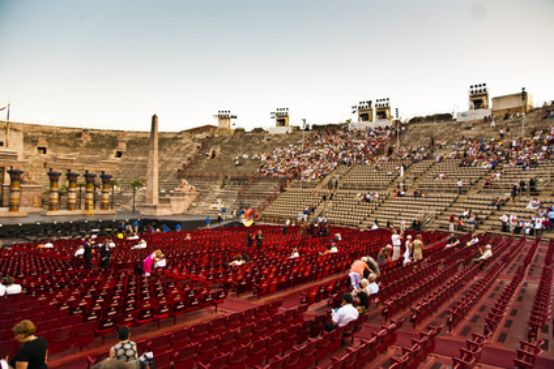
Photo: Jörg Hackemann - Fotolia.com

According to a report in the Austrian newspaper "Standard", Vincenzo Tiné, the director of the arena, is calling on Verona's mayor Flavio Tosi to be more cautious with permits for large concerts in the amphitheatre. The monument is endangered by the numerous events. Tosi takes a different view. He points out that it was precisely the major events that made it financially possible to renovate the arena. 

The straw that broke the camel's back for Tiné was the finish of a marathon in the theater, which is not actually allowed to be open for sporting events, and a fireworks display after a Paul McCartney concert.

Alongside the Colosseum in Rome and the Arena in Capua, the Arena in Verona is one of the largest ancient theaters that can be used for performances. It has space for 22,000 spectators and excellent acoustics.

Work grants 2013 from the canton and city of Lucerne

This year, the canton and city of Lucerne have announced competitions in four categories: product design, illustration, pop/rock/hip-hop/electro and jazz/improvised music. The winners have now been announced.

zvg

It is the first time that not just three, but four sectors have been considered, writes the canton of Lucerne. This was made possible by additional funds awarded to the Canton of Lucerne by swisslos. Work grants totaling around CHF 260,000 will be awarded, around CHF 70,000 more than usual.

The jury selected the following groups from the 30 applications for work grants in pop/rock/hip-hop/electro: Neustadtmusik (CHF 30,000), Huck Finn (CHF 20,000) and Tobi Gmür (CHF 15,000). 22 applications were received for work grants in the field of jazz/improvised music. The Lucerne Jazz Orchestra (CHF 20,000), Stimmorchester (CHF 15,000), Marc Unternährer (CHF 15,000) and Patrick Studer (CHF 15,000) have been considered.

The entries for product design and illustration will be announced later.
 

Swiss premiere of Holman scores

The legendary arranger Bill Holman has written down compositions in a private band book that have never been performed in Switzerland before. The Zurich Jazz Orchestra (ZJO) presents them at Moods.

Marko Lackner, zvg

The numbers "Front Runner" and "Moon of Manakoorah" only exist in Bill Holman's private band book and can only be heard at Moods on October 17. "Moon of Manakoorah" exemplifies Holman's writing style, writes the ZJO: Originally a schmaltzy musical theme ("The Hurricane"), the melody is alienated and developed contrapuntally over a long arc with a great deal of humor.

The Swiss trumpeter Daniel Schenker and the Austrian Marko Lackner have both had the opportunity to play under the direction of Bill Holman. The first performances in the first set of the Moods concert are due to this circumstance.

The second set will feature the program "Kaleidoscopia" by Marko Lackner, one of the contenders for the ZJO's directorship. The Austrian-born saxophonist, composer and conductor has worked with Bob Brookmeyer's "New Art Orchestra", the "Sunday Night Orchestra" in Nuremberg and the NDR and WDR big bands, among others.

Info:
"Meeting Bill & Marko", October 17, 2013, 8.30 pm, Jazzclub Moods, Zurich.

Swiss Luthier wins gold in Italy

Swiss violin maker Pierrick Sartre has won the gold medal at the 4th International Violin Making Competition in Pisogne, Italy.

Pierrick Sartre at the award ceremony. Photo: zvg,Photo: Robert Fux

Silver went to the South Korean Oh Dong Hyun, bronze to the German Andreas Haensel. The Italian Philip Protani won a special prize for sound, the German Christian Lijsen the Suzuki Prize. Around one hundred violin makers from eight countries took part in the competition.

Image

Born in 1982, Pierrick Sartre completed his training at the international violin making school in Cremona. He currently works in the Lausanne workshop of John-Eric Traelnes, where he restores old and new instruments and makes règlage.

The long history of the Zurich Mixed Choir

In 1863, the Gemischte Chor Zürich was founded as the first official mixed singing ensemble in Zurich. For the first time, men and women sang in the same association.

Outing of the Zurich Mixed Choir 1905, zvg

The constituent assembly took place on October 28, 1863 and on December 12 and 27, 1863 the first concert, Joseph Haydn's Creation. The purpose of the choir was "to cultivate all levels of mixed choral singing from the simplest folk song to classical oratorio". At the same time, the Easter holidays were to be celebrated "not only through prayer and preaching, but also through the performance of masterpieces of church music".

The Zurich Mixed Choir is one of the founding choirs of the Tonhalle Society, which was established in 1868 together with the City and Canton of Zurich, the Harmonie Singers' Association and the Zurich Male Voice Choir. In 1891, the Teachers' Singing Association joined the founding choirs. In 1872, the mixed choir donated the installation of an organ in the Tonhalle and in 1895 donated half of its assets for the construction of the new Tonhalle hall.

Friedrich Hegar became conductor of the choir in 1865. Under him, the choir experienced its first heyday; he conducted the choir until 1901. Hermann Suter (1901-1902) was followed by the long conducting periods of Volkmar Andreae (1902-1949) and Erich Schmid (1949-1975). Räto Tschupp led the choir from 1975-1996 and Joachim Krause, who still leads the choir today, took over in 1996. Today the choir has around 130 active members.

To celebrate its anniversary, the choir has commissioned a work from Zurich-based composer Edward Rushton. In D'un pays lointain will feature settings of poems by Henri Michaux, Gunnar Ekelöff, Dino Campana, Stevie Smith, Jürg Halter and Gerhard Meister. They tell of fictitious journeys to fictitious countries and the desire to set off for new shores. Handel's Ode for St. Cecilia's Day.

Anniversary concert: November 9, 2013, 7:00 pm, Tonhalle Zurich
Further concert: November 30, 2013 at 7:30 pm in the Stadthaus Winterthur

The anniversary commemorative publication will be published by Musikverlag Hug at the end of October
150 years of music for Zurich. The Zurich Mixed Choir 1863 - 2013
 

New research project, new training year

The activities of the Swiss University Center for Music Physiology in the 2012/13 season included advanced training courses and full studies, research projects and individual assistance.

Photo: Köpenicker - Fotolia.com

The Swiss University Center for Music Physiology is a cooperation and interest group of the music physiology and music medicine departments of the Swiss music universities.

On the Homepage The abstracts of the training events held can be found on the SHZM website. In the last school year, in addition to the local events in Basel and Zurich, the supra-regional event What musicians can learn from magicians. Performance techniques of magicians through the ages takes place.

Following the completion of the SNSF research project carried out in cooperation with the University of Lausanne Respiratory responses during music performance in anxious and non-anxious music students will start next season Prolonged performance-related psychophysiological activation in high- and low-anxious music students. This follow-up project is being funded by the Swiss National Science Foundation for three years and is again being carried out in cooperation between the University of Lausanne and the SHZM.

The project launched five years ago to build up the physical condition of music students at Swiss music academies is continuing.

Further training
The continuing education course in music physiology, which is supported by the SHZM and jointly organized by lecturers from several music universities, has accepted another intake of students. Information on the CAS, DAS and Master of Advanced Studies (MAS) certificate courses can be found on the homepage.

The majority of previous graduates of the continuing education program in music physiology at the DAS level and above have taught over 100 continuing education courses at music institutions throughout Switzerland. From the 2011/2012 fall semester, they will also be teaching the modular basic music physiology course as part of the bachelor's degree course at the Kalaidos University of Music in Aarau.

Manual laboratory
Through the SHZM, numerous students and lecturers from Swiss music academies were able to make contact with the Manual laboratory at the ZHdK, which was supplemented with new equipment last season. An individual hand profile that can be created there provides assistance in the prevention and resolution of job-specific complaints, in the development of an individual posture and instrumental technique, in the selection of ergonomic aids and in practicing technique, fingering and literature selection. 

Contact: www.shzm.ch
 

get_footer();