Hummel's signature

The manuscript of the popular concerto for keyed trumpet has been published as a facsimile. An invitation to tinker.


Page from the facsimile

At the Bern University of the Arts (HKB), research with a focus on interpretation is strongly encouraged. The results of these profound and conscientious studies are a number of valuable publications in the brass section, which are published in the SMZ some of which have already been reviewed. (cf. new edition of Eugène Roy's trumpet school, SMZ 10/2010, p. 34)

Johann Nepomuk Hummel (1778-1837) wrote his Concerto for Trumpet and Orchestra in E major for Anton Weidinger (1766-1852), the Viennese keyed trumpet virtuoso for whom Joseph Haydn also wrote his Trumpet Concerto in E flat major in 1796. The premiere took place on January 1, 1804 at the imperial court in Vienna. The original manuscript is in the British Library, London.

This facsimile shows the entire score in a clearly legible handwriting. The editor Edward H. Tarr concludes by comparing the handwriting that this must be the composer's autograph manuscript, although the score was created in several stages. The solo part was notated in a different font color and is scribbled over in some places with melodic variants (simplifications by the soloist?). Several leaps are marked, in two places even realized with glued-in insert sheets.

In Tarr's critical commentary (German/French/English), the proposed changes are examined and can be compared directly with the original in the solo part. A further chapter is devoted to the keyed trumpet, the original research project and object. Most of the 150 or so original instruments still in existence today are left-handed and equipped with 5 keys - unfortunately none of Weidinger's instruments have survived. This means that many questions about historical performance practice with this instrument are left to speculation and the puzzling of those trumpeters who get involved in playing the keyed trumpet.

Johann Nepomuk Hummel, Concerto a Tromba principale 1803, Facsimile, (= HKB Historic Brass Series 4), TP 306, Fr. 85.00, Editions Bim, Vuarmarens 2012

id., introduction, historical view, analysis, critical commentary, original solo part, by Edward H. Tarr; German TP 306d; French TP 306f; English TP 306e; Fr. 22.00 each, Editions Bim, Vuarmarens 2012
Improvisation, jazz and klezmer

A particularly successful introduction to jazz improvisation, now also for tenor saxophone; Klezmer for two and a well-guided introduction to jazz.

Photo: Gift Habeshaw/unsplash.com

Charlier and Sourisses introduce you to improvisation

The outstanding magazine, Initiation et perfectionnement à l'improvisation, which was previously only available for alto saxophone, is now also available as an edition for the tenor instrument. It contains ten pieces on common chord progressions (blues, anatole/turnaround), standards (Doxy, So What ...), but also a bossa nova, a batucada, a modal piece with "Celtic" echoes reminiscent of Jan Garbarek, etc. The first piece, which is formally quite demanding and based on alternating Ionic scales, is somewhat unwieldy. However, this should not deter you from immersing yourself further, as the other themes are catchy and supported by a great rhythm section: the two authors, André Charlier and Benoît Sourisse, completed by Jean-Michel Charbonnel on bass.

The concept is not new, but is excellently implemented with good notation. For each piece, the authors provide some precise explanations (in four languages) on improvisation, which give the pupils hints on stylistic and harmonic conditions. The tempos are moderate, the notated solos not too difficult - before Stéphane Guillaume on tenor sax shows how he would play if this were not an educational publication. The play-along versions each offer approx. 5 minutes to try out your own ideas.

Les cahiers Charlier Sourisse, Initiation et perfectionnement à l'improvisation, pour saxophone ténor, livre avec CD, AL 30544 (livre) + 30545 (CD), ca. € 17.75 + 7.95, Alphonse Leduc, Paris 2012

Discover Klezmer with two saxophones in two equal parts.

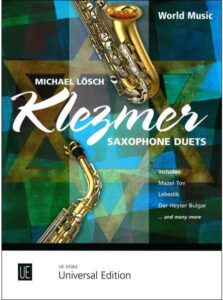
The klezmer duos from Universal Edition's World Music series are a real enrichment to the saxophone repertoire. Nine traditional and four musically equivalent new compositions by the editor Michael Lösch are waiting to be discovered by enthusiastic pupils of intermediate playing level and above. The quality of the arrangements is demonstrated by the fact that the second part is just as interesting as the first in every respect. At times it is a lively, rhythmic bass line, at others a parallel lower or upper voice, but never in a register that would hinder the liveliness of the music. Fortunately, this also applies to the added tenor sax part. The duos are not difficult, but they are only really fun if you can get close to the given tempi without being overwhelmed.

Michael Lösch, Klezmer Saxophone Duets (AA / AT), UE 33062, € 17.50, Universal Edition, Vienna 2012

Good guided introduction to jazz with "adaptable" accompaniment CD.

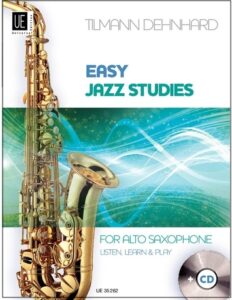
The ten pieces provide students who have learned the basics of saxophone playing with practice material to get them started in jazz. The phrasing is precisely notated, the keys are simple, the range is comfortable, and the accompanying CD provides up to three different tempos, allowing the pieces to be played at different technical levels. The harmonic background of the pieces are well-known jazz standards on the one hand, and blues forms enriched with quotations on the other.

The sound of the saxophone on the CD is light and somewhat undercooled, the rhythm section without drums is not loud, but precise and easy to understand. At best, you can hear from the accompanying band that the author originally wrote the pieces for flute, as mentioned in the foreword.

Tilmann Dehnhard, Easy Jazz Studies, for alto saxophone, UE 35262, with CD, € 17.50, Universal Edition, Vienna 2012

Sturm und Drang from Geneva

CD review: No music-historical corpse is being exhumed here. Gaspard Fritz's music pulsates and inspires.

Jean-Etienne Liotard, Portrait of Mary Adelaide of France in Turkish dress, 1753, detail from the CD cover

"He is a lean old man with whom I soon became acquainted. He was kind enough to play me one of his solos, which was very difficult but nevertheless pleasing. Although he must be about seventy years of age, he plays with as much zeal as a young man of twenty-five." The famous English music traveler Charles Burney tells of his visit in 1770 to a great Swiss composer (if Geneva can be counted as a place belonging to the Swiss Confederation): Gaspard Fritz (1716-1783), who is still a little to be discovered here. Fritz kept himself well in practice, wrote Burney, "despite having so few opportunities to show his talents and be duly rewarded for them". Local music historians have certainly paid tribute to him; Hermann Scherchen once championed him in music editions and recordings. Concert organizers, however, tend to neglect him, even though his music is quite remarkable. Burney has aptly described him as having the zeal of a youth (even though Fritz was only 54 at the time). Handel is also said to have praised his music.

The new recording of five symphonies from Opera 1 and 6 confirms this judgment - and not only because the orchestra La Stagione Frankfurt under the direction of Michael Schneider goes about its work with verve. From the very first note, it is clear that we are not dealing with a staid Helvetic minor master. This music pulsates vividly, storms and pushes, works with contrasts and can enamor a detail in the next moment. These are the most beautiful testimonies to a musical style that wanted to appeal directly to the emotions: through immediacy, clarity, variety and spontaneity of expression. Nothing seems contrived, there is no fat on it, it is always a pleasure to listen to and you never get the impression that yet another music-historical corpse is being exhumed. Fritzen's music is alive and kicking!

Image

Gaspard Fritz: 5 Sinfonias (op. 1 no. 5 & 6, op. 6 no. 3, 5, 6). La Stagione Frankfurt; conductor Michael Schneider; cpo 777 696-2

Hidden beauty

You first have to get used to the sound of the "Art of the Fugue". But then the benefit is all the greater.


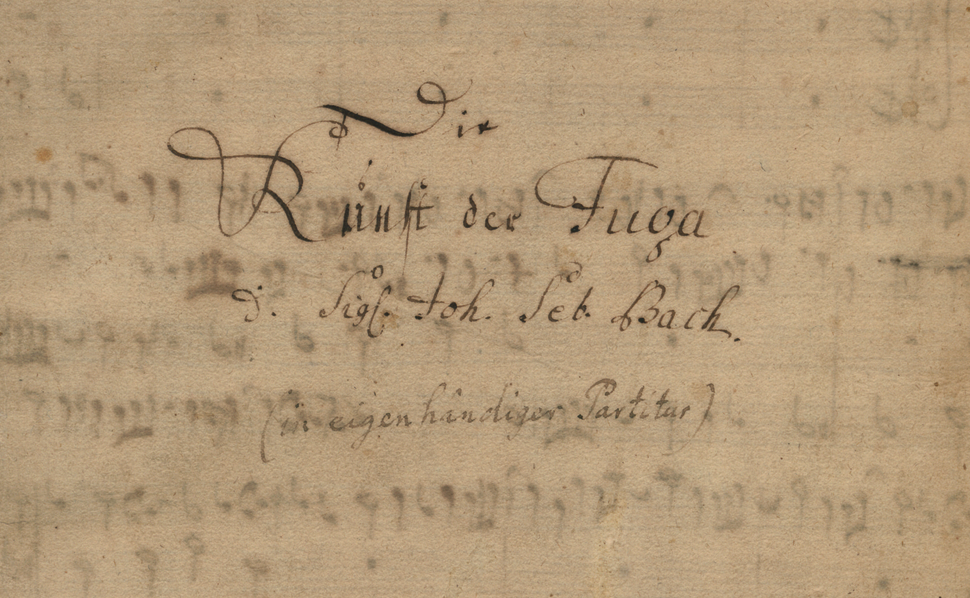
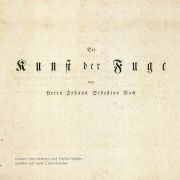
Title page of Bach's autograph manuscript, inscribed by Johann Christoph Altnickol: "Die / Kunst der Fuga / di Sig.o Joh. Seb. Bach / (in autograph score)", 1742. Berlin State Library

The question is what happens more often: are they recordings of the Art of the fugue or their characterization as abstract music that does not need to be performed at all? Johann Sonnleitner and Stefan Müller on the Clavichords are certainly not closing a "discographical gap" with their recording. But they gain the Art of the fugue a different tone than numerous existing organ, piano, saxophone or guitar arrangements.

Bach's canons, contrapuncti and mirror fugues sound very noble on the replicas of Johann Heinrich Silbermann's (1727-1799) clavichords. The concert pitch is 392 Hertz; the so-called Neidhardt tuning "for a large city" from 1724 was chosen. The resulting, somewhat muted sound takes some getting used to. But it is also incredibly subtle. It is easy to follow the voices, supported by moderate tempi. The simple cardboard packaging and restrained design are in keeping with a production that only reveals its beauty gradually, but very powerfully in the end. This more than does justice to Bach's enigmatic and unwieldy "Glass Bead Game" (Hermann Hesse). Because the power of Art of the fugue is known to lie in depth, in a highly spiritual construction that demands a special art of interpretation. Stefan Müller and Johann Sonnleitner obviously bring this to the table.

Image

Johann Sebastian Bach: The Art of Fugue. Johann Sonnleitner and Stefan Müller, Clavichords. www.contrapunctus.ch

Schoeck opera under the magnifying glass

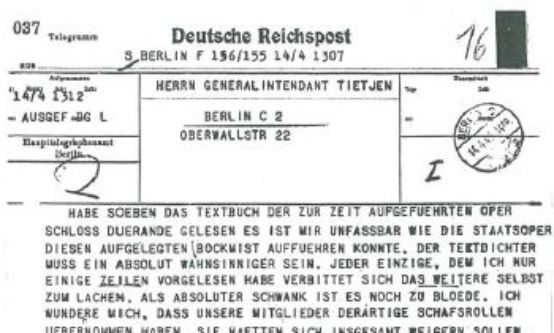
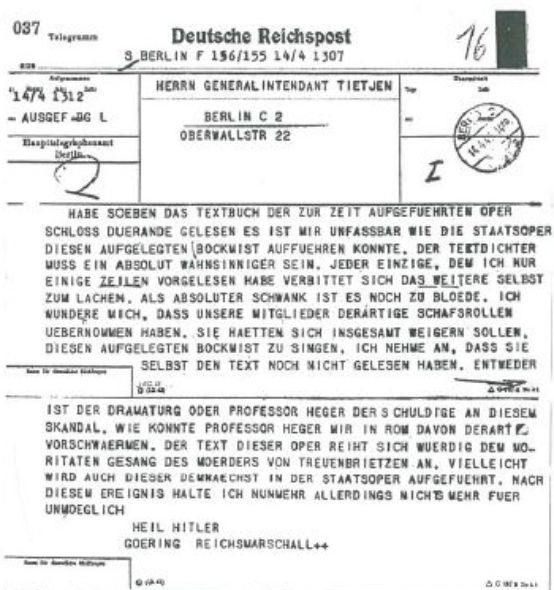
In connection with the project " 'Das Schloss Dürande' by Othmar Schoeck - Scenarios for an Interpretive Restoration", a dissertation on librettistics was announced.

According to a statement from the Bern University of the Arts, Thomas Gartmann is leading an investigation into where and how Nazi contamination is noticeable: in Hermann Burte's libretto and in the history of its creation, performance and reception.

An artistic perspective explores the extent to which the work can and must be recreated, with a partial re-texting by Francesco Micieli, more closely based on Eichendorff's original and retaining as much as possible of the dramaturgical structure coined by Schoeck, as well as a new musical version of parts of the work with preliminary instrumental retouching by Mario Venzago.

A project page will be launched soon at: www.hkb.bfh.ch
The dissertation on librettistics was publicly advertised: www.hkb.bfh.ch/de/hkb/stellenangebote
 

Image

Meier President of the FH Rectors' Conference

Thomas D. Meier, Rector of the Zurich University of the Arts (ZHdK) and representative of the Zurich University of Applied Sciences (ZFH) in the Rectors' Conference of the Swiss Universities of Applied Sciences (KFH), replaces Marc-André Berclaz (HESSO) as President of the committee. The Vice-Presidency passes from Rudolf Gerber to Franco Gervasoni.

Thomas D. Meier, born in 1958, has been Rector of the Zurich University of the Arts (ZHdK) since 2009. Before moving to the ZHdK, he held the position of Director of the Museum of Communication in Bern (1996), then (2003) served as Director of the Bern University of the Arts (BFH) and simultaneously as Vice-Rector between 2008 and 2009.

Franco Gervason, born in 1967, is Director of the Scuola Universitaria professionale della Svizzera italiana (SUPSI). He takes over from Rudolf Gerber, Rector of BFH, who is retiring.

The new crew will take over the KFH leadership in an educational policy
This is a challenging phase in which the new legislation on university funding and coordination needs to be implemented, writes the KFH.

Accordion - out of the usual drawers

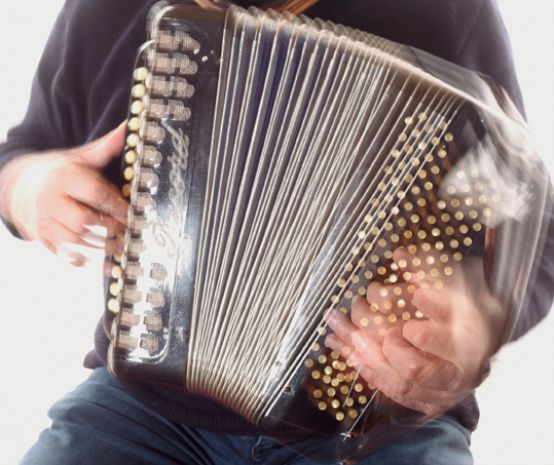
Is the impression deceptive or is the accordion really on the rise? We take a look around the music schools, hear from a quartet that "serves up" great repertoire works for strings and accordion in a new way; and Sofia Gubaidulina, who brought the Eastern European bayan into new music, is of course not to be missed.

Photo: Kaspar Ruoff
Akkordeon — raus aus den gängigen Schubladen

Is the impression deceptive or is the accordion really on the rise? We take a look around the music schools, hear from a quartet that "serves up" great repertoire works for strings and accordion in a new way; and Sofia Gubaidulina, who brought the Eastern European bayan into new music, is of course not to be missed.

Focus

Not only snow waltzes
The accordion is gaining ground at music schools and universities.

The sound of the suffering human being
Sofia Gubaidulina initiated a renaissance of the accordion in contemporary music. "The way out of the dead end" for Elsbeth Moser.

L'accordéon au Chili : instrument phare de la cueca
Un intérêt retrouvé pour le folklore remet l'instrument au goût du jour.

Sans sourdine, mais avec accordéon
Un ensemble instrumental hors du commun : nonSordino !

La fisarmonica come incarnazione del contemporaneo
Il percorso attraverso i generi di Danilo Boggini
 

and furthermore

RESONANCE

L'improvisation, une question de responsabilité et d'engagement.
Interview avec Jonas Kocher

Beat - Speak - Draw
Swiss composers enriched Berlin's Maerzmusik with physical immediacy.

Swiss Jazz Awards: effective commitment
Credit Suisse Sponsorship Award and Jazz Prize of Zürcher Kantonalbank

A springboard - also abroad
m4music has become the most important meeting place for the Swiss music industry.

5 centimes for 100 streams
A lot of music is heard - meagre money goes to the artists: this was discussed at the m4music festival.

Carte Blanche with Markus Ganz

Reviews
New publications (books, sheet music, CDs)


CAMPUS

Tools, tricks and theoretical background
Continuing education in rock and pop at Bern University of the Arts

Times are changing and with them the school subject of music
An exhibition at the Bern School Museum in Köniz

Talent factory in the Alps
A new model for promoting young talent at the Interlaken Classics festival

Reviews
Teaching literature


FINAL

Strict and open Puzzle by Thomas Meyer

Kategorien

Unloved, but everywhere

Translation Pia Schwab

Translation Pia Schwab

When we hear accordion, we don't just think of an instrument. Various, often negative connotations resonate. It has been given a whole host of unflattering nicknames: Bricklayer's piano, boatman's piano or poor man's piano, to make the distance to a real piano clear, home air compressor, to place it in a certain "music corner", or even squeezebox. It is the whipping boy among instruments.

It is strange, however, that this unloved accordion can be found everywhere: in Scottish jigs, the dances of Romanian travellers, Argentinian tango, French musette and in a whole range of Swiss folk music.

The accordion is easy to transport and quickly traveled around the world with soldiers and sailors. It can also replace an entire orchestra. Perhaps that is why it was looked at askance by other musicians: In the 19th century, many village orchestras lost their jobs due to the advent of the accordion. It could entertain a party all by itself, much like a DJ does today.

It was probably also the omnipresence that ultimately led to the rejection of the accordion. In my childhood, it had undoubtedly become the instrument that our parents listened to (whether they were yodeling or Jacques Brel fans). And we boys avoided it on principle. Fortunately, things are different today. Today, the accordion has moved back into the center of interest: in new folk music, but also in the avant-garde.

The "hand organ" is not a "second-class piano", it is an incredibly expressive instrument that can sustain a note indefinitely and can control its intensity, timbre and vibrato at any time. And it is a versatile instrument that has different characteristics depending on the region. So welcome to the world of the accordion and the Schwyzerörgeli (which I have always dreamed of being able to play in Scrabble).

Cordially
Yours

Jean-Damien Humair
 

Kategorien

Pictures to the music of Morton Feldman

In a workshop at the Design University in Geneva, students created videos to the music of Morton Feldman.

This spring, pianist Ivan Ilić was invited by the Haute école d'art et de design de Genève to spend a week creating videos with the students. The aim was to familiarize the future designers with Morton Feldman's music and create images to accompany it: Excerpt from Feldman's Palais de Mari. Piano Ivan Ilić, Video Stefan Botez

m4music: 5 centimes for 100 streams

As in 2012, there was discussion at this year's m4music about the fact that a lot of music is still being listened to, but only meagre money is flowing to the artists.

Switzerland is known for its liberal and therefore controversial copyright law. At the panel discussion What copyright law does Switzerland need? However, the call for a complete revision was hardly ever heard. Instead, a contemporary interpretation was called for. In his introduction, Tim Renner, Managing Director of Motor Music, recalled the emergence of radio. This was originally perceived as a source of artist expropriation. "Music was suddenly everywhere and free. With the consequence that the record industry at the time collapsed to 5% of its volume." Now we are in a similar situation. "That's why we need regulations that apply to everyone", such as the obligation to contract, "the legal obligation to establish a legal relationship with another person" (Wikipedia). This could force rights holders of a piece of music and users such as Swisscom to come to an agreement.

"Google is too big to pay."

Poto Wegener, Director of Swissperform, does not see the obligation to contract as a panacea. Concerts, for example, would not be covered. He would like to see a copyright law that mediates between the various interested parties and criticized the Internet company Google, which earns millions with free music content: "Google is too big to pay." The President of Musikschaffende Schweiz, Christoph Trummer, expects the law to protect works, and Lorenz Haas, Managing Director of the IFPI Switzerland label association, was keen to be able to influence the behavior of infrastructure operators: "We demand that hosting providers comply with certain duties of care." National Councillor Balthasar Glättli from the Green Party concluded: "In order for copyright law to be redesigned, the players must first come to an agreement."

"You get five centimes for 100 streams."

The subsequent discussion round, (How) Do artists earn money on the Internet?The main theme of the conference was the uncertainty prevailing in the music business and among collecting societies. While Oliver Sittl, Senior A&R at Believe Digital, praised the possibilities of the globalized market to the skies, Irène Philipp Ziebold, Director of the copyright society Suisa, pointed out the meagre reality: "For 100 streams, you get five centimes." Anything but a fair price, she noted. "We are also continuing to negotiate with the video portal YouTube, but some of their offers are incredibly low." If they were to agree to this, Suisa would not be doing the artists it represents any favors, she said.

Christoph Trummer also emphasized that it should not be acceptable for it to take 15 years for a musician to recoup the 50,000 francs that an album costs. Daniel Schönberger, Head of the Legal Department at Google Switzerland, spoke from the audience and explained that he had heard some unflattering things about his company during the discussion. He felt that the criticism that Google was making billions from third-party music content was undifferentiated. "We are a search engine and primarily provide legal content." And for free.

State Councillor Isabelle Chassot from Fribourg is to become the new Director of the Federal Office of Culture (FOC). The Federal Council has appointed the Fribourg native as the successor to Jean-Frédéric Jauslin.

In September, Jauslin takes up his duties as ambassador for UNESCO and the Francophonie in Paris. Isabelle Chassot takes up her post in November 2013. Deputy Director Yves Fischer takes over the management of the Office on an interim basis.

Isabelle Chassot (48) has been a member of the State Council of the Canton of Fribourg since 2002, where she heads the Directorate of Education, Culture and Sport. She has been President of the Swiss Conference of Cantonal Ministers of Education (EDK) since 2006. In this role, she has been involved in the National Cultural Dialogue from the outset.

Before her election to the government of Fribourg, Isabelle Chassot was a personal assistant to Federal Councillor Arnold Koller and Federal Councillor Ruth Metzler.

The Government Council of the Canton of Aargau has approved an application from the Swiss Academy of Music and Music Education for a contribution totaling CHF 260,000 from the Swisslos Fund.

The contribution will be used to establish a Master's degree program in music, which is expected to have a promising impact in the canton of Aargau, writes the Aargau cantonal government. The planned Master's degree course is a niche course that complements the courses offered by the FHNW School of Music.

The Swiss Academy for Music and Music Education SAMP based in Aarau, offers a full range of professional music and music education courses in classical and jazz & popular music throughout Switzerland.

The previous SMPV teaching diploma and concert diploma courses are run by the SAMP on behalf of the SMPV. At the same time, new courses are being offered and planned in cooperation with the Kalaidos University of Applied Sciences. The Bachelor of Arts in Music has been open to interested students since fall 2010.

High honors for Zurich dance students

15-year-old Lou Spichtig, a graduate of the Zurich Dance Academy, which is part of the Zurich University of the Arts (ZHdK), won the gold medal in her age category at the Youth America Grand Prix. Other Zurich students have also achieved great success.

Lou Spichtig has also received the Outstanding Artist Award from Dance Magazine Europe. She has been studying at the Zurich Dance Academy since 2008 and has already won several awards.

Two more ZHdK students excelled in New York. 19-year-old Leonardo Basilio won a silver medal for his performance, while 17-year-old Maiko Tsutsui made it to the final and came fourth.

The Youth America Grand Prix was founded in 1999 by two former dancers of the Bolshoi Ballet and has since served as a springboard for aspiring professional classical dancers from all over the world.

The solo variations of the award winners will be presented at the gala performance Fussspuren IX of the Tanz Akademie Zürich at the Schauspielhaus Zürich, Pfauen, on May 18 (sold out) and 20.
 

Friedl Wald scholarships awarded

Saxophonist Lino Blöchlinger and trombonist Maro Widmer - both students at Bern University of the Arts (HKB) - will each receive a scholarship of CHF 14,000 from the Friedl Wald Foundation.

Lino Blöchlinger is a graduate of a bachelor's degree course in jazz, Maro Widmer is aiming for a master's degree in C&T Jazz Composition & Arrangement.

The Basel-based Friedl Wald Foundation supports Swiss theater and music artists who are in need of and worthy of support and who have not yet reached the age of 26. The founder, Friedl Wenner-Wald, was a well-known and popular actress under her single name Friedl Wald.

Domestic acts use international platform

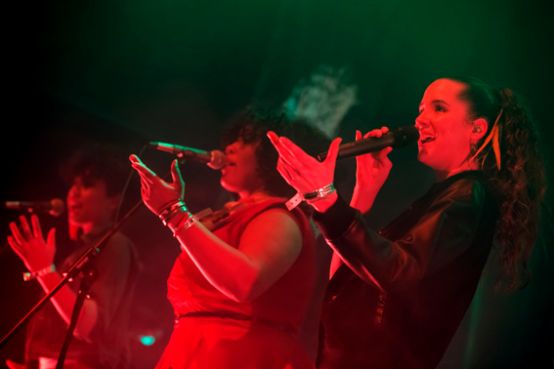
Swiss acts Evelinn Trouble, Velvet Two Stripes and Peter Kernel will have the opportunity to present their work to promoters and producers at the major industry festival The Great Escape in Brighton, UK.

Photo: Reto Schmid

The Great Escape is considered one of Europe's most important hubs for contemporary music creation. It is visited by the general public as well as talent scouts and other industry professionals. This year, 15,000 visitors are expected.

The festival, which was founded in 2006, will take place in 30 venues in Brighton. Debates, workshops and networking events are also organized. A total of 350 local and international artists perform. The event is sold out.

The Swiss promotional organization Swiss Muisc Export, in collaboration with the Fondation SUISA and Pro Helvetia, is organizing its own event, the Swiss Business Mixer, in Brighton for the first time. The three Swiss groups will present themselves both at this event and in the official festival program.

More info: mamacolive.com/thegreatescape
 

get_footer();