Ballad full of character

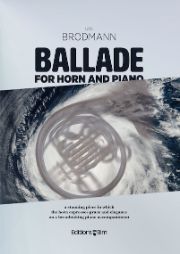
"Drammatico" and "Lento" describe the tonal characteristics of this piece.

Excerpt from the magazine cover

Urs Brodmann, who trained as a horn player in Basel, Fribourg and Brno and worked as such in the Orchestre de la Suisse Romande in Geneva and the former Basel Radio Symphony Orchestra, was Directeur Général of the Orchestre d'Harmonie de Nice from 1990 to 2013. Brodmann's passion seems to have always been composing, and his list has now grown to around sixty works of all genres, chamber music, vocal works and even two symphonies.

Published by Editions Bim, the Ballad for horn and piano, written in 1975, testifies to the knowledge of the technical and tonal possibilities of the horn. It is praised by the publisher as "a particularly dynamic and captivating piece".

Image

Urs Brodmann: Ballade for horn and piano, CO103, Fr. 20.00, Editions Bim, Vuarmarens

For the anniversary

In their selection of works by women for cello and piano, Anna Fortova and Kathrin Schmidlin looked primarily to the first half of the 20th century.

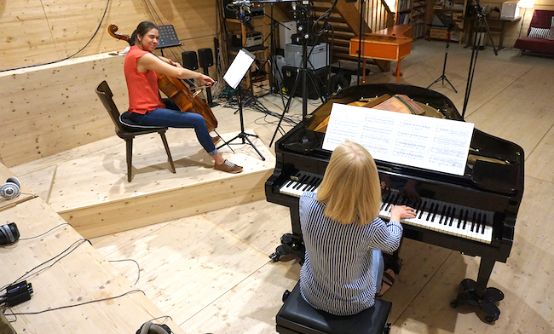
Anna Fortova and Kathrin Schmidlin during the shoot. Photo: Claves

No, the CD Women's voiceswhich was recently published by Claves, does not contain any female vocals. "Voices" is meant differently here. The two interpreters are interested in giving female composers a voice. The release date is perfect: the recording with music for cello and piano was launched on February 7, the 50th anniversary of the introduction of women's suffrage in Switzerland.

Prague-born cellist Anna Fortova (*1982) and Swiss pianist Kathrin Schmidlin (*1990) focus on the first half of the 20th century. Most of the six female composers are well-known personalities. Perhaps less well known is the Czech Vítězslava Kaprálová (1915-1940). She studied with Dvořák's pupil Vítězslav Novák in Prague and with Bohuslav Martinů in Paris. Despite her short life - she died at 25 - she left behind around fifty works. Her Military Sinfonietta (1937), which was awarded the Smetana Prize, was a great success. With Kaprálová's Ritornello op. 25 (1940), the two interpreters make a convincing start.

Nadia Boulanger (1887-1979) Trois pièces pour violoncelle et piano (1915) succeed very well in an intimate mood. The fast-paced third piece is a joy. In the Trois morceaux pour piano (1914) by Lili Boulanger (1893-1918), Kathrin Schmidlin demonstrates considerable skill. The transparency and precision in the "Cortège" are particularly impressive. The early, four-movement sonata for cello and piano (1919) by the Dutch composer Henriëtte Bosmans (1895-1952) is strongly romantic in tone and is characterized by expansive lines and simple, clear themes. In view of this unabashed romanticism, the interpretation here lacks a little intensity. With four piano pieces from The year by Fanny Hensel (1805-1847), listeners are transported back around 100 years. September" is the most pleasing with its flowing and lucid treatment of arpeggio and melody line.

The final point is the composition ni dónde, ni cómo by Stephanie Haensler (*1986), which Schmidlin and Fortova commissioned from her. The piece is based on a text by a Chilean artists' collective on the subject of violence against women. Haensler makes use of a wide range of compositional means to illustrate the most diverse moods between aggression and silence.
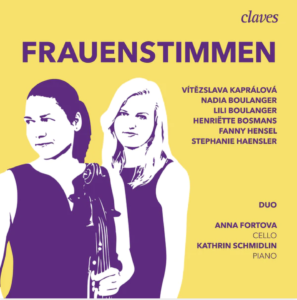
Women's voices. Works for cello and piano by Vítězslava Kaprálová, Nadia Boulanger, Lili Boulanger, Henriëtte Bosmans, Fanny Hensel and Stephanie Haensler. Anna Fortova, cello; Kathrin Schmidlin, piano. Claves 3029

Becoming a viola sonata

Adrian Wehlte has arranged a trio sonata by Carl Philipp Emanuel Bach for viola and obbligato harpsichord.

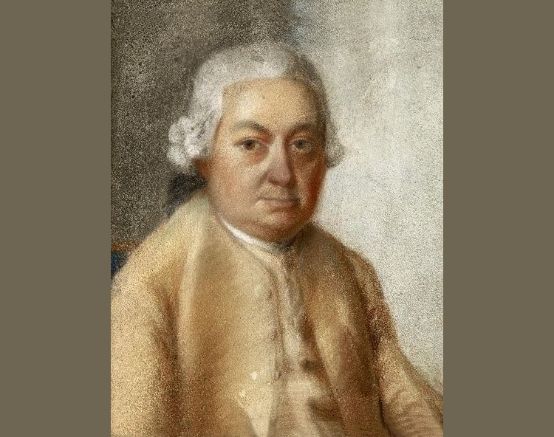
Carl Philipp Emanuel Bach. Pastel drawing from around 1780. Bach Archive Leipzig / Wikimedia commons

By including the bass recorder part in the right hand of the keyboard instrument, the player is given the rewarding task of participating in the melodic events. The viola and right hand have lively conversations in the two movements, which often intersect in terms of pitch, while the left hand takes over the bass, which only rarely interferes in the dialog.

Strangely enough, the viola part only moves to the C-string with an f at the end of the first movement, so the sonata could also be played on the violin!

The third pages of the two sets are also printed on an extra sheet to save you having to turn the pages - a good publishing idea!

Image

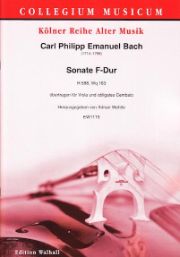
Carl Philipp Emanuel Bach: Sonata in F major H.588, Wq. 163, transcribed for viola and obbligato harpsichord, edited by Adrian Wehlte, EW 1119, € 14.80, Edition Walhall, Magdeburg 

Early romantic

The grateful Sonata in F major for cello and piano by Friedrich Schneider, which follows traditional forms, concludes with a Rondo alla polacca.

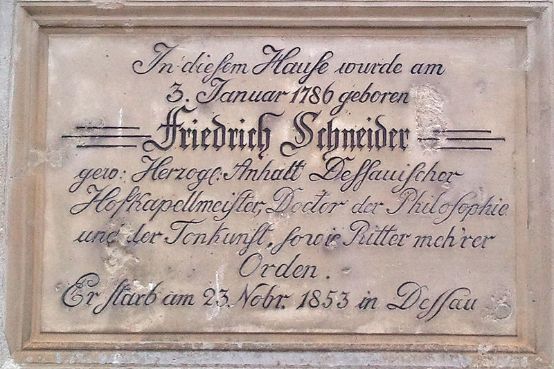
Commemorative plaque at Schneider's birthplace. Photo: Nicholas-Nickleby / wikimedia commons

Friedrich Schneider (1786-1853), a celebrated composer during his lifetime, is hardly known today. Of his extensive oeuvre, which encompassed all musical genres, the oratorio premiered in 1820 at the Leipzig Gewandhaus The world court op. 46 was a great and lasting success.

Scheider left behind a large number of chamber music works. The large-scale, four-movement sonata for cello and piano in F major was composed in 1831, but was never published. The pleasing, early Romantic tonal language is a typical product of the Biedermeier period, comparable to the Cello Sonata in E major op. 19 by Franz Xaver Mozart.

The cello and piano parts are equally developed, whereby the performers are given rewarding, if not highly virtuosic tasks. The cello part makes optimum use of the instrument's tonal possibilities in all registers (range of the cello part from C to s2) and offers both sparkling running passages and expressive cantilenas. The four movements are in the traditional forms (1st movement: Allegro moderato, F major, sonata form / 2nd movement: Larghetto, D flat major, A-B-A song form / 3rd movement: Scherzo, F minor / 4th movement: Rondo alla polacca, F major).

In addition to the piano score, the Urtext edition contains two solo cello parts, one is unmarked, the other contains bowings and fingering suggestions by Jürnjakob Timm.

Image

Friedrich Schneider: Sonata in F major op. posth. for violoncello and piano, edited by Nick Pfefferkorn, EB 32078, € 19.90, Breitkopf & Härtel, Wiesbaden

Composed in the 18th century

Some of the "34 pièces pour flûte seule" are by well-known composers of the time, others cannot be identified.

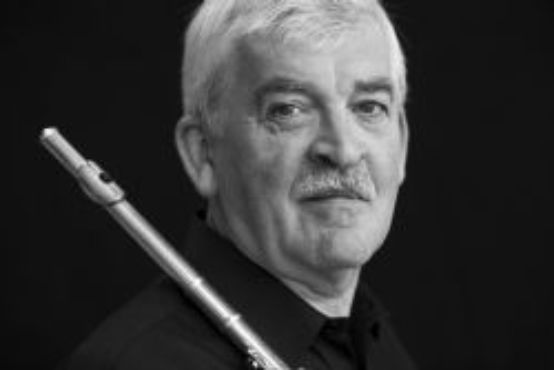
Rien de Reede. Photo: Annelies van der Vegt

The compilation selected by flautist Rien de Reede contains solo pieces by various composers from the 18th century. Most of them have titles such as Caprice, Fantaisie, Bohémienne or Gigue and are "technically challenging, but of delightful musical value", as the editor writes in the preface. Rien de Reede also mentions that, as Johann Joachim Quantz noted in his autobiography, flutists were forced to rewrite pieces for recorder or violin, as there was almost no solo literature for the transverse flute from 1719 onwards.

The parallels to violin music can be seen, for example, in the fact that many pieces, such as the Minuets by the Belgian composer Antoine Mahaut, contain chord breakdowns or large leaps over two octaves to suggest polyphony. Pieces with unusual titles such as the Bizzarria/Courante by Silvius Leopold Weiss, which is in the collection of Jean Daniel Braun, where a chromatic line in the upper voice is led from e3 to f sharp2 with a second melodic line at intervals of sixths and fourths. In addition to such rarities, there are also well-known pieces such as Alla Francese in D major, the Fantasia G major or the Minuetto "L'innconnue" with ten variations by an anonymous composer, which were already published in the Caprices by Johann Joachim Quantz are published. English composers such as Lewis Granom are also included. The collection by the French flautist Jean Daniel Braun, which makes up almost a third of the compilation, contains mainly dances such as Giga, Allemande, Minuetto and Rondeau. The work concludes with the unknown Capriccio by Wenceslao Zimmermann, which effectively jumps through all three octaves with chordal fragmentations in triplets.

This illustrious volume is a varied collection for flutists and transverse flutists from intermediate level upwards, combining familiar pieces with rarities and arousing interest in discovering unknown repertoire for solo flute.

Image

34 pièces pour flûte seule, pieces from the 18th century, selected by Rien de Reede, UE 38064, € 17.95, Universal Edition, Vienna

Overcoming the distance

In the duet for violin and double bass "Wind strich eine Schattenmelodie" by Eva Batt, the highest and the lowest string instrument are involved. - A double review from the perspective of a double bassist and a violinist.

Photo (cut): Nadine Shaabana / unsplash.com


Walter Amadeus Ammann
- A poem by Christiane Schwarze provides the framework for the intimate five-minute piece Wind stroked a shadow melody about pain, hope and consolation for the two loving souls left behind, separated by death. Syncopating, searching, dialoguing with pauses or duetting, changing from arco to pizzicato, melodies are created with melancholy, clinging semitones, ending in a comforting A minor. The idea of separation is represented by the distance between the pitches of the two instruments, which can also come closer together.

The composition by Eva Batt was published by Gilgenreiner. An important aim of this Swiss publishing house is the publication of music and teaching materials for double bass.


Heike Schäfer
- Wind stroked a shadow melody is from the poem Previously inspired by the lyricist Christiane Schwarze. It is therefore a work that combines the arts of music and poetry. The widely separated pitches of the two string instruments correspond with the poem, in which two loving people, separated in earthly life, are far apart and yet united in their love.

The composer makes skillful use of the technical advantages of the two instruments. With its expressive parameters (e.g. metaphorical instructions) and effects (e.g. tapping on the body, sul ponticello etc.), the work has a distinctly expressive character whose message is impressively conveyed both acoustically and performatively. "It demands intonational, rhythmic and technical security from the interpreting musicians and requires a polystylistic approach in view of the figures borrowed from the jazz idiom." The foreword in German and English also contains the underlying poem. Supplementary material is available in the form of a CD and a volume of poetry entitled The silence of the shadows - Mosaic of a search available in stores.

The inconsistency of the language - German or English - is a source of uncertainty. At first glance, the piece appears to have been influenced by Swiss culture, but at the same time the notes in the musical text are in English. The publication of a purely English and a purely German version would be a good idea. The double bass part is available in both orchestral and solo parts, so a performance is not dependent on the respective scordatura. Wind stroich eine Schattenmelodie is a source of inspiration and an example of transdisciplinary art - it opens up new sound and word spaces for musicians and listeners.

Image

Eva Batt: Wind strich eine Schattenmelodie, duet for violin and double bass; parts in score, double bass with two versions: Normal tuning and scordatura F sharp B E A, € 27.00, Gilgenreiner, Winterthur, ISMN 979-0-700268-32-9

The big crawl

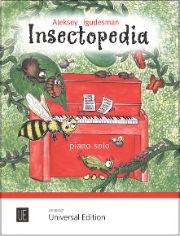
In these ten piano pieces, insects come to life and cavort on the keys.

Bug Hug? Bug hug? Photo: Peter Szabo / unsplash.com

How many times have I looked at and played through Aleksey Igudesman's ten pieces? Sometimes they seem like insects to me. On the one hand somewhat strange and uncomfortable, attractive and repulsive at the same time, and yet also so fascinating that they cast a spell over me again and again. The Russian-German violinist, composer and actor is not lacking in imagination and cheeky ideas.

With a persistent ostinato staccato, the ant does its work diligently and precisely. "Taking off" is written above the piece Butterfly(love)lingcarried by the gentle wind of the pedal in broken chords and floats through the room. One is not entirely at ease with the Bug hugin which you have to endure a "bug hug". It's better to keep your distance and then explore the keyboard all the more joyfully as a grasshopper, alternating hands in six-four time. Whether you're playing a bitchy tick or trying to avoid the cockroaches - the transformation is fun, and I have the feeling that you can sense the actor behind the composer.

The pieces can be played at lower to upper intermediate level and represent a welcome change from the all too familiar classroom pieces.

Image

Aleksey Igudesman, Insectopedia, 10 pieces about insects, UE 38047, € 14.95, Universal Edition, Vienna

Away from the mainstream, algorithms fail

Mainstream listeners receive more accurate music recommendations from streaming services than fans of non-mainstream music. This is the result of a study conducted by German, Austrian and Dutch universities.

Photo: Miikka Luotio / unsplash.com (see below),SMPV

A team of researchers from Graz University of Technology, Johannes Kepler University Linz, the University of Innsbruck and Utrecht University has investigated the accuracy of algorithm-based music recommendations for listeners of mainstream and non-mainstream music. A data set of the previous listening behavior of 4148 users of the music streaming platform Last.fm was used, half of whom mainly listened to non-mainstream music and the other half mainly listened to mainstream music.

The researchers compared the listening habits of the individual groups and determined which people most frequently listened to music outside their preferred genres and how broadly the music genres listened to were within each group.

Those who mainly listened to music such as ambient were most likely to be willing to listen to music that was actually preferred by hard rock, folk or electronica fans. Those with a preference for energetic music were the least likely to listen to music favored by folk, electronica or ambient followers. Instead, they listened to the widest variety of genres, for example hard rock, punk, singer/songwriter and hip-hop.

Using the computer model, the researchers predicted how likely it was that the different groups of non-mainstream listeners would actually like the recommendations generated by the four common algorithms. The recommendations for lovers of predominantly energetic music seemed to be the least accurate, while they were the most accurate for ambient listeners.

More info:
https://www.know-center.tugraz.at/epj-data-science-algorithmus-basierte-musikempfehlungen/

Open letter against Andreas Reize

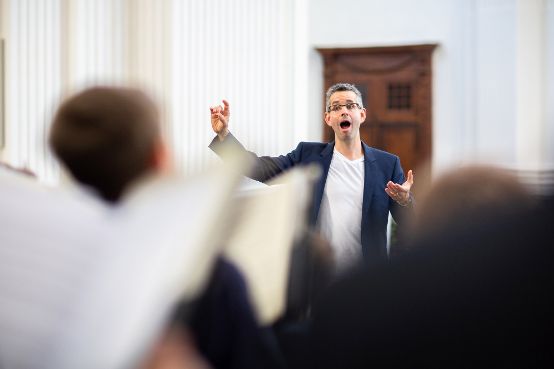
According to BR-Klassik, several St. Thomas choir members have written a letter of protest to the public. They reject Andreas Reize as Thomaskantor and plead for David Timm as choirmaster.

Andreas Reize. Photo: zVg

In their letter, the Thomaner 11th and 12th graders formulated a harsh reproach: Reize had not noticed during his rehearsal conducting that the choir's intonation was not good. Although the singers had almost dropped a tone during one piece, he had not intervened. According to BR-Klassik, Brödel, director of the Evangelische Hochschule für Kirchenmusik in Dresden and now president of the Neue Bach-Gesellschaft, explains that Reize deliberately did not intervene so as not to overtax the choir.

The radio station speculates that it is possible that former St. Thomas Boys' Choir members or employees have reservations about Andreas Reize because he is Catholic and comes from Switzerland.

Original article:
https://www.br-klassik.de/aktuell/news-kritik/thomaner-chor-andreas-reize-thomaskantor-widerstand-100.html

Plum-soft conclusions

Eighteen contributions on endings show how differently music can end, how time- and genre-bound endings are.

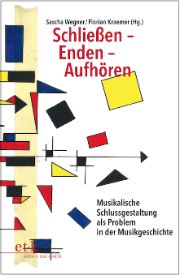
Excerpt from the book cover

How does a piece of music end? Does it end or does it simply stop? Is it a strong ending, eliciting applause? Or quiet, fading out? Does it conform to a convention? Or does it want to tell us something special? Tragic, funny? Questions of this kind are raised and examined in this volume, albeit not conclusively answered. For the Close - End - Stop of music is too diverse and too historically conditioned to be reduced to a single denominator. An Amen in a Gloria requires different solutions than the lieto fine of a baroque opera, and whether a symphony ends in a light rondo or a triumphant exaltation has a lot to do with the spirit of the times. Yes, sometimes the closing is not so "musical" at all, and we only realize that a piece is finished when the conductor drops his shoulders and arms.

So here it is: the "musical ending as a problem in music history", which the subtitle announces in a somewhat academic manner. Fortunately, the volume, which is based on a 2016 symposium in Mainz, is not that dry, but rather demonstrates (a nice side effect) how much musicologists are inspired by this fundamental topic. And most of them succeed in arousing interest and drawing you in as you read. In this way, the dissonant-consonant cadences of the 14th century or the tragic or cheerful opera finales or the morendo endings of the late Romantic period - Richard Strauss called them "plum-soft". The examples are each explained in such a way that, even if we don't know the piece, we can hear them in our mind's ear.

The eighteen contributions are divided into four sections: Under "Orders", more general (including philosophical, rhetorical and literary) aspects are examined. In the "Theory formations", the difficulty of a binding regulation of musical finales is immediately apparent; the levels of comparison are also too different: are we now talking about the end of a melody, an exposition, a movement or an entire work, even a cycle? Under "Appearances", the case studies from late medieval chant melodies to Mahler's "Lied von der Erde" are revealing. And in "Openings - (Re)solutions", it becomes clear what difficulties (post-)modernism has encountered in dealing with or circumventing conventions of endings. And this once again opens up a wide field. The editors conclude by stating that this is not the last word on endings.

Image

Closing - Endings - Cessation. Musikalische Schlussgestaltung als Problem in der Musikgeschichte, ed. by Sascha Wegner and Florian Kraemer, 467 p., numerous music examples, € 59.00, edition text+kritik, Munich 2019, ISBN 978-3-86916-662-9

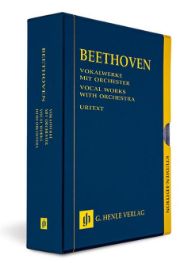
Beethoven's vocal art in compact form

A slipcase with six study scores by Henle contains the complete vocal works with orchestra.

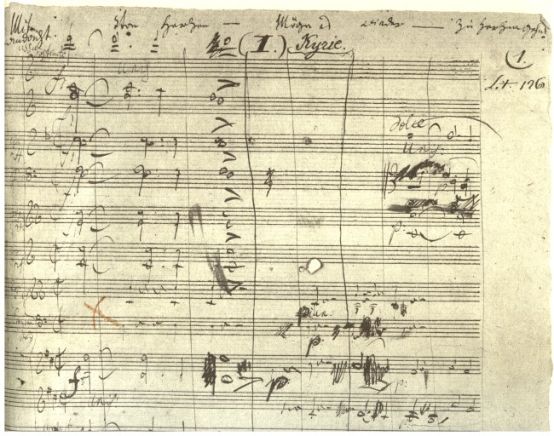
Autograph score of the Missa solemnis, beginning of the Kyrie. Source: wikimedia commons

Henle-Verlag has published Beethoven's complete vocal works with orchestra in a study edition as a paperback pocket score package in six volumes for the Beethoven anniversary year. The exemplary Urtext edition, which is based on the Beethoven Complete Edition, includes early cantatas, his only oratorio Christ on the Mount of Olives, the two masses, the popular choral fantasia and the Goethe setting Sea silence and happy journey up to Ah perfido! and other solo arias.

Concise prefaces with information on the history of the composition and footnotes with references to the edition and performance meet the highest quality standards and make this edition a must-have for interested singers and conductors.

Image

Ludwig van Beethoven: Vocal works with orchestra, study scores in slipcase, edited by Ernst Herttrich, Armin Raab, Norbert Gertsch and others, HN 9550, € 99.00, G. Henle, Munich

Still no prospects

Following the Federal Council's decision on March 19, there is no perspective for cultural event organizers after 13 months, and rehearsals in the amateur sector also remain restricted. The Covid-19 Act takes into account the key demands of cultural associations.

Daniil Kuželev / unsplash.com

The Culture Taskforce writes on March 25, 2021:

"The Federal Council will not decide on the next steps towards reopening until April 14. For cultural events, which often have a considerable planning lead time, this means that there is still no planning certainty. Major summer festivals are therefore canceling in turn. The cultural sector is dependent on a timetable being communicated now that includes statements on which events can take place again under which conditions and approval criteria and from when. If the Federal Council is unable to make this statement, we expect a decision by the end of March as to how long which event sizes will remain banned.

It is already becoming apparent that 2021 will be just as bitter a year for culture as 2020, with as yet unforeseeable long-term damage to cultural diversity. Wherever possible, cultural events must be able to take place. In particular, a differentiated approach to the various forms of events is needed.
 

Spring session of Parliament: amendments to the Covid-19 Act

Parliament has met some of the key demands of around 100 cultural associations and organizations as well as over 10,000 individuals who signed a petition from the Culture Taskforce within a very short space of time.

Amendments to the Covid-19 Act in line with the Culture Taskforce:
- The cost ceilings for culture-specific measures have been removed from the law. Should additional funds become necessary, which is already foreseeable, a supplementary credit can be requested from Parliament.
● "Freelancers" (employees with frequently changing, fixed-term project-related employment contracts) also have access to loss of earnings compensation.
● Cultural professionals can again apply for compensation retroactively as of November 1, 2020
● The threshold for access to the coronavirus income replacement for the self-employed has been lowered (a loss of turnover of 30% now applies instead of 40%).
● The deadline for payment of the full salary (short-time working compensation) for low incomes has been extended until the end of June.
● The Federal Council now has the option of extending the maximum period of entitlement to short-time working compensation from the current 18 to 24 months.

The law also includes a protective shield for events (Art. 11a - Measures concerning public events), which is a step in the right direction. However, the following questions and problems arise in this context:
- How quickly will it be implemented and what will be in the federal ordinance?
- We consider the requirement that events must have a cantonal permit to be problematic. Even in normal operation, permits are only issued relatively shortly before the event.
- Furthermore, only public events of supracantonal importance are covered by the protective shield and the cantons are involved in the financing. As a result, there is a risk that the protective shield will come too late for many events and that 26 different cantonal solutions will emerge.
The industry is happy to make its know-how available for the development.

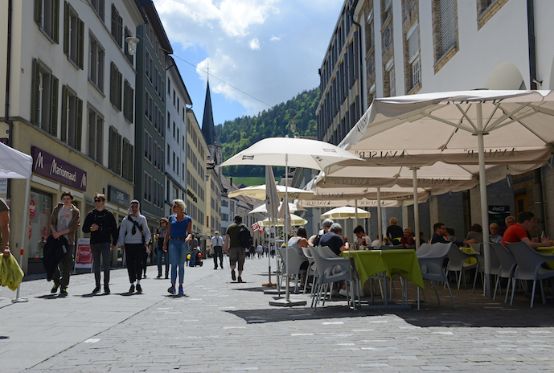
Chur city center becomes a cultural center

Chur has too few rehearsal rooms for artists and no cultural center. The city council has now drawn up a target vision for cultural spaces. The centrepiece is a decentrally organized but centrally managed cultural center.

Old town of Chur. Photo: City of Chur/Walter Schmid

According to the city's official communication, it has been known for some time that there is a lack of culturally usable spaces in Chur. The lack of a cultural center, for example, was already criticized in a corresponding petition in 2010. In-depth analyses revealed a glaring lack of rehearsal rooms for theater, dance, music, visual arts and literature in particular.

At the heart of the target vision for cultural spaces is a cultural center that is organized decentrally across the city centre but managed centrally. This is to take place in an independently managed cultural office attached to the Postremise. As far as possible, the existing cultural spaces scattered throughout the city center will be integrated into this concept if they can be rented.

In addition, there is a lack of rehearsal rooms for theater, music and dance as well as studios and band rooms. The target image makes suggestions as to how these shortcomings can be remedied. The Theater Chur, the Sennhof, the Haus zum Arcas and the Kulturhaus am Bienenweg all play a role here.

Original article:
https://www.chur.ch/aktuellesinformationen/1189481

Bern Corona Scholarships

The city of Bern wants to support creative artists in the form of coronavirus grants. The municipal council, the city's executive body, is making a total of 800,000 francs available.

Photo: Timon Studler / unsplash.com (see below)

The survey launched by the City of Bern entitled "How are you? Cultural workers and corona in Bern" confirmed, according to the city's press release, that the financial situation of cultural workers has deteriorated enormously within a year and that financial reserves are continuously decreasing or have already been used up. 411 cultural workers from a wide range of professions in the cultural sector took part in the survey.

With the Corona grant, the municipal council wants to give creative artists the opportunity to break out of crisis mode, so to speak, thanks to short-term help and make preparations for the next creative steps. While work grants always focus on work on a final product, the corona grants are intended to provide a breathing space and give an impetus for the next project idea. A total of CHF 800,000 is available for this purpose.

All professional artists living and/or working in the municipality of Bern who are in a financial emergency due to the current situation are eligible to apply. Grants are awarded up to a maximum of CHF 3000. The measure is intended to provide quick, uncomplicated and direct assistance and is limited in time. Applications can be submitted from March 26 to April 16.


Hertel Intendant in Pforzheim

Markus Hertel, who served as director and in-house director in Bern from 1991 to 1999, will take over the directorship of Theater Pforzheim from the 2022/2023 season.

Photo: zVg

From the 2022/2023 season, Hertel will manage Theater Pforzheim together with Administrative Director Uwe Dürigen. As the designated artistic director, he will already start the conceptual preparations for his term of office to a limited extent in spring. From September 2022, Markus Hertel will take up a five-year contract in Pforzheim as Thomas Münstermann's successor.

Markus Hertel was born in Essen in 1964 and studied directing at the University of Music in Munich, graduating with a degree in directing. His engagements have taken him from the Staatstheater am Gärtnerplatz in Munich to the theaters in Bern and Freiburg, the Bayerische Theaterakademie August Everding and Giessen, among others. From 2010 to 2020, Hertel was opera director at the Schleswig-Holsteinisches Landestheater in Flensburg.

He has been Artistic Director at the Wuppertaler Bühnen since 2020. In addition to his work at the theater, Markus Hertel is a lecturer at various colleges and universities and is dedicated to training the next generation of theater professionals. He is married and the father of three children.

get_footer();