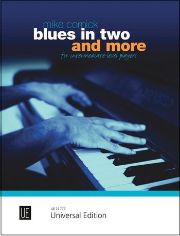
The slow swing piece Blues in Two was written by Mike Cornick (*1947) in 1994 and has enjoyed great popularity ever since. This very piece opens the new volume Blues in two and moreand eleven new compositions in various jazz styles have been added. I would like to recommend this collection to all those who sometimes have the blues and long for musical variety, whether when teaching or playing themselves.
The twelve appealing compositions cover styles such as blues, swing, ragtime, Latin and calypso. They are perhaps no more difficult than many pieces from the classical intermediate level, but require a completely different playing style in terms of harmony and rhythm. Certain harmonic sequences and rhythmic patterns often feel unfamiliar to players with a classical background and require a great deal of attention. This is precisely why it is worth exploring these fresh and light pieces. They are stimulating, instructive, entertaining and drive away the blues and more.
Mike Cornick, Blues in Two and More, for intermediate-level players, for piano solo, UE 21777, € 15.95, Universal-Edition, Vienna 2019
Interpreting style appropriately
Cornelius Frowein always starts from contemporary sources in his explanations of instrumental performance practice in the 18th century.
Historically informed performance practice has long been established in the concert hall; so much so that even amateur choirs often perform the popular baroque oratorios by Handel, Bach and other masters with orchestras that play on period instruments. However, what is standard for professionals with the appropriate training is still difficult to learn for amateurs, whether as practicing musicians or concertgoers.
The book published by Bärenreiter Performance practice compact by Cornelius Frowein, which, however, is limited to the instrumental music of the 18th century. For decades, Frowein has made a name for himself as a conductor of music from this century, especially by Mozart and his contemporaries, for which he has intensively studied the contemporary texts on the subject. He has now summarized this diverse knowledge in a handy, clearly structured volume. He has thus succeeded in providing beginners in the historical field - whether they are amateurs or modern orchestral musicians - with fundamental insights.
His book explains the central topics of "Affektenlehre-Tonarten-Rhetorik", "Tempo-Rhythmus-Agogik", "Dynamik-Akzentuierung", "Artikulation-Tongebung" and "Verzierungen-Manieren". The starting point for the discussion are sources from the period, which are consistently cited. The relevant authors include Quantz, Walther, Türk, C. P. E. Bach and Leopold Mozart - the bibliography in the appendix provides detailed information. It is to Frowein's credit that he explains the source texts, which are sometimes difficult to understand, in advance and then continues with his own comments. The result is a highly readable introduction.
The only annoying thing is that Frowein highlights many of his comments in bold type, which comes across as overly pedagogical. In addition, such aids to interpretation make it difficult for readers to form their own opinions and set their own priorities. In this way, Frowein's way of thinking is imposed too much and the ability to make one's own interpretation is diminished.
Cornelius Frowein: Performance practice compact. Interpreting 18th-century instrumental music in style, 196 p., € 24.95, Bärenreiter, Kassel 2018, ISBN 978-3-7618-2453-5
Colorful balloons with a fun factor
Mixed choirs will have a lot of fun with these arranged movie hits from the early days of sound film up to the fifties.
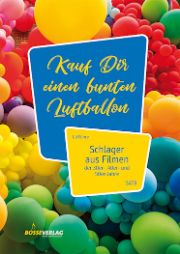
Uli Führe is widely known, among other things for his outstanding voice training canons, which have been published in volumes such as Vocal musicals 1+2 are collected and can enrich every singing session. Bosse-Verlag has now published the collection Buy yourself a colorful balloon with hits from films from the 1930s, 1940s and 1950s. What happens today online through providers such as Vimeo or YouTube happened from the 1930s with the linking of image and sound in films: an enormous popularization.
The collection ranges from the lascivious waltz I am from head to toe about the snappy marching song A friend, a good friend to the nonchalant foxtrot Bel ami. Uli Führe does justice to the different film scores in a very sensitive way, working out their characteristics and transforming them into easily feasible and appealing movements for mixed choir (SATB) without voice parts. A real enrichment for this type of repertoire with a great fun factor for the choirs.
Buy yourself a colorful balloon. Pop songs from films of the 30s, 40s and 50s, arranged for SATB choir by Uli Führe BE 921, € 17.50, Bosse Verlag, Kassel
Two in Wonderland
Knowing that great duo art is based on a lively exchange of ideas and the creativity of those involved, Daniel Schläppi and Marc Copland prepared themselves accordingly and set to work on their third album. With inspiring results.
Michael Gasser
(translation: AI)
- Feb 25, 2020
Photo: Rainer Ortag
His third collaboration with US pianist Marc Copland is also his most mature, bassist Daniel Schläppi says in the documentation for their joint CD Alice's Wonderland know. And duo partner Copland is also full of praise: "Playing with Daniel reminds me of the things I love most about playing jazz: the warmth, the communication and the attempt to share an experience with the listener."
The present work is not least intended to document how the music of the two has developed. Marc Copland (*1948), who has also performed on stage with jazz luminaries such as John Abercrombie and Ralph Towner, once again proves himself to be a master of the chordal and knows how to elicit an ethereal fluid from his piano with a fine touch. Meanwhile, his partner, Daniel Schläppi, 20 years his junior, stands out as a curious bassist with a penchant for groovy sounds. - He also runs a label and is an associated researcher at the Historical Institute of the University of Bern.
The 49-minute, nine-song encounter between the duo on Alice's Wonderland begins with a cover of Cole Porter's Everything I Love. The version by Schläppi and Copland is well-tempered, draws on a broad palette of timbres and is full of emotional power. Although the piece turns out to be stylistically trend-setting for the rest of the album, the two musicians always manage to surprise with their intimate, light playing, improvisation and superb timing. This is also the case on Blue In Greenwhich originates from the Miles Davis songbook. Conclusion: The elegant collaboration between Schläppi & Copland knows how to inspire - from A to Z.
Daniel Schläppi, bass; Marc Copland, piano: Alice's Wonderland. Catwalk CW 190019-2
Four weighty publications from recent years look at the string quartet from different angles.
Michael Kube
(translation: AI)
- Feb 25, 2020
Photo: Gila Hanssen / pixelio.de
For more than 250 years, the string quartet has not only been the most aesthetically ennobled genre of chamber music, but also the genre that has survived all the storms and revolutions of music history into the 21st century unbroken and unscathed. There are various reasons for this: the almost unmanageable international body of works with a simultaneous emphasis on an extended core repertoire even in the 20th century; the many stylistic changes with clearly traditional and intertextual points of reference; the early establishment of standing ensembles and the professionalization of compositional demands. In addition, there are the technical aspects of composition that are still valid under various guises, which Ludwig Finscher already worked out and recorded for Haydn's Opus 33. And so, even today, the string quartet corresponds to an entire cosmos into which one can immerse oneself: with brightly shining stars pointing the way, but also with a blurred, glimmering band in which one can lose oneself as in the Milky Way. The perspectives are inexhaustible, so that studies and books about the quartet not only fill shelves, but there is always something new to discover. Four book publications from the last few years show how different the aspects can be.
Hermann Walther takes an encyclopedic approach to the genre. In view of the data and lists available on the Internet, his List of the string quartet seems anachronistic at first glance (as does the unfortunate title). And yet its information, condensed to the bare essentials, offers a great deal, namely over 11,000 works, the composers listed alphabetically, with publisher's details. A treasure trove like an old telephone directory, which one would wish to have as a sortable data set for further analysis.
A virtually unknown part of the history of the genre is the subject of an almost 1000-page volume on the string quartet in Spain with 24 contributions in German, English, French and Spanish, including four comprehensive overviews and further special studies. A volume that invites you to browse and arouses curiosity about the sounding works.
The costly but beautifully appointed volume published by Christian Speck at Brepols has a completely different focus, documenting lectures from a 2013 conference in Lucca (enriched by a few additions). It examines case studies of the genre between private music-making and public performance, as well as in-depth studies of individual works.
John W. Barker, on the other hand, dedicates a study to the Pro Arte Quartet, founded in Brussels in 1912 and still in existence after many reshuffles, which not only tells the sometimes eventful history of the ensemble, but also a piece of music history itself. In the detailed appendices, fans of discographical information get their money's worth; however, I would have been happier to see a list of all the works ever performed.
Hermann Walther: Directory of the string quartet. String quartet compositions from 1700 to the present day, 596 p., € 39.99, Schott, Mainz 2017, ISBN 978-3-95983-542-8
The String Quartet in Spain, ed. by Christiane Heine and Juan Miguel González Martínez, 982 p., Fr. 115.95, Peter Lang, Bern 2017, ISBN 978-3-0343-2853-1
The String Quartet. From the Private to the Public Sphere, ed. by Christian Speck, XXX + 388 p., € 110.00, Brepols, Turnhout 2016, ISBN 978-2-503-56800-3
John W. Barker: The Pro Arte Quartet. A Century of Musical Adventure on Two Continents. 368 p., € 29.50, University of Rochester Press, Rochester 2017, ISBN 978-1-58046-906-7
Melting tome
"Souvenir" by Franz Drdla, originally for violin and piano, here in the viola version.
Walter Amadeus Ammann
(translation: AI)
- Feb 25, 2020
Photo: Thomas Max Müller/pixelio.de
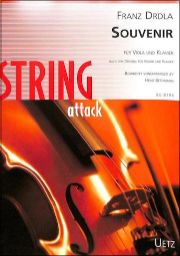
The widely traveled Czech violinist František Drdla (1868-1944), a theory student of Anton Bruckner at the Vienna Conservatory, wrote over 200 works of light music: in addition to two operettas and a violin concerto, many genre pieces for violin and piano. One of the best known, this melting, harmonically charming little tome, has now also been gratefully arranged for viola. It is as good on the viola in the same key as on the violin.
Franz Drdla: Souvenir, for viola and piano arranged by Heinz Bethmann, score and viola part, BU 8194, € 11.00, Musikverlag Bruno Uetz, Halberstadt 2019
Four mallets, freely selectable base
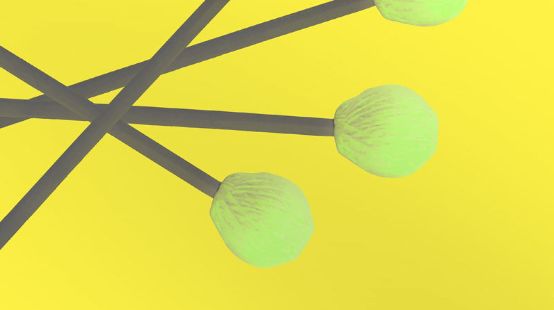
In Áskell Másson's "Fo(u)r Mallets", the stage floor or the conductor's podium can be played on. However, the composition is notated very precisely.
Daniel Maggi
(translation: AI)
- Feb 25, 2020
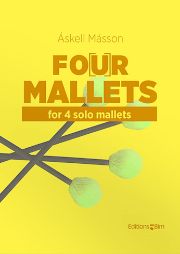
Excerpt from the title page
In 2015, Evelyn Glennie celebrated her fiftieth birthday, for which the Icelandic film composer Áskell Másson wrote her this gift, which consists of exactly fifty bars.
As the title Fo(u)r Mallets the work is played with four mallets. The rhythm and tempo of the performance are notated very precisely, just as the performance at the beginning and in between is described with centimeter precision: "... bring the hands halfway up to the face and strike the two mallets against each other about one centimeter behind the heads ..." From quarter triplets to 32nd figurations and 2:3 combinations, everything is demanded of the player technically.
The composer leaves the greatest freedom to the instrument. The surface on which the music is played should be freely chosen, e.g. it can be the floor of the stage or the conductor's platform. The player can stand or sit as desired. "Do not play this piece on four different surfaces and absolutely not on e.g. wooden or temple blocks ..." The four mallets should all have a different hardness, which increases from left to right.
The piece has many dynamic changes, is rhythmically quite impulsive and sounds complex due to the repeatedly interwoven single to triple suggestions: a somewhat unusual but very interesting firework! Due to the freely selectable "instrument", it will shine as a unique sound for each artist.
Áskell Másson: Fo(u)r Mallets, for 4 solo mallets, perc 42, Fr. 12.00, Editions Bim, Vuarmarens
Mendelssohn's organ music
The new publication by Birger Petersen and Michael Heinemann does not provide any specific interpretation tips, but it does provide a lot of background information.
Volume 7 of the Studies on organ music published by the Butz-Verlag, highlights various aspects of the organ works of one of the most frequently performed organ composers of the 19th century in 17 articles and 4 appendices. Mendelssohn's biographical relationship to the organ, the aesthetic context of his works as well as a brief outline of his registration practice and the general handling of the organ as an instrument at that time form the first part.
The subsequent, detailed analyses of his central organ works (Sonatas op. 65, Preludes and Fugues op. 37) provide valuable information on their formal and harmonic conception and sometimes surprising insights into the connections between the individual sonata movements, which on closer inspection appear less disparate than one might think at first glance. Unfortunately, there is a complete lack of practical consequences from the general observations or the analysis of the individual works, and much-discussed aspects of the musical text (dealing with Mendelssohn's - often inconsistent - bowing, questions of articulation and phrasing), which would be relevant for interpretation, are unfortunately not addressed here.
A third section - in addition to an overview of existing transcriptions of other works by Mendelssohn up to the present day - examines the impact of his example on the German organ sonata, but also on organ music in England and the Netherlands, where his organ music was particularly well received and had a formative effect. This should arouse the curiosity of some readers to take a closer look at the works mentioned. Particularly worth reading is the appendix with a detailed list of works and some highly differentiated and subtle reviews of Mendelssohn's organ music by Robert Schumann, August Gottfried Ritter and other critics in the 19th century.
Conclusion: A collection of texts which - without really giving specific interpretative advice - provides a wealth of information and can thus contribute to a better understanding of this music and its environment.
On the organ music of Felix Mendelssohn Bartholdy. Studies in Organ Music, Volume 7, edited by Birger Petersen and Michael Heinemann, 253 p., approx. € 19, Dr. J. Butz-Musikverlag, Cologne 2018, ISBN 978-3-928412-26-1
Melodious etudes
The "Capriccios and Exercises for the Violoncello" by Robert Lindley are not only good as etudes.
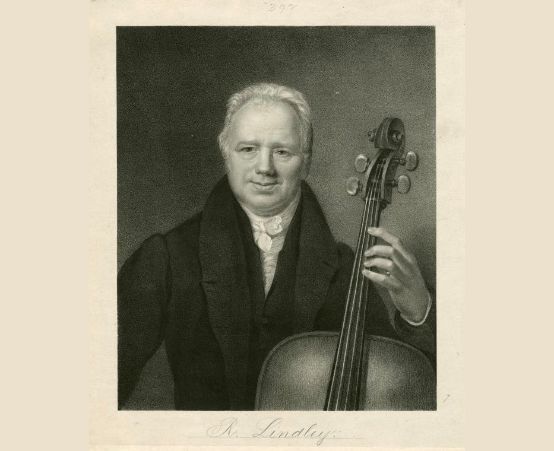
Robert Lindley (1776-1855) was considered the most important cellist in England for over 50 years and was appointed the first professor of cello at the Royal Academy of Music in London in 1822. He wrote mainly for his instrument, including four cello concertos and chamber music. In the etude literature for cellists, his twelve etudes, published in 1826, are among the most important. Capriccios and Exercises for the Violoncello op. 15 is not part of the standard repertoire, wrongly so, as a closer look soon reveals.
Lindley's Capricci are mostly in two movements and, with the exception of numbers 1 and 2, deal with several technical problems in one piece. Numbers 1 to 4 are in the first to fifth positions, from number 5 onwards the thumb attachment is required. Particularly instructive are the diverse and varied double-stop passages, which extend to decimals.
The Urtext edition, edited by Valerie Walden and based on contemporary sources, contains the original fingerings and bowings. Alternative fingerings are consistently placed under the staff, added slurs are printed in dotted lines. The clef notation is adapted to today's standard without octave treble clef. The generously proportioned edition even contains fold-out pages to make leafing through it easier.
Regrettably, the composer did not compose a second cello part, as this would have further enhanced the melodious capricci for concert use.
Robert Lindley: Capriccios and Exercises for the Violoncello, op. 15, edited by Valerie Walden, BA 10936, € 16.95, Bärenreiter, Kassel 2019
Expressive singing
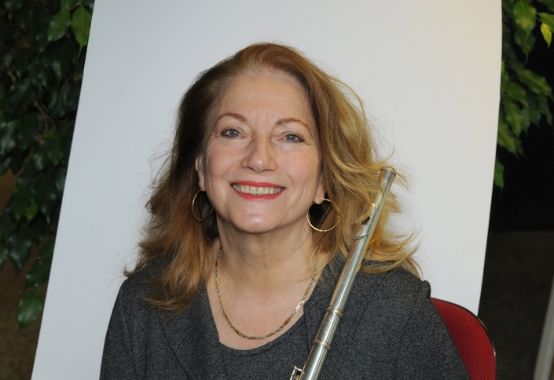
The two performers, Ursula Büttiker and Minako Matsuura, base their selection of pieces for flute and piano entirely on the French tradition.
Walter Labhart
(translation: AI)
- Feb 24, 2020
Ursula Büttiker. Photo: Venla Kevic
Swiss flautist Ursula Büttiker already attracted attention with her first CD releases. The last student of André Jaunet, she also took singing lessons. So it is no wonder that her flute playing is primarily aimed at expressive cantabile.
The musician champions little-known works with the passion of a discoverer striving for counter-positions. Made the CD Musical Postcards with rarities by Pál Járdányi or Bryan Kelly, the follow-up production, all works for solo flute, stood out with works by Jindřich Feld and Saverio Mercadante.
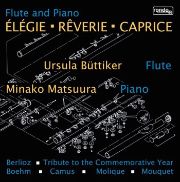
The CD produced to mark the 150th anniversary of Hector Berlioz's death is entirely in the French tradition shaped by the flute maker and composer Theobald Boehm Élégie - Rêverie - Caprice with pianist Minako Matsuura playing along with a keen ear. At the center is Jules Mouquet, a Rome Prize winner inspired by Greek mythology. In his La Flûte de Pan In her sonata from 1906, impressionistic moods alternate with brilliance and virtuosity in a classical manner just as frequently as the dynamic contrasts. Although she manages with a minimum of vibrato, Ursula Büttiker develops impressive expressivity even in very low registers. Her bravura breathing technique benefits strongly chromaticized runs; the pianist's delicate touch enhances the sound magic of the many delicate echo effects.
Typical French elegance fills both the Cinq Pièces brèves from Mouquet, Chanson et Badinerie by Pierre Camus as well as the Élégie op. 47 by Theobald Boehm and the music crowned by a tarantella Three musical sketches by Wilhelm Bernhard Molique, who shares the same year of death as Berlioz. In Rêverie et Caprice op. 8, Berlioz's only concertante work, thanks to the subtle arrangement for flute and piano by Hans-Wolfgang Riedel, it is impossible to tell that it was originally set for violin and orchestra and is based on sketches for Teresa's cavatina from the opera Benvenuto Cellini based.
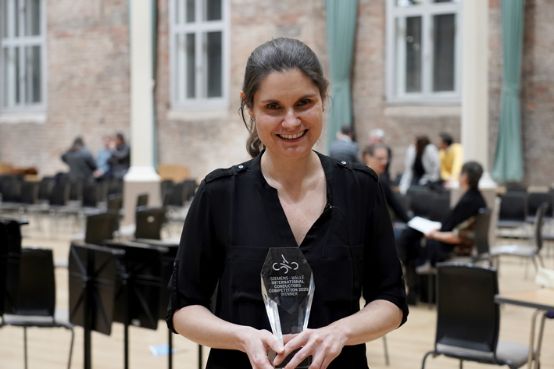
Bulgarian conductor Delyana Lazarova is the winner of the first Siemens Hallé International Conductors Competition. The prize money amounts to 19,000 Swiss francs (15,000 pounds).
PM/Codex flores
(translation: AI)
- Feb 24, 2020
Delayana Lazarova. Photo: Hallé
The award also includes a two-year engagement as Assistant Conductor in Hallé and the position of Musical Director of the Hallé Youth Orchestra.
In 2019, Lazarova won the first conducting competition of the National Radio of Albania and the James Conlon Conducting Prize of the Aspen Music Festival. She is currently studying for a master's degree in conducting with Johannes Schläfli at the ZHdK (Zurich University of the Arts). She has already completed a master's degree in violin at Indiana University (USA), where she graduated with honors.
Her current engagements include conducting the Hungarian National Radio Symphony Orchestra, the Albanian Radio Television Symphony Orchestra and the Italian Solisti Aquilani. Her ZHdK studies also include a debut with Carmen at the Meiningen State Theater in Germany.
Gebert teaches in Zurich
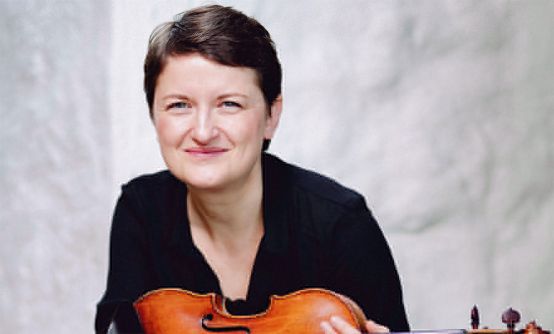
The Zurich University of the Arts (ZHdK) has appointed Anna Gebert as its new principal violin lecturer.
PM/Codex flores
(translation: AI)
- Feb 21, 2020
Anna Gebert (Image: ZHdK)
From the 2020/21 academic year, Gebert will join the Zurich Violin College with Ilya Gringolts, Andreas Janke, Rudolf Koelman, Sergey Malov and Alexander Sitkovetski. The Polish-Finnish violinist completed her studies at music academies in Europe and the USA. She is just as much in demand internationally as a teacher as she is as a musician in renowned orchestras and at numerous festivals. Her profound knowledge of historical performance practice and contemporary music enriches the ZHdK's existing expertise.
Symphony No. 9
Beethoven every Friday: to mark his 250th birthday, we take a look at one of his works every week. Today it's his Symphony No. 9 in D minor.
Michael Kube
(translation: AI)
- Feb 21, 2020
There are probably no more than a dozen compositions of classical music that have found a permanent place in the public consciousness. The reasons for this are extremely varied; they range from their frequent use on official occasions, in radio, film and television to sometimes not-so-local traditions. Hand on heart: who hasn't heard a more or less festive performance of Beethoven's Ninth on New Year's Eve or New Year's Day, at the end of which the singing seems to eclipse everything symphonic? At least in this sublime moment, it is as if - despite many everyday experiences - all people really are brothers. Moreover, this "Ode to Joy" has never been a bad substitute when no national anthem was available or would fit (for example in Rhodesia, in Kosovo or at the former entry of all-German teams at the Olympic Games). In all these cases, however, Friedrich Schiller's visionary verses were not sung, perhaps not even considered. The same applies (unfortunately) to its official use as the European anthem (since 1985). wordless arranged by Herbert von Karajan in the versions for piano, wind orchestra or orchestra.
There was no shortage of arrangements in the 19th century. Even then, the crucial question was how to deal with the text and the vocal parts. Franz Liszt's virtuoso transcription for piano two hands (1853), for example, became a piano reduction in the finale. Years earlier, Carl Czerny had already had reservations about such a performance when he made his own arrangement for piano four hands: Where should the vocal parts have been inserted, since (as is still customary today) the two players are assigned the left and right pages of the open edition respectively? And so the Leipzig publisher Probst finally published a piano volume in landscape format, while the vocal parts were enclosed separately in portrait format. In a letter dated September 3, 1828, Czerny had expressed himself even more pragmatically (and as we know today: with almost clairvoyant abilities): "The future will appreciate the greatness of musical composition so much that it will forget the words."
This year, the Bürgi-Willert Foundation's Culture Prize, endowed with 50,000 Swiss francs, goes in equal parts to the two Bernese musicians Shirley Grimes and Meret Lüthi.
Music newspaper editorial office
(translation: AI)
- Feb 20, 2020
Meret Lüthi (Photo: Guillaume Perret)
Irish-born singer and songwriter Shirley Grimes has been contributing to the cultural life of the Bern region for decades. She has contributed her musical versatility to various bands, but has also realized many of her own projects.
Over the past twelve years, Bernese violinist Meret Lüthi has built up the Bernese early music orchestra "Les Passions de l'Ame" and positioned it on the international music scene. She has discovered and publicly performed or recorded numerous baroque works.
Since 1992, the Bürgi-Willert Foundation has awarded a cultural prize every two years. It is awarded to people who have enriched Bern's cultural life for many years.
Kopatchinskaja is an honorary member of Vienna
Bern-based violinist Patricia Kopatchinskaja and baritone Christian Gerhaher have been appointed honorary members of the Wiener Konzerthausgesellschaft.
Music newspaper editorial office
(translation: AI)
- Feb 19, 2020
Patricia Kopatchinskaja. Photo: zVg
The 1913 statutes of the Wiener Konzerthausgesellschaft, founded in the same year, already provided for the possibility of appointing honorary members. The first use was made of this in 1937, when Felix Stransky, financial officer and member of the management of the Wiener Konzerthausgesellschaft, was appointed the first honorary member, the second being Richard Strauss in 1938.
The Moldovan-born violinist Patricia Kopatchinskaja initially studied violin with Michaela Schlögl, a student of David Oistrakh. In 1989, her family emigrated to Vienna, where she continued her studies at the University of Music and Performing Arts Vienna. At the age of 21, she moved to the conservatory in Bern on a scholarship. She graduated there with distinction in 2000.
After serving as Artistic Partner of the Saint Paul Chamber Orchestra in the USA from 2014 to 2018, she took over the artistic direction of Camerata Bern at the end of 2018, with whom she has since staged the projects "War and Chips" and "Time and Eternity".