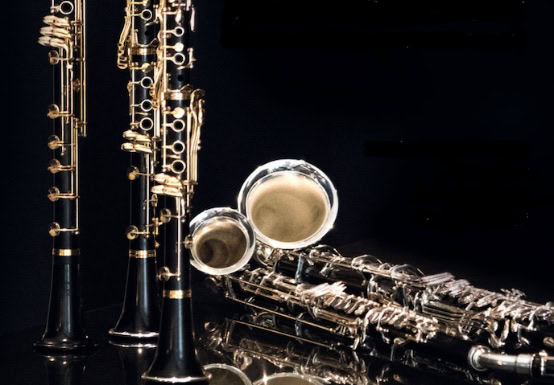
Saxophone sounds

On the current albums of the Bernese formation Klapparat or the composer Thomas K. J. Mejer, the instrument presents itself between improvisation and border areas.

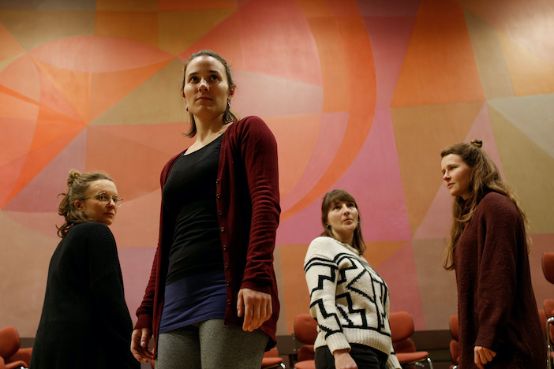
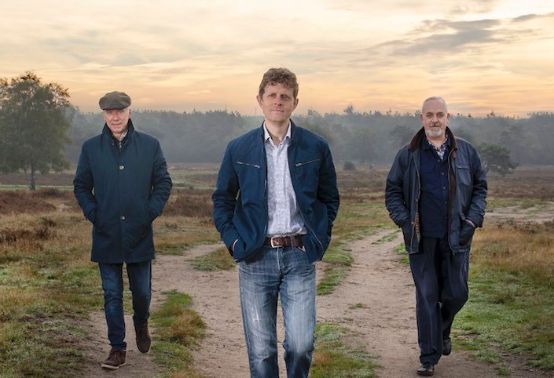
The saxophonists of "Uneven Same". Photo: zVg

The saxophone, patented in 1846 and invented by the Belgian Adolphe Sax, only began its triumphal march with the emergence of jazz in the US music metropolis of New Orleans. As early as 1929, the German music critic Alfred Baresel called it the "most important melody instrument of the genre". Two new publications prove that it has long been central in other areas too.

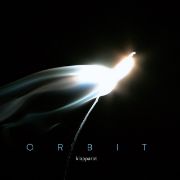
The trail first leads to Klapparat, who reformed in 2021 and are no longer a sextet but a quintet with four saxophones and drums. Their current album Orbit shows that the band, most of whom come from Bern, have not only changed their line-up, but have also realigned themselves: Klapparat have already managed to distinguish themselves with inventive improvisations and rumbling street jazz. Now, however, their work has reached a new level. Not least because it has proven to be a clever move to enrich their sound with a tubax - a bass saxophone. This makes for particularly low tones, ones that creak and growl. The result is tracks like Lydian sufferingsthat runs riot between the elegant and the intricate, or like Evening lightwhich gradually reveals itself to be a drama. Other highlights include the frankly swinging Part 3 and Fields - a finely layered number that knows how to impress with continuously varying atmospheric images. Songs like the ones mentioned above make it clear that Klapparat can work with Orbit has succeeded in creating a playful, dynamic and innovative work.

Folding apparatus. Photo: Stefan Marthaler

In comparison, the saxophone quartets written by Thomas K. J. Mejer present themselves as straightforward and downright brittle. His eleven pieces, performed by the four saxophonists Silke Strahl, Vera Wahl, Eva-Maria Karbacher and Manuela Villiger, are edgy and rely on sounds that are rhythmically complex and challenging. While Sulpician imagery I-IV flirts with interjections that prove to be light-footed, pleasurable and capricious, the subsequent Dark Snow Falls upon the Bagpipers on four identical alto saxophones. However, their interplay does not result in anything conformist, but rather a kaleidoscope of filigree sounds that stimulate the imagination and evoke various images. Sometimes they are reminiscent of clattering typewriters, sometimes of alphorns at dawn. The sounds on offer, which are on the borderline between new music and jazz, do not necessarily nestle in the ear, but they do provide in-depth insights into a jagged world of sound. If you take the time to listen to this music, you will inevitably come to the conclusion that it is worthwhile to explore it: Creativity is alive and well here.

Image

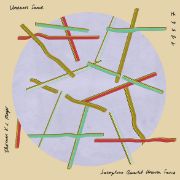
Saxophone quartets by Thomas K. J. Mejer: Uneven Same. Manuela Villiger, Eva-Maria Karbacher, Vera Wahl, Silke Strahl, saxophones. Wide Ear Records WER065

Image

Klapparat (Daniel Zumofen, Charlotte Lang, Ivo Prato, Matthias Wenger, saxophones; Philipp Leibundgut, drums): Orbit. www.klapparat.ch


Cheers to the emotional world

Stefanie Tornow and Beat Baumli came together during the pandemic. Their joint debut is based on jazz classics, which they shape in their own individual way

Stefanie Tornow and Beat Baumli. Photo: zvg

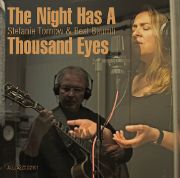
Corona has prevented some things, but sometimes it has also encouraged new things: During the lockdown, Munich-based singer Stefanie Tornow was looking for opportunities to rehearse her projects and ended up on JamKazam, an internet platform for jam sessions. Beat Baumli - a guitarist trained at the Swiss Jazz School and Berklee College of Music - was also on the site. After the two met during an online session, they soon decided to join forces and their debut album The Night Has A Thousand Eyes before. On this album, her focus is particularly on the Great American Songbookbut also bossa nova classics such as "Berimbau". The Swiss-German duo is not out to reinvent the wheel as far as the sound spectrum is concerned, but to give the 16 songs as personal a touch as possible - with a sound that is calm, relaxed and upbeat at the same time.

While the title track in the 1964 version by John Coltrane was still dense and urgent, in the arrangement by Tornow and Baumli it is cuddly, light-footed and a hymn to the turbulent world of emotions. The original composition Chasin' Wes meanwhile, turns out to be a finger-snapping homage to guitarist Wes Montgomery, who is one of Baumli's role models. And Moon River by Henry Mancini, another cover, is freed of any sentimentality by the duo, which gives the melancholy of the melody more contour.

The album is characterized by the singer's velvety voice and the sensitive guitar playing of her partner. The fact that there is only one single, albeit extremely skillful and stylish piece from her pen on the record may be a small shortcoming. At the same time, however, the work shows that there is still a lot of potential in this collaboration. It will be interesting to see what songs the duo will come up with together in the future.

Image

Stefanie Tornow & Beat Baumli: The Night Has A Thousand Eyes, All Jazz Records AllJazzCD2101

How does the Pfleger shelf from 1644 sound?

Only two instruments by organ builder Johannes Christophorus Pfleger have survived. Thanks to this CD, they have been documented together on a recording for the first time.

On display in Willisau: the shelf by Johannes Christophorus Pfleger. Photo: zvg

The enterprising director of the Willisau Musical Instrument Collection, Adrian Steger, and organist Zeno Bianchini have produced a recording that is inconspicuous in appearance, but is a gem for organologists and music historians. Bianchini works in Stockach (Baden-Württemberg). In the Loreto Chapel there is a positive organ by Johannes Christophorus Pfleger (1602-1674). This organ, together with the Pfleger shelf from 1644, which can be seen today in Willisau, is the only surviving instrument by this important organ builder from Radolfzell (Lake Constance) and Thann (Alsace).

Tongue whistle of the Pfleger shelf. Photo: zVg

The original surviving shelf was built for the Frauenthal convent (canton of Zug) and, according to a note from 1688 in the diary of Abbess Verena Mattmann, was used to accompany Gregorian chant. The Lucerne instrument collector Heinrich Schumacher (1858-1923) bought the Pfleger shelf from the Cistercian nuns and exhibited it with other musical instruments in hotel halls. The Schumacher collection was later transferred to the Richard Wagner Museum in Tribschen and in 2010 to Willisau. This playable reed instrument from the 17th century has now been documented on a recording for the first time. Bianchini alternates between playing works by Frescobaldi, Ferrini, Froberger, Buxtehude and other Italian and German composers of the 17th century on both instruments.

The shelf was popular in homes and churches four hundred years ago. But our ears first have to get used to the special sound. It expands our idea of pre-baroque music.

Image

"Qui pulchrè hanc calluit artem" - who understands art excellently. Sound portrait of the two surviving organ instruments by Johannes Christophorus Pfleger (1602-1674) from Radolfzell. Zeno Bianchini, organ and shelf. Source of supply: info@musikinstrumentensammlung.ch

Laconic wit, a spirited groove

The latest album by Simon Hari, alias King Pepe, is playful, quirky and also deeply serious. You can't hear his down-home origins at all.

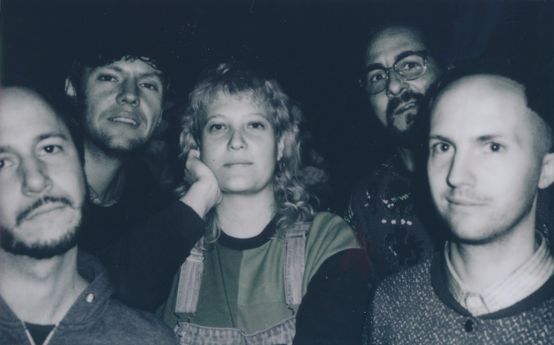
king pepe & the queens. Photo: zVg

Not for one synth beep would the suspicion arise that to hell with eternity like so many other albums in recent months, is a remote-controlled lockdown opus. On the contrary, the rhythms hit your legs like a red arrow and the laconic vocals of himself, the King Pepe, are no less laconic, melancholy and lazy than those on his earlier works. The album was recorded almost entirely at a distance. "So recording tracks and sending them to each other and sending them back again, etc.," writes Simon Hari, the carnal manifestation of the eccentric muse King Pepe, by email. "Later, it would have been possible to go into the studio together, but we thought the distance recordings were great and said: Come on, let's finish it like this!" Previously, the processes would have taken more time. "Normally I'd say in the studio: Hey, let's try this chorus again in a different way, so cheesy, so smooth or whatever. Here, this feedback was given by email or telephone, and it took another ten days before a new version was available."

Ironically, Hari's last album Karma OK The album was put together entirely on the computer and then painstakingly "brought to life" with co-producer Rico Baumann. This time, in addition to Baumann (drums, keys), Sibill Urweider (keys, vocals), Jeremias Keller (bass, vocals), Giulin Stäubli (drums) and sound engineer Sander Wartmann were also present, albeit in their "respective homes" (as it says on the cover drawn by Hari's nine-year-old son). Hari himself contributed guitar, piano, trumpet and piccolo to his often succinct Bernese-German lyrics, which are peppered with all kinds of double and triple entendres. "I found it impressive," he reports, "how easily life comes into it with genuinely played music. You get the full life for free. Through all the Veler, the funny stuff! It's beautiful! Even if it's not recorded in the same room!"

To hell with eternity begins with a smash hit, namely the title track. The synth bubbles and buzzes almost like in the eighties, percussion and drums gallop along like horses. Meanwhile, King Pepe bemoans his Tannhäuser-like fate: surrounded by ethereal dancing angels who are always smiling stupidly, he sits in heaven and is mortally bored. The neon light dazzles endlessly and the angelic music is exclusively in C major. With its psychedelically varied Giorgio Moroder groove, the sardonic Geit scho and literally cries out for an eleven-minute "Extended Disco Mix" maxi single. Hey moon is a nostalgic ode to the ailing celestial body: "Mier geits mängisch äänlich, nimm's bitte nid nid so schwär." Fingiguet is a minimalist hymn to the general "feeling good" and Stoubsuger a dreamy, crooned love song with a brilliant climax. Playful, versatile, ironic, a little eccentric, but also deeply serious - magnificent.

king pepe & the queens,to hell with eternity, Big Money Records

Plea for an anticyclist

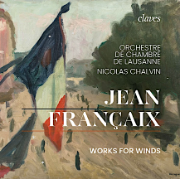
A double quintet of the Orchestre de chambre de Lausanne presents the entertaining wind music of Jean Françaix.

Orchestre de chambre de Lausanne. Photo: Federal studio

His music is full of wit, sparkling ingenuity and rhythmic sophistication: We are talking about Jean Françaix, a unique figure of the 20th century. Born in Le Mans in 1912, the French composer was anything but an avant-gardist; his music is based on Stravinsky's neoclassicism, but also internalizes the elegance and finesse of Francis Poulenc and the Groupe des Six in general. Françaix remained true to his line until his death in Paris in 1997.

While he achieved his international breakthrough in 1936 in Baden-Baden with a Concertino for piano and orchestra, he is particularly distinguished by his extensive oeuvre for wind instruments. The unusual instrumentation of his entertaining wind music is probably the main obstacle to its widespread distribution. Examples of this are his well-known Neuf pièces caractéristiques which were composed for ten wind instruments and are therefore rarely heard in the concert hall.

The wind section of the Orchestre de chambre de Lausanne under the direction of Nicolas Chalvin now remedies this, at least on CD. One marvels at the rhythmic accuracy of the motoric progression of the introductory Presto and the profundity of the elegiac, charming Amoroso that follows. It is a strong plea for music that is little known to the public.

The program sequence is cleverly structured, which sensibly begins with a Musique pour faire plaisir by Poulenc-Françaix, which puts us right in the middle of this rare, witty and eloquent "musical idiom" with two flutes, oboes, clarinets, bassoons and horns. Many of the pieces presented are arrangements, such as three Écossaises by Chopin or the Cortège burlesque by Chabrier.

The recording ends with Trois marches militaires by Schubert-Françaix, which are sometimes reminiscent of wind serenades from the early Classical period, but also seem somewhat lengthy, although the ensemble is stylistically confident in its use of the pieces. As a caveat, it should be noted that the "miniatures", most of which do not last longer than two minutes, can be tiring for an audience that is not exclusively affine to wind instruments.

Image

Jean Françaix: Works for winds. Orchestre de chambre de Lausanne; conductor Nicolas Chalvin. Claves CD 50-3032

Adventure stories, sometimes hairy, sometimes Atlantic

Two successful CDs for children: "Struwwelpeter - a (hairy) story" performed by a quartet from the Basel Chamber Orchestra and "Rubato and the wild ship's orchestra" by Musique Simili.

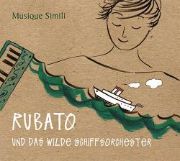
Drawing by Juliette Du Pasquier from "Rubato and the wild ship's orchestra"

Parents have to be, but they are not always the best advisors. There are helicopter fathers and mothers, there are doubters and worriers who sometimes deprive their children of their own experiences. This is what comes to mind when you listen to the wonderful CD Struwwelpeter - a (hairy) story listens. Four members of the Basel Chamber Orchestra have often played history and music in classrooms.

The children's book Struwwelpeter by the psychologist Heinrich Hoffmann was published in 1845. Hoffmann originally intended it as a Christmas present for his three-year-old son. But lo and behold, by the time the author died, the book had already sold 950,000 copies and become an evergreen. Who doesn't know them, the sometimes cruel Tales of the Soup Punch, from Hanns peek-in-the-air or from the Thumbsucker?

Eva Miribung (violin), Georg Dettweiler (violoncello), Konstantin Timokhine (horn) and Jan Wollmann (trumpet) not only tell stories. They also choose and play the music with great taste. Story of the evil Friederich excerpts from the sombre cello concerto by Dmitri Shostakovich. The story of the black boys accompanied by tongue-in-cheek reggae and ska rhythms. To the Fidgety Philipp the quartet intones chamber music arrangements of passages from Richard Strauss' Till Eulenspiegel's funny pranks.

Parents and their admonitions come off badly on the CD. Hanns looks up in the air, but the parents - no better - stubbornly look at their cell phones. At least that's what the children say, who also have their say. Their refreshing comments show that the parents don't need to worry about the potential cruelty of the stories. Perhaps they shouldn't put them on for a four-year-old to fall asleep to. But for all children from first to fourth grade, it's a great CD, especially musically educational. "Scary, but exciting," comments one girl The sad story of the lighter.

A quartet of the Basel Chamber Orchestra sings and plays Struwwelpeter, a (hairy) story. Solo Musica SM 355

Rubato is an elastic term. This time it is not a performance instruction, but the name of the boy who sets off as a stowaway on the Santa Helena - the ship that will set sail for Buenos Aires. As an accordion player who is Rubato, he can of course hardly imagine a more attractive place than the Argentinian capital, "where the dance of all dances is danced".

So the tango takes center stage. But there is not just a tango on the keyboard or a tango finale, but a colorful bouquet with waltz or Csárdás elements or with song additions by Franz Schubert. All this music is beautifully interwoven with the story told by Stella Hänsenberger and created by Zurich poet Rainer Frei. Rubato meets Sordina, the violinist of the wild ship's orchestra. After all the quarrels with Capitano Spavento, Rubato is finally allowed to play in the wild ship's orchestra - and it gets even better ...

Erlach-based Edition Simili presents a great children's CD with a beautifully cardboard and illustrated cover. The target age group of around four to seven years old will not usually be able to do much with the illustrated sheet music. But perhaps the parents can play a little bedtime encore?

Rubato and the wild ship's orchestra. Story by Rainer Frei; drawings by Juliette Du Pasquier; music by Marc Hänsenberger; Musique Simili. Audio book with or without CD. Edition Simili

From high to contra-low

Works for various clarinet instruments and piano by August Walter, Othmar Schoeck, Jean-Luc Darbellay and David Philip Hefti.

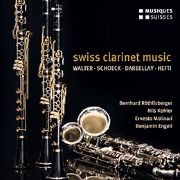
Excerpt from the cover

Last year, three clarinettists and a pianist made a virtue of the coronavirus emergency and recorded a concert with works by four Swiss composers from the Romantic period to the present day. It is extremely entertaining and stimulating to listen to because they use six different instruments of the clarinet family, plus a piano in three pieces. And: all the musicians are masters of their craft.

The very first work, Fantasy and Capriccio op. 13 for clarinet and piano by the forgotten Romantic composer August Walter is captivating: The Fantasy is reminiscent of Carl Maria von Weber, the Capriccio to Schumann. In this premiere recording, they are presented by Bernhard Röthlisberger (clarinet) and Benjamin Engeli (piano).

Röthlisberger also plays the beautiful Canto for bass clarinet (2012) by David Philip Hefti (*1975), where multiple sounds reminiscent of medieval polyphony appear. His internalized trio shows how Hefti skilfully combines baroque elements with contemporary ones Counterpoints on Come, Sweet Death (2000, after Bach's chorale Come, sweet death), sensitively interpreted by Röthlisberger, Nils Kohler and Ernesto Molinari. Two bass clarinets in dialog allow Röthlisberger and Kohler to play in Hefti's (T)raum-Ze(n)it (2008), whose complexly interlaced title already hints at what the composer is concerned with here: the connections between space and time, which can lead to unreal dream images.

Othmar Schoecks Andante E flat major WoO 35 for clarinet and piano is presented by Röthlisberger and Engeli as a premiere recording. It is astonishing that such a fascinating work from 1916 had to wait so long to be recorded. The repertoire, on the other hand, includes Schoeck's Sonata op. 41 for the same instrumentation from the border area between late Romanticism and extended tonality, excellently interpreted.

The Bernese composer Jean-Luc Darbellay (*1946) is represented with two characteristic works: Sentences, written in 2009 as a compulsory piece for the Concours National d'Exécution Musicale de Riddes and arranged for basset clarinet in 2020, nine pieces, some of them very short, that encourage listeners to reflect and think about music. The same applies to Darbellay's Chant d'adieux (1998), which he premiered as a clarinettist with his wife Elisabeth at Wartburg Castle near Eisenach: wonderfully calm, delicate music that one would like to hear again and again.

Image

Swiss Clarinet Music: August Walter, Othmar Schoeck, Jean-Luc Darbellay, David Philip Hefti. Bernhard Röthlisberger, Nils Kohler, Ernesto Molinari, clarinets; Benjamin Engeli, piano. Naxos Musiques Suisses NXMS 7002

Culture is the quintessence

Together with his trio, jazz violinist Tim Kliphuis has created an album in lockdown that reflects on the way we treat our planet.

Tim Kliphuis (center), Nigel Clark (left) and Roy Percy (right). Photo: zVg

"Never waste a good crisis" - this Churchill quote was the response of one of the musicians involved when Dutch jazz violinist Tim Kliphuis asked him to join his trio (with Nigel Clark on guitar and Roy Percy on double bass) for this production. The project was created during the first lockdown in spring 2020, when the musicians' agendas emptied and all their gigs were canceled. The album was produced in studios in the Netherlands, Ireland and Scotland, largely using the playback method. The Five Elements is a reflection on how we treat our planet and an expression of the hope that we can preserve the earth as a habitat for ourselves and our descendants. The fifth element, the "quintessence", stands for culture, especially music, which reaches our innermost being and teaches us to live in harmony with our vulnerable environment.

Anyone who dismisses this program as esoteric stuff fails to appreciate the sincere commitment of the musicians involved and their high level of professionalism. Using the vocabulary of jazz, minimal music and classical elements, they have created music that captivates the listener for its entire duration. Ostinate tutti passages alternate with imaginative solos and groovy riffs. Tim Kliphuis, also known in Switzerland as an inspiring teacher through his workshops at ESTA, ZHdK, Konsi Bern and Swiss International Music Academy, moves very skillfully in this crossover area and constantly discovers new ways of combining classical, jazz and world music to create stimulating compositions. The fact that he is a virtuoso violinist and surrounds himself with equally outstanding musicians only enhances his musical message. The piece Threnody (Lament) is an improvisation on Bach's Chaconne with string quartet, which essentially follows the original and reflects on it again and again in a predominantly baroque style. Here, too, the playing is virtuosic and spotless.

Image

The Five Elements. Tim Kliphuis Trio and Ensemble. Lowland Records, also on www.timkliphuis.com

Joseph Lauber's symphonies

The first of three recordings of these works has been released on the Schweizer Fonogramm label. The Biel Solothurn Symphony Orchestra is conducted by Kaspar Zehnder.

Joseph Lauber. Excerpt from the CD cover

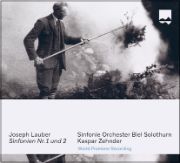
"Tradition is not the worship of ashes, but the passing on of fire." - A quote that is attributed to Gustav Mahler as well as Thomas More. On the cover of the first recording of Joseph Lauber's Symphonies Nos. 1 and 2, the Swiss composer is depicted adding twigs to a fire with a pitchfork. Conductor Kaspar Zehnder discovered Lauber's symphonic works in the Lausanne University Library and has now released a technically exemplary recording with his Biel Solothurn Symphony Orchestra (sound engineer: Frédéric Angleraux) on the new Schweizer Fonogramm label. Two more albums with Symphonies Nos. 3 to 6 will follow in the course of the year. No ashes are unearthed here, but blazing embers. Although Joseph Lauber (1864-1952) does not present himself as an innovator in the symphonies composed in 1895/96, his approach to tradition certainly has its own character.

Musically inspired by his teachers Joseph Rheinberger and Jules Massenet, he combines German late Romanticism with French refinement in the use of color. His symphonies are characterized by elegance, fine differentiation and a rather two-dimensional structure. And occasionally also Swiss local color, when he begins the first symphony with a two-part alphorn melody in the horns, which two flutes repeat as an echo and continue symphonically. The first symphony unfolds many lyrical points of calm and lacks any real drama. The warm string sound of the Biel Solothurn Symphony Orchestra, as in the fine unison opening of the Andante espressivo, is the basis of Zehnder's coherent interpretation. Agogic flexibility and dynamic nuance are further quality features. In the fast repetitions, as in the finale, Felix Mendelssohn also looks around the corner. The Second Symphony in A minor combines enchanting themes, for example in the opening movement, with more dramatic developments. The Andantino, quasi Allegretto is reminiscent of Antonín Dvořák in its sweet melancholy. Bohemia in Switzerland - this can also be discovered in Joseph Lauber's music.

Image

Joseph Lauber: Symphonies No. 1 and 2, Sinfonie Orchester Biel Solothurn, conducted by Kaspar Zehnder. Swiss Fonogram

Büchel freshly fathomed

Balthasar Streiff and Yannick Wey have thoroughly explored the sound and repertoire of this old instrument. Now they present an impressive collection of pieces in sound and writing.

Balthasar Streiff and Yannick Wey. Photo: Büchelbox

The Büchel is the handy version of the alphorn, so to speak. The name is derived from the word "bend" and comes from the fact that the sound body is folded twice and is correspondingly shorter. The Büchel is classified as a brass instrument, is covered with birch bark and is similar in sound to the baroque trumpet. Like the baroque trumpet and the alphorn, it has neither holes nor valves, so that the notes have to be produced solely by means of air pressure and embouchure. In an interview on the online platform, Balthasar Streiff explains that the fact that the Büchel still has a rather miserable existence today, when the alphorn is enjoying a boom in a wide variety of musical contexts, is probably due to the fact that it is so difficult to play Open Planet of Sound. "Because everything is smaller than with the alphorn, it's more delicate, more difficult and requires a better approach."

Originally a sculptor, Streiff found his way to music through land art and the concept of exploring "space" through sound. For many years, he has been exploring the sounds of the alphorn and many other natural wind instruments from all over the world. He made a name for himself not least with the experimental duo Stimmhorn, which has released five albums and won the Swiss Cabaret Award. Yannick Wey is a research assistant at the Lucerne University of Applied Sciences and Arts and plays the trumpet and Büchel in various formations and solo.

With the Büchelbox and the simultaneously published music book, which are based on a year of intensive research, the two musicians present the first stylistically, historically and geographically comprehensive collection of Büchel pieces. The chronological arc ranges from the Italian and Austrian baroque composers Bartolomeo Bismantova and Romanus Weichlein to anonymous and "traditional" pieces, which were transcribed by the German musicologist Christian Kaden, among others, to compositions by Alois Bucher, alias Büchel-Wisi, from Schwyz, who died in 2009, and Balthasar Streiff himself. Many of the contributions are linked to the Muota Valley, the Swiss stronghold of the Büchel family, and conjure up images of beautiful mountain worlds simply out of habit. The stylistic diversity of the 47 vignette-like short pieces is remarkable. The Shepherd signals from Thuringia The music is reminiscent of the question-and-answer games in gospel, while the three anonymous duets from Hungary, dating back to the 18th century, strike a higher pitch and sound downright spooky. The fact that the tones sometimes slip naturally and the scale does not fit the conventional radio music of our time anyway, creates a fascinating arc between timeless tradition and experimental modernity.

Image

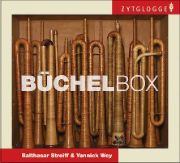
Büchelbox. Balthasar Streiff and Yannick Wey. Zytglogge, EAN 7611698043694

The music book for the CD is published by Müllrad-Verlag in Altdorf (Art.Nr. 1064, Fr. 34.00).

Loosely out of the sleeve

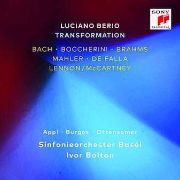
The Basel Symphony Orchestra under the direction of Ivor Bolton has recorded a double CD with arrangements by Luciano Berio: Bach, Boccherini, Brahms, Mahler, De Falla and Lennon/McCartney undogmatically different.

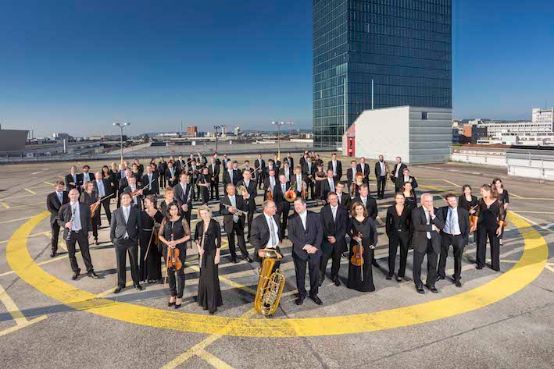
Basel Symphony Orchestra with Ivor Bolton. Photo: Matthias Willi

Luciano Berio was an exceptional composer. As early as the 1960s, he caused a sensation with his "open aesthetics", which led to such key works as the quotation composition Sinfonia (1968/69). "I borrow quotes from the museum," he once said, "and mix them with my own music." The CD recorded by the Basel Symphony Orchestra under the direction of Ivor Bolton with the simple title Transformation now offers special insights. Berio is indeed "open" - open to Johann Sebastian Bach, to Gustav Mahler, but also to Beatles classics such as Michelle, Ticket to Ride or Yesterday.

One could argue for a long time about the terms arrangement, orchestration or instrumentation. In any case, Berio does not engage in the deconstruction typical of the avant-garde in his rearrangements. Bach's Contrapunctus XIX from the Art of the fugue he embeds in a warm woodwind arrangement. The voices now come across elegantly, not with the "X-ray vision" that was still dear to the structurally oriented Schönberg school. In other adaptations, Berio also shows himself from an undogmatic, completely joyful musical side. Fiery Spain is reflected in the transcriptions of Manuel de Falla's Siete Canciones populares Españolas echoes. He orchestrates the sometimes brash, sometimes very intimate songs with tremendous sensitivity to sound, leaving the mezzo-soprano part untouched.

The Sonata op. 120 No. 1 for clarinet (or viola) and piano, written by Johannes Brahms in 1894, sounds like it was written off the cuff. In 1986, Berio orchestrated the five-movement chamber music into a veritable romantic symphony. The Beatles adaptations must be classified as quirky and funny occasional works. However, the strangely baroque, very much in the spirit of the Brandenburg Concertvalues Beatles classics. It is probably more of a private matter than a special contribution to the noble history of music. Cathy Berberian, the American singer and then wife of Luciano Berio, was "crazy about the Beatles" - so why not a baroque love greeting with "I love you, I love you, I love you" from Michelle? Well, all in all an enjoyable double CD, which incidentally also tastes good while cooking.

Image

Transformation. Arrangements by Luciano Berio. Sophia Burgos, soprano; Benjamin Appl, baritone; Daniel Ottensamer, clarinet; Basel Symphony Orchestra; conductor, Ivor Bolton. Sony classical 190759820728 (2 CDs)

Expressive counterpoint

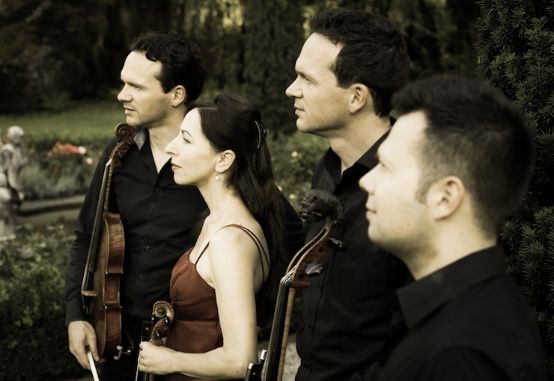
The Casal Quartet and Razvan Popovici bring Paul Müller-Zürich's gripping chamber music out of oblivion.

Casal Quartet. Photo: David Guyot

As a teacher of theory and composition, he influenced several generations of musicians in Switzerland; as an author of choral works, he created something lasting; his equally independent chamber music has yet to be rediscovered: Paul Müller-Zürich (1898-1993) was a gifted teacher and, as a composer, a master of counterpoint. His early works for string instruments bear witness to this.

Trained in Zurich, Paris and Berlin by Philipp Jarnach and Volkmar Andreae, among others, and familiar with the music of his contemporaries, he distanced himself from the avant-garde, preferring to orientate himself towards Brahms and Reger rather than Schoenberg or Webern. Paul Müller-Zürich went far as an advisor and organizer, joining the Pro Helvetia Foundation Board in 1957 before being appointed President of the Swiss Association of Musicians in 1960.

The expressive beginnings of the composer, who was awarded the Music Prize of the City of Zurich in 1953, are impressively demonstrated by the Casal Quartet with Razvan Popovici (viola) in three differently scored works. The String Quintet op. 2 in F major (1919) jumps out at the listener from the very first bar, when a fortissimo chord is followed by an initial ostinato motif pianissimo and the main theme, which soars upwards full of tension, is heard. Disturbingly buzzing presto interjections cloud the gentle flow of the slightly melancholy music in the third movement, an intermezzo that begins sweetly. Ostinati also characterize the finale, which is condensed by fugato interjections and ends abruptly in D minor.

The String Quartet in E flat major op. 4 (1921) is also dominated by highly expressive pushing and storming, with the chromaticism in the Adagio forming the greatest contrast to the less complicated harmony in the folk-dance-like rondo finale.

The String Trio op. 46, composed around 1950, is calm from the outset, with its lyrical first movement leading from C minor to C major. The members of the Casal Quartet charge into the powerfully gripping finale with great intensity of sound and musical esprit.

Image

Paul Müller-Zürich: String Quartet op. 4, String Trio op. 46, String Quintet op. 2. CasalQuartet (Felix Froschhammer, Rachel Späth, Markus Fleck, Andreas Fleck), Razvan Popovici, viola. Solo Musica SM 287

A sensitive cosmopolitan

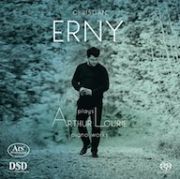
On his second solo CD, Christian Erny reanimates the piano music of the Russian Arthur Lourié.

Christian Erny. Photo: zVg

The melancholy melody of the opening prelude on this CD is almost like a minimalist film score. A waltz hints at Chopin, but is also imbued with a completely different, idiosyncratic color. The later impressionistic play of colors in Deux estampes permeated by a hitherto hardly known, very individual personal style ...

During his studies in the USA, Swiss pianist Christian Erny came across the oeuvre of Arthur Lourié, whose name sounds as "un-Russian" as his music. Is this precisely why Lourié, who was born in what is now Belarus in 1891, lived for a long time in Paris and later in the USA, where he died in 1966, has largely disappeared into obscurity?

On his second solo CD, Christian Erny's playing takes on this world of sound and thought in the most unagitated way possible. Erny knows how to subtly mix the registers and colors as if they were human voices. This is no coincidence, as Erny is very ambitious as the director of his Zurich Chamber Singers and, by his own admission, this brings with it many synergy effects for the pianistic interpretation.

Thus, certain neoclassical traits unfold in Lourié's music in an emphatically weightless and detailed manner, as well as a meditative Intermezzo and later a worn Nocturno touch deeply. But Lourié and his committed contemporary interpreter can also do things quite differently: a furious Gigue becomes an unleashed rhythm and sound study that is much more reminiscent of a rebellious Stravinsky and not at all of baroque models. The ambiguity of Lourié's circumstances is symbolized by a LullabyA lullaby: although still deeply rooted in Romanticism, a second writing unmistakably anticipates the beginning of modernism.

Image

Christian Erny plays Arthur Lourié: Piano works (Cinq préludes fragiles, Deux estampes). ARS Production 38 248 (SACD)


Magnificent, light, humorous

The Musikkollegium Winterthur under the direction of Roberto González-Monjas plays Mozart's Haffner Serenade with light-footedness. In Othmar Schoeck's Opus 1, there are flashes of mischief.

Musikkollegium Winterthur. Photo: Paolo Dutto

He is the comet in Winterthur's classical music sky: Roberto González-Monjas, concertmaster of the local Musikkollegium since the 2013/2014 season, who also performs as a conductor. He also works in the same capacity in Rome with the Orchestra dell'Accademia Nazionale di Santa Cecilia and as a professor of violin at the Guildhall School of Music and Drama in London. A jack-of-all-trades who has been shaking up concert life in the all-too-often overshadowed city of Zurich since taking up his post.

Now, with the Musikkollegium on the Swiss label Claves, he presents a CD that sparkles with verve and lightness. Recorded are the famous Haffner Serenade KV 250 by Mozart and the Serenade op. 1 by Othmar Schoeck, with González-Monjas acting both as conductor and solo violinist. It is astonishing how easily and accentuated the orchestra, which at times seemed rather ponderous under the former chief conductor Douglas Boyd, is now able to play.

The eight-movement Haffner Serenade is both a masterpiece and the conclusion of Mozart's serenade oeuvre. Magnificently scored (with the entire wind section) and thus colorful, it combines symphonic ambition with the entertaining lightness of this genre. As an ingenious special feature, Mozart designed movements two to four as a veritable violin concerto full of song-like quality and virtuosity, a "found food" for the violinist González-Monjas. With his filigree style and wonderfully singing violin sound, he dominates the serenade for long stretches, with sound engineer Andreas Werner emphasizing his art even more. This is a bit of a shame, because the orchestra has a lot to offer, as the witty Schoeck Serenade shows. Once composed as a final thesis in Zurich and reworked in Leipzig, the work pleases with its craftsmanship, humor and sensuality of sound: from the dance-like opening to the magnificent middle section, this eight-minute gem makes a convincing case.

Image

Mozart & Schoeck: Serenades. Musikkollegium Winterthur, conductor Roberto González-Monjas. Claves 50-1710

A master, masterfully played

With their subtle interpretations, Els Biesemans (fortepiano) and Meret Lüthi (violin) make it clear how inventive and sophisticated the chamber music of Franz Xaver Sterkel is.

Franz Xaver Sterkel, etching by Heinrich Eduard Winter 1816 Source: Source gallica.bnf.fr / BnF

Even 14 years after the Ramée label was founded, every CD is still a feast for the eyes and ears. Specializing in early music (in this case defined as up to just over the turn of the 19th century), Ramée does not focus on quantity, but rather brings to light many rarities from the depths of music history in consistently outstanding interpretations, which are then played again and again with lasting enthusiasm.

These treasures also include the chamber music of Franz Xaver Sterkel (1750-1817) - a composer who was widely known as a pianist during his lifetime, whose numerous sonatas and piano trios were held in high esteem by enthusiasts and yet (like so many of his generation) was forgotten far too quickly with the rise of musical romanticism. In addition to an artistic journey through Italy, it was of course not Vienna, Berlin, Paris or London that were the stations of his work, but rather Mainz, Regensburg, Aschaffenburg and Würzburg - places where Sterkel played a decisive role in establishing a lively musical life, but where he also remained true to himself despite the stylistic changes that he was well aware of: Sterkel thus despised the supposedly "unworthy arts", instead seeking "noble simplicity", "pure rhythm" and "harmony and melody" (1808).

This selection of sonatas, which appeared in print between 1785 and 1817, demonstrates that he succeeded in doing so in a remarkably unique language. They combine refreshing inventiveness with a pronounced sense of chamber music dramaturgy (both tonally and harmonically). Els Biesemans (fortepiano) and Meret Lüthi (violin) show just how much creative scope there is in their perfectly executed interpretation. They make it fascinatingly clear what Sterkel's works really contain.

Image

Johann Franz Xaver Sterkel: Sonatas for Fortepiano and Violin. Els Biesemans (fortepiano), Meret Lüthi (violin). Ramée RAM 1701

get_footer();