Hans Gál had to flee from the Nazis; his work fell into oblivion. Now his compositional work is being rediscovered.
Walter Amadeus Ammann
(translation: AI)
- Jun 12, 2025
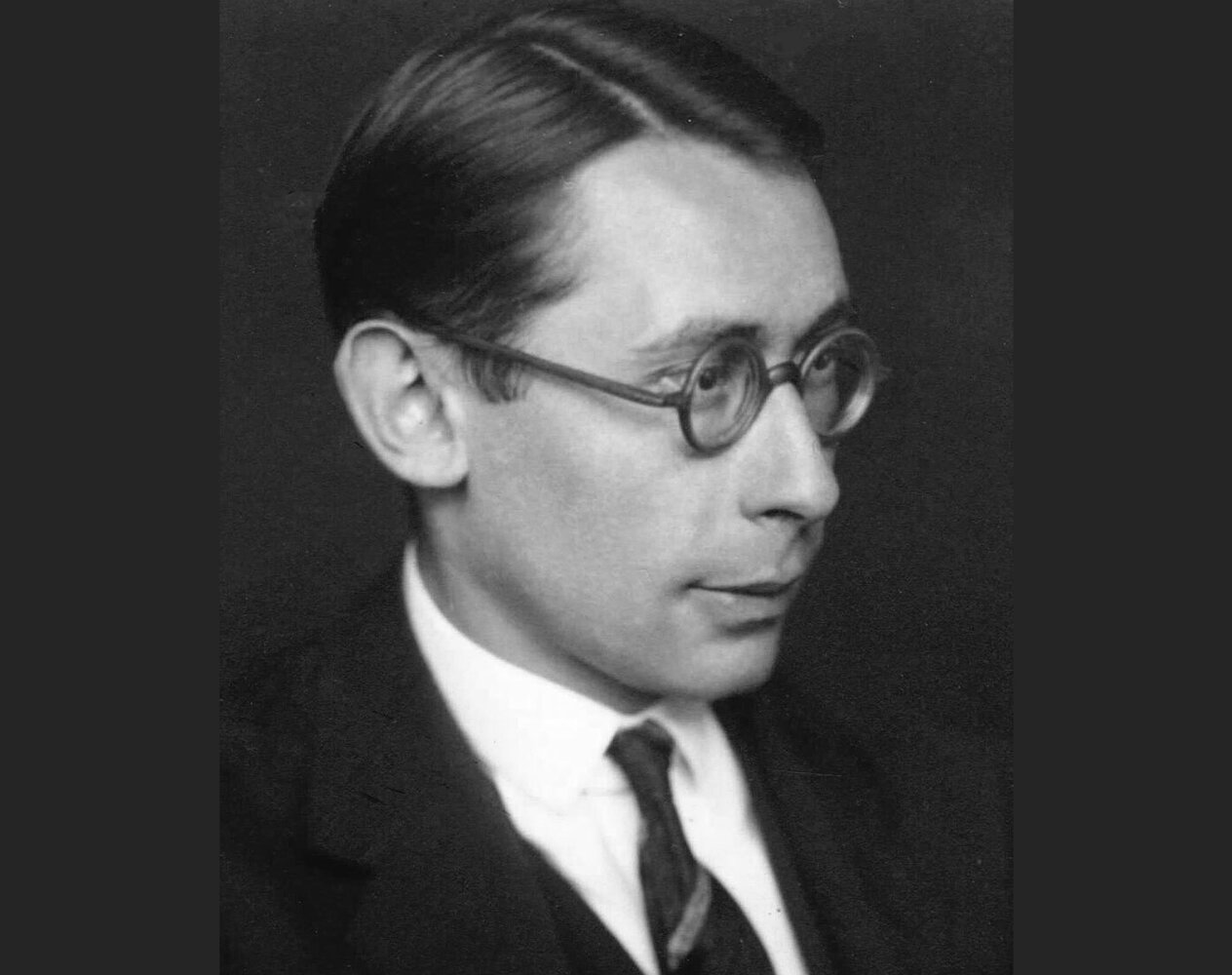
Hans Gál. Photo: Breitkopf & Härtel archive
Hans Gál (1890-1987) was an important man as director of the Mainz Academy of Music and with his compositions (operas, a symphony, songs, chamber music), which were performed everywhere. However, when Hitler came to power, he was banned from working as a Jew in Germany and fled to Vienna, then to Edinburgh when Austria was annexed in 1938, where he worked as a music lecturer until his death. His tonal music, based on Brahms, fell into oblivion as "anachronistic".
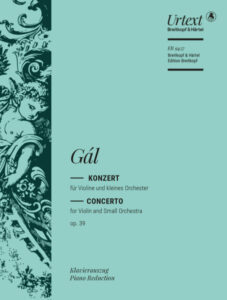
His enchanting violin concerto, composed in 1932 and published by Breitkopf, was premiered in Dresden in February 1933 with Georg Kulenkampff under Fritz Busch. Gál added three cadenzas to the concerto, all of which are also available in the piano reduction. The solo part is closely interwoven with the orchestral parts in a chamber music style, and the music flickers with melodic and harmonic ideas. The concerto was not performed again until 2005. The careful new edition of 2023 compares all existing sources and corrects minor inconsistencies, justified in the critical commentary. The performance material is available for hire.
Hans Gál: Concerto for violin and small orchestra op. 39, edited by Anthony Fox and Eva Fox-Gál, piano reduction by the composer and violin part, EB 9457, € 33.90, Breitkopf & Härtel
Through the symphony orchestra via app
The Tonhalle-Orchester Zürich has developed an interactive game for children to help them get to know instruments, sheet music and composers in a playful way.
Bernhard Suter
(translation: AI)
- Jun 11, 2025
Mouse Pip, spider Fidelia and ghost Gustav guide you through the game.
If you don't go to the opera house, Kunsthaus or Tonhalle as a child or teenager, it will be difficult to find your way there later. The worlds of sound and images remain distant and unapproachable for many. A new app from the Tonhalle Orchestra Zurich now introduces children aged 6 and over to the world of heavenly violins and rumbling basses in High German. Let's go to The magical symphony orchestra: Select your avatar and walk through the colorful entrance into the next room, where Pip, Fidelia and Gustav are peeking out. The mouse, the spider and the ghost live in the Tonhalle because they love listening to music and because there are so many exciting things to discover there. One evening, when the visitors have gone, the three of them find a little book lying on the floor with all kinds of funny characters. A puzzle book?
First puzzle: The instruments are all mixed up and need to be sorted. To do this, drag the picture of the trumpet to the designated orchestra space, followed by the other musical instruments. You've done it! You learn that there are strings, woodwinds and other instrument families. But watch out, Carlos the cat is sneaking into the Tonhalle, high alert for Pip the mouse. Which instrument is best suited as a hiding place? Pip searches for the right hole in various instruments. Short melody fragments of individual instruments are played. In which order were they played? Click and continue.
This is followed by acoustic courses with an instrument-picture-sound-memory, with melodies and graphic note pictures as well as portraits of composers. (Mozart began composing at the age of five. Beethoven at seven. Bach played the harpsichord, violin, viola, organ and sang in the choir. He composed over 1000 vocal works).
Fidelia the spider winds five threads from her body, which form into staves - a small score is created on which you can follow the music being played. It's exciting how music can be written down in musical notation. Or is it the other way around? Seventh and final riddle: What does a conductor actually do? He conducts. And so do we. We use the cursor to draw 4/4 and triple bars on the screen and conduct the Tonhalle Orchestra Zurich.
So, enough learning and practicing (the course lasts about 45 minutes), now the doors to the Tonhalle are open. And you are cordially invited and well prepared.
The game can also be played in English from the 2025/26 season.
Come down
Kristin Thielemann has produced a book with techniques, exercises and advice to help children calm down in music lessons.
Torsten Möller
(translation: AI)
- Jun 10, 2025
Photo: bilanol.i.ua | depositphotos.com
Music teachers are facing particular challenges today: The short pace of life is increasing and our children's attention spans are constantly decreasing. A new picture or voice message here, a link to a cool video there or endless playlists on Spotify or YouTube. A latent restlessness is already spreading in daycare centers and elementary school - in other words, among those age groups that Kristin Thielemann describes in her book Fully relaxed in view.
She describes in practical terms how music teachers can promote calm and concentration in children. Be it through physical exercises, acupressure techniques, listening or making music together or through calming stories with and about music. Thielemann proposes Johann Sebastian Bach's Goldberg Variations before: These could play quietly in the background while the children lying comfortably on mats are told a story featuring Bach and Count Keyserlingk (p. 80/81). Elsewhere, Thielemann describes how children use singing bowls to produce sounds that allow slowness, peace and relaxation to "almost arise by themselves".
Preventing restlessness
The devil is often in the detail - the author also draws attention to this in an illuminating way. An open piano lid is an invitation to an unintentional, hyperactive "piano concert". A music room equipped with too many instruments also leads to restlessness, which must first be "captured" again.
In interspersed text sections in the form of "hint boxes", Thielemann repeatedly offers concrete suggestions. For example, she advises against the question: "Which of you will be the first to guess which object or instrument these sounds are?" The result would only be "ill-considered answers" shouted into the room, leading to unnecessary unrest (p. 70).
The book is informative and the expandable teaching content is certainly very useful, for example in the form of a discreetly quiet opening exercise at the beginning of the lesson. The fact that music is functionalized in the sense of "medication against such an accelerated world" takes some getting used to when reading the book. In the end, of course, music and its mediation should be more than an oasis of calm.
Kristin Thielemann: Voll entspannt - Ruhe und Konzentration für Ihren Musikunterricht, 104 pages, with online material, € 24.50, Schott, Mainz 2025, ISBN 978-3-7957-3315-5
From the viola da gamba to the flute
Leona Rötzsch has opened up new repertoire for the transverse flute with her arrangement of Telemann's viol fantasias.
Claudia Weissbarth
(translation: AI)
- 09 Jun 2025
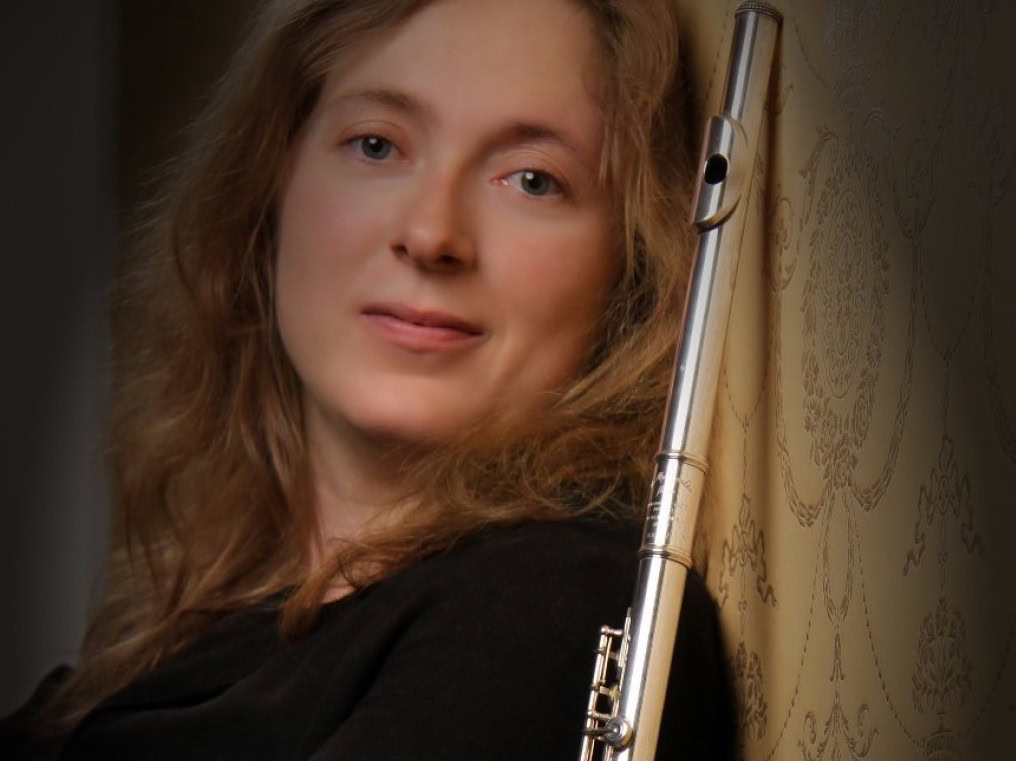
Flutist and arranger Leona Rötzsch. Photo: Cornelia Normann
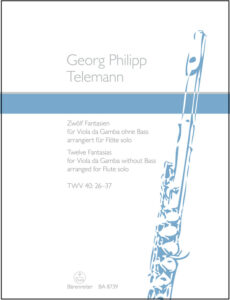
Georg Philipp Telemann, one of the most prolific composers of the Baroque period, composed twelve fantasias each for transverse flute, violin and viola da gamba in the twelve fundamental keys. The twelve fantasias for viola da gamba solo (TWV 40:26-37) are characterized by their variety of styles and musical ideas as well as their own expression and character, which makes them particularly interesting for an arrangement.
Their transposition to the flute poses a particular challenge. As the six-string viol has a wider range than the flute, the editor Leona Rötzsch has usually transposed the fantasias upwards by a minor or major third. This means that fewer octave shifts are necessary. The respective original key is indicated. In the arrangements, the range extends from B' to G''', with alternatives noted for the minor B. In contrast to the flute, the viola da gamba allows a wide range of chords and double stops. In the transcriptions, these passages are often arpeggiated or resolved. Leana Rötzsch finds interesting solutions for this in the Grave of Fantasia No. 4, for example, where she replaces the original progression in double stops with preluding phrases around the two notes of the double stop.
The stylish arrangements of the fantasias for viola da gamba represent an exciting expansion of the repertoire for transverse and transverse flute and open up new possibilities for interpretation.
Georg Philipp Telemann: Twelve Fantasias for viola da gamba without bass TWV 40:26-37, arranged for flute solo and edited by Leona Rötzsch, BA 8739, € 17.95, Bärenreiter, Kassel
This is how Telemann decorated his music
The recorder and oboist Astrid Knöchlein presents a detailed and systematic study of the ornamentation practice of the Hamburg Baroque composer.
Lukas Nussbaumer
(translation: AI)
- 08 Jun 2025
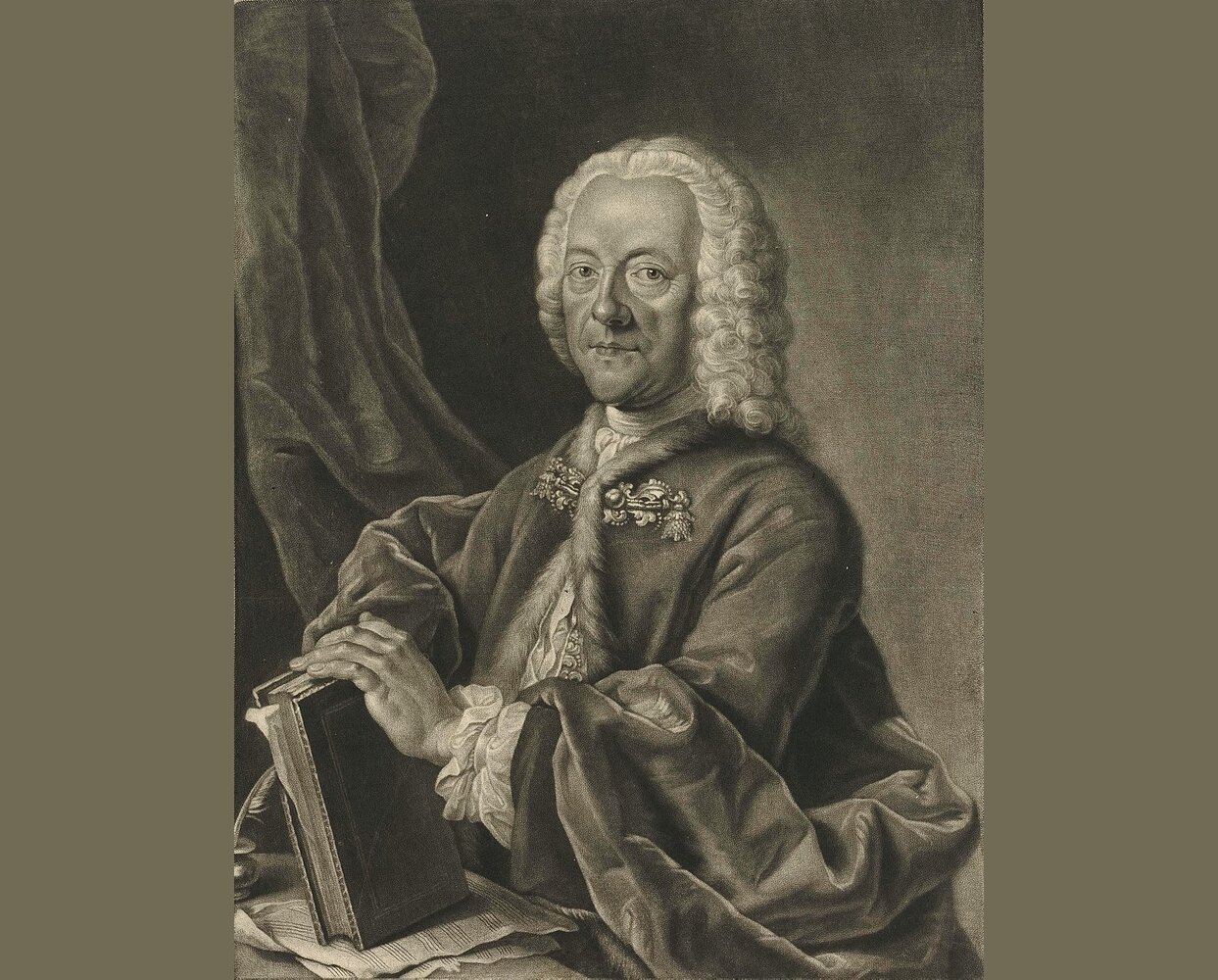
Georg Philipp Telemann. Etching by Valentin Daniel Preisler, 1750. source: wikimedia commons
Writing a non-boring book about different ornamentation patterns in a composer's work is a challenge; there is a great danger of falling into dry schoolmasterly language and instantly putting off the readership.
In her new study on Georg Philipp Telemann's ornamentation practice, Astrid Knöchlein shows that such an undertaking is also possible in a lively and practical way. Using his methodical sonata collections (TWV 41 and 42, published in Hamburg in 1728, 1731 and 1732), the recorder player and oboist compiles a comprehensive catalog of ornaments - from the alternating note to the slider to salti composti and circolo - and meticulously locates them in the respective slow movements of the sonatas that Telemann used for ornamentation.
Theory and practice
The "Handbuch der Verzierungen" as volume 2 is preceded by a first part with music-theoretical foundations, which underpins the practice with a lively presentation of the discourse in Telemann's time. Knöchlein gives his fellow musicians Johann Mattheson and Johann Joachim Quantz ample opportunity to have their say through their most important treatises. As a reader, you feel as if you are sitting in the middle of a theoretical circle of music scholars in northern Germany during the high baroque period.
To ensure that the musical examples in the second part are not merely dry musical notation, Knöchlein focuses on the theory of affects in volume 1. She explains this in a clear, source-based and practical way with the help of musical parameters: Key, melody, rhythm, harmony, meter and finally ornamentation.
One of the strengths of this two-volume book is that it allows for readings of varying degrees of depth: Anyone interested in Telemann's music-theoretical environment and the most common views on ornamentation practice at the time will find what they are looking for in the first part. Anyone wishing to study and analyze the methodical sonatas in detail, for example with regard to their interpretation, will find it difficult to avoid volume 2.
This book was written by a music lover for music lovers.
Astrid Knöchlein: Ornamentation - like Telemann! Georg Philipp Telemann's Methodical Sonatas and Trietti methodichi, ed. by Claire Genewein, Dorit Führer-Pawikovsky and Peter Schmid, 2 vol., 57+145 p., Fr. 65.00, Schmid & Genewein, Zurich 2024, ISBN 978-3-033-05348-9
Jazz meets chamber music
The first joint album by the Julie Campiche Quartet and Capella Jenensis presents a subtle musical synthesis of past and present.
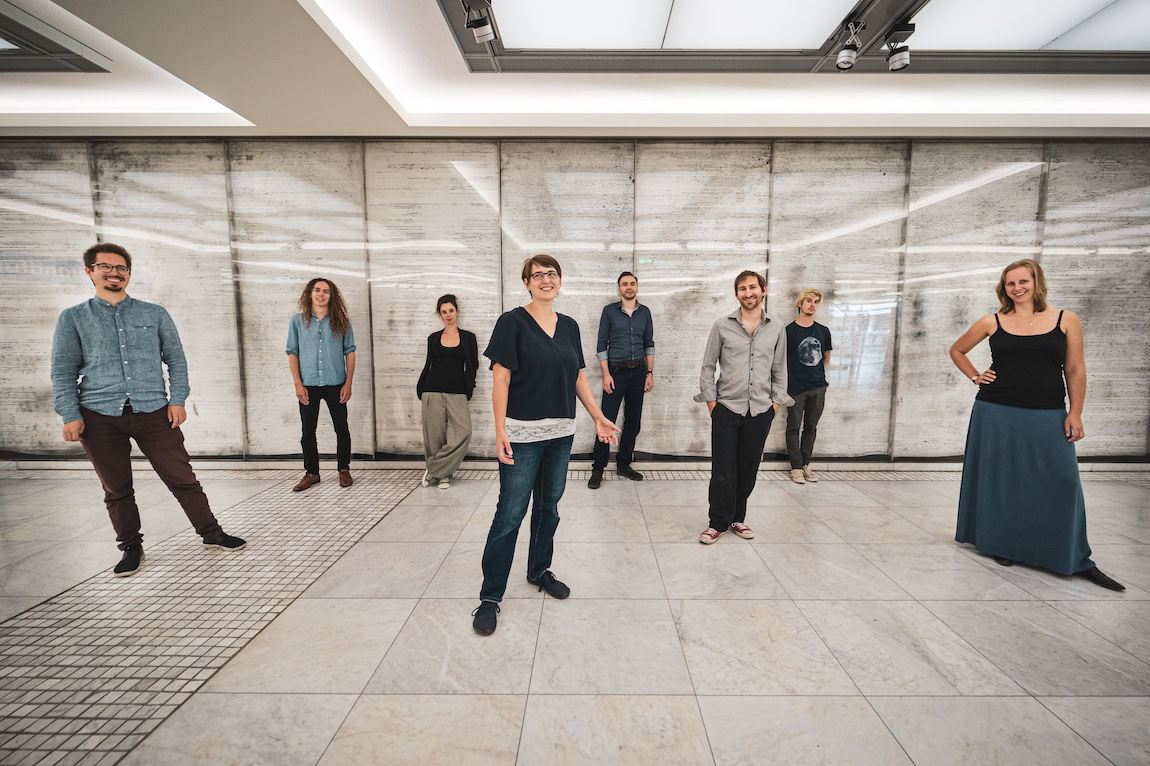
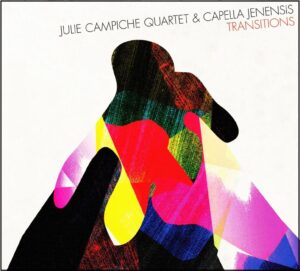
At the request of the baroque ensemble Capella Jenensis, Julie Campiche, the harpist and composer from western Switzerland, wrote music for a meeting between her quartet and the formation from the German city of Jena a good five years ago. With the release of the CD Transitions this collaboration now finds a well-deserved continuation. The aim of the eight musicians is to confront chamber music with electronic music, but also to bring together familiar elements from jazz and classical music. To this end, Campiche presents three pieces from its own pen as well as works by the Franco-Flemish Renaissance composer Jacques Arcadelt (1507-1568) and the French viola da gamba virtuoso Marin Marais (1656-1728).
The set, which deliberately blurs the boundaries between baroque music and jazz, is captivating not least because of its clever use of the available sound resources: although the musicians use instruments as diverse as the recorder, soprano saxophone, harpsichord and percussion, the result is fluid and skillful. While pieces such as the graceful Perche Al Viso - Part I or the one that relies on finely chiseled rhythms parenthesis know how to beguile primarily through a subtle togetherness, show themselves Aquarius or H-Cab curious, keen to experiment and in constant exchange between past and present. It is exciting, playful, full of nuances and always wonderfully free-spirited. As a result, the album likes to take a few turns - the sparkling is followed by quiet dissonances and the elegant by the intricate. In the process, a sonic opulence develops that is never sought after and always knows how to captivate. This is undoubtedly also thanks to the clever direction of band leader Julie Campiche.
The fact is that Transitions is tantamount to a quiet yet spectacular sound experience that only gradually reveals its many facets.
Julie Campiche Quartet & Capella Jenensis: Transitions. nWog Records nwog063
Shouting with a united voice
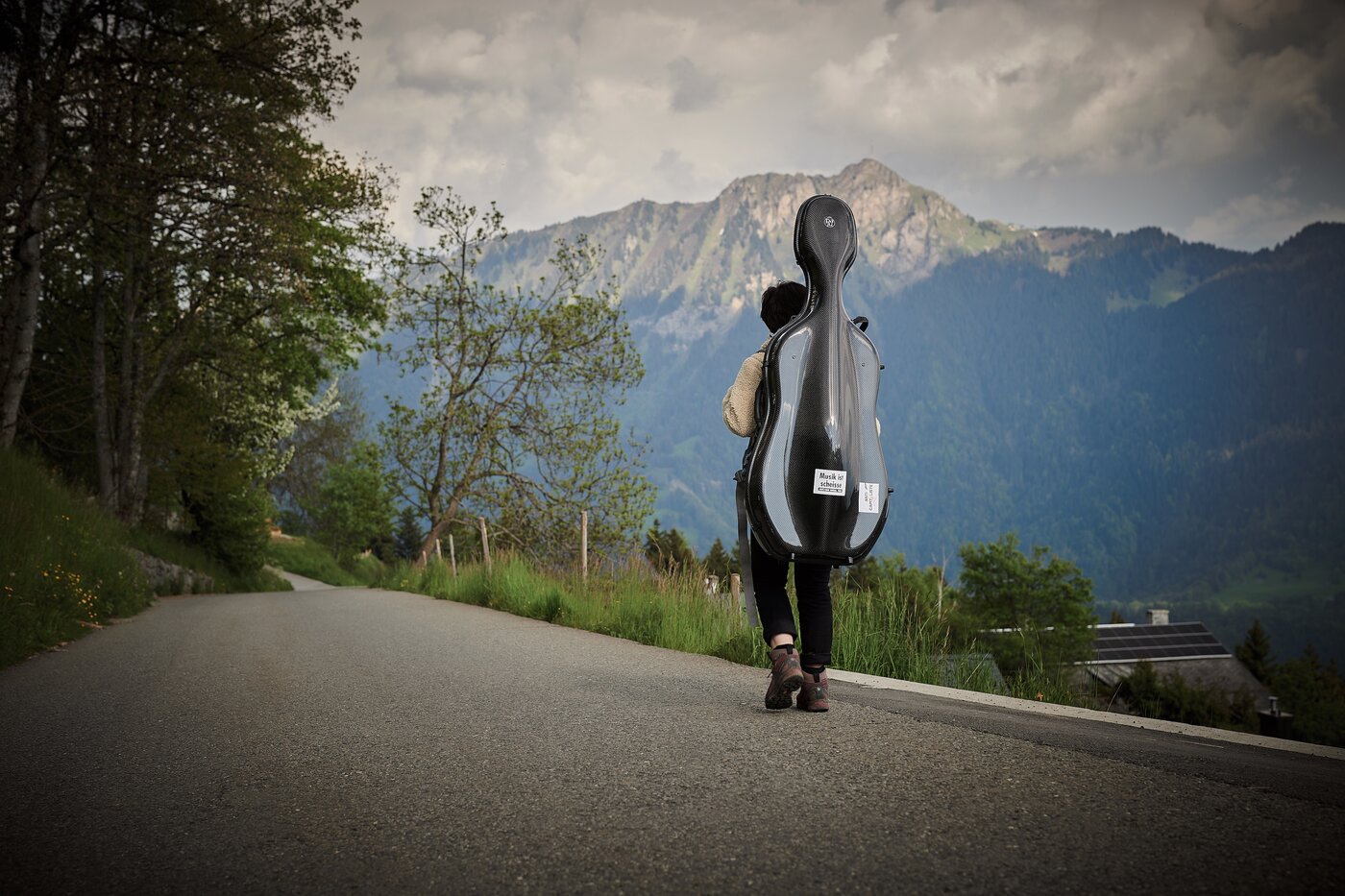
Maybe it's just a chain of circumstances, maybe the measure is full, but in any case, musicians from French-speaking Switzerland have spoken out to express their concerns and the increasing difficulties in practicing their profession.
Jean-Damien Humair; translation by Pia Schwab (French-German)
(translation: AI)
- May 21, 2025
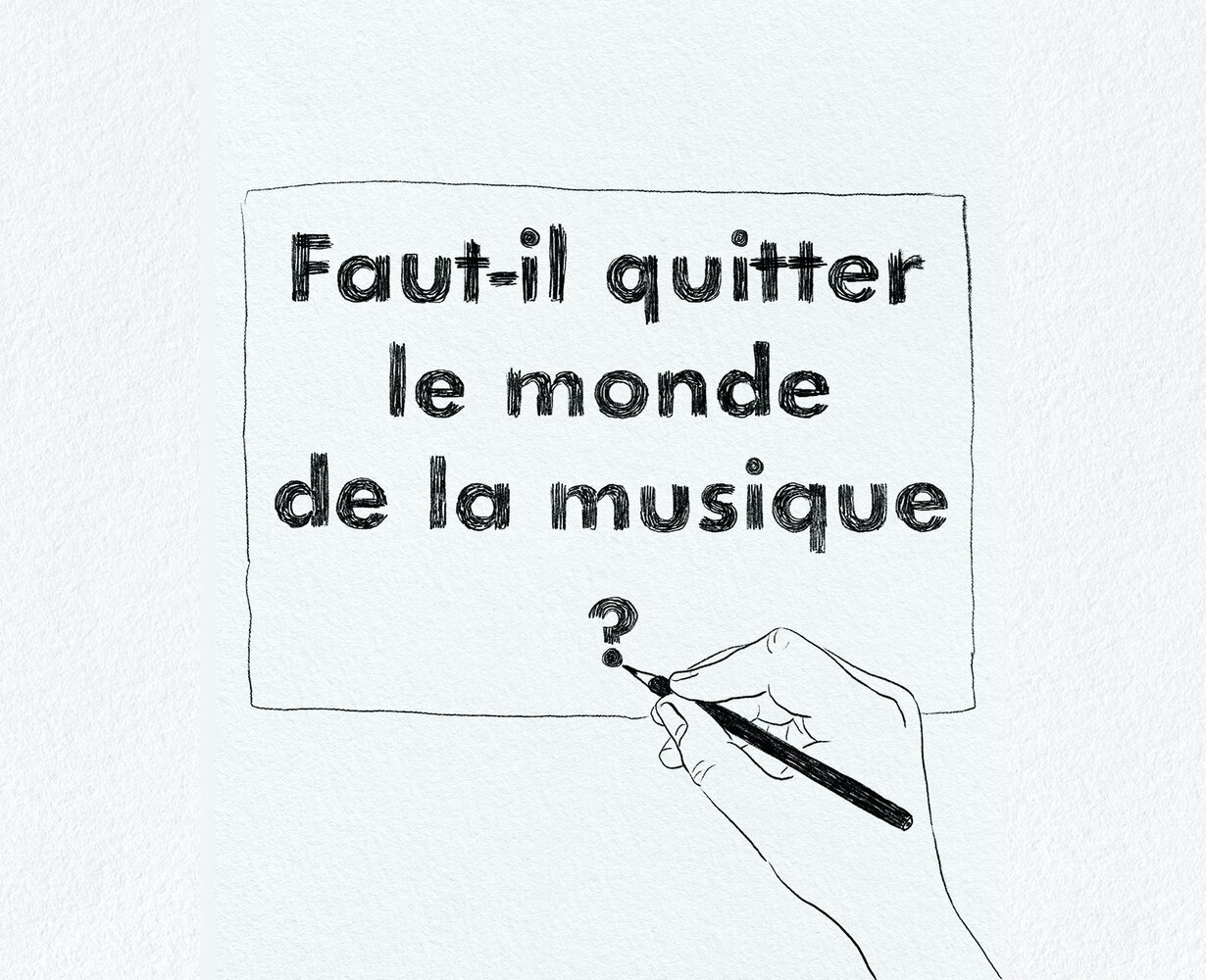
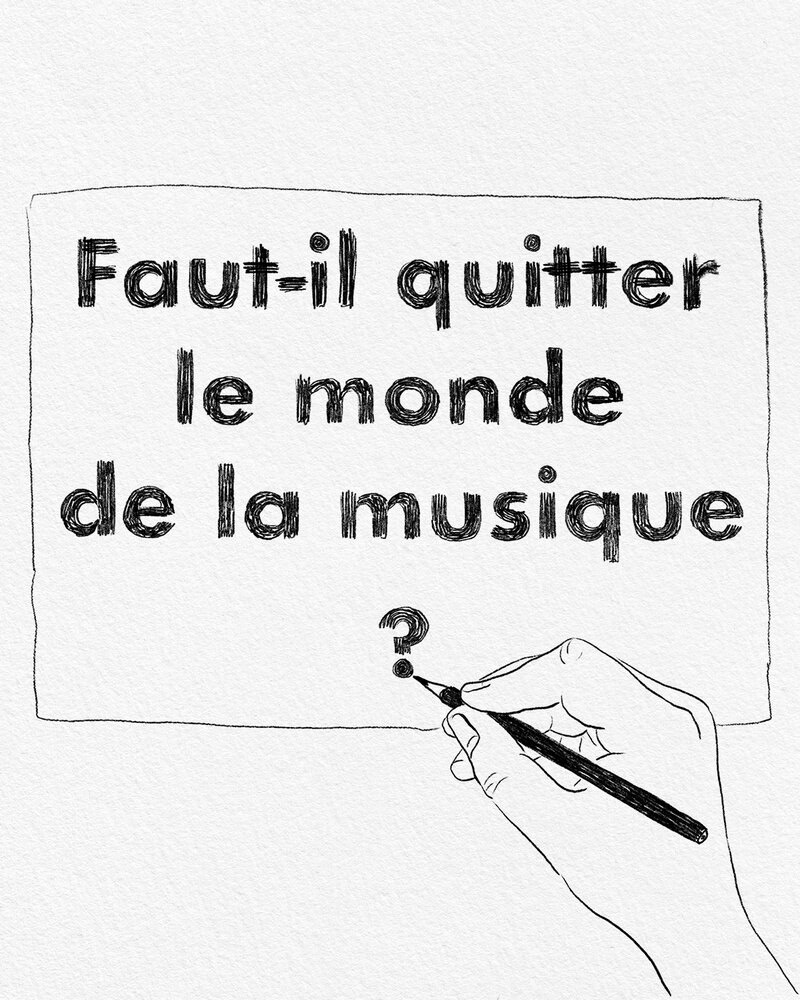
Do I have to give up music? Drawing by Meimuna
At the beginning of May, the cellist Sara Oswald published an open letter on social media in which many artists recognized their own situation. She speaks of an "... exhaustion from always having a meagre salary while the cost of living is rising. An exhaustion of always having to apply for a premium reduction from the health insurance company, because without it I can really pack it in. Exhaustion from having to create tons of dossiers to realize my projects."
She reminds us that professional training does not protect musicians from precarious circumstances: "I studied at the HEMU Lausanne and completed a master's degree in baroque cello at the HEM in Geneva. I've been a professional musician for 23 years. There are months when I earn 400 francs because I can only play one concert in 30 days. Yes, I could teach, I could play in an orchestra. But that doesn't suit me at all. I like writing music, composing for projects, giving concerts. That's why I learned this profession. It takes time to create music, practise my instrument, promote concerts, do administrative work (more than half of my time). Who has the energy after a day of lessons to sit down in their practice room and find the inspiration for an original composition? Because, in addition to being a musician, you also have to learn to sell yourself. I can say that my work takes up more than 100 percent of my time. To be clear: I only do that: work. And for free."
The singer from Valais Meimuna has expressed her dissatisfaction in drawings: a series of 14 illustrations that can also be seen on social media. They reflect the same concern and address an existential question: "Do I have to give up music?"
Paléo deep beater
On 2 May, a third artist, singer Moictani, who will be performing at this year's Paléo Festival, will take up the subject on the RTS radio program. We hear that she too has to make do with fees of 200 to 300 francs per concert and that Switzerland's biggest festival is in no way more generous. The entire budget flows into the dizzying fees of the stars. People dream of a Paléo that would invite two fewer celebrities and pay the lesser-known artists correctly. It would then perhaps sell its 200,000 tickets in 30 minutes instead of just 13.
Overall, we dream of a society that is aware of the indispensable role of culture and the need to represent our own culture instead of delegating cultural life to individual stars from across the Atlantic. This requires support from the state that is not questioned every time money is needed to save a bank or compensate for customs duties.
The Fee recommendationswhich were recently drawn up by Sonart, are a very good step in this direction. As her open letter has triggered numerous reactions, Sara Oswald is now conducting an online survey that will ultimately result in a manifesto. It will most likely be published in the French-speaking Swiss daily newspaper Le Temps appear. In order to achieve an improvement, musicians in Switzerland agree that they must act together and open their mouths - or rather: shout - with a united voice. The Swiss Music Newspaper is precisely for this purpose.
Sara Oswald. Photo: Holger Jacob
Open letter from Sara Oswald: Invisible
"It started a few years ago. A touch of tiredness. An emerging irritation at still having to explain that I would like to be paid when I play on this or that album or when I give a concert. A growing dismay at the unrealistic ideas people have about the life of an artist. I still hear the same thing: it's nice to be able to live out your passion.
The years go by and all this is compounded by exhaustion, combined with the thousands of kilometers travelled to perform somewhere in French no man's land for 300 euros, with no travel allowance. I ask myself how useful it is to go and play somewhere else, and the desire for something unfamiliar is always stronger than the sense of reality. An exhaustion from always having a meagre wage while the cost of living is rising. Exhaustion from always having to apply for a premium reduction from the health insurance company, because without it I can really pack it in. Exhaustion from having to create tons of dossiers in order to realize my projects.
And speaking of projects: Recently, at the age of 47, I have been filled with undisguised anger at the rejection of a grant that puts a very personal performance, the fruit of my work over the last four years, in jeopardy because "we can only consider a third of the applications submitted". I am aware that there is not an infinite amount of money available for culture. Talking to musician friends, I hear that some of them put their entire meagre savings on the table to produce and manufacture an album. (Needless to say, we don't get a penny from Spotify and the like). Others squander a small inheritance "so as not to abandon projects altogether", others actually quit in disgust and still others burn out. Everyone is suffering. More and more. In silence. Invisible.
I studied at the HEMU in Lausanne and completed a master's degree in baroque cello at the HEM in Geneva. I have been a professional musician for 23 years. There are months when I earn 400 francs because I can only play one concert in 30 days. Yes, I could teach, I could play in an orchestra. But that doesn't suit me at all. I like writing music, composing for projects, giving concerts. That's why I learned this profession.
It takes time to create music, practice on the instrument, promote concerts, do administrative work (more than half of my time). After a day of lessons, who has the energy to sit down in their practice room and find the inspiration for an original composition? Because, in addition to being a musician, you also have to learn to sell yourself. I can say that my work takes up more than 100 percent of my time. To be clear: I only do that: work. And for free.
It goes without saying that rehearsals are also unpaid. Just like the work on the instrument, composing, putting together a concert program, the hours spent on the computer to put together a budget or a project presentation. Only the concert is paid for. And the travel expenses, often if you fight for them. As the excellent study by Marc Audétat and Marc Perrenoud, published by Stéphanie Arboit in Le Temps on April 25, shows, the average fee for jazz and new music is 300 francs. Even if you perform every weekend, which (I believe) hardly any Swiss artist can do, it is extremely difficult to make a living ... The beautiful drawings by Maimuna (on Instagram, April 25) show this very clearly.
Isn't it sad and shocking that we have to say to ourselves: We do vocational training, go to university, learn self-taught or via other educational paths, we spend our lives making music and can't make a living from it. What I also find unfortunate in our profession is the unfair competition. Since we're in such an unfortunate situation, I don't think you're doing the profession a service if you're prepared to play somewhere for less than 300 francs. It gives the impression that our services are worthless. Hence the question: what is a professional musician? Someone who lives from their art, has studied at a school and has no other income than music?
Over the past few days, I have spoken to many musicians. And everywhere I go I feel this exhaustion, this healthy anger, this dejection. I think we have to do something.
What conclusions can be drawn from the above-mentioned study? How do we become visible? What should we do to be heard? How do we join forces? And above all: what do we propose to change things?
This morning I am tired of my/our invisibility."
Drawings by Meimuna: Do I have to give up music?
Do I have to leave the world of music behind me?
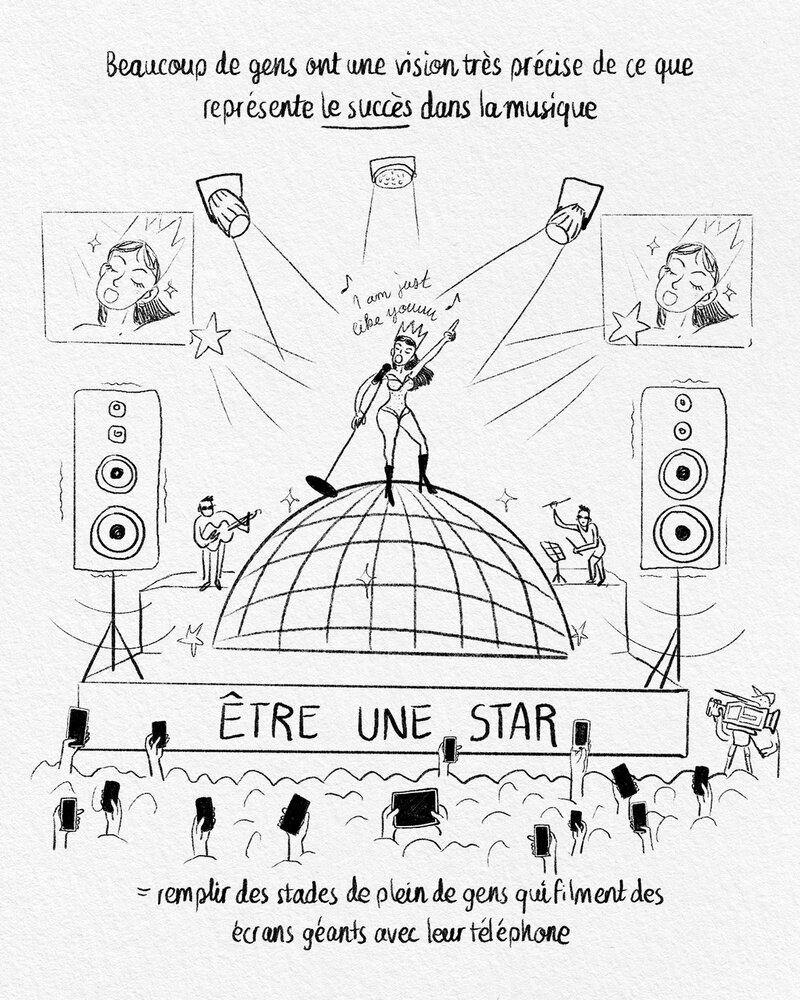
Many people have a very precise idea of what success in music means: being a star, filling stadiums with people filming big screens with their cell phones.
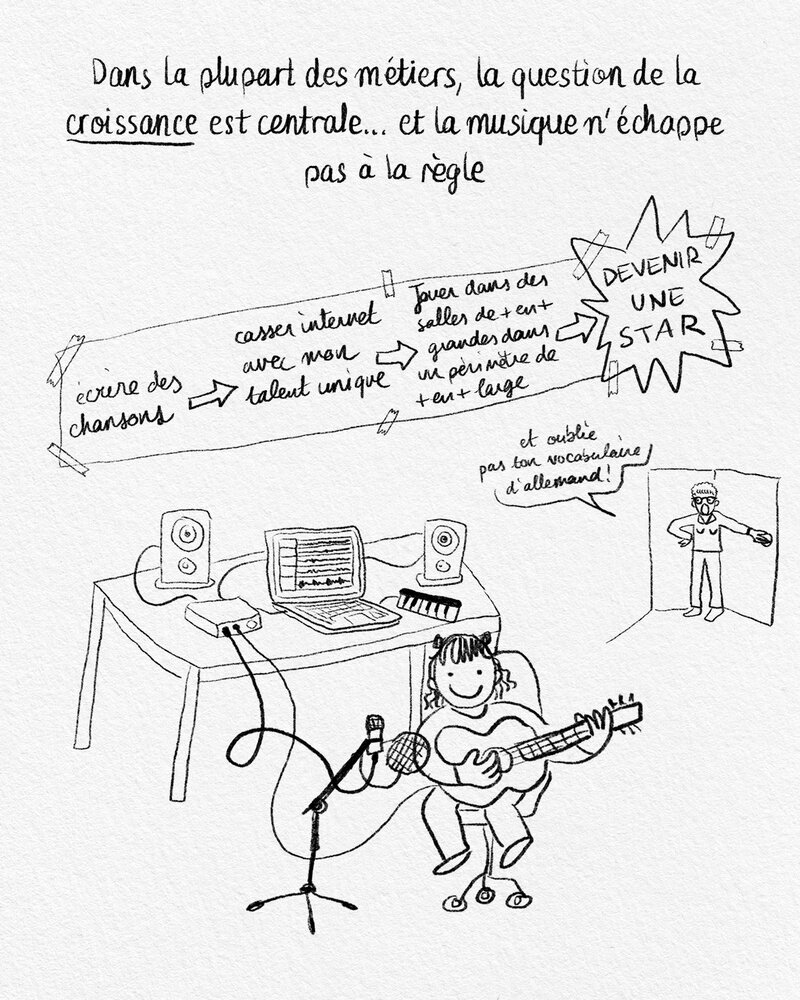
In most professions, the question of growth is central ... and music is no exception: writing songs that go viral thanks to my unique talent, playing in bigger and bigger venues in ever wider circles, becoming a star. (Don't forget your German words!)
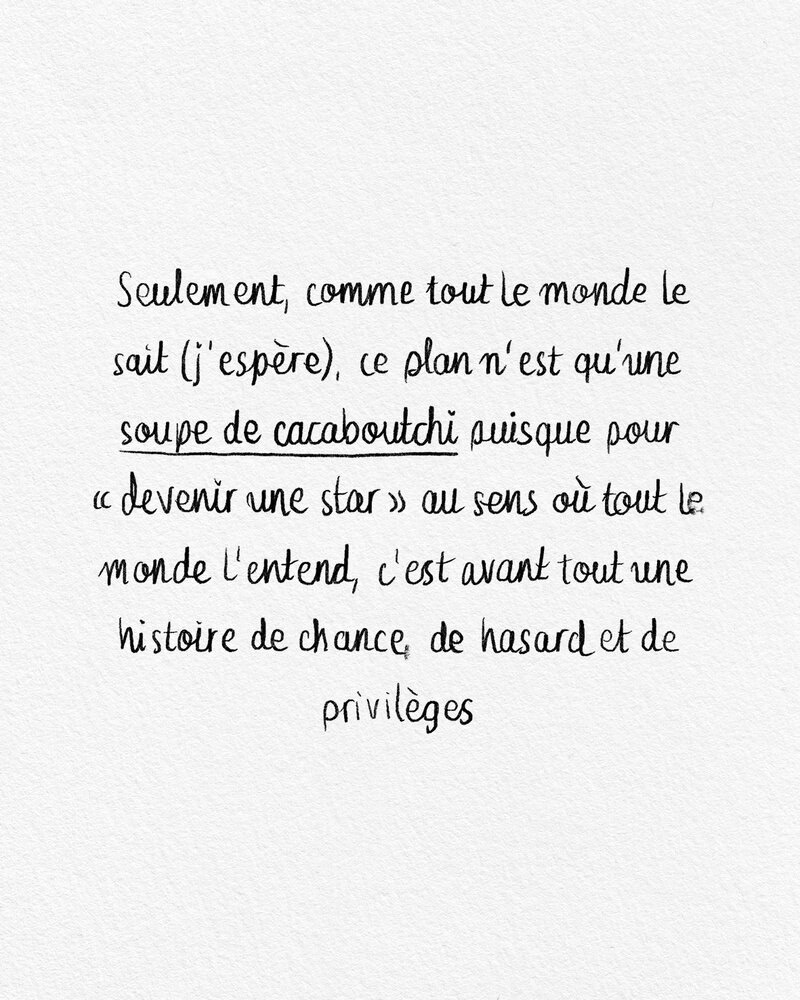
However, as (hopefully) everyone knows, this plan is complete garbage, because in order to "become a star" in the popular sense, you need luck, chance and privilege above all else.
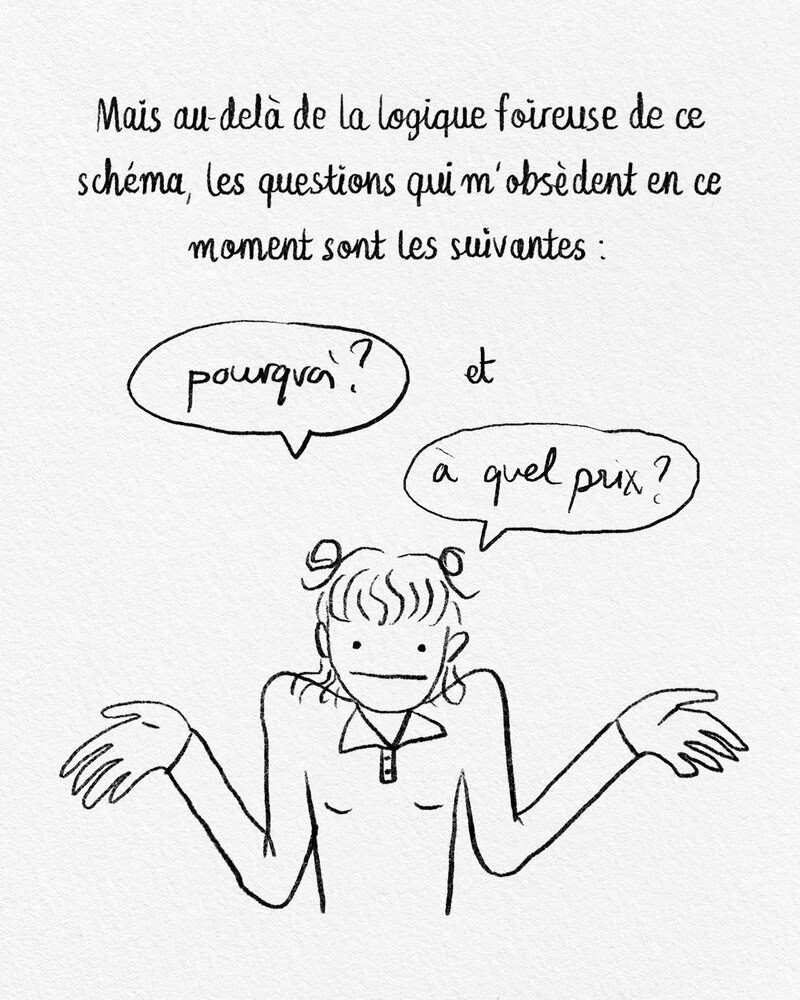
But beyond the flawed logic of this scheme, the following questions are driving me at the moment: Why and at what cost?
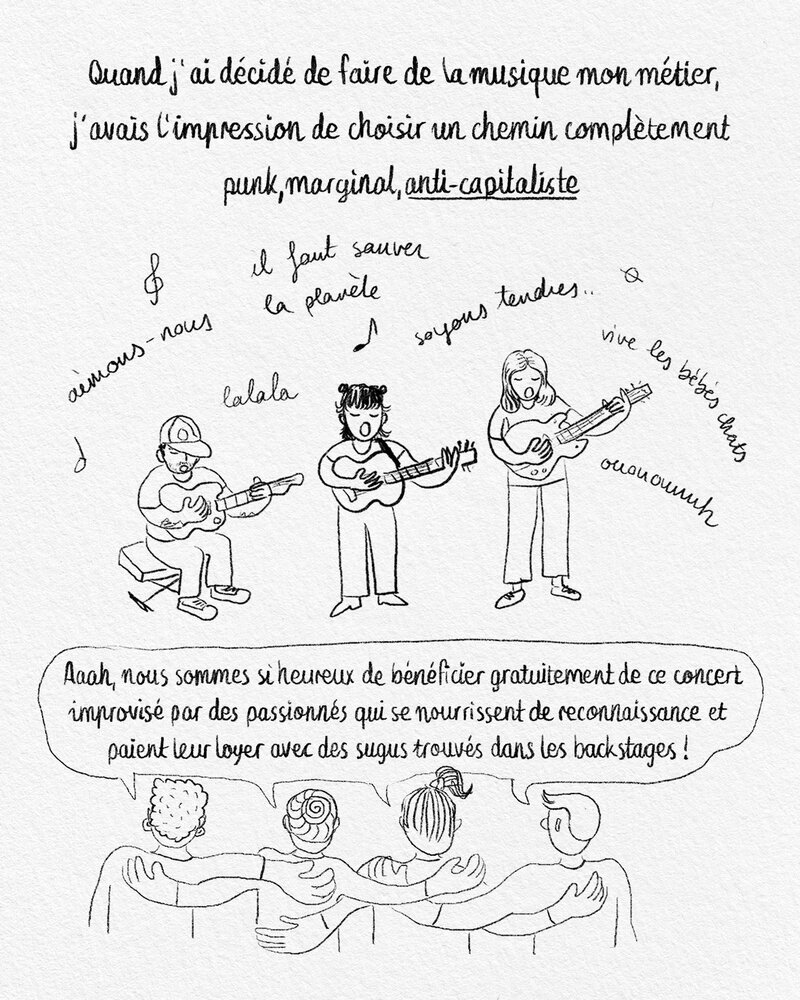
When I decided to make music my profession, I thought I was going down a totally punk, outsider, anti-capitalist path: let's love each other, let's save the planet, let's be tender, kittens are great... (Oh, we're so happy about this free concert, improvised by dedicated musicians who feed on gratitude and pay their rent with Sugus they find backstage).
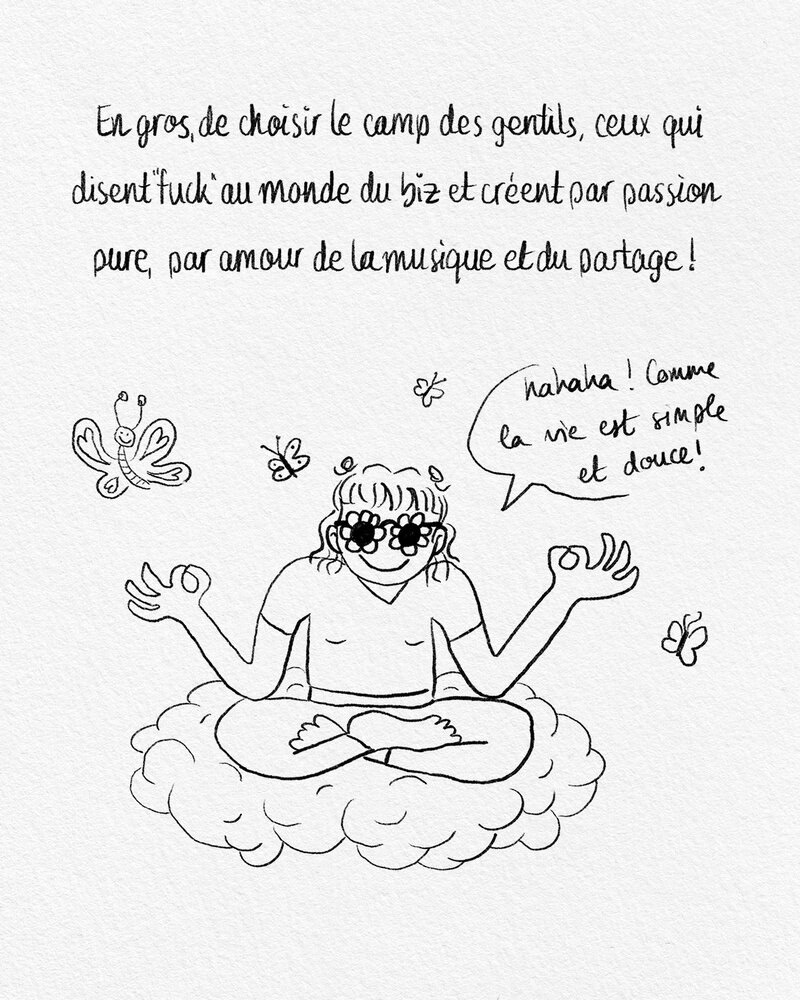
In short: to choose the camp of the nice ones who give showbiz the middle finger and are creative out of pure passion, out of love for music and togetherness: Hahaha! How simple and sweet life is!
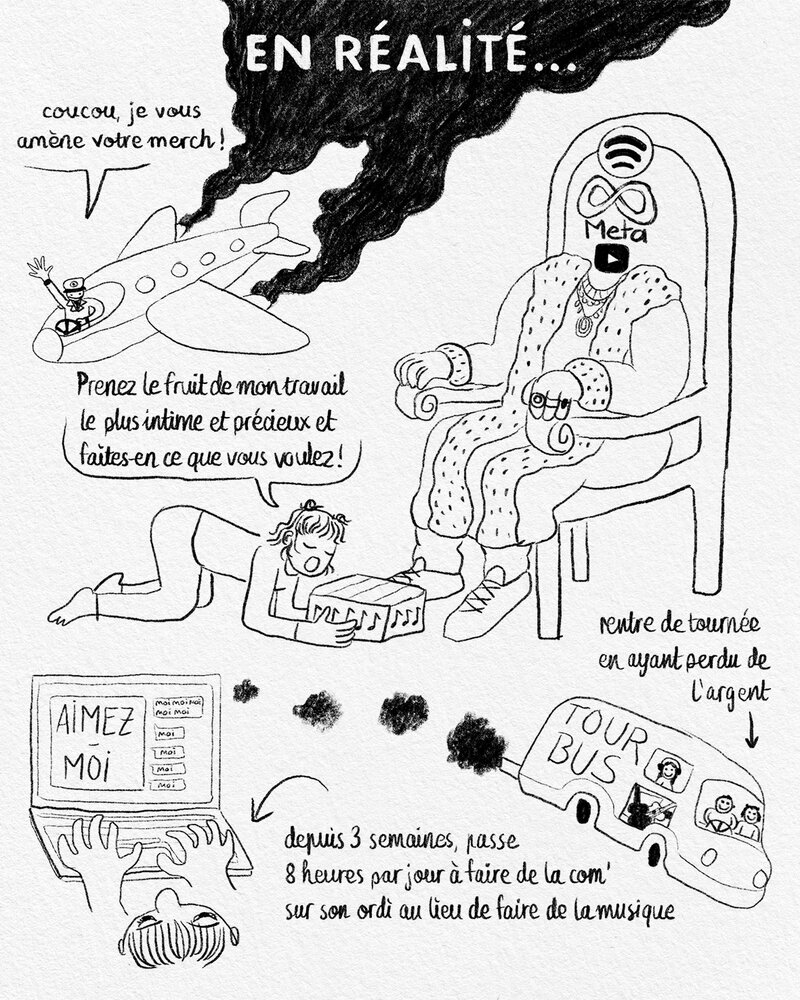
The reality ... Hello, I bring you your merchandise! Take the fruits of my most personal and precious labor and do with them what you will! Returning from a tour where you put money on it. For the last 3 weeks I've been spending 8 hours communicating on the computer instead of making music.
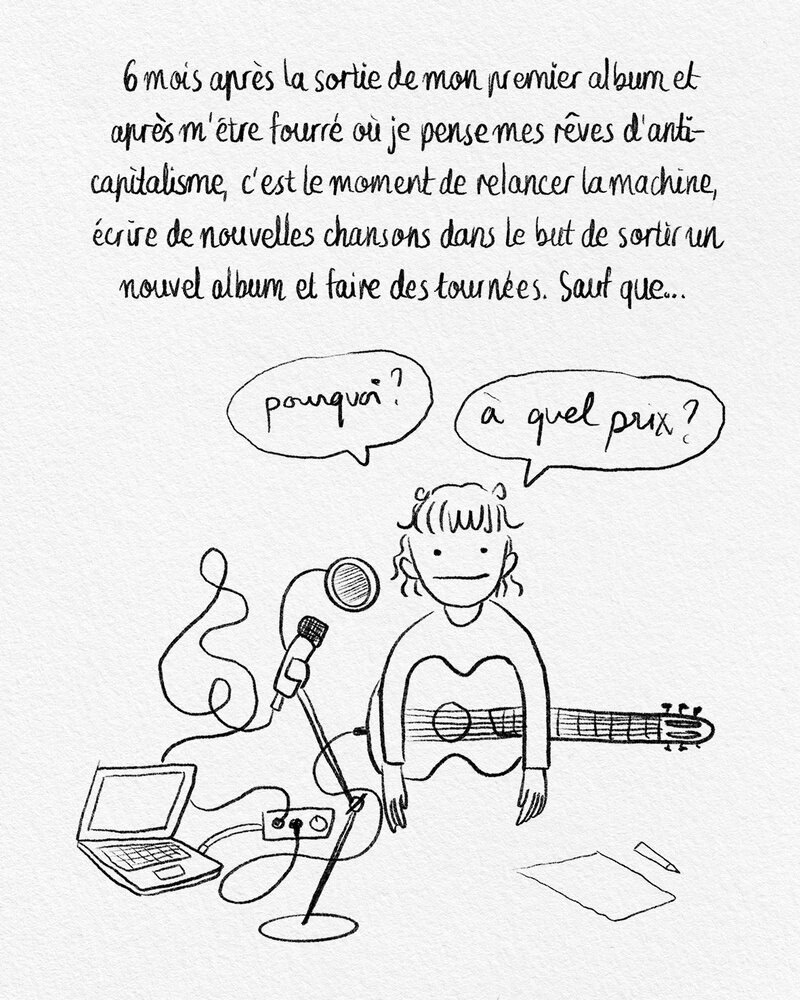
6 months after my first album and after putting my anti-capitalist dreams elsewhere, it's time to fire up the machine again, write new songs for a new album and tour. Except ... Why and at what cost?
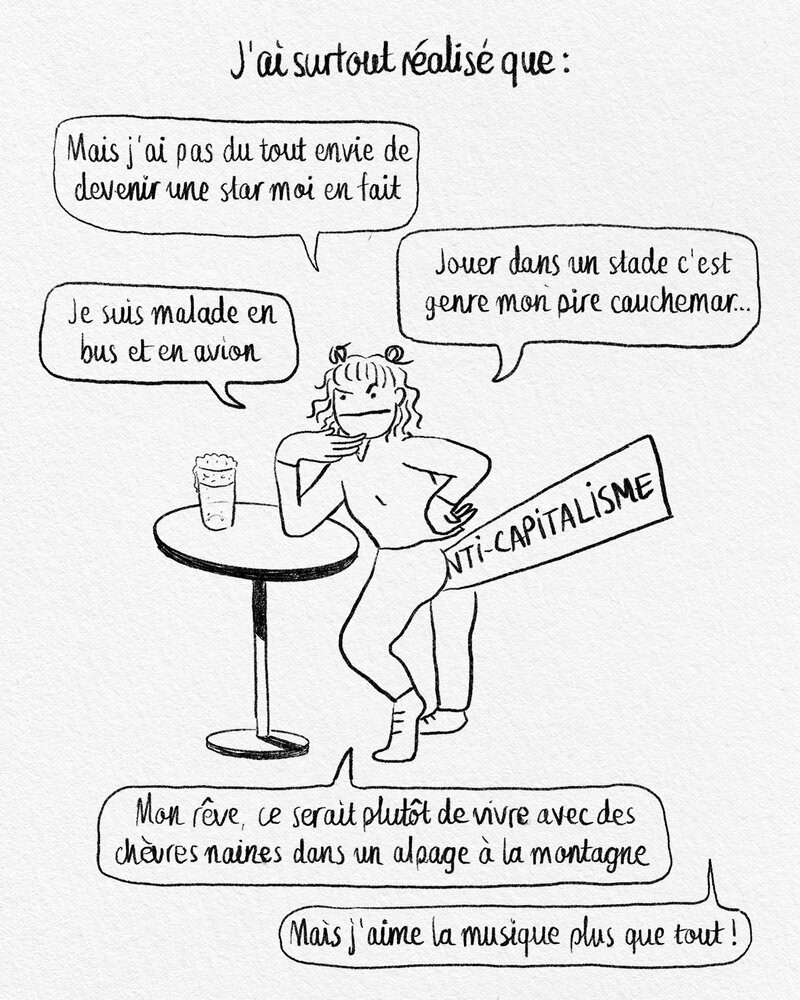
Above all, I realized that I don't really want to be a star. Playing in a stadium is about my worst nightmare. I get sick on buses and planes. My dream would be to live on a mountain pasture with dwarf goats. But I love music more than anything.
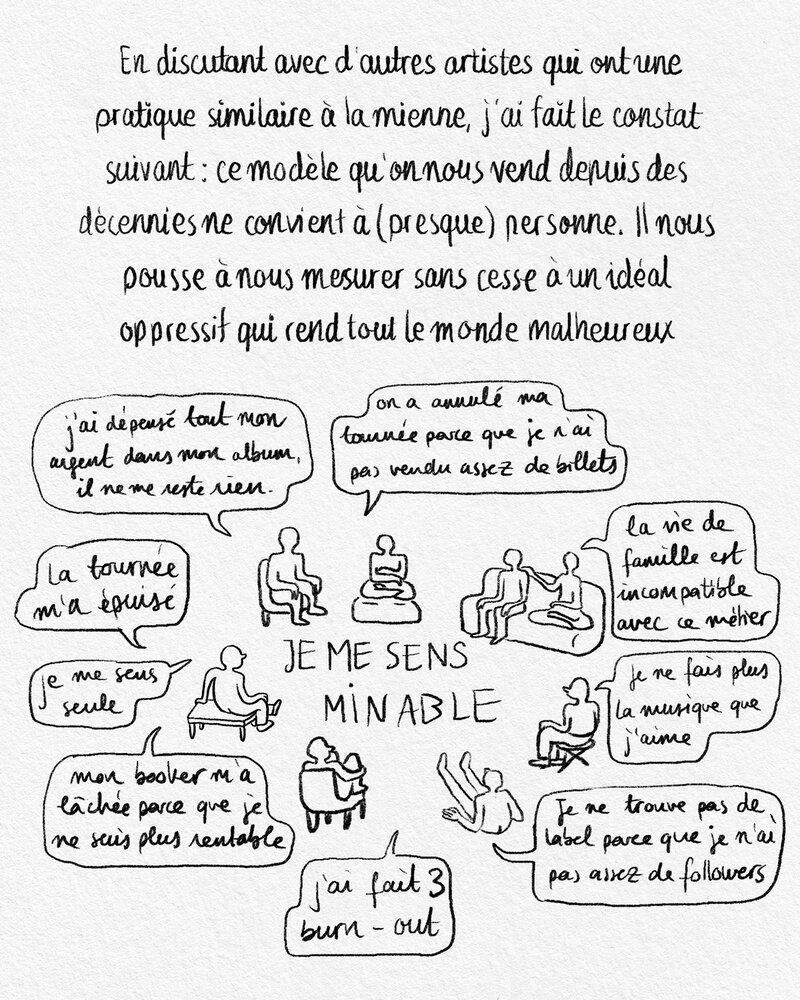
Talking to other artists who work in the same profession as I do, I've come to realize that: The role model that has been sold to us for decades corresponds to (almost) no one. Because of it, we constantly measure ourselves against a burdensome ideal that makes everyone unhappy: I put all my money into my album, I have nothing left. My tour was canceled because I didn't sell enough tickets. The tour exhausted me. Family life is not compatible with this job. I feel alone. I'm no longer making the music I love. My agent has dropped me because I'm no longer profitable. I can't find a label because I don't have enough followers. I've already burnt out three times.
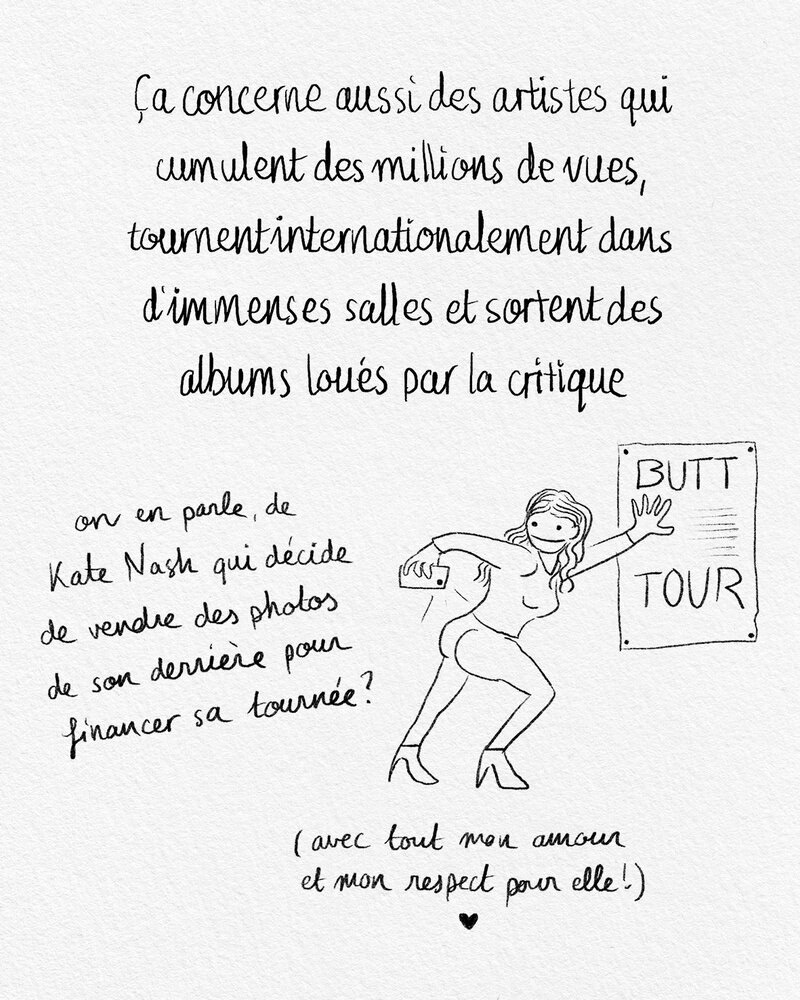
This also applies to artists who generate millions of clicks, tour internationally in huge halls and release critically acclaimed albums. Are we also talking about Kate Nash, who decided to finance her tour with photos of her butt? (With all my love and respect for her...)
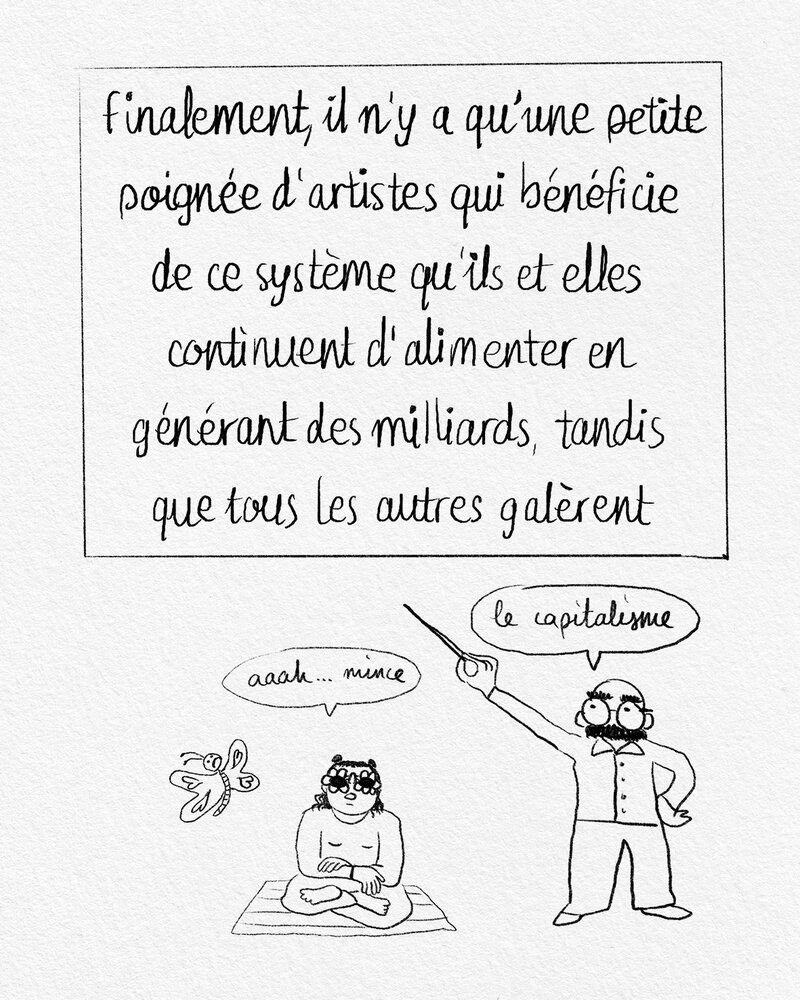
In the end, only a handful of artists benefit from this system, which they maintain by generating billions while everyone else struggles: capitalism. Oh ... well, that's too bad.
So, this is getting long and you can see what I'm getting at: If you want artists to stay healthy, programs to stay diverse and clubs to survive ...
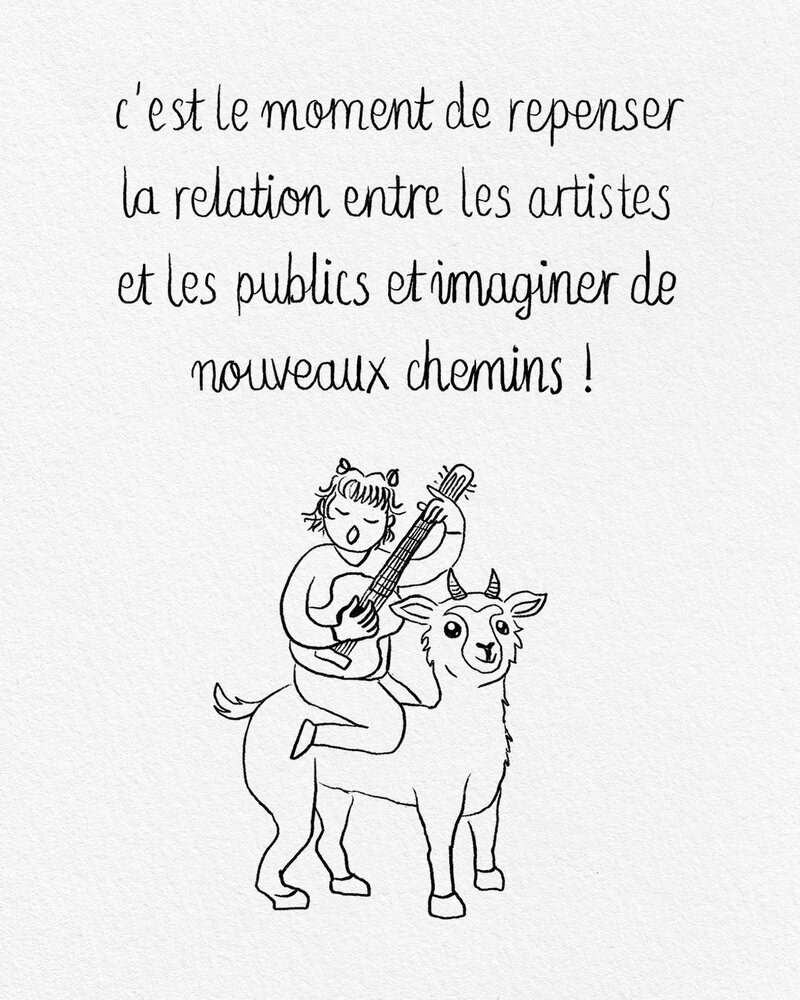
... the time has come to rethink the relationship between artists and audiences and to take a different approach.
Tarantella with modified solo part
The violin part, arranged by Henri Vieuxtemps, is now available with both piano and orchestral accompaniment.
Walter Amadeus Ammann
(translation: AI)
- 09 May 2025
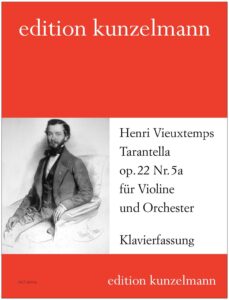
The Belgian violin virtuoso and composer Henri Vieuxtemps worked for six years at the court of Tsar Nicholas I in St. Petersburg. At the beginning of this engagement in 1846, he composed the Morceaux de Salon op. 22 for violin and piano, including No. 5 Tarentelle, and put it into print. As he also found it suitable for the big stage, he created an orchestral version, which was printed in 1854. Vieuxtemps made considerable changes to the violin part from 1846, changes that had previously only been found in the score.
New editions (5a) are now available, on the one hand of the version for violin and piano with the solo violin part of the orchestrated version, and on the other hand of the score. The orchestral material is available to borrow - the perfect prerequisite for performing the Tarantella on a larger scale! The preface is exciting and the critical report helps with many questions of detail. The fingerings in the score and the piano reduction are by Vieuxtemps, those in the violin part by the editor.
Henri Vieuxtemps: Tarantella for violin and orchestra op. 22 no. 5a, first edition published by Olaf Adler; score, OCT-10371, Fr. 40.60; piano version, OCT-10371a, Fr. 29.50; Edition Kunzelmann, Adliswil
String quartets recorded for the first time
The Colla-Parte Quartet has recorded Richard Flury's contributions to the genre No. 2 and 3.
Daniel Lienhard
(translation: AI)
- 08 May 2025
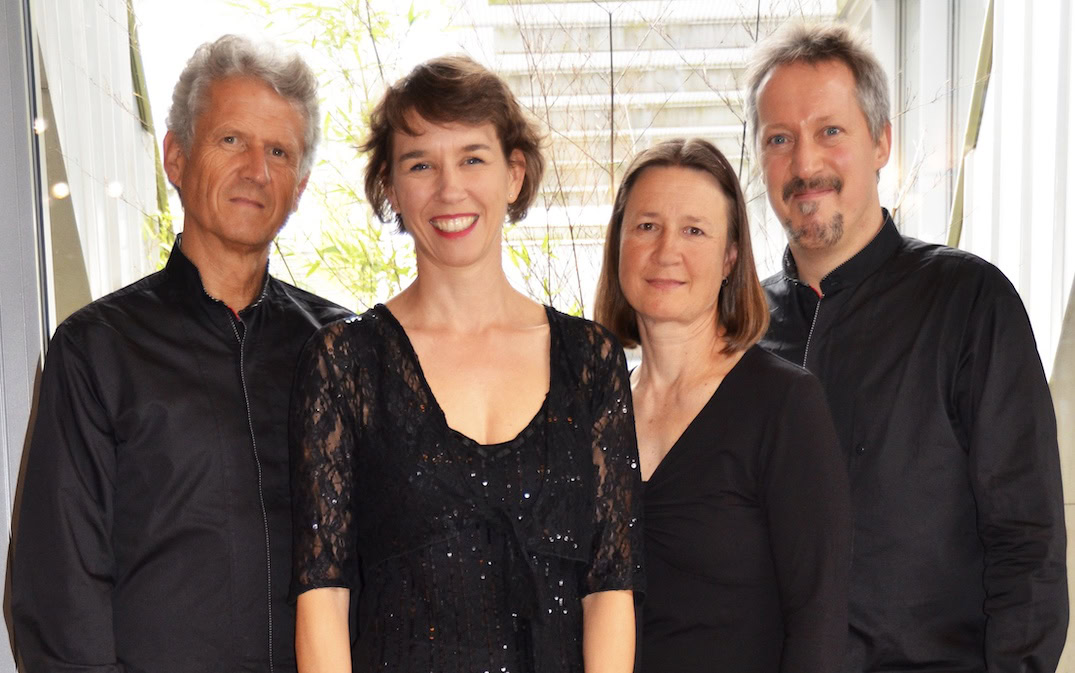
Colla-Parte quartet (from left): Friedemann Jähnig, Eva Simmen, Susanna Holliger and Georg Jacobi. Photo: zVg
In his 1950 publication Memories writes the composer Richard Flury (1896-1967): "I do not consider the possibility of new and original musical ideas with Romantic means to be exhausted by any means, and I seek originality less in the invention of new, technical means of expression at any price than in the vitality of a strong experience. Creativity in art is like an organic growth in which the temperament and intuitive powers of the soul are more involved than the intellect, which is in danger of having a disastrous influence on the natural development of art."
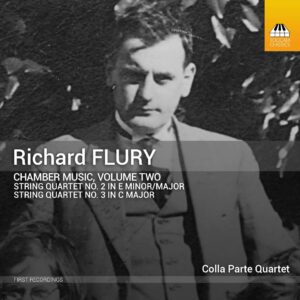
Flury's String Quartets No. 2 (1929) and No. 3 (1938), which have never been recorded before, have been released on a CD by the English label Toccata Classics in outstanding interpretations by the Colla-Parte Quartet from Bern. They are good examples of Flury's aesthetic, which was influenced by his teachers Hans Huber, Ernst Kurth, Joseph Lauber and Joseph Marx. The "unbearable accumulation of sought-after and also unintentional accidental dissonances" in some works, which he criticizes in his memoirs, is sought in vain; tonality is preserved, as is the classical four-movement structure. It is obvious that Flury, a central figure in Solothurn's musical life as a teacher at the cantonal school and conductor of the town orchestra, was a trained violinist and violist and knew the string instruments very well. The Colla-Parte-Quartett, founded in 1997, with Georg Jacobi, Susanna Holliger, Friedemann Jähnig and Eva Simmen, plays the works with commitment, nuance and color, allowing them to come into their own.
Richard Flury: Chamber Music, Volume Two: String Quartet No. 2 and No. 3. Colla Parte Quartet. Toccata Classics TOCC 0717
Froberger's charming keyboard art
The Dutch specialist for keyboard music Pieter Dirksen has published a new edition of Froberger's suites for harpsichord.
Dominik Sackmann
(translation: AI)
- 07 May 2025
Detail of a harpsichord by Jean Denis II, 1648 Photo: Maniac Parisien / Wikimedia commons
With the exception of two motets and an ensemble piece, Johann Jacob Froberger's (1616-1666) oeuvre consists of compositions for keyboard instruments. "What Chopin became for the piano literature of the 19th century, Froberger was for the piano music of the 17th century: both placed the subjective feelings of player and listener at the center of their work and both succeeded in taking their instruments to the limits of sound and expression" (Siegbert Rampe).
Now Pieter Dirksen, the Dutch specialist in 17th century keyboard music, has reissued Froberger's suites, giving all keyboard players an insight into suite music before Bach and Handel. Here you can learn expressivity and the kind of sound design that comes from the "style brisé" of French music for lute. This peculiarity requires a meticulously notated resolution of the chords, which is not easy to read. A less crowded layout would therefore have been desirable, and the distribution of the musical text between the two keyboard systems could also have been more player-friendly. Even if one is surprised at some of the editorial decisions, the Henle publishing house has nevertheless closed a gap in a repertoire which can also be used with profit in piano pedagogy.
Johann Jacob Froberger: Suites for Harpsichord, edited by Pieter Dirksen, HN 1091, € 31.00, G. Henle, Munich
Emotionally charged violin concert
Antja Weithaas and the Camerata Bern have recorded the second violin concerto by Pēteris Vasks.
Georg Rudiger
(translation: AI)
- 05 May 2025
Antje Weithaas. Photo: Marco Borggreve
In his music, Pēteris Vasks searches for the last things. The Latvian composer wants to "feed the soul" and emphasizes the importance of emotions for his tonal musical language. His second violin concerto, composed in 2020 Vakara gaismā (In the evening light) unfolds a great deal of emotion and has great breath. A melancholy undertone lies over the five-movement work, which is mostly written in a minor key, but also contains combative passages and dissolves spherically in the bright light at the end. A last ray of sunshine before night falls, which the spiritual composer associates with death.
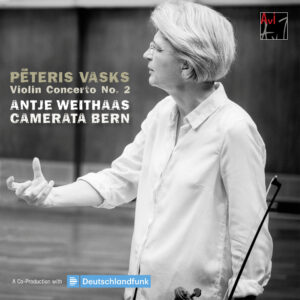
Antje Weithaas and the Camerata Bern dedicate themselves to this work, which is deeply rooted in the Romantic period and in some passages is also pompous, with great intensity and never flagging creative power. The great ups and downs that punctuate the opening Andante con passione have tension and direction. Weithaas' violin sound emerges almost imperceptibly from the tutti. It is only in the Cadenza I, characterized by double stops, that the solo violin comes to the fore. The long-standing artistic director of the Camerata Bern keeps the urgency high. And is able to increase the emotional and rhythmic intensity in the Andante cantabile, which is reminiscent of Shostakovich's music with its manic repetitions and forced string sound. The glissando crashes in Cadenza II are shattering, the clusters in the tutti tell of excitement and resistance. The strings of the Camerata Bern can grab hold, but also lay out a floating carpet. And always reflect the emotionality of the solo violin.
In the finale, the Andante con amore, the emotional struggles are over apart from one last rebellion. At the beginning of the movement, the solo violin floats above the orchestra's organ part as if redeemed. Even in the icy heights of the finale, Antje Weithaas' violin tone never becomes cold, but instead develops warmth and emphasis.
Pēteris Vasks: Violin Concerto No. 2 (Vakara gaismā/In the evening light). Camerata Bern; Antje Weithaas, violin and conductor. CAvi-music (only available digitally)
Facing the world with intuitive music
The documentary about the Ensemble for Intuitive Music Weimar shows a piece of the history of contemporary music in the GDR and the relationship to Karlheinz Stockhausen. The International Composition Competition of the Künstlerhaus Boswil is not insignificant.
Torsten Möller
(translation: AI)
- 04 May 2025
Postcard from Stockhausen to Michael von Hintzenstern, who was in Boswil at the end of 1976/beginning of 1977 and had visited Stockhausen on the outward journey. Illustration from the book
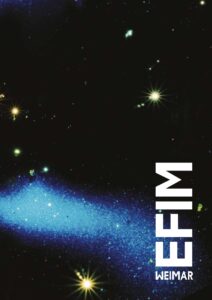
Stories that life writes: Thanks to a prize at the International Composition Competition in Boswil, Michael von Hintzenstern was able to embark on his first trip to the West from the GDR in 1976. Not only did he take advantage of the three-month work and study stay in rural Switzerland that came with the prize, but he also changed his itinerary - without permission from the GDR regime, of course: he also went to Cologne to visit the revered "master" Karlheinz Stockhausen. Stockhausen's approach to "intuitive music" would shape both Hintzenstern and his Ensemble for Intuitive Music Weimar (EFIM) - and ultimately also the richly illustrated and entertaining book Sounds of the momentwhich, among other things, reproduces some handwritten testimonies of the correspondence with Stockhausen.
The focus is on the history of the ensemble, which was founded in 1980 and consists of four musicians who are as active as they are experimental: Michael von Hintzenstern plays organ and all kinds of synthesizers, Hans Tutschku is the specialist for electro-acoustic and electronic music, the "jazzman" Daniel Hoffmann plays horn and trumpet, Matthias von Hintzenstern usually plays the cello, but also makes appearances with sound installations.
At the beginning, Stockhausen's works take center stage, such as the 15 text compositions for intuitive music in variable instrumentation From the seven days (1968) or the well-known Zodiac (1974/75). Increasingly, also due to the fall of the Berlin Wall in 1989, the programs expanded. Tutschku increasingly contributes his experience with French electro-acoustic music, the EFIM seeks out venues far away from concert halls, plays in parks, botanical gardens or in potash mines 670 meters underground. The EFIM can now also accept concert and workshop invitations to 30 countries on 4 continents.
Anyone who is enthusiastic about experimental music will also be thrilled by this documentary. But it is also worth reading for anyone interested in the cultural history of the GDR. There was a great deal of freedom in music in particular - freedom that the EFIM used in an astonishingly open, intelligent and sympathetic way.
Michael von Hintzenstern: Klänge des Augenblicks - 44 Jahre Ensemble für intuitive Musik Weimar 1980-2024, 256 p., over 300 illustrations, € 44.00, Weimar 2024, ISBN 978-3-00-078834-5, hintzenstern.eu
Beethoven's Septet in a new edition
Following Beethoven's symphonies, Jonathan Del Mal has also edited this work for four string and three wind instruments.
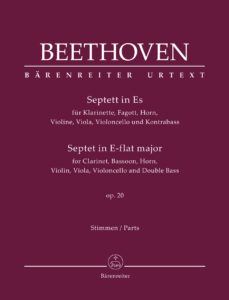
Which new work was performed for the first time on April 2, 1800 by Schuppanzigh, Schreiber, Schindlecker, Bär, Nickel, Matauschek and Dietzel at the Hofburgtheater in Vienna? A septet for strings and winds by Ludwig van Beethoven. Was it a "Sinfonia concertante", a genre that enjoyed great popularity at the time, or a symphony for chamber music ensemble?
With its six movements and a playing time of almost forty minutes, this composition far exceeded the dimensions of the other works played that evening, the 1st Piano Concerto and the 1st Symphony, which were also premiered. The delightful interplay of the string quartet, without second violin but with double bass, with the winds playing in harmony and the solo parts of the violin and clarinet, whereby the former is required to display the highest virtuosity comparable to the later Violin Concerto op. 61, especially in the cadenza of the last movement, was received with enthusiasm and subsequently enjoyed great popularity.
Beethoven's Septet also became a model for Franz Schubert and his Octet in F major D 803, composed in 1824, and other works with similar instrumentation by Louis Spohr, Ferdinand Ries, Franz Berwald and others. Beethoven's satisfaction with the septet continued after his pride at the first performance in the Vienna Castle and his remark to Joseph Haydn: "This is my Creation" in later times according to Ignaz Pleyel. The work was published by Hoffmeister in 1802 with a dedication to Empress Marie Therese.
This Urtext edition was edited by the English Beethoven scholar Jonathan Del Mar, who completed the Beethoven symphonies in the new edition in 2000, which is now used by all well-known conductors as a basis for interpretation. The study score also contains four autograph pages from the Biblioteka Jagiellońska in Kraków and is excellently equipped with a preface and detailed source notes.
Ludwig van Beethoven: Septet in E flat op. 20, edited by Jonathan Del Mar; parts: BA 10944, € 38.95; pocket score: TP 944, € 18.95; Bärenreiter, Kassel
Improvising with Walter Fähndrich
In a slim booklet, the former lecturer in chamber music improvisation lays a music theory foundation for his specialty.
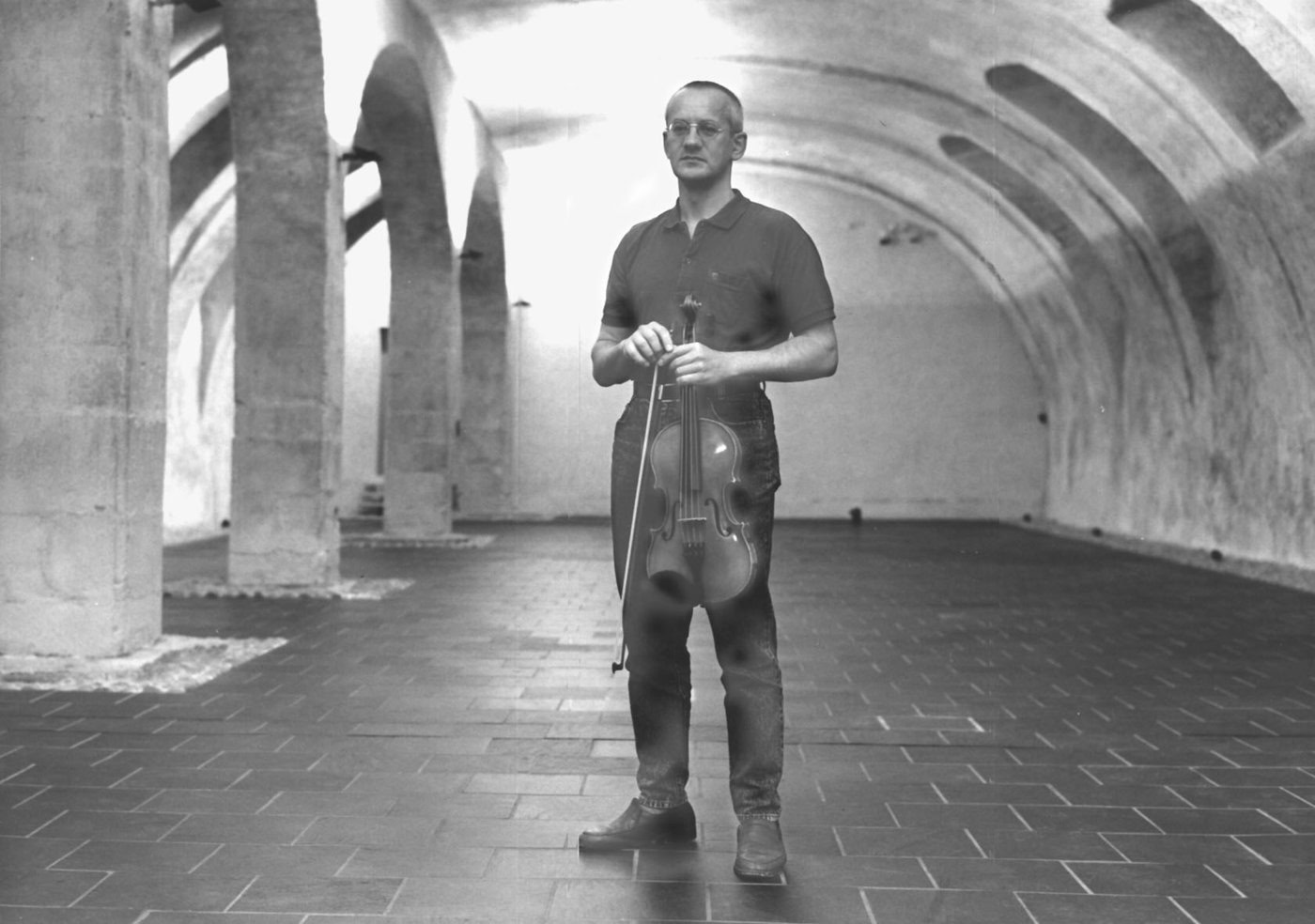
I met Walter Fähndrich quite by chance in the summer of 1984 at what was then the Quellenhof student hotel in Schuls. Even back then - before I even knew he was a musician - I was struck by his uncompromising attitude and ambition. It was only later that I became aware of his publications on the subject of Music and spaces and I heard about his incredible electro-acoustic sound installation at Lago del Sambuco in the upper Maggia Valley.
Fähndrich, born in Zug in 1944, is a trained violist, composer, theory teacher and improviser. For 25 years he was a lecturer in improvisation/life composition in Basel and set up a master's course in improvised chamber music. His eight compositions for solo viola were written up to 2002 Viola I to Viola VIII.
In the booklet Why do we improvise? Fähndrich presents a music-theoretical foundation for his specialty, chamber music improvisation. In this respect, the slogans on the blurb are provocative: "Total freedom - everything is possible and right!!!", "You can play whatever you want!!!" and "You can't make mistakes!!!". The opposite is true: if you follow Fähndrich's reasoning, you are indeed limited.
His reflections begin with "Ten aspects of improvisation". These range from "communication", "willingness to take risks" and "energy management" to "product, purpose". Fähndrich understands improvisation as "A player with equal rights and full responsibility in the compositional process, at the heart of which is a result that is realized with great playfulness, unpredictable and yet as convincing as possible". He also makes a strict distinction between the positive Acting outwhich he has shifted from the negatively connoted Letting go stands out.
Naturally, much of the volume remains very verbose and theoretical. There are no notated examples, because the improvised music is precisely not written down. Fähndrich's book is a must-read for anyone who takes a serious and reflective approach to improvisation.
Walter Fähndrich: Why do we improvise?, 80 p., € 18.00, Wolke-Verlag, Hofheim 2024, ISBN 978-3-95593-270-1
"Zogä am Bogä" for music corps and choirs
Until now, only the melody of this popular piece by the Uri composer Bärti Jütz has been notated in songbooks. Now the arranger Roman Blum has made the polka available as a score with all the parts - also suitable for music schools.
SMZ/House of Folk Music
(translation: AI)
- 04 Apr 2025
Bärti Jütz. Photo: zVg
"Zogä am Bogä, de Landammä tanzäd, wieä dr Tiifel dur Dieli dure g'schwanzet ..." - With these cheeky lines and the lively rhythm, the Uri composer and musician Bärti Jütz (1900-1925) poked fun at the widespread ban on dancing at the beginning of the 20th century. It was only a good ten years ago that the original writing by Zogä am Bogä in the canton of Uri. Written by hand on squared paper and signed by Bärti Jütz.
Michel Truniger, the director of Theater Uri, recognized the play's potential for larger ensembles. Together with the Haus der Volksmusik Altdorf, the clarinettist, conductor and arranger Roman Blum, who was born in Aargau and lives in Root (LU), was entrusted with the preparation of the sheet music for individual registers and voices. Arrangements for brass band, choir and for the marching booklet are now available.
The sheet music is also suitable for ensembles at music schools. "The publication is in line with the House of Folk Music's fundamental aim of promoting local folk music and making it accessible to as many people as possible," says Markus Brülisauer, Managing Director of the House of Folk Music Altdorf.
To mark the 125th anniversary of Bärti Jütz's birth and 100th anniversary of his death, the House of Folk Music Altdorf is focusing on the life and work of the Uri composer and musician throughout the year. Together with Theater Uri, a concert tribute will be performed on 17 May 2025. To the event