Through the eyes of the learner
When I took over the management of the new Master's degree program Music and Scene in Transformation in Basel in 2024, I had been reading the book "Through the Eyes of the Learner" by Catalan philosopher Marina Garcés for a while.




Even the blurb is all about the big picture: what use is knowledge "if we don't know how to live? Why learn if we can't imagine the future?".
Education is the substrate of our coexistence, the battleground where the resource of education is exploited rather than being a playground where new ways of life can be tried out. Garcés, however, envisions a workshop in which lifelong learning is not based on the necessity of being forced to experiment under neoliberal performance imperatives, but rather an invitation. An invitation to "take the risk of learning together, against the forces of one's own time."
Reign of talent and logic of the two
Music academies are places of talent. Places where it is already clarified during the aptitude assessment whether it is worth continuing to follow the rule of talent or whether a different career and an alternative path in life should be advised. With the concept of the dominance of talent, I am referring to the American literary scholar and psychoanalyst Eric L. Santner, who worked out how the perfection of our talents can also harbor the potential for lack of freedom. Music academies are also places of a logic of two. The masters possess something that, in a mostly linear transfer of knowledge, has a historically informed interpreter in mind. In this transfer, we seem to know for whom or what we are educating: for an area of life that we ourselves have already colonized. An area of life that we perhaps even had to fight for ourselves through competitions, prizes and selection processes. Not only in these competitive areas of education, but in society as a whole, there seems to be hardly any room for a workshop in which we can tinker, build, stumble and design together. In the words of Marina Garcés: There is a lack of time in which we can grow slowly, organically. We are nervous and need to learn quickly. Instead of creating a garden in which we combine new plants and herbs, creating a place that is not only cultivated, but a whole archipelago worth living in, the logic of the two can lead to a monoculture. Perhaps even become a reserve in which life forms are to exist separately from one another. If we replace the concept of life forms with artistic disciplines, there is a danger that we will also create artistic disciplines as monocultures.
Polyphonic workshop
However, artistic education is a place of three. Between the teacher and the learner there is a third object, a common question, thesis, conflict or concern that is worth working on together. A third knowledge is created here, radically subjective, but born of a common interest, beyond the naked demands of the market.
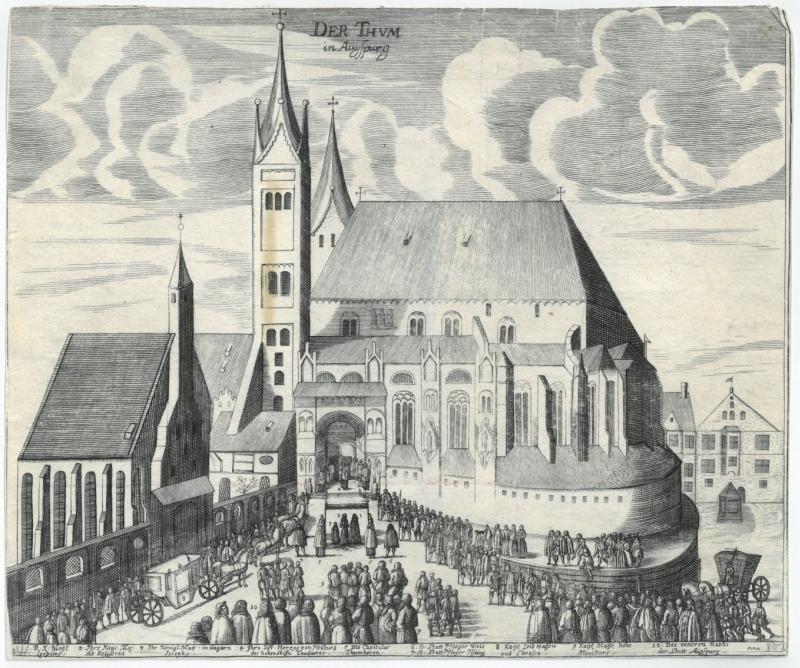
This place of a third knowledge is a workshop, not a factory. In Basel, we speak of polyphonic workshops, a term I borrowed from Clemens Risi and David Roesner and developed further with the students. Here we give space to change because it is part of life. In the first year of Music and Scene in Transformation, projects for public spaces, performances on the figure of the witch as a feminist figure and new concert and performance formats in the form of music installations were created in these workshops. We dealt with space-body-time music and initiated a student campus. We have thought about music as a temporary ritual in political contexts, examined music, commemorative culture and the politics of remembrance in the context of 80 years of the end of the war in Europe at the Augsburg Peace Festival and founded a bank robber orchestra as part of the Basel Social Club, which critically contextualized music, which was often used for representational purposes, in an empty bank during Art Basel.
Emancipated interpreters
In recent years, there has been repeated talk of the need for classical music academies to orient their courses towards an increasingly complex and competitive market and to model their courses accordingly. Students should increasingly become decathletes instead of professionalizing in one discipline, or preferably both. More and more tools and additional qualifications are to be acquired so that they can react flexibly to new professional challenges. There seems to be a strange pressure at work here to acquire more of various other disciplines instead of learning with and in them. We cannot have been concerned with this struggle when we wanted to develop artistic-musical teaching in the direction of transdisciplinarity. Rather, the aim must be to provide historically informed interpreters with emancipated interpreters. Not to replace them, but as companions. They are emancipated because, in addition to learning classical repertoire, they are encouraged to research their very own, third knowledge together with fellow students and teachers. This knowledge is important because it allows us to imagine a future - to use Marina Garcés' words again. A common future, beyond the isolation that has crept almost unnoticed into artistic education through the dominance of talent and competition focused on the individual. We have made a start in Basel. Experimental and open to cooperation and at the same time embedded in the university's existing institutes.