Make a virtue out of necessity
Many music teachers feel that their students’ lessons are too short and that they have to cram too many lessons into too short a time frame. However, there isn’t enough funding for longer lessons, and for organizational reasons, the time allocated for music lessons remains relatively short.




The solution to these problems may lie in making a virtue of necessity and finding teaching formats in which students spend more time at the music school without requiring teachers to work longer hours—which is not feasible for cost reasons. We would therefore have to move away from viewing private lessons as the only valid form of instruction. Ensemble lessons are certainly a good complement to private lessons, but they only make sense if the ensemble members already possess a certain level of skill. And in group lessons, there is a risk that individual students will be either overstimulated or underchallenged. So how can we create, without incurring additional costs, a learning environment with more time spent at the school—one in which students can fully develop their potential, learn in a sustainable way, and be encouraged to practice efficiently?
I interview music teachers who were ahead of their time, having already pioneered new approaches to music education years ago.
Multidimensional Instrumental Instruction
Gerhard Wolters is certainly known to many because they have already completed continuing education in MDU with him® have visited. And even though not everyone thinks his method can be implemented at their music school, I’d like to see for myself, so I’m meeting with him for a conversation at his Academy for Musical Innovation in Langnau in the Emmental.
MW: Dear Gerhard, thank you very much for taking the time to explain your method to me. What is MDU?
Gerhard Wolters: The MDU is about student-oriented instruction, though this should not be confused with student-centered instruction. In student-oriented teaching, the teacher is always attentive to the student’s needs, but does not let the student determine everything—since the teacher has a head start in knowledge and experience—instead offering advice that ensures the desired goal can be achieved. It is important that the student is taught by the teacher only when he or she truly needs it—that is, when learning something new or when seeking clarification on a question. Once this point is reached, the student simply needs to practice what he or she has understood. He or she does not need a teacher for this. They only need the teacher again when a question arises or when practicing a specific example. We use a traffic-light system for this: Red means the student needs input from the teacher; Yellow means the student has understood; and Green means the student has mastered the piece or a sequence of it, and the teacher can simply listen and enjoy. It’s important that, when the light is yellow, the student can practice undisturbed, without the teacher standing nearby and commenting. We’ve even coined a term for how the teacher feels when the light is yellow: «EUGAZE»—emotionally impossible to bear being present when the light is yellow.
Is that why you need multiple classrooms for this type of instruction?
Certainly not for the first step—at that stage, the focus is on teachers «practicing» student-centered instruction using clear methods. Later on, a more extensive organizational framework becomes a great advantage, ideally when more people join in: students of different ages and skill levels, and even other teachers. The advanced students learn by showing the beginners how to do something. Or they realize that a piece that’s actually a level below their current ability isn’t so easy to play without practicing it again. In doing so, they reinforce what they’ve recently learned. The younger students sometimes prefer to learn from the older ones rather than from the teacher, but they can also help the older students by, for example, distracting them during a recital, which allows the older students to practice their ability to concentrate for the recital—and everyone has a blast doing it! When several teachers work together in a team-teaching setting, they can deliberately draw on their individual strengths for specific tasks.
So what does the dimension of time look like here?
At MDU, we regularly observe that our students spend much more time at the music school. Within a set time frame, they have one-on-one lessons, practice on their own or with others, teach the younger students what they’ve already learned, and learn from the older students. Musical games and theory lessons are also part of the schedule.
How do you handle payment for these lessons?
In a fixed group of four children, for example, each child pays for 30 minutes, and everyone can stay for two hours. However, you can also increase the flexibility to the point where students can come to the music school every day—say, between 2:30 p.m. and 7:00 p.m.—whenever they want. Those who pay for 60 minutes can do so every day. Those who pay for 40 minutes can do so on two flexible days, and those who pay for 30 minutes can do so on one day. Of course, there are peak times when lots of children are there, practicing together, playing games, and performing pieces. Many children enjoy interacting with the others and are incredibly motivated to practice and play as a result. And if they get stuck on something, the teacher is there to help. Quieter students and especially talented ones come during off-peak hours; this works out on its own. They quickly realize that the teacher then has plenty of time for them. In this respect, there’s no need for a separate gifted program in this system. It happens quite naturally.
Even when working in fixed groups, it makes sense to introduce so-called “chaos weeks”—or at least “chaos days”—during which classes are held using this highly flexible model. For this to work, good communication with the students and, above all, with the parents is essential. With well-reasoned arguments, we’re usually able to convince almost all parents to let their child try something new—for example, for six weeks—once they realize that their child will benefit more this way and can get much more learning time for the same cost. And on top of that, they’ll have a lot of fun! Experience shows that parents are then more willing to drive their child to a somewhat more distant classroom location or arrange for transportation. After all, decentralized instruction isn’t really feasible here.
You lead seminars and also train people to become MDU-certified teachers. Will these teachers be able to implement the principle of simultaneous instruction, even if their music school is located in a region with many mountain valleys, where decentralized instruction is the norm?
Yes, absolutely! Take Sami Lörtscher, for example, who enthusiastically plays the trumpet at the Interlaken Ost Music School according to the MDU method.® taught. Suitable classroom space was also made available at this music school. During the “Chaos Weeks,” two 8-year-old girls from Grindelwald spent most of their time at the music school. Three days a week after school, they boarded the train to Interlaken to go to the music school.
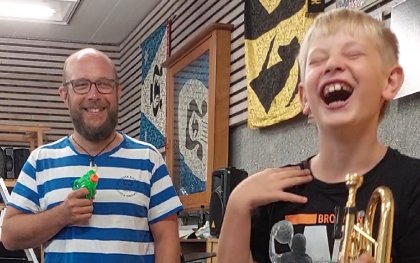
Sami Lörtscher and Sämi Seiler are having a lot of fun in their trumpet lessons based on the MDU method®
Photo by Gerhard Wolters
Or take drum teacher Andreas Aeppli, who invested in a dedicated space with built-in practice booths in Winterthur and holds his music school classes there—to name just two examples.
Thank you very much for the interview!
For more information and videos, visit: www.mdu.ch
Talent development
The approximately 2% music students who are particularly talented need special support. Today, there are established support programs, talent cards, and federal grants.
In 2017, two dedicated colleagues at the Bantiger Music School established a regional talent development program, and in the process, they gained insights that may be of interest to anyone working in talent development today.
I’m speaking with Valentina Zürcher, a flutist, mental coach, and former school principal, and with violinist and composer Gabrielle Brunner, who, as a violin teacher, has successfully prepared countless students for competitions and college admissions.
MW: How did the Talent Development Project come about?
Valentina Zürcher (VZ): As the director of the Wohlen AG Music School, I was familiar with other cantonal support programs, and as the mother of a daughter on her way to becoming a top athlete, I’ve seen firsthand how support is organized in that context: Training takes place several times a week—in a team setting right from the start. There is a wide range of support and opportunities to participate in regional, cantonal, and national events and receive feedback.
That’s what inspired me to start something similar at the music school. I asked the faculty if anyone would like to help—and Gabrielle volunteered right away.
Gabrielle Brunner (GB): I had long realized that gifted students and those with above-average curiosity were not being sufficiently supported by the programs available at the time, so I was happy to get involved.
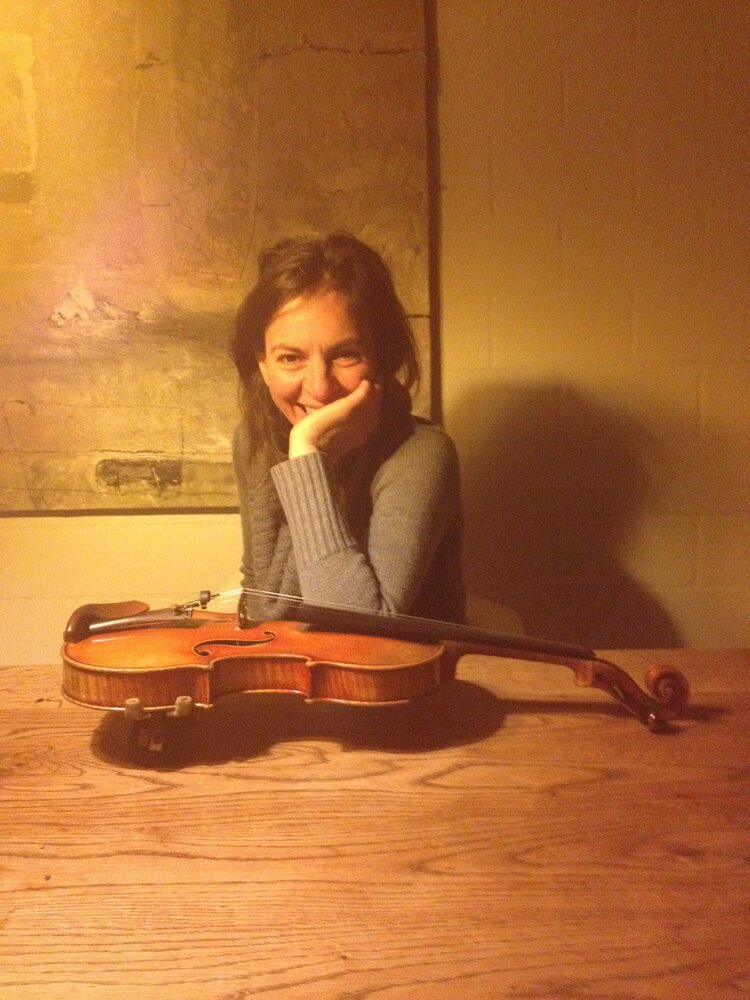 Gabrielle Brunner – Photo by Ivo Ubezio
How did you go about it?
VZ: Twenty-four participants (ages 7–15) had registered for the kickoff event. We offered the program free of charge during the first year so we could discuss with the participants what their needs were and what schedule would work best for them. Above all, they wanted to meet with like-minded people, make music, share ideas, and perform concerts. From then on, we met every two weeks.
Was everyone able to participate, or did you select certain people?
GB: Everyone! It’s always a wonder to see how children blossom—in their personal and artistic development—whatever path that may lead to. Even a highly gifted child doesn’t have to become a professional musician; perhaps he’ll become a fantastic doctor, and his musical education will have given him a great deal in terms of his personal development as a person, helping him on that path.
What was the program like?
VZ: The most important components of the program were discussions in the plenary session, chamber music, and accompaniment. In guided settings, the participants learned to reflect specifically on what they wanted to experience musically. We formed groups accordingly, often bringing together participants of different age groups.
GB: And we brought stacks of sheet music so they could figure out what they liked. And, of course, some of the major-subject teachers were there to help us with their literature recommendations.
Were the main subject teachers involved in other ways as well?
VZ: Of course, some of them helped teach or were there during talent development sessions and at concerts.
GB: The program didn’t just consist of chamber music, recitals, and discussions about them; it also included working with accompanists, guided practice sessions, mini-masterclasses, theory and music history lessons, improvisation, and workshops on specific topics. We always brought in colleagues for that.
And would that be on a volunteer basis, at least at first?
GB: I didn't see it as volunteer work but as part of my educational mission, and over time we did receive some compensation.
VZ: Yes, to a large extent. But it was worth it in every way.
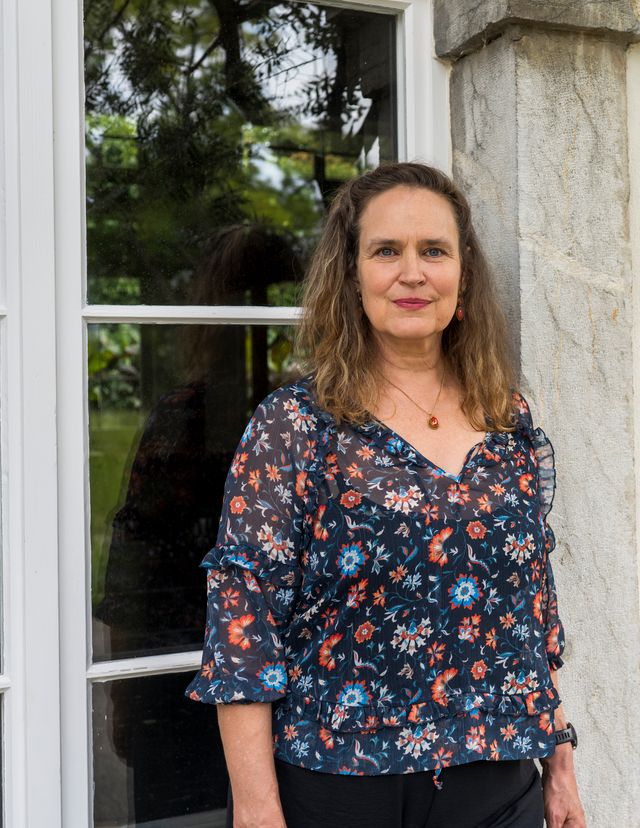 Valentina Zürcher – Photo by Caroline Marti
What were your main areas of focus in this project, and what have you taken away from this experience?
VZ: In addition to the overall organization, my focus was on mental training and fostering a culture of feedback. It was fascinating to observe how the children and teenagers increasingly took responsibility for their own artistic learning processes. As an auditory learner, one engages with both internal and external listening and strives—with unwavering dedication—to refine cognitive, motor, and instrumental skills. One learns very early on that this gives rise to new questions and challenges. Bringing music to life with like-minded people and exploring how it might be shaped or experienced in new ways is incredibly motivating.
GB: When a student shows passion, it’s my duty to do everything I can to ensure that their endeavor succeeds. I’m quite strict and demand a lot from my students in terms of tone, technique, and musicality. Making good music requires a holistic use of body tension, a desire to express something, a strong presence in the moment, and technical skill. In the classes, we were able to explore this in depth and try it out in recital situations. Through collaboration with others, they’ve made progress in thinking for themselves, recognizing their feelings, and accurately translating their emotions into their playing. And the recitals we organized naturally motivated them to practice much more. «Put the music first» was our motto.
Have you also had experience with methods and projects that encourage children and teens to spend more time or attend music schools more often, and that motivate them to enjoy practicing? If so, I’d love to write about it in an upcoming issue. Please write toShe said to me: marianne.waelchli@smpv.ch