Beethoven's masterpieces quite simply
In a project, nine Swiss pianists play Beethoven's symphonic work on the piano and juxtapose it with modern music. A concert report from January 18 in Bern and an interview.




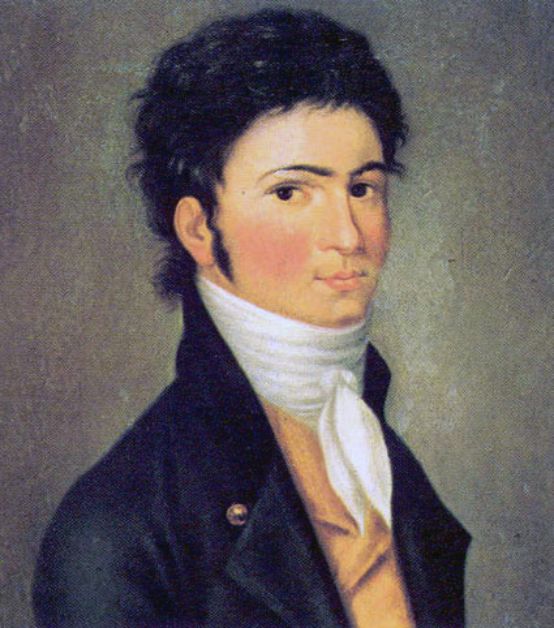
"I struggled to control my excitement as I climbed the stairs to the poor apartment where the big man lived. When I opened the door, I found myself in a kind of hovel, which was not only dirty, but also in terrible disarray." With these words, Gioacchino Rossini recalled a visit to Ludwig van Beethoven. Let us imagine Beethoven sitting at his home instrument, perhaps a clavichord, and composing: scattered in front of him were sheets of paper with sketched themes, motif ideas and melody fragments. Beethoven transformed these into sound for the first time on the clavichord.
A fictitious scene that became reality, at least in the performance at the first concert of the "10 x Beethoven" project. The program included Beethoven's first symphony in the four-hand piano version by Hugo Ulrich (1827-1872), played by the Bernese pianist and composer Erika Radermacher and Michael Kaufmann, Director of the Lucerne School of Music. Beethoven's first symphonic work was played in a very simple, seemingly original manner. Of course, the palette of orchestral colors had to fall by the wayside. Instead, other elements of the masterpiece came to the fore: the monophonic melodies, for example at the beginning of movements two and four, were particularly impressive. The simple, vulnerable tone of the piano immediately captivated the audience and they listened to the melody perhaps even more attentively than they would have done with the orchestra.
Successful start
The C major Symphony was introduced with the extremely short composition Vision of the original form by Erika Radermacher. In the piece, dominated by repetitive staccato figures in the lower register, the co-initiator of the project prepared the key of C major, which was predominant that evening. Without a break, the work led into the performance of the famous waltz by Anton Diabelli (1781-1858). Radermacher then presented the 33 variations by Beethoven in an extremely fast-paced and dynamic interpretation. On the one hand, this emphasized the humorous character of the work, but on the other, it offered only a few pauses for breath and created almost cluster-like sounds through the sometimes generous use of the pedal.
What contrasts: From the playful late work (Diabelli-Variations) to the serious first work (Symphony No. 1), from the giant of piano literature to the orchestral work in piano transcription. Although the pronounced dynamics of the Waltz Variations were missed here and there, it was a successful and surprising conclusion to the evening that left the audience wanting more: How the heroic tones of the Eroica sound on the piano? Or the pastoral thunderstorm from the Sixth Symphony? Or the second movement of the Seventh Symphony, often described as a funeral march?
Michael Kaufmann gives an answer
Michael Kaufmann has been Director of the Lucerne School of Music since 2011. He also works part-time as a cultural journalist, pianist, choirmaster, composer and arranger. Hannes Liechti interviewed him.
What is the «10 x Beethoven» project about?
Michael Kaufmann: The initial idea was to perform all of Ludwig van Beethoven's symphonies in piano transcription. Gradually, we added further material to this core idea and contrasted the symphonies with other pianistic works by Beethoven and contemporary compositions. Finally, we also commissioned compositions, for example from Katharina Weber.
Why «10 x Beethoven»? The composer only wrote nine symphonies.
The last concert with the original four-hand work I think your by Beethoven marks the finale. As a contrast, we programmed the crazy piece Fantasia contrappuntistica by Ferrucio Busoni, who studied Beethoven intensively and transcribed some of his works for piano.
Why should you listen to a Beethoven symphony in a piano version?
The piano versions offer a different approach. They allow you to experience the structure of the originals in a completely new way. You suddenly hear intermediate voices, ideas and swings that you have never consciously taken note of in the orchestral version. This is a real treasure trove for Beethoven interpretation and analysis. Of course, elements such as contrasts and timbres are lost in the transfer to the piano. But it was not the intention of our project to say that this is exactly how Beethoven should sound.
In concert, the symphonies are rarely performed on the piano.
This was not always the case. In the 19th century, when it was not yet possible to record music, home concerts on the piano were the only way for many citizens to get to know the great symphonic works. Musicians and conductors were also guided by the piano versions. It seems to me that this strand of the culture of interpretation has largely been lost.
Your concerts feature arrangements by Franz Liszt, Theodor Kirchner and Hugo Ulrich. What distinguishes these transcriptions from one another?
Ulrich is the classic. He always stays as close as possible to the score. His transcriptions are very well arranged and easy to play, almost a little unimaginative. Kirchner, on the other hand, is a romantic spirit. In his eight-hand versions, the pianists can communicate with each other almost like in an orchestra. Liszt, finally, stages an extroverted Beethoven showdown. He tried to bring everything to the piano right up to the last note. Musically, this sometimes seems very ponderous and is technically incredibly demanding.
One of the main aspects of the project is the juxtaposition of Beethoven's symphonies and contemporary compositions. What do you hope to gain from this?
We are trying to bring Beethoven's revolutionary spirit into the 21st century. In new music, too, you always have to ask yourself: What is convention and what would be a violation of it? What is the artistic aspiration you have when you write a piece? It should not be a pretension to compete with Beethoven, but simply an enrichment of the program.