Baroque music from Switzerland? Absolutely!
Johann Melchior Gletle was born 400 years ago in Bremgarten in the canton of Aargau. His career took him to Augsburg as an organist and cathedral choirmaster.




The Swiss Confederation is hardly known as a country of origin for Baroque composers. It was less due to a lack of musical talent that hardly any composers stood out in this country than to the social and institutional conditions. For married Catholic musicians in particular, there were only a few positions in the early modern Swiss Confederation that allowed them to work as composers on a permanent basis. Johann Melchior Gletle (1626-1683), who was born in Bremgarten/AG and whose 400th birthday is at the beginning of July, therefore left his homeland and made a career as a cathedral conductor in the Bavarian-Swabian city of Augsburg.
We know surprisingly little about Gletle's years of education. All that is certain is that he attended the Jesuit school in Freiburg/FR in 1641. In August 1651, he was employed as organist at Augsburg Cathedral. Shortly afterwards, he married Katharina Streitlin, with whom he had 16 children. In April 1654, he was the first non-clergyman to be appointed cathedral choirmaster. In return, he was given a surplice so that he could perform in processions like the clergy. He held both posts until his death at the beginning of September 1683.
Between Bremgarten and Augsburg
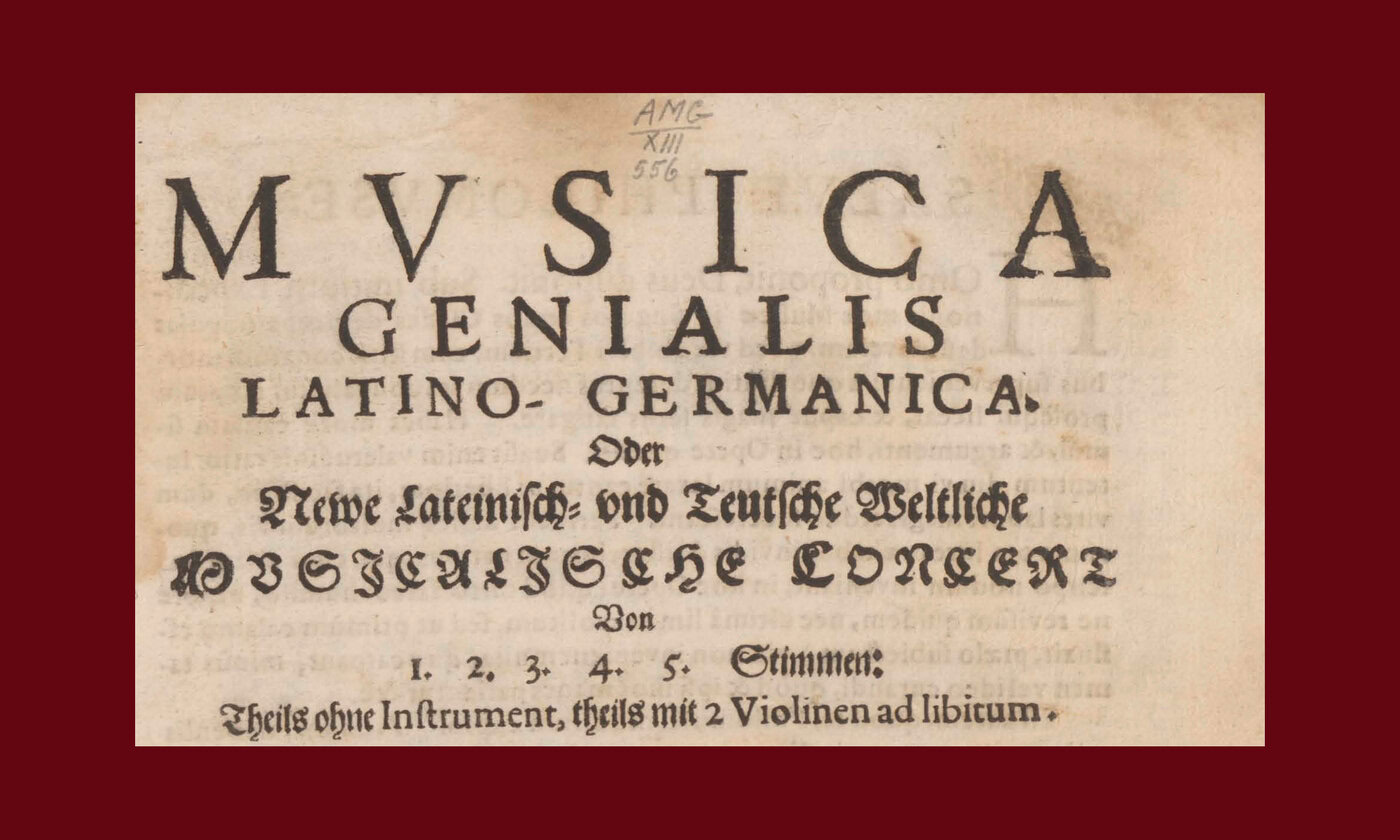
Gletle spent a total of 32 years with his family in Augsburg and published eight music prints there, seven of which have survived. He appears on all title pages as a citizen of Bremgarten and Augsburg cathedral bandmaster («Bremgartensi. Ecclesiae Cathedralis Augustanae Capellae magistro»). He was entered in the Bremgarten register of citizens every year until his death. The reason for this remains unclear. These and other questions about Gletle and his environment will be the subject of a conference at the University of Geneva from August 21 to 23, 2026 in Muri/AG. At the same time, the concert series «Music in the monastery church» works by Gletle and his musical environment.
Augsburg Cathedral opened up professional opportunities for Catholic laymen that would have remained largely closed to them in the Confederation: Chapel master positions in Swiss monasteries were usually filled by conventuals and required entry into a religious order. As a married family man, Gletle's employers were in fact almost exclusively cathedral and collegiate churches.
A judgment by the music theorist Sébastien de Brossard (1655-1730) shows how highly regarded he was during his lifetime. Among the composers of the German-speaking world, he particularly appreciated Johann Melchior Gletle and Samuel Capricornus (1628-1665). He wrote about Gletle: «His music is balanced and regularly structured, but at the same time - when necessary - brilliant and light. It is artistic, expressive, graceful and, above all, excellently adapted to the respective places, times and the actual meaning of the words [translation by the author].»
For a composer who is largely forgotten today, this is a remarkable achievement. In the run-up to the 400th anniversary of his birth, further works from his oeuvre, which has so far only been partially catalogued, were therefore transcribed - both for performances and for the critical classification of his oeuvre. The preparations for the conference and anniversary have also made the wide contemporary reception of his music visible: in Central Europe (Central Germany, Alsace, Switzerland, Austria, South Tyrol), in Central Europe and Scandinavia as well as in the Jesuit reductions of South America.
A citizen of Bremgarten who made a career in Augsburg and whose music was already being heard as far away as South America around 1700: Johann Melchior Gletle is one of the fascinating, still too little-known figures in the musical history of the Old Swiss Confederacy - with a global reach.
Further article on the topic: https://www.musikzeitung.ch/basis/smg/2026/06/johann-melchior-gletle-1626-1683-tagung-und-konzerte-zum-400-geburtstag