

No. 2: The Guitar
Giuseppe Mennuti is a guitarist and guitar teacher at the Biel Music School and the Bernese Jura Music School. He studied in Italy, Spain, and Switzerland and focuses primarily on contemporary music.




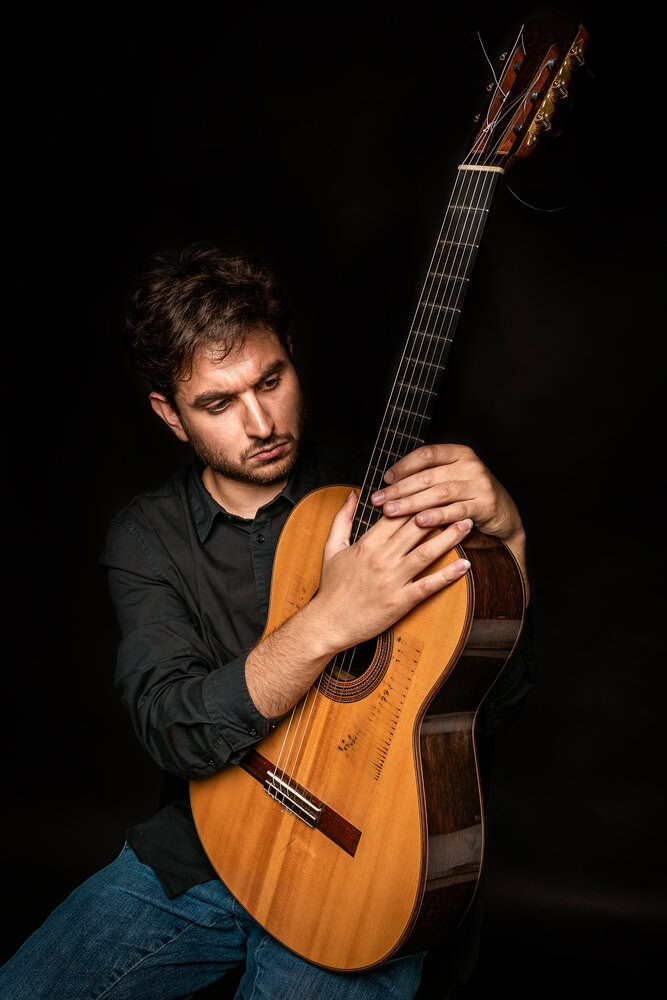
Giuseppe, why is the guitar so popular?
It’s a very accessible instrument. You can pick it up right away and play notes on the strings with your right hand. If the piano is even more popular, it’s perhaps because you can play two or three notes at the same time to form a chord—which is more difficult on the guitar. Besides, guitars aren’t expensive; you can find good ones for as little as forty or fifty francs.
Why did you decide to play the guitar?
I grew up in a small village in Italy where there were hardly any opportunities to take music lessons. There were no professional musicians. A worker at Fiat played the guitar, and since we had one at home, I started playing it. My father played bass guitar, but he didn’t have much time—he ran a small supermarket. Since I took to music right away, I later went to the neighboring village, where I was able to take lessons.
What made you decide to pursue a professional career?
When I was 12 or 13, my passion for music began to grow, and I was able to learn from well-known musicians who lived in the area from a very early age. My friends also played music, and there were many bands in the region. I was really lucky.
These days, you focus primarily on contemporary music.
Exactly. I've been playing in ensembles for years and recently took over as artistic director of the Nouvel Ensemble Contemporain (NEC) in La Chaux-de-Fonds.
Besides teaching, do you still have a lot of time for music and artistic pursuits?
I’ve decided to teach no more than 50 % classes; otherwise, it’ll be too much with all my other responsibilities. I try to make sure I can practice for at least an hour and a half each day. When you play a lot of contemporary music, you have to be careful not to lose the classical sound—that’s something I’m working on a lot right now. For example, I enjoy playing pieces by the Catalan composer Miguel Llobet. On top of that, there are many administrative tasks and computer work.
What advice would you give to students who are interested in the electric guitar? Is it better to start with the classical guitar?
On an acoustic guitar, the string spacing is greater, and the way you use your right hand is also quite different. It’s perfectly fine to start with an electric guitar, but you should still learn to read music—it helps a lot. If someone is interested in a specific instrument, that works too: it’s a bit like the difference between a drum set and classical percussion.
In your experience, how long do the students stay in class?
I couldn’t say for sure, since I’ve only been teaching for a few years. But I’ve taken on students who have been at the music school for six or seven years. The geographical aspect is very interesting. In some regions, recreational options in the villages are limited: perhaps there’s one sport and two or three instruments offered at the music school, which rotate depending on the day of the week. Students who only have time on a single day learn the instrument that’s available on that day.
How do you motivate your students?
When I notice their motivation waning, I ask them what they’d like to do and what kind of music they like to listen to, and then I put together little arrangements for them—for example, of pop or rock songs. They’re always happy when they realize they can play the music they like on their guitars. As a teacher, it’s important to be flexible.
Do you also play contemporary music in class?
Absolutely. There are students who are very interested in it; generally speaking, children and teenagers are like sponges—they soak everything up. Sometimes, though, parents also want to know why their child isn’t playing the Beatles anymore (laughs). It takes a lot of empathy to understand what inspires students and to support them accordingly.

