

Top 3: The Violin
Anna Modesti is a violinist and music educator at the Conservatorio della Svizzera italiana (CSI) in Lugano. She has been teaching violin to children and adults there for many years and also launched an orchestra project.




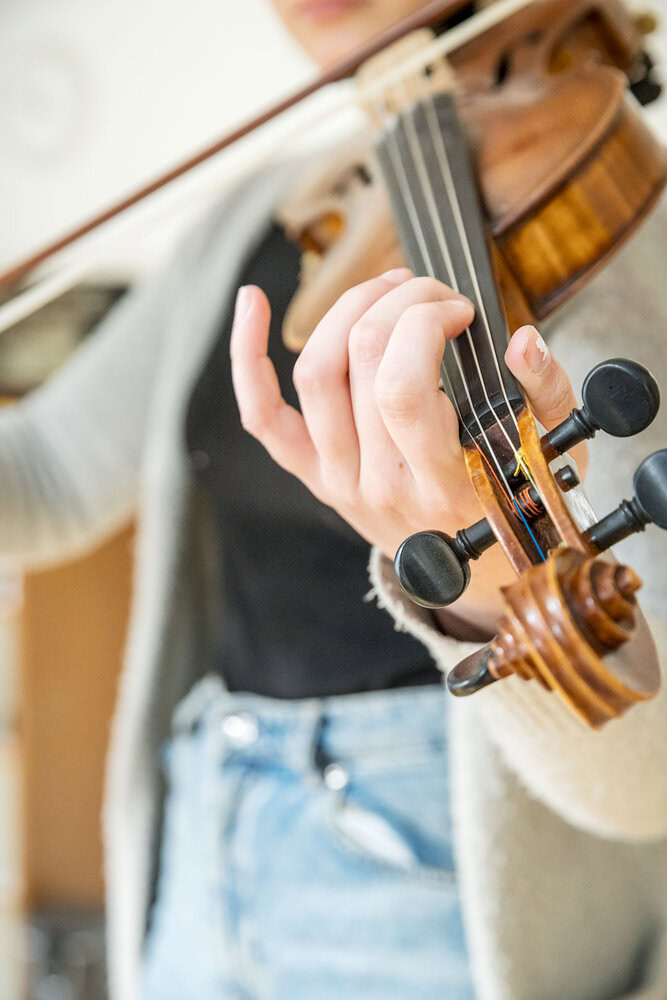
Top 3 Instruments: The Violin (Photo: Gabi Pavanello)
The violin has been one of the most popular instruments at music schools for many years. Why? What do you think?
I think one of the reasons is the opportunity to play in an ensemble or an orchestra. You don't just get to play in your own little room—you get to be with friends, become part of a large orchestra, and maybe even perform in a big concert hall.
How long does it take for a child to be able to play in an orchestra?
At the conservatory, we’ve developed an orchestra program alongside individual lessons so that children can start at an early age. These orchestra classes are free—that is, they’re offered by the school, and families don’t have to pay extra for them—which, of course, makes it easier for them to attend. We also offer group lessons in which the children experiment with playing together—first in unison, then in two parts, and so on.
How did you come to choose the violin?
I don't remember exactly. I really liked the sound. It wasn't exactly easy, though, because my parents come from a family of lawyers that goes back generations, and they assumed their daughter would pursue a serious education—playing the violin wasn't exactly a serious pursuit (laughs).
Here’s the funny thing: a few years after I started teaching, my uncle called me and said he’d found a violin in the closet at my grandmother’s house—would I like it? It was a wonderful instrument. I studied in Milan and then started teaching in Lugano, which I really enjoyed. It was an environment that allowed me to continue learning alongside my work.
In your opinion, what is the ideal age to start playing the violin?
In my opinion, there’s no ideal age. When working with very young children, parental support is crucial—parents need to remind the child to practice and guide them through it. Generally speaking, a child can start as early as three or four years old; I’ve seen this firsthand. When I start working with an eight-year-old, the lessons and the approach change completely. Support from the family is still important, but it’s crucial to gradually allow the child to become more independent. Parents can make sure the child has a good practice spot where the violin is always ready to go.
Teaching adults is different, too. One of the first students I had was already sixty years old; he had worked with his hands his whole life and could no longer even bend his index finger. After that, he played the violin passionately for twenty years. Every now and then I hear the cliché that the violin is very difficult to play. But I’m convinced that’s not true.

