The monster from Greek mythology "Medusa" inspired the composer Thomas Fellow to write a piece for solo guitar. It is fast and moving, but remains tonal.
Werner Joos
(translation: AI)
- 23 Jan 2018
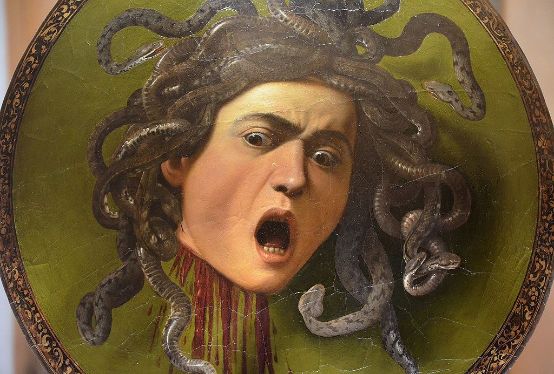
"Medusa" by Caravaggio, 1597, Uffizi Gallery; wikimedia commons
Medusa is a monster from Greek mythology: her hair is like snakes and anyone who looks at her turns to stone. German guitarist Thomas Fellow, born in 1966, was inspired by her depiction by the painter Caravaggio to create a virtuoso guitar solo piece. He had already seen the symbolic image as a teenager in the psychological thriller The horrors of the Medusa seen (in the original The Medusa Touch), with Richard Burton in the leading role.
The piece is in D minor, with the 6th string tuned low. Although Medusa's snake hairs perform a wild dance, they do not cross the boundaries of tonality. Melodic notes, which are embedded in a flurry of rapid, mostly continuous semiquaver movements, follow each other predominantly downwards in whole or semitone steps. Various melodic layers allow for a differentiated design. Tension is transformed into energy in striking chord repetitions, reinforced at the end by percussive elements.
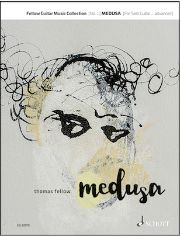
Technically, the piece is easy to master. The challenge lies in the tempo indication fast and furious, which applies to all five pages of the score. The notes are also reproduced as tablature at the back of the carefully and aesthetically pleasing edition. This means that, despite the sparse fingering indications, you can always make sure which notes are to be played in which positions. The piece can be heard in a version for two guitars and guitar percussion on the debut CD of the European Guitar Quartet - of which the composer is a member - and as a live recording on YouTube.
Thomas Fellow: Medusa, for solo guitar, ED 22595, € 7.50, Schott, Mainz 2016
Fewer positions in German professional orchestras
According to the German Orchestra Association, the number of musicians in German professional orchestras has continued to fall. From 2016 to 2018, the number of positions fell from 9816 to 9746, which corresponds to a decrease of 70 positions.
Music newspaper editorial office
(translation: AI)
- 23 Jan 2018
Photo: Denis De Mesmaeker/flickr.com
The number of orchestras also continued to decline. This was due to two mergers: the merger of the two SWR orchestras from Baden-Baden/Freiburg and Stuttgart as well as the Thüringen Philharmonie Gotha and the Landeskapelle Eisenach.
When the first all-German survey was carried out in 1992, there were 168 publicly financed, regularly performing professional orchestras. Since then, 39 orchestras have disappeared from the map. Between 1992 and 2018, the number of reported musician posts fell from 12,159 to 9,746, meaning that the number of jobs has fallen by around 20 percent. Further losses are looming in Saxony-Anhalt and Mecklenburg-Western Pomerania.
In eastern Germany in particular, many professional musicians only have emergency collective agreements. Remuneration in some orchestras is up to 30 percent below the collectively agreed wage and therefore only just above the minimum wage level. Nationwide, 39 orchestras do not pay according to collective agreements, 27 of them in the east.
Lucerne Symphony Orchestra receives Rugeri cello
Patrons associated with the Lucerne Symphony Orchestra have purchased a violoncello by Francesco Rugeri, Cremona, dating from 1690, to make it available to the Lucerne Symphony Orchestra on permanent loan.
Music newspaper editorial office
(translation: AI)
- 22 Jan 2018
Rugeri made a decisive contribution to the development of Cremonese cellos: he shaped the scale length, which was subsequently adopted by Stradivari. His instruments are among the most sought-after and valuable instruments today.
In December, the Lucerne Symphony Orchestra also published its annual report for the 16/17 season. The focus of the season was a multi-part Beethoven project. All of Beethoven's piano concertos were performed together with Oliver Schnyder, first as chamber music on the Pilatus, then "prima vista" with the orchestra and finally in three symphony concerts at the KKL Lucerne. The concerts were recorded for Sony Cassical and released as a CD box set in November 2017.
A total of 10,700 people attended music education events. Compared to the previous year, this represents an increase of 30 percent. Guest performances took the orchestra to the Bogotà International Music Festival (3 concerts) and for the first time to Bologna, La Chaux-de-Fonds and Udine, where it opened the concert season at the Teatro Nuovo Giovanni.
Aderi replaces Frauchiger
The municipal council, the city's executive body, has elected replacements to three of Bern's cultural promotion commissions as of January 1, 2018: It elected the singer Joana Maria Aderi to the Music Commission.
Music newspaper editorial office
(translation: AI)
- Jan 18, 2018
Joana Maria Aderi. Photo: Mario Heller
The singer, producer and performer Aderi works in the field of electronic music. She replaces Katrin Frauchiger, who was a member of the Music Committee from 2012 to June 2017. Aderi grew up in central Switzerland. She initially studied Renaissance music, but then also became interested in contemporary music from hip-hop to free jazz and electronics. In 2004 she started her own experimental electronic project EIKO. During her studies at the Basel Jazz School, she spent an exchange semester in Norway, where she completed her studies in Trondheim with a Master of Performance. Aderi returned to Switzerland in 2012.
Regina Füchslin is a new member of the Literature Commission. The classical philologist is co-director of the literary magazine "orte". She replaces Simone Ammann, who stepped down at the end of 2017. Since the departure of Claudine Metzger at the end of 2016, the Art Commission has only consisted of six members. Lucie Kolb has now been elected as an additional member. Kolb teaches at the Zurich University of the Arts and is co-editor of the art criticism magazine "Brand-New-Life".
10th Lucerne Music School Competition
The Lucerne Music School launched the Lucerne Music School Competition in 1998, a platform that enables participants to exchange ideas and meet like-minded people. In its anniversary year, pop/rock/jazz has its own category for the first time.
PM/Codex flores
(translation: AI)
- 17 Jan 2018
Photo: zVg
The first edition of the music school competition took place on a small scale. Back then, around 20 pupils appeared before the jury to perform. Since then, the number of participants has increased tenfold. In the meantime, the Lucerne competition has developed into a major music festival. This year, the pop/rock/jazz style has its own category for the first time and participants can be accompanied by a professional jazz combo.
Whereas in the past only the most talented and best could take part in the competition, today it is open to all pupils of the Lucerne Music School. Beginners and advanced students perform and compete against each other in a protected and benevolent environment. The approximately 200 participants receive professional feedback and gain their first competition experience or even prepare for larger regional and national competitions.
The music school competition will take place on Sunday, January 28, at the Südpol. The auditions during the day, the final and the ranking ceremony are open to the public and admission is free. The audience will have the opportunity to award audience prizes in the pop/rock/jazz and classical/folk categories at the final. The program can be found on the Lucerne Music School website: www.musikschuleluzern.ch
Art turns 1,000,055 years old
The international birthday of art goes back to Robert Filliou. Together with Espace 2, the Forum Valais organized a celebration at the Ferme Asile in Sion.
Music newspaper editorial office
(translation: AI)
- 17 Jan 2018
Erika Stucky celebrates Art's Birthday 2018, the global birthday party of art. Photo: E. Stucky,SMPV
On January 17, it's that time again: it's art's birthday and it will be 1,000,055 years old. At least according to the calculations of Fluxus artist Robert Filliou. In 1963, he invented "Art's Birthday", the global birthday party for art. This year too, the Ars Acustica Group of the European Broadcasting Union EBU is celebrating with numerous concerts and performances in over 20 cities. And the Festival for New Music Forum Valais, in collaboration with Radio Suisse Romande Espace 2, is taking part with a twelve-hour marathon event at the Ferme Asile in Sion. Between 7pm and 11pm, 20 mobile radio studios from Chicago via Helsinki, Moscow and Lisbon to Sion will be broadcasting concerts and statements on art live via satellite. In Sion, Audrey Cavelius, Yannick Barman and Erika Stucky will perform, and from 11.30 pm to 7.30 am, Sara Oswald, Colin Vallon and Julian Sartorius will present their mammoth eight-hour performance Rêverie based on Max Richter's Sleep. Rêverie is music to be experienced while you fall asleep and sleep, an "endless lullaby" of beguiling beauty. The audience lies on specially provided loungers. Reservations are essential.
Jazz and classical pianists use brains differently
Scientists at the Max Planck Institute for Human Cognitive and Brain Sciences (MPI CBS) in Leipzig have shown that different brain processes occur in jazz pianists than in classical pianists, even when they play the same piece of music.
Music newspaper editorial office
(translation: AI)
- Jan 16, 2018
Heidelberg Street Art, August 2012 by Eleye. Photo: liborius/flickr.com,SMPV
A significant difference lies, for example, in the planning of movements when playing the piano. In principle, pianists, regardless of the style, must first know what they are playing, i.e. which keys to press, and then how to play it, i.e. which fingers to use. What varies according to the style of music, however, is the weighting of these two steps.
Accordingly, classical pianists concentrate particularly on the second step in their playing, the how. For them, it is about playing a piece in a technically flawless and personally expressive way. The choice of fingering, for example, is crucial for this. Jazz pianists, on the other hand, are different: they focus primarily on the what. They are always prepared to improvise and adapt their playing flexibly to surprising harmonies.
The scientists at the MPI CBS investigated these correlations with the help of 30 professional pianists, half of whom had specialized in jazz for at least two years and the other half in classical music. They were shown on a screen a hand playing a sequence of chords on a piano, peppered with deliberate stumbling blocks in the harmonies and fingerings. The professional pianists were asked to imitate her and react flexibly to the irregularities, while their brain signals were recorded by EEG sensors on their heads. In order to exclude interfering signals such as acoustic signals, the whole thing took place completely without sounds, as silent piano playing.
In Germany, the Intergovernmental Committee on Intangible Cultural Heritage has added organ building and organ music in Germany to the Unesco List of Intangible Cultural Heritage.
Music newspaper editorial office
(translation: AI)
- Jan 15, 2018
Organ dismantling St. Agnes 2012, photo: Parish of St. Boniface Berlin/flickr.com
400 organ building businesses with around 2800 employees, 180 trainees and 3500 full-time and tens of thousands of volunteer organists characterize the craft and art of organ building and organ music in Germany. Over 50,000 organs are currently in use in the country.
The organ, organ building and organ music were invented more than 2000 years ago in Hellenistic Egypt and came to Europe via Byzantium, where they were further developed as a cultural asset from the Carolingian Renaissance to the present day. Since the Middle Ages, organs have been exported from Europe, where most organs are built, to many countries around the world. Germany is one of the most important countries in the world for the further development of organ building and organ music.
The Intergovernmental Committee is made up of 24 elected States Parties to the Intangible Cultural Heritage Convention. It decides annually on the inclusion of new cultural forms in the Unesco Lists of Intangible Cultural Heritage. To date, 377 forms of intangible cultural heritage have been inscribed on the International Representative List. By inscribing, the States Parties undertake to promote the intangible cultural heritage on their respective territories.
Winner of the Zwyssig competition 2018
The three composers Cyrill Schürch (Zurich), Markus Fricker (Rupperswil) and David Lang (Mammern) win the Zwyssighaus Bauen Foundation's 2018 composition competition.
Music newspaper editorial office
(translation: AI)
- Jan 12, 2018
Cyrill Schürch (right) with Stephen Montague. Photo: zVg
Cyrill Schürch was born in Lucerne in 1974. After private piano lessons with Konstantin Scherbakov, he studied piano and composition at the University of Houston. He later completed his doctorate at King's College London. Since fall 2014, he has been Vice-Rector of the Zug Music School with a teaching assignment for piano, music theory and composition. He is a member of the artistic advisory board of the European Youth Choir Festival Basel.
Markus Fricker is a retired school musician who trained under Andreas Juon and Willi Gohl. He completed his teaching diploma in solo singing at the Zurich Conservatory under Sylvia Gähwiller. Today he is the director of a church choir and is mainly active as a composer of vocal music.
David Lang is a trained singer, pianist and conductor for choir and orchestra. He began his composition studies at the ZHdK in Zurich in the Composing/Arranging department. After his piano studies, he continued his education as a self-taught pianist.
A total of eleven compositions were submitted to the public composition competition. The prizewinners' concert will take place in St. John's Church in Zug in the fall of 2018. The works will be premiered by the Walchwil church choir under the direction of Peter Wehrlen.
Call for entries for "Classical:NEXT"
Pro Helvetia is launching a call for applications to participate in "Classical:NEXT", the trade fair for classical and contemporary music, which will take place in Rotterdam from May 16 to 19, 2018.
Music newspaper editorial office
(translation: AI)
- Jan 11, 2018
The Rotterdam cultural center De Doelen. Photo: Classical:NEXT/Rien van Rijthoven
Classical:NEXT" is a forum for musicians and professionals from all areas of classical and contemporary music. From event organizers and festivals to publishers, labels and associations to agents and musicians: Around 1200 participants from over 40 countries will meet over four days at the de Doelen congress center in the center of Rotterdam.
Trade fair participants will have the opportunity to expand their international network and attend the extensive trade fair program with showcases, conferences and project presentations.
Pro Helvetia supports representatives of ensembles from the independent music scene who wish to take part in "Classical:NEXT 2018" by covering the accreditation costs (around 360 euros) and contributing a lump sum of 350 francs per person towards travel and accommodation costs. Interested parties should send an email to Tobias Rothfahl, Music Department (trothfahl@prohelvetia.ch) by February 12, 2018 at the latest.
Höppner on the advisory board of the Fondation Hindemith
The Board of Trustees of the Fondation Hindemith has appointed Christian Höppner, Secretary General of the German Music Council, to the Board of Trustees. The Fondation Hindemith, based in Blonay, Switzerland, is dedicated to preserving and disseminating the cultural legacy of the composer Paul Hindemith.
Music newspaper editorial office
(translation: AI)
- Jan 10, 2018
Paul Hindemith rehearsing in Turin in 1958. Photo: Radiocorriere, January 1958, No. 4, p. 3/WikiCommons,SMPV
According to Andreas Eckhardt, President of the Board of Trustees of the Hindemith Foundation, Höppner not only has "significant cultural-political expertise, but also a close connection to music-making and teaching practice as a university lecturer at the Berlin University of the Arts". Paul Hindemith held a professorship for composition at the predecessor university from 1927 to 1937.
Founded in 1967, the Fondation Hindemith supports or initiates scientific research in the field of music and ensures its dissemination. It is based in Blonay (VD) on Lake Geneva in Switzerland, where the Hindemith couple spent the last years of their lives. Since 1978, it has maintained the Centre de Musique Hindemith Blonay there, which primarily serves musical practice. In 1974, the foundation established the Hindemith Institute Frankfurt, which is dedicated to musicological research and the study of Paul Hindemith's life and work.
Streaming now counts for the hit parade
In addition to physical sales and downloads, data from music streaming providers will now also be included in the weekly album charts, which are determined by GfK Entertainment on behalf of IFPI Switzerland.
Music newspaper editorial office
(translation: AI)
- 09 Jan 2018
Streaming has been included in the single hit list since 2014. It is based exclusively on premium streams with a playing time of 30 seconds or more.
The first frontrunner in the Official Swiss Album Chart under the new rules is Ed Sheeran, whose longseller "÷" is once again at the top. Silver and bronze go to Martin Suter/Stephan Eicher (Song Book) and Eminem (Revival) respectively. They are followed by Gölä (Urchig) and Helene Fischer (Helene Fischer).
Parallel to the streaming integration, the Official Swiss Hit Parade is celebrating its 50th anniversary these days. The first singles charts were published on SRF on January 2, 1968, back then as a Top 10, with Roland W. (Monja), the Bee Gees (Massachusetts) and Mireille Mathieu (La dernière valse) occupying the top three places. The 2018 chart anniversary will be celebrated with many specials and retrospectives, including a major TV show on SRF1 on February 10.
Death of Schubert specialist Walther Dürr
According to a statement from the Schubertiade in Hohenems, Walther Dürr, one of the most important Schubert connoisseurs of the 20th century, died unexpectedly last Saturday of a pulmonary embolism.
Music newspaper editorial office
(translation: AI)
- 09 Jan 2018
Walter Dürr (picture: Schubertiade),SMPV
After studying in Berlin and Tübingen and working at various universities in Italy, Germany and Switzerland, Walther Dürr became a managing member of the editorial board of the New Schubert Edition in Tübingen in 1965.
According to the Schubertiade, his work focused on the volumes containing all of Franz Schubert's songs, which could be described as his central life's work; however, he was also responsible for other groups of works. He retired in 1997, but continued to work as a member of the editorial board and as an editor for the New Schubert Edition.
The Schubertiade "mourns the loss of a companion who was closely associated with it from the very beginning as a musicological advisor, author of program booklet contributions and participant in panel discussions". The funeral will take place on Monday, January 15, 2018 at 11 a.m. at the Bergfriedhof cemetery in Tübingen.
Flying high in a high-rise building
Many things may be sedate in Bern, but the new and experimental music scene is definitely not. Connected in the pakt bern network, it puts on daring projects and inspires audiences.
Andreas Zurbriggen
(translation: AI)
- 08 Jan 2018
Franziska Baumann in the command center. Photo: Roger Ziegler
Probably the most famous haunted house in Bern is on Junkerngasse, while the largest is on the outskirts of the city. Sounds can be heard in its stairwell. The source of the music remains invisible. Individual light projections illuminate the white of the bare walls. Listeners appear - and disappear again. The scenery seems surreal. What sounds like the plot for a ghost movie is in fact the eagerly awaited "flash! (back and forward)" event organized by the pakt bern network in the former Swisscom building. The building has been empty for three years. Now, at the beginning of December, it came back to life for the first time. At least for one evening. For five hours, members of pakt bern and invited musicians performed in selected rooms of the 19-storey high-rise. One of them: the claustrophobic stairwell. Students from Bern University of the Arts (HKB) performed solo works by Iannis Xenakis, the mathematician among composers.
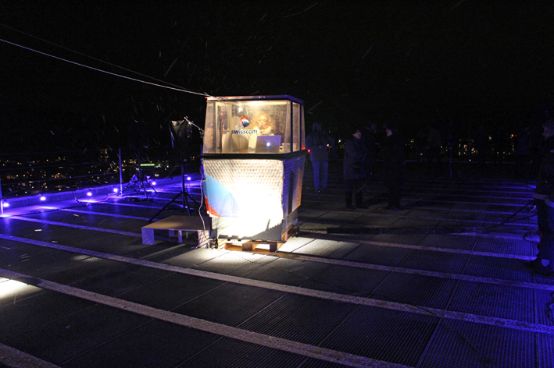
The 200 visitors - more were not allowed into the building at Ostermundigenstrasse 93 for security reasons despite the large crowds - were treated to their first listening experience as soon as they entered, Ending II. This fascinatingly iridescent, viscous installation, which plays with a multitude of loudspeakers distributed throughout the room, was created by students of the SoundArts course at the HKB on the basis of a composition by Tobias Reber. In the midst of the snow flurries, 19 floors higher, on the roof of the 72-meter-high building, singer Franziska Baumann sent a sublime cloud of sound merging voice and electronics out into the icy cold night. Her command center was a gondola, stolen from a ski resort, which added to the audiovisual magic of the performance.
Classic avant-garde meets young and wild
A veritable panopticon of contemporary music unfolded during the five-hour event, demonstrating the pleasing breadth of the pakt bern network, which was founded two years ago to pool forces in the field of new and experimental music. Almost 60 exponents, all of whom have a connection to the city of Bern, have come together in the association, which is organized on a grassroots democratic basis: Composers, performers, concert organizers, mixed generations and genres. In the network, the classical avant-garde of today's septuagenarians meets the young and wild, improvised meets fully composed, electronic meets instrumental music. "The history of pakt bern is long, but the desire is clear: to think and create music outside the box. The network brings together those who are curious and keen to experiment," says Christian Pauli, board member of pakt bern, an association without a president, nota bene.
The "neue musik netzwerk", as pakt bern also calls itself, caused a sensation back in 2016. A "neue musik battle" was organized in the Sternensaal in Bümpliz, based on the boxing and wrestling matches that are regularly held in this traditional hall. Instead of fighting with fists, the participants attacked each other with sounds. For the first time, a broad audience gained an insight into the wide-ranging spectrum of the club, which brings together all the big names in Bern's new music scene. Even after its short existence, the association has made it a tradition to organize a major event at the end of each year. After the boxing ring, it was now the turn of a high-rise building as the venue.
Soap Box concert series
An almost endless glissando, wrapped in the most beautiful mixture of frequencies, can be heard on the seventh floor of the former Swisscom building. This comes from the composition Chronos-Kairos by the Bernese old master Peter Streiff, produced in 1972 on one of the first portable desktop synthesizers, the "Synthi VCS3". The sensual sound journey lasts 25 minutes and puts the musical perception of time into a whole new perspective. When asked about the pakt bern network, Streiff welcomes the solidarity created by this association. "Despite the wide artistic and aesthetic range, there is enough room for individual orientation," he adds as a characteristic feature of the association.
There was a lot to discover at "flash! (back and forward)". Improvised minimalist saxophone sounds by the Konus Quartet, powerful, instrumentally produced "industrial sound" by Hamburg's Felix Kubin, played live to unknown industrial and corporate training films from the period between 1960 and 1990, or a meditative sound massage by Maru Rieben, which you could enjoy as a single guest in a passenger elevator, complemented each other to form a harmonious whole at this feast for the senses. However, no one who wants to immerse themselves in the sounds of Bern's dynamic music scene will have to wait a year. The Soap-Box concert series launched by pakt bern takes place approximately once a month at the Progr. These are parlor concerts between improvised, electronic and installation music.
More information about the association and information about the concerts of the association members at:
The unerhört! festival took place for the sixteenth time in Zurich and Winterthur from November 24 to December 3, 2017. It uses unusual approaches to create exceptional music and reach new audiences.
Hanspeter Künzler (translation AI)
(translation: AI)
- Jan 05, 2018
Kukuruz quartet. Photo: Michelle Ettlin
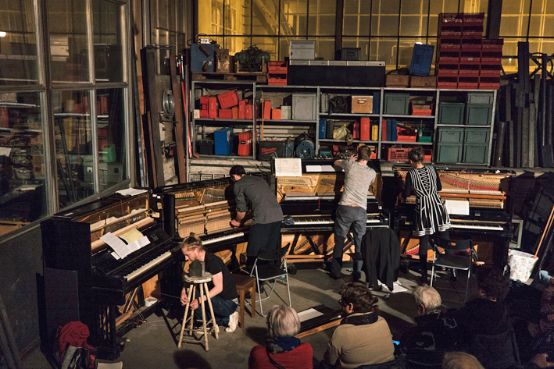
Jazz club Moods, Rote Fabrik, Musikklub Mehrspur and Werkstatt für improvisierte Musik (WIM) may still sound quite conventional as venues. But Museum Rietberg? Küsnacht cantonal school? The Bürgerasyl-Pfrundhaus retirement home? Surprises are part of the concept at the unerhört! festival. A prime example of the efforts to pull music out of its stylistic pigeonholes and place it in new contexts was the concert by the Kukuruz Quartet at Schlosserei Nenniger during the latest edition. Nomen is more than omen here: the Nenniger locksmith's shop is actually an active craft business. It is located in Zurich's Binz district, a stone's throw away from the offices of Intakt Records, the record label that has achieved worldwide renown in the independent music scene. The machines have been rolled up against the walls and made way for chairs. Pulleys hang from the ceiling. There are more benches on a ramp.
Eastman Renaissance
All the seats are taken, around one hundred spectators of all ages have gathered to enjoy a rare performance of Julius Eastman's works. The four pianos needed for the performance are arranged like a crescent moon. Behind them is the huge gate of the locksmith's shop, to the right a rack of colored plastic crates. The Kukuruz Quartet - Philip Bartels, Duri Collenberg, Simone Keller, Lukas Rickli - has dedicated itself for years to re-exploring the works of Eastman, who died in 1990 at the age of 49. His talents as a pianist, singer, composer and lecturer were encouraged early on. The bolder his experiments became, the more clearly he acknowledged an Afro-American, homosexual perspective and gave his works titles such as Evil Nigger or Gay Guerrillathe less he was heard in the New York scene. In the 1980s, he lived for a time as a homeless alcoholic in Tompkins Square Park. It was not until eight months after his death that a first small obituary appeared in the Village Voice. For some years now, Eastman has been experiencing a posthumous renaissance. In the Schlosserei, the Kukuruz Quartet impressively demonstrates how well deserved this is. The compositions may belong to the realm of minimalism, but the fact that the various repetitive "riffs" are performed by four pianos gives them a wonderful sonic opulence, not to mention a groove that lies somewhere between Thelonious Monk and Funkadelic. But there is also room for a captivating piece where the barely perceptible sounds are generated by strings pulled across the piano strings. The audience reacts with great enthusiasm. The sad question remains as to what else could have been created if Eastman had not been driven to the brink of existence and beyond by the conventions of his time.
Monk commemoration
The unerhört! festival has its origins in the weekly improvisation evenings that pianist Irène Schweizer and saxophonist Omri Ziegele once organized at Casablanca on Zurich's Langstrasse. "In addition to the concerts, we also wanted to create a celebration for our music," Schweizer wrote in the brochure published to mark the tenth anniversary. "This wish was the catalyst for unerhört!" Florian Keller from the unerhört! program group cites the educational aspect as a difference to the Taktlos festival, for example: "We work with schools, with an age residence and make sure that different scenes and age groups come together." He cites the example of the young Zurich saxophonist Tapiwa Svosve, who performed alongside bassist William Parker and drummer Hamid Drake at the Rote Fabrik and at the Küsnacht and Stadelhofen cantonal schools. "Those are truly magical moments," says Keller. "I know from Hamid Drake and William Parker that they really enjoyed it. Because in the question and answer session afterwards, there were also political questions, and so they were able to say in front of 200 or 300 young people: 'This is what we do, this is our story'."
Outrageous! 2017 was once again a resounding success. The idea of a tribute to Thelonious Monk, who was born a hundred years ago, was the common thread running through the program. While the works of Eastman Monk could be traced as an influence, both Irène Schweizer and Mike Westbrook each performed interpretations of his pieces. In addition to Svosve/Parker/Drake and Byron/Ortiz, the London Jazz Composers Orchestra, Aki Takase (piano) and Ingrid Laubrock (sax), Michael Arbenz & Big Band of the Lucerne University of Applied Sciences and Arts, the band Human Feel and the Stephan Crump/Ingrid Laubrock/Cory Smythe trio provided further highlights with and without Monk references.