Cellist Kian Soltani is to be honored with the Credit Suisse Young Artist Award, which comes with CHF 75,000 in prize money. The prize, which is closely associated with the Lucerne Festival, will be awarded for the tenth time in 2018.
Music newspaper editorial office
(translation: AI)
- 13. dec 2017
Kian Soltani (Image: zVg)
Cellist Kian Soltani comes from a family of Persian musicians. He was born in Bregenz, Austria, in 1992 and began his cello studies at the age of twelve with Ivan Monighetti at the Basel Music Academy. He also took part in masterclasses with Sol Gabetta and Jens Peter Maintz, among others, and completed his studies as a "Young Soloist" with Frans Helmerson at Kronberg Academy.
In 2015 and 2017, Kian Soltani performed as solo cellist with the West-Eastern Divan Orchestra under the direction of Daniel Barenboim at the Lucerne Festival. The prize includes a concert with the Vienna Philharmonic Orchestra as part of the Summer Festival. This will take place on September 8, 2018 under the direction of Franz Welser-Möst in the concert hall of the KKL Lucerne.
The Credit Suisse Young Artist Award is an initiative of the Lucerne Festival, the Vienna Philharmonic Orchestra, the Gesellschaft für Musikfreunde Wien and the Credit Suisse Foundation. Outstanding young musical personalities receive the award for exceptional achievements. The prizewinners receive funding and an opportunity to perform at the Lucerne Festival. The prize is awarded every two years (alternating with the Prix Credit Suisse Jeunes Solistes for the promotion of highly talented young musicians in Switzerland).
In the beginning was the cheese
Zurich's JazzBaragge has been serving up its weekly live sessions for sixteen years. Now it is presenting itself to the whole world with a new face.
Hanspeter Künzler (translation AI)
(translation: AI)
- 13. dec 2017
Picture: JazzBaragge
Every Wednesday evening, the auditorium of the Moods jazz club in Zurich disappears behind a black curtain. A carpet is rolled out in front of it and the instruments are placed on it, leading through the program like a red thread: Piano (occasionally guitar), double bass and drums. The mood of a room is the most important prerequisite for a well-tempered jam session. And here, supported by a well-stocked bar, it is without a doubt just right. The room feels intimate enough to give you the feeling of being among friends. But it's also big enough for an audience whose applause doesn't sound like a plucked chicken: "When we have 150 people, we're packed," says Dave Feusi, a co-founder and president of JazzBaragge: "And last week we had that."
The live session organized by the JazzBaragge association has been at home at Moods since February 2016. Now they feel comfortable enough to present themselves to the world. Thanks to an elegant new homepage, the Journey to JazzBaragge only as long as a mouse click. Entry is free of charge. Each session is streamed live in full length and parts of it are archived. There's no need to worry that jazz fans will prefer to sit at home in future and watch the evening on their computers. Thanks to the first-class picture and sound quality, you get the impression that a lot of good things are happening here. But you also sense that this good would be much better if you were there yourself. "It's like getting records of experimental music," says board member Nicole Johänntgen: "It's a teaser. You know that you have to be there live to really experience the music."
In search of the right club
After a false start in 1999, Dave Feusi and Peewee Windmüller came across the Chäsbaragge in Brunau. Fondue was served here from Thursday to Sunday, and the store was empty for the rest of the week. The location was ideal for the idealistic plans of the two initiators, and so they founded the "JazzBaragge" in January 2001. In the beginning, they programmed bands on Monday and Tuesday and invited musicians to a jam session on Wednesday. The bands didn't take off. So the jam remained. It lasted just under a year in the steaming cheese bell. Then the money ran out here too.
In the search for new synergies, the Zurich Jazz School came onto the scene. It ran its own club at Waldmannstrasse 12, and JazzBaragge also took up residence here. The connection lasted for fourteen years - until the jazz school moved to the Zurich University of the Arts (ZHdK) in the Toni-Areal. The attempt to relocate JazzBaragge to the new Mehrspur music club at ZHdK failed: "The new club already looked big and cold on the plans," says Feusi. "You can't have a jam in front of 500 people." That's when the welcome invitation from Moods arrived. "It was very important to us that nobody was interested in making money," says Feusi. "It's all about bringing musicians together and giving young people the opportunity to make contacts and learn their trade."
The sound goes around the world
The renovation period at Moods was ideal for JazzBaragge to acclimatize. There was a spirit of optimism all around, and it was fitting that Wednesday evening first had to get used to the new surroundings. Thanks to the new audiovisual possibilities of Moods, completely new perspectives opened up. However, this is not the first time that the jam sessions have been streamed live. Ten years earlier, the Digital Broadcast Channel (DBC-TV), which was launched in France and continued in Engelberg, had already set up cameras in the JazzBaragge. And because the company founder was a big fan of the alternative gaming world Second Life, the session even had its permanent digital home there. Of course, the image and sound quality at Moods is much better today. "We had to try things out first," says Feusi. "We soon realized that there were too many microphones and cameras around. They disturbed the audience and distracted the musicians. Now there are just two overheads, plus the Sennheiser head and mics for bass and piano, sometimes guitar. That works well. It gives an authentic sound. You can hear everything, but it's not a studio recording." So the sound of JazzBaragge is now traveling around the world again. For the time being, however, the goals are not yet so ambitious. "We're still concentrating on Switzerland," explains Johänntgen. "Our aim is to promote exchanges between musicians and perhaps encourage them to set up similar sessions. That's already enough work. But musicians from Germany, France and other countries already sometimes appear. Last week there was one from Palermo who had already heard of us."
The technology is brand new, the concept has remained unchanged for sixteen years. A basic trio plays a set that lasts 30 to 45 minutes. Then the session opens. Everyone can join in. "Everyone has to see for themselves what they are capable of," says Feusi. To keep the dynamic fresh, the core trio, which is also put together especially for this event, is changed every two weeks: "Nothing should become a habit," explains Feusi, "otherwise the session is dead."
Following protests, the Bavarian Broadcasting Council has decided that the Bavarian classical radio station BR-Klassik will continue to be received on FM. In 2014, BR had announced a frequency swap with the youth channel Puls for 2018 and thus a migration to DAB+.
Music newspaper editorial office
(translation: AI)
- 13. dec 2017
The German Music Council is satisfied with the decision. This solution ensures that the "excellent BR-Klassik program can be received in analogue and digital form by all sections of the population".
The background to the decision is a significantly changed environment compared to 2014: Bayern 3 is the market leader among 20-29-year-olds in Bavaria: When the decision was made in 2014 to broadcast Puls on FM instead of BR-Klassik in the future, there was a threat of a generation break across BR's program range.
Today, however, Bayern 3 has succeeded in becoming the market leader in the target group of 20 to 29-year-olds in Bavaria - thanks to the consistent realignment of Bayern 1 and Bayern 3, which was introduced in 2015 and has made Bayern 3 much younger in terms of its musical orientation and appeal.
This means that the FM range will be retained for the classical music audience, a significant proportion of which has yet to make the switch to digital radio.
Isa Wiss honored in Lucerne
For the third time, the Lucerne Jazz School Association, which laid the foundations for jazz training at Lucerne University of Applied Sciences and Arts, is awarding a prize. This year's award, worth CHF 10,000, goes to vocal artist and improviser Isa Wiss.
Music newspaper editorial office
(translation: AI)
- 12. Dec 2017
Isa Wiss (Photo: Francesca Pfeffer)
Born in 1978, Isa Wiss graduated from Lucerne University of Applied Sciences and Arts in 2005 with a Master's degree in music education. For some years now, her creative focus has increasingly been on stage and musical-literary projects.
Isa Wiss is co-founder of Mullbau, the space for improvised music. She worked as a curator at the migma performance days in Lucerne until 2017. She also carries out educational work with specific projects for children. The Lucerne Jazz Prize 2017 will be presented to her on Monday, December 18 at the Jazzkantine Lucerne.
The Lucerne Jazz Prize is awarded every two to three years to an innovative and creative project, an organization, a label, a band or an individual musician with a connection to the Lucerne region. The previous winners were the Willisau Jazz Festival (2012) and the Fischermanns Orchestra (2014).
A "dedicated" seat in the chamber music hall
In three years' time, the new building of the Lucerne University of Applied Sciences and Arts Department of Music will open in Kriens. One of the building's key features is the chamber music hall. In order to realize the vision of a high-quality and professional concert hall, the university is dependent on additional financial resources. To this end, it is launching a chair sponsorship scheme for private individuals and companies.
Music newspaper editorial office
(translation: AI)
- 12. Dec 2017
Visualization of the chamber music hall (Image: Enzmann Fischer & Büro Konstrukt AG),SMPV
The "Salquin Hall" in the new building of the Department of Music at Lucerne University of Applied Sciences and Arts promises to set new standards in the cultural scene in Central Switzerland in terms of acoustics and sound experience. The hall, which is named after Hedy Salquin from Kriens, the first female Swiss orchestra conductor, pianist, chamber musician and composer, can accommodate around 300 people. Audiences, concert organizers and cultural professionals from the entire region will be able to enjoy smaller music productions in all genres. "In order to realize this vision, however, the Lucerne University of Applied Sciences and Arts is dependent on private partners and sponsors to finance the interior design," says Michael Kaufmann, Director of the Department of Music. The aim is to secure around ten percent of the funding for the interior design through chair sponsorships. The remaining amount will be covered by donations from patrons, foundations and the private sector.
With the now launched Chair sponsorship" campaign private individuals and companies have the opportunity to "buy" one or more chairs in the Chamber Music Hall and have them individually inscribed in the form of a plaque. "But this is not just for a good cause. Our chair sponsors also create a lasting memory and receive attractive benefits in return," explains Michael Kaufmann. The sponsorship is available in three categories, for 300 francs, 750 francs and 1000 francs. Depending on the category chosen, sponsors receive special benefits in return, such as free concert tickets or an invitation to the grand opening ceremony in 2020.
Occupation in summer 2020 In Kriens, the new building of the Department of Music of the Lucerne University of Applied Sciences and Arts. The move-in date, originally scheduled for 2019, was postponed to summer 2020 for technical reasons. Unexpected construction measures and the cold and wet weather at the beginning of the year led to the delay. Setting the commissioning date for the 2020/21 academic year ensures that the schedule and cost risks are minimal and the quality of construction is guaranteed.
The text and image of this entry correspond to the press release sent to the media by the Lucerne School of Music on December 7, 2017.
Furrer Member of the Austrian Art Senate
The Schaffhausen-born composer Beat Furrer has been appointed a member of the Austrian Arts Senate.
Music newspaper editorial office
(translation: AI)
- 11. Dec 2017
Beat Furrer (Copyright: Beat Furrer)
In 2014, the composer, who was born in Schaffhausen, Switzerland, in 1954 and has lived in Austria for a long time, was awarded the Grand Austrian State Prize, which is a prerequisite for membership of the Kunstsenat, according to a statement from Bärenreiter Verlag.
The task of the Austrian Art Senate, founded in 1954, is to represent the concerns of art in public and to advise public authorities on important issues relating to art. Beat Furrer succeeds the writer Ilse Aichinger, who passed away in November 2016.
"Ode to the tractor"
From November 14 to 18, the Bern University of the Arts held a study week on the subject of "Composition and Conducting for Wind Orchestras".
Oliver Waespi and Theo Martin
(translation: AI)
- 11. Dec 2017
Composers and conductors of the study week. Photo: zVg
Composing is as exciting as it is demanding: the path from an unformed idea to performing a composition in front of an audience is a complex one. The composer has to deal with their own visions on their own. However, when it comes to actually realizing music with conductors, practical experience with orchestras is crucial. This raises many questions: what notation options are there, what are their advantages and disadvantages, how can misunderstandings be avoided? What resistances, practical difficulties, but also new perspectives emerge? How can a composition be optimally projected acoustically into the concert hall? How versatile and powerful is the "wind orchestra" medium?
The Bern University of the Arts (BUA) addressed such questions with the Composition and Conducting for Wind Orchestra study week (November 14 to 18, 2017). The concentrated master class (project leader Rolf Schumacher) also brought composers together with master's students in the field of wind orchestra conducting.
Wide stylistic range
The composers began working on the new pieces before the study week, as did the exchange with the composition lecturer, Oliver Waespi. The stylistic range and quality of the resulting compositions clearly exceeded expectations: influences from jazz, film music, classical and traditional wind music as well as contemporary music were evident. A highly stimulating week of study was therefore to be expected.
This began with an input lecture, in particular on the structure and aesthetics of the symphonic wind orchestra, as well as intensive individual tuition. Various participants continued to work on their composition drafts for a very long time. In some cases, new sketches were submitted to the instructors as late as 3 o'clock in the morning.
Mutual suggestions
Subsequently, the drafts had to be brought into a performance-ready form and usable sheet music had to be produced. In addition, the composers met for the first time with the students who would be performing their works. This resulted in a valuable exchange. This was followed by the first full-day rehearsal session with the symphonic wind orchestra of the Swiss Army Band. First, the two works for chamber ensemble were rehearsed: Michel Byland interpreted a fairy tale by the Brothers Grimm in his piece "The Enraged Elves", while Pascal Gendre explored certain aesthetics of chamber music for wind instruments in the 20th century in his "Suite No. 1", developing a rich, personal palette of expression.
Six pieces for symphonic wind orchestra were then placed on the music stands, some of them literally only one or two hours before the rehearsal. Michael Künstle's "On the Pulse of Time" contained pulse forms, melody lines and timbres typical of modern film music, while Tobias Fasshauer's "Invenzione alla Minuetto" subjected a minuet to a contemporary interpretation, simultaneously deconstructing it and reassembling it with his own personal signature. Anton Vinogradov declared his piece "Music op. 16a" an homage to Alfred Schnittke and followed finely drawn, aleatorically notated gestures by the woodwinds - which evoked the image of an imaginary, mysterious dialog - with a harrowing processional throughout the orchestra. "Genealogy" by Timmy Schenk, on the other hand, follows a spectralist tradition in which the harmonic material is derived from the overtone components of certain fundamental sounds; here, the orchestra had to develop a sound balance that was as controlled as possible. David Carillo's timbre piece "Translucency" thrived on the tension between light and shadow, based on the filtering to which light is subjected when it shines through translucent materials. Finally, in "Ode to the Tractor", Loris Knüsel took a march astray, so to speak, and restaged it in an original and formally concentrated way.
Interpretation as the next step
Based on this experience, certain pieces were revised, which was followed by another intensive rehearsal day, now focusing more on aspects of rehearsal methodology under the guidance of Philippe Bach. Incidentally, Bach will succeed Ludwig Wicki as a guest lecturer at the HKB from spring 2018. The new works were rehearsed by conducting students Loïc Bera, Jonas Danuser, Isabelle Gschwend and Stefan Popp and conducted at the final concert. All of them - as well as the army ensemble - demonstrated great flexibility and stamina, as they had to simultaneously do justice to the composers' ideas in the complex rehearsals, receive input from the lecturers and develop a personal interpretation.
All of them mastered this task brilliantly, as the final concert of the study week in Kriens showed. Here, the wide variety of compositional and conducting styles could once again be heard. Ultimately, not every work will prevail. However, the further development of music history always involves detours. Those who - like the interested audience at the Südpol - listened to the world premieres with an open mind and open ears gained extremely exciting insights.
A competence center
This reaffirms the BUA's position as a leading "hub" in the field of contemporary wind music, as a training center for prospective conductors in the field of tension between the tradition, present and future of wind music making. This is also underlined by last year's creation of a new Master's core subject "Composition Harmony and Brass Band".
From fall 2018, new applications can be submitted for the Master's in Composition for Harmony and Brass Band within the Composition&Theory specializations at Bern University of the Arts. This course, which is probably unique in Europe, complements the existing Master's specializations at the BUA.
The main lecturer is the award-winning Swiss composer Oliver Waespi, whose aim is to embed composing for wind instruments in a broader aesthetic context.
The Master's degree lasts four semesters. In addition to the core subject, artistic practice, theory and research, individual seminars and lectures in the elective area as well as the final Master's thesis and the connection to the Master's course for wind music direction (director: Rolf Schumacher) are important.
The application deadline is March 15, 2018, and the course begins in September 2018.
Contact: Xavier Dayer, Program Director Master of Arts in Composition & Theory
E-Mail: xavier.dayer@hkb.bfh.ch
Phone: +41 31 848 39 84 www.hkb.bfh.ch/de/studium/master/mact
Brecht's Chur director's chair in Zurich
The "Threepenny Opera" is currently being performed at the Schauspielhaus Zurich. At the same time, an armchair that served as Brecht's director's chair during the 1948 production of his adaptation of Sophocles' "Antigone" can be admired at the Hotel Ambassador until the end of the year.
Music newspaper editorial office
(translation: AI)
- 11. Dec 2017
Brecht's director's chair in the Hotel Ambassador. Photo: zVg,SMPV
Bertolt Brecht (189 -1956) is one of the most important German poets and playwrights of the 20th century. He lived in Zurich from 1947 to 1949 and a total of five of his plays were premiered in Switzerland. Mother Courage and her children (1941), The Good Man of Szechwan (1943), Galileo Galilei (the Danish version, 1943), Mr. Puntila and his servant Matti (1948) at the Zurich Schauspielhaus and the Antigone by Sophocles (1948) in Chur. At the then Stadttheater in Chur's Rätushof under the legendary theater direction of Hans Curjel, Brecht performed his Antigone himself as director. Rehearsals began at the beginning of January 1948. The world premiere of the play took place on February 15, 1948 with a large media presence and much excitement surrounding the bustling world star of literature.
Brecht's original Chur director's chair is now available until the end of the year at the Culture Hotel Ambassador à l'Opera to see. And during this time, Bertolt Brecht's favorite dish is served at the hotel bar: chive bread!
The Lübeck University of Music, presided over by Swiss saxophonist Rico Gubler, has developed an orchestra academy together with Theater Lübeck as a cooperation model that is new to Germany.
PM/Codex flores
(translation: AI)
- 08. dec 2017
Academy members of the new Lübeck Orchestra Academy (see names below) Image: Christine Rudolf
The new Lübeck Orchestra Academy was launched in fall 2017. Its special feature is the cooperation between the two institutions, which jointly supervise the students, while other orchestra academies are usually only affiliated with the professional orchestra.
Combining this with training at a music academy in the form of a three-stage model is unique in Germany. The first academy students have been performing in the theater's concerts and operas since September. The aim is to better dovetail training and career, which is becoming increasingly intensive. For each stage, students have to overcome the hurdle of an audition.
Around 40 young musicians presented themselves to the selection panel and 20 of them have been accepted into the Orchestra Academy so far. The project, in which the students receive a flat fee for their work, is financed by both institutions with the support of the Possehl Foundation Lübeck.
Orchestras can make their selection from among the best students at internationally renowned music academies. Depending on the instrument, around 60 to 100 young musicians apply for an orchestral position with the Lübeck Philharmonic Orchestra. An excellent command of the instrument and great musical flexibility are expected. The young musicians are expected to integrate and develop a comprehensive repertoire for the start of their careers.
Academy members of the new Lübeck Orchestra Academy (from left to right): Caroline Spengler (viola), Holger Roese (percussion), Julia Puls (clarinet), Caroline Lüer (violin). Picture: Christine Rudolf
vote
What's right when it's right? From composed tuning to the tuning of instruments to the question of the extent to which the values of sponsors and sponsored persons match.
SMZ
(translation: AI)
- 07. dec 2017
What's right when it's right? From composed tuning to the tuning of instruments to the question of the extent to which the values of sponsors and sponsored persons match.
All articles marked in blue can be read directly on the website by clicking on them. All other content can only be found in the printed edition or in the e-paper.
Focus
Inside the sound Where the process of tuning leads us
Accorder à l'oreille, c'est comme le vélo Entretien avec Julien Vernaz, accordeur de piano
Le diapason : entre accord et désaccord
Create and consolidate Contribution to the discussion on the consistency of values between sponsors and sponsored persons
"Musician's medicine" is no longer a foreign word - Pia Bucher and the SMM
klaxon Children's page - page des enfants
FINAL
Riddle - Pia Schwab is looking for
Row 9
Since January 2017, Michael Kube has always sat down for us on the 9th of the month in row 9 - with serious, thoughtful, but also amusing comments on current developments and the everyday music business.
Here you can download the current issue. Please enter the search term "e-paper" in the print archive. The download is free of charge for subscribers.
All other interested parties will receive the PDF of the current issue (or an earlier issue) by e-mail. Costs: Fr. 8.-. Click here to order the e-paper.
The complete new edition, compiled by Carus-Verlag Stuttgart in collaboration with the Bach Archive in Leipzig, comprises 23 volumes in 3 slipcases.
Music newspaper editorial office
(translation: AI)
- 07. dec 2017
Bach memorial in front of St. Thomas Church in Leipzig. Photo: Gabriella Alu'/flickr.com,SMPV
From now on, all motets, masses, passions, oratorios and the 200 or so sacred cantatas by the Thomaskantor will be available in sheet music for choir and orchestra that reflects the latest state of research. In the area of sacred vocal music, many works were last published 50 or more years ago, and in most cases without performance material.
The sacred vocal work is part of the Stuttgart Bach Edition. Carus has attached great importance to the scholarly new edition of the music. However, the editions always have the performance in mind. Scores, piano reductions, choral scores and orchestral material have been consistently presented for all works. Until now, conductors, singers and instrumentalists have had to rely on material from the 19th century, which did not meet today's demands for historically informed performances. Many of the changes to the musical text based on the latest findings are quite audible and have been recorded on CD by leading Bach interpreters, including Frieder Bernius, Hans-Christoph Rademann and Masaaki Suzuki.
In the editions of the major works, new editorial paths were taken and in some cases versions were made available that deviate from the usual versions. Where the source situation allowed, reconstructions now make it possible to perform certain works, with the reconstructed parts clearly marked in the musical text. Solutions are also offered for the differences in pitch between the instrumental groups in Bach's early cantatas.
The sacred vocal works. Complete edition in 23 volumes Edited by Ulrich Leisinger and Uwe Wolf in collaboration with the Bach Archive Leipzig
- Format 19 x 27 cm, piano reduction format, also suitable for conducting - 12,500 pages - 248 works - 23 volumes - 3 slipcases - 629 € (instead of 769 €; introductory price valid until 30.6.2018) - Available separately: cantatas and motets (2 slipcases 31.501/00), masses, passions and oratorios (1 slipcase 31.502/00)
Unesco has inscribed the Basel Carnival on the Representative List of the Intangible Cultural Heritage of Humanity. This second Swiss entry follows the winegrowers' festival in Vevey, which was inscribed in 2016.
Music newspaper editorial office
(translation: AI)
- 07. dec 2017
Guggemuusig \"Schränz-Gritte\" in the subject costume 2006 (Picture: Markus Nägele)
According to the Federal Office of Culture (FOC), Unesco judged the candidacy to be exemplary. Inclusion on the Representative List increases the visibility of intangible cultural heritage in urban areas and underlines the important role of language, in this case the Basel dialect, in communicating this cultural heritage.
In March 2016, the Basel Carnival was submitted by the BAK to UNESCO as the second Swiss candidacy for the Representative List of the Intangible Cultural Heritage of Humanity. At its meeting on Jeju Island (South Korea) on December 7, 2017, the twelfth Intergovernmental Committee for the Safeguarding of the Intangible Cultural Heritage decided to include the Basel Fasnacht on the Representative List.
City of Geneva remembers Dinu Lipatti
The city of Geneva is honoring the pianist Dinu Lipatti, who died young in 1950, with a memorial plaque on the house he lived in with his wife Madeleine in the city on the Rhone before his death to mark the centenary of his birth
Music newspaper editorial office
(translation: AI)
- 06. dec 2017
Lipatti with his wife in Besançon on September 16, 1950 (Image: Bibliothèque nationale de France)
The house is located at 7 Rue des Chaudronniers, where the Romanian pianist lived for the last few years of his life. With the plaque, the city wants to commemorate his "immense talent and unmistakable style", which continues to influence pianists to this day. Lipatti settled in Switzerland in 1943 and taught a piano master class at the Geneva Conservatory from 1944.
At his last performance on September 16, 1950 in Besançon, he had to cut short his concert due to weakness; he bid farewell to the audience with a piano arrangement of the Bach chorale "Jesus bleibet meine Freude". He died at the age of 33 on December 2, 1950 in Geneva. His grave is in the cemetery in Chêne-Bourg.
Richard Flury - a romantic?
Chris Walton has traced the life and work of the Solothurn composer Richard Flury (1896-1967). In addition to the detailed English-language biography, a short German summary with a list of works is also available.
Christine Fischer
(translation: AI)
- 06. dec 2017
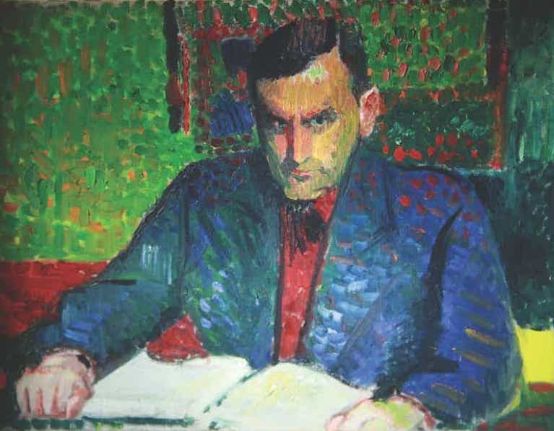
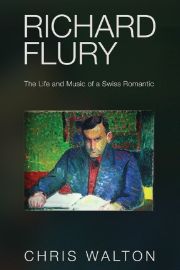
Painting by Cuno Amiet, 1948 (excerpt from the book cover)
"S isch immer e so gsi" - Chris Walton thought he could hear Solothurn's musical motto himself when writing his Richard Flury biography in English, which is well worth reading and based on extensive unpublished material (p. 102/3). His biography of the composer, who was born in Biberist and educated in Basel, Bern and Vienna, which includes a complete list of his extensive oeuvre and a CD with a successful selection of historical recordings and new recordings, also deals fundamentally with his self-prescribed musical anachronisms.
It takes a good 200 entertaining, richly illustrated and strictly chronological pages for Fleisch to get to the romanticisms of the composer, born in 1896, already mentioned in the book title. A pleasantly underlined view of German-speaking Switzerland from the outside (What does flour soup taste like? What do the Table Mountain and the Weissenstein have in common?) leads to an argumentative derivation of the romantic Flury from a complex of provincialism that has never been overcome, and states a spiritual refuge that has been defined here, to which there would certainly have been alternatives. Strong passages are found in the localization of this interesting composer figure in the Swiss education and music training system (Flury worked as an orchestra director and cantonal school teacher in Solothurn), also in comparison with his Swiss professional colleagues, who, in contrast to Flury, all fell almost completely silent in old age (pp. 95, 113).
Walton's authorial perspective, which seeks to pass final judgment on the good and bad of the music, does not fundamentally question this ultimately self-isolationist figure and places the book in a progressive mindset that the composer had just opposed. Thus, the "most modern" and shortest works of the 1920s with tendencies towards atonality and Gebrauchsmusik are described as the best and still worth performing today.
To pursue in depth the romanticisms that are particularly pronounced in his later works would probably also have meant a clearer examination of Flury's - probably not physically consummated (p. 189) - preference for very young girls, which is documented as a source of inspiration in some unpleasant passages in his correspondence with his teacher Ernst Kurth (p. 124) and in the dedications, especially of his songs and chamber music. It would have meant not shying away from a discussion of his religiousness (with excommunication after divorce and readmission after a vow of celibacy) in order to understand his sacred compositions (and a transfiguration of these girls into the role of Madonna). Presumably, all this was not easy to implement in a book that was written in close collaboration with his son from his second marriage and with the support of the family foundation. "S isch immer e so gsi".
In the Small series A 30-page biographical outline and an abridged catalog raisonné in German have been published by the Solothurn Central Library: Chris Walton: Richard Flury (1896-1967). A Swiss Romantic, Small Series Volume 5,
41 p., Fr. 20.00, Central Library Solothurn, 2017, ISBN 978-3-9524247-2-8
Chris Walton: Richard Flury. The life and music of a Swiss romantic. 328 p., £ 25.00, Toccata Press, London 2017, ISBN 978-0-907689-44-7
Romantic trouvailles
On December 1, 2017, Coviello Classics released an album for flute and piano entitled "Fantasie | Sonate" that is well worth listening to.
Niklaus Rüegg
(translation: AI)
- 05 Dec 2017
Miriam Terragni and Catherine Sarasin (from left) Photo: zVg
There is very little literature for the transverse flute from the Romantic period, which is why it is extremely commendable that the principal flutist of the Aargau Symphony Orchestra "argovia philharmonic" Miriam Terragni and her duo partner, the pianist Catherine Sarasin, went on a discovery tour through the antiquarian bookshops of Basel and Paris. The result was very pleasing: six pieces on this CD alone are being recorded for the first time worldwide - and they are real gems from the German (late) Romantic period and the French fin de siècle.
It starts with the Fantasy Sonata in A major op. 17 by the Liszt pupil Max Meyer-Olbersleben (1850-1927). Although it has been published several times in print, this large three-movement sonata is as good as forgotten today. A genuine reference recording has been lacking until now. This gap can now be considered closed. The two soloists pull out all the stops right at the beginning and reveal a subtle, balanced interplay. In the demanding Ballad in G sharp minor op. 9 for piano by the same composer, Catherine Sarasin is able to distinguish herself as a competent soloist. We owe the violin part to Richard Wagner's short piano romance WWV 94 to August Wilhelmj, violin virtuoso and concertmaster by Wagner's grace at the Bayreuth Festspielhaus, which Miriam Terragni in turn transcribed for the flute. Wilhelmj himself wrote the BalladIt combines echoes of Wagnerian chromaticism with an expansive late Romantic harmony. Lili Boulanger's Pièce experiences a dreamy premiere, followed by the better known, delicately played Nocturne. In Dans la forêt enchantée by the French artist Léon Moreau (1870-1946) vividly depicts the tranquillity of the forest and the whirring of sylphs (air spirits). In the Valse Lente Louis Masson gradually varies the leisurely melody in a very delicate way - with catchy tune potential. Deux Morceaux op. 41 by Victor Alphonse Duvernoy (1842-1907), discovered in the famous Rue de Rome in Paris, are no longer listed by any publisher. The Intermezzo, which is similar to the meaningful Lament follows, with its enchantingly light rhythm, brings this all-round successful recording to a close.