As part of the "Corpus Musicae Ottomanicae" (CMO) project funded by the German Research Foundation, the Orient-Institut Istanbul of the Max Weber Foundation and the Institute of Musicology at the Westfälische Wilhelms-Universität Münster intend to critically edit music manuscripts from the Ottoman Empire.
Music newspaper editorial office
(translation: AI)
- Nov 18, 2015
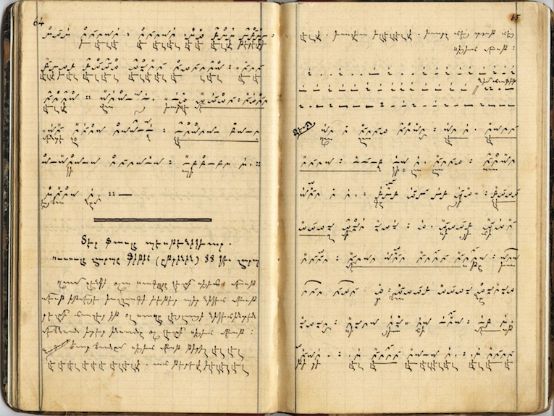
Armenian music manuscript in Hamparsum notation (late 19th century). Photo: WWU - Ralf Martin Jäger,SMPV
According to the Max Weber Foundation, the repertoire of courtly and urban art music in the Ottoman Empire was recorded in an increasing number of manuscripts from the 19th century onwards - in a notation developed before 1812. Western notation was also increasingly used from the mid-1830s. The critical edition and editing of the manuscript holdings in both forms of notation is intended to enable the transmission of an art music culture that was cultivated until the early 20th century in the metropolises of present-day Turkey as well as in the urban centers of Syria and Egypt.
The aim of the long-term project is to produce critical editions of the central manuscripts in Hamparsum notation from the 19th century in a first project phase. The second phase is primarily dedicated to the critical edition of selected manuscripts written in Western notation from this period. The song texts will be edited in parallel in an interdisciplinary network.
As an open access publication, the CMO edition is published by the editorial team perspectivia.net (Max Weber Foundation); in addition, the editions of the individual manuscripts will be available as book-on-demand editions. The project, led by Ralf Martin Jäger, an expert in ethnomusicology from the Institute of Musicology at the University of Münster, is being carried out in Münster, Istanbul and Bonn and is supported by an international academic advisory board.
Insider tip in Bern
Since 2013, the Yehudi Menuhin Forum has been organizing chamber music concerts with outstanding performers under the artistic direction of Bernese pianist Hiroko Sakagami.
Music newspaper editorial office
(translation: AI)
- Nov 18, 2015
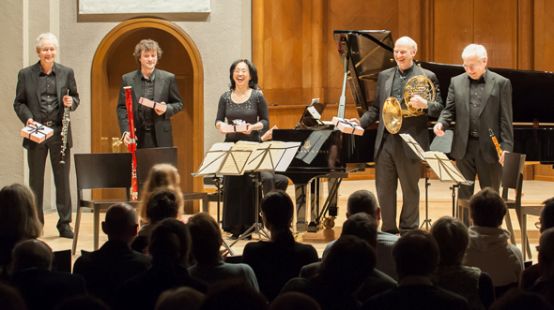
Concert on January 12, 2014 Photo: Bertrand Limoges,SMPV
Without timpani and trumpets, a concert series of the smallest scale and greatest significance was established in 2013 on Helvetiaplatz in Bern, near the historical museum: the Forum Kammermusik - five concerts under the artistic direction of pianist Hiroko Sakagami, with the participation of outstanding musicians from Switzerland and abroad, such as the Carmina Quartet, Erich Höbarth, Patrick and Thomas Demenga and many others.
The concept is as simple as it is convincing: chamber music with piano is played in the acoustically well-sounding room of the Yehudi Menuhin Forum in various instrumentations of strings and winds from the classical, romantic and more recent periods. The concerts - always on Sundays - start at 5 pm and last around 90 minutes. Afterwards, an après-concert in the basement offers the opportunity to come into direct contact with the musicians over food and drink. The concert series is supported by a small group of music enthusiasts and prominent personalities such as Thomas Füri, Alexander Wick, Michael Kaufmann and Werner Schmitt under the honorary patronage of the President of the Swiss Confederation Simonetta Sommaruga.
At the next concert (Sunday, November 29, 2015), Erich Höbarth (violin), Patrick Demenga (violoncello) and Hiroko Sakagami (piano) will perform works by W.A. Mozart (Trio in E major KV 542), Alfred Schnittke (Piano Trio 1985/1992) and Franz Schubert (Trio in E flat major, D. 929)
The Thurgau cantonal government has once again approved a lottery fund contribution of CHF 100,000 per year for the "Culture and School Thurgau" project for the period from 2016 to 2018.
Music newspaper editorial office
(translation: AI)
- Nov 17, 2015
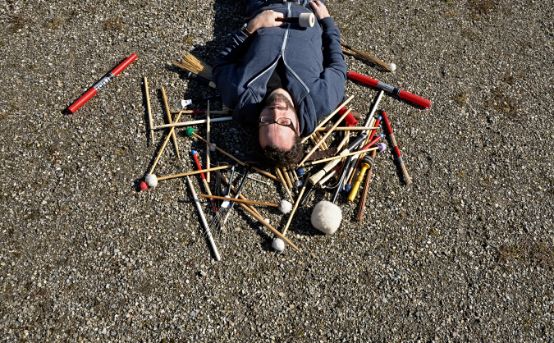
Musician Enrico Lenzin offers "drumming with children" on the platform. Photo: zvg,SMPV
According to the canton's press release, the project essentially consists of two sub-areas. On the one hand, the intercantonal platform for cultural mediation was established between 2013 and 2015 together with the cantons of St. Gallen and Appenzell Ausserrhoden. www.kklick.ch be built up.
Since August 2014, cultural offerings in Eastern Switzerland have been presented on this website, organized by region, sector and school level. This website, which requires a lot of support and is already well used by schools, is to be continuously adapted and expanded in line with user needs using the lottery funds.
The second part of the "Culture and School" project consists of a contact network of teachers responsible for culture in schools who are responsible for anchoring culture in their respective schools.
Both areas of the project are to be further supported and expanded in the years 2016 to 2018 with the money provided. In addition to elementary school, the focus is now also shifting to secondary schools and vocational schools. The long-term goal is to have a teacher responsible for culture at every school in the canton of Thurgau so that cultural activities have a permanent place in the curriculum.
As was the case for the project period from 2013 to 2015, Stephanie Kasper and Cornelia Spillmann will continue to be responsible for the internet platform and the network of cultural representatives for the project period from 2016 to 2018.
Klanghaus Toggenburg clears another hurdle
The preliminary advisory committee of the St.Gallen Cantonal Council has proposed that a loan of 19 million francs be approved for the Toggenburg Sound House. However, it rejected the contribution of CHF 300,000 earmarked for art in the building.
Music newspaper editorial office
(translation: AI)
- Nov 17, 2015
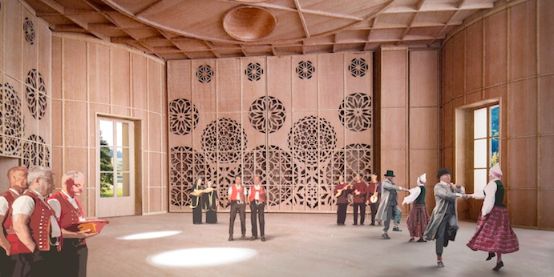
Simulation of the interior of the Klanghaus: nightnurse images, Zurich
With the Klanghaus, a center for natural sound music is to be created in the upper Toggenburg on Lake Schwendi, which will expand the Toggenburg sound world. As a sound workshop, it will be available to both professional musicians and amateurs for rehearsals, courses and experiments.
In November last year, the public planning process began with the design plan, the partial zoning plan, the partial road plan and the amendment of the protection ordinance. In any case, the construction project will only be started once the co-financing of CHF 5 million from private donors has been secured. A total of three objections were received against the partial zoning plan and the partial road plan, which were withdrawn after negotiations.
In the November session, parliament will discuss the matter at first reading. If the Cantonal Council approves the bill, the people will decide on the construction of the Klanghaus in the fall of 2016.
From the niche to the scene
Festivals for new music are increasingly shaping urban cultural life. A project by the Austrian Science Fund FWF describes the emergence and impact of these contemporary platforms using three international examples.
Music newspaper editorial office
(translation: AI)
- Nov 16, 2015
Klangforum Wien. Photo: Judith Schlosser,SMPV
Under the direction of Simone Heilgendorff from the University of Salzburg, musicologists are researching the international scene of new art music across national borders for the first time. Renowned festivals in three European capitals are at the heart of the research project: the Warsaw Autumn Festival, the Paris Festival d'Automne and the Wien Modern Festival.
In addition to reviewing historical material, the international team of researchers is primarily trying to map the changes in the new music scene. Aspects of content are examined, but also factors such as music management and promotion. As a central part of the success of festivals, the actors are also the focus of the analyses: above all the curators, composers and musicians.
The research team analyzes the lives of selected individuals and ensembles in biographical portraits, for example of Jagoda Szmytka, Georg Friedrich Haas, Hugues Dufourt or Helmut Lachenmann and the Ensemble Intercontemporain, Klangforum Wien and Orkiestra Muzyki Nowej.
Finally, the audience is also part of the research project, providing answers to questions about age, education, motivation, expectations, internationality and their own connections to contemporary (art) music in detailed surveys conducted in 2014. The results of the audience survey will be presented at Wien Modern in Vienna on November 22.
Cultural education and creativity in elementary school
How does cultural education affect the creativity of fifth graders? Researchers at the Alanus University of Arts and Social Sciences in Alfter near Bonn and the University of Kassel are investigating this question.
Music newspaper editorial office
(translation: AI)
- Nov 13, 2015
Photo: Rainer Sturm/pixelio.de,SMPV
The first round of data collection has been carried out in more than 50 school classes from the Bonn/Rhein-Sieg, Cologne and Kassel regions as part of the KuBiK5 research project, short for "Effect of cultural education on creativity in the 5th school year". The study differs from previous studies in that family and individual factors are taken into account in addition to school and extracurricular characteristics.
The study assumes that cultural education is of great importance for the development of personality and creativity. Cultural education is seen as an indispensable part of a comprehensive education. At school, it is usually the subjects of art, music or sport in which children come into contact with cultural education.
The project is part of the "Research Fund for Cultural Education - Studies on the Effects of Cultural Education", a project of the Council for Cultural Education, funded by Stiftung Mercator. An independent commission selected KuBiK5 alongside five other projects from a total of 78 project applications received.
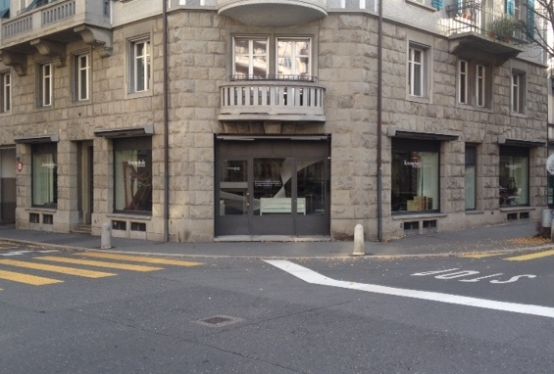
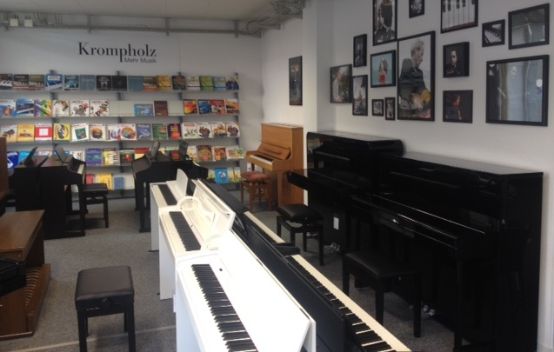
At Klosterstrasse 11 in Lucerne, the long-established store based in Bern is opening a new branch. In addition to selling musical instruments, the company also offers a comprehensive piano and grand piano service.
Music newspaper editorial office
(translation: AI)
- Nov 13, 2015
Photo: zvg,SMPV
Just over a year ago, Alexander Steinegger, the previous managing director, took over Krompholz Musik AG as part of a management buy-out from Loeb Holding AG at a new address: Effingerstrasse 51 in Bern. Now the music store, which is celebrating its 160th anniversary this year, is getting another location, a branch in Lucerne.
Krompholz specializes in acoustic and electronic keyboard instruments, acoustic guitars, small instruments and music supplies. At the new location, the music store offers a wide range of high-quality instruments in every price category, as well as a comprehensive package of services. "Lucerne and the surrounding area is already considered an important region, which was previously served from Bern. We are now looking forward to being closer to our existing customers and establishing new partnerships," says Alexander Steinegger. With a comprehensive piano and grand piano service, Krompholz is an experienced and competent partner for concert organizers.
At the opening on November 14, 2015, Lucerne guitarist and beatboxer Damian Lynn will be playing in the store at Klosterstrasse 11, while up-and-coming musician Ishantu will be performing a number of live gigs in the city center (Bahnhof room).
The new episode of the song project, which aims to promote singing with children, is dedicated to the musical richness of Christmas songs from all over the world.
Music newspaper editorial office
(translation: AI)
- Nov 12, 2015
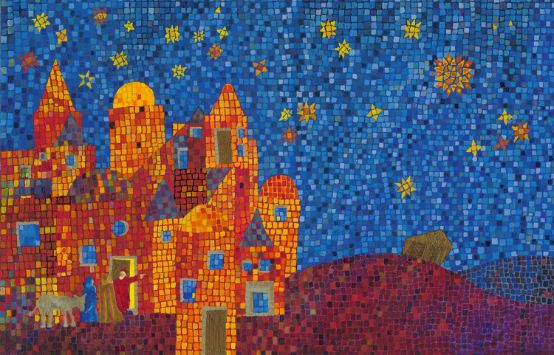
Bethlehem: one of the double-page illustrations of the songbook by Frank Walka,SMPV
Christmas is celebrated all over the world, in this country in the deep snowy winter, but in other countries in blazing heat under a bright sun. But everywhere the singing of Christmas carols is part of the festivities. Some songs, like Adeste fideles or Silent night can be heard all over the world. All countries also have their very own songs that reflect their respective customs and traditions. The new song project series, published by Carus and Reclam, is dedicated to them.
The new songbook contains 72 songs from 40 countries Christmas carols from all over the world. The spectrum is wide-ranging. The book, which comes with a sing-along CD to make it easy to get to know the songs, is accompanied by two CDs with a selection of the most beautiful songs, a choir book and a song booklet in paperback format.
The song project - a charity project for singing with children
Copyrights in Germany put to the test
The German Federal Cabinet has passed a draft law on the collective management of copyright and related rights. The German Cultural Council sees dangers.
Music newspaper editorial office
(translation: AI)
- Nov 12, 2015
Photo: Rainer Sturm/pixelio.de
The German Cultural Council is pleased that, according to the text that has now been adopted, collecting societies are to promote culturally significant works and performances and set up pension and support schemes for their beneficiaries. The draft bill still contained an optional provision.
The German Cultural Council also considers the proposed provision on the provision of security to be positive in order to ensure that manufacturers and importers of devices and storage media meet their remuneration obligations even after protracted legal disputes.
According to the statement from the Cultural Council, however, it is regrettable that there are still plans to force members of supervisory bodies to disclose sensitive personal data or, with regard to companies, information relevant to competition. It is also a pity that the collecting societies should publish the overall agreements concluded on their websites. This would ultimately mean that business secrets would have to be disclosed.
The Cultural Council particularly regrets that the VGG "missed the opportunity to clarify publisher participation in the remuneration of collecting societies". According to Olaf Zimmermann, Managing Director of the German Cultural Council, a solution must be found above all for the "publisher's share in the income of the collecting societies based on rights of use or statutory remuneration claims", which has been pending for years.
ÖGMW welcomes Bernese researchers
The Bern University of the Arts will be prominently represented at this year's annual conference of the Austrian Society for Musicology (ÖGMW) from November 18 to 21 at the University of Music and Performing Arts Graz.
Codex flores
(translation: AI)
- Nov 11, 2015
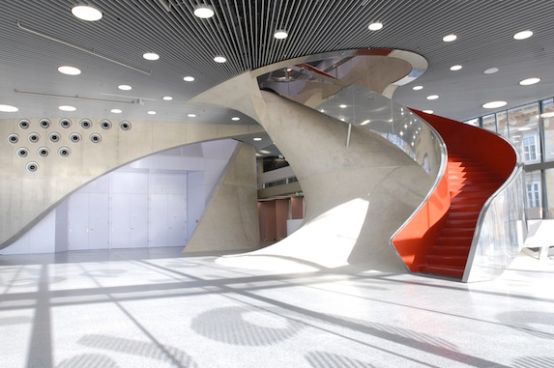
Foyer of the MUMUTH (House of Music and Music Theater) at the University of Music and Performing Arts Graz. Photo: KUG/Wenzel
At its annual conference, which this time takes place at the University of Music and Performing Arts Graz, the Austrian Society for Musicology brings together academics from leading international universities. The focus is on musical performance. The conference will not least explore the question of how practice-oriented intuitive knowledge and analytically sound musicological knowledge can work together fruitfully.
The main lectures will be given by Kai Köpp (Bern University of the Arts, "Musikgeschichte als Interpretationsgeschichte - neue Quellen, neue Challenges"), Joshua Rifkin (Boston University), John Rink (University of Cambridge), Renee Timmers (University of Sheffield) and Sarah Weiss (YaleNUSCollege Singapore).
Further presentations by Bernese researchers: Johannes Gebauer will be giving a lecture on editions of Pierre Rode's 24 Caprices for violin, and Sebastian Bausch will be analyzing the interpretation of Josef Pembaur's Beethoven recordings.
The conference will also feature two world premieres and the presentation of a reconstruction of a historical trumpet automaton.
The jury has awarded the CHF 15,000 Prix de Composition of the 70th Concours de Genève to Shoichi Yabuta from Japan. The audience honored the South Korean Sunghyun Lee.
Music newspaper editorial office
(translation: AI)
- Nov 10, 2015
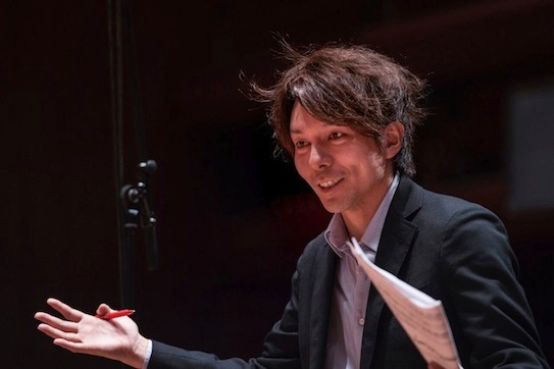
Shoichi Yabuta won the competition with his string quartet "Billow". The 32-year-old studied composition at the Tokyo College of Music and won (among numerous other awards) the Vienna Konzerthaus Prize in 2013. He has also studied the traditional arts of Japan intensively.
The Audience Award (1500 francs), the Young Audience Award and the Student Award (1000 francs each) went to 20-year-old South Korean Sunghyun Lee. The Otto and Regine Heim Foundation Prize (3000 francs) was awarded to Aderito Valente from Portugal.
The jury of the 70th Concours de Genève consisted of Michael Jarrell (President), Pascal Dusapin, Luca Francesconi, Dai Fujikura and Wolfgang Rihm.
Money for Swiss labels and artist management
For the eleventh time, Migros Culture Percentage is supporting pop and independent labels and artist management companies based in Switzerland. They can submit their applications until December 6. The grants are endowed with 50,000 Swiss francs.
Music newspaper editorial office
(translation: AI)
- Nov 10, 2015
Swiss independent labels and artist management companies such as Two Gentlemen in Lausanne and Bakara Music in Zurich do a lot for the Swiss music scene. However, they are operating in a difficult economic environment. Migros Culture Percentage has therefore been involved in promoting labels and artist management since 2006. The supported labels and management receive contributions of between CHF 10,000 and CHF 50,000. Philipp Schnyder von Wartensee from Migros Culture Percentage explains: "The music managers and agents do indispensable work in the background for artists such as Sophie Hunger, Lo & Leduc or Fai Baba. The aim of label promotion is to strengthen the chances of survival and professionalization of these structures."
The winners will be announced on April 16, 2016 in Zurich as part of the m4music festival.
Independent labels that have released at least four albums by artists based in Switzerland within the last 24 months or have achieved a comparable performance are eligible. It is important for the artist agencies to perform comprehensive management tasks. In addition, they should manage at least two Swiss musicians who have already released CDs.
Closing date The deadline for applications for the 2016 grants is December 6, 2015. Guidelines and application documents can be found at www.migros-kulturprozent.ch/foerderung
Experimental zones at the 28th Days of New Music
Young musicians from the Basel, Bern and Zurich universities left their mark on the Fesival in Weimar.
Dirk Wieschollek
(translation: AI)
- Nov 10, 2015
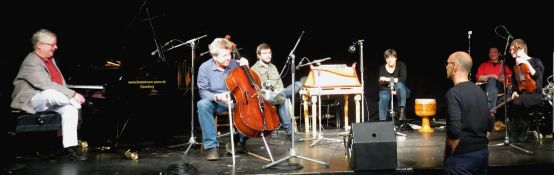
EFIM and Swiss guests at the rehearsal for "instant composing". Photo: saTo2015
The Tage Neuer Musik in Weimar is a small but fine festival that bravely flies the flag of new music in the midst of the museum-like comfort of the German capital of classical music. Artistic director Michael von Hintzenstern has been cultivating experimental sound art in Thuringia not only since the fall of the Berlin Wall, which is also reflected in his own ensemble with the programmatic name Ensemble for Intuitive Music, which owes decisive inspiration to his earlier collaboration with Karlheinz Stockhausen.
Sound axes: Switzerland-Germany
This year's edition of the festival once again focused on improvisation, composition and live electronics and was dedicated to "Sound Axes: Switzerland-Germany" from October 28 to 31. The remarkable thing about it: it was mainly young musicians and composers from the Swiss universities who left their mark on the Weimar festival!
The first performance was given by the zone expérimentale Basel ensemble, which is made up of students from the Basel Master's degree program in contemporary music. Hannah Walter (viola), Pedro Pablo Cámara Toldos (saxophone), Carlota Cáceres (percussion) and Haize Lizarazu (piano) performed not only pieces by established composers such as Heinz Holliger, Toshio Hosokawa and Michael Beil, but also more recent works in a colorful opening concert: Jose Pablo Polo staged a new piece in Better out than in (2014) created a percussive noise choreography as "instrumental theater" around the piano; the Basel-based Martin Jaggi knitted a Strata (2010/11), a polyphonic network based on the similarity of the different or the approximation of the instruments' sound colors (through alienation).
The Berlin pianist Frank Gutschmidt had compositional gems from the former GDR and Switzerland in his luggage: filigree-poetic pieces, also involving the piano's interior, which revolved around the poetry of Trakl, Nietzsche and Silvia Plath and left the framework of a conventional "piano recital" far behind. Holliger's Ellis - Three night pieces for piano (1961/62) and Beat Furrer's Voicelessness. The snow has no voice (1986) were juxtaposed with compositions by Christfried Schmidt (born 1932) and Georg Katzer (born 1935). Schmidt's virtuoso Moments musicaux (1976) also made the pianist the reciter of Nietzsche's late work, Katzer's Dialog imaginary No. 2 (1986) entangled Gutschmidt in a dialog with a layer of tape.
From the moment
The interaction of live electronics and instrumental sound is also an essential aspect of the Ensemble for Intuitive Music Weimar (EFIM), which for over 30 years has dedicated itself to music that is "only created in the moment of performance". Under the title Instant Composing the "hosts" Michael von Hintzenstern (piano), Matthias von Hintzenstern (cello), Daniel Hoffmann (trumpet/flugelhorn) and sound director Hans Tutschku (electronics) teamed up with Hannah Walter, Pedro Pablo Cámara Toldos and Françoise Rivalland to explore the border areas of open form and guided improvisation, which provoked very different results between the poles of two-dimensional silence and eruptive outbursts.
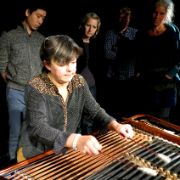
Françoise Rivalland explains cymbalom techniques to the audience. Photo: saTo2015
Françoise Rivalland presented a rousing solo program in which the percussionist, vocal performer and director, who is currently a professor of musical theater at the Bern University of the Arts, pulled out all the stops of her wide-ranging skills. In addition to arrangements for cymbalom of pieces by György Kurtág and John Cage, Rivalland delighted the audience with super-precise, explosive performances of several vocal pieces by George Aperghis, with whom she has a close musical-theatrical collaboration. Also enchanting was a bundle of various Schwitters texts, in which her self-made "Esperou" was used, a mixture of string and metal instrument, which is capable of merging amazingly different timbres (including almost electronic ones); Schwitters also Ursonata has not been heard for a long time in such a nuanced and rhythmically gripping way.
Students at the controls
The inclusion of the Bauhaus University's Studio for Electroacoustic Music (SeaM) under the direction of Robin Minard is a welcome tradition at the festival. This time, the students themselves were also allowed to take to the controls and, together with their "colleagues" from the Institute for Computer Music and Sound Technology (ICST) and the Zurich University of the Arts, presented their latest works. It would be unfair to single out any of the multi-layered pieces by Kenn Mouritzen, Ursula Meyer-König, Carlos Hidalgo (Zurich), Paul Hauptmeier, Martin Recker, Mikhail Yarzhembovskiy and Andreas Vorwerk (Weimar). It was striking that the works from the Swiss studios were mainly based on the transformation of analog sound objects, while the Weimar-based artists took a more "narrative" approach and presented hybrid soundscapes made up of digital sound, voice and field recordings.
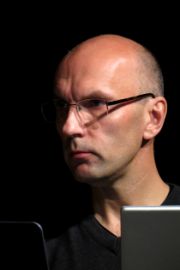
Hans Tutschku. Photo: saTo2015
The activities of the ICST, which aims to bring aspects of scientific and artistic research, digital technology, media art and musical practice into a fruitful dialog, were also the focus of the remarkable final concert. Germán Toro Pérez (current director of the ICST), Carlos Hidalgo, Hans Tutschku, Karin Wetzel and Florian Bogner had conceived pieces that transformed virtuoso solo parts with live electronic real-time processing into multidimensional sound spaces. This took place as particularly impressive, heterogeneously vibrating "spatial music" in Pérez' Signos Oscilantes - confused and wavering (2012) thanks to a great, incredibly accentuated performance by Alejandro López (saxophone). But Hugo Queirós (bass clarinet) also proved himself in the complex lineaments of Hans Tutschku's Interlaced 1 (2014) as a totally present acoustic sculptor of a jagged soundscape in productive exchange with the sound direction. It was precisely the indifferent intermediate areas of sound and noise, electronics and instrumental gestures that opened up spaces for a sound poetry beyond tangible categories.
Honorary doctorate from the University of Cologne for Max Haas
The Faculty of Philosophy at the University of Cologne has awarded Max Haas, Professor Emeritus of Musicology at the University of Basel, an honorary doctorate.
Music newspaper editorial office
(translation: AI)
- Nov 09, 2015
Photo: zvg,SMPV
With the honorary doctorate, the Faculty of Philosophy at the University of Cologne is recognizing "Haas' special academic and scientific achievements", according to a statement from the University of Basel.
Born in 1943, Max Haas studied musicology, medieval church and dogmatic history and Slavic philology in Basel and Heidelberg. He received his doctorate from the University of Basel in 1970 with a thesis on Byzantine and Slavic notation. Seven years later, he habilitated with studies on the relationship between medieval musicology and scholasticism. At the University of Basel, he was head of the microfilm archive of the musicology department and, from 1982, associate professor of musicology.
In the 1990s, he was a guest lecturer at Bar Ilan University in Israel and at the Graduate Department of the City University of New York in the USA. Until his retirement in 2005, he worked as a research assistant and lecturer at the Department of Musicology at the University of Basel. His most recent monographs deal with forms of perception and thought in music (2002) and musical thought in the Middle Ages (2005).
Martinů Festival in Basel
Numerous Swiss orchestras and theaters also celebrated the 125th birthday of the Czech composer with performances of his works.
Music newspaper editorial office
(translation: AI)
- Nov 07, 2015
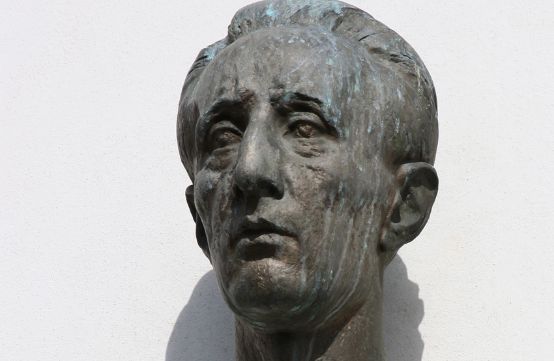
Bust of St. Martin in Prague - Na Kampě 512/11 Photo: Matěj Baťha/WikiCommons
For twenty years, Robert Kolinsky has been organizing the Martinů Festival in Basel, with which he aims to raise international awareness of the work of Bohuslav Martinů (1890-1959). In 2015, the 125th birthday of the Czech composer, who lived in Switzerland at the end of his life and died in Liestal, was and is being celebrated not only in Basel but also elsewhere. In February, for example, the Zurich Opera House staged a new production of the opera Juliettethe Tonhalle Orchestra Zurich the Rhapsody-Concerto for viola and orchestra or the Orchestre de la Suisse Romande Les Paraboles.
The 21st Martinů Festival from November 15 to 29 will be held under the patronage of Federal Councillor Alain Berset, conductor Mariss Jansons and Madeleine Albright, former US Secretary of State. It will open with a concert by the London Symphony Orchestra conducted by Tomáš Hanus, which will give Bohuslav Martinů's Symphonies Nos. 2 and 5 their Brahmsian Academic festive overture in front. The Basel Marionette Theater has shows for children aged eight and over Who is the most powerful on earth and the Hagen Quartet combines works by Mendelssohn, Kurtág and Martinů in a chamber music concert. There will also be cabaret (Duo Calva) and jazz. The festival is rounded off with the traveling exhibition Bohuslav Martinů - Life and work by Sibylle Ryser and Gabriele Jonté.