Call for public signs

In connection with the "Voices for Refugees" concert, musicians, ensembles and bands are invited to make statements on the events of recent weeks.


Photo: Volkshilfe / Johannes Zinner

How the austrian music information center mica - music austria today announced that "Voices for Refugees", a solidarity concert for a humane Europe, will take place in Vienna on October 3. It is being organized by the Volkshilfe Austria together with Nova Music and other organizations. There will be 15 bands to listen to, from Bilderbuch to Zucchero.

mica - music austria and Volkshilfe Österreich are now offering musicians who are not taking part in the concert the opportunity to make their voices heard. Until September 29, solo artists, ensembles and bands can send their "thoughts on those people who have had to leave their homeland, on European history and the future, on the self-image of a democratic republic" or on the events of the last few weeks in the form of a statement together with a photo or as a video message (download link) to:

steiner@musicaustria.at
Subject: Voices for Refugees

Statements from Switzerland are also welcome. This appeal by mica - music austria is also addressed to labels, publishers, managers, organizers, etc. with the request that they forward this appeal to their musicians.
 

Further information: http://voicesforrefugees.com

Caption


Volkshilfe Director Erich Fenninger and Nova Music Managing Director Ewald Tatar present details of the solidarity concert "voices for refugees", which will take place on October 3 at Vienna's Heldenplatz.
Yodeling in the choir

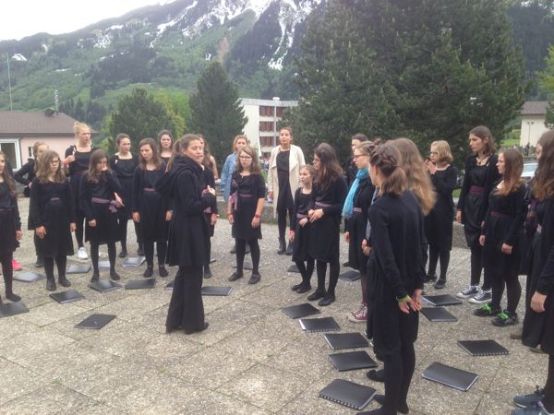
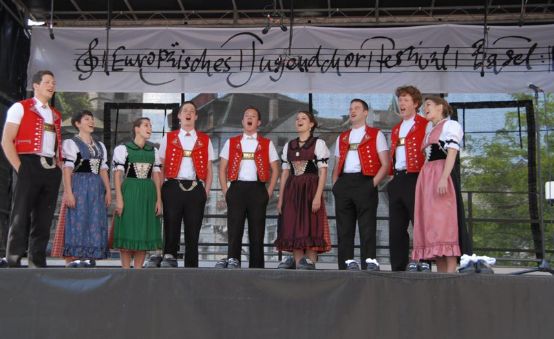
jutz.ch is the name of the choir that has been invited to the 10th European Youth Choir Festival Basel even before it exists. Anyone who is interested in yodeling, sings well and is under 25 years old can register for the project until October 31.

The Hitziger Appenzeller Choir at the EJCF 2014 Photo: Andreas Meier/EJCF

Marco Beltrani and Nadja Räss are rehearsing an exciting program with jutz.ch for the 10th European Youth Choir Festival Basel (EJCF) between 4 and 8 May, with a special focus on performance. Young singers or yodelers who are used to performing as soloists or in ambitious choirs are cordially invited to immerse themselves in the Swiss yodelling tradition as part of this project. Anyone between the ages of 16 and 24 who is interested is invited to audition in December. The program, which lasts around 40 minutes, will be rehearsed from January to April 2016.
The jutz.ch project choir will sing the entire program by heart. Small choreographies will be rehearsed during the rehearsals.
The costs for accommodation and meals during the rehearsal weekends and the festival in Basel are covered. Travel expenses are borne by the singers.

Participation in the EJCF, the renowned meeting of the best European youth choirs, is a unique opportunity for ambitious singers from the classical choir scene and the folk music scene.
Singing teachers are therefore asked to make their students aware of this offer. The deadline for registration is October 31, registration is handled online: www.ejcf.ch/projekt-jodelchor

Information about the project choir can be obtained by calling Marco Beltrani on 079 543 81 60 or the festival office on 061 401 21 00. Further information about the festival can be found here www.ejcf.ch
 

Rehearsal and concert dates


Sat, December 19, 2015 Audition in Zurich


Tue, January 26, 2016 Rehearsal male voices
Wed, January 27, 2016 Rehearsal women's voices
Thu, January 28, 2016 Rehearsal Tutti
Sat - Sun, January 30 - 31, 2016 Rehearsal weekend
Fri - Sun, March 11 - 13, 2016 Rehearsal weekend
Sat - Sun, March 19 - 20, 2016 Rehearsal weekend
Sat - Sun, April 9 - 10, 2016 Rehearsal weekend
Tue, April 26, 2016 Rehearsal Tutti


Tue - Sun, May 3 - 8, 2016 Participation in the European Youth Choir Festival

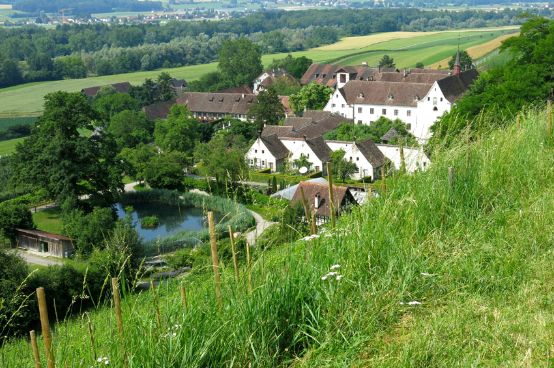
Canton Schaffhausen supports Haberhaus stage

The Government Council and the Schaffhausen City Council have concluded a service agreement with the Haberhaus Bühne association.

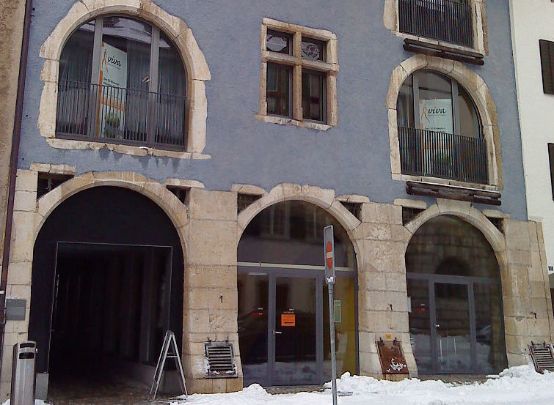
Photo: Wandervogel, wikimedia commons

The Haberhaus Kulturclub in the old town of Schaffhausen is indispensable for cultural life in the Schaffhausen region, writes the canton in a press release. It provides various regional event organizers with a performance venue that meets their needs for a small stage.

The Haberhaus Stage Association is separate from the operation of the associated restaurant. The association makes the space available for broad and varied cultural use. The financial contribution from the canton amounts to CHF 25,000 per year. The annual contribution from the city of Schaffhausen is CHF 20,000. The service agreement with the Haberhaus Bühne association is valid from mid-2015 until the end of 2018.

Christoph Croisé wins the Brahms Competition

The cellist, who lives in the canton of Aargau, was awarded first prize in the cello category at the finals of the international music competition on September 13.

Christoph Croisé (3rd from left). Photo: Günter Jagoutz Photo-Video, Klagenfurt

50 cellists competed in the violoncello category at the 22nd International Johannes Brahms Competition in Pörtschach am Wörthersee, Austria. Christoph Croisé won first prize in the 3rd round. Second prize went to Yoosin Park (born 1990, South Korea) and third prize to Kacper Nowak (born 1987, Poland). The jury consisted of Alexandre Bouzlov, Catalin Ilea, Matthieu Lejeune, Kyung-Ok Park and Éva Simić-Németh.
Around 200 soloists and over 30 ensembles performed in the piano, chamber music, violin, viola and cello categories at the Brahms Competition from September 5 to 13. The competition is organized by the Johannes Brahms Society Pörtschach.

Born in 1993, Christoph Croisé has been performing internationally as a solo cellist since the age of 17. On November 7, he will be performing together with pianist Oxana Shevchenko at the Tonhalle Zurich to hear.
 

www.christophcroise.ch
www.brahmscompetition.org
 

German Unesco Commission wants to set limits to TTIP

At its 75th General Assembly in Regensburg, the German Unesco Commission passed a resolution demanding that the free trade agreement TTIP (Transatlantic Trade and Investment Partnership) currently being negotiated should include freedom of regulation to safeguard cultural and media diversity.

Protests against TTIP in Spain. Photo: Marc Lozano

In view of the fact that the USA has not acceded to the UNESCO Convention on the Protection of Cultural Diversity, the resolution calls for "normatively effective approaches to cultural, media and educational policy protection to be enshrined in all relevant chapters of the TTIP agreement".

It also points out that "the far-reaching effects that such an agreement could have on the cultural infrastructure and on the media, culture, science and education on offer in Germany" continue to require an informed and broad social and political debate and should not be subject exclusively to economic policy considerations.

Finally, it calls on German politicians to unequivocally "advocate legally effective protection mechanisms in the sense of a technology-neutral further development of regulation to safeguard diversity of information and opinion, media pluralism and linguistic and cultural diversity, and to advocate this in the coming rounds of negotiations".

The whole resolution: www.unesco.de/index.php?id=reshv75_ttip
 

Big bang and cosmic noise

The Bern Music Festival unites the region's musicians in a diverse program with unusual projects.

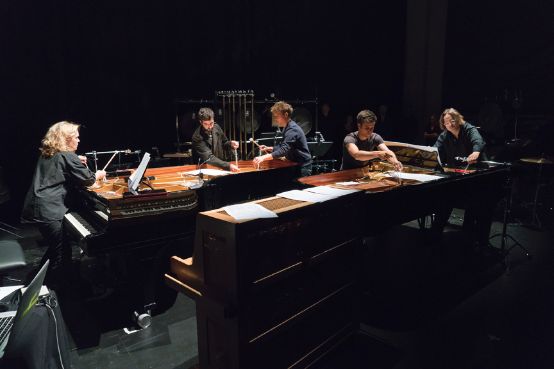
Piano duo huber/thomet and Ensemble This/Ensemble That. Photo: Philipp Zinniker

Every two years it takes over the Bern Music Festivalto bring together the wealth of local musical life - until now alternating with the interdisciplinary Biennale Bern. This year's fifth edition, entitled Big Bang From September 3 to 13, the festival offered an almost unbelievable series of events for all ages. It opened in the cathedral with the Genesis Suitea setting of texts from the First Book of Moses, premiered in 1945, in which prominent composers including Arnold Schönberg and Igor Stravinsky participated.

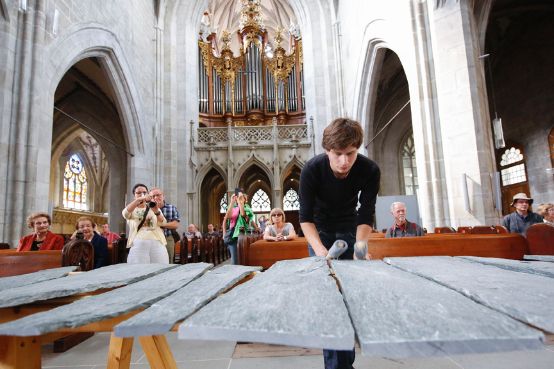
Alongside such traditional concerts were (dance) performances and sound installations; in Club Bonsoir, musicians from the computer and turntable scene presented their own remix of the festival's sound material; in the city, Zoro Babel and Andrea Lesjak let passers-by make music on their giant stone slab xylophone; and percussionist Fritz Hauser transformed Münsterplatz into a fascinating soundscape in his own choreography with around 120 small and large percussionists, string players and bell ringers. A series of scientific talks also explored topics relating to the "Big Bang".

Image
"Serpente Litophonie" in Bern Minster. Photo: Philipp Zinniker

Guard rails

The festival tradition began in 2007 with a major music festival to celebrate the 100th birthday of the composer and teacher Sándor Veress. Even then, the plan was to continue the format, says musicologist Hanspeter Renggli, but no longer to focus on a single personality. Renggli is head of the festival's program group and will remain president of the supporting association until the autumn. The program group, he explains, determines the festival motto. This is intended as a guard rail to prevent arbitrariness, but also to encourage the artists to make their own associations. For example, the term "Big Bang" can be associated with the findings of space physics as well as the biblical story of creation, the beginning of contemporary music in the work of Arnold Schönberg or the beginning of a love affair when you "fall in love". The program group examines all projects that are proposed for the festival. Cooperation between different institutions is particularly welcome. This is what makes the festival so special.

Ensemble collective

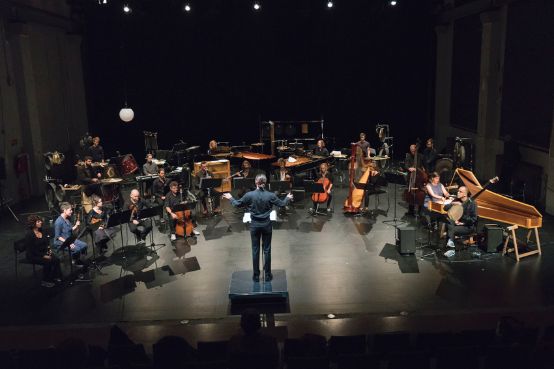
One such co-production of five (!) very different formations was the concert Planck at the Dampfzentrale. Two baroque orchestras, Die Freitagsakademie and Les Passions de l'Amethat ensemble protonthat Piano duo huber/thomet (Susanne Huber and André Thomet) and the percussion quartet Ensemble This/Ensemble That (the festival's ensemble-in-residence) played a clever program in which baroque music alternated with new pieces by younger composers who were inspired in different ways by the festival motto. Proton had been working with Leonardo Idrobo Adrift which creates elements from a mass of sound and light that expand and contract. The sounds of the ensemble are complemented by electronic feeds, spoken texts and the projection of colorful images. On this evening, however, only an excerpt without electronics and projection could be heard, a transparent network of colorful sound lines; the actual premiere took place a few days later.

Huber/thomet and the four percussionists interpreted Cosmic Swoosh by Michael Pelzl. With two prepared concert grand pianos, celesta and gongs, the composer contrasts a dark and a light sphere - with tonal imagination, but somewhat schematically. At the beginning and end of the evening, the five groupings merged in Planck of the Basler Martin Jaggi to the ensemble collective. Jaggi refers to the Planck space probe, which was able to capture the cosmic background radiation, the "footprint" of the Big Bang, for the first time.

The American physicist John G. Cramer's attempt to convert Planck's data into sounds forms the background of the piece at times in the form of a tape recording. Jaggi integrates the different instruments, which are also tuned differently, into a differentiated whole and finds distinctive sound combinations, for example in the dialog between the (amplified) theorbo and the softly struck gongs. The music-making was excellent throughout. The phenomenal violinist Meret Lüthi from Les Passions de l'Ame in one of the most memorable performances. Rosary-sonatas by Heinrich Ignaz Franz Biber.

Image
The ensemble collective interprets Jaggi's "Planck". Photo: Philipp Zinniker

Future

The festival is currently facing important changes. In 2014, the city government decided to fund either the Biennale or the music festival in future and ultimately opted for the music festival. Since then, internal discussions about the future shape of the festival have been ongoing. It is clear that the city expects an opening to the outside world and more international appeal. However, it is equally clear that the event must not degenerate into a transit station for traveling stars. To this end, the artist-in-residence model is to be expanded, with more foreign artists - such as this year's percussion quartet - taking part in various events and thus helping to shape the program.

musicfestivalbern.ch

German health insurance pays for app against tinnitus

The German Techniker Krankenkasse is covering the costs of a smartphone app, a new treatment method for tinnitus, on a trial basis.

Photo: R.A./pixelio.de

An ENT doctor or a hearing aid acoustician appointed by him determines the individual tinnitus frequency of a patient. This indicates which areas of the auditory center of the brain are affected by the tinnitus. With the Tinnitracks app, the frequency can be filtered out of the patient's favorite music. According to the health insurance company, regular listening to the filtered music calms the overactive tinnitus nerve cells. This can reduce the intensity of the tinnitus.

The treatment method is useful if there is subjective, chronic stable-tonal tinnitus without fluctuation in pitch that lasts longer than three months in total. The phantom sound must be narrow-band enough so that a tinnitus frequency can be determined. The frequency must be below 8500 Hz.

Founded in 2012, Sonormed GmbH has developed Tinnitracks, an award-winning medical product for tinnitus treatment that, according to its own advertising, gives over three million tinnitus sufferers in Germany access to a new form of therapy. In June 2014, the European Institute of Innovation and Technology named Sonormed the most innovative company in the healthcare sector in the EU.

Musicology and computer science in dialog

German and Spanish musicologists and computer scientists are holding a workshop on the campus of Saarland University to discuss how the musical works of Spanish composer Tomás Luis de Victoria can be analyzed using digital signal processing methods.

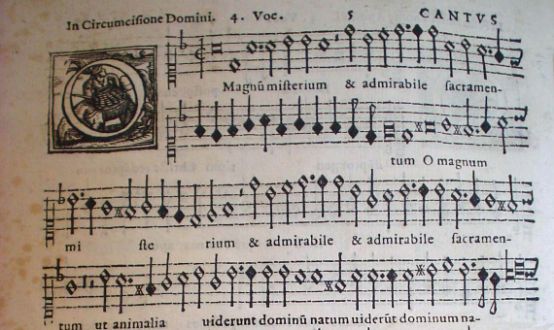
"O magnum mysterium", Cantus, from the "Motecta", Venice 1572,SMPV

Musicologists led by Rainer Kleinertz from Saarland University want to open up new avenues of research into the Spanish composer Tomás Luis de Victoria and prepare a historical-critical complete edition of his works. Kleinertz is an expert in Spanish music history and, together with computer scientist Meinard Müller from the University of Erlangen-Nuremberg, has been leading a German Research Foundation (DFG) project on the computer-aided analysis of harmonic structures since 2014.

With his current workshop, the musicologist from Saarbrücken is bringing together computer scientists and musicologists from Spain and Germany with other specialists. The researchers are discussing which methods can be used to analyze the musical structures in Tomás Luis de Victoria's work.

Tomás Luis de Victoria (ca. 1548, Ávila - 1611, Madrid) is considered a central composer of the Spanish Siglo de oro. He worked in Rome for a long time, had close ties to Germany and finally returned to Madrid.

The workshop currently being held is entitled "Musicology and computer science in dialog: Problems of transmission and possibilities of analyzing works by Tomás Luis de Victoria (ca. 1548-1611)".

More info: www.uni-saarland.de/musikwissenschaft


Canton Thurgau strengthens cultural education

The Government Council of the Canton of Thurgau has approved the canton's cultural concept for the years 2016 to 2018. Two new development goals have been incorporated into the revised concept: the development of a museum strategy and the expansion of cultural education offerings.

The Ittingen Museum is also listed in the cultural concept. Picture: © Ittinger Museum, Ittingen Charterhouse

The projects launched between 2013 and 2015 will be continued, according to a press release from the cantonal government. In addition, a museum strategy will strengthen the cantonal museums for future challenges and the expansion of outreach programs will improve access to culture in the canton of Thurgau: Gaps in offerings are to be closed and institutions supported in the development of outreach programs.

The cultural concept provides information on the criteria for the allocation of resources from the lottery fund. It shows how the funds from the state account and the lottery fund are used for cultural and charitable organizations.

The annual contributions from the state account will increase minimally due to the increasing share of the Canton of Thurgau in the Eastern Switzerland Cultural Burden Equalization Scheme from the previous CHF 1,866,100 to CHF 1,889,600 per year. The annually recurring contributions from the lottery fund will increase from CHF 2,548,500 to CHF 2,666,000, in particular due to the two newly set development goals.

In addition, the framework credit for one-off cultural projects will be increased from CHF 2.3 million to CHF 3 million based on past experience. Whether the framework credit is used up depends on the applications to the lottery fund and is still only a theoretical figure.

The concept can be downloaded at:
www.tg.ch/documents/Kulturkonzept_2016_2018.pdf


Zug Sinfonietta under new direction

The Zug Sinfonietta has appointed Daniel Huppert, the future General Music Director at Theater Schwerin, as its new Chief Conductor. He will take up the post in summer 2016.

Photo: zvg

The choice was made after a selection process lasting almost two years with over 270 applications. Huppert will already conduct two concerts in the 2015/16 season: on December 8, 2015 and January 30, 2016.

Daniel Huppert initially studied cello and conducting as well as musicology and German studies in Saarbrücken and then continued his studies in Weimar at the Franz Liszt Academy of Music. This was followed by postgraduate studies in concert performance.

In 2010, he won the 2nd German Operetta Prize for Young Conductors at Leipzig Opera. He won the MDR Symphony Orchestra Leipzig Conducting Competition and the International Lutoslawski Competition for Young Conductors in Poland in 2011.
Until the end of 2010, he was engaged as "Assistant du chef d'orchestre" at the Opéra national de Paris (Bastille).

Daniel Huppert was a fellow of the Conductors' Forum of the German Music Council. In the 2015/16 season, Daniel Huppert will conduct the new production of "The Tales of Hoffmann" at the Komische Oper Berlin, directed by Barry Kosky.

Foundation of a network of girls' choirs

A network for girls' choirs from Switzerland, Austria and Germany has been founded in Basel. The initiative consists of choir directors and managers of girls' choirs from German-speaking countries.

Basel Girls' Choir at the Swiss Children's and Youth Choir Festival 2015. photo: Mattias Nutt

The aim of the new group is to strengthen networking and improve communication of the concerns of girls' choirs. The network aims to "showcase the strengths of young female singers and draw attention to the unequal treatment of boys' and girls' choirs that exists in many places".

Among others, Anna Katharina Kalmbach, Luzerner Kantorei, Martina van Lengerich, Mädchenkantorei Freiburg DE, Marina Niedel, Mädchenkantorei Basel, Gerd Rixmann, Mädchenchor Wiesbaden DE and Lea Scherer, Solothurner Mädchenchor.

The group is open to all interested managers from the sector and a follow-up meeting is planned for February 2016.

Info:
afintelmann@maedchenkantorei.ch

SJMW anniversary at the Tonhalle Zurich

The largest national music competition for young amateurs celebrated its 40th anniversary with a concert matinee. Martin Vollenwyder will head the Board of Trustees from 2016.

Photo: Michael Ingenweyen, Munich

"How is the Swiss Youth Music Competition doing?" Gerd Albrecht, chief conductor of the Tonhalle Orchestra Zurich from 1975 to 1980 and founder of the Swiss Youth Music Competition (SJMW)would have received a gratifying answer if he had been able to attend the anniversary matinee at the Tonhalle Zurich on September 13. The question of how the SJMW was doing was always at the top of the agenda for their meetings, recalled Bobby Keller, the then Commercial Director of the Tonhalle Orchestra and now Honorary President of the SJMW. While the initial focus was on promoting young talent for Swiss orchestras, the competition has adapted to developments in musical life and opened up accordingly. What has remained the same is the quality of the support, which focuses on the jury's discussions with the competition participants, their teachers and parents.

The competition showed its best side this morning. Speakers paid tribute to its development and significance. The commemorative publication designed for the occasion offered a successful snapshot of the SJMW from the perspectives of various players. And the focus was, of course, on the music. Current and former prizewinners from four decades were presented in a Program which was held together in its diversity by a fine tonal thread and thus represented the entire range of variation of the SJMW. Supposed contrasts were obsolete; the focus was solely on the music.

Finally, there was one piece of news: The new President of the Foundation Board from 2016 will be the current President of the Tonhalle Society, Martin Vollenwyder. This brings the competition a little closer to its starting point.

www.sjmw.ch

Caption

The Bazar Qartet opened the concert matinee on September 13 in the small hall of the Tonhalle Zurich.

The photo was taken at the prizewinners' concert of the 2014 SJMW final in Lausanne.

Sébastian Jacot winner of the ARD music competition

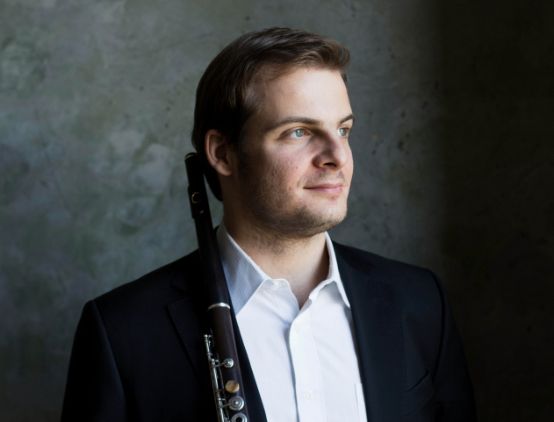
After HKB student Michael Buchanan, another Swiss representative, Geneva flutist Sébastian Jacot, won first prize in his discipline at the 2015 ARD Music Competition.

Photo: BR/Daniel Delang.

Spaniard Francisco López Martín was awarded second prize and the Audience Award. His compatriot Eduardo Belmar came third.

Jacot is the winner of the 2013 Kobe Competition, among others. In 2014 he won the Carl Nielsen International Flute Competition. Between 2006 and 2008, he was assistant principal flute of the Hong Kong Philharmonic Orchestra, then principal flute of the Saito Kinen Festival and principal flute of the Geneva ensemble Contrechamps. This year he has been appointed Principal Flute of the Gewandhaus Orchestra Leipzig.

In the trombone category, 22-year-old British HKB student Michael Buchanan won over the jury. He won first prize and the audience prize (the SMZ reported). The second prize went to Jonathan Reith from France. Guilhem Kusnierek from France was awarded third prize.


Online course on music notation at the University of Basel

The University of Basel is now offering free online courses that are open to the general public. One of the first two, entitled "From Ink to Sound", is on music notation through the ages. The course language is English.

Photo: Dieter Schütz/pixelio.de,SMPV

The online course "From Ink to Sound" deals with theoretical and practical aspects of writing down music and sheds light on the development of music notation from the Middle Ages to the Renaissance.

Matteo Nanni and Angelika Moths from the Department of Musicology at the University of Basel show how music was recorded in manuscripts, how it was decoded and transcribed into modern notation. Musicians from the Schola Cantorum Basiliensis have made over 15 recordings especially for the course - including a music manuscript from the Basel University Library, which has been transcribed and performed for the first time in 700 years.

The course is aimed at musicians with an interest in music paleography as well as students and those interested in music, history, philology, theology, art history and semiotics. The only prerequisite for students is that they are familiar with the modern notation system.

Website: www.futurelearn.com/courses/from-ink-to-sound

The Codex Gisle

One of the most magnificent music manuscripts of the German late Middle Ages, the golden gradual of Gisela von Kerssenbrock, is being made accessible to a wider public by Quaternio-Verlag.

Advent miniature in the Codex Gisle. Picture: zvg,SMPV

The Codex Gisle is a gradual, i.e. a choir book for the daily singing of the Mass. It originates from the Cistercian nunnery Marienbrunn in Rulle, north of Osnabrück, and was created there around 1300.

It is highly unusual that the names of the artist and scribe are known: In red ink, Sister Gisela von Kerssenbrock, a member of an old Westphalian noble family, signed the gradual in several places with an adoring nun and the words "Gisle". Gisela was the cantrix or song mistress of the convent, taught her fellow nuns to sing and was responsible for the production of the musical manuscripts. She created the book decorations, wrote texts and sheet music and donated the Codex Gisle their convent in Rulle, where it was in uninterrupted use for around 500 years.

Unusual at the Codex Gisle is also its immense variety of images: with 53 pictorial initials, it surpasses other graduals by more than double. The ornamental letters are magnificently decorated and show the most important stages in the life of Jesus in sometimes unusual scenes.

The Quaternio publishing house in Lucerne has discovered this most beautiful Lower Saxon-Westphalian manuscript from the period between 1250 and 1400 in the Osnabrück diocesan archives and is making it accessible to a wide audience through its facsimile edition.
The elaborate facsimile edition will be accompanied by a scholarly commentary volume; a music edition of selected chants is also planned.

In the exhibition Golden splendor for heavenly songs - The facsimile edition of the Codex Gisle in Kloster Eberbach (D-65346 Eltville im Rheingau, opening hours: daily 10 am - 6 pm), the facsimile edition is on display until October 29, 2015 - in individual pages and for browsing.

Image

Facsimile Codex Gisle: 172 leaves in the original format of 35.5 x 26 cm with 53 initials, leather binding with corner fittings, in linen case, commentary volume, edition: 480 copies, ISBN 978-3-905924-20-6, Fr. 12 400.-; documentation folder with two original facsimile leaves and information brochure, Fr. 124.-.
www.quaternio.ch

get_footer();