Two Swiss pop musicians have been nominated for one of the German industry awards Echo Pop 2013. The award will be presented on March 21 in the halls of Messe Berlin.
Music newspaper editorial office
(translation: AI)
- 05. Mar 2013
In the category Newcomer International the Bernese DSDS winner ("Deutschland sucht den Superstar") Luca Hänni is nominated. He is up against Alex Clare, Lana Del Rey, Of Monsters and Men and Emeli Sandé. At the Swiss Music Awards a few days ago, Hänni already proved himself as the Best Breaking Act National against Eliane and Müslüm.
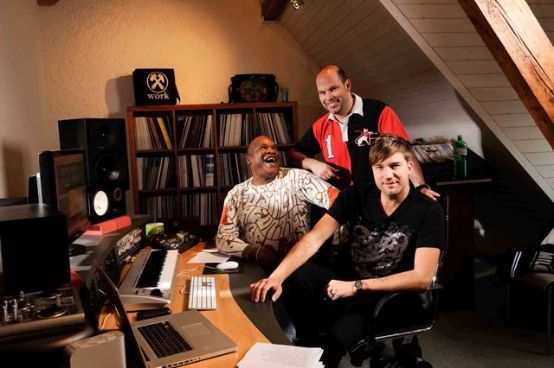
A nomination in the category Club / Dance National / International goes to DJ Antoine, probably the most successful Swiss pop music export at the moment. His single "Ma Chérie" has sold a million copies. At this year's Swiss Music Awards, he is nominated in the category Best Hit National but came away empty-handed.
Picture: Mr. Mike, Mad Mark and DJ Antoine in the studio. Stephan Pick, wikimedia commons
Gérald Berger, Head of the Office for Culture at the Directorate for Education, Culture and Sport (EKSD) of the Canton of Fribourg, will retire at the end of September 2013.
Music newspaper editorial office
(translation: AI)
- 04 Mar 2013
Gérald Berger has done much to open up the canton's cultural scene, making it bigger, more diverse and more professional. This has also resulted in productions that have become known beyond the canton's borders, the canton writes. Berger's name is also associated with the founding of the Fribourg Chamber Orchestra, among other things.
In 1987, the offices of Head of Service and Secretary General of the Directorate of Education, Culture and Sport (EKSD) were separated in Fribourg. Gérald Berger became the first full-time head of the Office for Cultural Affairs of the Canton of Fribourg, which was renamed the Office for Culture in 2003.
It manages its own dossiers in the area of cultural promotion. It is also responsible for the State Archives, the Cantonal and University Library, the Conservatory, the Museum of Art and History and the Natural History Museum.
Reductions at Schaffhausen music schools prevented
The Schaffhausen legislature has rejected the cantonal government's request to cut contributions to music schools.
Music newspaper editorial office
(translation: AI)
- 04 Mar 2013
According to a report by Radio SRF, the Schaffhausen cantonal council has rejected a reduction in contributions to music schools of CHF 275,000 per year. In future, the shortfall would have had to be covered by the parents of the music students.
The proposal to forego this cut did not come from left-wing circles, but from FDP circles. According to SRF, Urs Hunziker, Schaffhausen city councillor and head of education, spoke of "a reduction in education that he could not support".
On February 25, the Aargau Board of Trustees decided which of the applications received would be funded.
Music newspaper editorial office
(translation: AI)
- 04 Mar 2013
At its February meeting, the Aargau Board of Trustees allocated a total of 779,100 francs for cultural events. Of this amount, 152,500 francs are program contributions for classical music events, 97,000 francs flow into the rock and pop sector as program and tour contributions.
The lists of supported projects are here is now available.
The Aargau Board of Trustees decides on the awarding of grants at two to four meetings a year, depending on the subject area. Cultural institutions based in the Canton of Aargau, Aargau event organizers and Aargau artists can also submit their applications digitally. Further information can be found on the Website of the Canton of Aargau.
Learning companions for all ages
What does a 21st century piano school look like? Perhaps like the "Piano Coach" by Mike Cornick.
Stefan Furter
(translation: AI)
- 04 Mar 2013
Symbolic image. Photo: tonodiaz/depositphotos.com
Mike Cornick knows how to meet the needs of today's students with this refreshingly innovative piano school in two volumes. It is published by Universal Edition and, according to the foreword, is aimed at "budding piano players - whether young people or adults of all ages up to retirement age". The author is keen to provide the student with a comprehensive learning guide and pulls out all the stops. This work is therefore more than just a progressive collection of lesson pieces. The clearly structured chapters each contain the aspects of notation, playing technique, theory and ear training. What I like about it is the comprehensiveness of the supporting texts and the careful structure.
The basics of piano playing (introduction to two-handed playing, independence, parallel and contrary motion, imitation, polyphony, chord playing, etc.) are laid out in a thoroughly classical manner. What goes beyond the usual content of a piano school are all the explicit instructions on the aspects mentioned above. This means that the pupil can work out a lot of information independently and, if necessary, discuss and deepen it with the teacher. The pieces, many of which were composed by Mike Cornick himself, range from classical music to folk and jazz. The enclosed CD contains the recordings of the pieces, some playalong tracks and ear training exercises. But that's not all, under universaledition.com/pianocoach1 and /pianocoach2 there is further material available for free download: additional pieces, chord charts, triad breakdowns, keys, hints for improvisation. Readers of these lines who would like to get a taste of piano coaching should also click on these pages.
Mike Cornick, Piano Coach, Die Klavierschule für Erwachsene und Wiedereinsteiger, Volume 1 UE 34991, with 1 CD, € 19.95, Universal Edition, Vienna 2010
Chiara Enderle, cello student in the Bachelor of Music program at the Zurich University of the Arts (ZHdK) under Thomas Grossenbacher, has won first prize at the internationally renowned IX Witold Lutoslawski International Cello Competition in Warsaw.
Codex flores
(translation: AI)
- 04 Mar 2013
In addition to the main prize, Chiara Enderle also won the prize for the best interpretation of the compulsory piece and the Award of the European Union of Music Competitions for Youth (EMCY).
Born in 1992, the daughter of ZHdK music lecturers Matthias and Wendy Enderle is currently studying at the Zurich University of the Arts, BA Music Art and Sports High School, with Thomas Grossenbacher.
The Witold Lutoslawski International Cello Competition has been held in Warsaw every two years since 1997. Since the beginning, it has been under the patronage of Mstislav Rostropovich. The age limit for the competition is set at 24 and, in addition to a broad repertoire ranging from baroque to contemporary music, the cello concerto by Witold Lutoslawski is required as a compulsory piece, which is performed with orchestra in the third round of the competition.
"youth+music": Initiative committee honored with prize
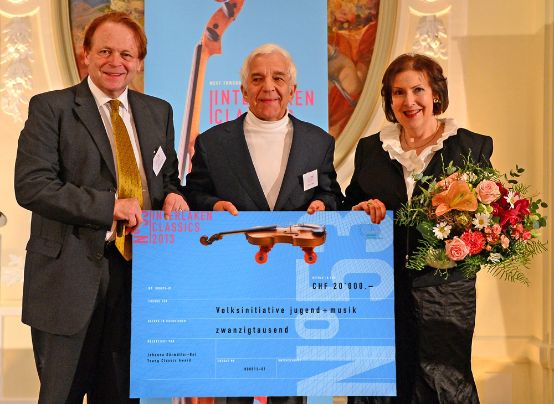
In Bern, Vladimir Ashkenazy, president of the jury, presented the 7th Johanna Dürmüller-Bol Young Classic Award, endowed with 20,000 Swiss francs, to Christine Egerszegi, member of the Council of States.
Music newspaper editorial office
(translation: AI)
- 02. Mar 2013
ZVG
As president of the initiative committee, Christine Egerszegi and her team played a major role in ensuring that over 70 percent voted in favor of the introduction of the constitutional article in the referendum in September 2012. The clear result offers all children and young people access to music, regardless of the size of their parents' wallets, write those responsible for the prize.
The Johanna Dürmüller-Bol Young Classic Award is a joint project of the Interlaken Classics Festival and the Fondation Johanna Dürmüller-Bol. The award is presented annually to an institution that has made a special contribution to the promotion of young classical musicians.
Previous winners include the Davos Festival - young artists in concert, the Sibelius Academy Helsinki, the Bern Conservatory Music School and the Friends of the Anne-Sophie Mutter Foundation.
A concise guide to working on or adjusting clarinet reeds yourself.
Music newspaper editorial office
(translation: AI)
- 01. Mar 2013
SMPV
An excuse? The reeds have been the cause of many a clarinettist's unfortunate tone and other mishaps! Hanstoni Kaufmann wants to change that and has written a wonderful guide to improving clarinet reeds. He can look back on over 30 years of experience as a reed maker and corrector: ever since he started making his own reeds with the then principal clarinettist of the Vienna Philharmonic, Alfred Prinz, and was eventually chosen as Prinz's personal reed maker. As a course instructor, Kaufmann regularly passes on his knowledge and teaches clarinettists the secrets.
On 40 pages in A4 format, Hanstoni Kaufmann provides many facts and all sorts of instructive information as well as concise and extremely precise instructions on how to work the small sound generators. The booklet begins with the material, the cane, with its properties, characteristics and vibrational behavior. Kaufmann shows how the reed geometry should be designed and how individual tones can be directly assigned to a region on the reed. The methods of processing are explained in detail using specific techniques, and the author presents the tools required and how to use them. At the end of the booklet, reference sources are given for all materials. The chapter "Correcting and adjusting with a system" is extremely helpful, as it describes common reed problems and how to solve them. Finally, Kaufmann lists numerous analysis steps with diagnoses and correction options.
Correcting clarinet reeds belongs in every clarinettist's library, even if you have no intention of getting to work with sandpaper and chisels. If only because of the interesting information on the reeds and the wonderful illustrations. If you really want to get to work yourself, you would probably be well advised to take a course with the author.
Hanstoni Kaufmann, Klarinettenblätter korrigieren, 40 p., Fr. 29.80, misura Verlag, Lucerne 2012, and directly from the author: mhtk@bluewin.ch
From March 2013, the City of Zurich's cultural funding department will be switching to online applications in stages. Applications for funding will now be submitted via a central portal and processed electronically by the departments and specialist commissions.
Music newspaper editorial office
(translation: AI)
- 01. Mar 2013
The City of Zurich's Department of Culture receives around 1500 applications for funding every year, which are processed by the various departments. The entire application and processing process, from submission to decision, is now carried out electronically and online via the Internet.
The solution has been developed for Kultur Stadt Zürich together with the Zurich Organization and Information Technology (OIZ) and a private provider. As before, the content of the submissions will be assessed by a specialist commission external to the administration.
The individual cultural departments are switching to electronic applications in stages. Applications for funding must be submitted electronically and online from the following dates: Electronic music from March 1, 2013, jazz/rock/pop from March 15, 2013, visual arts from May 6, 2013, theater, dance and literature from July 1, 2013.
The Government Council of the Canton of Thurgau supports the "School and Culture Network" project. The aim is to strengthen cultural education in schools and thus make it easier for children and young people at all school levels to access art and culture.
Music newspaper editorial office
(translation: AI)
- 01. Mar 2013
A coordination and information office is given the task of setting up an online database that lists all cultural education offers in Thurgau and its catchment area. The service is to be added to the existing cultural agenda thurgaukultur.ch and networked with the planned database of other eastern Swiss cantons.
A second task of the new position is to establish a network of contact persons at the schools who are particularly concerned with cultural education issues.
A project group headed by René Munz, Head of the Cultural Office, will be set up for the duration of the three-year development phase of the new position - the Government Council has approved CHF 100,000 per year from the lottery fund for this purpose. Adrian Bleisch, a trained primary school teacher and museum educator from Egnach, will be appointed to manage the project on a contract basis.
Benjamin Schmid honored in Germany
Benjamin Schmid, violinist and lecturer at the Bern University of the Arts (HKB), has been awarded a German Record Critics' Prize.
Codex flores
(translation: AI)
- 01. Mar 2013
Schmid received the prize for his recording of a CD with music by Ermanno Wolf-Ferrari (Concerto for Violin and Orchestra in D major op. 26, orchestral music from the operas Il campiello, Le donne curiose, L'amore medico and I quattro rusteghi). The Oviedo Filarmonia is conducted by Friedrich Haider.
According to the jury, the recording is "a fervent plea for Ermanno Wolf-Ferrari's highly romantic but still little-known violin concerto; at the same time an exceptionally well-documented edition and a tribute to Guila Bustabo, the great American violinist and dedicatee of the work".
The German Record Critics' Award is an independent association of currently 145 music critics and journalists from Germany, Austria and Switzerland. Organized in 29 expert juries, the jurors examine the range of new recordings in 29 categories on a quarterly basis.
Berne Platform for Applied Research
The research department of Bern University of the Arts (HKB) has a new event format: Research Wednesday offers insights into the research activities of the HKB and its four research focuses every two weeks.
Codex flores
(translation: AI)
- Feb 28, 2013
On the Wednesday dates, some ongoing or completed HKB projects are presented, or national and international guests are invited. Students also have the opportunity to present their work and approaches as young researchers. In addition to the projects, questions relating to the significance of research for the departments and research in the arts will also be discussed.
The first such event will focus on the SNF-DORE project "Recording the Soul of Piano Playing (Geisterhand 3)": the perforated paper rolls for self-playing pianos and organs by the Welte company are among the earliest sound documents of artistic interpretation. Nevertheless, they have received little attention from researchers because their creation process - and thus their credibility - was unclear.
Thanks to the examination of the only surviving recording apparatus and the discovery of more than 1,300 recording rolls with the ink traces of the apparatus, the current research project was able to clarify central questions and test new ways of evaluating the piano and organ rolls as interpretative documents that go back well into the 19th century.
Info: HKB, large concert hall, Papiermühlestrasse 13d. March 6, 5 to 7 pm. Guest and co-speaker: Martin Elste, State Institute for Music Research / Prussian Cultural Heritage Berlin. www.hkb.bfh.ch/forschung.html
According to the industry association IFPI, the international music market is "slowly recovering after years of landslide slumps that have halved the level of sales".
Music newspaper editorial office
(translation: AI)
- Feb 27, 2013
According to the International Federation of the Phonographic Industry (IFPI), global revenue from music sales rose in 2012 for the first time since 1999, driven largely by sustained growth in the digital business segments.
The overall market grew by around 0.3% to 16.5 billion dollars. Overall, global sales of downloads, subscriptions and ad-financed online services increased by 9 percent last year. This means that the digital market currently accounts for 34% of global music sales.
Download sales have increased by 12% overall and now account for 70% of digital sales. The number of music subscribers to premium streaming services has risen by 44% to around 20 million paying customers - global revenues from this segment now account for 10% of digital revenues.
Health management for orchestras
The Corporate Health in Orchestra project, which the Lucerne School of Social Work carried out together with the Zurich Opera Orchestra, has developed a systematic occupational health management system for an orchestra.
Codex flores
(translation: AI)
- Feb 26, 2013
In a first step, Monica Basler, Sarah Dupasquier and Nadine Näpfli, the university's experts, surveyed 77 members of the orchestra, the Philharmonia Zurich, to identify physical complaints and stress factors as well as criteria that are decisive for well-being at work.
The result: 18% of respondents complained of noise hypersensitivity, 14% of hearing loss, 13% of tinnitus and 10% of other hearing impairments. Other frequently mentioned physical complaints were pain in the shoulders or neck (20%) and eye problems (12%). The orchestra members also found their posture to be detrimental, partly due to poorly adjustable chairs, as well as the high temperature and inadequate lighting in the orchestra pit.
In a second step, the experts worked with the management and representatives of the orchestra to develop measures for workplace health promotion based on the results.
The Philharmonia Zurich is now taking measures in line with the suggestions of experts in occupational health management. For example, the musicians now have access to a massage service. The installation of showers is also planned. As part of a reorganization of the premises, a relaxation room is also planned for the near future. New chairs and a new desk lighting system will also be purchased.
An organizational development process has also been initiated in order to promote the exchange between the orchestra management and the orchestra, but also between the musicians, and to reduce the insecurities of the concertmaster and section leaders in performing their management functions.
The canton of Geneva considers a public-private partnership with the Fondation Hélène et Victor Barbour to be a successful model. Since 2008, it has offered more than 48,000 tickets to cultural events to school-age children in the canton.
Music newspaper editorial office
(translation: AI)
- Feb 25, 2013
For the past five years, the foundation has raised CHF 100,000 a year, which enables the city's cultural department, the Département de l'instruction publique, de la culture et du sport (DIP), to purchase tickets to cultural events for the city canton's schoolchildren or to enable them to take part in workshops.
Around 400,000 francs have now been invested in the project, writes the canton. The cultural offerings for young people have thus been increased by around a quarter. In 2012, the foundation increased the amount by an additional 56,000 francs due to the success of the project.
In 2013, the project "Stravinsky s'invite à Geisendorf" will be supported with 25,000 francs, among other things, as part of which pupils will be able to explore Stravinsky's soundscapes through dance under the guidance of the Atelier danse Manon Hotte.