Catalan guitar romance

Two booklets open up pieces by composers from Barcelona who are little known in this country

Publisher Rafael Catalá. Photo: zVg

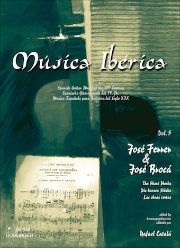
The Spanish guitarist Rafael Catalá, who works in Austria, is making a name for himself with those parts of 19th century Spanish guitar music that have not yet entered the general repertoire. In the fifth volume of his series Música Ibérica he juxtaposes pieces by the Catalan José Broca (1805-1882) with those by José Ferrer (1835-1916), who, like Broca, was active in Barcelona, but also in Paris. Ferrer's late romantic minuets, tangos and other musical "bouquets", often dedicated to his friends or advanced female students, always impress with their effective musicality. The pieces by Broca, his teacher and friend thirty years his senior, are also pleasing, but do not quite come close to those of his successor.

In the fourth volume of the same series, published at the same time, the editor presents all ten works by José Costa y Hugas, who is largely unknown but also active in the Catalan capital. Here is the waltz El Fagot which was also arranged by Daniel Fortea, among others. And with the wedding piece Rêverie Nupcial is for all those guitarists who are looking for substantial tremolo pieces.Image

José Costa y Hugas, Complete Works, (=Musica Iberica, Spanish Guitar Music of the 19th Century, Vol. 4), edited by Rafael Catalá, D 35 917, €22.95, Doblinger, Vienna 2010

José Ferrer & José Brocá, Die kurzen Stücke, (=Musica Iberica, Spanische Gitarrenmusik des 19. Jh., Band 5), ed. by Rafael Catalá, D 35 918, €22.95, Doblinger, Vienna 2010

The British composer, film musician and jazz pianist Sir Richard Rodney Bennett has died in New York at the age of 76, according to British press reports.

Born in Kent in 1936, Bennett came from a musical family; his mother was a pupil of the composer Gustav Holst. He won a scholarship to the Royal Academy of Music in 1953. His teachers were Lennox Berkeley and Howard Ferguson. He was introduced to avant-garde music by the composer Elizabeth Lutyens and, with the support of the French government, he studied with Pierre Boulez for two years. He was also a frequent guest at the Darmstadt Summer Course.

Bennett developed his own language, known as "neo-romantic serialism". In the 1960s, Bennett wrote several operas, including the children's opera "All the King's Men", which is still very popular today.

In addition to orchestral music, Bennett also wrote a number of successful film scores, for which he was nominated for an Oscar three times. His last work for film was the music for "Four Weddings and a Funeral" in 1994. He was also active as a jazz pianist.

For the early start

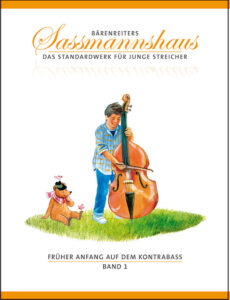
The tried and tested "Sassmannshaus" is now also available in a version for double bass.

Excerpt from the magazine cover

After a year and a half ago (SMZ 7-8/2011p. 34), some new double bass schools have already been discussed, further new publications have now enriched the range.

The "Sassmannshaus" is anything but new. What is new is that the school originally conceived for violin and cello for early lessons from the age of four has now been adapted and published for the double bass. At this age, it makes sense to work with text-backed exercises, a concept that runs through the entire first volume. Immediately after the first simple rhythms on empty strings, the placement of the 1st finger is practiced. Experience has shown that this is less favorable on the bass. Fingers that are not used quickly cramp up, and the same applies when playing on the low strings and when placing and immediately lifting the fingers on empty strings. The latter makes it difficult for the youngest children to find their position. More suitable Mary had a litttle lamb On page 27, the young players can start from the fully placed hand and "feel their way" to the notes below by lifting the upper fingers.

The legato exercises, often leading over the next string, and the introduction of the change of register from the 1st to the 2nd position (instead of the preferred change from the 1st to the 3rd position in most current schools) show that a successful concept for high strings cannot simply be transferred to the double bass. In the third band (up to the 4th position), such an early start requires a few more intermediate steps. Nevertheless, many pieces and attractively arranged duos are suitable for classically oriented lessons. The publisher Bärenreiter is to be highly commended for its commitment to early instrumental teaching on the double bass.Bärenreiter's Sassmannshaus, Early Beginnings on the Double Bass, edited by J. Peter Close and Holger Sassmannshaus; Volume 1, BA 9660; Volume 2, BA 9662; Volume 3 BA 9663; € 14.50 each, Bärenreiter, Kassel 2012

For young and older players

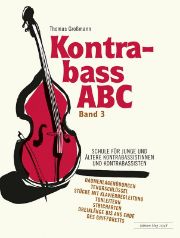
The "Double Bass ABC" has received a third volume. An overview.

Photo: biggur/depositphotos.com

To anticipate this: The promise announced on the cover page that the Double Bass ABC The idea that the piece is suitable for young and older players is realized. The musical material moves between classical musical language and standard jazz. The latter, however, is exclusively written out. After one volume each in spring 2011 and 2012, a third booklet now continues the development.

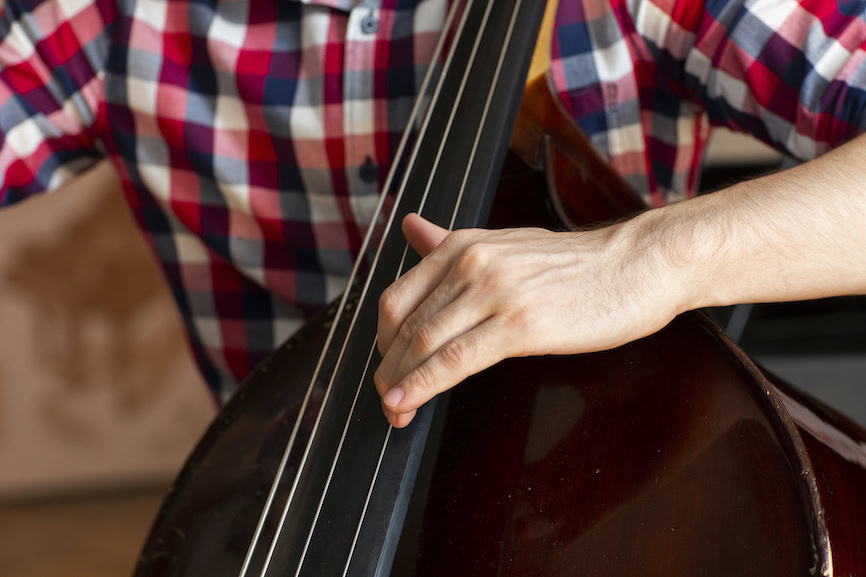
The introduction in the first volume with harmonics and 3rd position is physiologically favorable, but requires a basic understanding of the tonal material and musical notation in bass clef. The introduction of the bow is followed by the pizzicato technique in jazz. The objectives of the respective materials, which include scales, exercises and pieces, are presented in a factual, competent and appealing manner, both in the text and by means of photos and graphic elements. The two CDs (exclusively for the first volume) are also of unpretentious quality and support self-study. They contain corresponding model recordings and accompanying parts for all exercises. While the author uses traditional and classical melodies in addition to the jazz exercises in the first volume, from the second volume onwards most of the music is composed by the author himself. This enables a consistent step-by-step and goal-oriented structure, but in the long run it seems predictable and offers too little musical substance.

In summary, it can be said that the school is particularly suitable for advanced lessons with young people and adults. However, it urgently needs sufficient supplementary material from the diverse original repertoire, which is fortunately increasingly available again today.

Image

Thomas Grossmann, Double Bass ABC, School for young and older double bass players; Volume 1, GH 11746, with 2 CDs, Fr. 32.80; Volume 2, GH11747, Fr. 28.80; Volume 3, GH 11748, Fr. 29.80; Hug Musikverlage, Zurich 2011/2012

Sounds from nowhere to nowhere

Miniatures for voice and cello by Andrea Lorenzo Scartazzini

Photo: zeferli/depositphotos.com

In Bern, the composer Scartazzini, born in Basel in 1971, is best known for his opera Anger (2010 in the repertoire of the Stadttheater). The miniatures, which last around four minutes, prove that he is also fascinated by the smallest ensembles with singing voices Night low and moon.

The demands on the singer are not primarily in hitting the notes, which do not seem abstract even in harmony with the violoncello; the dynamic markings - lying between pppp and mp - are demanding, notes come out of nowhere or disappear into nothingness. In addition, the counter or the female voice (preferably a mezzo) has to play crotales (small cymbals), in the first movement with a double bass bow, in the second with metal brushes.

The texts are referred to as "boutades". (I had to look up this expression: conceit, idea, whim.) The airy word creations such as "Blattanbeter" or "Windverehrer" are composed coherently; only in the third movement does the composer dispense with text altogether and assigns the voice a sotto voce vocalise, corresponding to the line of text set to music: "Ich lausch dem Winde, schweigend und versonnen". Instead, the cello, which until now has played around, trilled and accompanied with glissandi, is given the task of embodying the wind with all the sound possibilities of the bow and instrument.

The instructions are clearly notated in the musical text, which saves you having to leaf through an index.

Image

Andrea Lorenzo Scartazzini, Nachttief und Mond, Three miniatures for counter (or female voice) and violoncello on texts by Arno Schmidt, BA 9366, € 9.75, Bärenreiter, Kassel 2012

Fun mix of styles for beginners

Simple, inspiring pieces for cellists alone or in ensemble.

Excerpt from the magazine cover

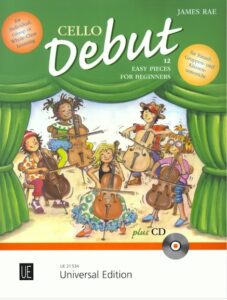
The Englishman James Rae (*1957) has published several series of beginner pieces for various wind and string instruments with Universal Edition (Debut series). Young cellists will enjoy the collection Cello Debut - 12 easy pieces for beginners for 1-2 cellos will certainly have great pleasure. With his varied compositions, Rae strikes just the right note to make it easier for music students to enter the world of music. Whether you are just starting out with the TV Tangothe Pineapple Rumbathe Motorcycle Rock or the eerily creepy Skeleton in the broom closet busy: Making music with this popular mix of styles is fun.

The booklet is cleverly designed to be multifunctional: It contains solos with accompaniment (Nos. 1-4), ensembles with accompaniment (Nos. 5-8) and ensembles with accompaniment that can be combined with booklets for other instruments from the Debut series (Nos. 9-12). The accompanying CD with upbeat piano and combo accompaniments, each with a play-along version and a complete recording to listen to, enables and facilitates practicing at home. The cello part is limited to the first (narrow) register. Despite their simplicity, the pieces contain varied musical and technical tasks. Pizzicato-arco changes, syncopations, tremolos, sul ponticello playing, but also the use of dal segno repetitions are used in a pedagogically meaningful and stimulating way.

The piano accompaniments can be purchased separately or, like the pretty drawings in the edition, can be downloaded free of charge from the publisher's website.

James Rae, Cello Debut, 12 easy pieces for beginners for 1-2 violoncellos, with CD and piano accompaniment, UE 21534, € 12.95; piano part, UE 21535, € 14.95; Universal Edition, Vienna 2012

Review of the debut booklet for flute: SMZ 3/2012  P.38, 3rd column

Circles around Schönberg and Suter

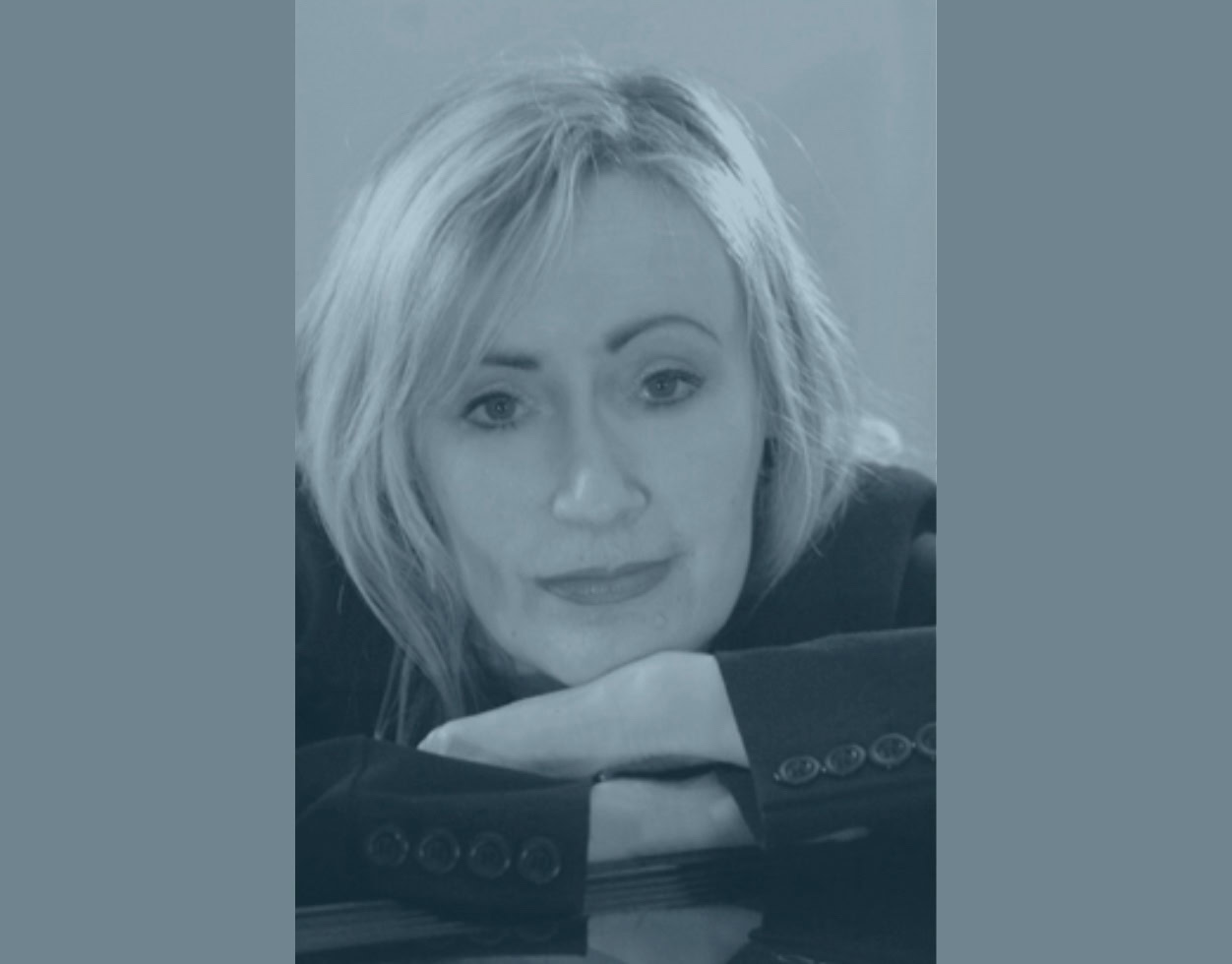
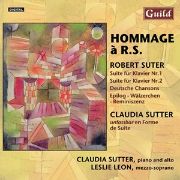
The pianist, singer and lyricist Claudia Sutter honors the composer Robert Suter in her "Hommage à R. S.".

Claudia Sutter. Photo: lesalonbleu.ch

As in the chamber music piece related to Robert Schumann Hommage à R. Sch. by György Kurtág prevail in the work dedicated to Robert Suter (1919-2008). Hommage à R. S. expressive miniatures. These include not only the two suites for piano (1943 and 1945) and the very short piece Epilogue - tome reminiscence (1997) by Robert Suter, but also the composition inconceivable en Forme de Suite for singing and speaking voice and piano (2011) by Claudia Sutter.

The musician, who has become known as a pianist, singer, lyricist and director of the Basel concert series "Le Salon bleu", feels a kinship with Robert Suter. His basic principles served her as a model for her vocal suite, which combines her own texts with a poem by Ingeborg Bachmann: Archaic, intimate, abstract and virtuoso. With its inclusion of the speaking voice and expressive gestures, the composition is reminiscent of unbelievable to Schönberg's Pierrot lunairewhich stood at the beginning of Robert Suter's compositional development.

Like Claudia Sutter in her composition, Robert Suter also circles around the German chansons for voice and piano (1978 and 1987) by the Viennese twelve-tone pioneer. In his German Chansons (Brettl songs) with the Swiss composer, along with the lyricists Otto Julius Bierbaum and Frank Wedekind, the light tone, irony and that typical Viennese charm that also characterizes Georg Kreisler's chansons, which are related to Suter. In Suter's witty refrain songs and the other gems, the artist is just as convincing as a sensitive alto as she is as a pianist in the free-atonal piano suites. The way she shapes trill chains and legato slurs, astounds with a wealth of tonal color even in pianissimo passages and remains faithful to the musical text down to the smallest dynamic detail is deeply impressive.

Image

Hommage à R. S. Robert Suter: Suites for Piano No. 1 & 2, German Chansons for voice and piano ; Claudia Sutter : unfassbar en forme de Suite for voice and piano. Claudia Sutter, piano, alto voice and Sprechgesang; Leslie Leon, mezzo-soprano. Guild GMCD 7382

In the current fall semester 2012, a total of 12,995 students have enrolled at the University of Basel. Musicology remains a very small niche.

SMPV

The official figures for the University of Basel's fall semester 2012 are now available. As in previous years, the number of students continued to increase this year. The university currently has a total of 12,995 enrolled students, compared to 12,617 in the previous year (+378). This means that the total number of students rose by 2.5 percent and reached a new high.

Three applicants are aiming for a Master's degree in Musicology, 12 students are applying for a Bachelor's degree in the subject. English (27), History (26) and German Philology (18) have the highest number of Master's applicants at the Faculty of Humanities.


Suisse Diagonales Jazz

From January 12 to February 17, the "Suisse Diagonales Jazz" festival offers ten young Swiss jazz bands the opportunity to perform in at least five clubs outside their home region in order to gain national recognition.

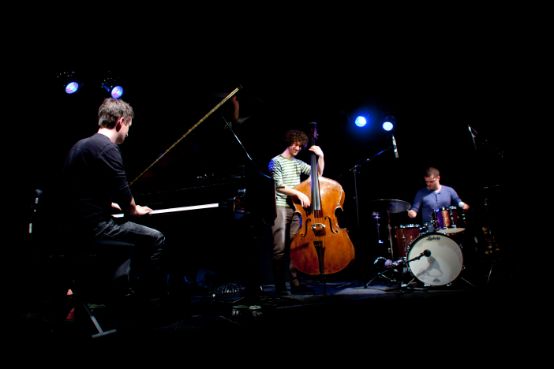
Swiss percussionist Pierre Favre, pianist Colin Vallon and composer and pianist Nik Bärtsch open the "Suisse Diagonales Jazz" festival in Lucerne.

From January 12 to February 17, it offers ten young Swiss jazz bands the opportunity to perform in at least five clubs outside their region of origin in order to gain national recognition. The festival opens its program, supported by Pro Helvetia, on 12 January at the Südpol in Lucerne. The festival is organized by the Suisse Diagonales Jazz association.

More info: www.diagonales.ch

Photo: FM Trio (zvg)

The general meeting of Suisseculture has unanimously elected the writer Johanna Lier as its president. Johanna Lier succeeds Ruth Schweikert, who is relinquishing her presidency after four years.

The reason for Ruth Schweikert's resignation is time overload and because she wants to devote more time to her core activity - writing - again, writes Suisseculture.

Johanna Lier became known as an actress in Fredi Murer's "Höhenfeuer". She later switched to literature. Poetry and lyric poetry is her literary focus. She also works as a freelance journalist. She is a member of the association "Autorinnen und Autoren der Schweiz" (AdS).

Johanna Lier takes office as President of Suisseculture with immediate effect. She will be supported by an eleven-member board, in which the Swiss associations of professional cultural practitioners from all sectors are represented.

As an umbrella organization, Suisseculture is primarily involved in the nationwide and overarching interests of its affiliated associations and organizations.

Members from the music side are the Swiss Performers' Foundation SIS, the Swiss Music Syndicate SMS, the Swiss Musicians' Association, SUISA and the SUISA Foundation for Music as well as the Swiss Musicians' Association SMV.

Folk music: brash and bold

An ensemble from Berlin makes folk music or plays with folk music elements - also from Switzerland.

Photo: Anthony Gomez / unsplash.com

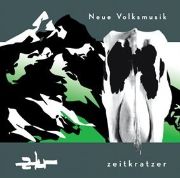
No, the ladies and gentlemen of Zeitkratzer are not making fun of themselves. The ten musicians have already worked with Arnold Schönberg, with Lou Reed's pop music and with electronic experimental music. Now it's the turn of folk music, which they approach no less brashly than their free Schönberg interpretation. A propulsive Romanian rhythm (Bouchimich), a melody from the Swiss canton of Valais (Ländler) or a folk music recording from Appenzell (Zäuerli) - in the hands of the ten Berlin avant-garde musicians, all of this becomes a strangely rugged, indeed quite original music, which has only one catch: it hardly corresponds to the (sound) image that many have of the ideal world of folk music.

Ultimately, however, the Zeitkratzers are absolutely right: their vital pieces are no less based on a construction than much more sterile, glossy productions of folk music on evening television programs. When Romanian ingredients are combined with Bavarian and Swiss sounds and songs, the gentlemen take the "fluid" principle of orally or musically transmitted folk music to the extreme, so to speak. Because they discover many a dissonant and microtonal overlap with 20th century art music during their research in the archives, the CD Neue Volksmusik is an immediate listening pleasure full of energy and excitement. Incidentally, it was recorded at the Alpentöne festival in Altdorf.

To sum up: sometimes it's not the often cerebral avant-gardists who are ahead, but the farmers. Of course, this is also a cheeky exaggeration - but definitely worth thinking about.

Image

New folk music. Ensemble Zeitkratzer. Zeitkratzer Productions. Zkr 0014, distribution Broken Silence

For the third time, class groups and study groups from all over Europe are invited to submit their innovative and creative school music projects for a
convince the jury of experts.

SMPV

The ESP is awarded in the two categories of musical work in class lessons and musical work in study groups, each of which is divided into three subcategories: Grade 1 - 5, Grade 6 - 12 and Special School.

In total, the ESP is endowed with prize money of 21,000 euros, and an individual school can be awarded up to 4000 euros. In the first two years in which the ESP was awarded, twelve schools were honored.

The European School Music Prize ESP was established in 2010 by the SOMM - Society Of Music Merchants e. V. association. It has been awarded annually ever since. The declared aim of the competition is to strengthen music teaching in schools with its many positive aspects for children and young people.

More info: www.europaeischerschulmusik-preis.eu

Picture: knipseline - pixelio.de

The Galatea String Quartet, which transcends stylistic boundaries, is awarded the Canton of Zurich's sponsorship prize in the field of music, dance and theater.

The Government Council awards the Culture Prize to individuals or groups who have made outstanding artistic achievements or promoted culture through their mediation activities. This year's prize, worth CHF 50,000, goes to 67-year-old designer Hans Knuchel.

Young artists with great development potential can win the Canton of Zurich's sponsorship prize, which is endowed with 40,000 francs. Next year, it will go to the musicians Yuka Tsuboi, Sarah Kilchenmann, David Schneebeli and Julien Kilchenmann.

The four have been performing as a classical string quartet under the name "Galatea Quartet" since 2005, regularly crossing genre boundaries. They have already performed with John Lord from Deep Purple, Tina Turner or in the musical theater "The Dark Side of the Moon" based on Pink Floyd by Daniel Fueter. Contemporary works are also part of their repertoire.

The cantonal government has awarded the Golden Medal of Honor to singer and musician Fritz Näf for his great services to professional choral music in Switzerland. The 69-year-old Näf studied singing at various Swiss music academies and trained as a choir and orchestra conductor.

He himself took part in numerous vocal projects. In 1978, he founded the professional vocal ensemble "Basler Madrigalisten" and in 1997, together with the Tonhalle Orchestra Zurich, the "Schweizer Kammerchor". From 1986 to 2000, Näf was director of the Winterthur Music Academy and Conservatory.

What goes around comes around

A conference at the Lucerne University of Music highlighted scientific aspects of teaching music to older people.

In 2035, more than a quarter of the population will be over 65. Young older people are healthier and more energetic than ever and a large proportion are interested in active and, above all, meaningful leisure activities. More and more older people want to learn something new, refresh or develop what they have learned in the past. They have time and money, and many have above-average assets. The widespread opinion that older people can no longer learn anything new has long been refuted. The growing 65+ population segment therefore represents the boom market of the future and is also an interesting target audience for music lessons. Music schools are experiencing an increase in the number of requests.

Music education is worthy of higher education
In the mid-1990s, the first two chairs of music education were established in Germany at the University of Vechta and Münster University of Applied Sciences. Music geragogy deals with music-related mediation and appropriation processes as well as musical education in old age. There are special didactic and methodological requirements for older people that differ from music education for children and young people. Marc Brand, lecturer in pedagogy, research and development assistant at the Lucerne University of Applied Sciences and Arts and organizer of the conference, considers geragogical knowledge to be essential for teachers of older people: "The teacher must like older people, be interested in them, recognize the possibilities and limitations of older pupils and have a somewhat broader cultural horizon". Young teachers should not be afraid to teach older people: "As long as they are authentic, they have no problems." They can also gain a lot from teaching children and young people.

Participation at any age
Concepts such as "active ageing" and "live-long-learning" have also reached music lessons. Hans Hermann Wickel, Professor of Music Education at Münster University of Applied Sciences, emphasized that "the opportunity to actively participate in music culture" must be just as open to older people as it is to young people. In his workshop, Theo Hartogh, Professor of Music Education at the University of Vechta, addressed the neurobiological, developmental-psychological and educational-theoretical background to music lessons for older people. In her presentation, Reinhild Spiekermann, professor at the University of Detmold, outlined in detail the age-related changes in resources: "Teachers should know which aspects of seeing and hearing relevant to teaching are changing. Changes in motor skills and cognition also play an important role." Urban Diener, Head of the Stans Music School, has many years of experience in teaching older people. Since 1989/90, adults have been able to receive musical training at his school. At the beginning, the "elderly" made up 1.9 percent of the student body. Today they make up almost 10 percent. However, teaching adults places special demands on the teacher: they must be able to "respond to the often special needs of older adults, give good advice, enable a gradual approach and make flexible offers". Older people are demanding and usually know exactly what they want. Urban Diener identifies the following main reasons: they want to "fulfill a long-cherished wish, make the newly gained freedom meaningful, do something for themselves personally and maintain their mental fitness". Adults don't like to be pushed or reprimanded. They usually no longer have any ambitions and learn out of pure joy, which they do not want to have spoiled by the teacher.

Study at the HSLU
The elderly are a "market" with great potential for music schools. Some music schools have offers for adults, but often neither a concept nor targeted advertising for this customer segment. According to Marc Brand, there is still a lot to do here. There is plenty of basic research on the subject of music education, but there is still a lack of research into the biographies of older people with regard to music lessons. Marc Brand is supervising a study at Lucerne University of Applied Sciences and Arts that is based on interviews with senior music school students and their teachers. The aim is to raise awareness of music lessons for older people and provide music schools and teachers with material on the subject. In spring 2013, a seminar on the topic will be held by the Lucerne University of Applied Sciences and Arts as part of the cantonal continuing education program.

Documents for the conference: www.hslu.ch/musik-alter


Photo: Music lessons fulfill a long-cherished wish for older people. © Marcel Bucher

 

Bern's music theater had fewer visitors in the 2011/12 season, while the concerts of the city's symphony orchestra were somewhat better attended.

Musik Theater Bern closed its first financial year 2011/12 with a positive result of CHF 402,547. This was due to cost savings, higher ticket income than expected and special effects from the merger project, the institution writes in its press release. In general, the number of visitors increased slightly compared to the previous season.

The most significant increase in audience numbers was recorded by the drama department: In his last season in Bern, drama director Erich Sidler and the ensemble presented 241 performances, 38 more than in the previous season. The number of visitors rose from 40,572 to 46,353.

By contrast, the number of visitors to the music theater fell by around 7,000 to 33,851 in 2011/12, partly due to the fact that one fewer new production was presented than in the previous year.

In music theater, the most successful productions were Richard Wagner's "The Flying Dutchman" (70% capacity), Mozart's "Cosi fan tutte" (65% capacity) and the revival of Handel's "Semele" (72% capacity). The number of concertgoers of the Bern Symphony Orchestra rose from 28,874 to 30,316.

The dance division under the direction of Cathy Marston was able to attract new audiences, in particular through an increased presence in the Grosses Haus and participation in the Swiss-wide STEPS dance festival: The total number of spectators rose from 9946 to 10,697.

The French-language performances of the "Nouvelle Scène" were attended by a total of 3,453 spectators, around ten percent more than in the previous year (3,124). There were 1128 visitors to guest performances - including a performance by the "Kummerbuben".

get_footer();