Tramontana - On the prowl 2021

Trio Tramontana is looking for new works for its line-up. Projects can be submitted until February 28.

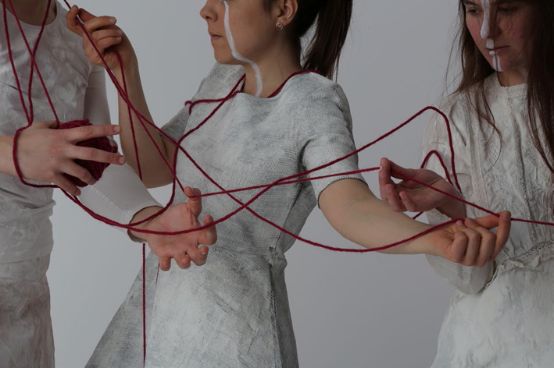
Open Call 2021 of the Trio Tramontana. Photo: Tramontana,SMPV

Mathilde Bernard (harp), Aurora Pajón Fernández (flute) and Alejandra Martín Hernández have formed the Trio Tramontana for several years. For this year's project, they are looking for diverse ideas and formats that have a musical core and take the trio's line-up into account. The condition is: 2021 residence in Switzerland. Joint creative work is one of the main objectives. Applications must be submitted by February 28 at the latest.

Conductors

Women conductors are increasingly present in the world of classical music. This article aims to awaken vocations by reflecting on this phenomenon with the conductor Graziella Contratto.

Antoine Gilliéron - After almost twelve intense years at the head of the music section of the HKB, Graziella Contratto has just left this position. She tells us about her vision of the feminization of the profession as well as support for the next generation of women.

Graziella Contratto, how do you look back on your years at KMHS?

When I took over as head of the Department of Music at the HKB almost 12 years ago, succeeding Romand Brotbeck, I did not know exactly what to expect - and this was probably the case for many colleagues of my generation: I encountered a rather small, but highly individualized university with several niche offerings, an art school in which transdisciplinarity had been established as a basis for artistic work and education from the very beginning. But I also sensed that many of my predecessor's brilliant visions were still waiting to be realized. Back then, I was mainly on the road as a conductor and festival director, had some teaching experience as a music theorist and had worked in Berlin and France for more than ten years - so from a personal point of view, it was both a homecoming and an arrival in open territory. The same applied to my involvement in KMHS.

What view do you have of today's female orchestra leaders and the challenges they still have to face?

The current generation of female conductors is currently experiencing a fantastic period of promotion - I even hear from conducting lecturers that young female orchestra conductors find an agency straight away, while young men of the same age have to worry about sharpening their profile for the first time. But as in previous years, I don't want to reduce this issue to the gender level - we can see that diversity has also arrived in the conducting world. Never before has the cultural background of conductors been so diverse; after a long period of South American 'Dudamelization' and a strong Baltic generation, conductors with African, Indian and Maori roots are now being taken much more seriously - this invigorates the interpretative field immensely, but is also a heavy burden. For me personally, in this context too, the dignity of the music should be at the center, not the cultural affiliation of the conductor; the conducting profession is and remains a challenge - psychological, aesthetic, technical and leadership skills form a complex mix, supported by an artistic maturity that cannot be shortened....., not even by aggressive management....

You were the first woman in the conference: how satisfied are you with the progress KMHS has made in this respect?

I always felt very accepted as a female member of the KMHS, but there were of course topics in which I often reacted with a Mediterranean emotionality - whether this was particularly feminine would have to be answered by my colleagues. The discussions were lively and stimulating, even if we didn't agree on something. You also have to remember that many of my colleagues had been working at KMHS for over ten or twenty years - I was really a beginner and had to get my bearings first. The demands on a university management have grown immensely since Bologna - the complexity of responsibilities, also as a kind of intermediate body with interactions between the federal government, the canton and the Swiss Universities, between the social and cultural realities of the students and the funding bases of the universities, between the links to universities of applied sciences and the artistic desire for an academy-like free-floating existence - I was often glad that each member of the KMHS was particularly well versed in specific issues, and the trust in each other has grown steadily. Noémie L. Robidas - and now also Béatrice Zawodnik - have precisely those qualities as committed and confident (certainly more thoughtful than me) artists and directors that make them ideal colleagues for the KMHS - and I hope that they both contribute to the committee as new, powerful voices, as I did twelve years ago.

What do you look back on with pride when you think about your work as Head of the Music Department at the BUA?

I am particularly proud of four developments and study programmes that I was able to realize together with my fantastic team: On the one hand, the establishment of Europe's first Master's Specialized Performance course with a specialization in Music in Context, which corresponds to a specific Bernese variant of music education, and on the other, the PreCollege Bern HKB for classical music, sound arts and music&movement with a 1001TP3 success rate. The third project close to my heart is the further development of the Opera Studio, which has entered into a cooperation agreement with the theaters in Biel and Bern and will soon be offering opera directing as a unique course for opera singers. At the Bern University of the Arts, I am delighted that more and more music students are subsequently embarking on doctoral studies in the cooperation between the University of Bern and HKB Research / SINTA. SINTA is a unique artistic-creative and scientific doctoral program in Switzerland run by the Faculty of Philosophy and History at the University of Bern and Bern University of the Arts (HKB).

What were the biggest achievements and the main challenges faced by the association during this period?

The KMHS has established itself as a body, has increasingly championed a common position and communication on general issues in the university context, has intelligently transformed politically challenging topics into synergetically supported visions, partly within task forces, working groups or also through the individual initiatives of members. On this KMHS page of smz, you can read every month that topics such as research, the third cycle, professional practice, talent promotion and role models, new Master's models and issues relating to interculturality, diversity, digitality and artist profiles of the future have been and are being shaped, communicated and further developed as diversity and diversification in the KMHS committee. The KMHS is currently also developing new strategies internally, not least through the creation of a General Secretariat and the further development of the activities and objectives of the KMHS initiated by the presidency of Noémie L. Robidas and Vice President Valentin Gloor. I was struck by how agile the KMHS was during the pandemic - despite all the pressure, it was really impressive to see how quickly, efficiently and cooperatively the former competitors worked to find solutions.

With your rich experience as head of the music department at the HKB, what is your vision for the development of higher music education in Switzerland in the coming years?

Higher education seems to be developing in merveille, where we find a mélange équilibré between quality and openness, practice and research, artistic and sociocultural awareness, analog and digital. Sense and sensibility - a magnificent title of a novel by Jane Austen, often badly translated elsewhere - exactely reflects for me this tension, positive and full of inspiration for the teaching of the future. Le sens en tant que perception multisensorielle de notre existence pour rendre audible notre art comme musique/son/installation/improvisation/mouvement/geste/vision sonore, etc.. The sensibility as reason, reflection and mirror of the reality that entails our students and in which the musicians of the future will express their art and convey their ideas to society in the future. As far as tradition is concerned, I believe that the demands of classical music in terms of high-level interpretation of the works of the musical canon must continue to be respected; they are part of our heritage, to be sure, but they still offer a magnificent basis for developing other things, a different musical world, later on.

What advice do you give to young musicians who wish to pursue higher music studies or are currently in training to do so?

At present, the Z generation among high schools - often of an incredible openness of mind, of awareness of many even extreme trends, strongly formed by a diverse multiperspective, nourished by a permanent desire for communication, I feel a little old in proposing this : in order to propose to your future public a narrative that will lead the way, it is essential to know and understand the lines of art, culture and music in which one aims to excel one day. A narrative develops - in my opinion - thanks to a research and a permanent critique of the sources - and a ludic, but pertinent, questioning of the message that you want to pass. A philosopher from Germany says that zapping and swiping prevent us from developing a narrative because we let ourselves be distracted by different options, by the elements that disappear after illuminating our attention for two seconds... But : le sens critique, l'introspection silencieuse pour approfondir l'enquête de votre Art, et après la joie inouïe de partager le narratif avec d'autres être humains - c'est ce que je souhaite à la nouvelle génération de musicien.ne...

In your opinion, what can the Swiss music schools do to promote even more gender equality in the training courses they offer and perhaps also in their interaction with initial and pre-professional training courses?

I personally experienced the gender mix at the HKB as a matter of course, although there are still more women studying rhythm, for example, and more men studying jazz. The current generation of millennials, who are currently filling music studies from within with completely new demands, experiences and - I call it this - post-dialectical expectations, are overlaying the old gender discourse with a kind of diversity hyperbole, with a new alertness that reacts at lightning speed to possible disadvantages, injustices or no longer justifiable attitudes in the political-artistic context. This specific energy is a challenge for universities (and the KMHS will deal strategically with this phenomenon in depth) and an opportunity. If I may be completely honest, for me the solution to gender issues is rarely found in the ideological untangling of sometimes diffuse accusations, but rather in the encouragement for students to tackle the topic artistically - in transdisciplinary settings, creative processes, in moments of failure as well as success, and always: in the encounter with the other, previously suspected, then close.

"Musicians conquering their image", published in Hémisphères, a Swiss review of research and its applications.

From Abel to Zolotareff

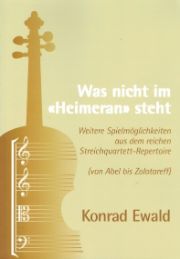
Playing possibilities for string quartet beyond the hundred standard works can be found in the new book by Konrad Ewald.

Photo: David Pisnoy/unsplash.com

Like the manual Music for viola. The rich repertoire from Aaltonen to ZytowitschThe fourth version of which was published in 2013, the work now dedicated to music for string quartet and also self-published is also a collection of very personal experiences and recommendations. The secondary school teacher Konrad Ewald was already playing in a local orchestra as a violinist and violist at the age of seventeen. Later, the extremely adventurous amateur belonged to several string quartets, playing around 1000 works by almost 400 composers over six decades.

The main part of the book, illustrated with title pages of scores, proves to be an idiosyncratic guide to the little-known quartet literature. In the introduction, the author comments on the annotated works: "The fact that they are unknown has nothing to do with them, but with us. We do not know them. They have all given us something (or wanted to give us something), we have not taken note of it." Ewald was inspired to write by the question: "Why do most string quartet formations only ever play the same 100 works by just 20 composers?"

The book title refers to the standard work first published in 1936 The quietly enjoyable string quartet by Ernst Heimeran, which has contained newly formulated reviews of works by Bruno Aulich since the 17th edition in 1969. Ewald frequently underpins his recommendations with quotations from chamber music guides by Wilhelm Altmann and from Friedhelm Krummacher's three-volume History of the string quartet. In the alphabetically arranged contributions, he not only deals with technical problems and the musical content of the compositions, but also with new editions of long out-of-print works and CD recordings.

With his in-depth specialist knowledge, Ewald puts many unsuspecting chamber music professors who know neither the spirit of discovery nor passion to shame. There are particularly exciting things to discover in the intelligent commentaries on the works of Elfrida Andrée, Carl Czerny, the Swiss early Romantic composer Friedrich Theodor Fröhlich, Friedrich Gernsheim, Louis Théodore Gouvy, Alexander Gretschaninow, Emilie Mayer, the Lachner brothers, Friedrich Lux, Louis Massonneau, Bernhard Molique, Nikolai Myaskovsky, Ignaz Joseph Pleyel, Carl Gottlieb Reissiger, Beethoven's pupil Ferdinand Ries, Anton Rubinstein, Anton Ferdinand Titz and Wenzel Heinrich Veit.

Ewald's book gives an idea of the inexhaustible wealth of quartets that Hermann Walther described in his Directory of the string quartet. String quartet compositions from 1700 to the present day (Schott, Mainz 2017, cf. Swiss Music Newspaper 3/2020, p. 21) with works by over 11,000 composers. If you want to study international string quartet music in depth, there is no getting around these two books.

Image

Konrad Ewald: What is not in the "Heimeran". Further playing possibilities from the rich string quartet repertoire (from Abel to Zolotareff), 224 p., Fr. 36.00, self-published by Konrad Ewald, Liestal 2020, distributed by Schlöhlein GmbH, Basel, ISMN 979-0-50274-999-6

Fierce idealist

Alexander Schaichet not only enriched the Swiss music scene in the first half of the 20th century by founding the Zurich Chamber Orchestra. The biography edited by Irene Forster and Esther Girsberger also impresses with the testimonies of former students.

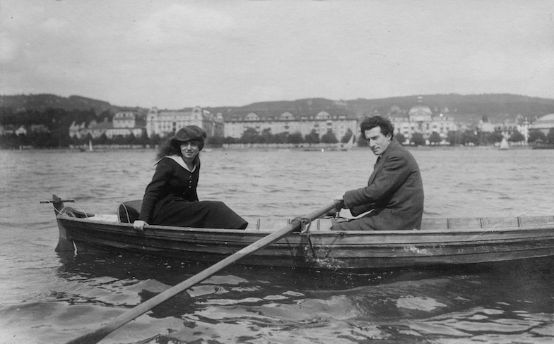
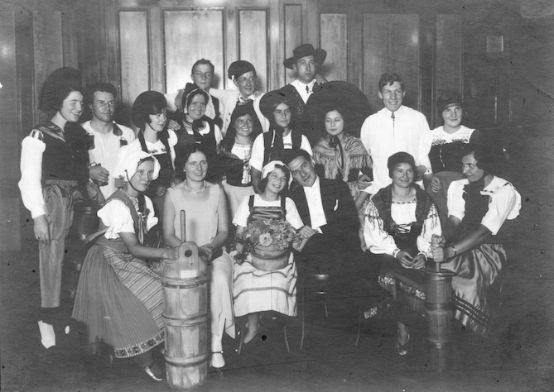
Irma Löwinger and Alexander Schaichet on Lake Zurich, 1918 Photo: Zentralbibliothek Zürich, Musikabteilung, Mus NL 38

A biography is always tricky: Here the person, who should of course be the focus. On the other hand, there are the social and cultural conditions that open up opportunities for action, but also restrict them. Alexander Schaichet (1887-1964) was a strong personality. But even the outstanding conductor, violinist and violist sometimes found his hands tied when harsh reality struck.

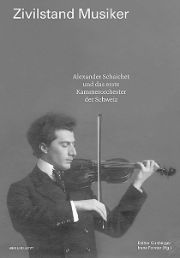
The entertaining anthology Civil status musician - Alexander Schaichet and the first chamber orchestra in Switzerland reads like the combative path of a tireless idealist. Schaichet was "stranded" in Zurich in 1914. The outbreak of the First World War prevented him from returning to Jena, where he already had a position as concertmaster at the age of 25. Schaichet became a stroke of luck for Zurich's music scene, particularly through the founding of the Zurich Chamber Orchestra in 1920.

Image
Cheerful celebration of the Zurich Chamber Orchestra after a performance on November 29, 1928 with the child prodigy Annie Fischer in the Zunfthaus zur Waag. Sitting in the front center, between Irma and Alexander Schaichet Annie Fischer. Photo: Zurich Central Library, Music Department, Mus NL 38

Under adverse conditions, the small orchestra played even the unwieldy works of the avant-garde of the time. The fact that Schaichet had to make do with amateurs due to constant funding problems was no reason for critics of the time to qualify their criticisms. Ernst Isler, a reviewer for the NZZ, apparently went so far as to question the chamber orchestra's right to exist in 1925. Schaichet was quite right to defend himself against such attacks. In his letter to Isler, he posed an eloquent question that also highlighted his own commitment: "Do you believe that an experience can be guided by technically perfect mastery?"

Despite the irrepressible energy of its founder, 1943 was the end of the chamber orchestra. The anti-Semitism directed against Schaichet and the competition with the much richer Collegium Musicum literally left little room for maneuver in Zurich.

The thoroughly edited and richly illustrated anthology captivates with its personal tone. Not only the printed memories of former students contribute to this; the texts by Verena Naegele, Michael Eidenbenz, Dieter Ulrich and Peter Hagmann are also very vivid, offer music history as cultural history and skillfully weave in the person of Schaichet. In addition to further information, all concert programs from the 23 years of the Zurich Chamber Orchestra's existence are available on the website https://schaichet.ch/de/ to view.

Image

Zivilstand Musiker - Alexander Schaichet und das erste Kammerorchester der Schweiz, ed. by Esther Girsberger and Irene Forster, 216 p., 60 ill., Fr. 39.00, Verlag Hier und Jetzt, Zurich 2020, ISBN print edition 978-3-03919-481-0

Icy, eerie moods

David Philip Hefti has created a "Snow Queen" with shimmering quarter tones and serial techniques that should appeal to adults and children.

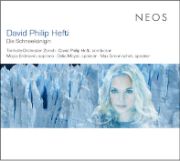
Excerpt from the CD cover

It was a prestigious anniversary commission awarded by the Tonhalle Orchestra Zurich in 2018 to mark its 150th birthday. And it was intended to benefit young audiences, i.e. children and teenagers. David Philip Hefti accepted, even though he had never composed for young people before. He wrote his second piece of music theater, The Snow Queen based on the fairy tale of the same name by Hans Christian Andersen. The live recording of the semi-staged premiere has now been released on CD.

Hefti says that as a young father, he came into contact with several musical productions for children. He has experienced good, but also very non-committal performances. "And I think that adults are often neglected in family concerts." So why not compose a fairy tale for adults that children can also understand? Add to that the fact that The Snow Queen has not only been released recently as an animated film by Disney, but in Germany and Denmark several composers have adapted the material for musical theater.

However, the fairy tale by Danish author Andersen has been accused of being too long and too complex for children and lacking "naivety and authenticity". It is the story of two children, Gerda and Kay, who fall into the clutches of the Snow Queen. Kay becomes cold and unfeeling, Gerda misses him and searches for him. The Snow Queen appears to her in various guises to stop her. The warm tears that Gerda cries when she sees Kay again also thaw his feelings.

The author Andreas Schäfer has created a libretto that is simple and easy to understand, but the "abstract" aspect of Andersen's original remains. Does a child understand when "poetry" conquers the Snow Queen? It is Hefti's music that makes the fairy tale come alive. He knows how to capture the atmosphere of the icy and eerie with shimmering quarter tones and serial techniques.

The musical theater has only one singing part, the others are speaking roles. Soprano Mojca Erdmann has to portray four different characters at once: in addition to the Snow Queen, she also appears as an old woman, a young man and a robber's bride. Erdmann sings this challenging role with impressive color changes, she masters the low register just as confidently as the virtuosic, soaring role of the Snow Queen. Yet for all the drama required, she remains true to her lyrical voice.

The two actors Delia Mayer and Max Simonischek also contribute greatly to the success of this production. They tell the story with great empathy, know how to alternate with relish between liveliness and desolation and give the two children sympathetic and authentic voices. Hefti's score is very precisely notated and demands great attention and musicality (it is available, as well as the piano reduction and the libretto, from Edition Kunzelmann). The Tonhalle Orchestra, conducted by the composer, is also able to convey the mysterious aura of this music in a multi-layered way in the recording.

Image

David Philip Hefti: The Snow Queen. Libretto: Andreas Schäfer after Hans Christian Andersen. Mojca Erdmann, soprano; Delia Mayer, narrator; Max Simonischek, narrator; Tonhalle Orchestra Zurich; conducted by David Philip Hefti. Neos Music NEOS 12028

Diversity as a funding criterion

From March 2021, the Department of Culture Basel-Stadt will be working with four Basel cultural institutions, including the New Orchestra Basel, to make culture diverse. For the first time, the opening of cultural institutions is being tackled comprehensively.

Photo: Kristina Kruzkova/unsplash.com (see below)

From 2021 to 2023, the Kunstmuseum, the Kaserne, the Literaturhaus and the Neue Orchester Basel will work with external experts to open up to Basel's diverse urban society. Around 75,000 people without a Swiss passport currently live in Basel. This means that a large proportion of the population has a family history of migration in their biography. However, this facet of diversity is hardly reflected when it comes to shaping culture. The focus of the project is therefore on the program, curation, communication, audience development and staff training.

"Kultur divers gestalten" is a partner project of the Swiss Arts Council Pro Helvetia as part of the "Intercultural Society" initiative. In October 2019, interested cantons and cities were able to propose pilot projects to be supported by Pro Helvetia for a defined period (one to three years) in the form of cooperative funding. The Culture Division's project idea was selected as one of four initiatives to be implemented throughout Switzerland.

Original article:
https://www.bs.ch/nm/2021-vielfalt-als-potential-im-kulturbetrieb-pd.html

Excursions alone or as a couple

The two clarinet booklets by Charles Reskin offer a wide variety of solo pieces and duets.

Excerpt from the cover

The two volumes Easy Clarinet Outings and Intermediate Clarinet Outings by the American composer and trumpeter Charles Reskin, published by the Swiss publisher Editions Bim, each contain 12 solo etudes and 12 duets. The pieces are stylistically extremely varied and are each dedicated to completely different themes. Sometimes it is about a particular composer, sometimes about a rhythmic or stylistic challenge or then about a specific technical difficulty. All the pieces in the booklet are introduced by a brief classification and tips on how to approach them.

There is an MP3 demo and accompaniment version for each of the solo etudes in the first part of the booklet, which can be downloaded from the publisher's website or streamed via SoundCloud. These accompaniments are also very varied and have a certain film music touch. It is regrettable that the solo part was not recorded live. Unfortunately, the audio sounds quite synthetic.

While the solo etudes have a lot to offer musically and can also be used as performance pieces, the duets in the second part are more didactic, but are no less varied. Overall, the duets are much easier to master than the solos.

This interesting teaching aid is rounded off with a glossary. This contains translations and explanations of the musical terms used, which are appropriate to the style (in the Debussy-inspired etude in French, for example). The etudes from the Easy-band are not aimed at complete beginners, but require a certain level of confidence on the instrument. Similarly, the Intermediate-In some cases, the pieces are already quite technically and/or rhythmically demanding, especially if they are to be played at full tempo with accompaniment.

All the pieces can be listened to on the Editions Bim website and when you buy the booklets from the publisher, you also get access to an online version of the sheet music and recordings via the Newzik app.

Image

Charles Reskin: Easy Clarinet Outings, 12 Etudes & 12 Duets, for 1 or 2 clarinets with MP3 accompaniment, CL37, Fr. 22.00, Editions Bim, Vuarmarens

Image

 Charles Reskin: Intermediate Clarinet Outings, CL38, Fr. 24.00

Poetic and playful

Heinz Holliger's "Airs" is characterized by recitative-like sound speech; dialogical episodes and a call motif define "Duett" by Rudolf Kelterborn.

Photo: Birger Strahl / unsplash.com

Seven poems by Philippe Jaccottet from his poetry cycle Airs is set to music by Heinz Holliger in his collection of the same name for two oboe instruments. In the preface, the composer explains that the texts are "made to sound" in a variety of ways, that they should be "as if sung by a singing voice". And further: "Oboe and cor anglais declaim the text", "a recitative-like sound speech" or "transformed into sound by oboe and cor anglais according to the content".

The edition was designed by Schott-Verlag with great care and in clear print. The poems are printed as subtitles or integrated into the musical text, so that the interpretation of the text is clearly conveyed in each piece.

The pieces take the performers to practically every conceivable extreme (dynamics, ambitus, timbre, espressivo) and challenge them to explore the limits of the instruments. The work is worth it, because what you get in return is a 25-minute treat of poetic expression, magical sounds and impressive moments.

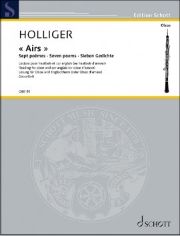
Image

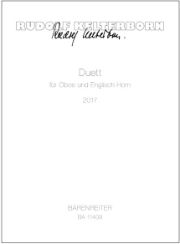
On the other hand, the new Duet for oboe and cor anglais by Rudolf Kelterborn. The laconic title describes an episodic and entertaining piece, which is initially characterized by a recurring "call motif" in the oboe. Alternating dialogic situations are played through, melodically imitating, contrasting, often marked violente, espressivo and furioso and also leading into unison. A noisy passage in the middle of the composition ends with the call motif that appears for the last time. After this, the listener is misled several times because they think they recognize the beginning of a fugue, and towards the end it becomes really virtuosic.

It is a pity that the 9-minute piece was edited rather unkindly by the Bärenreiter publishing house: Two stacks of single sheets as manuscript copies in medium quality, which is less than one might expect these days. In about three days, someone who is professionally involved in music typesetting could produce a perfect edition that could be edited as a page-turning booklet. The Schott publishing house has shown how it could be done (with far greater typesetting effort)!

Image

Heinz Holliger: Airs. Seven poems, reading for oboe and cor anglais, OBB 55, € 19.00, Schott, Mainz

Rudolf Kelterborn: Duet for oboe and English horn, BA 11409, € 37.50, Bärenreiter, Kassel 

Songs by female composers of the Romantic and late Romantic periods

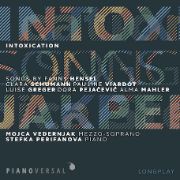
The mezzo-soprano Mojca Vedernjak and the pianist Stefka Perifanova present a broad spectrum of songs by women on the CD "Intoxication".

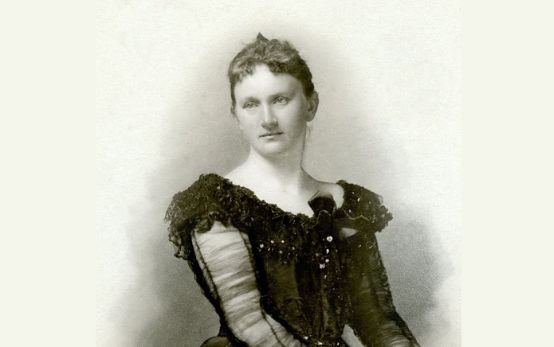
Luise Greger (1862-1944), German pianist, composer and singer. Photo: Photographer unknown / wikimedia commons

The songs that the duo Mojca Vedernjak (mezzo-soprano) and Stefka Perifanova (piano) have recorded for the Pianoversal label present a fascinating panorama of the creativity of female composers of the Romantic and late Romantic periods.

Fanny Hensel, Clara Schumann and Pauline Viardot, who are among the most famous female composers of the 19th century, left behind an extensive oeuvre of songs: Fanny Hensel left her subtle settings of Lord Byron's poems in the original English language; this makes them an exception in her oeuvre. One can only regret that Clara Schumann gave up composing after the death of her husband when one hears her impressive songs set to texts by Rückert, Heine and Burns. Pauline Viardot described Mörike's poetry as "the greatest and most genuine in all German poetry after Goethe". The three songs recorded here are good examples of her sensitive art of characterization and psychologization.

Luise Greger's powerful music is yet to be rediscovered after it was often performed until the 1930s. Unlike other female composers, Dora Pejačević is held in high esteem in her native Croatia. The Croatian Music Information Center has republished all of her works, including her numerous songs, in exemplary editions. The further dissemination of her songs, especially those recorded here Three songs op. 53 from 1919/20 based on poems by Friedrich Nietzsche, nothing should really stand in the way. Pejačević's refined harmonies subtly illuminate the texts. Most of Alma Mahler's compositions have been lost. The Five songs by the pupil of Josef Labor and Alexander Zemlinsky were published in 1910 on the initiative of Gustav Mahler. They are indebted to the Viennese fin-de-siècle style.

The songs of the six composers have been recorded many times before. The present recording is no alternative, although the performers have clearly studied the works intensively. Some of the agogic liberties taken by the artists are not indicated by the text. The singer can be forgiven for small lapses in intonation and occasionally not quite correct pronunciation, but her vibrato should have been more decidedly restrained. Unfortunately, the voice also sounds strained and sharp from the upper middle range onwards. Stefka Perifanova accompanies the songs with a distinguished and beautiful sound, but she cannot make up for the recording's shortcomings. It would have been desirable to print the song texts in the booklet, perhaps at the expense of the extensive comparative chronological table with facts from the composers' lives.

Image

Intoxication: Songs by Fanny Hensel, Clara Schumann, Pauline Viardot, Luise Greger, Dora Pejačević and Alma Mahler. Mojca Vedernjak, mezzo-soprano; Stefka Perifanova, piano. Pianoversal PV105

Handel's sacred opera

The new Carus edition of "Belshazzar" combines three versions in one publication.

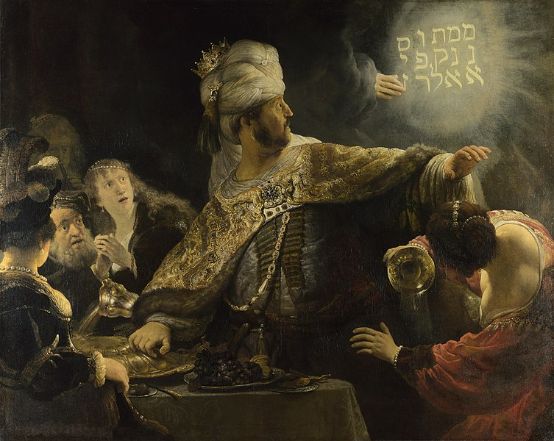
Rembrandt: The Banquet of Belshazzar (c. 1636). Source: National Galery / wikimedia commons

Who doesn't know the story from the Book of Daniel, in which King Belshazzar's "menetekel" announces the downfall of Babylon and thus the liberation of the Jewish people. On the one hand, this was ideal material for a sacred opera with detailed scene instructions and accompagnati, but on the other hand, biblical acts were forbidden on stage at the time. Handel therefore made a virtue of necessity and, four years after his Messiah with the Belshazzar one of his many oratorios, which ultimately emancipated England from the dominance of Italian opera that had prevailed until then.

The Carus publishing house cannot be praised highly enough for uniting all three performable versions of the oratorio in one edition for the first time with this exemplary Urtext edition: that of the first performance in 1745 as well as the revisions of 1751 and 1758, which consistently follow Handel's conducting score. A real recommendation, because it doesn't always have to be the Messiah be.

Image

George Frideric Handel: Belshazzar HWV 61, versions 1745, 1751 and 1758, edited by Felix Loy; score: CV 55.061, € 129.00; piano reduction: CV 55.061/03, € 32.95; Carus, Stuttgart

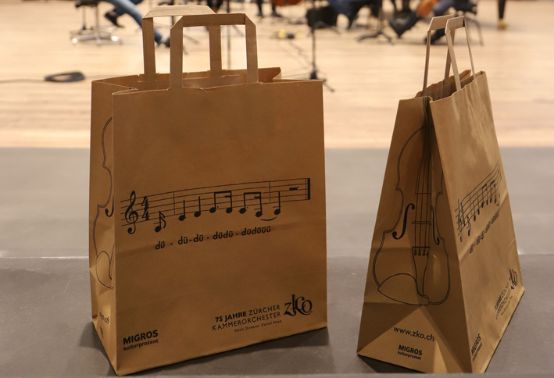
Migros Zurich congratulates ZKO

The Zurich Chamber Orchestra was recently featured on thousands of Migros Zurich shopping bags.

Photo: Natasa Angov,SMPV

The bags feature the Migros jingle, which the Zurich Chamber Orchestra played in an orchestral version and recorded digitally. In addition, the contours of the Stradivarius violin played by concertmaster Willi Zimmermann adorn the 50,000 shopping bags that were used in 110 Migros Zurich stores. With this and a special clip featuring the orchestral version of the jingle, Migros congratulated the Zurich Chamber Orchestra on its 75th anniversary.

Suisseculture calls for diverse SRG culture

Suisseculture, the umbrella organization of Swiss cultural professionals, is calling on the SRG to work towards a strong public service with high-quality cultural programming. The association also wants to be more involved in this process.

Photo: Christian Walker/unsplash.com (see below)

According to Suisseculture, the strategic changes at SRG "represent a fundamental paradigm shift alongside the recent reduction in cultural production, the effects of which on the cultural sectors are unforeseeable in several respects". On the one hand, because the process of developing these strategies is not transparent. On the other hand, because the representatives of the cultural associations, in particular Suisseculture as the representative of creative artists and their copyright societies, are not actively involved in the process.

Suisseculture is aware that "the technological change in the forms of media distribution and consumption ('digitalization') represents an important process of reorientation for SRG and its cultural departments". This process will have far-reaching consequences and means that many fundamental considerations and clarifications will have to be made regarding the long-term consequences.

Suisseculture sees great opportunities in digitalization, but insists that this does not lead to a reduction in quality and that cultural professionals are actively involved in this process.

Original article:
https://www.suisseculture.ch/index.php?id=23&tx_ttnews%5Byear%5D=2021&tx_ttnews%5Bmonth%5D=02&tx_ttnews%5Btt_news%5D=212&cHash=3c52cb7306852d608f0357e50b41c111

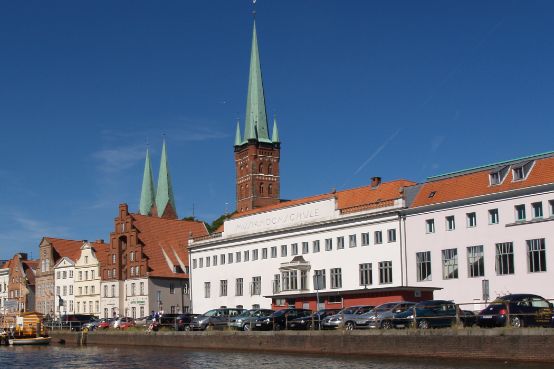
Lübeck professorship for musicians' health

The Lübeck University of Music (MHL) and the University of Lübeck (UzL) are offering a joint professorship for musicians' health for the first time. A public consultation hour is to be set up at the UzL.

Lübeck University of Music. Photo: Arnold Paul/WikiCommons,SMPV

The Lübeck model for musicians' health comprises several building blocks that aim to offer assistance and prophylaxis: A public consultation hour is to be established at the UzL with the aim of countering these complaints with learning strategies and training on the subject of body awareness. Not only professional musicians are affected by health problems, but also children and young people, for whom prevention and education should be the focus.

A theoretical and practical teaching program on musicians' health and music medicine is being developed at the MHL. The professorship also offers advice and further training not only for students and lecturers, but also for the public. Research on music medicine and music physiology will also be conducted at both universities.

The Lübeck model is characterized by the fact that it is not only aimed at university members, but also at music school teachers, freelance music teachers, orchestral musicians as well as singing and music-making amateurs by offering further training and advice. It is based on close cooperation between the MHL, the UzL and the UKSH with its clinics. Other Lübeck cultural institutions are cooperation partners such as the Lübeck music schools and the Philharmonic Orchestra of the Hanseatic City of Lübeck.

Original article:
https://www.uni-luebeck.de/universitaet/aktuelles/artikel/erste-gemeinsame-luebecker-professur-fuer-musikergesundheit.html
 

Best Swiss Video Clip 2021

m4music, the pop music festival of the Migros Culture Percentage, the Solothurn Film Festival and the Fondation Suisa are presenting the awards for the "Best Swiss Video Clip" for the ninth time. The jury prize goes to the Kenyan artist Muthoni Drummer Queen for the music video for the feminist anthem "Power".

The "Power" video was directed by Mei Fa Tan from Lausanne. Muthoni Drummer Queen grew up in Nairobi and has made a name for herself as a rapper, singer, producer and entrepreneur in collaboration with the music scene in western Switzerland. The musical style of her three albums contains both hip-hop and electro elements.

Bastien Bron and Laetitia Gauchat win the Audience Award with their film agency . The audience voted "Une autre Chanson" by My name is Fuzzy as the Best Swiss Video Clip 2021. The awards are endowed with CHF 5000 each and will be presented digitally. A total of 195 entries were submitted for the "Best Swiss Video Clip" 2021.

Original article:
https://www.m4music.ch/de/best-swiss-video-clip/winner-2021

Sonart criticizes cultural cutbacks at SRG

Sonart, the association for independent musicians in Switzerland, is observing "the restructuring announced by the SRG in the cultural sector with great concern". A recognizable strategy in the transformation process for culture is not apparent

Photo (detail): EinDao/WikiCommons

Important cultural formats would be cut without replacement, and there is no future-oriented development project in the music sector, writes the association. For the already beleaguered cultural scene, which had significantly supported the SRG in the NoBillag campaign, this cutback without prospects is a hard blow and is akin to "a betrayal of the many supporters of almost three years ago".

The cutbacks really come at the wrong time in the middle of the coronavirus crisis. Sonart is generally open to the development of contemporary formats, but is calling for the associated reorientation of cultural reporting and the involvement of the relevant industry associations. The association is also demanding that SRG continues to comply with the licensing conditions and fulfills its legal mandate to promote culture.

More info: www.sonart.swiss
 

get_footer();