Leopold Mozart twice

An analytical approach by Eric Broy; Silke Leopold provides biographical information with a historical context.


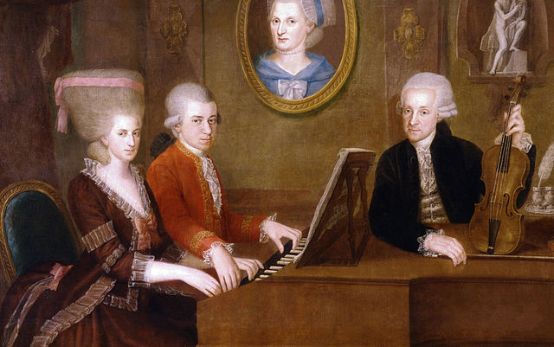
Leopold Mozart with his children Wolfgang Amadeus Mozart and Maria Anna, on the wall a portrait of his deceased wife Anna Maria. Painting by Johann Nepomuk della Croce, around 1780. source: wikimedia commons

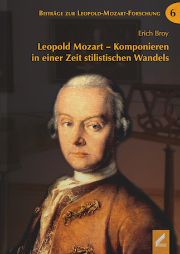
Two contrasting books were published in 2019 to mark the 300th anniversary of Leopold Mozart's birth. Erich Broy researched the compositional style that moved away from the basso continuo and towards the Italian opera symphony. He used Wolfgang Amadeus' works for boys and the first movements of Leopold Mozart's symphonies as material. Leopold drew on the theoretical writings of Joseph Riepel, who described composing as a componere (putting together precisely defined bar parts). The masterly way in which the father taught his son can be seen in the rapid progress in his works KV 1 to KV 7 and also in the many similarities between the compositions - which causes confusion in the attribution and speaks for the quality of Leopold's work!

The scientifically precise analyses based on many musical examples in the text and in an additional volume of sheet music require professional knowledge; readers can familiarize themselves with the text with the help of musikanalyse.net/tutorials make yourself smart. The table on pages 307-309, which lists all of Leopold Mozart's known symphonies with details of the source and its dating, authenticity, stylistic classification and presumed date of composition, is valuable. In this context I mention the book by Christian Broy, Eric's brother, on the transmission of the sources and Leopold Mozart's distribution strategy (On the transmission of Leopold Mozart's large-scale musical works, Beiträge zur Leopold-Mozart-Forschung, vol. 5, Wissner Musikbuch, Augsburg 2012).
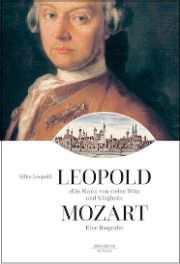
Silke Leopold enthusiastically allows us to participate in Leopold Mozart's self-sacrificing life. Even the two-column chronological table in the appendix makes the European significance of his work clear: in addition to Leopold's family data and activities, the second column shows the most important political and cultural events that he witnessed - an interesting history lesson!

The main section, illustrated in color, tells in seven chapters (each clearly divided with red quotation headlines) how the father, who was a bookbinder in Augsburg, gave Leopold a privileged Jesuit education, how Leopold cleverly established himself in Salzburg among the capricious or generous archbishops, married and marketed his works. Like a nobleman, he took his children on extensive educational trips, making useful contacts and doing business throughout Europe, while at the same time paving the way to success for his children. The many letters quoted show a great deal of intellect, authority, feeling and humor. For example: his judgments on the various denominations of Europe - including his own - become increasingly critical the further he moves away from Salzburg. The author demonstrates Leopold's genius for tone painting in vivid analyses of some of his compositions. The significance of his violin school is embedded in the context of other instrumental schools of the time. The hardening of his relationship with his "unreasonable" and profligate son is tragic, while the grandfather's concern for Leopoldli, Nannerl's son, is touching. The prominent author shines with scholarship and narrative power.
Eric Broy: Leopold Mozart - Composing in a time of stylistic change, Beiträge zur Leopold-Mozart-Forschung, Vol. 6.1 and 6.2 (sheet music volume), together 506 p., € 59.80, Wissner Musikbuch, Augsburg 2019, ISBN 978-3-95786-162-7

Silke Leopold: Leopold Mozart - "A man of much wit and wisdom", A biography, 280 p., € 29.99, Bärenreiter/J.B. Metzler, Kassel/Stuttgart 2019, ISBN 978-3-7618-2086-5


Catalog of works by Leopold Mozart:
Cliff Eisen: Leopold-Mozart-Werkverzeichnis (LMV), Beiträge zur Leopold-Mozart-Forschung, Vol. 4 (ed. Internationale Leopold Mozart Gesellschaft), 272 p., € 39.80, Wissner Musikbuch,
Augsburg 2010, ISBN 978-3-89639-757-7
With minimalist motifs

After her band Orioxy broke up, Julie Campiche founded a jazz quartet (named after her) in 2016. On her debut album, the harpist and her accompanists devote themselves to meditative but also fidgety sounds.

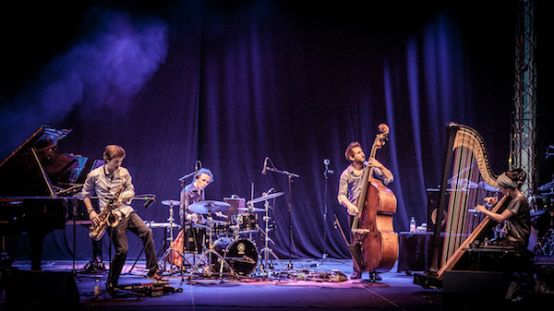
Julie Campiche at Nova Jazz, Yverdon. Photo: Gerald Langer

It all began with an ending: after eight years, the Geneva quartet Orioxy, whose jazz-based sound was able to combine even the most tender moments with wild energy, disbanded unexpectedly in 2016. "When everything fell apart, I got the blow of my life," recalls harpist Julie Campiche. Nevertheless, or perhaps precisely because of this, she started her new project just two weeks later. It actually happened too quickly for her, she admits, but: "You have to take advantage of the surprises that life has in store."

Three years have now passed and the Julie Campiche Quartet, which includes saxophonist Leo Fumagalli, double bassist Manu Hagmann and drummer Clemens Kuratle in addition to the band's leader, has released a new album at the end of January. Onkalo has released his debut album. The work comprises six songs and is curious and experimental: the first track, Flash Infobegins with an introspective harp melody, which is interrupted after a minute by sudden jazz sequences - at least temporarily.

What is on offer is surprisingly energetic and presents a flair for improvisation and minimalist motifs. Progressive jazz unfolds on the album, which is primarily interested in soundscapes that change constantly and surprisingly. The effect is meditative, but sometimes also fidgety and occasionally even stirring. Perhaps because you can sense that there are always stories behind the compositions. Onkalo - Finnish for cavity - is intended to tell of buried radioactive waste, for example. On the CD, Julie Campiche and her companions succeed not only in developing a maelstrom, but also music that takes you on a fascinating and courageous sound journey.

Image

Julie Campiche Quartet: Onkalo. Leo Fumagalli, sax & FX; Julie Campiche, harp & FX; Manu Hagmann, double bass & FX; Clemens Kuratle, drums & FX. Meta Records META 083

Orchestral power

The Merel Quartet, founded in Zurich, is once again devoting itself to Felix Mendelssohn Bartholdy and is teaming up with the English Castalian String Quartet for the Octet.

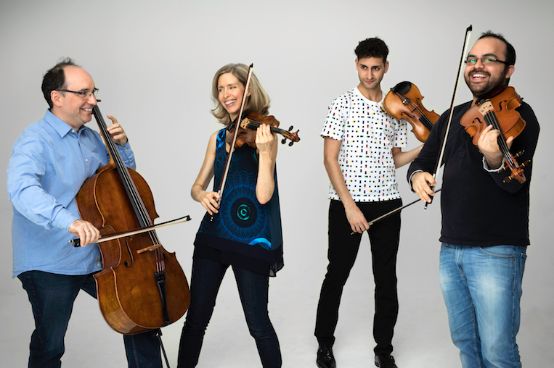
Merel quartet. Photo: Hannes Heinzer

The Merel Quartet has already successfully explored the music of Felix Mendelssohn Bartholdy (and his sister Fanny) for an album (Genuin 11204: Felix: String Quartet in F minor op. 80; Four Pieces for String Quartet op. 81; Fanny: String Quartet in E flat major). The Swiss ensemble has now been joined by the young English Castalian String Quartet to record the Octet op. 20.

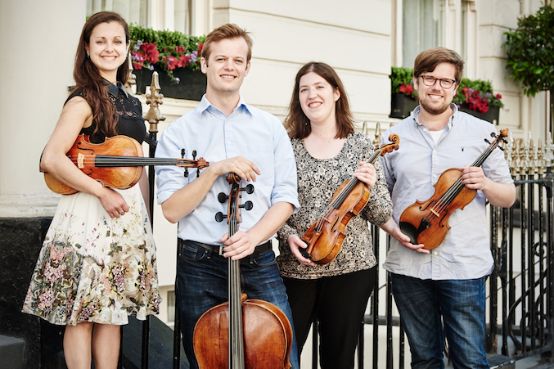
Castalian Quartet. Photo: zVg

In the first string quartet in E flat major op. 12, however, the Merel Quartet is still among itself. The four perform the fast middle section of the Canzonetta as an elf dance, the Andante espressivo has great breath. And in the finale, Mary Ellen Woodside (violin 1), Edouard Mätzener (violin 2), Alessandro D'Amico (viola) and Rafael Rosenfeld (violoncello) combine lightness with a dramatic effect that creates a real pull. Only in the opening movement does the quartet take too many liberties in terms of agogic, so that the pulse is lost a little in the numerous small delays when quaver figures are played out too much or caesuras introduce new sections.

Together with Sini Simonen (violin 1), Daniel Roberts (violin 2), Charlotte Bonneton (viola) and Christopher Graves (cello), the octet creates a tonally balanced, narrative interpretation that ranges from fragile intimacy to orchestral power. The composer wanted the octet to play "in the style of a symphonic orchestra". The fusion of the two ensembles into a single, flexible body of sound is impressively successful. The way the tension in the development section of the first movement reverberates and the recapitulation is heralded in the rush of semiquavers chasing through the voices - that's great! A highly emotional Andante and an airy Scherzo are followed by a somewhat rumbling cello introduction and an extremely fast Presto finale that celebrates virtuosity and leaves a strong impression despite minor rhythmic inaccuracies.

Image

Felix Mendelssohn Bartholdy: String Quartet No. 1 in E flat major op. 12 and Octet in E flat major op. 20, Merel Quartet & Castalian String Quartet, Solo Musica SM 293

Jazz and heavy metal

George A. Speckert has set jazz pieces from his homeland for two cellos, David Floer has captured the sound of heavy metal.

Photo: Alberto Bigoni / unsplash.com

The boundaries between serious and popular music in music lessons and concerts are becoming increasingly permeable, and the mutual influence of the different musical styles is an enrichment. The compositions for two violoncellos discussed below take this development into account.

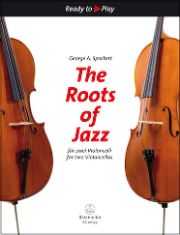
The American composer George A. Speckert was born in 1951 in Missouri (USA), a center of American jazz culture. The booklet The Roots of Jazz includes arrangements of well-known catchy tunes by Scott Joplin (The Entertainer), Arthur Harrington Gibbs (Runnin' Wild) and Nick La Rocca (Tiger Rag) as well as witty original compositions by Speckert himself. Both cello parts have the same level of difficulty and do not go beyond the fourth position. The collection will give pleasure to pupils and teachers and will not fail to have an effect on the audience.

Image

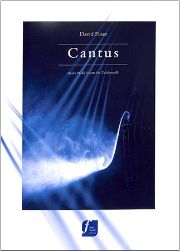
The heavy metal sonata Cantus by David Floer is technically demanding and combines heavy metal rhythms and harmonies in the form of a classical three-movement sonata. The piece is aimed at advanced cellists and combines extended cantilenas with guitar-like rock fingerings. If you want to enhance the heavy metal sound even further, you can use effects devices such as wah-wah or sound distortion to achieve the desired effect.
You can get an impression of the piece on Youtube provide.

Image

George A. Speckert: The Roots of Jazz for two violoncellos, Ready to Play, BA 10649, € 14.95, Bärenreiter, Kassel 2019

David Floer: Cantus, Heavy Metal Sonata for two violoncellos, Floer Music Verlag, Cologne 2017, ISMN 979-0-700351-13-7

A dance from every canton

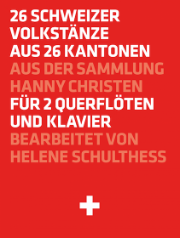
The flautist Helene Schulthess has arranged dances from the Hanny Christen collection for two flutes and piano.

Photo: Isinor/pixelio.de

The collection by ethnomusicologist Hanny Christen, who traveled through Switzerland between 1940 and 1960 to record or write down melodies, contains a colourful compilation of various folk dances from different regions. In the foreword to her selected edition for two flutes and piano, editor Helene Schulthess points out that the diversity in the Christen collection is a reflection of the "cultural and regional small-scale nature of Switzerland", but is nevertheless also characterized by the influences of other European countries. The collection contains a conspicuous number of pieces labeled "Scottish", which are, however, arranged differently depending on the region.

Schulthess has included 26 dances, one from each canton, in her booklet (three are not from the Christen collection). The unchanged melodies can be performed with two flutes and mostly chordal piano accompaniment, but also sound very good as pure flute duets with the second part added by the editor, which is often contrapuntal. The first dance Scottish from the canton of Zurich has a very concertante effect due to its animated second voice. The melody part of the Mazurka from the canton of Uri is accompanied in the first part by the second flute part, yodeling as it were. Melodiously the Ländler from the canton of Nidwalden and is contrasted by cheeky interjections with suggestions in the second voice. The virtuoso dance of the Trumpet polka from the canton of Zug and is challenging to play for both voices due to its sixteenth-note figures combined with triplets. Even the well-known Basel Fasnacht Arab march found its way into the varied collection. Some pieces, such as the lively Jupiter gallop from St. Gallen or the Venus gallop from the canton of Vaud seem almost like salon music, as does the lively Rose waltz from the canton of Aargau. This successful, interesting collection gives an insight into the variety of melodies in Swiss folk music and can be easily played by advanced pupils.

Image

26 Swiss folk dances from 26 cantons, from the Hanny Christen collection, arranged for 2 flutes and piano by Helene Schulthess, Fr. 26.00 plus postage, www.helene-schulthess.ch/de/kompositionen-bearbeitungen

Sutermeister succeeds Cordonier in Valais

The State Council has appointed Anne-Catherine Sutermeister as Head of the Department of Culture (DK). She will take up this post on September 1, 2020 as the successor to Jacques Cordonier, who is retiring.

Anne-Catherine Sutermeister (Image: zvg)

Anne-Catherine Sutermeister holds a master's degree in literature from the University of Montpellier, a doctorate in theater studies from the University of Bern and a Master of Business Administration from the University of Geneva with a focus on human resources management. She is currently a lecturer in cultural management at the Universities of Geneva, Lausanne and Basel and in cultural mediation at the School of Social Work and Education in Lausanne.

Anne-Catherine Sutermeister previously headed a research and teaching laboratory at the School of Art and Design (HEAD) in Geneva. She is familiar with the public administration sector thanks to her four years of experience as head of the French-speaking section and assistant to the head of the Department of Culture of the Canton of Bern.

As former director of the Jorat Theater and former Vice President of the Pro Helvetia Foundation Board, she is a well-known personality on the national cultural scene. As an independent consultant, she has carried out several evaluation mandates in the cultural sector.

"Funeral Cantata"

Beethoven every Friday: to mark his 250th birthday, we take a look at one of his works every week. Today we look at the cantata on the death of Emperor Joseph II.

Yes, they do exist, the works that have fallen through the cracks of history. The reasons for this are manifold: in the 20th century, it was often political circumstances that caused them to fall through the cracks, before that a wide variety of factors played a role: a lack of initial success, an unusual instrumentation, an unsuccessful text ... When such scores are unexpectedly found or are performed again after decades, there is often talk of an "unjustly forgotten" composition. Whether it then enters the repertoire or at least comes to the attention of the general public remains to be seen. One heretical question always arises: Aren't there also "unjustly forgotten" compositions - such as all-too-early youthful works or even occasional music?

In any case, the mechanisms of the repertoire do not work according to fixed rules. This is also the case with Beethoven and his rich oeuvre, not all of which is equally well known - on the contrary: there is still much to be discovered. So too the Cantata on the death of Emperor Joseph II. WoO 87 (1790), a work commissioned by the Bonner Lese- und Erholungsgesellschaft (which, incidentally, still exists today and has also admitted women as members since 2019). The old minutes of the Executive Committee contain the suggestion that "perform something musical either before or after the speech" was to be performed. However, the cantata was never performed. As it was later said: "from several causes". Perhaps Beethoven had planned the work too extensively (with a playing time of just under three quarters of an hour), perhaps it was completed too late (there were only three weeks between the commission and the memorial service on March 19), and Elector Maximilian, the brother of the deceased and Prorector of the Society, had asked for an hour of silence in the sense of a funeral service.

Beethoven's autograph was lost unplayed. A copy did not reappear until 1884, and the cantata was performed for the first time at a concert of the Gesellschaft der Musikfreunde in Vienna at the suggestion of Eduard Hanslick. Since then it has led a shadowy existence. - Rightly so? Certainly not, because a great deal of the later Beethoven can already be heard here. It is no coincidence that the master later used musical material in other of his works (including the Fidelio) is reused.


Listen in!

280 million in emergency aid for culture

The Federal Council has announced measures to cushion the economic impact. In the cultural sector, too, it is important to prevent bankruptcies and mitigate the drastic financial consequences.

Anastasiia Chepinska/unsplash.com

In this way, the Federal Council aims to "prevent permanent damage to the Swiss cultural landscape and preserve Switzerland's cultural diversity", as it stated in the Media release writes. And further:

"The economic impact of the ban on events on the cultural sector (performing arts, design, film, visual arts, literature, music and museums) is to be cushioned by means of emergency aid and compensation. As a first step, it is making CHF 280 million available as an initial tranche for two months. During these two months, the Confederation will monitor further developments together with the cantons and cultural organizations. The following measures are planned:

Firstly, the federal government provides funds to provide emergency aid to cultural enterprises and creative artists: non-profit cultural enterprises, for example foundations, can receive repayable interest-free loans to ensure their liquidity. Cultural professionals can claim non-repayable emergency aid to cover their immediate living costs, provided this is not covered by the new compensation for loss of earnings based on the Loss of Earnings Compensation Act. This is handled by the cantons (cultural enterprises) or by Suisseculture Sociale (creative artists).

Secondly, cultural enterprises and cultural professionals can apply to the cantons for compensation for the financial loss associated with the cancellation or postponement of events or the closure of businesses. The compensation covers a maximum of 80 percent of the financial loss. The Confederation shall bear half of the costs awarded by the cantons.

Thirdly, amateur associations in the fields of music and theater can be supported with a financial contribution for the financial loss associated with the cancellation or postponement of events."
 

The Federal Council has also Gatherings of more than five people prohibited. He refrains from imposing a ban on going out and instead relies on the solidarity and personal responsibility of each individual. It is important that the population understands the measures. After all, they must be adhered to by April 19. This requires a great deal of perseverance from everyone.


Picture credits

Photo by Anastasiia Chepinska on Unsplash
https://unsplash.com/photos/WLfG-Q_tv2A
 

Aargau with a new head of culture

The Aargau cantonal government has appointed the former cantonal archaeologist Georg Matter as the new head of the Culture Division in the Department of Education, Culture and Sport (BKS). He succeeds Thomas Pauli-Gabi, who has been appointed Director of the Bern Historical Museum.

Georg Matter (Image: zVg)

Georg Matter has been Deputy Head of the Culture Department since February 2018. Before joining the canton, he was a founding member and member of the management board of ProSpect GmbH in Reinach for ten years.

Georg Matter studied prehistory and early history, medieval archaeology and classical archaeology at the Universities of Basel and Freiburg im Breisgau (Germany). In 2008, he completed his doctorate at the Institut d'Archéologie et des Sciences de l'Antiquité (IASA) at the University of Lausanne. In 2012, he completed a CAS certificate course at the University of Applied Sciences Northwestern Switzerland on the fundamentals of business administration.
 

What the 2021-2024 cultural message can achieve

The latest event of the Parliamentary Group on Music focused on the new cultural message - despite the current major challenge facing the music sector due to Covid-19.

The Federal Palace in Bern, where Parliament meets. Photo: Claudio Schwarz | @purzlbaum on Unsplash

The program of the March meeting of the Parliamentary Group on Music included Explanations on the new Cultural Dispatch 2021-2024. Business as usual, one might have thought. Nevertheless, never before have so many association representatives and members of the National Council and Council of States gathered in the Schmiedstube hall in Bern as this time. It was obvious: there was an elephant in the room - the forced shutdown of the cultural sector due to the coronavirus, which is putting event organizers, freelance musicians, technicians, concert logisticians and ticket providers in financial difficulties. After the presentations by the Federal Office of Culture (FOC) and Pro Helvetia on the cultural strategy for the next four years, there were also emotional votes, with urgent appeals to the councillors to find solutions to limit the devastating economic damage that is looming for the music industry.

Pro Helvetia Director Philippe Bischof felt compelled to remind those present not to confuse the issues. And indeed, there is basically good news to report on national cultural policy. The Federal Council wants to increase spending again. David Vitali, Head of the Culture and Society Section at the BAK, explained where the priorities lie with regard to music.

Musical education

Firstly, there is the Youth+Music (Y+M) program launched with the last dispatch. Following an encouraging evaluation, the training of Y+M instructors is to be "adjusted in terms of content" and certification integrated into the courses of study for music teachers at music universities. A database will make information on the program and course instructors transparently accessible. Performance and impact measurements are also to be expanded. From 2022, the Confederation also plans to offer its own program for the promotion of talented students, which will allow around 1,000 talented students to be identified each year. The core of the program will be a "music talent card", which will "provide access to suitable (cantonal) support services". However, according to Vitali, the idea of a talent card did not meet with universal approval during the consultation process. For this reason, the federal government, cantons and other stakeholders will now work together to develop a framework concept.

According to Vitali, the federal government is also focusing on music school fees. The goal remains "equitable access to music education for all children and young people". An evaluation carried out here has also shown that the differences in fees for adults and young people vary significantly within the education regions. Around an eighth of music schools have no subsidized tariffs up to upper secondary level, around two thirds have no income-based tariff structure and over half have no extended subsidized offers for gifted students. This situation has hardly changed since 2016, Vitali admitted. The Federal Council's proposals on how to tackle this remain rather vague: it wants to further sensitize music school providers to the issue and re-evaluate them.

Measures for musicians

Director Philippe Bischof and Head of the Music Department Andri Hardmeier provided information on the near future of the national arts council Pro Helvetia. According to Bischof, the Arts Council wants to work more specifically to ensure that financial support is increasingly linked to fair pay for creative artists. Pro Helvetia would also like to promote equal opportunities between men and women. In addition, efforts are to be made to establish solid statistics on the cultural sector.

Andri Hardmeier explained that the cultural foundation wanted to take account of the fact that art and cultural forms are changing and merging ever more rapidly. Formats that do not correspond to the concept of works previously applied in the music sector are to be better taken into account in future as part of the promotion of works. Hardmeier mentioned, for example, site-specific or collective works, sound installations and sound art or multimedia works. The promotion of music theater is also to be "consolidated and further developed". Pro Helvetia is also concerned with the cross-cantonal and international dissemination of new works.

This is not enough for the Swiss Music Council. As it writes in a statement, it would like to see "the development of longer-term development strategies for the three genres of folk music, contemporary music (pop, rock, jazz, new classical music) and classical music". The German Initiative Musik gGmbH or the European Agenda of Music (EAM) of the European Music Council could serve as a model here. Furthermore, although the Music Council acknowledges that the visibility of Swiss music abroad has been "substantially improved" in some cases, its members perceive music exports as too fragmented and therefore not powerful enough. In order to improve its effectiveness, the music sector believes that exports need to be more coordinated and better funded.

"Extraordinary situation" due to coronavirus

Stores, restaurants, bars, entertainment and leisure businesses will be closed until April 19 for the time being. The cultural sector is to be supported.

Vulnerable groups should stay at home. Photo: Paweł Czerwiński/unsplash.com

The Federal Council announced today that it now considers the situation in Switzerland to be "extraordinary" in accordance with the Epidemics Act. Among other things, this means that "public and private events (are) prohibited from midnight today. All stores, markets, restaurants, bars and entertainment and leisure facilities such as museums, libraries, cinemas, concert halls and theaters, sports centers, swimming pools and ski resorts will be closed." (...) "The supply of food, medicines and everyday goods to the entire population is guaranteed." Schools will also remain closed until April 19.

The current media release can be viewed here:

https://www.admin.ch/gov/de/start/dokumentation/medienmitteilungen.msg-id-78454.html
 

Cultural sector

The Federal Council already promised support for the sports and cultural sector on Friday, March 13: "The Federal Council also intends to make additional funds available for the cultural sector. In an urgent procedure, the FDHA is drafting a temporary bill for additional economic measures that can be used in addition to other instruments to cushion cases of hardship in the cultural sector. In this way, the Federal Council aims to prevent the existence of recurring cultural events from being threatened and, in particular, to support self-employed and freelance cultural professionals in emergency situations. As part of the drafting of the law, it is also to be examined how the cantons, as those responsible for the cultural sector, can be included in the funding."

The exact nature of this support is being worked out. The Federal Council is endeavoring to find concrete solutions quickly.


Quintet in E flat major

Beethoven every Friday: to mark his 250th birthday, we take a look at one of his works every week. Today it's the quintet for piano, oboe, clarinet, horn and bassoon.

According to Count Waldstein's ideas and wishes, Beethoven was to live in Vienna "Mozart's spirit from Hayden's hands" received. Due to the circumstances (Mozart had died unexpectedly ten months earlier), the classical triad had already been named in 1792, even before Beethoven had been able to develop his own style. This privately imposed obligation on his departure from Bonn was, however, more likely to lead to Beethoven soon exploring his legacy creatively and independently, not always allowing himself to be swayed by the well-meaning Haydn. (Brahms had it with Schumann's prominently printed essay New lanes far more difficult to roll the publicly imposed burden off one's own shoulders).

What Waldstein could not have known in the days of his farewell, of course, and what still amazes him today, is that Beethoven based his Quintet for Piano, Oboe, Clarinet, Horn and Bassoon in E flat major op. 16, which he sketched in Berlin in the spring of 1796, very specifically on a work by Mozart - the Piano Quintet K. 452. "for the best thing I have ever written in my life". It is not only the instrumentation, which was unusual for the time, and the key of E flat major, which was convenient for wind instruments, that are identical, but also the movement sequence and character. Beethoven demonstrates even more in the Andante cantabile pays musical tribute to his role model: the theme plays, recognizable to everyone, on Zerlina's "Batti, batti, o bel Masetto" from the Don Giovanni on. However, an incident handed down by Ferdinand Ries on the occasion of a Viennese performance of the piano quintet shows that Beethoven not only began to fantasize during the cadenzas of his piano concertos, but also knew how to expose himself in other places: "In the last Allegro there is a stop a few times before the theme begins again; during one of these Beethoven suddenly began to fantasize, took the Rondo as his theme and entertained himself and the others for quite some time, which was not the case with the accompanists, however. They were indignant and Mr. Ramm was even very upset. It really looked strange when these gentlemen, who expected to start again at any moment, kept putting their instruments to their mouths and then calmly taking them off again. At last Beethoven was satisfied and fell back into the rondo. The whole company was delighted."


Listen in!

The Swiss cultural sector stands together

The culture and events sector met with the Federal Office of Culture and Pro Helvetia in Bern. It expects swift and effective measures due to Covid-19.

PM/SMZ

In a press release, the Swiss Music Council, Sonart - Music Creators Switzerland and many other associations announced that the cultural and performing arts sector was "delighted with the constructive exchange with the federal authorities" on March 12.

The common goal is to preserve the diverse Swiss cultural landscape as well as its locations, organizers and jobs. To achieve this, all stakeholders must and want to pull together. Quick-acting measures are needed to prevent or at least mitigate the damage caused by the coronavirus crisis, which could have a lasting impact on the industry in particular, but also on the economic development of the country as a whole.

The demands are as follows:

"1. temporary unemployment insurance in the cultural sector for self-employed persons and all those for whom short-time work would not apply now (e.g. sole proprietors, freelancers, management, owners and partners)
2. uncomplicated access to short-time work for all SMEs in the cultural sector
3. compensation for canceled events, including artist compensation
4. emergency fund for cultural professionals and businesses facing existential threats
5. public funding for culture must continue to flow, cultural sponsors (including private ones) should coordinate their efforts
6. continued direct involvement of organizations of creative artists and event organizers in the design and implementation of concrete measures"

The night worker

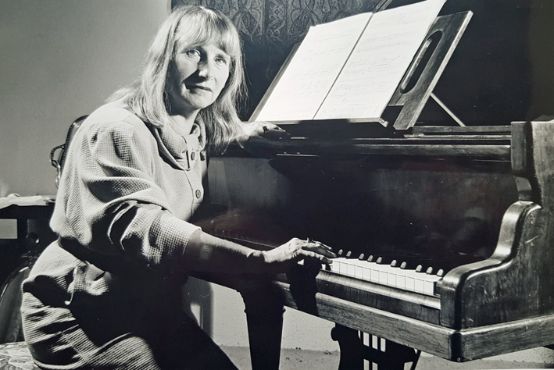
Margrit Zimmermann, composer, conductor, pianist, teacher, born 1927, died 2020.

The Swiss musician at her Erard grand piano. Photo: zVg

Margrit Zimmermann's list of compositions is extensive and covers all musical genres apart from opera. She devoted a great deal of attention to chamber music and chose unusual combinations of instruments and soundscapes. A pianist by training, the piano was close to her throughout her life. Everything was written on it, mainly at night, whether the large orchestral scores, the string quartets or the actual piano compositions. The Erard grand piano in her house in Bern's Schönberg district was her working instrument and place of work, on which she piled up sketches and finished, written compositions. One central work was literally written for the piano: In the Etudes bianchi-neri the black upper keys are set against the white lower keys, as if the keyboard had two manuals.

Margrit Zimmermann described her music as free-atonal and traditional. The latter refers to the notation and the formal structure. Her tonal language moves in the non-tonal, dissonant border area. It is characterized by the horizontal and vertical layering of fourths and sevenths, and consequently also by their inversions, fifths and seconds. The composer used tonal extensions in a playful, improvisational way to create pointed effects and wrote her own signs in the scores with explanations in front of them. A heavy chain rattles along with the piano, forearms have to be rolled over the keys, winds and strings play in quarter tones. She devoted a theoretical work and graphic illustrations to the organization, tuning and use of quarter-tone music.

Margrit Zimmermann's works have found their interpreters, small and large stages, and have won several awards.

Born in Bern in 1927, Margrit Zimmermann trained as a pianist in Bern with the pianist and composer Jeanne Bovet and later in Paris with Alfred Cortot, where she was fortunate enough to attend a composition course with Arthur Honegger for a year. She later trained as a conductor and founded her own orchestra in Berne in 1973. In 1978, she completed eight years of composition studies at the Conservatorio Giuseppe Verdi in Milan with a Diploma di Composizione.

Margrit Zimmermann's catalog raisonné can be viewed at musinfo.chcompositions are available in the library of the Bern University of the Arts. A CD brings together the works Quadriga and Piano Time for piano, Pensieri for tenor, guitar and flute, a string quartet and the Orphic Dances for flute, clarinet, viola, violoncello and piano (available from gerber.iris@gmx.ch). In the book Nachtwerk - Homage to a female composer, published in 2011 by Publisher Zytglogge Oberhofen/BaselIris Gerber Ritter, Margrit Zimmermann's former pupil and interpreter, talks about her life and work.

On February 23 of this year, Margrit Zimmermann passed away after a long illness at the age of ninety-three. Her final resting place will be the Schosshalden cemetery in Bern.
 

Zürcher Tonhalle Gesellschaft becomes AG

The former Tonhalle-Gesellschaft Zürich association has decided to transfer its assets and liabilities as well as all contractual and employment relationships to a newly founded public limited company.

Chief conductor Paavo Järvi visiting the Tonhalle construction site. Photo: Alberto Venzago

Following the transfer of assets, Tonhalle-Gesellschaft Zürich AG intends to carry out an ordinary increase in the share capital of CHF 100,000 to a maximum of CHF 2,650,000 at an Extraordinary General Meeting. The date of the Extraordinary General Meeting can only be set once it is foreseeable that the Municipal Council of the City of Zurich will approve the transfer of the subsidy agreement.

A subsidy agreement exists between the City of Zurich and the Tonhalle-Gesellschaft Zürich association, in which the City of Zurich undertakes to make contributions to the association on a calendar-year basis. As part of the restructuring, the subsidy agreement must be transferred and adapted to Tonhalle-Gesellschaft Zürich AG with the approval of Zurich City Council.

The total nominal amount by which the nominal share capital is to be increased through the issue of a maximum of 25,500 fully paid-up registered shares with a nominal value of CHF 100 is a maximum of CHF 2,550,000. 23,000 registered shares will be offered to the public at an issue price of CHF 400 and 2,500 registered shares will be offered to the City of Zurich at an issue price of CHF 100.

More info: https://tonhalle.ch/ueber-uns/die-liebhaberaktie/

get_footer();