Career

Moving up, moving on, moving out ... We ask people at the beginning, in the middle and towards the end of their musical lives what a career means to them. How do you become the director of a jazz festival? And what do you learn at the Graduate School of the Arts?

derbildermann - Fotolia.com
Karriere

Moving up, moving on, moving out ... We ask people at the beginning, in the middle and towards the end of their musical lives what a career means to them. How do you become the director of a jazz festival? And what do you learn at the Graduate School of the Arts?

Focus

Get in, get on, change
Musicians look back on their careers.
Detailed interviews

At the head of a large orchestra
Portrait of the conductor Marin Alsop  
Online report: Orquestra Sinfônica do Estado de Sao Paulo

Une carrière de directeurs de festival
Serge et Francine Wintsch
German summary

"Singing careers have their own laws"
An interview with artist agent Rita Schütz

A hybrid between science and art
Doctoral studies at the Graduate School of the Arts in Bern

... and also

CAMPUS

La formation Willems rejoins the HEM

Un stage aux archives musicales
Le fonds Clara Haskil à la BCUL

Reviews Teaching literature

FINAL

Riddle Pia Schwab is looking for ...

Kategorien

Better not to be moved to tears

Emotions such as crying, anger or rage, but also dust, wind, cold air, irritant gases and so on can cause the eyes to water. This can lead to problems, especially when making music.

Georg von Arx - Watery or even watery eyes often only occur in special situations. During demanding visual activities such as reading, working on a PC or making music, even slightly watery eyes can lead to a considerable reduction in performance. Common causes of watery eyes are conjunctivitis, dry eyes, eyelid malpositions, drainage obstructions in the draining tear ducts and much more. These causes will not be discussed in detail here.

Functional disorders that do not appear to have an obvious cause are more important for musicians, as they are difficult to control. In the interplay of local and central control factors during visually demanding activity, a central reduction in the blink rate, i.e. controlled by the brain and nervous system, causes increased evaporation of the tear film and thus a relatively dry eye.

The more we concentrate on our visual task, the less frequently we blink. The tear film becomes unstable, breaks up and causes a "dryness irritation" of the cornea, which in turn triggers increased, sometimes excessive tear secretion via a reflex arc. This can be exacerbated in particular by insufficient lighting (for example in the orchestra pit), as we then reflexively "tear open" our eyes even more and blink even less frequently. Optimum lighting of the music stand (without glare!) is therefore also important in this respect.

Blinking is a rapid, usually involuntary and unnoticed closing and opening of the eyelids (eyelid closure reflex), which primarily serves to maintain the tear film and thus the optimal optical quality of the visual system. We normally blink about 12 to 15 times per minute, i.e. every 4 to 6 seconds, over an average period of 300 to 400 milliseconds. The dark phase caused by eyelid closure is not consciously perceived, as visual perception is suppressed in the relevant areas of the brain shortly before blinking.

Monotonous visual work, especially, as already mentioned, with inadequate lighting of the work area and work with high visual demands lead to staring at the work area with a decrease in blink frequency of more than 50 percent. Frequent but brief interruptions to work for a few minutes can improve the moistening of the cornea sufficiently so that there is no increased reflex tear secretion and therefore no watery eye.

Networked "tear center"

Crying can be an expression of strong emotions such as pain, sadness, helplessness, fear, feelings of deep hurt and injustice. These emotionally induced tears do not play a role in professional musicians in that they have learned to control their emotions in the course of their work. The "tear center" is connected to various regions of the brain, such as the limbic system ("emotional center"), but also to the frontal brain. The functions of the frontal brain concern the reception and processing (control) of sensory information for perception, thinking, language, motor operations, activity, movement and action control, voluntary movements and actions, consciousness, higher intellectual processes and emotional-affective aspects of behavior.

Nevertheless, a particularly "touching" piece of music can touch the corresponding emotional "button" and make us cry, which can then cloud our clear view of the sheet of music. It is not uncommon for poorly corrected defective vision to cause watery or even watery eyes. This is because the eye then has to work much harder to see well. Visual aids that are individually and optimally adapted to professional needs can provide a remedy.

Dr. med. Georg von Arx

Ophthalmologist FMH

Admedico Eye Center

Fährweg, 4600 Olten

> info@admedico.ch

A look inside Fauré's workshop

Review: A new edition of the Violin Sonata op. 13 makes it possible to make one's own decisions with regard to binding and dynamics.

Gabriel Fauré, oil painting by Ernest Joseph Laurent. Source: wikimedia commons

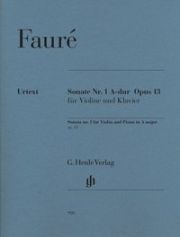
Camille Saint-Saëns, half a generation older, was right to praise Fauré's first violin sonata, published in 1877, effusively: "... and over everything hovers a magic ... which makes the mass of ordinary listeners accept the wildest audacities as quite normal ...". It is at the forefront of the repertoire of concert performers. Fauré had been appointed secretary of the Société nationale de musique in 1774, which had dedicated itself to the "renouveau" of French musical life in competition with German instrumental music. This is stated, among other things, in the interesting preface to this new edition. Henle's Urtext compares the first edition by Breitkopf & Härtel with the autograph sketches and points out differences in slurring and dynamics that should be considered when working on the work; it is a glimpse into Fauré's workshop. In addition to the Urtext violin part, there is also an arrangement by Igor Ozim. Ozim seeks out the right colors of the strings and adapts the bow strokes to the dynamics. Sometimes he uses careful string changes for exciting intervals that would be more expressive on one string.Image

Gabriel Fauré: Sonata No. 1 in A major op. 13, Urtext edited by Fabian Kolb, with additional marked violin part by Igor Ozim, score and parts, HN 980, € 21.00, G. Henle Verlag, Munich 2012

Even Liszt had too few fingers for it

Review: Gabriel Fauré's extremely complex "Ballade" op. 19 is much easier to read in Christoph Grabowski's large-format edition.

Photo: WavebreakmediaMicro / Fotolia.com

"Sa complexité formelle, sa densité d'écriture, sa richesse harmonique, sa variété émotionnelle et ses difficultés techniques considérables placent cette composition parmi les plus difficiles du répertoire pianistique du 19e siècle." This judgment by Philipp Fauré about the Ballad op.19 by his father may sound somewhat exaggerated today. The fact is that it is one of Gabriel Fauré's most representative and ambitious piano works.

As far as the pianistic difficulties are concerned, none other than Franz Liszt complained to the composer with his characteristic charm that he did not have more fingers. It was probably also Liszt who advised a reworking. Fauré obviously took this advice to heart, and today the work is more commonly known in the version for piano and orchestra.
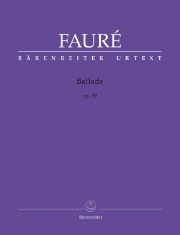
The Bärenreiter publishing house has done well to publish the original version in large format. Fauré's comlpex piano writing is much more pleasant to read this way. As editor, Christophe Grabowski has not only included a preface that is well worth reading, but also inspiring notes on interpretation from the pen of Philipp Fauré and the pianist Marguerite Long.

Image

Gabriel Fauré: Ballade op. 19, Urtext ed. by Christophe Grabowski, BA 10841, € 12.95, Bärenreiter, Kassel 2012

A touch of Chopin's melancholy

Review: The piano works of Franz Xaver Mozart point to the early Romantic period. Karsten Nottelmann has reissued them in two volumes published by Henle-Verlag.

Franz Xaver Mozart. Painting by Karl Schweikart, Lemberg, around 1825. source: wikimedia commons

Franz Xaver Wolfgang Mozart (1791-1844) was a remarkable pianist and composer. Trained by Johann Nepomuk Hummel and Antonio Salieri, among others, he left his native city of Vienna in 1808 for Galicia, where he settled in Lemberg (now Lviv in the Ukraine). Always celebrated as "W. A. Mozart's son", he also explored his father's legacy in composition. His Don Giovanni Variations of interest, in which the 14-year-old composer adds a lot of empty keyboard ringing to the minuet from the opera, but rather the cadenzas and ornaments that he wrote for some of his father's piano concertos. Some of the harmonies and pianistic writing here are already very much influenced by early Romanticism.

Musically, F. X. Mozart is at his most convincing (no wonder?) when he does not borrow from his father's music and is inspired by the folklore of his Galician surroundings, for example. This is what happened in the Polonaises mélancholiques op. 17 and 22, with a touch of Chopin's elegance and melancholy...

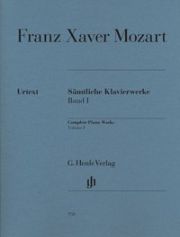
All these works and many more (including two "Diabelli Variations") have now been published by G. Henle-Verlag in two beautifully designed and very handy volumes.Image

Franz Xaver Mozart: Complete piano works, Urtext edited by Karsten Nottelman, fingering by Rolf Koenen; Volume 1, HN 958; Volume 2, HN 959; € 22.00 each, G. Henle, Munich 2011/12

Requiem with variations

How do composers in different periods translate their preoccupation with death and dying into music? A weighty book looks in depth and remains very close to the scores.

Photo: alf loidl - pixelio.de

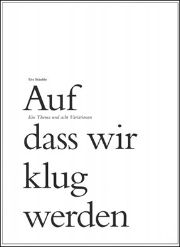
Urs Stäuble's recently published volume So that we become wise is an unusual book in many respects. It begins with the title, the meaning of which only becomes clear when you know the whole sentence from which it quotes: "Teach us to remember that we must die so that we may become wise."

This verse from the 90th Psalm, which Johann Sebastian Bach wrote in his Actus tragicus now puts the reader on the right track. Starting with the Gregorian Requiem, Urs Stäuble discusses eight works that deal with death on his journey through music history. In addition to Bach's aforementioned cantata, these include the Musikalische Exequien by Heinrich Schütz, the Requiem settings by Mozart, Verdi, Brahms, Dvořák and Fauré as well as No. VIII from Le Laudi by Hermann Suter.

The formal structure of the book is also unusual: the individual contributions are grouped as a "theme and eight variations", whereby the similarities and differences in the settings are presented in a short epilogue. The analyses of the individual works - explained using numerous musical examples - reveal an author who knows this music not only from listening to it, but also from playing it himself. The wealth of material always includes very personal and original insights that only a practicing musician can provide.

The individual chapters or variations each begin with a biographical sketch that sheds light on the composer's life up to the creation of the work under discussion. In Mozart's case, this logically concerns his entire life. At first, you might be taken aback. What's the point? However, these sketches are very successful introductions that should not be missed.
Urs Stäuble's book is of course also unusual in its length. The 560 pages are not suitable for a one-off read-through. The volume is a rich treasure chest and invites us to linger and compare again and again - so that we become wise ...

Image

Urs Stäuble,
So that we become wise
One theme and eight variations
568 p., hardcover, Fr. 129.00
Books on Demand, Norderstedt
ISBN 978-3-9522448-1-4

Instructive original text

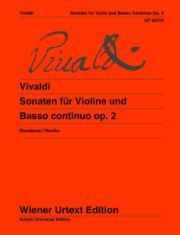
Review: Vivaldi's violin sonatas op. 2 - spread throughout Europe from Venice. Newly edited by Bernhard Moosbauer as a Viennese Urtext.

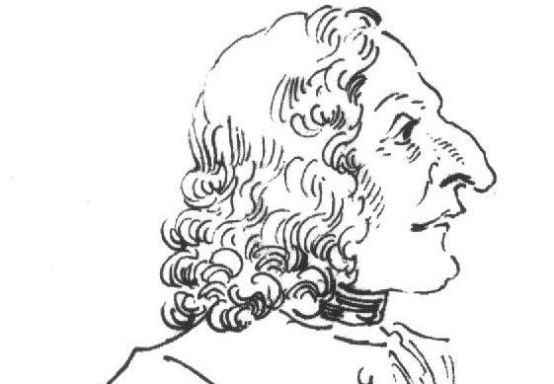
Antonio Vivaldi, caricature by Pier Leone Ghezzi, wikimedia commons

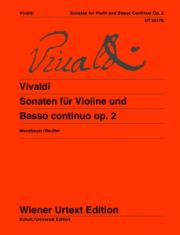
Vivaldi's Sonatas op. 2 - the usual debut work of a young aspiring musician since Corelli - were for a long time completely overshadowed by his violin concertos, even though they stand out from the comparable works of his contemporaries. These sonata da camera with a clearly dialogic basso could even be used as duets with cello. It seems that Vivaldi wrote many of the virtuoso, yet not too difficult, fast movements in the work for use in lessons with his pupils at the Pio Ospedale della Pietà. He dedicated the first edition, published by Bortoli in Venice in 1709, to the King of Denmark and Sweden, who was staying in that city at the time. The order for the reprint from Rogers in Amsterdam was also in line with this ambition: It is produced in copperplate engraving technique - more legible than the Venetian type print (a facsimile of the latter can be found in the score on page 47) - and now includes figuring of the bass, which suited its use by aristocratic amateurs in the north. In Italy, where only trained musicians played, this was not necessary.

Adolf Busch's fine arrangement of the Sonata II with a beautifully ornamented Adagio and the "Urtext op. 5" by Nagels (Walter Upmeier) - described by Vivaldi in the title as the second part of op. 2 - prove the high regard in which the work was held in the last century. In the present, excellent Urtext with easy-to-perform continuo realization by Joachim Reutter, the detailed and helpful preface and critical notes are impressive. They provide many valuable tips for a stylish interpretation.

Image

Antonio Vivaldi
Sonatas for violin and b.c. op. 2
edited by Bernhard Moosbauer
Score with continuo realization by Jochen Reutter
Violin and bass part

UT 50176, € 29.95
Wiener Urtext Edition (Schott/Universal Edition)
Vienna 2012


Important first printing of "Lohengrin" restored

One of the few copies of the first print of "Lohengrin" from the estate of conductor Theodor Hlouschek, who died in 2010, ended up in the University Archive / Thuringian State Music Archive in Weimar, where the opera was premiered. There, however, it first had to be saved from decay.

Photo: Rike / pixelio.de,SMPV

Originally, Richard Wagner's opera was to be premiered in Dresden, but the composer, who was wanted on a warrant, had to flee the city in 1849. His friend Franz Liszt, court conductor in Weimar, stepped in: 163 years ago, on August 28, 1850, the romantic opera was performed for the first time at the court theater. Only two years later, the three-volume score was printed in a small edition: it is still rare today.

At the request of the new Weimar musicology professor Christiane Wiesenfeldt, the Sparkassen-Kulturstiftung Hessen-Thüringen and the Sparkassenstiftung Weimar-Weimarer Land agreed to make the restoration of the score possible with a total of 4800 euros. In addition, the chairman of the Weimar Wagner Society, Eberhard Lüdde, supported the project with a donation. The restored score will be presented to the public for the first time on the occasion of the Lohengrin premiere on September 7, 2013 at the Deutsches Nationaltheater Weimar.

The Landesmusikarchiv also acquired a handwritten piano transcription of Lohengrin "for piano alone" by Conrad Götze, who was Grand Ducal music director in Weimar from 1826. This autograph is very similar to a piano reduction of Lohengrin, which was published shortly after the premiere of the opera in Weimar under the name of Theodor Uhlig,

RhB locomotive as an instrument

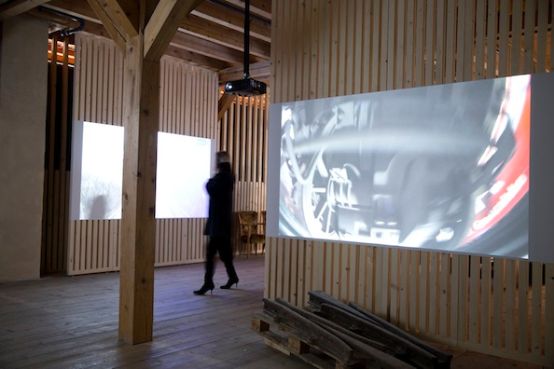
The Albula Railway Museum in Bergün is hosting the special exhibition "My first sonic Lok" until February 28, 2014. St. Gallen sound artist Andy Guhl uses a Rhaetian Railway locomotive as a musical instrument.

OTS.Bild/Bahnmuseum Albula AG,SMPV

Guhl creates audible and visible sound and light waves from the inaudible electromagnetic vibrations of a 65-ton, 2400 hp machine and uses them to compose an auditory and visual experience. Various motifs can be perceived, such as the power when starting up, different engine states or the condition of the rails. Guhl has installed a 5-channel video work in the museum's temporary exhibition room. With these recordings, he takes the viewer on a journey from Samedan to Landquart. Technology and nature appear in poetic, unfamiliar images and sounds - the landscapes pass by, sometimes rapidly and sometimes leisurely.

At least since Arthur Honegger's (1892-1955) composition Pacific 231, in which the railroad journey on a Pacific steam locomotive is musically realized in the form of a tone poem, the locomotive is a fascinating motif in classical music. The engine, the rhythmic power, the journey to top speed - Honegger has realized this characteristic in his composition in a vivid and impressive way. The work was composed in 1923 and premiered at the Paris Opera on May 8, 1924.

Andy Guhl (*1952) has made a name for himself with the duo Voice Crack. In 2001, they performed at the Venice Biennale, where they played the sounds of the Grand Canal in the church of San Staë. Luigi Russolos Manifesto of noise music (1913) paved the way for the emergence of experimental electronic music, as played by Voice Crack together with Poire Z, Borbetomagus (US), Otomo Yoshihide (Japan), Phil Minton (UK), Erik M (FR) and Jim O'Rourke (US), among others.

www.bahnmuseum-albula.ch

The "unfulfilled in the past"

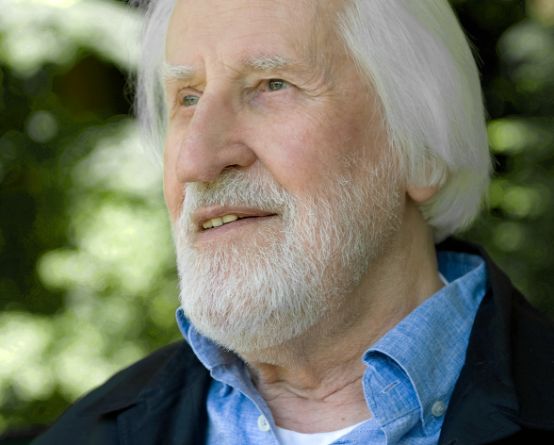
A Zurich symposium volume provides a comprehensive insight into Klaus Huber's work.

Photo: Harald Rehling

Composers who work with historical and non-European music are a dime a dozen these days. The results are not always truly exciting. Klaus Huber, however, was one of the first to make suggestions from other cultures productive in a substantial way, far removed from world music fashions and postmodern superficialities. This is one of the reasons why this instructive introduction to his work is called Transformations, "a conceptual leitmotif of Huber's compositional strategies", as the editors Jörn Peter Hiekel and Patrick Müller explain.

This volume, which goes back to a symposium at the Zurich University of the Arts in March 2010, was long overdue! For in the case of the recent winner of the Music Authors' Prize, there is a strange disparity between the unquestionable relevance of his oeuvre and its scholarly reception; not to mention Klaus Huber's importance as a teacher who had a decisive influence on numerous protagonists of new music (one of the few aspects, incidentally, that this publication does not take into account).

Jörn Peter Hiekel begins by setting the aesthetic milestones under the "idea of the transformative", which is designed to overcome one-dimensional Eurocentric thinking. In the following, Huber's closely interwoven fields of tension of the political, spiritual, transcultural and historical are comprehensively illuminated.
Two long-time companions of Huber's oeuvre provide for tense attention at the beginning: while Max Nyffeler sharpens Huber's Swiss profile in his knowledgeable discussion of national sensitivities, Claus-Steffen Mahnkopf makes a passionate plea for a concept of art that has fallen into disrepute in his contribution "The truth of Klaus Huber's music". For Mahnkopf, Huber is a prime example of artistic integrity. The fact that Huber's music is confessional music at the very highest level is made evident by Thomas Gartmann in his remarks on "Spiritual Music", marking the spiritual as artistic resistance with utopian-social potential. This aspect is also emphasized by Susanne Kogler, who sees Huber's sound language as a decidedly communicative place of (self-)experience. The fact that the solo pieces are not left out here is thanks to Heidy Zimmermann, who reveals the human dimension of the individual voice in the mode of instrumental monody (Ein Hauch von Unzeit, Transpositio ad infinitum, ...Plainte ...).

One idea that runs like a red thread through this publication is the "unfulfilled in the past" that Huber found in Ernst Bloch. In other words: a creative rethinking of aesthetic phenomena that were not yet able to develop their full potential at the time. This is what Martin Zenck's fruitful investigation On the transepochal affinity of the late 20th century to the Mannerism of the early 17th century the intellectual heart of this book. In doing so, he not only emphasizes the importance of Gesualdo's music for Huber's work by means of selected sketch analyses of the Lamentationes sacrae et profanae ad responsoria lesualdi but also exemplifies an essential function of old music in the new music of recent decades. Sibylle Kayser uses selected "re-compositions" to illustrate how the "unpaid" and its strategies also relate to Huber's own pieces.

A strictly analytical approach is taken by Christian Utz, who in his study Morphology and meaning of the sounds in Klaus Huber's "Miserere hominibus" dives deep into the matter of sound - physicality instead of semantics, objectivism versus author-centered interpretation. In his search for an "inherent musical narrativity", Utz exemplifies a congruence of structural sound organization and "morphological presence" in an expansive manner. But this should be found in every halfway reasonable work. The "gestural topoi" that he uses in Miserere could also be found in numerous pieces by other composers.

Central to Klaus Huber's work, especially from 1990 onwards, is his work with tunings and tonal systems beyond the European twelve-note division of the octave. Till Knipper devotes himself to this essential aspect in a differentiated illustration of the manifold manifestations and combinations of "microtonality" (a term that Huber no longer accepts) between natural intervals, quarter tones, thirds and sixths and the use of Arabic maquams, focusing not least on their semantic function in the context of the work. Anything else with Huber would probably be nitpicking ...

Image

Transformations, On the work of Klaus Huber, edited by Jörn Peter Hiekel and Patrick Müller, Edition Neue Zeitschrift für Musik, 232 p., € 22.95, Schott, Mainz 2013, ISBN: 978-3-7957-0823-8

From a royal hand

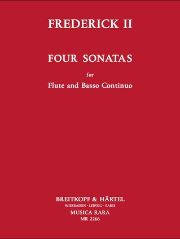
Mary Oleskiewicz presents four sonatas by Frederick II playing the flute as first publications.

Portrait of Frederick II by Johann Georg Ziesenis the Younger. Source: wikimedia commons

The Prussian King Frederick II (1712-1786) published numerous compositions for his instrument. He wrote to his sister Wilhelmine about his works with enthusiasm and humor, and it is also clear from the correspondence that Frederick sometimes received help from court composers such as Carl Heinrich Graun, Johann Joachim Quantz and Johann Friedrich Agricola. During Friedrich's lifetime, his works were systematically recorded by court copyists, but most of the copies were lost. In 1889, the Bach copyist Philipp Spitta published an edition of 25 sonatas by the Prussian king, almost half of which were among his latest works.

Most of Friedrich's sonatas are in four movements in the order slow-fast-slow-fast, as was common for most other Berlin court composers such as Quantz, Benda and Carl Philipp Emanuel Bach. The slow first movements are mostly of an ingratiating nature, richly ornamented, often lyrical and with a rhetorical style. The first movement of the very early Flute Sonata in A minor Sp. 21 contains an instrumental recitative. Friedrich may have intended the cantabile first movement of the C major sonata as an homage to his teacher Johann Joachim Quantz, who had composed the first movement of his own C major sonata in a similar manner. The Sonata in B flat major Sp. 76 even begins with an expansive Largo in B flat minor before reaching B flat major in the second half of the piece. In the slow opening movement of the Sonata in B minor Sp. 83, the sensitive style, such as that of C. Ph. E. Bach composed, for example. Friedrich's compositions reveal a tendency to make the sonatas ever longer and technically more demanding. The fact that the king, who played a repertoire of around 290 concertos and 150 sonatas by Quantz on the transverse flute, must have had extremely virtuoso skills himself is demonstrated by the Sonata in B minor Sp. 83, which, for example, contains very fast passages in the second movement Allegretto with leaps up to the three-note e and f sharp, notated in 32nd notes. The Allegro assai also impresses with its playful triplet configurations.

These four sonatas are appealing compositions in which the Prussian king's inventiveness, sense of style and skill can be seen and heard.Image

Frederick II the Great: Four Sonatas for Flute and Basso continuo, first edition ed. by Mary Oleskiewicz, score and part, MR 2266, € 29.50, Breitkopf & Härtel, Wiesbaden 2012

Duo, Trio, Villanelle

Chamber music works with horn in new, excitingly documented editions.

Photo: Sabine Schmidt / pixelio.de

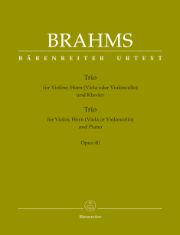
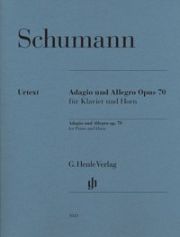
There are three Urtext editions in excellent presentation to report on. What is striking and pleasing in all three is the meticulous source research and the resulting accompanying texts, which are fascinating to read. These are gems of the chamber music repertoire with horn: the Trio for violin, horn and piano op. 40 by Johannes Brahms, the Villanelle for horn and piano by Paul Dukas and Adagio and Allegro for horn and piano op. 70 by Robert Schumann. Brahms' Trio was originally written for natural horn, Dukas' Villanelle for natural horn in combination with valve horn, Schumann's work is considered to be the first piece in which the chromatic horn was used.

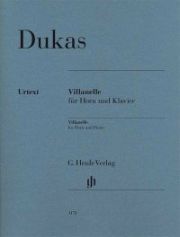
Dominik Rahmer's foreword to the Villanelle reads almost like a detective story and also sheds light on the history of the horn in the transition from natural to valve horn in Paris at the turn of the 20th century.Image

Christopher Hogwood has performed the BrahmsTrio also in the version for violin, violoncello and piano authorized by the composer, edited with knowledge and care. The four instruments, violin, violoncello, piano and horn, were incidentally those that Brahms himself played. The appendix contains an album leaf from 1853, twelve years before the composition of Opus 40, with the theme of the trio from the third movement of the horn trio which was written later, as well as several facsimile pages.Image

From Schumann's Adagio and Allegro the Urtext edition of a version for violin and piano was published at the same time (HN 1025).Image

Paul Dukas: Villanelle for horn and piano, Urtext edited by Dominik Rahmer, HN 1170, € 13.00, G. Henle, Munich, 2012

Johannes Brahms: Trio for violin, horn and piano in E flat major op. 40, Urtext edited by Christopher Hogwood, BA 9435, € 26.95, Bärenreiter, Kassel 2011

Robert Schumann: Adagio and Allegro for Horn and Piano in A flat major op. 70, Urtext edited by Ernst Herttrich, HN 1023, €13.00, G. Henle, Munich 2012

Creator against all odds

Mel Bonis used rural impressions in her Suite for violin and piano. Her entire, extensive oeuvre is worth rediscovering.

Mel Bonis portrayed by Charles-Auguste Corbineau / wikimedia commons

Mélanie Bonis' piano improvisations were considered a nuisance by her petty-bourgeois Parisian parents, but - encouraged by César Franck - she was allowed to attend the Conservatoire Supérieur, but had to abandon her successful studies before the end because her parents did not approve of her love affair with fellow student Amédée Hettich. Married to the rich widower Albert Domange, 25 years her senior, with five sons, to whom she gave another four children, she had little time for music. Nevertheless, she was able to publish several works under the pseudonym Mel Bonis (women composers were not taken seriously at the time; she had to finance some editions herself) with Leduc and Eschig. Towards the turn of the century, Hettich encouraged her to return to intensive, even prize-winning music-making (she even became secretary of the Société des Compositeurs). She was able to keep their daughter a secret until 1914. During the First World War, she became involved in helping orphans and prisoners of war. Despite depression, she continued to compose tirelessly until the end of her life. Her 300 works for piano, organ, chamber ensemble, voice and orchestra are on a par with Fauré and Chausson, but were unjustly forgotten.

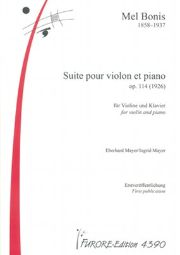
For the three-movement Suite from 1926, the manuscript of which was found in the family archive, the composer was inspired by her life in the country: I Jour de fête surprises with sparkling, syncopated upbeat motifs in which the two instruments follow each other. A more vocal intermezzo is concluded by a gallop. II Sous la ramée is an extended reverie, floating confidently between the keys. III Cortège champêtre returns to the C major of I with many imaginative modulations, reminiscent of a light-footed parade of majorettes. Musically demanding, this suite gives the performers much pleasure.

Image

Mel Bonis, Suite pour violon et piano op. 114, edited by Eberhard Mayer and Ingrid Mayer, first publication, fue 4390, € 22.00, Furore-Edition, Kassel 2012

Instructive original text

Review: Vivaldi's violin sonatas op. 2 - spread throughout Europe from Venice. Newly edited by Bernhard Moosbauer as a Viennese Urtext.

Antonio Vivaldi, caricature by Pier Leone Ghezzi / wikimedia commons

Vivaldi's Sonatas op. 2 - the usual debut work of a young aspiring musician since Corelli - were for a long time completely overshadowed by his violin concertos, even though they stand out from the comparable works of his contemporaries. These sonata da camera with a clearly dialogic basso could even be used as duets with cello. It seems that Vivaldi wrote many of the virtuoso, yet not too difficult, fast movements in the work for use in lessons with his pupils at the Pio Ospedale della Pietà. He dedicated the first edition, published by Bortoli in Venice in 1709, to the King of Denmark and Sweden, who was staying in that city at the time. The order for the reprint from Rogers in Amsterdam was also in line with this ambition: It is produced in copperplate engraving technique - more legible than the Venetian type print (a facsimile of the latter can be found in the score on page 47) - and now includes figuring of the bass, which suited its use by aristocratic amateurs in the north. In Italy, where only trained musicians played, this was not necessary.

Adolf Busch's fine arrangement of the Sonata II with a beautifully ornamented Adagio and the "Urtext op. 5" by Nagels (Walter Upmeier) - described by Vivaldi in the title as the second part of op. 2 - prove the high regard in which the work was held in the last century. In the present, excellent Urtext with easy-to-perform continuo realization by Joachim Reutter, the detailed and helpful preface and critical notes are impressive. They provide many valuable tips for a stylish interpretation.

Image

Antonio Vivaldi: Sonatas for violin and b.c. op. 2, edited by Bernhard Moosbauer, score with continuo realization by Jochen Reutter, violin and bass parts UT 50176, € 29.95, Wiener Urtext Edition (Schott/Universal Edition), Vienna 2012

"A dream come true for Brazil"

The Orquestra Sinfônica do Estado de São Paulo, or OSESP for short, has big plans: If it is one of the leading orchestras in Latin America today, it wants to play among the best in the world. With the American chief conductor Marin Alsop in office since 2012, it could succeed. A visit to an orchestra with vision.

Photos: Rebekka Meyer
«Ein wahrgewordener Traum für Brasilien»

The Orquestra Sinfônica do Estado de São Paulo, or OSESP for short, has big plans: If it is one of the leading orchestras in Latin America today, it wants to play among the best in the world. With the American chief conductor Marin Alsop in office since 2012, it could succeed. A visit to an orchestra with vision.

You can't escape São Paulo. It's a fierce city, skyscrapers towering mightily into the sky, everywhere and all the time there are crowds and traffic jams. And it is never quiet in São Paulo. Engines roar in front of the red lights, motorcycles honk and overtake at breakneck speed, and on Rua 25 de Março, shouting traders sell their wares. And then there's the music. Lots of music. On the Praça da Sé, homeless people dance to poor quality pop music, in a busy alleyway a man with a guitar plays Brazilian pop songs. But there are other sounds too. Such as that of the symphony orchestra.

Image
Foyer of the concert hall

A train station as a concert hall

In the middle of the hustle and bustle, in a beautiful old station building on Praça Julio Prestes, lies the OSESP concert hall. It is a haven of peace in "Zombieland", as the area around the hall is called by the inhabitants of São Paulo, the Paulistas - because of the many drug addicts who hang around the building. In between, people hurry home, cars honk and an emaciated man pushes a shopping cart filled with pineapples and huge watermelons past. Nobody lingers here. Inside, however, the atmosphere is completely different, here you have space and peace to breathe. And to make music. A concert hall with excellent acoustics has been created in the winter garden of the former train station - thanks to a ceiling that is one hundred percent movable. The audience, orchestra and chief conductor Alsop are delighted with the concert hall, which was opened in 1999 as the "Sala São Paulo" and gave the orchestra a home.
 

Image
Marin Alsop

High goals for a young orchestra

It had already been around for some time. Founded in 1954, it underwent fundamental changes in recent years. The long-standing, allegedly tyrannical, but also very valuable chief conductor John Neschling was dismissed and a number of things were restructured. After a transitional phase, the American Marin Alsop for the OSESP, who is also principal conductor of the Baltimore Symphony Orchestra. In addition to Alsop, the orchestra owes its new direction to two men in particular: Artistic Director Arthur Nestrovski and Executive Director Marcelo Lopes. The two directors, both originally trained as musicians, are at work with a great deal of Brazilian passion and innovative energy. And they have big plans: "I don't think it's unreasonable to hope that the São Paulo Symphony Orchestra will one day come to mind for everyone who thinks of the world's leading and most exciting orchestras." The fact that this does not seem completely megalomaniacal is also due to Arthur Nestrovski's eloquent and modest manner. He is well aware that a lot of time and energy will be needed before that day arrives, but he believes the basic requirements are in place: "The orchestra consistently - and consistently is the most important word here - performs at a very high level." 

Enthusiasm and optimism

So the potential for growth is there, but there is still a lot to do - the hopes placed in Marin Alsop are correspondingly high. It's good that she herself is also enthusiastic about the orchestra: "The orchestra is growing musically and is so enthusiastic. I see it as an orchestra with real depth and temperament and I'm trying to build on that." This enthusiasm on the part of the orchestra musicians, the desire to play and improve, were also the main reasons for Alsop to come to São Paulo. In any case, she likes the Brazilian mentality, which is also reflected in her work with the orchestra: "It's all about the future here, about opportunities. The mentality is very optimistic and warm." You can certainly feel this in the rehearsals and in the concert. Especially with the piece The rescued Alberich for solo percussion and orchestra by Christopher Rouse, all participants demonstrate their skills: Alsop with her gesturally broad, yet pointed conducting style, the soloist Colin Currie with full physical commitment and rhythmically precise percussion fireworks and the orchestra with its interplay of romantic, opulent devotion and restrained, magical accompaniment.

Rooted in society

Image
120,000 children visit the educational programs every year

Europe as an opportunity, Brazil behind us
In the fall, the OSESP will also be able to showcase its enthusiasm in Europe - an important step towards raising its international profile. Executive Director Lopes even sees the OSESP's fifth European tour as a "turning point, even a milestone, in terms of international appeal." With the Salle Pleyel in Paris, the Vienna Konzerthaus and the Berlin Philharmonie, the program includes prestigious venues that have never hosted a professional Latin American orchestra before. What is possible for the orchestra today would have been unthinkable 10 years ago: "We are a dream come true for the country," says Lopes. This is precisely why it is important to both directors to be both role models and motivators for cultural institutions in Brazil. To show what is actually possible in this country.
Because before international recognition comes national recognition. The very next goal is to make the orchestra known throughout Brazil: "We want to be a part of what Brazil is." This rootedness in society is so important because, as Marcelo Lopes says, you can only take care of the international level when the social relevance in your own country is given: "A cultural project must be relevant to society."
 

Image

More popular than soccer?
Being relevant for Brazil means being there for the population, as 52% of the budget is borne by the public sector, the state of São Paulo. "We have to work at the highest possible level and at the same time not lose touch with the society we come from," is Nestrovski's credo. As a result, the elitist character that was still attached to classical music 20 years ago is gradually disappearing. The audience has also changed in these 20 years, both in terms of age and class - and further investment is to be made in this change. The digital concert broadcasting capacities are currently being expanded, free concerts are held every Sunday and the orchestra keeps going out to the people. For example, it played a concert on Santos beach near São Paulo in front of an audience of 10,000: "It's a different way of engaging with society," says Nestrovski. This also includes the mediation programs: More than 120,000 children and teenagers, mainly from public schools, which are frowned upon in Brazil, visit the concert hall every year. Then the seemingly stoic hall fills with noise, cheerful laughter and smiling faces. Lopes suspects that for these reasons the orchestra has never been exposed to the kind of protests from the population that have recently hit the World Cup, for example.

Image
Clarice Assad

Clarice Assad - ever heard of her?

This may come as a surprise, as football seems to be almost sacred in Brazil. Apparently, Brazilians really love the orchestra. And they are interested in contemporary music: "We have the advantage and the disadvantage of not having as great a tradition as the European countries. So people are more open to sounds they are not used to." If you leaf through the OSESP's seasonal program, you will find many contemporary Brazilian composers who are often completely unknown in Europe or North America - the classical music of their own country is intensively promoted. Each season, the orchestra commissions at least six works from Brazilian composers. Nestrovski says: "If we want to be connected with the world we live in, with society, with Brazil, we have to have a connection with the music that is written here. We are not just a museum." And he adds pragmatically: "If we don't play it, who will play it?" These six commissioned works, as well as older Brazilian music and new editions of Villa-Lobos' compositions, are also published by the in-house publishing house - with the aim of ensuring that classical Brazilian music is accessible to all orchestras around the world and is therefore also played. A beautiful utopia or a realistic goal? Chief conductor Marin Alsop is certainly enchanted - she loves conducting Brazilian music, which is mostly unknown even to her: "It's really fun to discover a whole new musical world." European audiences will get a taste of this in the fall when, alongside Beethoven and Mahler, a piece by the young Brazilian composer Clarice Assad is on the program. Will she take the hearts of the Swiss by storm? To be continued!


Rebekka Meyer was invited by the orchestra to São Paulo at the end of August. In Switzerland, the OSESP will perform under the direction of Marin Alsop and with pianist Nelson Freire on October 12, 2013 at the Victoria Hall in Geneva and on October 13, 2013 at the Zurich Tonhalle.

Kategorien

get_footer();