German music critics praise Lucerne Symphony Orchestra

The Lucerne Symphony Orchestra is awarded the German Record Critics' Quarterly Prize for a recording of works by Henri Duttileux and Debussy.

Photo: ©Christian Flierl

The concerto "Tout un monde lointain" by Henri Dutilleux, composed between 1967 and 1970, has long since become a modern classic and is already available in several recordings, some of which feature a highly prominent cast, according to the explanatory statement written by Michael Stegemann for the jury. According to the statement, what makes the recording by the Lucerne Symphony Orchestra (LSO) with cellist Emmanuelle Bertrand stand out is its deeply poetic and, in the most beautiful sense of the word, "speaking" interpretation.

The references to the eponymous verses by Charles Baudelaire are the common thread here as a kind of "sound speech" that is interpreted, to which the Lucerne Symphony Orchestra under James Gaffigan contributes all the other colors that the work unfolds. The program selection also places Dutilleux in the context of Debussy.

In 2015, the Swiss Music Council (SMR) organized a National Music Day for the first time. Another one is to be held this year. Local events are planned for June 21.

The highlight of the Day of Music will be an open-air closing concert with Swiss music greats from various genres on the Bundeshausplatz in Bern.

To make music accessible to everyone, the Swiss Music Council is calling on everyone who is involved with music in any way to get active on June 21, 2016. Under the label "Day of Music", concerts on the village square, club parties for members and fans, an open day at a sheet music store, a spontaneous celebration for friends and acquaintances and much more can be organized.

The Day of Music - or the Fête de la musique, as it is known in French-speaking regions - was initiated by former French Minister of Culture Jack Lang and is celebrated every year on June 21. In France, Germany and other European countries, as well as in French-speaking Switzerland, the TdM/FdM has long been an integral part of the annual calendar.

More info: www.musikrat.ch/tag-der-musik

An orchestra of leaders

The Orpheum Foundation establishes an "Orpheum Supporters Orchestra" - a project orchestra made up of personalities from business, politics, research, culture and science who play an orchestral instrument at the highest level in their free time.

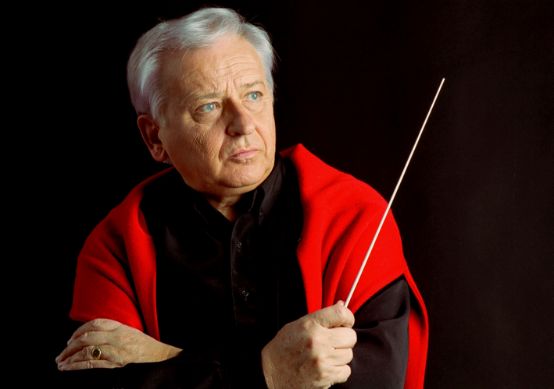
Howard Griffiths. Photo: zvg

The musicians of the Orpheum Supporters Orchestra can work on masterpieces in a professional setting and perform with young soloists. This also provides opportunities to cultivate and expand their personal network. The project aims to raise awareness of the Orpheum Foundation among opinion leaders in society and build new relationships with sponsors and patrons.

The participants of the Orpheum Supporter Orchestra are invited to make a contribution to the project. This income is part of the project budget.

The Orpheum Supporter Orchestra will perform works by Mozart, Sarasate and Bizet at the Tonhalle Zurich on Wednesday, April 20, 2016. The soloists are former Orpheum soloist Claire Huangi, young Orpheum soloist Aurelia Shimkus and SRF Head of Culture Nathalie Wappler (pianos) and Elin Kolev (violin). Howard Griffiths conducts.
 

Leadership crisis at the Orchestre de la Suisse romande

The Orchestre de la Suisse romande (OSR) and its orchestra director Henk Swinnen are parting ways by mutual agreement. It has also been announced that Jonathan Nott's appointment to the OSR has not yet been finalized.

The OSR in Santa Barbara, USA tour from February 2015. photo: zvg

According to the "Journal de Genève", the OSR Foundation is keeping quiet about the reasons for Swinnen's departure. It is therefore also unclear whether Swinnen is leaving the orchestra voluntarily or involuntarily.

Moreover, the ensemble is currently without a chief conductor. The OSR will not have a new chief conductor for several months: The plan is for Jonathan Nott to officially succeed Neeme Järvi, who relinquished the post in 2015, in January 2017.

According to the OSR itself, the contract with Nott has not yet been signed. OSR Foundation President Florence Notter and Vice-President Sylvie Buhagiar will travel to London to "resolve the situation".

Mirga Gražinytė-Tyla appointed to Birmingham

Mirga Gražinytė-Tyla, who was first conductor at Konzert Theater Bern in 2013/14, is continuing her stellar career: Following her engagement in Salzburg, she is now Music Director of the City of Birmingham Symphony Orchestra (CBSO).

Photo: City of Birmingham Symphony Orchestra

The City of Birmingham Symphony Orchestra (CBSO) announces that Lithuanian conductor Mirga Gražinytė-Tyla has been appointed as the orchestra's 12th Music Director from September 2016 for an initial period of three years. She succeeds Andris Nelsons, who led the orchestra from 2008 to 2015.

Born into a family of musicians in Vilnius, Lithuania, Mirga Gražinytė-Tyla initially studied choral and orchestral conducting at the Graz University of Music and Performing Arts in Austria. She then furthered her studies at the conservatory in Bologna, at the Leipzig University of Music and at the Zurich University of the Arts.

In the 2011/12 season, she was appointed 2nd Kapellmeister at the Theater und Orchester Heidelberg for two seasons, before moving to the Konzert Theater Bern as 1st Kapellmeister in 2013/14. In spring 2014, she was appointed as the new music director of the Salzburg State Theater from 2015/16.


Musicians as a motif of musical theater

Oldenburg musicologist Anna Langenbruch has been accepted into the Emmy Noether Program of the German Research Foundation (DFG) to set up a junior research group on the subject of "Music History on Stage".

Roberto Saccà as Palestrina, Hamburg State Opera 2011 (see below). Photo: Jörg Landsberg, Bremen,SMPV

The five-year funding of 1.1 million euros will enable Langenbruch and her group to investigate how "the musical past is constructed in music theater - for example in operas, operettas and musicals".

Langenbruch explains that there are hundreds of plays that deal with historical musicians. They often appear as stage characters themselves. Music history itself thus becomes an aesthetic event. The researcher is interested in how this type of knowledge production works, i.e. how knowledge about music is created in the medium of music.

Photo: Scene from the opera "Palestrina" by Hans Pfitzner: Roberto Saccà as Palestrina, surrounded by the dead masters of the art of music in Act 1. Performance of the Hamburg State Opera 2011. photo: Jörg Landsberg, Bremen. Source: wikimedia commons
 

Painted music

The exhibition in Aarau focuses on the relationship between the constructive-concrete artist Camille Graeser and music. It will be on display from January 30 to April 10, 2016 and will be accompanied by musical events.

Exhibition view. Photo: Timo Ullmann,SMPV

The works of Swiss-born Camille Graeser (1892-1980) sometimes appear strictly geometric, sometimes as a dancing structure of moving pictorial elements. With the exhibition Camille Graeser and the music focuses on an important aspect of the artist's work that has been little researched to date: Camille Graeser's relationship to music. The exhibition focuses on the 'Loxodromic Compositions'1 created between 1946 and 1955. The approximately 70-part group of works shows the influence that musical rhythms and sound patterns had on Camille Graeser's artistic work.

Born in Carouge near Geneva, Camille Graeser (1892-1980) is considered an important pioneer of constructivist-concrete art in the post-war period. In 1933, he emigrated from Stuttgart to Zurich, where, as a former furniture designer, graphic artist and interior designer, he devoted himself entirely to the visual arts. As a concrete artist, Camille Graeser cultivated a sober formal language that dispensed with narrative content. In contrast to his companions Max Bill and Richard Paul Lohse, who pursued a strictly theoretical approach, Graeser chose a freer and more poetic approach, comparing the creation of images to the virtuoso composition of music. He made his first reflections on the analogy between art and music in Adolf Hölzel's lectures at the Academy of Fine Arts in Stuttgart. Furthermore, Johann Sebastian Bach's Art of the fugueThe free tonality of Paul Hindemith, as well as Arnold Schönberg's twelve-tone technique, inspired him to rethink concrete art compositionally.

Between 1946 and 1955, the group of works of the Loxodromic compositions. In them, geometric shapes, rhythmic angular and bar constructions combine to form dynamic compositions. Titles like Symphony of color or Delicate joint in red-green-black illustrate the reference to music. For his virtuoso handling of color, form and material, Graeser draws not least on his media-rich experience as an interior designer, furniture designer and commercial artist.

Image
Camille Graeser, Symphony of Color, 1946/50
Camille Graeser Foundation, Zurich. Photo: © Camille Graeser Foundation, Zurich / ProLitteris, Zurich

The exhibition Camille Graeser and the music, January 30 to April 10, 2016, is a collaboration between the Camille Graeser Foundation, the Kunstmuseum Stuttgart and the Aargauer Kunsthaus. Around 70 paintings, drawings and conceptual sketches are on display.

 

As a reader of the Swiss Music Newspaper free admission to the exhibition by Camille Graeser!

Canton Valais promotes participation projects

With the aim of promoting cultural participation, the Canton of Valais supports projects that unite creative artists and the public in a joint creative process.

Photo: www.helenesouza.com/pixelio.de

As part of the "Cultural diversity in the regions" initiative of the Swiss Arts Council Pro Helvetia, a joint project entitled "Art en partage - cultural participation" is being launched. This will promote artistic productions that are created between an existing or specially formed group of people and professional cultural practitioners. A cultural mediator can assist in the development of the project.

One of the aims of the initiative is to facilitate access to contemporary creation through personal contact with creative artists and to use "the potential of joint creative processes to explore social issues".

An invitation to submit projects is open until 15 April 2016. The supported projects should be realized by 31 October 2017. The conditions of participation can be found on the website of the Department of Culture: www.vs.ch/kultur > Subsidy opportunities > Art en partage - cultural participation


A journey on the sound arcs of music

"Music is incredibly versatile. Music is therapy, music is science, music is also the eternal laws of nature and the universe. Music permeates matter." Yehudi Menuhin

Photo: Stefan Kubli,Photo: zVg/Lassalle-Haus,Photo: Manuela Burkart/Lassalle-Haus,SMPV

You've probably already experienced this: you hear a piece of music, a melody, and suddenly your heart soars - you could whoop with happiness. Or you come home angry because something has gone completely wrong and instinctively reach for the CD that will give you some breathing space.

Music goes straight to the heart, without detours via the intellect. The sense of hearing is the only one of our senses that is directly connected to the limbic system, the emotional center of the brain. And so music resonates directly with our moods, can deepen or change them. Above all, however, music is one of the surest door openers to the realms of the unconscious; it releases blockages or resistance and gives us access to hidden resources.

Music as a guide
Try it out for yourself! If you are about to make a decision that you are struggling with, you could try the following: First, visualize the situation at hand. What is at stake? What alternatives are available? Then A hero's life, the hero's escape from the world and completion by Richard Strauss so that all you have to do is press the button to play the music. Lie down, relax and visualize the question you are looking for an answer to. Then search for a path in your mind, go to a fork in the road, let the music take effect on you - what images, symbols, feelings emerge? Where does the path take you? What changes? After the last bar of the piece, give yourself some time to process the impressions.

Image
Anna Röcker

When I listened to this very piece during my first course with music therapist Anna Röcker at Lassalle-Haus and went "on a journey" with it, I didn't know immediately after the music faded out which would be the right decision. But based on the images and moods that emerged during my musical journey, I sensed which path was more suitable and also recognized which resistances were there that made my choice more difficult. I can only say: it turned out well, I was able to let go of something, give up an activity that took up a lot of time and energy and with which I was never completely satisfied.  

Death of the Swiss flautist Aurèle Nicolet

The legendary Swiss flautist Aurèle Nicolet has died at the age of 90, according to a report by French-speaking Swiss radio and television.

Born in Neuchâtel in 1926, Nicolet studied the flute with André Jaunet and theory and composition with Willy Burkhard at the Zurich Conservatory and continued his studies with Marcel Moyse and Yvonne Drappier at the Paris Conservatory. Wilhelm Furtwängler recruited him as principal flute with the Berlin Philharmonic, where he was active from 1950 to 1959. Renowned composers, including Toru Takemitsu, Rudolf Kelterborn and György Ligeti, wrote works for him.

From 1952 to 1965, Nicolet was a professor at the Hochschule der Künste in Berlin and from 1965 to 1981 he was head of the master class in Freiburg. With his own school for flautists, he influenced generations as an outstanding teacher and performer for his instrument.

Appreciation for Ralf Weikert

The Allgemeine Musik-Gesellschaft Zürich (AMG) awarded conductor Ralf Weikert honorary membership on January 26, 2016.

Photo: Oli Rust,Photo: General Music Society Zurich

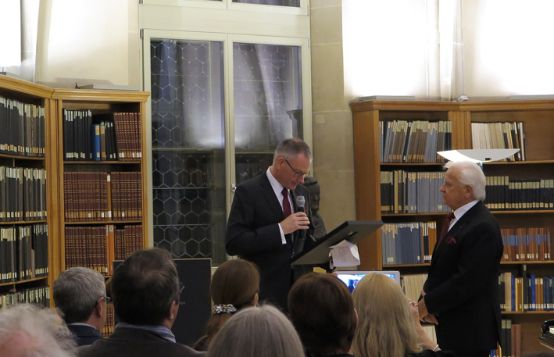
The long-standing musical director of Zurich Opera House was presented with the award during a ceremony in the Predigerchor of Zurich Central Library. The laudatory speech was held by Alois Koch. Ralf Weikert thus joins a long and distinguished line of honorary members of the AMG, ranging from Richard Wagner and Bernhard Romberg to Matti Salminen and David Zinman.

In his Laudation Alois Koch portrays Weikert's personality, pays tribute to his great achievements as a "gifted conductor and gifted teacher" and traces his international career.

The AMG has existed since 1812 and was founded through the merger of Zurich's musical societies. Its library and archives are world-renowned, and it is known for its events and exhibitions - as well as its annual Neujahrsblatt, the world's oldest musical periodical.

www.amg-zürich.ch

Image
Ceremony in the Predierchor of the Zurich Central Library on January 26, 2016
Laurenz Lütteken, Vice President of the AMG, presenting the certificate to Ralf Weikert

Laudatory speech for Ralf Weikert

The laudation can be read in full by clicking on the link marked in blue: Laudatory speech for Ralf Weikert (with the kind permission of Alois Koch). 

Gema files unsuccessful lawsuit against YouTube

The Higher Regional Court (OLG) in Munich has ruled that YouTube cannot be held liable for copyright infringements. The judges consider the individual uploaders to be solely responsible.

Photo: Rainer Sturm/pixelio.de

The background to the legal dispute is the demand by Gema, the German counterpart to Suisa, that music authors be appropriately remunerated for the use of their copyrighted repertoire on the YouTube platform. So far, YouTube has not paid Gema a license fee for the use of music on its video platform, although it generates considerable advertising revenue from the music. The OLG's ruling is not yet legally binding. An appeal has been expressly permitted.

According to Gema, the unfair distribution of value creation in the digital economy has been a problem for authors for many years. In the online sector, creative content generates considerable revenue. However, it is mainly platform operators such as YouTube that have benefited economically to date, who have evaded their responsibility to remunerate authors appropriately by invoking liability privileges. This is why authors must finally receive a fair share of the value created in the digital economy, Gema continues.
 

Focus on current Swiss folk music

The Fondation Suisa is dedicating this year's recognition prize to the complete works of a composer of new, contemporary Swiss folk music. Applications are open until February 26.

digitalice / pixelio.de

The Fondation Suisa Prize is a recognition award for outstanding creative work. It is awarded annually to composers and publishers whose work makes a special contribution to enriching our country's cultural heritage. The prize, endowed with CHF 25,000, is awarded in a different category each year.

Applications are open to individual composers or groups of composers working together. All candidates must be able to demonstrate a connection to current Swiss music-making and folk music composition should play an important role in their overall work. Nominations by third parties are also possible. An expert jury will assess the submitted nominations based on the prize regulations.

For a valid candidacy, a registration form and an application dossier must be submitted in electronic form by February 26.

Theodor Kirchner's estate digitized

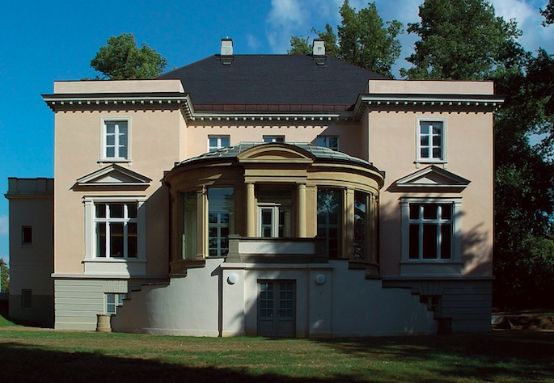
The Brahms Institute at the University of Music (MHL) is making the digitized estate of the composer Theodor Fürchtegott Kirchner accessible to the general public. Around 9000 pages from the Institute's collection are now available on a website.

Institute headquarters Villa Eschenburg. Photo: Brahms Institute at the Lübeck University of Music, Tomas Szamek

Theodor Fürchtegott Kirchner (1823-1903), a contemporary and friend of Johannes Brahms, was one of the most prolific composers of the 19th century. In addition to a few songs, an ambitious string quartet and smaller chamber music works, he dedicated the largest part of his oeuvre to the piano, with over 1000 individual pieces. Around 9000 individual pages from his estate have now been catalogued and digitized for over a year.

Kirchner's musical path was also shaped by his encounter and friendship with Robert Schumann, who reviewed his Opus 1 favorably in 1843 and in 1853 counted him among the most up-and-coming artists of his time. He had a close liaison with the young widowed Clara Schumann for several years.

In the later years of his life, Kirchner lived ill and impoverished in Hamburg, where he died in 1903 and was buried in Ohlsdorf cemetery. The estate came to the Brahms Institute via Kirchner's last piano pupil Conrad Hannss.

More info: www.brahms-institut.de

Bern Kiwanis Prize 2016 goes to Laura Schmid

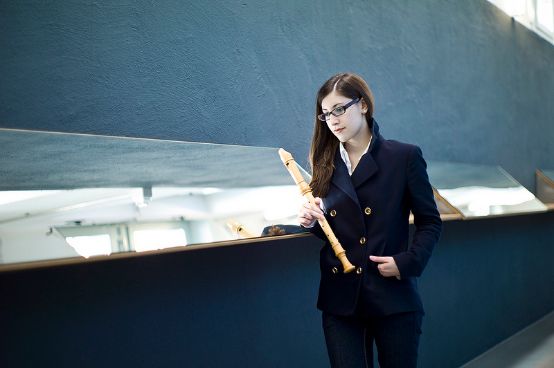
This year, the German recorder player Laura Schmid receives the Kiwanis Music Prize of the Kiwanis Club Bern, which is awarded every three years.

Photo: Laurent Burst

Laura Katherina Schmid completed her Master of Arts in Music Pedagogy with distinction at the Bern University of the Arts (HKB) in 2014. In addition to her further studies and projects, she teaches at the Music School of the City of Lucerne. Her virtuoso performance as well as her body language and strong personality unanimously convinced the jury, writes the Bern University of the Arts.

The Kiwanis Music Prize is awarded every three years to graduates of the Master of Arts in Music Pedagogy program who are above average in both artistic and pedagogical terms. Great importance is attached to an exceptionally high level of pedagogical competence in passing on the acquired skills.

Laure Schmid will perform a prizewinners' concert on March 1, 2016, at 8:30 p.m. in the large concert hall of the HKB at Papiermühlestrasse 13d.

get_footer();