From Angklung to Zimbel

At last there is a comprehensive reference book for percussion practice.

Angklung made of metal, Emil Richards collection. Photo: Xylosmygame, wikimedia commons

It has been almost half a century since the last book on the diverse world of percussion was published (Peinkofer/Tannigel: Percussion manualSchott, 1969). Against this background The big book of percussion practice published by Gyula Racz is almost overdue. In collaboration with 14 authors, he presents the percussion and everything that goes with it in detail. The compendium is divided into the sections Instrumentology, Playing Practice and Pedagogy, with Instrumentology occupying the most prominent position.

In this colorful chapter, richly illustrated with historical subjects, the authors talk about the origins and history of the drum set. The first important rudiments for the snare drum can already be found here in notated form. And a lot is also revealed about the Basel drum and its notation, which Fritz Berger developed.

In Gyula Racz's book you can wonder about exotic instruments such as the angklung, lion's roar or donkey's teeth, just as you can find out about onion flutes, whistles or birdsong. Although the latter are not percussion instruments, they are part of the classical percussionist's instrumentarium.

Benjamin Franklin was not only President of the USA, but also a brilliant inventor. Among other things, he invented the glass harmonica. This is usually played by specially trained musicians. Some well-known compositions for the glass harmonica date back to the 18th century. Among those who used the instrument in their compositions were great masters such as Mozart and Gluck. However, the glass harmonica eventually fell into oblivion because, according to press reports from the 19th century, it was not entirely safe for the nerves of performers and listeners. Nevertheless, at the beginning of the 20th century, Richard Strauss wrote in his opera Woman without shadow again some chord sequences for the glass harmonica.

In the first sub-chapter of the section "Literature and playing practice", solo and ensemble pieces from the era of New Music are presented, introducing the reader to composers such as Varèse and Cage, but also many others. Two separate, comprehensive sub-chapters are devoted to the jazz vibraphone and the drumset. Of course, the world of Latin percussion is also included. Numerous examples of sheet music and many pictures allow the reader to immerse themselves in this fascinating cosmos.

The big book of percussion practice was created in cooperation with the Kolberg company, which is well known as a manufacturer of high-quality percussion instruments and accessories. With its cross-genre structure, it is a suitable reference work for conductors, composers, teachers and anyone interested in music. With 360 pages and perfectly laid out, it will win you over at first glance and should not be missing from any well-stocked music library.

Image

The big book of percussion practice, edited by Gyula Racz, 364 p., € 39.90, ConBrio, Regensburg 2014, ISBN 978-3-940768-43-8

The search for a musical identity in Ticino

Carlo Piccardi's study is dedicated to the festival play in southern Switzerland, which played an important role around the middle of the last century.

Photo: Heinz Hasselberg/pixelio.de

In the encyclopedia Music in the past and present in the fourth volume of the first edition of the "Feste und Festspiele", published in 1954, mentions the important role played by the festival genre in Swiss musical life: "Today, hardly any major festival (especially singing festivals, centenary festivals, etc.) is conceivable without a festival." At that time, this genre could look back on a tradition of around one hundred years. The origin of this success story was the first Fête des vigneronswhich François Grast composed in 1851. Sometimes dealing with rural folk themes, as in Vaud, sometimes with historical-patriotic events, performed by amateur actors and actresses and usually accompanied by amateur orchestras, these stage works with their rich musical accompaniment quickly spread throughout French- and German-speaking Switzerland. What all the festivals had in common was their ideological connotation: these works were intended to strengthen the (musical) identity of the Swiss people. In the canton of Ticino, the genre did not gain a foothold until the 1920s. The people of Ticino had to overcome similar (musical) identity problems as the Swiss Confederation as a whole. However, they were faced with an additional dilemma: on the one hand, it was important to maintain a tradition that was considered typically Swiss in southern Switzerland, while on the other, the Ticino authors wanted to avoid touristy platitudes in their self-portrayal.

After a few isolated attempts (first in 1924 for the Festa delle camelie in Locarno), a continuous tradition of festivals developed on the occasion of the annual sample fair in Lugano between 1933 and 1944, which was then continued sporadically until 1953. It is the focus of the latest book by Carlo Piccardi, the doyen of Ticino musicology. A separate chapter is devoted to each festival in its heyday. The ideological tensions mentioned above naturally took on a new dimension and urgency at the time of Italian fascism and during the Second World War. The best Ticino artists of the time made their contribution to the Lugano Festival, such as the writers Guido Calgari and Vinicio Salati, the composers Otmar Nussio and Enrico Dassetto and the choreographer Ada Franellich. An extremely rich documentation section makes up a good half of the book and shows numerous score excerpts, libretti and visual material.

Piccardi has reconstructed these works and their context with great attention to detail and has created a vivid picture of the late flowering of a lost musical genre in Ticino. Their material seems strange or at least outdated to us today, but their ideological backgrounds were certainly justified at the time. It is worthy of our recognition simply because numerous artists worked on it with great dedication.

Image

Carlo Piccardi, La rappresentazione della piccola patria: gli spettacoli musicali della Fiera Svizzera di Lugano, 1933-1953, 6 + 631 p., € 24.00, Libreria musicale italiana, Lucca 2013, ISBN 9788870967388

Peace concerts in Switzerland

The Jesuits worldwide have been organizing concerts with young musicians from four continents since 2006. On Wednesday, October 21, and Thursday, October 22, the youth orchestra will make stops in Sursee and Zurich.

Conductor Max Röber with the youth orchestra on tour in 2013. photo: zVg

The aim of the project, which is being carried out for the sixth time, is cultural exchange in the language that the whole world understands - music. In view of the many conflicts, this year's tour aims to set an example for peace. The concert will therefore feature a performance of the work The Armed Man - A Mass For Peace for choir and orchestra by Karl Jenkins. The program is complemented by music from all over the world. The musical director is the Dresden conductor Max Röber.

According to the organizers, the young musical talents come from the poorest quarters of the world. At the end of September, around 30 young adults from Jesuit social and educational projects from four continents came together in Nuremberg, where they prepared for the European tour. From Switzerland, a virtuoso violinist from Gossau and a young singer from the cantonal school in Sursee took part.

The Nations Orchestra will be making a short stop in Switzerland on its tour from October 16 to 24. The concert on October 21 at 7.30 pm in the Stadtkirche St. Georg in Sursee will also be attended by the President of the Swiss Confederation, Simonetta Sommaruga. The concert will be repeated on October 22 at 7 pm in the Herz Jesu Wiedikon parish. A CD will be available from December.

Further information:

www.jesuiten-weltweit.ch/weltweite-klaenge-2015 html

Schlingensief's opera village to live on

Christoph Schlingensief is posthumously honored with the Konrad Wolf Prize. The award is named after a film director and long-time president of the Academy of Arts of the GDR.

In the Opera Village 2014 Photo: Thierry K. Oueda

Konrad Wolf was a political filmmaker, according to the citation. For him, it was not only important what films showed, but also what they achieved. For this reason, the prize "in its intellectual dimension should go to a film artist who never allowed his autobiographical stubbornness and political independence to be driven out of him".

The prize money will go to the opera village in Burkina Faso, specifically "to support the project there to help young people to adopt the cinematic as a means of expression". The prize was accepted by Aino Laberenz, Managing Director of Operndorf Afrika.

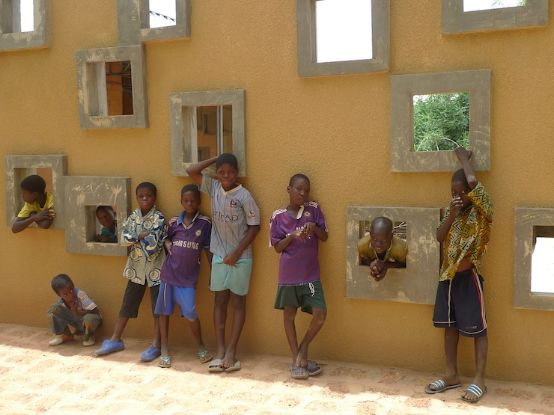
The Operndorf Afrika project was launched by Schlingensief in Burkina Faso at the beginning of 2010 as a place for international encounters. The government of Burkina Faso has made 20 hectares of land near the capital Ouagadougou available for this purpose. The village, designed by Burkinabe architect Francis Kéréhat, borders on a sculpture park that has been in existence for over 25 years.

Alten-Kulturstiftung honors Maki Wiederkehr

Solothurn pianist Maki Wiederkehr has been awarded the 2015 Kurt and Barbara Alten Solothurn Cultural Foundation Sponsorship Prize worth 20,000 francs.

Photo: Andreas Zihler

Maki Wiederkehr deserves the prize as special recognition of her outstanding achievements on the piano, writes the foundation. It should help the young artist to further refine her highly developed playing and realize new plans.

Maki Wiederkehr studied with Hiroko Matsumoto in Nagoya (Japan), then in Switzerland with Taeko Szedlak at the Musikschule Konservatorium Bern, at the Kantonsschule Solothurn with Adalbert Roetschi and at the Zurich University of the Arts (ZHdK).

She completed her studies in the soloist class at the ZHdK (from 2003) in winter 2008/2009 with a concert and teaching diploma under Homero Francesch. From 2010 to 2014 she taught piano at the Basel Music Academy. She now works at the Musikschule Konservatorium Zürich. She is also the pianist of the piano trio Rafale, which has won several international awards.

Every two years since 2003, the Kurt and Barbara Alten Swiss Cultural Foundation has awarded sponsorship and recognition prizes to artists with a close connection to the canton of Solothurn.

Donaueschingen fights against male dominance

Björn Gottstein, the new artistic director of the Donaueschingen Music Days, wants to actively ensure that women composers are given a greater voice. He is convinced that their share of current music production is still far too small. This year's Musiktage program proves him right.

Few women in the program. The enseble mosaik performs at this year's festival. Photo: Distruktur

"Since its foundation, the Donaueschingen Music Days have been dominated by male composers, the proportion of women is negligible," the German Press Agency quotes Gottstein, who took over from the late Armin Köhler. There are now concrete plans to give the popular new music festival a more feminine touch.

In the current edition of the festival - which takes place from October 16 to 18 and is already sold out - Olga Neuwirth is the only composer represented. She has analyzed the sound spaces of St. Mark's Basilica in Venice in the electronic studio and transformed them musically.

From October 16 to 18, the Donaueschingen Music Days 2015 will shed light on the relationship between new music and classical tradition with 18 world premieres and four sound installations.

"In the halls of the brain city"

A kind of music theater between poetry, image and improvised music with Jeannine Hirzel, Peter K Frey and Daniel Studer. Report from the world premiere on September 25 at Kunstraum Walcheturm Zurich.

Jeannine Hirzel, Peter K Frey and Daniel Studer. Photo: Dominic Büttner

A duo of double basses, starting in the depths and gradually spreading out over the course of the evening across a number of sound and noise registers, as two such excellent improvisers as Daniel Studer and Peter K Frey are capable of. The first sprinkles of a dreamlike, half-sleepy text by the poet Kurt Aebli are soon added via the loudspeakers - and soon noises too. From where? Is it important to know? The program booklet tells us: from a Zurich streetcar workshop. Would we have found out? What does this place of idle urban traffic and maintenance tell us? Are we moving somnambulistically through an imaginary city? Later, the first individual images will appear on the monitor, images of a landscape, an urban environment.

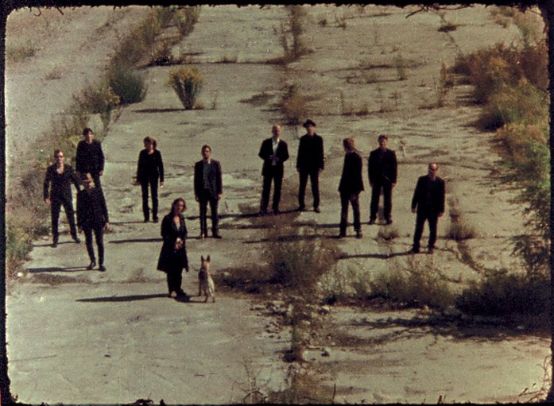
Finally, a cut: the singer Jeannine Hirzel appears, she plays no role, she sits down, sings the first meaningless sounds, then recites texts in a chanting voice, they are the ones we have already heard, which now occasionally sound back antiphonally from the loudspeakers. The individual images come together to form a film of stops - a film with a blurred, somewhat dreamlike patina. It comes from Super 8 recordings made by the architect Ernst Studer when he was developing utopian cities with wax figures at the ETH from 1975 to 1977.

Music, text, sound, song and film come together, and the music-theatrical piece that Peter Schweiger has staged slowly grows out of this. In the halls of the brain cityThe title is based on a passage by Aebli: "I was obsessed with the idea of words moving through the halls of my brain city a stream of strange people I let them have their lives their ugly shape rather groupings of letters and syllables that my hearing gave me that my eyes gave me that my heart my soul my body strictly took" ...

Grouping letters, syllables and words - and giving them meaning through the senses and the soul - is a simple way of paraphrasing what happened in this piece. For only perception soon created connections from the multimedia constellations. Pareidolically, it formed grammars and structures, established relationships and at the same time asked itself self-reflexively: Are there any relationships at all in the heterogeneity of these events? Is it not also about the self-perception of the perceiver? As in Aebli's text - and on stage. Suddenly we see the singer's face on the screen - via the camera. Later, we observe the two bassists as they play. This is how the piece looks at itself. Well, why this self-reflection, which always has a moment of embarrassment in it? Hasn't such magnifying and doubling self-reflection become blind? A nice accessory from the age of reflexivity - perhaps a little too much and unnecessary. But it was probably part of this "attempt to make the constantly reflected desire for perfection and its momentary failure or success tangible in the visually powerful design of a city of the future". According to the program text.

Was that it? The formulated intention was not clear enough to me personally. Overall, however, the half-awake tranquillity of the constellation was impressive, the intended "unsmooth" intensity, a great seriousness. The result was a coherent piece, even if it was hardly fulminant or lively; indeed, one might ask oneself whether it wasn't a little satisfied with its confused, cerebral coherence. In any case, it didn't jump up, didn't do any somersaults, certainly not mortali - maybe it didn't have to, maybe it didn't want to ...

If it wasn't blatant, it was perhaps groundbreaking. The key to this is provided by the inconspicuous subtitle: "Eine Spielanordnung". The "arrangement" indicates that something is pre-arranged here - as is not usually the case with freely improvised music. It is, however, in the sense of an arrangement to enable a dramaturgy and still give room for free interpretation. This doesn't seem to be particularly new, but it is central when it comes to incorporating vocals and lyrics: Because this is still not a matter of course in this genre, but a challenge that presupposes a linear fixation. Some earlier projects, such as those of the improv trio Karl ein Karl, of which Peter K Frey is also a member, have already led in this direction. With the music-theatrical arrangement and the free improvisation or their interplay, something peculiar emerges, a constellation that I would almost describe as essayistic music theater making.

Career boost for top young talent

Orpheum Soloists on Stage occupies a special position in the promotional landscape. Between the end of August and mid-September, four concerts were held at the Tonhalle Zurich featuring young soloists who are already well known.

Philippe Jordan, Nikolay Znaider and Kyoungmin Park. Photo: Thomas Entzenroth

 The Orpheum Foundation, which celebrated its 25th anniversary in September, praises itself as a "successful sponsorship model": "For young musicians, this not only means artistic encounters at the highest level, but often also a career boost," continues the foreword to the cultural magazine Du, which published a special edition. The anniversary was celebrated at a high artistic level with four major symphony concerts in the Tonhalle Zurich, a rather unusual manifestation of sponsorship worth millions.

On February 21, 1990, the Orpheum Foundation for the promotion of young soloists was founded in Zurich by Hans Heinrich Coninx, who was for many years president of the publishing house Tamedia AG. For some time now, the Orpheum Music Festival has been held every two years, and there have been a total of twelve events of this kind. The members of the 17-member board of trustees nominate young talents for inclusion in the Orpheum sponsorship program, who can perform with a renowned orchestra and conductor in the Tonhalle Zurich.

There are therefore no unknowns to be found in the Orpheum concerts. One example this year is the 22-year-old cellist Kian Soltani, who was accepted to the Basel Music Academy by Ivan Monighetti at the age of twelve and has since studied with Sol Gabetta and David Geringas. In addition to his Orpheum concert on September 6 with the Tonhalle Orchestra under Neville Marriner, he played at the Schubertiade in Hohenems and at the Kissinger Sommer, performed with Anne-Sophie Mutter's Virtuosi and interpreted Beethoven's Triple Concerto with Daniel Barenboim's West-Eastern Orchestra. So why Orpheum when soloists are already so well established in the concert world? Howard Griffiths, Artistic Director of Orpheum Young Soloists on Stage - as the event is now called - for 15 years, says of the current situation: "The competition is extreme and only artists with a very special character and the highest instrumental ability have a lasting career."

Orpheum is therefore not about conventional talent promotion, but about further career support. The list of soloists from the last 25 years includes such illustrious names as Renaud Capuçon, Alice Sarah Ott, Martin Grubinger and Baiba Skride. However, they have all only performed once at Orpheum, which inevitably raises the question of sustainability. Griffiths explains: "We use our network to place the musicians we sponsor with other orchestras and promoters, including other concerts in Germany, Russia, Switzerland and Austria. I myself regularly invite soloists to play with the Brandenburg State Orchestra, where I am principal conductor."

To mark the anniversary, they came up with something special and presented "two generations of Orpheum soloists", to put it somewhat exaggeratedly: The 40-year-old violinist Nikolaj Znaider, who joined Orpheum in 1996 and is now an established musician, played Mozart's Sinfonia Concertante in E flat major KV 364 together with the 25-year-old violist Kyoungmin Park. It was a successful performance on 4 September in the Tonhalle Zurich, in which the confident playing of the established violist harmonized well with the sonorous sound of the up-and-coming violist. In the middle register and when changing registers, the violist still had some minor difficulties, but these were covered up by the beautiful sound of the Vienna Symphony Orchestra. Philippe Jordan was on the podium and demonstrated his class as chief conductor of the Vienna Symphony Orchestra at the end with a brilliant interpretation of Beethoven's Symphony No. 7. The name "Jordan" has a resounding tradition at Orpheum, as Philippe's father, Armin Jordan, was one of the conductors from the very beginning.

Since then, much has changed in the music business, as Howard Griffiths pointedly describes: "There are many more highly qualified musicians, both technically and musically, especially from Asia, but also from Russia, Europe and the USA. The number of competitions and festivals has also increased. However, young soloists in particular are now faced with enormous challenges due to the financial restrictions that many orchestras and cultural institutions are struggling with. There is a danger that many talented artists are not given enough opportunities to build a sustainable career." Orpheum wants to make a contribution, which now includes a cooperation with the CD label Sony, which will release recordings by the Orpheum soloists.

Endo Anaconda receives the Bern Music Prize 2015

The 2015 Music Prize of the Canton of Bern, endowed with CHF 20,000, goes to Endo Anaconda, known for the group Stiller Has. Musician, composer and performer Lilian Beidler, accordionist Mario Batkovic and techno pioneer Marco Repetto each receive a recognition prize of CHF 10,000.

Photo: Michael Schär

Endo Anaconda, alias Andreas Flückiger, founded Stiller Has together with Balts Nill, alias Ueli Balsiger, in 1989. The musician with Austrian roots has close ties to the canton of Bern and is a figurehead of Bernese rock music. The ninth studio album by Stiller Has was released in 2013: "Böses Alter".

The composer and performer Lilian Beidler first attracted attention with large-scale acoustic environments, to which she now also contributes her body and voice as a performer.

In his accordion playing, Mario Batkovic mixes traditional Balkan songs with contemporary jazz and rock music and echoes influences ranging from Tom Waits and Astor Piazzolla to Johann Sebastian Bach.

As drummer for the post-punk band "Grauzone" around 1980, Marco Repetto captured the zeitgeist of the time and honed proto-techno tracks such as "Film 2". At the end of the 1980s, he became one of the most important protagonists of the emerging Swiss techno scene.

Pianist Gilles Grimaître will be awarded the "Coup de cœur 2015" prize for young talent in the amount of CHF 3,000.
 

Newly positioned southern German music academies

In future, musical skills are to be taught selectively in five state centers in the German state of Baden-Württemberg. However, the core areas of orchestra, piano and singing will continue to be taught everywhere.

The music academy in Trossingen. Photo: Gabriel Rinaldi, wikimedia commons

In Freiburg, a teaching and research center for music with a strong focus on musical practice and the subjects of musicology, music theory, music pedagogy and music physiology is being established. In Karlsruhe, the focus is on music journalism and music informatics. The Institute for Music Journalism, which offers multimedia training, and the Institute for Music Informatics have joined forces in this regional center.

A large conducting center is being built in Mannheim, covering choral conducting, orchestra/symphonic music, opera, avant-garde, conducting (amateur) wind orchestras and conducting jazz ensembles. Stuttgart is home to the "Campus Gegenwart" with a cross-disciplinary combination of the various artistic disciplines in art, research and education. New music (with electronic music/computer music, vocal art, new music theater), composition, jazz/pop, performing arts, speech art, musicology/music theory are brought together. The Academy of Fine Arts and the Academy of Media Arts, creative artists and the independent scene are also included.

In Trossingen, the focus is on the areas of music - design - performance. This takes into account the generation of digital natives, who often have a different musical socialization than the traditional clientele of a music university. Cooperation with Furtwangen University of Applied Sciences is a key component of this regional center.

The establishment of the regional centers is intended to be permanent. In order to finance them, a pool of positions has been created for which the state is providing five W3 professorships and a further five mid-level positions (E13) for five years. The universities of music each contribute two W3 positions to this pool.
 

Exuberant, visionary and with a video message

The "ZeitRäume" festival in Basel: Impressions of the 1st Biennale for New Music and Architecture.

Opening concert on Münsterplatz. Photo: Martin Schmid

With over 1200 participants, the 1st Biennale for New Music and Architecture in Basel involved many young people in particular. Over the extended weekend from September 10 to 13, 6,500 concertgoers and around 14,000 listeners attended the free performances. The 12 projects with around 140 performances took place at 21 different venues and 26 works were premiered. It was a huge logistical challenge for festival director Bernhard Günther and production manager Anja Wernicke to coordinate all the participants and make the various spaces accessible for the artistic idea. The festival program really overflowed, with many exciting events running in parallel.

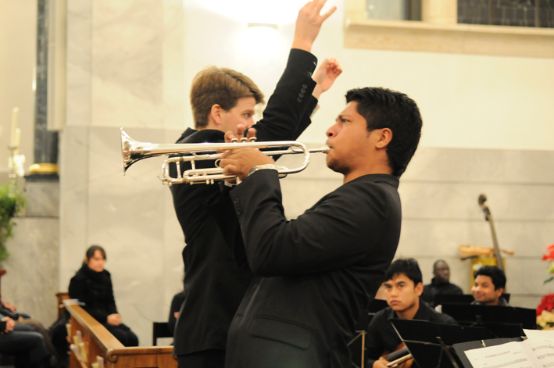
The young drummers from all over Switzerland kicked off the event, and the weather played along: The quiet Münsterplatz with its noble houses was transformed into a space for a loud drum and whistle concert, accompanied by live electronics. Basel drumming star Ivan Kym and East Tyrolean composer and performer Wolfgang Mitterer had rehearsed their new pieces and actions with the participants of the Swiss-wide drumming week on the Brünig. The performance in Basel was well prepared and the drummers' precision was astonishing. The audience was there - naturally including many parents and siblings of the participants.

The audience then entered the venerable cathedral, which for once provided space for new music. The British composer James Clark (*1957) had conceived a piece especially for Raumklang Basel that divided the 300 singers from five grammar schools into six choirs: in front, behind and to the left and right of the audience. The ensemble of eight trombones, the Trombone Unit Hannover, was spread across the galleries. What was surprising was that the choirs under the direction of Oliver Rudin not only sang, they also shouted and called out in a simple sequence. Wine glasses filled with water were gently swirled, wine bottles were blown into and clapped. This half-hour performance was original, the high Münster filled with vital energy, powerful and poetic sounds, agitations and counter-reactions.

A visionary project was Chronos in the newly renovated Volkshaus. A revolving stage was installed in the middle of the auditorium; the composers Beat Furrer, Thomas Kessler, Beat Gysin and Georg Friedrich Haas explored this special performance situation. On one occasion, the audience sat on the revolving stage and the musicians played in the middle and outside the audience circle. For another piece, the audience moved to the gallery and the music took place on and next to the revolving stage. Michael Simon's lighting direction provided cool white.

Beat Gysin (*1968) was structurally most intensively involved with the rotary movement in the commissioned work Chronos (radial) for ensemble and voices. He made the possibility of "driving around a center" and "turning around oneself" audible and tangible. With increasing tonal complexity and intensifying dramaturgy, he cast a spell over the audience on the revolving stage, and a kind of round dance unfolded. The Ensemble Recherche and the two singers Svea Schildknecht and Johanna Greulich almost fell into a trance.

The Swiss Grand Prix Music award ceremony took place as part of the premiere of this special Drehklang project. In a festive ceremony, Federal Councillor Alain Berset presented the CHF 100,000 prize to Heinz Holliger, who was streamed live from his tour of Japan.

German music retailers plan cooperative

20 German music retailers met in Fulda to discuss the establishment of a cooperative in the music retail sector. The groundwork for such a move was laid back in April of this year at the German music retail industry meeting in Frankfurt.

Photo: Richie Johns, flickr commons

According to the GDM, the participants at the meeting voted "overwhelmingly" in favor of founding a cooperative. It was made clear in Fulda that the aim was not just to achieve purchasing advantages when ordering goods. Rather, the cooperative should focus on carrying out marketing campaigns in partnership with suppliers and ensuring that active music-making is further promoted overall. Ultimately, this should "create more market for the entire industry".

One focus of the cooperative will be to expand its activities on the Internet. Plans for a uniform database that can be made available to all cooperative members were presented. Questions regarding a core product range and formal issues such as the amount of deposits and member liability were also discussed. The next step is for a competence team to draw up a business plan including financial planning.


Bach's Mass in B minor is a World Heritage Site

The autograph of Johann Sebastian Bach's Mass in B minor, BWV 232, together with documents on Luther's life and work from the Staatsbibliothek zu Berlin - Preussischer Kulturbesitz (Berlin State Library - Prussian Cultural Heritage), has been inscribed on the UNESCO World Heritage Register.

Page 1 of the autograph, Kyrie, detail. Illustration: Staatsbibliothek zu Berlin - PK

The autograph mass is part of the library's large Bach collection, which contains around 80 percent of all of the master's surviving compositions. The music collection also contains the autograph of Ludwig van Beethoven's Symphony No. 9, which was inscribed on the World Heritage Register in 2001.

He completed the Mass in B minor, Bach's last choral work, shortly before the end of his life in 1748-49, thus completing his mastery. Bach used historical and modern movement types, forms and compositional techniques in his mass. Bach's exploration of traditional patterns on the one hand and the use of modern compositional techniques on the other in a single work, the Mass in B minor, is a unique feature.

This only complete score from Bach's lifetime is written in ink on paper; Bach used 99 leaves and four title pages. It is not dated by the master himself, but it can be determined by comparing the handwriting.

Among the twelve documents newly added to the Unesco register are also those that bear witness to Martin Luther's work as a pioneer of the Reformation in the early 16th century: one of the rare poster prints of the 95 Theses on Indulgence and Luther's hand copy of the Hebrew Bible edition. They are also in the possession of the Berlin State Library.

Lucerne Festival Ark Nova in Fukushima

From October 24 to November 3, 2015, the Lucerne Festival Ark Nova mobile concert hall will be used for the third time, this time in Fukushima. Once again, a music festival featuring traditional Japanese music and European classical and jazz musicians will take place.

Lucerne Festival, Ark Nova 2014 © Yu Terayama | Till Fellner

Concert performers include the solo flutist of the Lucerne Festival Orchestra Jacques Zoon, the Japanese pianist Kazune Shimizu, a wind ensemble of Lucerne Festival Orchestra soloists led by solo trumpeter Reinhold Friedrich, the winner of the 2010 Chopin Competition, pianist Yulianna Avdeeva, I Musici of the Conservatorio Santa Cecilia in Rome and the Swedish saxophonist Magnus Lindgren.

The Lucerne Festival Ark Nova is the first mobile and inflatable concert hall. It was initiated by Michael Haefliger, Artistic Director of the Lucerne Festival, the Japanese star architect Arata Isozaki, the British artist Anish Kapoor and the Japanese concert agent Masahide Kajimoto and was built for the first time in 2013.

The basic idea of Ark Nova is to bring courage and confidence to the people during the reconstruction in the Japanese region of Tōhoku affected by the disaster of March 11, 2011. An ensemble of soloists from the Lucerne Festival Orchestra already performed in the mobile concert hall in Matsushima in 2013 and in Sendai in 2014.

Andres Bosshard honored in Denmark

Swiss sound artist Andres Bosshard has been awarded the Aarhus 2017 Prize, endowed with 30,000 Swiss francs. He won the award with "The Sonic Arc". The sound project will be presented in 2017, when the Danish city of Aarhus is the European Capital of Culture.

Andres Bosshard with the Aarhus Prize (Photo: Niels Aage Skovbo)

Andres Bosshard plans and creates the work with the inhabitants of Aarhus and the Midtjylland region. According to the jury, it is this citizen-oriented collaboration, for which Andres Bosshard's works are known, that was ultimately decisive for the choice.

"With the winning project 'The Sonic Arc', the European Capital of Culture Aarhus 2017 receives a unique and poetic work of art that involves and moves many people in a completely unique way," the jury stated in its statement. Bosshard prevailed against 31 competitors from all over the world.

Andres Bosshard was born in 1955 and lives and works in Zurich. He graduated as a painter, but began experimenting with music and theater at an early age. He developed circling sound objects, interactive computer music, programs and sound installations, such as the "Sound Tower" on Lake Biel at Expo.02

get_footer();