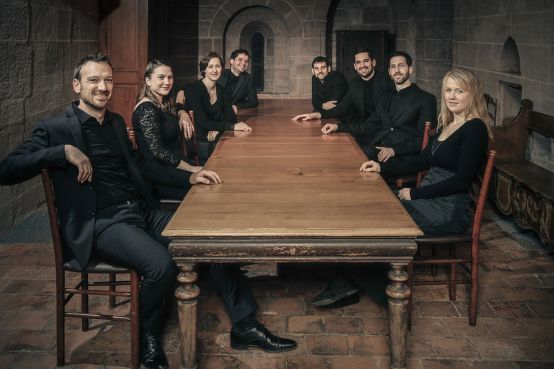
Anna Gebert teaches in Basel

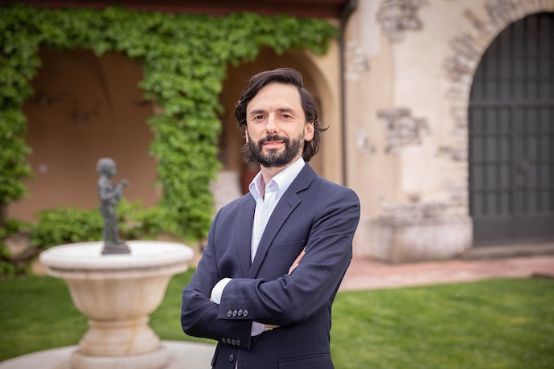
The FHNW Academy of Music/Basel Academy of Music has appointed Anna Gebert as its new Professor of Chamber Music. She will teach at the Department of Classical Music from the 2021/22 academic year.

Photo: FHNW

Anna Gebert was a scholarship holder of the Karajan Academy of the Berliner Philharmoniker Foundation from 2005 to 2007 with a subsequent one-year contract as a permanent assistant with the Berliner Philharmoniker.

From 2011 to 2018 she was first concertmaster of the Trondheim Symphony Orchestra and from 2007 to 2011 deputy concertmaster of the Gürzenich Orchestra Cologne. She has been a lecturer at the Zurich University of the Arts since 2020.

Gerzenberg Winner of the Concours Géza Anda

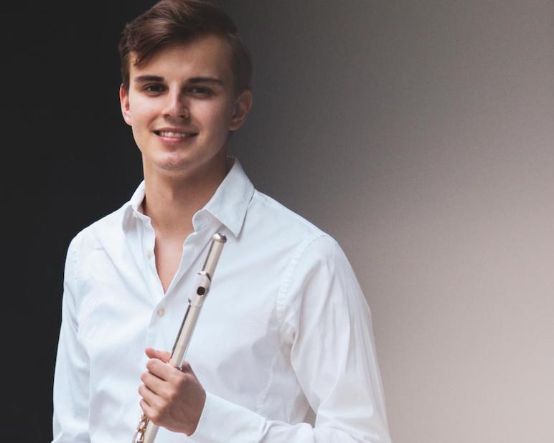
Anton Gerzenberg, born in Hamburg in 1996, is the winner of the Swiss Concours Géza Anda. The second prize, the audience prize and the prize for the best Mozart interpretation go to Julian Trevelyan from the UK.

Anton Gerzenberg. Photo: © Géza Anda Foundation/Dmitry Khamzin, 2021

The third prize was won by Marek Kozak from the Czech Republic. The first prize is endowed with 40,000 francs, the second with 30,000 francs and the third with 20,000 francs. 36 musicians were admitted to the Zurich competition.

Anton Gerzenberg is the son of pianist Lilya Zilberstein. He also performs as a duo with his brother Daniel Gerzenberg and founded the ensemble for new music ÉRMA in 2019.

The Géza Anda Foundation was established in 1978 in memory of the pianist Géza Anda, who died in 1976, by his widow Hortense Anda-Bührle. It aims to promote young pianists in the musical spirit of Géza Anda and has therefore organized an international piano competition in Zurich every three years since 1979. The Géza Anda Foundation undertakes to accompany prizewinners for three years as a mentor and, among other things, to provide performance opportunities.

Rossini in Romansh

Under the direction of Claudio Danuser, "La Cambiale di Matrimonio" will be performed ten times this summer with local artists in Zuoz, Sils, St. Moritz, Arosa, Stampa and Ardez - for the first time in Romansh.

The area near Sils, also the venue for "La spusa chapriziusa". Photo: maxxup/unsplash.com,SMPV

The Opera Engiadina Association was founded in January last year as the successor to Opera St. Moritz AG and the Opera Club. It runs the Cor Opera Engiadina, the Opera Forum Engiadina with smaller events throughout the year and the Opera Engiadina Festival, which takes place every summer. The latter alternates between opera productions and opera choir concerts. Festival director and vice-president of the association is Claudio Danuser.

The concerts planned for 2021 had to be postponed until next year due to coronavirus. However, Rossini's opera "La Cambiale di Matrimonio" will be performed in Romansh for the first time as "La spusa chapriziusa". The plot, directed by Ivo Bärtsch, will be supplemented with dialog in German. The ensemble (Sara-Bigna Janett, Gianna Lunardi, Daniel Bentz, Flurin Caduff, Chasper-Curò Mani, Martin Roth) and the Kammerphiharmonie Graubünden will be conducted by Claudio Danuser.

Further information and performance dates:

www.operaengiadina.ch
 

Swiss Orchestra becomes Andermatt's house orchestra

Lena-Lisa Wüstendörfer's Swiss Orchestra will become the resident orchestra of the Andermatt Concert Hall. The Swiss conductor will also take over the directorship of Andermatt Music from January 1, 2022.

Lena-Lisa Wüstendörfer conducts the Swiss Orchestra. Photo: Dominic Büttner

As the new resident orchestra of the Andermatt Concert Hall, the Swiss Orchestra combines Swiss symphonic music with repertoire works. The orchestra is accompanied by renowned soloists. Members of the orchestra now also perform in chamber music concerts.

From January 1, 2022, the Swiss conductor and musicologist Lena-Lisa Wüstendörfer will take over the concert operations of Andermatt Music on behalf of Andermatt Swiss Alps. This means that concerts will take place in the alpine concert hall all year round. The artistic strategy with three program levels is planned for at least five years. The existing artistic director team from England will continue to be responsible for the current programs until the end of 2021.

Andermatt Swiss Alps will also become a platform for local music, with performances by bands from Uri and classical family concerts. The "Young Artists" format to promote young artists will be continued. Finally, international orchestras, conductors and soloists will perform in Andermatt.


Suisa annual result

Income for composers, lyricists and publishers of music fell by CHF 16.8 million. And the difficult situation is set to continue.

Photo: Claudio Schwarz/unsplash.com (see below)

In 2020, income from copyrights in Switzerland and abroad amounted to CHF 144.1 million. This is CHF 16.8 million or 10.5% less than in the previous year (CHF 160.9 million). Accordingly, composers, lyricists and publishers of music will receive less money from copyrights: CHF 120.4 million can be distributed to rightholders in 2021 - almost CHF 15 million less than last year.

As expected, revenue fell primarily in the area of performance rights: while revenue in this area amounted to CHF 52.1 million in 2019, it was CHF 34.4 million in 2020, i.e. CHF 34% less. This decline was mainly due to the concert sector, where income fell by CHF 51%, from CHF 23 million in 2019 to CHF 11.4 million in 2020. In the hospitality sector, income fell from CHF 3.7 million to CHF 1.99 million. CHF 3.7 million to CHF 1.99 million (-46%), for entertainment events it fell from CHF 2.36 million to CHF 1.24 million (-48%) and for cinemas from CHF 2.6 million to CHF 1.07 million (-58%).

Suisa was only able to partially offset this decline in other areas. Income from broadcasting rights rose slightly from CHF 63.6 million in the previous year to CHF 64.3 million in 2020. The feared declines, e.g. due to lower advertising income from television and radio stations due to the cancellation of major events, did not materialize for the time being.

Revenue in the online sector also increased last year, from CHF 14.5 million to CHF 17.1 million (+17.4%). This is due in particular to higher income from the subsidiary Suisa Digital Licensing and Mint Digital Services, the joint venture with the US company Sesac.

Suisa is also expecting less income for composers, lyricists and music publishers this year and next. It will take months, if not years, before concerts and major events with music can be held again on the same scale as before the pandemic.

Annual Report 2020: www.suisa.ch/geschaeftsbericht

Detailed article on the annual results: https://blog.suisa.ch/de/ein-beachtliches-ergebnis-trotz-covid/


Neuronal mechanisms of music learning

The Max Planck Institute for Empirical Aesthetics is expanding its spectrum: under the direction of Fredrik Ullén, the Department of Cognitive Neuropsychology is researching the neuronal mechanisms underlying the acquisition of musical skills and creativity.

Prof. Dr. Fredrik Ullén is the new director at the MPI for Empirical Aesthetics. Photo: Sara Appelgren,SMPV

The Swedish pianist and cognitive scientist has accepted the call to the Max Planck Institute for Empirical Aesthetics on April 1, 2021. As Director of the new department, he will initially direct the research there on a part-time basis, then full-time from September 2021.

Ullén's interests include the connections between cultural engagement, mental well-being and health, as well as the complex interaction between genetic preconditions and environmental factors in musical expertise.

Fredrik Ullén was born on April 13, 1968 in Västerås, Sweden. He received his doctorate from the Karolinska Institute in Stockholm in 1996. He was appointed Associate Professor there in 2006 and Full Professor of Cognitive Neuroscience in 2010.

In addition to his academic career, Fredrik Ullén is an internationally recognized concert pianist. He completed his piano studies at the Royal College of Music in Stockholm in 1993. His discography currently comprises 25 titles, including complete recordings of György Ligeti's piano works and Sorabji's "Transcendental Studies", one of the greatest cycles ever written for piano solo.

ZHdK Rector Meier announces his resignation

Thomas D. Meier has announced his resignation as Rector of Zurich University of the Arts (ZHdK) at the end of September 2022. By this time, the content of the major study reform project Major-Minor initiated by Thomas D. Meier will have been finalized and will be implemented.

Photo: Regula Bearth © ZHdK

Born in Basel in 1958, Thomas D. Meier worked as a research assistant at the University of Bern and in public relations and as a member of the museum management team at the Bernisches Historisches Museum. From 1996 to 2003, the doctor of history and English was director of the Museum of Communication in Bern, and in 2003 he was elected director of the Bern University of the Arts.

He was President of the Conference of Swiss Universities of the Arts from 2004 to 2011, President of the Rectors' Conference of Swiss Universities of Applied Sciences in 2013 and 2014 and a member of the board of the swissuniversities association, which was responsible for preparing the future joint Rectors' Conference of Swiss universities. Thomas D. Meier was elected Rector of the Zurich University of the Arts by the Zurich University of Applied Sciences Council in December 2008 and is currently in his third term of office.
 

Five percent fewer cultural professionals

In 2020, the number of cultural professionals fell by 4.7% compared to the previous year. In rural municipalities, the decrease was almost three times as high as in cities. Women and cultural professionals with part-time jobs are more affected.

Photo: Sebastian Schuppik / unsplash.com (cropped, see below)

For those employed in a cultural profession in the cultural sector (e.g. musician in an orchestra), the decline was more or less limited (minus 1.8 percent), whereas for non-cultural professions in the cultural sector (e.g. accountant in a theater), the decline was much greater at 6 percent, and for cultural professions outside the cultural sector (e.g. graphic designer in a bank) it was even higher at 7.8 percent.

In 2020, 298,000 people were counted as working in the cultural sector in Switzerland. This is 4.7% fewer than in 2019, when there were still 312,000. This is the sharpest decline since 2010. The decline recorded in 2016 and 2017 was significantly lower. On average, however, the number of cultural professionals grew by 1.3% per year until 2019.

Original article:
https://www.bfs.admin.ch/bfs/de/home/aktuell/neue-veroeffentlichungen.assetdetail.17224093.html

Is the cultural sector systemically relevant?

Are there trends that are emerging for the creative economies as a whole? And if so, what does this mean for employment figures? The Zurich Centre for Creative Economies (ZCCE) presents its latest analyses.

Photo: Damjan Dobrila / unsplash.com (see below)

In the first research note, Frédéric Martel, Roman Page, Christoph Weckerle and Simon Grand make a historical comparison with the Great Depression in America, before using qualitative interviews in the second part of the study to provide initial perspectives from the present. The third paper focuses on current statistics on the creative industries in Switzerland. And finally, the fourth research note looks at structural changes: What answers do the creative economies have to the challenges of the crisis?

Researchers at the ZCCE have been analyzing statistical data since 2003 in order to make the dimensions of the creative economies visible. They are now using their methods to measure the potential impact of the coronavirus crisis on the labor market.

Original article: https://zett.zhdk.ch/2021/05/25/ist-der-kulturelle-sektor-systemrelevant/


Singing out of faith

Anne Smith has dedicated a biography to Ina Lohr, the pioneer of early music and formative personality in Basel's music history. Unfortunately only in English.

Basel, the cathedral in the background. Photo: Corina Rainer / unsplash.com

Musical life needs personalities who normally escape the focus of popular music history because they have left no significant mark either as performers or composers. They work as church musicians, music teachers, music researchers or program managers. The Dutch-born musician Ina Lohr (1903-1983) made her mark on Basel's musical life in all four of these areas. She grew up in a culturally-minded and music-loving family and acquired a broad musical education at an early age. She came to Switzerland in 1929 to study composition. Ina Lohr was one of the founders of the Schola Cantorum Basiliensis and was a highly regarded lecturer in basso continuo, Gregorian chant, hymnology and domestic music. She was also a keen advocate of the renewal of church music in the period around the Second World War. Making music with lay people was particularly close to her heart, and singing together as a congregation met an essential need for her as a believing and therefore singing Christian. This mission led her to teach at the Faculty of Theology at the University of Basel and to give numerous courses and lectures to mixed and specialist audiences on fact-based yet contemporary church music. She was also interested in improving music and recorder teaching in public schools. As a decades-long collaborator of Paul Sacher in organizing the concerts of the Basel Chamber Orchestra, as a rehearsal preparer and rehearser of this choir, she contributed significantly to the success of Sacher's concert enterprise throughout almost its entire existence. Lohr, who championed Honegger, Krenek, Milhaud and especially Stravinsky, also proved to be an expert in new and contemporary music from the very beginning.

So it was high time that a female author delved into the life and various fields of activity of Ina Lohr, who shaped musical life in Basel for half a century and was one of the pioneers of early music! Anne Smith, herself a teacher at the Schola Cantorum Basiliensis for almost forty years, has now published a comprehensive biography of this musician, who has also escaped women's music history, and has read countless letters, conducted interviews and compiled musical sources.

Reading the book, one gains an impression of the willpower and hard work of an admirable musical personality, but also of her crises, some of which were caused by illness. At the same time, it provides insights into little-known facets of musical life in Basel and the history of the Schola Cantorum. In her monograph, Anne Smith places a clear emphasis on Lohr's changing relationship with Paul Sacher, with whom she worked in various institutions. Not only does Lohr's contradictory personality come to life, but Sacher also appears in a remarkably new light. Although all the texts are also quoted in the original languages, the publication would benefit from a translation into German.

Image

Anne Smith: Ina Lohr (1903-1983). Transcending the Boundaries of Early Music (Schola Cantorum Basiliensis Scripta 9), 514 p., Fr. 82.00 (print), Fr. 66.00 (e-book), Schwabe, Basel 2020, ISBN 978-3-7965-4106-3

Of the chambered stag and slender songs of destiny

Mendelssohn's setting of the 42nd Psalm as well as "Nänie", "Rhapsodie" and "Schicksalslied" by Brahms have been published in new versions with reduced orchestral parts.

Photo: Luka/stock.adobe.com

Oversized orchestral oratorios have been a problem for today's choirs, which no longer consist of 200 or more singers as they did in the mid-19th century, and not just since the coronavirus.

The Carus series "Great Works in Small Orchestration" takes this into account: for example, with the exemplary new chamber orchestra edition of the popular Mendelssohn psalm cantata How the stag cries by Jan-Benjamin Homolka. It retains the original sound, but reduces the wind section to a quintet for reasons of balance.

Image

The Doblinger publishing house in Vienna is taking a different approach, having recently published three magnificent Brahms works in "chamber versions": Naniewhich Alto rhapsody and the Song of Destiny. Urs Stäuble has created intelligent arrangements for string quintet and flute, which contain all the important musical elements in a sophisticated way, even if the smaller instrumentation reduces the spectrum of instrumental timbres. For example, haunting timpani passages are excellently replaced by the pizzicato of the cello in the lower register. The chorus and thus the poetry of Schiller and Goethe come across all the more forcefully in these arrangements. - A side effect that should not be underestimated.Image

Really worthwhile purchases for ambitious chamber choirs who want to create oratorio masterpieces at low cost and with low personnel expenditure.

Felix Mendelssohn Bartholdy: The 42nd Psalm, Wie der Hirsch schreit, MWV A 15, arranged for chamber orchestra by Jan-Benjamin Homolka; score, CV 40.072/50, € 43.00; piano reduction, CV 40.072/03, € 9.50; Carus, Stuttgart

Johannes Brahms: Schicksalslied, for choir and chamber ensemble arranged by Urs Stäuble; score, D 46 102-PA, € 18.95; set of parts, D 46 102-ST, € 29.95; Doblinger, Vienna

Id.: Nänie; score, D 46 100-PA, € 14.95; set of parts, D 46 100-ST, € 24.95

Id.: Rhapsody; score, D 46 101-PA, € 14.95; set of parts, D 46 101-ST, € 24.95

Death of guitarist Urs Vögeli

According to a press release from SRF 2 Kultur, the Schaffhausen guitarist Urs Vögeli, who was also a member of the Schaffhausen Jazz Festival management team, has died at the age of 45.

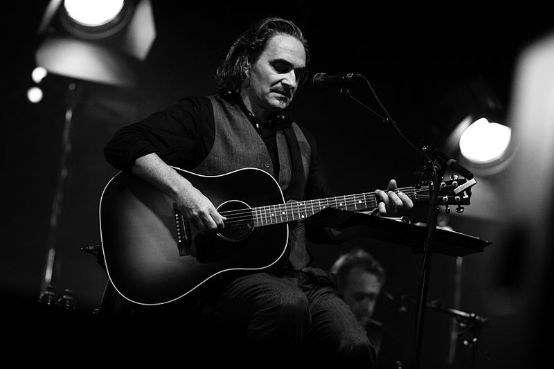
Photo: Sabrina Niederer

Born in 1976, Vögeli lived in Schaffhausen and graduated from the Lucerne School of Music. In addition to the guitar, he also plays the dobro, lapsteel and banjo. His musical versatility brings him together with musicians from various fields.

In addition to his jazz quartet "flyOut", he worked with the jazz crossover band "Ghost Town" and as a solo artist "Voegeli Solo", and was a member of the space folk combo "Grünes Blatt". He has performed as a guest artist with the Zurich Free Opera and the Ensemble for New Music Zurich, among others.

Vögeli has played concerts and tours with Sylvie Courvoisier, Bugge Wesseltoft, Elina Duni, Corin Curschellas, Hendrix Ackle, Vera Kappeler, Andreas Schaerer (Hildegard Lernt Fliegen), Julian Sartorius. Christian Weber and many others. He has received awards from the City and Canton of Schaffhausen and the International Lake Constance Conference (IBK).
 

Music-loving animals

Videos of dogs playing the piano or cats meowing melodies are watched millions of times on YouTube. But beyond manipulation and the transfer of human perspectives, it can be assumed that the animal world is probably not very fond of music.

Paul Barton plays Beethoven for the elephants. Do they get anything out of it? Photo: P. Barton
Musikliebende Tiere

Videos of dogs playing the piano or cats meowing melodies are watched millions of times on YouTube. But beyond manipulation and the transfer of human perspectives, it can be assumed that the animal world is probably not very fond of music.

If you play a C followed by a D on the piano, the probability that your cat's subsequent meow will be exactly the same pitch as an E is about the same as a red car passing by after you have already seen a blue and a white one. However, considering that there are far fewer car colors than possible frequencies of cat meows, it is far less likely that your pet will continue the scale than that a motorcade will complete the colors of the tricolor. In order to get cats to follow the traditional pitch steps of human music, Pavlovian training methods could be used to learn thirds or fifths. However, the most commonly used method today remains video manipulation. This is more ethically justifiable, but supports the prejudice that animals are fundamentally irrelevant when it comes to music. Some Youtubers have uploaded videos with the title "cat perfect pitch" and waited for their cat to make a C sound. They then added this as the final note after the played series C-D-E-F-G-A-H. Or they adapted the meowing electronically to the played scale. What makes these little films so fascinating, even if they are fake, is that they feed the illusion - and thus underline the impossibility - that cats could have an idea of harmonic correctness. Unless they always meow at this pitch or are sufficiently trained. Assuming other "paw whisperer" hypotheses, the discussion could be taken a little further, disingenuously and more or less parodically: Perhaps cats don't meow at the right pitch because they have a completely different musical sensorium to us. Or maybe they don't want us to notice that they have a soft spot for Puccini operas. Or even: fortunately, they are not as stupid as humans, who consider absolute pitch to be a gift of nature.

Autotune and songbirds

Videos that play the gentle howling of a dog over autotune suggest that dog singing can only be perfect with technical support. The musicality of the animals therefore depends on special effects. The animal-plug-in combination is a 2.0 version of anthropomorphism that likes to limit itself in order to survive. The birds that sing best are not necessarily the most popular with those that are less good at it (to fit the hypothesis according to which "nature does not so much take back its rights as reinvent its tasks, to the extent that it obliges us to listen to the birds that sing less clearly, masked by the screamers"). {Note 1} In any case, the selection of songbirds is obviously based on human music criteria. François-Bernard Mâche puts them on a human scale: "Of the 8700 or so bird species, 4000 to 5000 are songbirds. Of these, 200 to 300 have such varied songs that they are musically interesting. Incidentally, that's 50 to 100 times the percentage of professional musicians in relation to the total population of France."{Note 2} Like the attempts of Youtubers who trim their cats and dogs to Pavarotti, François-Bernard Mâche's efforts to play with the musicality of birdsong also fall into the category of technical manipulation. For example, when he arranges a more or less representative selection of bird calls over a harpsichord score.

Beethoven for elephants

When you see a dog on YouTube playing the piano without any manipulation, you are amazed, not just amused. Does this dog like the piano or, more precisely, does it think it is a human? Is it a trained dog or one that spontaneously wants to play music? Even without a direct command from his master, his behavior is copied from the musical people he lives with. Videos with animals that seem to love musical situations are extremely popular. The camera angles are therefore chosen in such a way that they seem to confirm the musicality of the animals. But despite all the emotion about a little film showing elephants gathered around a piano on which Paul Barton plays them the Pastoral anyone can ask themselves whether the elephants really love Beethoven or rather the apples lying around the piano. Perhaps it is elephants who, beyond Barton's piano skills, like the exchange between different animal species. If there is anthropomorphism here, if the fixation on humans distorts the interpretation of the situation, then perhaps these open-air concerts prove less the animals' affinity for music than the pianist's empathy for the elephants. Playing Beethoven to someone is a sign of sympathy and is perceived as such. The official stories about these videos with hundreds of thousands of clicks are nourished by a logic of care. These are maltreated animals being rehabilitated in a park in the Thai province of Kanchanaburi. Paul Barton's recitals are a therapy to "rebuild their physical health and their souls".{Note 3} The belief in the beneficial effect of music on the animals is certainly a decisive element in the bond that the pianist is able to forge with the elephants, even without proof that Beethoven or Chopin exerts a visibly healing power on the animals. After all, these concerts are musical performances by a person who detaches himself from other people and would rather play to the pachyderms than to his music-loving fellow human beings.

{Notes}

1 Cora Novirus, "Oiseaux et drones", Multitudes n° 80, Fall 2020, p. 150
2 François-Bernard Mâche, Musique - Mythe - Nature, Éditions Aedam Musicae, 2015, p. 116
3 Paul Barton, cité par Philippe Gault, "Les singes affamé en Thaïlande, apaisés par Beethoven grâce au pianiste Paul Barton", www.radioclassique.fr


 David Christoffel

... is a poet and composer, radio producer and researcher. He is dedicated to poetry and music in specific environments.

Kategorien

A panorama of expressions

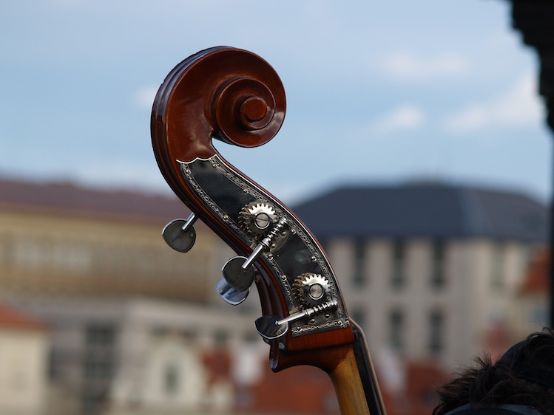
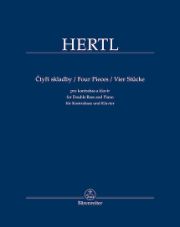
In his "Four Pieces" for double bass and piano, written in 1968, František Hertl explores the sound palette of his instrument to its extremes.

Double bass player on the Charles Bridge in Prague. Photo: Paulwip / pixelio.de

The composer, who was born in 1906 in West Bohemia and died in Prague in 1973 after a musically varied life, is best known as the author of the Sonata for double bass and piano, written in 1946. He also made a name for himself as a formative double bass teacher of the Prague School, as a composer for various chamber music ensembles and orchestral works and as a conductor.

While the Sonata for Double Bass and the rarely performed Double Bass Concerto mostly move in chromatically extended tonality, the Four pieces more in the direction of a modality based on fourths and fifths. With its concise rhythms, the refreshingly rapid succession of contrasting dynamics, the contrasting tempi and the tonal shifts between light and dark, expressive and impressionistic, her tonal language can be seen as connected to tradition, yet individual and at home in the 20th century.

The Prelude (Moderato to Allegro) explores the extremes of dynamics and articulation. The Burlesque in ABA form begins with playful, Scherzo-like staccatos in the piano and ends in an exaggerated stretto in fortissimo. The fine, cantabile Nocturne follows a Tarantella. František Hertl skillfully plays with its idiom and uses dissonances to lend it an expressiveness that goes far beyond the entertaining.

Editorial errors are to be regretted. Presumably the original printing plates were copied without proofreading, resulting in accidental errors as well as incorrect notes and slurs and the corresponding need for detective work. In view of the technology available today, it is incomprehensible that the piano score in the Prelude the double bass part is notated in the octave, but in the other three pieces it is notated a major second lower or a minor seventh higher than the actual sound, i.e. the notation required for the solo double bass in D is adopted. In his arrangement, Stefan Schäfer has limited himself to a few technical bowing recommendations in favor of interpretative freedom.

The new edition enriches the otherwise not too abundant chamber music repertoire for double bass players.

Image

František Hertl: Four pieces for double bass and piano, double bass part arranged by Stefan Schäfer, BA 11556, € 18.95, Bärenreiter Prague

Animals

On the relationship between animals and humans in relation to music.

Cover picture: neidhart-grafik.ch
Tiere

On the relationship between animals and humans in relation to music.

All articles marked in blue can be read directly on the website by clicking on them. All other content can only be found in the printed edition or in the E-Paper.

Focus

Does this donkey sing?
Making music does not seem to be reserved for humans. Interview with cultural anthropologist Britta Sweers

Bestiaire musical
Comment les compositeurs mettent-ils les animaux en musique

Cool cats, bad dogs
Animals often have to lend their heads to sung metaphors

Les animaux mélomanes
Entre trucages et anthropomorphisme
Music-loving animals - between trick and anthropomorphism (translation)

The singing Dr. Dolittle
Roland Zoss and his animal songs


Anyone interested in birds and music will find reading material on the topic of "twittering" in issue 4/2016.

La RMS parle du sujet de ce numéro à la radio :
Espace 2, Pavillon Suisse, mardi 25 mai 2021, de 20h à 22h30

from 2:03:30


... and also

RESONANCE

Radio Francesco - le coeur / the heart

Clavardon's... - au sujet de la Cité de la musique de Genève

A vos partitions ! - le Festival International de Musiques Sacrées Fribourg et son concours de composition

Contemporary melancholy - Wittener Tage for new chamber music

Carte blanche for Wolfgang Böhler

CAMPUS


Honorary doctorates for Harald Strebel and Rudolf Lutz
 

FINAL


Riddle
- Torsten Möller is looking for


Row 9

Since January 2017, Michael Kube has always sat down for us on the 9th of the month in row 9 - with serious, thoughtful, but also amusing comments on current developments and the everyday music business.

Link to series 9


Download the current print edition

Here you can download the current issue. Please enter the search term "e-paper" in the print archive.
The download is free of charge for subscribers.

All other interested parties will receive the PDF of the current issue (or an earlier issue) by e-mail. Costs: Fr. 8.-.
Click here to order the e-paper.

We are also happy to send you the printed version. Costs: Fr. 10.-
Click here to order the printed edition.

Kategorien

get_footer();