

Reorientation of the "Days for New Music"
As part of a three-year pilot project, Zurich's "Tage für Neue Musik" festival for contemporary music is to be given a new direction in terms of content. The city's culture department would like a new private sponsor.






According to its press release, the City of Zurich is looking for a sponsor for the current "Tage für Neue Musik" for the years 2021 to 2023. The aim of this pilot project is to reorganize and reposition the festival in terms of both content and form. A suitable operating and program concept will be selected by a committee of external experts established for this purpose and chaired by the Director of Culture of the City of Zurich.
The city is supporting the festival during the three-year pilot phase with a one-off contribution totaling CHF 850,000. This is divided into an initial contribution of CHF 100,000 in 2020 and operating contributions of CHF 250,000 for each of the years 2021 to 2023. The festival will be evaluated during the pilot phase. Afterwards, further support from the city in the form of annual operating contributions can be reviewed and applied for from the relevant authorities.
The festival for contemporary music has been held annually since 1986. Due to limited financial resources, it was switched to a biennial rhythm in 2016. The reaction of the music scene and the experience with the replacement festival "Focus Contemporary Zurich West" in 2017 showed that an annual festival of contemporary music is highly valued in Zurich. The aim of this pilot project is to examine and evaluate a new direction for the content of the festival.
Link to the invitation to tender
Valais supports organizers
The services of the State of Valais will pay the amounts promised to the organizers of cantonally supported events, even if they have to be cancelled due to the coronavirus epidemic.
The costs arising from the postponement of an event are also taken into account according to the canton's avoidance notice. Subsidies for a canceled or postponed event can only be paid in the event of a deficit.
The State of Valais supports numerous events by granting subsidies, particularly in the areas of tourism, culture and sport. It undertakes to maintain the payment of the amounts granted for each event canceled or postponed due to the coronavirus epidemic.
In the event of cancellation, the promised grants will be retained by the beneficiaries, provided they relate to the costs incurred that have already been paid or still have to be paid.
In the event that the event in question is postponed, the amounts committed for the expenditure on the new date will be retained. Expenses incurred for both the originally planned and the postponed edition can be taken into account when proving the costs incurred. However, any losses from previous editions cannot be taken into account.
The departments concerned will make the promised payments, subject to compliance with the official recommendations by the organizers at the time of the decision to cancel or postpone the event. The link between this decision and the coronavirus epidemic must also be clear.
Picture credits
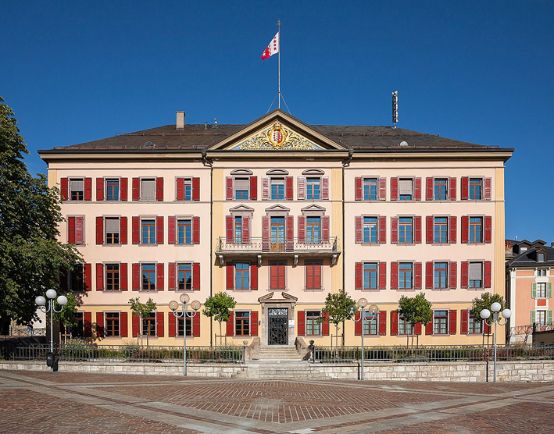
Photographer: Oliver Cossalter
https://commons.wikimedia.org/wiki/File:Palais_du_Gouvernement_Sion.jpg
License:
https://creativecommons.org/licenses/by-sa/4.0/deed.en
Sonata for Piano No. 30
Beethoven every Friday: to mark his 250th birthday, we take a look at one of his works every week. Today it's the Sonata for Piano in E major op. 109.

There are those who are always on time. They deliver their work in an orderly condition ahead of time or on time. And they also leave the impression of a perfectly regular lifestyle. And there are those who simply always take a little longer. It's easy to use the bad word procrastination, but this is a special form of creativity that doesn't savor the allure of the "last moment", but only achieves the very best results under increased pressure. Entire opera overtures have been completed just in time overnight with this widespread creative disposition. But until everything turns out well in the end, there is a lot of postponing, putting off and excusing in the diary.
Beethoven was not one of the most punctual composers either. After he had already informed the Berlin publisher Scottish songs op. 108, the composition of the sonatas op. 109, op. 110 and op. 111, which were not only outwardly understood as a group, was also delayed. On May 31, 1820, he had announced all the works for July - but little had happened. Even the benevolent reminder in August from his friend Franz Oliva was of little help ("on the sonata to Berlin you must think"). Finally, Beethoven felt compelled to provide the publisher with information about the status of the work. With familiar key words and formulations that have hardly changed in such situations over the centuries: "It will go faster with the 3 sonatas as last with op. 108The first is almost finished to the point of correction, and I am now working on the last two without delay."
The wait was certainly worth it. Schlesinger finally received the promised engraver's model at the beginning of 1821, but above all works that represent a conceptual departure at the end of Beethoven's sonata oeuvre. In the case of the E major Sonata op. 109 with a first movement that is not only small-scale, but also alienates itself from the usual structure with its imaginative Adagio interludes, a brisk, through-composed Scherzo in a minor key and a variation movement that soon proves to be the finale with its more or less clear references. It forms the core of the composition, also and especially with its touching expressive content: Full of song with heartfelt emotion.
Listen in!
Petrenko convinces as a sound organizer
The Berliner Philharmoniker are happy with their new chief conductor Kirill Petrenko. At the Easter Festival in Baden-Baden, they will perform Beethoven and Mahler under his direction.
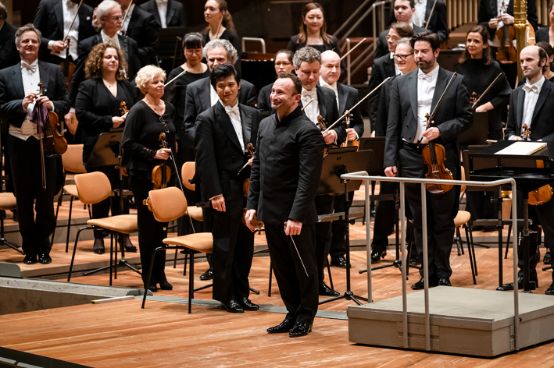
The Berlin Philharmonic Orchestra have long since left the stage when Kirill Petrenko returns because the audience won't stop clapping. The conductor bows and points behind him to the empty chairs. He wants to say that it is not him but the orchestra that deserves the applause, even though the musicians are already enjoying their after-work beers. Then the friendly little man scurries out again with quick steps. The audience in the Berlin Philharmonie has not often seen the new chief conductor since the end of August last year, because Petrenko is still tied up as General Music Director of the Bavarian State Opera in Munich. Beethoven's 9th Symphony at the start of the season, also performed at the Brandenburg Gate, a New Year's Eve concert with soprano Diana Damrau and Gustav Mahler's 6th Symphony were the only programs Petrenko has conducted in Berlin so far.
In this fourth concert, the new chief conductor shows himself in the first part, with Igor Stravinsky's thoroughly brittle Symphony in three movements and Bernd Alois Zimmermann's sensual and groovy ballet suite Alagoanaas a rather sober sound organizer who often conducts with both arms in parallel, always has his head in the score and gives clear cues. Kirill Petrenko is not a zampano, but a craftsman. His markings are functional, not aesthetic: not one squiggle too many. He does not stage himself, but simply does his job. However, Petrenko can also be freer in his conducting and let things take their course, as is the case in the second part, with the perfectly balanced Symphonic dances by Sergei Rachmaninov. He gives the wind solos enough breath, the homogeneity of the strings is delightful. Everything is perfectly coordinated - the team is the star.
Very attached to the opera
How precisely Petrenko works on the balance can be observed in the dress rehearsal beforehand. It is not a simple run-through, but a search and discovery of modeled transitions, clear rhythms and subtle dynamic differences. The new conductor speaks in a friendly but firm voice - and the Berliner Philharmoniker prick up their ears. "Kirill Petrenko comes to the rehearsal better prepared than anyone else I know," says cellist and orchestra board member Knut Weber in the subsequent interview. "He always knows exactly what he wants to correct and is very quick to do so. The tension in the orchestra is currently at a level I've never experienced before." At the press conference, there was talk of a long honeymoon and a spell that will last for a long time to come. "We're just getting to know each other," adds Andrea Zietzschmann, the artistic director from Sankt Georgen in the Black Forest. "He's not overly present in the first season. That's also good for this growing relationship."
A shorter tour in the fall with him at the podium has already been completed, with two more to come this season. Above all, however, the Baden-Baden Easter Festival Kirill Petrenko, who has a strong connection to opera and was already General Music Director in Meiningen and at the Komische Oper Berlin before Munich, will open the season on April 4 with Beethoven's Fidelio. Slovenian drama director Mateja Koležnik will stage an opera for the first time in Baden-Baden, expanding Florestan's perception through dreams, reveals Andrea Zietzschmann. "With our Artist in Residence Marlis Petersen, we also have an excellent singer as Leonore."
Knut Weber is very much looking forward to the Easter Festival and promises a "firework display of content". The fact that all 16 of Beethoven's string quartets and the Great Fugue will be performed by 17 different ensembles of the Berliner Philharmoniker at the Kurhaus Baden-Baden is ambitious. "Especially in the chamber concerts, we also appreciate the many personal encounters we have with the audience. This direct contact is something very special in Baden-Baden," he says. In addition to guest conductors Herbert Blomstedt, Tugan Sokhiev and Swiss conductor Lorenzo Viotti, who is standing in for Yannick Nézet-Séguin, Kirill Petrenko can also be heard in the orchestral concerts: with Beethoven's Missa solemnis, exclusively in Baden-Baden, and Mahler's 6th Symphony, with which Simon Rattle bid farewell to the Berliner Philharmoniker.
Zietzschmann would like to market the Easter Festival even more internationally. She counters the recurring rumors that the Berlin Philharmonic would return to Salzburg with a self-confident smile: "We feel at home in Baden-Baden." And announces that Kirill Petrenko will only conduct opera in Baden-Baden from 2022. Not only Salzburg will be disappointed about this. But Baden-Baden can rejoice.
Cantonal measures to contain the epidemic
Suisseculture has published a list for event organizers showing the measures taken by individual cantons in response to the coronavirus crisis.

The regulations are currently handled inconsistently by the various cantons, writes Suisseculture, but in principle it applies almost everywhere that all events (private and public) must be reported to the respective canton and that the public must be informed that no one who has visited the affected areas defined by the FOPH in the last two weeks will be admitted.
The following information on the individual cantons is subject to change. Anyone with questions about a specific event should contact the authorities of the relevant canton. All cantons provide corresponding information and contact addresses on their websites.
Link to the Suissculture compilation:
https://www.suisseculture.ch/index.php?id=23&tx_ttnews%5Byear%5D=2020&tx_ttnews%5Bmonth%5D=03&tx_ttnews%5Btt_news%5D=172&cHash=0f7d764ef005efe2e835fbbec954f755
Musikmesse Frankfurt postponed
Due to the continuing spread of the disease Covid-19 caused by a new coronavirus, Musikmesse 2020 will be postponed. The regional events "Musikmesse Plaza" and "Musikmesse Festival" will take place as planned.

Messe Frankfurt has announced that it has decided to postpone Musikmesse 2020 due to the increasing spread of Covid-19 in Europe. "The health of exhibitors, visitors, partners and employees is Messe Frankfurt's top priority. The new date will be announced shortly. Visitor tickets will remain valid.
From today's perspective, the pop-up experience market 'Musikmesse Plaza' (April 3 and 4) and the 'Musikmesse Festival' (March 31 to April 4, 2020) can take place on the planned dates. These events are primarily aimed at a regional audience from the greater Frankfurt area.
The continued increase in the spread of Covid-19 in Europe required a new assessment of the situation in close coordination with the City of Frankfurt's health department. It should be avoided that participants of the fair come from risk areas and visit the fair with the disease. As these trade fair participants may also be infected with Covid-19, a health check is necessary to counteract the further spread of infection. This is an essential part of the infectiological risk assessment. The necessary implementation cannot be realized by Messe Frankfurt. In addition, there are increasing travel restrictions that make it difficult for potential visitors and exhibitors to participate in the trade fair.
Current information is available at www.musikmesse.com."
Musikmesse 2020 canceled!
Updated on March 13, 2020
Coronavirus threatens the music industry
While concerts are being canceled all over the country, there is growing concern in the music industry about an economic catastrophe due to the coronavirus.

According to Sonart, the "professional association of freelance musicians", all those involved in concerts that are planned over the next two weeks must expect a major loss of income. If the measures are tightened or extended, i.e. events with fewer than 1,000 people are also canceled, or the state of emergency remains in place beyond 15 March, the losses will grow with each passing day.
As many musicians in ensembles, bands and sometimes orchestras are self-employed, such cancellations hit them particularly hard. This applies to the entire spectrum, from jazz and pop bands to opera and classical productions. Freelancers often earn large parts of their annual income during the short time in which performances take place and therefore have to cross-finance long preparation and rehearsal phases.
When concerts don't take place, the organizers are also directly affected. Canceled individual events are catastrophically affected. Even regular music event organizers often work with few reserves, so that cancellations of just a few weeks can lead to existentially threatening financial holes.
Sonart expects the Federal Council to be aware of the music industry as a whole, alongside the other eligible economic sectors, and to include it when discussing further measures and compensation options.
Suisseculture welcomes cultural message
Suisseculture, the umbrella organization of professional cultural workers, is pleased and sceptical about the Confederation's new cultural message, including the measures in the area of music education.

In an official press release, Sussculture writes that the Federal Council has made it clear that it intends to maintain the current level of funding during the funding period. The association sees this as a binding promise and hopes that parliament will follow this proposal.
Although Suisseculture considers the cultural expenditure of CHF 222.6 million from 2021 to be sufficient, it also notes that this de facto continuation of the status quo does not allow for any major development steps. This also applies in particular to the welcome measures in the area of music education: Here, an area of education is being supported with cultural funds. Should parliament tighten the budget framework, the association expects the Confederation to examine how other budgets can support these measures.
The whole statement:
Serenade in D major
Beethoven every Friday: to mark his 250th birthday, we take a look at one of his works every week. Today it's the Serenade for flute, violin and viola.

It is far too rarely considered that it was often not the composers who wrote music history with their works, but rather those industrious authors who, on the basis of scores, letters and other documents, created a tangible context and connection in the first place. And the further one goes back through the centuries, the more extensive the interpretations and hypotheses become, on which comprehensive bodies of thought are often based. This happens less with Beethoven - so you feel safe and can sit back and relax.
But far from it! Anyone who only believes in the ideas behind Beethoven's great works will always find themselves in need of an explanation and desperately seek arguments to straighten out the order of thought. This is also the case with the work published in 1802 Serenade op. 25 for flute, violin and viola. The title and instrumentation alone seem strangely peripheral. Had Beethoven not systematically prepared his first string quartets op. 18 on the basis of his opus 1? Had he not long since shed the outdated traditions of the 18th century? Why a composition without a bass? And the tempo marking Allegro disinvolto (cheerfully casual) in the finale? -
How wonderfully convenient it was to simply date the Serenade as a work from the Bonn period (which is not tenable on the basis of sketches) or even to assume that Beethoven merely wanted to help Giovanni Cappi with his newly founded publishing house with the Serenade. Perhaps Cappi himself also added the opus number to the print ...
But why should Beethoven not have written a serenade just because he was preparing to reach for the stars in other genres? Help and clarification can be found one hundred years later in a letter from Max Reger. He had asked for a symphonically dimensioned work in terms of form and texture. String quartet op. 74, the classical style of the work, which contrasts sharply with the Serenade op. 77a (as in Beethoven in D major and with identical instrumentation) on April 22, 1904 with the words:
"Enclosed you will find something very easy, simple and very melodious .... But I ask you very much not to look at this little inconspicuous booklet ... 'from the side', as op. 77a will in any case be suitable for making me many new friends and will finally silence those ignoramuses a little who always claim that I can only write 'complicated' and 'have to' cover up the 'lack of ideas', the 'lack of spirit' with 'clutter and complexity'!"
Listen in!
German music market grows
After a successful first half of the year, the music industry in Germany also recorded a significant increase in sales for 2019 as a whole: revenue from music sales and income from the streaming business grew by 8.2 percent.

In total, revenue amounted to 1.623 billion euros. Following two years of decline in 2017 and 2018, the world's fourth-largest music market thus returned to the positive global trend of recent years in 2019. Several factors contributed to the growth in revenue: the dynamic growth of audio streaming (up 27 percent), a year-on-year decline in CD sales that almost halved (minus 10.5 percent) and a 13.3 percent increase in vinyl records.
As the leading market segment, audio streaming now accounts for 55.1% of total sales, followed by CDs (29%), downloads (6.2%) and vinyl (4.9% share of sales). In total, 64.4 percent of revenue was generated in digital business segments last year (up 20.8 percent) and, correspondingly, 35.6 percent with physical sound carriers (down 8.9 percent).
In terms of the share of certain music genres in sales, pop remained the genre with the highest sales in 2019 at 25.8%. For the first time, however, hip-hop/rap moved into second place with a share of 19.7%, just ahead of rock (19.6%). Children's products (9.8%) and dance (7.3%) are also among the five most successful segments in terms of sales.
Previously unknown Beethoven composer discovered
A previously unknown and unpublished piano piece by Ludwig van Beethoven was found by Jochen Reutter, editor-in-chief of Wiener Urtext Edition, during research in the music collection of the Vienna City Hall Library.
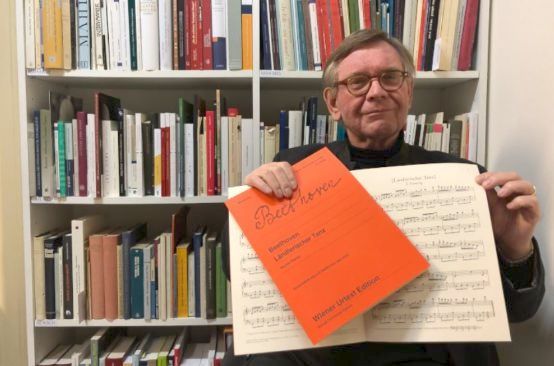
The work is notated on a double sheet of sketches by Ludwig van Beethoven from the years 1790 to 1792. At the end of the fourth page, a piano piece called Andante had already been discovered some time ago among the many different sketches. However, the fact that there is also a complete little piano piece on the first page had remained unknown until now. It has no title and does not begin at the beginning, but only towards the end of a line, immediately following a previous sketch, which makes it difficult to find.
As a previously unknown piece, it does not yet appear in the new catalog of works and has neither an opus number nor a WoO number. The musical character of the 16-bar piece is reminiscent of a Ländler. Beethoven recorded the melody part of his piece without any gaps, even revising it in a few places and notating the accompaniment in abbreviated form. The piece is published as the first edition of the Wiener Urtext Edition (UT 50296).
Clouds
"Hear" clouds? Yes! The term "sound cloud" offers a wide range of interpretations: from music in the cloud to ambient as a musical scent cloud, diffuse acoustic fields to pieces of music with the same name.

"Hear" clouds? Yes! The term "sound cloud" offers a wide range of interpretations: from music in the cloud to ambient as a musical scent cloud, diffuse acoustic fields to pieces of music with the same name.
All articles marked in blue can be read directly on the website by clicking on them. All other content can only be found in the printed edition or in the e-Paper.
Focus
Enveloped by sound
Interview with acoustician Jürgen Strauss
Sur un nuage de moins en moins noir
La musique dématérialisée dans le nuage
Django Reinhardt's "Nuages"
Music like clouds
Ambient as active non-listening
Just water and air?
Of clouds and mists of sound
... and also
RESONANCE
La musique est-elle politique, abstraite, métaphysique ?
Genevois à lʼhonneur - au program de lʼOrchestre Da Capo
The opera house as a meeting place - Aviel Cahn's first season in Geneva
Prophet in his own land - the Basel Madrigalists with Ammann and Raff
The daughter of the distant beloved - Minona, opera by Jüri Reinvere
The mysterious count and his festival - Scelsi concerts in Basel
Lost in the jungle - Manuel Renggli's "Brass Opera" in Lucerne
Carte blanche for Max Nyffeler
CAMPUS
Primary school pupils next to professionals - Orchestra school Insel and SOB
Entrepreneurship and lobbying as a role model - FMB of the VMS in Baden
Thinking and acting together - Symposium in Feldkirch
The new "Music Dictionary of Switzerland" is online
BASIS
Articles and news from the music associations
Swiss Federal Orchestra Association (EOV) / Société Fédérale des Orchestres (SFO)
ForumMusicalDiversity (FMD) / ForumDiversitéMusicale (FMD)
Konferenz Musikhochschulen Schweiz (KMHS) / Conférence des Hautes Ecoles de Musique Suisse (CHEMS)
Kalaidos University of Music / Kalaidos Haute École de Musique
Swiss Music Council (SMR) / Conseil Suisse de la Musique (CSM) and CHorama
Swiss Society for Music Medicine (SMM) / Association suisse de Médecine de la Musique (SMM)
Swiss Musicological Society (SMG) / Société Suisse de Musicologie (SSM)
Swiss Musicians' Association (SMV) / Union Suisse des Artistes Musiciens (USDAM)
Schweizerischer Musikpädagogischer Verband (SMPV) / Société Suisse de Pédagogie Musicale (SSPM)
SONART - Musicians Switzerland
Swiss Youth Music Competition Foundation (SJMW) and Arosa Culture
SUISA - Cooperative Society of Authors and Publishers of Music
Swiss Association of Music Schools (VMS) / Association Suisse des Écoles de Musique (ASEM)
FINAL
Riddle - Torsten Möller is looking for
Row 9
Since January 2017, Michael Kube has always sat down for us on the 9th of the month in row 9 - with serious, thoughtful, but also amusing comments on current developments and the everyday music business.
Download the current print edition
Here you can download the current issue. Please enter the search term "e-Paper" in the print archive.
The download is free of charge for subscribers.
All other interested parties will receive the PDF of the current issue (or an earlier issue) by e-mail. Costs: Fr. 8.-.
Click here to order the e-paper.
We are also happy to send you the printed version. Costs: Fr. 10.-
Click here to order the printed edition.
High altitude excursions on the cello
The Lausanne cellist Constantin Macherel demonstrates his subtle skills in works by Boccherini, Servais, Franchomme and Rossini.

Like Johann Sebastian Bach and later Joseph Haydn, Luigi Boccherini (1743-1805) emancipated the cello from its continuo function and treated it as an instrument for true virtuosos in his twelve concertos. Now the Swiss cellist Constantin Macherel, born in Lausanne in 1991, has chosen Boccherini's Cello Concerto in D major (G 479) for his debut CD with the London Mozart Players (conductor: Sebastian Comberti) alongside other technically demanding, musically catchy pieces. Macherel's slender, flexible, only occasionally somewhat narrow tone is ideal for the spectacular flights of fancy that the Italian composer demands of the performer. His Joseph Hill cello from 1765 sounds as fine as a violin in the high register. The careful, tasteful vibrato and airy phrasing lend the interpretation lightness and esprit. The slow movement is touching in its simplicity. The London Mozart Players are subtle accompanists - only sometimes, as in the finale, one wishes for a stronger profile.
In the imagination Souvenir de Spa op. 2 by Adrien François Servais, the cellist, who studied with Ivan Monighetti in Basel and Raphael Wallfisch in Zurich, demonstrates his subtle bowing technique. Rossini's Une larme, Thème et variations with great cantability. And August-Joseph Franchomme's musical language, which is exciting to a limited extent, is also enhanced by Macherel's fine stylistic flair, as in the Variations sur deux thèmes (russe et écossais) op. The fact that the banal Scottish theme would also fit in well with a Rosamunde Pilcher film is ultimately not the interpreter's fault. Macherel's restraint makes it enjoyable and prevents it from becoming too kitschy.
Virtuoso Music for Cello. Works by Boccherini, Franchomme, Rossini and Servais. Constantin Macherel, violoncello; London Mozart Players, conductor: Sebastian Comberti. Claves 1903
Melting tome
"Souvenir" by Franz Drdla, originally for violin and piano, here in the viola version.

The widely traveled Czech violinist František Drdla (1868-1944), a theory student of Anton Bruckner at the Vienna Conservatory, wrote over 200 works of light music: in addition to two operettas and a violin concerto, many genre pieces for violin and piano. One of the best known, this melting, harmonically charming little tome, has now also been gratefully arranged for viola. It is as good on the viola in the same key as on the violin.
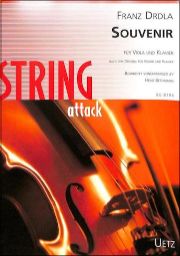
Franz Drdla: Souvenir, for viola and piano arranged by Heinz Bethmann, score and viola part, BU 8194, € 11.00, Musikverlag Bruno Uetz, Halberstadt 2019
With blues against the blues
Those who carefully rehearse Mike Cornick's piano pieces in the booklet "Blues in Two and More" will be rewarded.

The slow swing piece Blues in Two was written by Mike Cornick (*1947) in 1994 and has enjoyed great popularity ever since. This very piece opens the new volume Blues in two and moreand eleven new compositions in various jazz styles have been added. I would like to recommend this collection to all those who sometimes have the blues and long for musical variety, whether when teaching or playing themselves.
The twelve appealing compositions cover styles such as blues, swing, ragtime, Latin and calypso. They are perhaps no more difficult than many pieces from the classical intermediate level, but require a completely different playing style in terms of harmony and rhythm. Certain harmonic sequences and rhythmic patterns often feel unfamiliar to players with a classical background and require a great deal of attention. This is precisely why it is worth exploring these fresh and light pieces. They are stimulating, instructive, entertaining and drive away the blues and more.
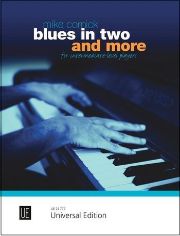
Mike Cornick, Blues in Two and More, for intermediate-level players, for piano solo, UE 21777, € 15.95, Universal-Edition, Vienna 2019