Swiss Cultural Forum 2027 in La Chaux-de-Fonds

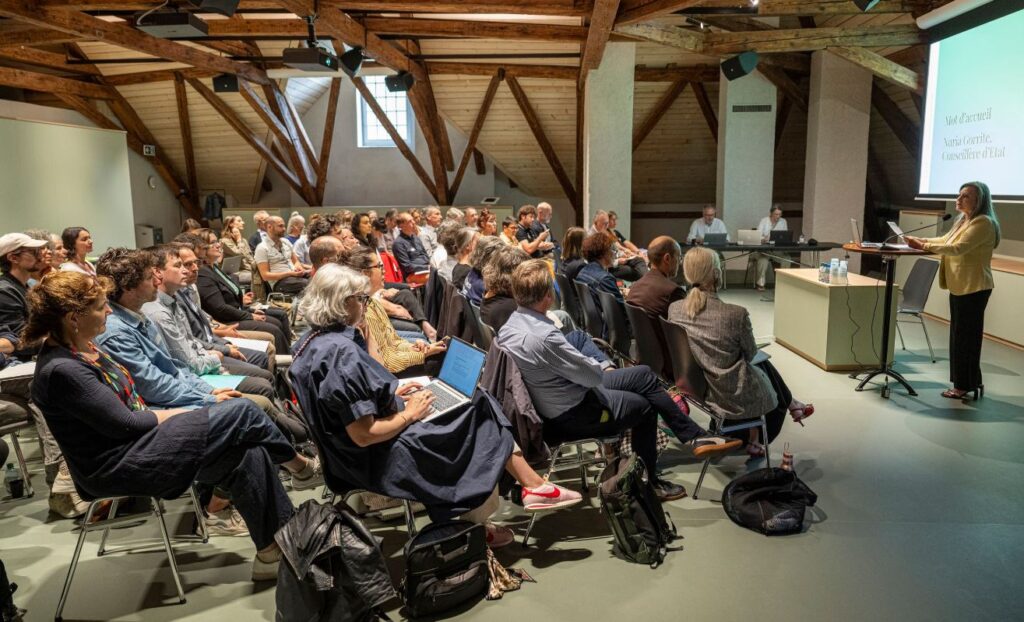
As part of the «Capitale culturelle suisse», a national Swiss cultural forum will be held in La Chaux-de-Fonds on June 19, 2027.

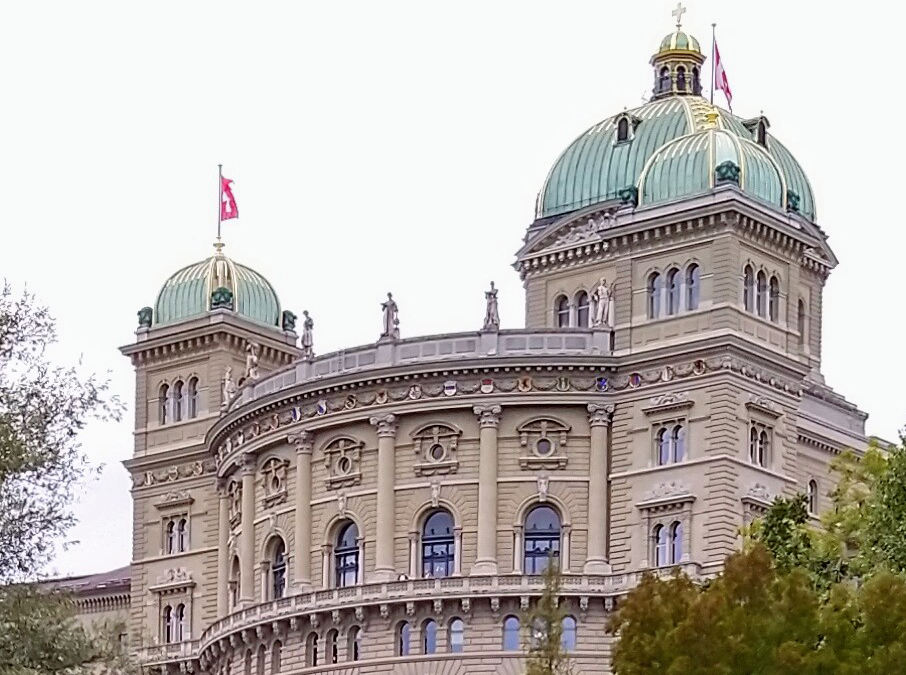
Flagged facade of the Federal Palace in Bern. Photo: william87/depositphotos.com

The political level of the National Cultural Dialogue (NKD) has taken note of the ongoing work at the specialist level of the NKD to organize a first «Swiss Cultural Forum». The aim is to focus on the importance of culture for society. According to the federal government's press release, the event will take place on June 19, 2027 in La Chaux-de-Fonds as part of the «Capitale culturelle suisse». It is aimed in particular at stakeholders from the fields of culture and cultural promotion, specialist areas such as business, education and research, social affairs and health, politicians at all levels of government and the media.

Culture and other socially relevant areas such as health, education and research, social affairs and the economy influence and are mutually dependent. The first edition of the «Swiss Cultural Forum» aims to give greater visibility to these diverse relationships. The National Cultural Dialogue (NKD) was launched in 2011 and brings together representatives of the political authorities and cultural promotion bodies of the cantons, cities, municipalities and the federal government.

Digital edition of a Beethoven sketchbook

The «Beethoven's Workshop» research project is making one of the composer's sketchbooks available in a digital edition.

(Image: Beethoven-Haus Bonn)

How Ludwig van Beethoven worked can be traced today in more than 7500 surviving pages of sketches. A large proportion of these have been handed down in 70 surviving sketchbooks, which have been the subject of scholarly research since the 19th century. The «Beethoven's Workshop» project has now produced the first digital edition of one of these sketchbooks: the so-called «Notirungsbuch K».

Beethoven used the book in spring 1823 to sketch parts of the Ninth Symphony and the Diabelli Variations. Early sketches for the later «Ode to Joy» can also be found in it. After Beethoven's death, the sketchbook was divided into several parts. The seven surviving individual parts are now in the Beethoven-Haus Bonn, the Staatsbibliothek zu Berlin and the National Library in Paris.

The new digital edition brings these holdings together again virtually and makes it possible to experience the sketchbook in its original form for the first time. In contrast to printed editions, the digital format opens up new possibilities for presentation and communication. At the heart of the edition is the specially developed fluid transcription. It makes the editorial cognitive process visible by allowing users to use a slider to move from a digital facsimile of a sketch to a musical text that is readable and comprehensible by today's standards.

More info:
https://www.adwmainz.de/aktivitaeten/aktuelles/details/erste-digitale-edition-eines-beethoven-skizzenbuchs-veroeffentlicht.html

Glasson Scholarship for Anaïs Hess

The Canton of Fribourg is awarding the 2025-26 scholarship from the Pierre and Renée Glasson Fund in the amount of CHF 10,000 to the flautist Anaïs Hess.

Anaïs Hess (Image: State of Fribourg)

Anaïs Hess, born in 2002, lives in Villaz-St-Pierre. In 2024, she completed her bachelor's degree in flute at the Lausanne University of Music (HEMU). Parallel to her studies, she is involved in several regional music ensembles both as an instrumentalist and as a singer, with a repertoire ranging from classical to Celtic to electro-acoustic music, variety and pop. She is a member of the «Concerts du Cœur Fribourgeois» and teaches flute in Fribourg.

Anaïs Hess won a first prize at the Swiss Youth Music Competition (2022) and the Prix Musique of the Swiss Wind Music Association (2021). The scholarship will help Anaïs Hess to broaden her professional experience and continue her master's degree in music education at the HEMU.

The Pierre and Renée Glasson Fund for Music, established in 1995 and administered by the Office of Culture of the Canton of Fribourg, supports the activities of musicians from the Canton of Fribourg or the rest of Switzerland who live in the Canton of Fribourg. The scholarship from this fund serves as a contribution to the financing of a Master's or postgraduate degree course at a music college in Switzerland or abroad.

City of Lucerne honors Openair Funk am See

The city of Lucerne awards the Openair with a recognition prize of 10,000 francs, while the city's 2026 Culture Prize goes to theater artist Ursula Hildebrand.

The Funk am See 2026 OC (from left to right): Linus Bürgi, Reto Schefer, Silvana Emmenegger, Pascal Segmüller, Sofia Grütter, Nora Graber, Noemi Mahler (source: City of Lucerne/zvg)

According to the city, the Funk am See open air festival has become an integral part of Lucerne's cultural life since it was founded in 1996. The non-commercial music festival takes place every two years on the Lido meadow and attracts up to 12,000 visitors over two days. The consistently low-threshold access is particularly characteristic. Admission is free. It enables people from a wide range of social and economic backgrounds to participate in cultural life.

At the same time, Funk am See has served as an important platform for young and regional artists for three decades. Numerous acts from Central Switzerland were able to perform here for the first time in front of a larger audience. The festival is supported by an honorary organizing committee and numerous volunteers, whose continuous commitment has made it possible to maintain and further develop Funk am See for 30 years now. The festival is thus exemplary of cultural work that originates from the grassroots and has a lasting impact on regional music and youth culture.

Music Council concerned about cultural radio

The Swiss Music Council has noted with great concern the SRG's presumed plans to abandon the cultural channels SRF 2 Kultur, Espace 2 and Rete Due.

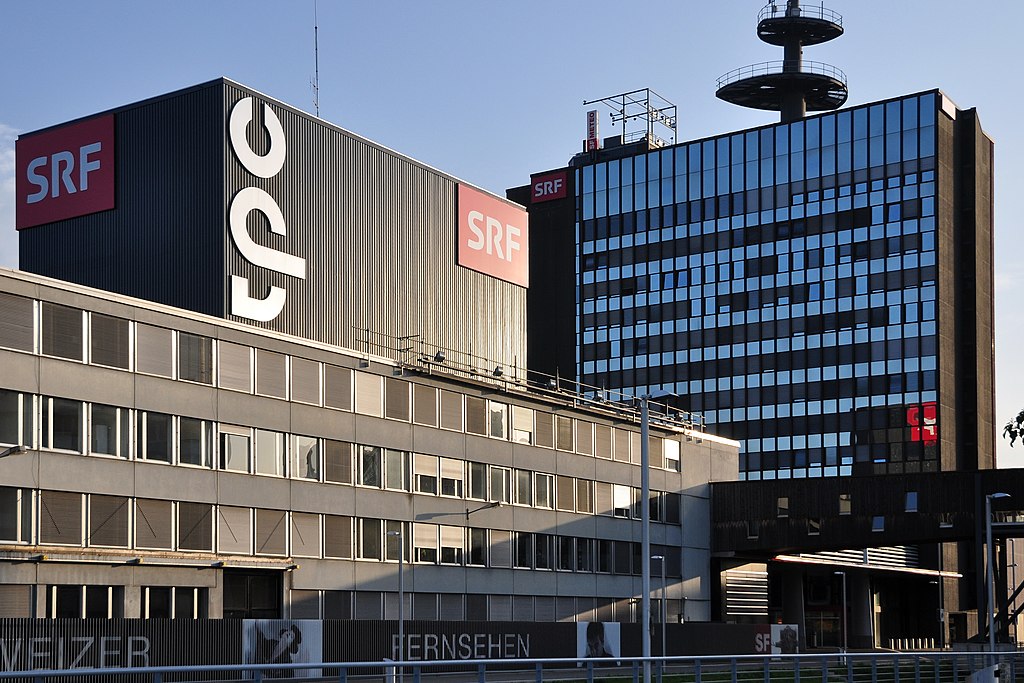
SRG headquarters in Leutschenbach (Image: zVg)

In an official statement, the Music Council expects culture - and cultural reporting in particular - to remain a core mandate of SRG. The current discussion about the future of SRF 2 Kultur is irritating and comes at a sensitive time. The SRG halving initiative was clearly rejected by the population. This result is also a clear commitment to the importance of culture, information and education in the public service.

The Swiss Music Council states: A reduction in the area of culture - particularly in central channels such as SRF 2 Kultur, Espace 2 and Rete Due - would substantially weaken Switzerland's cultural infrastructure and contradict the clear result of the vote. SRF 2 Kultur is a central media platform for music and culture in Switzerland - for artistic production, mediation, critical classification and public debate. The broadcaster fulfills an indispensable function, especially for those areas that hardly find a place in the commercial environment.

The Music Council sees culture as part of the public service with a clear social mission: it provides orientation, enables reflection and makes a significant contribution to a country's cultural identity. This is particularly true for minorities, for challenging formats and for those voices that would otherwise hardly be heard.

Link: musikrat.ch

Death of the musicologist Peter Gülke

Peter Gülke, who held a professorship in musicology at the University of Basel from 1999 to 2002, has died at the age of 91 in his home town of Weimar.

Peter Gülke at the Conducting Forum with Clemens Mohr and Ingmar Beck (Image: Deutscher Musikrat/Marie Liebig)

Lydia Grün, President of the German Music Council, paid tribute to Gülke as «an outstanding personality who has set standards for decades - as a conductor, scholar, author and formative voice of cultural mediation work in the field of music». His work was characterized by the highest artistic and intellectual integrity. At the same time, he was an important source of inspiration and mentor whose judgment and experience carried weight far beyond his own discipline.

Gülke studied music and humanities in Weimar, Jena and Leipzig, worked as a repetiteur and dramaturge and increasingly turned to conducting from the late 1950s onwards. He worked as Kapellmeister at the Semperoper Dresden and as chief conductor in Stendal, Potsdam, Wuppertal and the city of Brandenburg. He has appeared internationally as a sought-after guest conductor and taught conducting at the University of Music in Freiburg and musicology at the University of Basel. From 2011 to 2014, he was President of the Saxon Academy of the Arts.

Fight against cultural cuts in Austria

The Austrian Cultural Council fears massive cuts in public cultural funding and a disastrous change in funding structures.

The Austrian parliament building (Image: PD)

According to the Austrian Cultural Council, cuts of more than 60 million euros over the next three years are on the cards as part of the ongoing budget negotiations. At the same time, the proposals from the funding task force point to a fundamental reorganization of state funding logic. Particularly problematic would be criteria according to which funding would in future only be understood as start-up funding or only be awarded by a single regional authority.

The Cultural Council is convinced that this would miss the mark, particularly in the arts and culture sector. Cultural funding in Austria is based on co-financing: Municipalities, federal states and the federal government share responsibility. If one level is removed, entire financing structures are thrown into disarray. The approach of reducing arts and cultural funding to mere start-up financing also contradicts the actual requirements of continuous cultural work as well as the legal mandate of arts funding.

The whole text:
https://oemr.at/keine-kuerzungen-kunst-kultur/

Unanimous concern about the situation of the Lake Constance Philharmonic Orchestra

In view of the vacant position of director of the Lake Constance Philharmonic Orchestra, the German Orchestra Union Unisono has written an open letter to the mayor of the city of Constance.

Lake Constance Philharmonic Orchestra (Image: Lake Constance Philharmonic Orchestra)

The main reason for this is that no publicly communicated search procedure has been initiated to date, writes Unison. Even if an interim solution were to be sought for the time being, this would not «release us from the need to carry out a regular, transparent selection procedure in parallel». Neither the reasons for the lack of a search procedure nor the strategic considerations of the city were communicated in a comprehensible manner. Such a handling of a central management function of a municipal orchestra is unusual, non-transparent and in need of explanation.

A public debate on the cultural policy direction of the city of Constance is long overdue, they continued in unison. This discussion concerns both the public and the employees. Both need a clear commitment that the city will continue to fully support its orchestra.

The Lake Constance Philharmonic Orchestra was founded in 1932. It is one of the most important cultural institutions in south-western Germany, shapes the cultural life of the university city of Constance and is also an important player in concert life in Switzerland. With over 60 permanently employed musicians, the orchestra reaches around 80,000 people at over 100 concerts a year.

National Fund supports ZHdK project

The «Animated Objects and Moving Sound Sources» project at Zurich University of the Arts is being funded by the Swiss National Science Foundation (SNSF) for four years.

ZHdK (Image: Google Maps)

The project with the full name «Project Animated Objects and Moving Sound Sources: Expanding Spatial Audio in Post-Instrumental Practice» investigates new concepts and methods in the field of spatial audio reproduction with a focus on embodied and object-based performative practices in contemporary music. It is funded for four years.

Under the direction of Rama Gottfried, the project combines various strands of research from the Institute for Computer Music and Sound Technology (ICST) at ZHdK on the subject of spatiality. It links 3D audio rendering with Peter Fäber's work on «Moving Sound Sources», Daniel Bisig's research on movement analysis in dance and Gottfried's work in post-instrumental material theater and with animated objects as embodied presence.

Hanna Järveläinen and Germán Toro Pérez provide scientific advice for the project. A postdoctoral position and a PhD position will be advertised as part of the project next year.

Canton of Thurgau supports David Flütsch

The canton of Thurgau is supporting the career of percussionist David Flütsch with a grant of 25,000 francs.

David Flütsch (Image: Flütsch/Instrumentor)

David Flütsch grew up in Graubünden and studied jazz drums and music education in Zurich, according to a press release from the canton of Thurgau. He has lived in Weinfelden for ten years and runs a music studio called Sour Soul in Bürglen. His clients are both international and regional music bands. He is a musician, songwriter, composer, sound engineer and sound designer.

As an outstanding drummer, Flütsch is part of various bands. He also has his own signature as a producer. Many of the projects he has been involved in have been promoted throughout Switzerland and have received nominations and awards such as the M4Music Demotape Clinic, including his own project MonoDada.

With his current project, he wants to move away from purely commissioned work in order to have time to strengthen his own musical signature and find a clearly profiled, artistic independence. He would like to devote more time to his own musical projects.

The Canton of Thurgau awards personal grants once a year to artists from Thurgau who want to take their career a step further with a convincing project. The grants are endowed with CHF 25,000 each.

Connection between pain and creativity

A team involving the University of Zurich and the Psychiatric University Hospital Zurich has investigated the links between pain and creativity.

University of Zurich (Image: Leonhard Lenz/Public Domain)

According to the team, creativity and pain are associated with complex sensory and emotional experiences, suggesting possible overlaps between their neural network models, learning rules and executive functions. Identifying and characterizing these commonalities could highlight the potential of creativity as a therapeutic approach in pain management.

In a recent article in the trade journal Neuroscience & Biobehavioral Reviews the team presents challenges derived from current research. It highlights several relevant components, including physiological mechanisms, neural network models, learning rules, and the benefits of a multilevel approach, including for managing executive function impairments with pain sensitization in neurodevelopmental and clinical disorders, such as attention-deficit/hyperactivity disorder and autism spectrum disorders.

The article cites numerous studies that have linked creative expression such as visual arts and music to reduced pain perception, suggesting that holistic, therapeutic approaches that integrate the two are not only possible, but worth exploring. Finally, it presents a framework for future research on the relationship between creativity and pain, providing guidance for therapeutic options for managing chronic pain through creative acts.

Original article:
https://www.sciencedirect.com/science/article/pii/S0149763426001077?via%3Dihub

New guidelines for sampling

The highest European court has created new guidelines for sampling in a legal dispute between the band Kraftwerk and the music producer Moses Pelham.

Power plant in a photo from 1975 (Image: Public Domain)

According to a report by the New Music Newspaper the European Court of Justice (ECJ) has ruled that sampling may be permissible under certain conditions without the permission of the rights holder. However, a final ruling in the specific case is still pending.

The ECJ focuses primarily on so-called pastiches. These are uses that «are reminiscent of an existing work, but at the same time have perceptible differences. In addition, they must engage in a recognizable artistic or creative dialogue with the work». This dialog can take various forms, such as the open imitation of a style, an homage or a humorous confrontation.

At the center of the controversy was a two-second sequence that Pelham took from the Kraftwerk track «Metall auf Metall» (1977) without the music group's prior consent and used in a slightly modified version in his own song. Because the use of such samples from older songs is a common practice in the music industry, the dispute has a signal effect for the entire industry.

Original article:
https://www.nmz.de/politik-szene/musikwirtschaft/wie-weiter-im-streit-um-kraftwerk-beat-eugh-setzt-massstaebe

Streaming destroys income in the music industry worldwide

According to a study by the Oxford Internet Institute and the University of Groningen, musicians worldwide are suffering from the virtually total destruction of their income through streaming.


Streaming services (Image: flickr)

Based on a survey of around 1,200 musicians, the study comes to the conclusion that artists feel trapped in a so-called «streaming paradox»: Thanks to streaming, it has never been easier to be visible, but a decent income remains out of reach. At the same time, musicians report that they are under increasing pressure to become content creators and audience managers, constantly posting, interacting with their audience and promoting - just to get noticed.

However, the most striking result of the study is how differently musicians in different countries experience the same pressure. In Nigeria, 83% of musicians stated that their career had improved since the advent of streaming. In the Netherlands, only 14 percent said this. There are also interesting differences between genres and generations. These differences suggest that culture, expectations and economic context are shaping the way artists navigate the platform age in fundamentally different ways.

Original contribution:
https://www.eurekalert.org/news-releases/1123042

Juan David Toro wins Andorra Competition

ZHdK student Juan David Toro Martín has won the Andorra International Saxophone Competition, the world's most important saxophone competition.

Juan David Toro graduated from the Granada Conservatory in 2023, where he studied with Professor Javier Linares Leyva. He has received numerous awards as a soloist. He has performed as a guest saxophonist with the Orquesta Ciudad de Granada (OCG) and the Joven Orquesta Sinfónica de Granada (JOSG). In May 2023 he was admitted to the Master's program in Performance at the Zurich University of the Arts (ZHdK) in Zurich under the direction of Lars Mlekusch.

There were over 200 applications for the competition from all over the world. Just over 130 were invited to the first round in Andorra, the first selection lasted three days, followed by the semi-finals and finally six candidates took part in the final with orchestra, which Juan David won.


Work grants from the Canton of Schwyz announced

In 2026, the Cultural Commission of the Canton of Schwyz will once again be offering work grants for artists as part of a competition.

Town hall in Schwyz. Photo: Tobyc75

The aim of awarding work grants is «direct and personal support». According to the canton's press release, the grants make it easier for artists to devote themselves to their work for a certain period of time. They should be able to engage with an experimental, innovative and artistic idea or deepen and develop their artistic skills in a targeted manner. Work grants primarily support artistically interesting, independent and feasible projects. The work grant is primarily intended for the personal artistic development of artists.

Eligible to participate are 2026 creative artists with a track record in the fields of visual arts, music, dance and theater as well as short and animated film who have been resident in the Canton of Schwyz for at least two years or have a close connection to the canton (origin, focus of artistic work). Groups can participate provided that their work and production location has been mainly in the canton of Schwyz for at least two years.

More info:
https://www.sz.ch/kanton/medien-und-datenschutz/medienmitteilungen/detailseite.html/8756-8757-8803-10391-10392/news/24839

get_footer();