Schwyz cultural promotion to be expanded

The Schwyz Cantonal Council has decided to provide greater support for culture from 2026 onwards. Cultural associations and institutions are to be strengthened and the sharp increase in the number of applications addressed.

Town hall in Schwyz. Photo: Tobyc75

The cultural landscape of Schwyz has developed enormously, writes the canton. Whereas cultural life used to be dominated by folk theater, concerts, individual readings, and music clubs in the villages, many new local and regional cultural associations have emerged in recent years. Well-trained cultural professionals strengthen the cultural associations and create new offerings.

Additional funds come from the lottery fund. The government has continuously increased this contribution in recent years. At the beginning of 2026, there will be another significant adjustment to CHF 2 million per year. The Cultural Commission uses a substantial portion of these funds for the large number of applications that are submitted. The amount allocated to cultural associations and artists has more than doubled in recent years and now stands at around CHF 1 million.

The additional funds will also make it possible to strengthen cooperation with larger event organizers and cultural associations. Service agreements will specify the services that these cultural providers must render for the benefit of Schwyz culture. This expanded regulation will benefit cultural institutions that the Cultural Commission considers to be of strategic importance to Schwyz's cultural scene, such as the Music Club Mauz in Einsiedeln, the Gaswerk in Seewen, the Theater Arth, and «Der Herbst» in Brunnen/Gersau.

Trade in pernambuco wood is not banned

At the 20th Conference on International Trade in Endangered Species of Wild Fauna and Flora (CITES), Brazil's proposals to completely ban the trade and transportation of pernambuco wood failed to pass.

Pernambuco tree (Image: CC BY 2.5/the colonist)

Pernambuco wood has been used to make bows since around 1750 and, according to bow makers, is virtually irreplaceable in violin making. Musicians feared having to obtain complicated special permits when traveling with pernambuco bows, which would have jeopardized tours.

The pernambuco tree, Brazil's national tree since 1978, was added to the country's official list of endangered plant species in 1992. In 2007, Brazil achieved its inclusion in Appendix II of the CITES Convention, with an exemption for finished products such as bows.

In proposing to list Pernambuco in Appendix I of CITES, Brazil emphasized that more than 90 percent of the harvested wood is discarded during the production process, as it is considered unsuitable for the production of professional bows due to strict quality standards. In addition, this wood is subject to extensive illegal trade, which increases the pressure on this tree, which only grows in the Brazilian Atlantic Rainforest, and undeniably threatens the species in an already very weakened ecosystem.

Pernambuco is therefore retained in Appendix II with a compromise text that provides for enhanced measures to better protect this species with a felling ban.

Clément and Bialobroda teach in Geneva

The Haute École de Musique de Genève (HEM) in Geneva has appointed Noémie Bialobroda and Hélène Clément as professors of viola. They will take up their posts in September 2026.

From left: Noémie Bialobroda and Hélène Clément (Image: HEM)

Hélène Clément was born in 1988 and studied with Jean Sulem at the Conservatoire National Supérieur de Paris, then with Hariolf Schlichtig at the Musikhochschule München and finally with Tabea Zimmermann at the Musikhochschule Hanns Eisler in Berlin. She is a member of the Quatuor Doric. She is Professor of Viola and Chamber Music at the Royal Academy of Music in London until the end of the academic year 25/26 and will move to the HEM in September 2026.

Noémie Bialobroda is professor and coordinator for chamber music at the Geneva Conservatory of Music. She also teaches viola at the CNSMD in Lyon. She has also been a member of the Aviv Quartet since 2014. In 2020, she founded the Geneva International String Academy together with violinist Sergey Ostrovsky, of which she is the artistic director. There she offers promising young musicians the opportunity to spend a summer studying and playing with experienced artists. In 2024, she received the cultural scholarship from the Fondation Leenaards.

Structural contributions for Lucerne cultural institutions

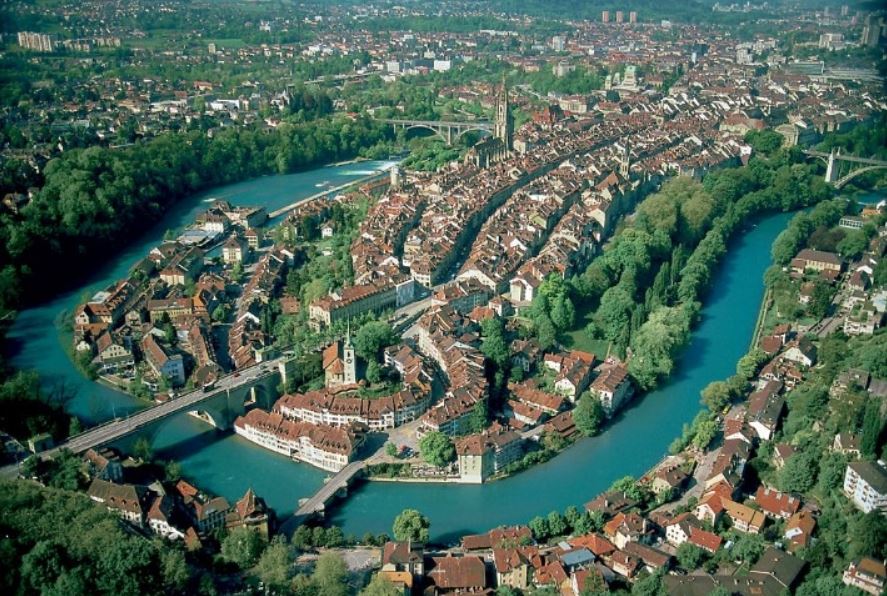
From 2027, medium-sized cultural institutions in the canton of Lucerne will be able to benefit from fixed structural contributions. The cantonal government has drawn up a dispatch on this.

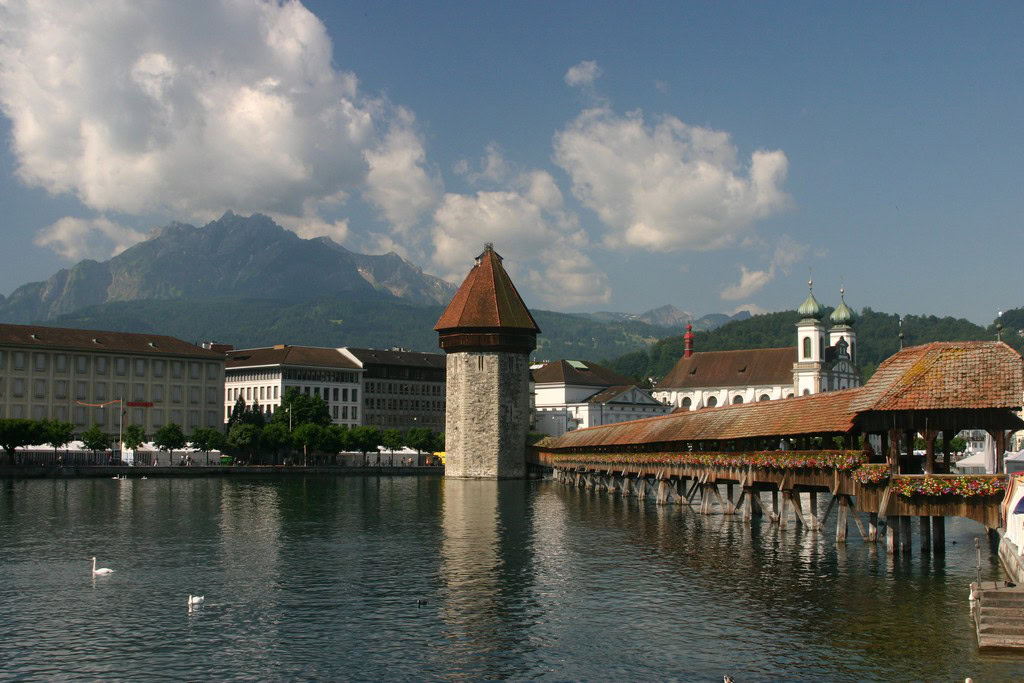
Lucerne (Image: Andyindia)

According to the canton's press release, the aim of the new proposal is to provide binding structural support for medium-sized cultural institutions, with the canton and local municipalities each bearing half of the costs. The structural promotion of medium-sized cultural enterprises in the canton of Lucerne is to be reorganized. The cantonal government is presenting a new, revised dispatch on this. This follows the Cantonal Council's rejection of Message B 126 "Further development of regional cultural promotion" to the Government Council in spring 2023.

At the heart of the new proposal is the new structural funding, which provides for financial contributions from the canton to recurring structural and operational costs of selected cultural institutions. On the basis of clear criteria and in cooperation with the local or sponsoring municipalities, the canton concludes trilateral performance agreements with selected cultural institutions. The prerequisite for a cantonal contribution is that the respective host municipality makes a structural contribution of at least the same amount.

More info:
https://news.lu.ch/html_mail.jsp?id=0&email=news.lu.ch&mailref=000lyg00000ti0000000000000bsk6ec

Liza Lim honored with Grawemeyer Award

The Australian composer Liza Lim, whose work will be performed at the Lucerne Festival as part of the Roche Commissions 2026, has been awarded the prestigious Grawemeyer Award.

Liza Lim (Image: Nik Hunger)

Born in Perth, Australia, in 1966, Liza Lim is Professor of Composition and holds the first Sculthorpe Chair in Australian Music at the Sydney Conservatorium of Music, where she also directs the Composing Women program. She has received commissions from some of the world's leading orchestras and ensembles, including the Los Angeles Philharmonic, Ensemble intercontemporain, Ensemble Modern, Arditti Quartet and Klangforum Wien. Lim last appeared at the Lucerne Festival in November 2023 with the world premiere of her work Multispecies Knots of Ethical Timea composition for 15 musicians, gestural performers and video.

The Grawemeyer Awards, currently endowed with 100,000 dollars, are presented once a year by the University of Louisville in Kentucky. Winners are nominated in the categories of education and teaching, ideas that improve the world order, music composition, religion and psychology. In 2015, one award went to Wolfgang Rihm, then director of the Lucerne Festival Academy.

Chailly remains head of the Lucerne Festival Orchestra

Riccardo Chailly has extended his contract with the Lucerne Festival Orchestra until the end of 2028. In addition, tour projects abroad and future projects with the Lucerne Festival Contemporary Orchestra (LFCO) are also planned.

Riccardo Chailly (Picture: Priska Ketterer)

According to the festival's press release, Chailly will continue to conduct concerts in spring and summer, including the official opening. Riccardo Chailly has been Chief Conductor of the Lucerne Festival Orchestra since 2016, succeeding Claudio Abbado. With the founding of the Lucerne Festival Orchestra, which was presented to the public for the first time in August 2003, conductor Claudio Abbado and Festival Director Michael Haefliger took up where the Lucerne Festival left off in 1938, when Arturo Toscanini formed an elite orchestra with the Concert de Gala.

The orchestra members perform as soloists outside of the festival season, take up positions with renowned orchestras, teach at universities or come from the ranks of the Mahler Chamber Orchestra and the Filarmonica della Scala. Claudio Abbado was the orchestra's artistic director until his death in January 2014.

German music schools sound the alarm

A study by German music education associations paints a dramatic picture of a future shortage of music teachers. Half a million children in Germany and Austria could no longer have access to lessons.

(Image: CC)

According to the study, around 14,700 music school staff will retire by 2035 (projection based on current figures from the Association of German Music Schools and the German Music Information Center). In contrast, there are only around 4,000 students of instrumental and vocal pedagogy and elementary music pedagogy. This means that in ten years' time, around three quarters of vacancies could not be filled by suitably qualified music school teachers. In view of constantly rising demand, this means that at least 500,000 children will no longer be able to receive music school lessons.

The study was a joint initiative of the Arbeitsgemeinschaft der Leitenden pädagogischer Studiengänge (ALMS) and the Committee for Artistic-Pedagogical Study Programs of the Rectors' Conference of Universities of Music (RKM). With the participation of numerous universities of music and study institutions as well as the Association of German Music Schools (VdM), causes, challenges and approaches to action were examined in a broad-based crowd research project with over 50 research groups.

More info:
https://www.musikrat.de/fileadmin/redaktion/news/2025/11_2025/DMR_PM_MiKADO-Musik-Studie_belegt_existenziellen_Nachwuchsmangel_an_Musikschulen.pdf

Zurich Saxophone Quartet and A-Delta Trio win Orpheus Competition

The Zurich Saxophone Quartet of the Zurich University of the Arts (ZHdK) and the A-Delta Trio of the Basel University of Music (FHNW) have won the Orpheus Swiss Chamber Music Competition 2025 ex aequo.

A-Delta Trio (Image: zVg)

A second prize went to the Mars Quartet from the Zurich University of the Arts. The Ensemble Brisae, with students from the Haute école de musique Lausanne and the Lucerne and Basel music academies, was awarded a sponsorship prize. A total of 15 ensembles took part in the competition.

The top three finishers will win prizes of 4000 and 2000 francs. In addition, they can each win one of the Fondation Nicati-de Luce financed composition commission. These three new works will be premiered at the next Swiss Chamber Music Festival Adelboden (September 11-20, 2026). The ensembles will receive further support through a joint workshop with the commissioned composers and the opportunity to take part in a master class in Rheinau.

Since 1974, the Orpheus Swiss Chamber Music Competition The Swiss Chamber Music Award recognizes outstanding chamber music ensembles every year. Around 800 award-winners have been supported to date - many of whom now belong to the Swiss, European and global elite.
The prizewinners' concerts always take place as part of the Swiss Chamber Music Festival Adelboden. Other organizers are constantly including Orpheus prize-winning ensembles in their concert series.

HKB students will pay more in future

Bern University of Applied Sciences is introducing higher tuition fees for the fall semester 2026/27. In doing so, it is implementing a political decision at cantonal level.

Bern University of the Arts (Image: HKB)

As part of a revision of the university ordinances, the cantonal government of Bern has decided to increase tuition fees at Bern's universities. The increase affects the University of Bern and the universities of applied sciences (BFH) in equal measure. Tuition fees at BFH will rise from CHF 750 to CHF 850 from the fall semester 2026/27. Students who are foreign nationals and were not officially resident in Switzerland or Liechtenstein when they obtained their university entrance qualification (vocational or technical baccalaureate or baccalaureate) will pay CHF 2550 per semester instead of CHF 950.

Students in the last category who started their studies at BFH before the fall semester 2026/27 will now pay a fee of CHF 1050 until they complete their Bachelor's or Master's degree. According to the UAS Ordinance, a change from a Bachelor's to a Master's degree is considered a new start of studies, which is why the new fees (of CHF 2550) apply in this case.

More info:
https://www.hkb.bfh.ch/de/aktuell/news/2025/kanton-bern-erhoeht-studiengebuehren/

Death of the conductor Lutz Rademacher

According to a statement from the Landestheater Detmold, the German conductor Lutz Rademacher, who was assistant to the chief conductor at the Theater Basel from 2003, has died at the age of 56.

Lutz Rademacher (Image: Ultraschall Berlin/KUMR)

Trained at the Hamburg University of Music and Drama, Rademacher was engaged as a conductor in Basel and Freiburg, among other places. Most recently, as GMD, he gave new impetus to the concert life of the city of Detmold with innovative concert formats and ambitious music theater programs.

Since the summer semester of 2024, Lutz Rademacher has passed on his knowledge as a lecturer in orchestral and ensemble conducting at Martin Luther University Halle/Wittenberg. He was also a lecturer for Ensemble New Music at the HfMT Hamburg. No cause of death is given in the announcement.

Schütter book honored in America

Ute Stoecklin's book about the Chur composer Meinrad Schütter has won an ARSC Award in the USA.

Meinrad Schütter is one of the most fascinating Swiss composers of the 20th century. Four years after Schütter's death, Ute Stoecklin published the book "Meinrad Schütter 1910-2006" in 2010, which deals with the life's work of the composer from Chur. (Link to the review in the SMZ)

In 2024, Chris Walton's book was published under the title Meinrad Schütter - Maverick Swiss Composer translated into English. It is the first English publication to deal with the life of Meinrad Schütter. It was published by the ARSC (Association for Recorded Sound Collections) 2025 in the category with the Award "Best Historical Research in Recorded Classical Music - Best History" excellent.

Two new organ works by Bach definitely confirmed

The Bach Works Catalogue (BWV) has been enriched by two new numbers: two previously unknown organ works have been clearly attributed to Johann Sebastian Bach.

Johann Sebastian Bach (oil painting by Elias Gottlob Haussmann)

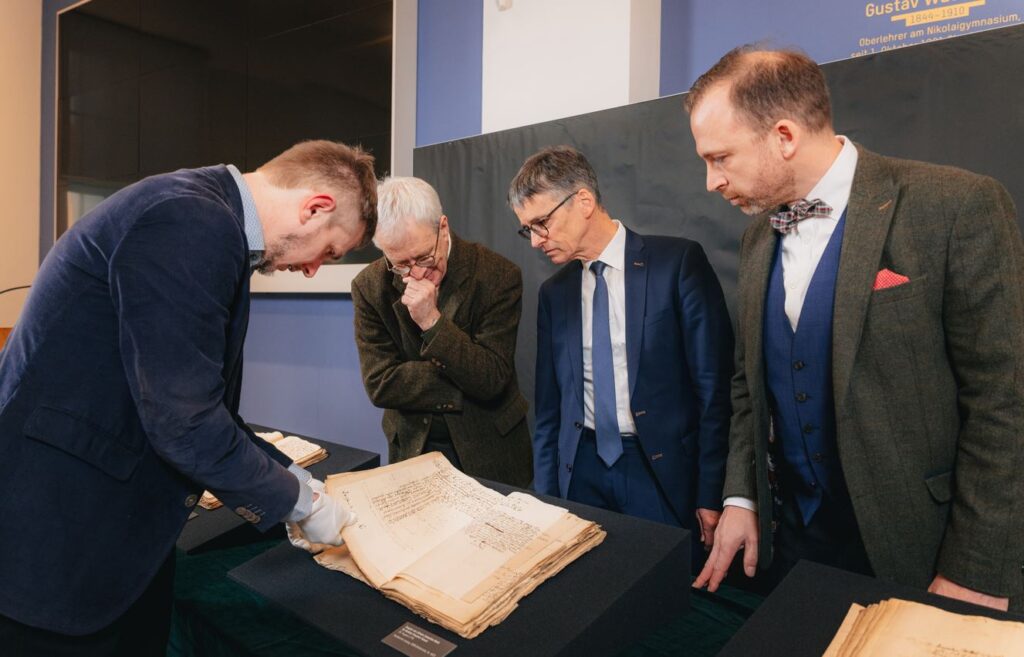
The two compositions now identified as early works by Bach, the Ciacona in D minor BWV 1178 and the Ciacona in G minor BWV 1179, have been known to Leipzig Bach researcher and director of the Bach Archive Leipzig Peter Wollny for over 30 years. He found them in the Royal Library of Belgium. Over the course of his research career, the musicologist has collected numerous clues which, together with the final piece of the puzzle - the identification of the scribe by name - now form a complete picture.

The identification was made as part of the work on the "BACH Research Portal", an academy project of the Saxon Academy of Sciences and Humanities in Leipzig, in which all available archival sources on the entire Bach family of musicians are being digitally indexed and made publicly accessible for the first time.

The anonymously transmitted pieces Ciacona in D minor and Ciacona in G minor are located in the Bibliothèque royale de Belgique de Bruxelles / Koninklijke Bibliotheek van België (Royal Library of Belgium), Brussels, call number: Ms II 3911 Mus (Fétis 2013). The sheet music edition is available from Breitkopf & Härtel (EB 9648).

Yodeling should become a UNESCO cultural heritage site

In December, yodelling is expected to be added to Unesco's list of intangible cultural heritage in New Delhi. The canton of Schwyz will celebrate this on December 13 with a special "Yodeling Day".

Yodeling club Gruss vom Wasserngrat Gstaad (Image: www.bkjv.ch)

Just over a year and a half ago, Switzerland submitted its candidacy to Unesco for the inscription of yodelling on the "Representative List of the Intangible Cultural Heritage of Humanity". Inclusion on this list would recognize an important form of folk music expression for the whole of Switzerland, writes the canton of Schwyz.

Unesco will decide on the candidacy at an international conference in the Indian capital in December. Regardless of this, the musical tradition will be celebrated on December 13 at the Mythenforum Schwyz with a special "Yodeling Day". The Canton of Schwyz and the participating sponsors, the Swiss Yodelling Association, the Lucerne School of Music and the Roothuus Gonten - Center for Appenzell & Toggenburg Folk Music, are inviting you to attend.

The "Day of Yodelling" aims to offer different approaches to yodelling and focus on various aspects of the tradition.

More info:
https://www.sz.ch/kanton/medien-und-datenschutz/medienmitteilungen.html/8756-8757-8803-10391-10392/news/24175

Graubünden supports Grossmann and Kägi

Five artists, including musicians Robert Grossmann and Stefan Kägi, will each receive a work grant or a free scholarship of CHF 10,000 from the canton of Graubünden.

Government building Canton of Graubünden (Image: Canton of Graubünden)

Robert Grossmann from Sils receives the grant for his project "Der Stadtbrand von Chur", while Stefan Kägi, who lives in Winterthur, receives the grant for his sound installation "Undersized empire". The other recipients are Ella Moana Bürkli (Chur, dance), Sandro Livio Straube (Vella, visual arts) and Jan-Andrea Bernhard (Strada/Ilanz, history and memory).

The competition for professional cultural creation (small projects) in the canton of Graubünden is announced every July. The closing date for entries is the end of August. In this competition, work grants or free scholarships of up to CHF 10,000 are awarded. The competition for professional cultural creation (large projects) is announced each January. The closing date for entries is the beginning of March. In this competition, work grants or free scholarships of up to CHF 20,000 are awarded. The same person can receive a scholarship or work grant a maximum of three times. Training courses are excluded from the competition.

Christoph Müller takes over Klosters Music

Basel-based cultural manager Christoph Müller has been appointed Artistic Director of Klosters Music. He succeeds David Whelton in this position.

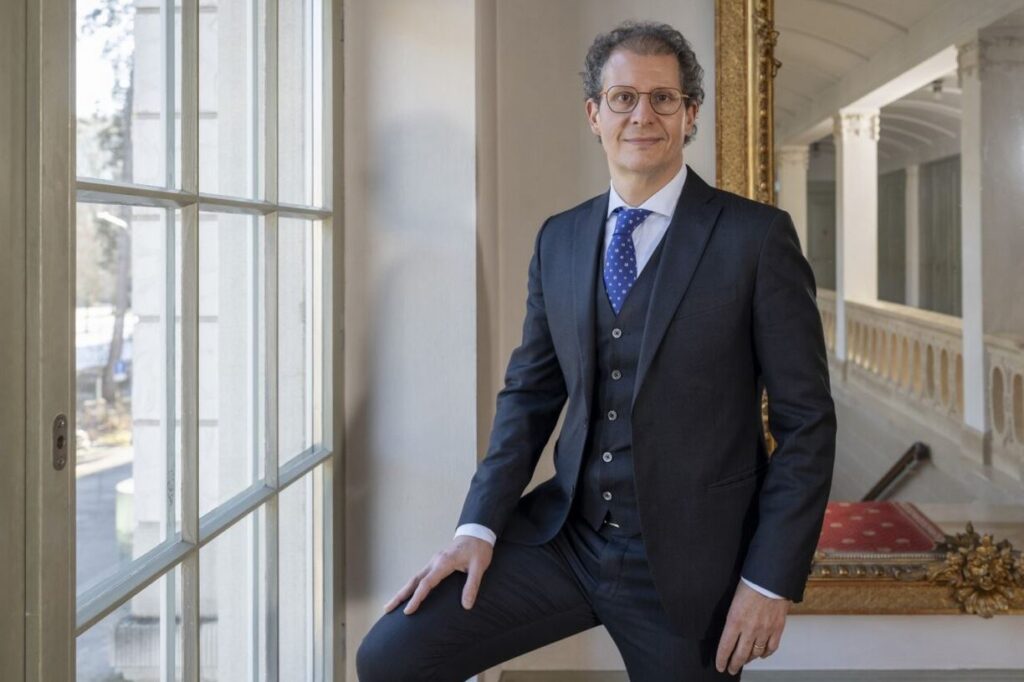
Christoph Müller (Image: Menhuin Festival/Adrian Moser)

Müller will take over the role at the Graubünden festival on November 1, 2026, succeeding David Whelton, who will retire as artistic director with the upcoming festival edition (July 31 - August 9, 2026). From 2027, Müller will launch an additional project as part of Klosters Music, the "Klosters Fine Violin Summit", which combines music and the art of violin making. The new project he has planned is also linked to Müller's work as Vice President of the Swiss Stradivari Foundation Habisreutinger-Huggler-Coray, the most important Swiss institution for the preservation and awarding of historical string instruments.

Klosters Music is organized by the Art & Music Foundation, Klosters. With the establishment of the foundation and the support association of the same name in spring 2019, a basis was created to develop a cultural offering. In future, the foundation will realize various styles and formats in the fields of art and music in Klosters, Prättigau and beyond.

Müller directed the Gstaad Menuhin Festival from 2002 to 2024. He will also take over the artistic direction of the Settimane Musicali Ascona in 2026. Born in 1970, the cultural manager is a trained cellist and has held various positions with the Basel Chamber Orchestra since 1996. He has been the orchestra's artistic delegate and concert manager since 2011.

get_footer();