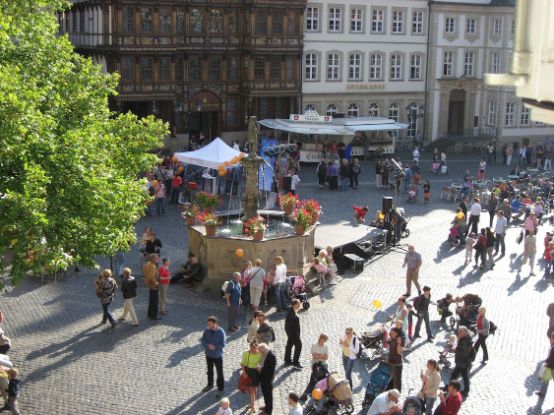
The International Conference on Cultural Policy Research (iccpr), the world's largest conference for cultural policy research, is coming to Germany this fall after Montreal, Istanbul and Barcelona: The University of Hildesheim is hosting the world congress from September 9 to 12, 2014.
Music newspaper editorial office
(translation: AI)
- Aug 27, 2014
The conference will open in Hildesheim. Speakers include Bernd M. Scherer, Director of the House of World Cultures Berlin and Basma El Husseiny from the Egyptian cultural research institute Al Mawred Al Thaqafy in Kario. The congress will continue in Berlin on September 12 and 13.
A total of 400 experts from around 60 countries are expected to attend. In 75 parallel forums, they will discuss cultural policy and transformation processes, cultural education and participation. Registration as a visitor to ICCPR2104 is possible via the conference website, but the number of places is limited.
Contributions from Switzerland come from Iolanda Pensa from the Scuola universitaria professionale della Svizzera italiana (SUPSI) and Lisa Marx from the University of Geneva.
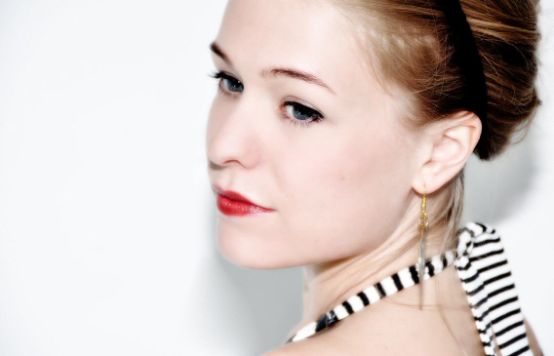
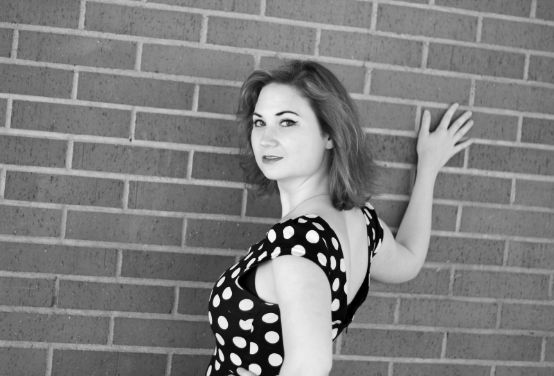
Isabelle Stettler and Madeleine Merz, both mezzo-sopranos and Master's students at the Bern University of the Arts (HKB) in the class of Christian Hiltz, have won the shared ABA Award 2014 of the Austria Baroque Academy and thus a joint concert at the Schwetzingen Winter Festival 2016.
PM/Codex flores
(translation: AI)
- Aug 26, 2014
Isabelle Stettler. Photo: zvg
The Austria Baroque Academy offers master classes in Gmunden, Moscow and Belgrade for graduates of music academies and conservatories. Students in higher semesters can be admitted with the recommendation of their teacher. Its partner organizations include the Tchaikovsky University in Moscow, the Gnessin Academy of Music in Moscow and the music universities of Vienna, Prague, Belgrade and Warsaw.
Isablle Stettler graduated from the Hochschule für Musik Main in 2012 with a diploma as a singing teacher. She has been studying at the HKB since September 2012. The Aargau mezzo-soprano Madeleine Merz began her vocal training with Regula Grundler and has been studying at the HKB in Christian Hilz's class since 2010. She graduated with a Bachelor of Arts with distinction in summer 2013.
Madeleine Merz. Photo: zvg
In close contact with the next generation
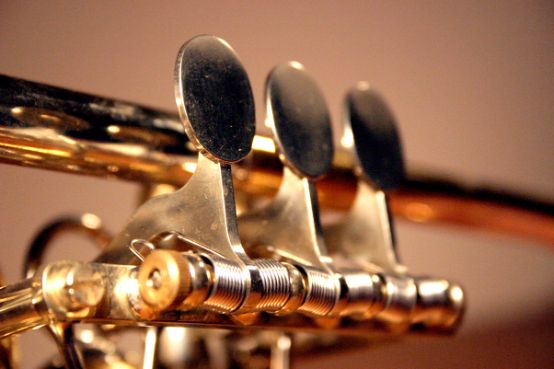
On January 17 and 18, 2015, the Lucerne School of Music will be holding a Brass Academy for the first time. Young and talented brass players aged 12 to 20 from Central Switzerland can take part.
Music newspaper editorial office
(translation: AI)
- Aug 25, 2014
Photo: Marcus Brauer/pixelio,SMPV
Participants will receive individual and chamber music lessons from the following professors and lecturers at the university: Markus Würsch (trumpet / cornet), Immanuel Richter (trumpet / cornet), Thomas Rüedi (euphonium, baritone, E-flat horn), Simon Styles (tuba), Markus Wüest (trombone), Lukas Christinat (horn), Olivier Darbellay (horn).
Thomas Rüedi explains why he is taking part in the Brass Academy as a lecturer, what sets these two Academy days apart from other courses and who can take part:
For a long time, we brass teachers at the Lucerne University of Applied Sciences and Arts have been keen to intensify contact with young musicians in Central Switzerland. The "Konsi", as it is still traditionally called, should not be an elitist castle high above the city.
The young musicians are given the opportunity to gain an insight into musical life at Lucerne University of Applied Sciences and Arts over the course of two days. The focus is also on personal contact with the lecturers. Our aim is to give young, talented brass players a boost on their musical path and to pass on our passion for classical music to them.
All brass instruments are welcome without exception. Registration should be supported by a verbal or written recommendation from the music teacher or conductor of the brass band. It is very important to us that music teachers and/or conductors in the region draw the attention of their pupils to this brass festival.
Short public concerts by the lecturers will take place during the academy. The final concert, also open to the public, will take place on January 18, 2015 at 6 pm.
Registration deadline: October 31, participation fee including two lunches: CHF 40. Exceptions to the geographical limitation of the group of participants may be granted. Contacts for further information: Lucerne School of Music (Reimar Houtman: 041 249 27 12) or Immanuel Richter (immanuelrichter@hslu.ch).
In October, the first young entrepreneur event explicitly for the creative industries takes place in Zurich. 100 participants will develop new business ideas in the field of art and culture at ewz Selnau, accompanied by coaches and experts.
Music newspaper editorial office
(translation: AI)
- Aug 25, 2014
Picture: Rawpixel - Fotolia.com
The Startup Weekend (October 3-5) is a non-stop entrepreneurship event that focuses on targeted input, networking and work. Participants go through the entire process of creating a startup in one weekend, from Friday to Sunday evening, and are supported by a professional team and renowned experts in terms of financing, marketing, strategy and feasibility. At the end, they present their business models to a jury of investors and experts.
The participants are supported by a team of students, who implement the event operationally, and an advisory board. Sponsors include Migros Engagement and Pro Helvetia, as well as the canton and city of Zurich's location promotion agency, representatives of the universities and various cultural entrepreneurs. Gebert Rüf Stiftung also makes a financial contribution.
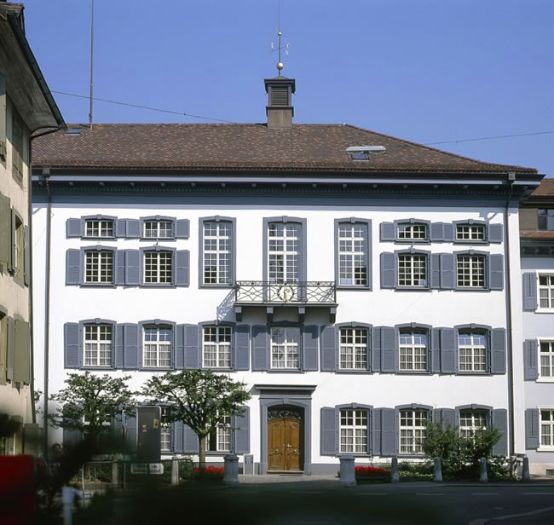
The University of Applied Sciences Northwestern Switzerland is opening a jazz campus on the site of the former Willy A. Bachofen AG Maschinenfabrik (WAB) in Basel. It is financed by foundation funds from the patron Beatrice Oeri.
PM/Codex flores
(translation: AI)
- Aug 22, 2014
Picture: FHNW (zvg)
The construction of the building was made possible in particular by the Habitat Foundation, while the expansion for the jazz school was made possible by the Levedo Foundation: both foundations are largely funded by Beatrice Oeri. The architects Buol&Zünd have combined historical substance and modern architecture and integrated the jazz campus into the neighborhood context.
The Basel Music Academy and the University of Applied Sciences and Arts Northwestern Switzerland have secured the maintenance contract. The campus has a public club for 150 people, a performance hall in the basement for 120 people, another hall on the upper floor for 100 people and a total of 49 music rooms.
There is also a café bar, a music store, a library, a residential building with shared student apartments and a guest apartment, as well as an inner courtyard with a fireplace. The Jazzcampus Basel on Utengasse in the Old Town will open its doors to interested parties from September 19 to 21, 2014.
On the imperial trail
The Bünder Festival Origen has been setting unusual accents in the cultural landscape for years and expanded this year with Charlemagne.
Thomas Meyer
(translation: AI)
- Aug 22, 2014
Photo: Benjamin Hofer
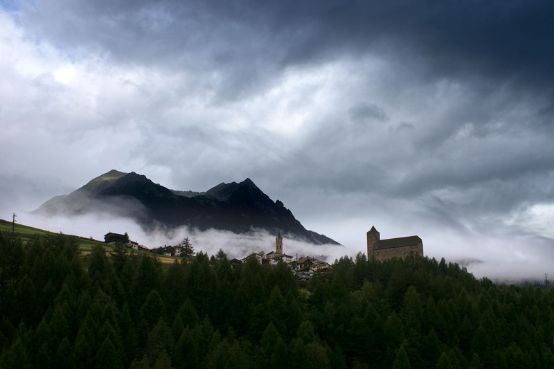
The site where Riom Castle has stood in the Oberhalbstein and Surses since the 12th century and dominates the Savognin valley basin was once the location of a royal court, which the penultimate Carolingian emperor Arnulf of Carinthia owned and then gave away. It is therefore conceivable that it had previously served the Carolingians and that Arnulf's great-great-grandfather Charlemagne once stayed at this court on a journey through his vast empire. He is said to have actually visited the region. Two valleys further on, in Münstertal, he is said to have narrowly escaped a snowstorm and founded the monastery of Müstair. And even if this is just legend, Riom and Müstair are likely to have been bases in his vast empire.
For ten years now, Riom Castle has been home to one of the most original and unique Swiss summer festivals, which manages without stars and repertoire hits and is entirely tailored to the region: "Origen" (Origin, Origin, Creation), founded and directed by Giovanni Netzer, has been attracting an enthusiastic audience since 2006 with a daring Origen program, as the themes are often taken from the Bible (Samson, Messiah, Paradise or the Flood). Smaller event cycles are grouped around a main musical-theatrical production: theater and dance productions, chants in one of the old churches, performances and radio plays in the trains of the Rhaetian Railway. Art-historical guided tours and exhibitions complete the program. There is a summer café in the Sontga Crousch house in the village of Riom, and the barn next door is currently being renovated so that performances can also take place in winter in future, as Origen is expanding and wants to extend its operations.
As central as the castle is: Time and again, the festival leaves Riom and seeks out other unusual locations for the theater performances: Solomon and the Queen of Sheba met high up on the Julier Pass in 2010, for example. In 2014, a stage was also set up for Noah and his ark on the dam wall of Marmorera, in a place where an entire village sank into the reservoir sixty years ago to generate energy. Another time, the festival made a guest appearance at Zurich main station. Origen works with what it finds on site, as only the Rümlingen New Music Festival does. And just as he transfers biblical stories to Graubünden, Netzer changes them further, enriches them with variations from other sources, lets his imagination run wild - in order to extract a dramatic core. In recent years, he has in any case begun to rework the themes several times. Each time, they are also expanded into comedy: the small cast of "Commedia", consisting of former students of the (Clown) Scuola Dimitri, travels through the countryside with a traveling stage and plays in the villages. This year, they took on an old Zurich legend of Charlemagne with a brilliantly cheeky version, as Charlemagne was the focus of the festival in the 1200th anniversary year of his death.
Riom with castle. Photo: Benjamin Hofer
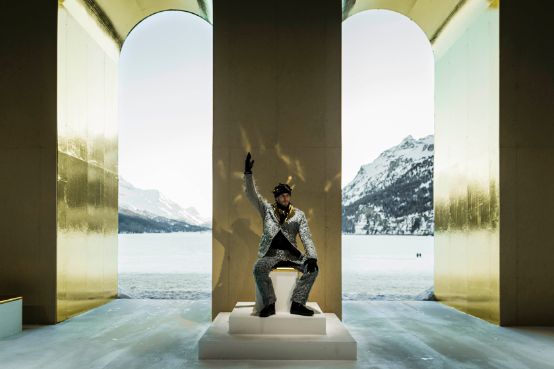
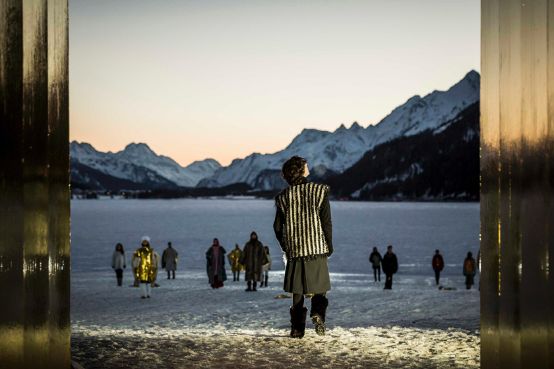
Origen once again expanded in terms of space and time. Most of the events took place during the summer months in Riom and the surrounding area. However, the festival opened at the end of March in the Upper Engadine on frozen Lake Silvaplana. The golden cuboid of the temporarily rebuilt "Festspielhaus" shone in the white snowy landscape, illuminated by the evening sun. The audience sat in the warmth on ascending rows of seats, with the stage in front of them, looking out into the snow from where the dancers performed. The story was about Karl, the "King in the Snow", who gets lost in a snowstorm, arrives with his wife and children in the realm of the Prince of the Dead and is confronted there with his past misdeeds, the murder of his brother Karlmann and his family. This fictional story is certainly only based on conjecture and not on historically proven facts, but it gave Giovanni Netzer the opportunity to explore some of his main motifs: Domination, conflict and violence. The dark side of power becomes visible, as Charlemagne rarely appears in all these productions only as the glorious emperor, but above all as a wild and cruel, power-hungry upstart.
The story was told in the snow without words, only through dance and with electronic music by Lorenz Dangel. The landscape provided an impressive backdrop, but it would have been too superficial if the production had relied on this alone. This performance reached deeper, into the existential, and went to the heart of the matter. This was revealed on several levels. Because of the cold, the dancers were unable to move in the usual way. They wore heavy shoes and were wrapped in thick robes. Nevertheless, the virtuosity of their gestures unfolded. This gave the dance a new intensity, the bodies wrestled with each other and sometimes did not let go of each other. It had an oppressive effect. We almost breathed a sigh of relief when Karl and his family were released back into life at the end.
"King in the snow". Photo: Benjamin Hofer
Origen almost always presents a kind of sacred music theater, not only in terms of its themes, but also in terms of its form, which derives less from opera than from a mystery play or a staged oratorio. This is as unique and fascinating as it may seem strange at first: certainly not a typical program for summer visitors. Giovanni Netzer has moved away from dramatic singing. He usually focuses on dance and the movement of the bodies, with music from a computer or sung by a vocal ensemble. This can become enormously charged, as in the King in the snowbut it can also lead to a liturgical performance in ritual stages, as was the case this summer with the production David was also shown at a suitable location, in Müstair near the border with South Tyrol. There - on a stage recreated from the Carolingian church next door - it was all about the coronation of Charlemagne. The latter, an actor who only appeared occasionally, remained silent; a narrator led through the chronicle. From the vocal ensemble, which performed Gregorian chants and responsories by Carlo Gesualdo in between, six soloists broke away one after the other to portray a person from the life of Charles in a new aria composed by Edward Rushton: Pope Leo III, who performs the coronation again willy-nilly, the prophet Samuel, who appeared as a kingmaker from the Old Testament; the scheming Byzantine empress Irene and her weak son Constantine, Charles's neglected wife Luitgard and a mistress of Charles. Each time, the emperor appeared in a different light - not exactly positive. The whole production was coherent; the vocal ensemble, rehearsed by Clau Scherrer, has been working at a high level for years; the magnificent costumes, created by textile designer Martin Leuthold from the St. Gallen textile company Schläpfer, are one of the attractions of the festival. And yet: this "David" (as Karl called himself at his court) remained a sequence of images that did not intensify or build up. This is in stark contrast to the dance production Emperor in the bathwhich was shown at Riom Castle. There again, a very physical, expressive dance took center stage: the life of Karl passed by, and in combination with the percussive sounds of Peter Conrad Zumthor and Lukas Niggli and the motets of Francis Poulenc, an abstract and yet very moving biography was created.
Origen's "Charlemagne Year" will conclude on September 5 and 6 at Zurich Main Station: Requiem - requiem mass for Emperor Karl. Music by W. A. Mozart and O. Weber
Nine up-and-coming talents were honored at the eighth edition of the music competition, including Basel saxophonist Patrick Stadler.
Music newspaper editorial office
(translation: AI)
- Aug 21, 2014
How the Marianne and Curt Dienemann Foundation from Lucerne writes in its press release, the participants played at an exceptionally high level this year. The foundation awarded a total of 66,000 francs to nine young wind players.
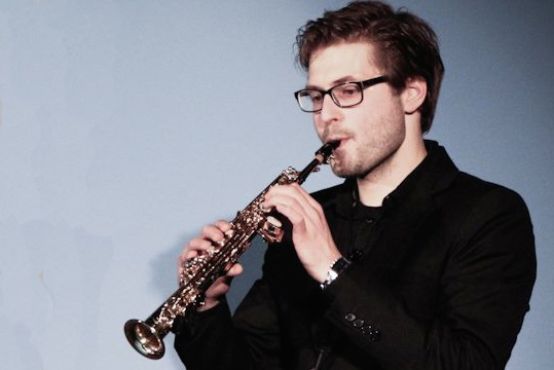
The saxophonist Patrick Stadler from Basel was awarded a year's work, while the Basel flutist Jin-Ah Lee and the Bernese oboist Bruno Lucas Pérez received two extra prizes.
Further prizes went to Claudiu Marius Danciu, clarinet, Basel; Calogero Presti, clarinet, Basel; Niklaus Egg, trumpet, Rothrist; Wong-Ji Hwang, flute, Lucerne; Isaac Makhdoomi, recorder, Basel; Ana Teresa Herrero Bordell, bassoon, Basel.
Established in 1986, the foundation's main aim is to promote training in the field of music (jazz and classical) and the development of literary works. It is aimed at young (up to the age of 40), talented literary artists, musicians and composers of Swiss nationality or artists who live in Switzerland.
Adolf Wölfli and the music
Adolf Wölfli was born 150 years ago. To mark the occasion, the Wölfli&Musik association is organizing a series of concerts and readings in Bern. Wölfli will also be brought to life on stage in a musical theater.
Music newspaper editorial office
(translation: AI)
- Aug 21, 2014
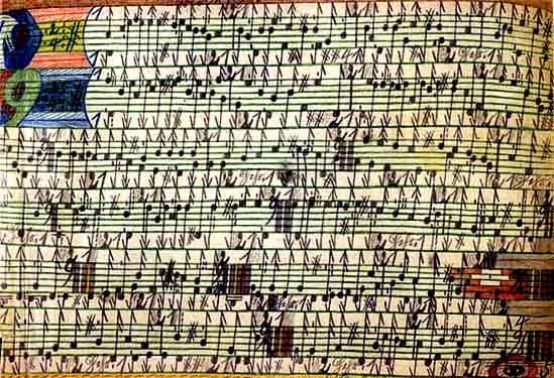
Drawing by Adolf Wölfli, wikimedia commons,SMPV
The Wölfli&Musik association was founded in 2012 with the aim of supporting cultural projects with a musical connection to Adolf Wölfli and his life's work. To date, the association has commissioned a composition every year, for example to Jost Meier (2012) and Christian Henking (2013). Several textual-musical events are now planned to mark the 150th anniversary of the artist's birth. Further compositions have been commissioned and a composition competition for students at music academies has been held.
Under the title 150Wölfli the weekends from August 29 to 31 and October 3 and 4 will be dedicated to the "Musik-Diräkthor" and "Riesen-Theaat'r/Diräktohr", as Wölfli called himself. Wölfli's place of residence, the former cantonal insane asylum Waldau and today's Psychiatric University Hospital, will be included as a venue. Other venues include the Kunsthalle and the Dampfzentrale Bern. The program includes a twelve-hour reading from Wölfli's From the cradle to the grave, a homage to Wölfli for children, the world premiere of the prize-winning pieces from the university competition, further world premieres by Kjell Keller, Roland Moser and Daniel Glaus. For the music theater The omnipotence tube was composed by Helena Winkelman, who is also the musical director. Steamboat Switzerland performs and Meret Matter directs.
Further information about the musician Wölfli and a detailed program: www.150woelfli.ch
No misappropriation of lottery funds
According to the draft of the Federal Gambling Act, it will be possible in future for cantons to regularly subsidize the operating costs of non-profit cultural institutions from the lottery fund. According to Suisseculture, the umbrella organization of cultural professionals, this is not a good idea.
Music newspaper editorial office
(translation: AI)
- Aug 21, 2014
Photo: KFM/pixelio.de
Suisseculture believes that operating contributions should continue to be financed from the regular public budget, as these are constitutional and statutory tasks of the cantons. According to Suisseculture, it is unacceptable for state tasks to be financed from gambling revenues.
According to the Federal Constitution and most cantonal constitutions, the arts and culture in Switzerland are supported by the public sector. Without this support, very few professional artists in Switzerland would have an economic livelihood and the diversity of cultural offerings would be thinned out.
In most cantons, individual artistic projects in particular have so far been supported from the proceeds of the big lotteries, while permanent art institutions are subsidized with annual budgets from the ordinary budgets of the cantons and municipalities. From the point of view of cultural professionals, this is correct and should remain so.
However, Suisseculture generally welcomes the fact that the profits from large lotteries will continue to be used in full for charitable purposes. Suisseculture also welcomes the criteria set out in the draft law and the planned greater transparency of the award processes.
Reclaims from the canton of Basel-Landschaft
The government council of the canton of Basel-Landschaft wants to reclaim compensation paid to several people in connection with the representation of the canton in institutions with cantonal participation. The head of the Cultural Affairs Department, who may initially also be affected, will be removed from the firing line.
Music newspaper editorial office
(translation: AI)
- Aug 20, 2014
According to a statement from the canton, the Basel-Landschaft cantonal audit office found in an audit report in mid-December 2013 that institutions in which the canton holds a stake had paid out compensation to cantonal representatives that had not been properly accounted for. As a result, the cantonal government commissioned law professor emeritus Enrico Riva to examine the canton's claims for repayment.
The Riva report states that, according to the Personnel Decree, all employees of the canton must hand over any remuneration they receive in connection with the performance of duties on behalf of and in the interests of the canton. The report also states that this also applies to members of the cantonal government.
Former member of the cantonal government Adrian Ballmer, the late former member of the cantonal government Peter Zwick, member of the cantonal government Urs Wüthrich and former land registrar Walter Mundschin are affected by a clawback.
For former member of the cantonal government Jörg Krähenbühl, President of the cantonal government Isaac Reber, member of the cantonal government Anton Lauber, member of the cantonal government Thomas Weber, member of the cantonal government Sabine Pegoraro and Niggi Ullrich, Head of the Cultural Affairs Department, who have also been listed in previous reports, there are no claims for repayment, even taking into account the review of the remaining mandates and shareholdings that has been carried out in the meantime, the canton writes further.
Uzbek woman wins European Composer Award
Aziza Sadikova from Uzbekistan was awarded the 2014 European Composer Prize at the Young Euro Classic festival in Berlin. The work "Enallagai" by Swiss composer Stefan Wirth also received its German premiere at the festival.
Music newspaper editorial office
(translation: AI)
- Aug 19, 2014
The European Composer Prize, endowed with 5000 euros, is awarded annually by the Governing Mayor of the City of Berlin for the best premiere or German premiere at the Young Euro Classic Festival. Aziza Sadikova received it for her work Letter Shards received.
The composer cites the diary of Daniil Charms, a Russian avant-garde writer of the 1930s, in which he recorded emotional despair and erotic desires, as the inspiration for her work. The physical process of writing a diary is reproduced in the composition through the use of a typewriter and corresponding orchestral effects, among other things.
The jury justified its choice with the diversity of musical and dramatic means of expression, which "can be heard as tones, sounds and words like a prayer from a distant world, ghostly and yet intensely disruptive". Born in 1978, Aziza Sadikova studied at the Tashkent State Conservatory, the Birmingham Conservatory and Trinity College of Music in London. Her music has been performed at the Salzburg Aspekte Festival, Wien Modern and the Southbank Festival in London, among others.
As part of Young Euro Classics, the German premiere of Enallagai by the Swiss composer Stefan Wirth. The "Festival of the World's Best Youth Orchestras" in Berlin attracted a total of 23,500 visitors.
Eastern Switzerland platform for cultural mediation
The three cantons of Appenzell Ausserrhoden, St. Gallen and Thurgau are launching a joint platform for cultural education under the name "kklick - Kulturvermittlung Ostschweiz".
Music newspaper editorial office
(translation: AI)
- Aug 18, 2014
Excerpt from the flyer for the first Eastern Switzerland School Theater Days
Teachers and other people interested in culture can now register at www.kklick.ch inform about projects by artists and institutions. According to the three cantons, this is the first comprehensive intercantonal cultural mediation platform in Switzerland.
Around 100 cultural education offers are already available on the site at launch and are constantly being supplemented with new, up-to-date offers. kklick offers teachers in particular a central point of contact, provides information on all matters relating to cultural education in the region and facilitates direct contact with cultural providers. An editorial team is responsible for selecting the offers.
kklick is an initiative of the three cultural offices of the cantons of Appenzell Ausserrhoden, St. Gallen and Thurgau. kklick also works together with the school authorities of the participating cantons. kklick provides information via newsletters, publishes a brochure to accompany the Internet platform and regularly invites teachers to network meetings.
With a slight decline in sales of 0.8%, the German music market remained stable in the first half of 2014 following weaker spring months.
Music newspaper editorial office
(translation: AI)
- Aug 15, 2014
Image: Spectral-Design - Fotolia.com
According to the German Music Industry Association (BVMI), revenue from music sales amounted to EUR 656 million - around EUR 4 million less than in the first half of 2013.
The most important sales pillar remains the CD, which once again recorded only a slight decline in sales (-3.6%) and continues to represent around two thirds (65.6%) of sales on the German music market. The greatest growth was recorded by the subscription-based and ad-financed music streaming segment (+77%), which now accounts for 7.7% of the German music market.
Vinyl is also continuing on its successful course, growing by 34.5% compared to the first half of 2013 and thus increasing its market share to 2.4%.
In line with the trend of recent years, sales of music videos (-10.4 percent) and physical singles (-31.2 percent) as well as music cassettes (-39.3 percent), which no longer play a role in the music business after celebrating their 50th anniversary last year, declined.
Sales from the digital business segments increased by a total of 7.5 percent to 174 million euros. With a 26.5 percent share of sales, more than one in four euros in the German music industry is generated digitally. Even though downloads declined for the first time (-7.1%), they continue to be the second most important source of revenue in the German music industry with a share of 18.6%.
Music lessons influence children's brain activity
Scientists at Heidelberg University Hospital and the University of Graz have investigated how learning a musical instrument at an early age has a long-term effect on children's brain development.
Music newspaper editorial office
(translation: AI)
- Aug 14, 2014
Image: lassedesignen - Fotolia.com,SMPV
If both ears receive the same information, the right and left auditory cortex of the brain work practically synchronously in musically trained children. In untrained children, they are slightly out of sync; in children with ADHD, the scientists were even able to detect a marked time shift between the two hemispheres of the brain in their current study.
This discovery could explain why auditory processing and perception disorders, ADHD and dyslexia often occur together, explains Annemarie Seither-Preisler from the Institute of Psychology at the University of Graz, one of the authors of the study. Some of the problems of the affected children are likely to be due to insufficient cooperation between the two hemispheres, with negative consequences for attention, rapid language processing and reading and spelling skills.
The team also found that the gray matter in the auditory cortex of musically active children is around half the size of that of their peers. Long-term observation showed that this brain region already had a very specific shape and size before musical training and did not change over time.
As a next step, the team would like to investigate whether auditory processing and perception disorders can be diagnosed at an early stage using neurological measurements in the brain.
Original article: Annemarie Seither-Preisler, Richard Parncutt, and Peter Schneider. Size and Synchronization of Auditory Cortex Promotes Musical, Literacy, and Attentional Skills in Children. The Journal of Neuroscience, August 13, 2014, 34(33): 10937-10949; doi: 10.1523/JNEUROSCI.5315-13.2014
Competition for Europe's young jazz talents
IG Jazz and the town of Burghausen are organizing the 7th European Jazz Competition for Young Musicians. With 10,000 euros, it is one of the most highly endowed competitions on the continent.
Music newspaper editorial office
(translation: AI)
- Aug 12, 2014
Picture: Didi01/pixelio.de
Participation is limited to a maximum age of 30 years and all styles of jazz from combos (three musicians or more) or big bands in Europe are eligible. The prize is endowed with a total of 10,000 euros, divided into a 5000 euro cash prize and a 5000 euro promotional prize tailored to the needs of the winner.
The jury will select five formations for the final round in a blind process. The finalists will be announced in December 2014. The final round will take place on the first day of the 46th International Jazz Week, March 17, 2015, as part of a public concert event.
The jury consists of Joe Viera (director, artistic director of the International Jazz Week Burghausen), Roland Spiegel (music editor for jazz and classical music at Bayerischer Rundfunk), Ralf Dombrowski (music journalist) and Reinhard Köchl (music journalist).
The application deadline is 31.10.2014. Only applications that are complete and received by the IG Jazz office by this date at the latest will be considered.