Journalist Elena Yakovich interviewed Irina Antonovna, whose accounts shed a nuanced light on the events of the composer’s final years.
Jakob Knaus
(translation: AI)
- September 2, 2026
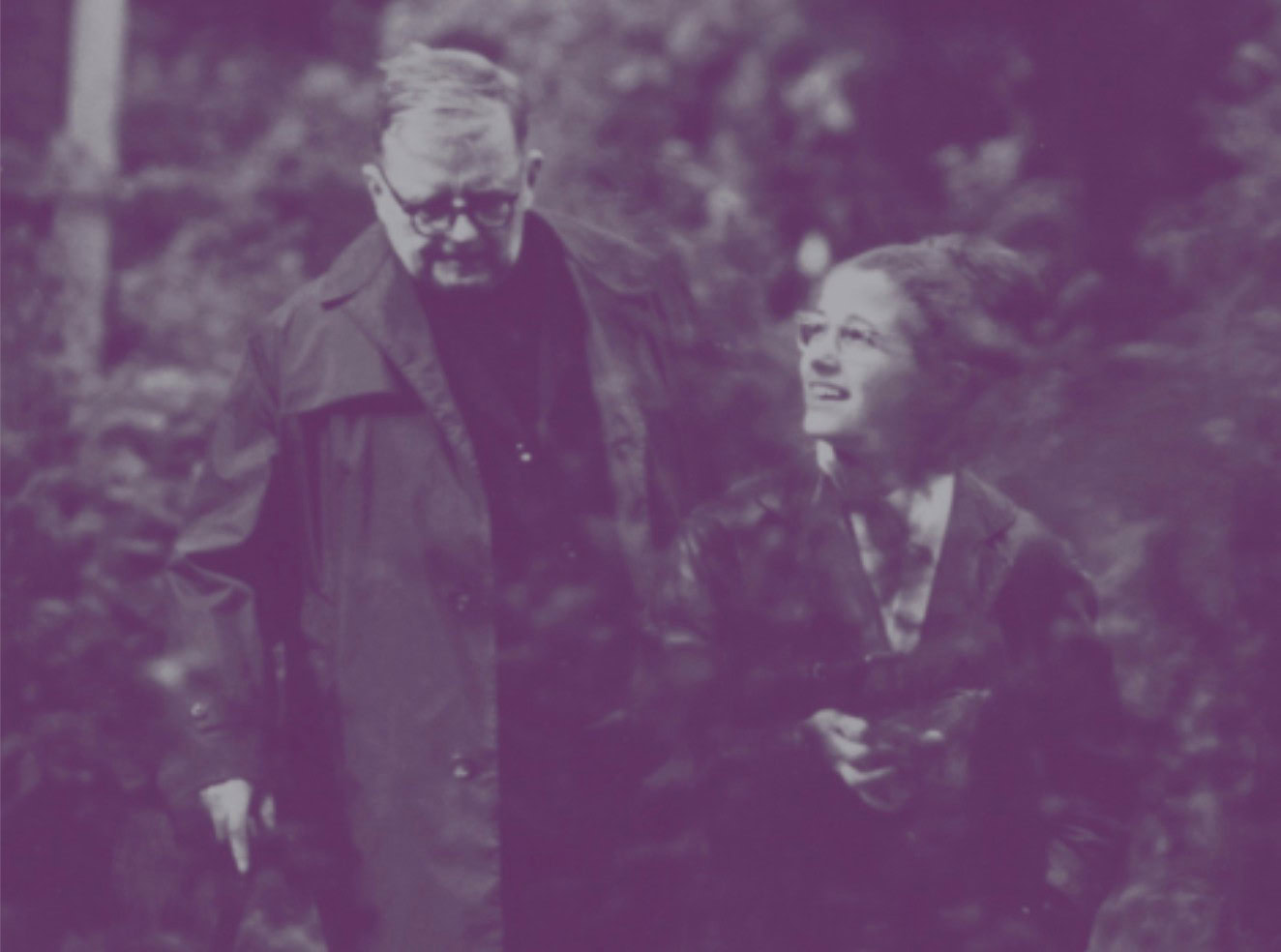
Composer Dmitri Shostakovich with his wife Irina, who is 28 years his junior. Photo: Courtesy of the publisher
This slim volume sparks interest in the final period of Shostakovich’s life, which is arguably the least well-documented. His third wife, Irina Antonovna—28 years his junior—was by his side for the last 13 years of his life. Even today, at the age of 91, she is still working on his estate. That is why it is worth reading these conversations with her, conducted by Russian journalist Elena Yakovich in 2021, which also touch on the background story in a few sections.
Irina was three years old when her father was arrested by Stalin’s henchmen and sentenced to eight years in prison; her mother died that same year. Her descriptions of her childhood in blockaded Leningrad, which was under siege for more than two years, are striking. The fact that, as a seven-year-old orphan, she came to live in the house where the composer Shostakovich resided was a strange coincidence that repeated itself twenty years later when, as a literary editor at the Soviet Composers’ Publishing House, she edited libretto texts and attended meetings where Shostakovich was also present. She was then commissioned to write the libretto for his operetta Moscow, Cheryomushki (Op. 105, 1958) and, if necessary, to correct it.
An Unromantic Marriage
Irina recounts how they got married in 1962 in a reserved manner, without romanticizing the story. For her, it was a realistic, unpoetic, and strictly professional relationship, the emotional side of which she only gradually came to realize. She attended several world premieres with him and thus also experienced the difficulties surrounding the 13th Symphony Babi Yar. For the «Thaw»—the period of Khrushchev’s de-Stalinization campaign—was coming to an end. The years leading up to Shostakovich’s death were once again marked by Stalin-like repression. Irina was now a patient source of support to him in his daily life, which was hampered by heart attacks and falls but nevertheless burdened by public duties, travel, and performances.
Some events described in the scholarly literature are clarified through the statements contained herein—such as the forged signature on the open letter from Sakharov’s opponents. However, she never puts herself in the spotlight and, since Dmitri’s death in 1975, has been working tirelessly to organize his estate and to bring about a complete edition of his works.
Elena Yakovich: Just the Two of Us. Irina Antonovna Shostakovich – My Life with Dmitri Shostakovich, 120 pp., €20.00, Jaron, Berlin 2025, ISBN 978-3-89773-185-1
How Sebastian Nordmann Brings Music to the Streets of Lucerne
This year's Lucerne Festival, held in August and September, featured a number of unusual formats. The new artistic director, Sebastian Nordmann, hopes this will help attract new audiences.
Georg Rudiger
(translation: AI)
- September 1, 2026
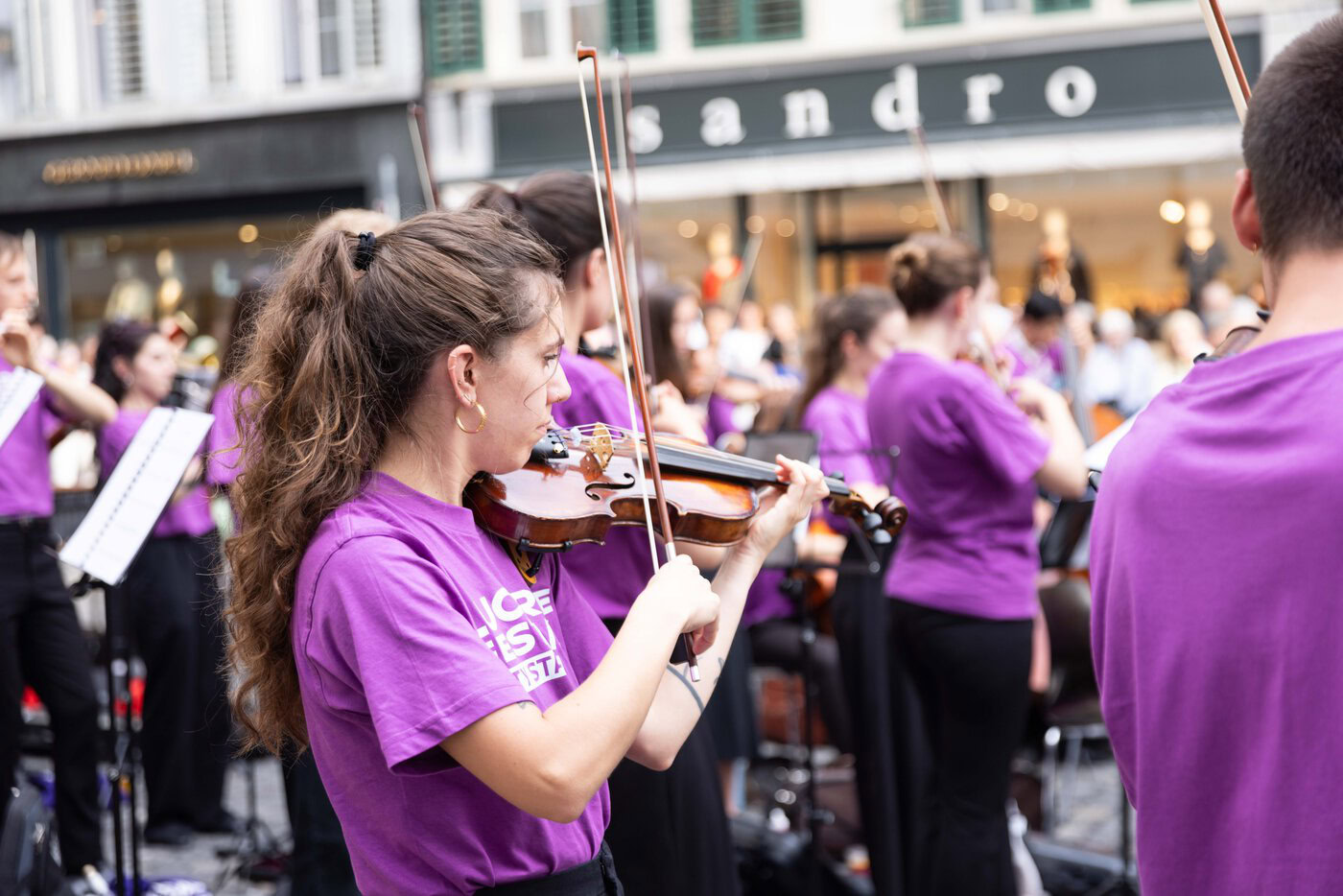
At the «Symphonic Jukebox,» the musicians play pieces chosen by the audience. Photo: Manuela Jans/Lucerne Festival
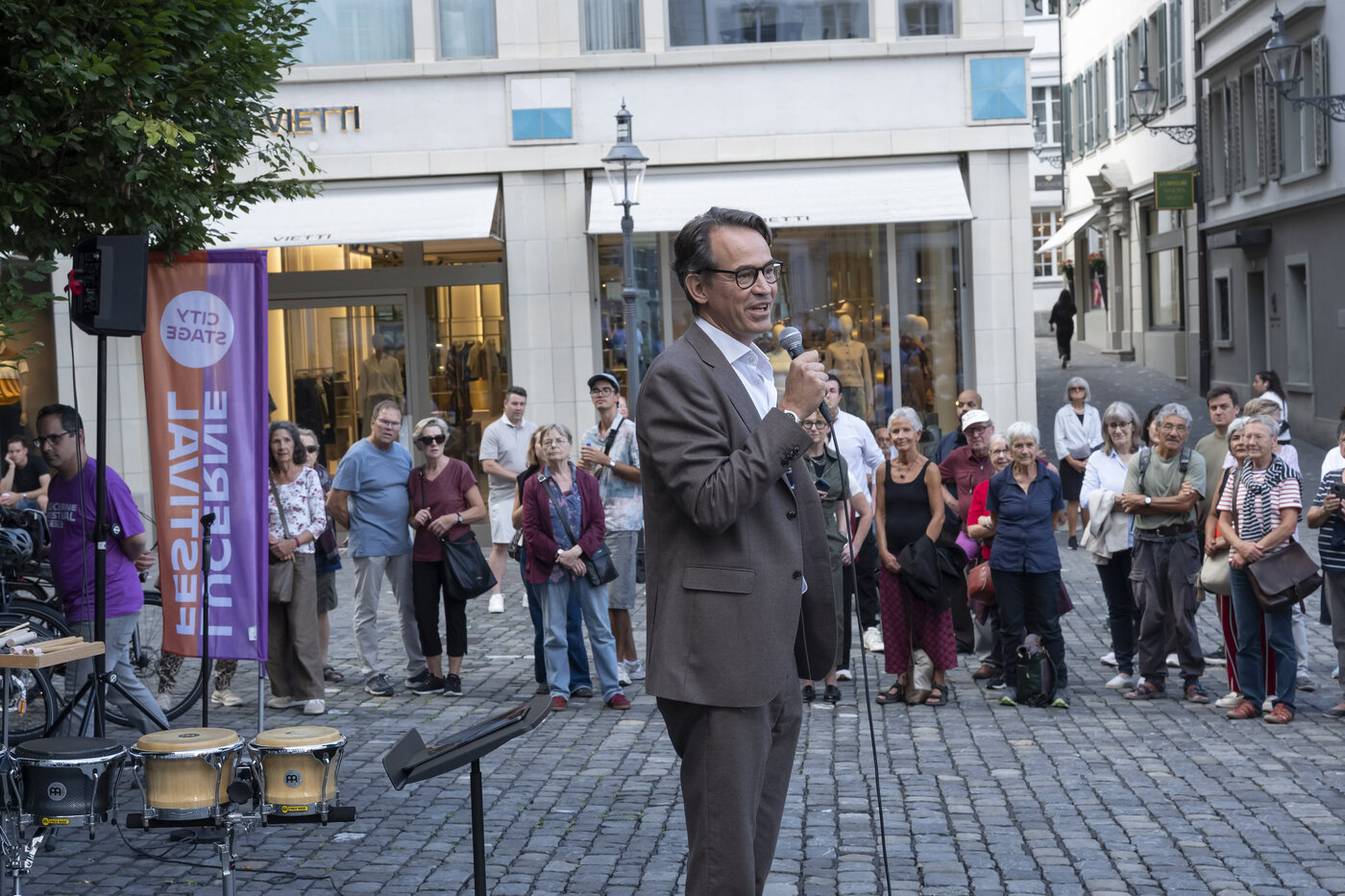
In Lucerne’s Old Town, you can hear muffled beats. «Is that a tower clock?» a tourist asks the person she’s with—and continues on toward the Weinmarkt. Curious onlookers flock to the square from all sides, where a circle of people has already formed and a drummer is tuning his bongos. Two vibraphones and two marimbas are also set up on the pavement. The free concert, part of the newly conceived «In den Strassen: City Stage» festival, is ready to begin.
The new artistic director, Sebastian Nordmann, wants to bring the Lucerne Festival even more into the city. The four young participants of the Lucerne Festival Academy manage to captivate passersby at the Weinmarkt. People pull out their cell phones, and some start moving to the groovy, rhythmically shifted sounds of Steve Reich’s Mallet Quartet.
A few blocks away on Kapellplatz, the experience gets even more interactive. At the «Symphonic Jukebox,» listeners can choose from over 30 songs, which are then performed live by the Lucerne Festival Contemporary Orchestra. Popular pieces such as the waltz from Shostakovich’s Jazz Suite resonates just as much as the rhythmically complex Short Ride in a Fast Machine by John Adams. Conductor Joseph Sieber briefly explains the selected pieces and occasionally offers commentary during an excerpt from Jupiter by Gustav Holst's The Planets hand the baton to a volunteer.
At the Schirmerturm, «sound gardener» Andres Bosshard welcomes a group of twenty for a «Sound Walk.» Together, they listen to the rain, press their noses against the Musegg Wall while humming, learn about the positive social impact of the «Murmelstrom,» and are impressed by the echoes produced, which even make the cows grazing on the neighboring meadow flinch.
Beethoven, as perceived in the 18th century
With this new awareness, you descend the stairs toward the city with a changed perspective. And you savor the subtleties that can be heard in the Royal Concertgebouw Orchestra Amsterdam’s concert at the packed KKL. The orchestra’s interpretation of Beethoven’s Piano Concerto No. 5 in E-flat major is airy. The strings play with little vibrato, and the timpanist uses wooden mallets. Icelandic pianist Víkingur Ólafsson, who is curating the new Pulse Festival in Lucerne this spring, also approaches Beethoven from an 18th-century perspective—in the cadenza, he makes the Steinway grand sound almost like a fortepiano. The strings’ pizzicatos are perfectly executed; indeed, the Amsterdam orchestra delights with its flawless ensemble playing. Ólafsson plays the Adagio with a completely ethereal touch. He then floods the finale with energy and, even if not every triplet opening is technically flawless, transforms it into a rousing dance through his close interplay with the orchestra.
In Sergei Prokofiev’s Symphony No. 5, which premiered in 1945, the Royal Concertgebouw Orchestra, under the baton of Finnish guest conductor Santtu-Matias Rouvali, presents itself as a vibrant ensemble in which the individual instrumental sections are perfectly interwoven. In the second movement, the contours become more jarring and the rhythms sharper—the Adagio is filled with tension and urgency. Only when the violins play in the upper registers in a highly exposed manner, as they do here at the beginning of the movement, is the intonation slightly off.
Hadelich, the Aesthete of Sound
The Berlin Philharmonic also features a rarely performed Russian composition on its program: Alexander Scriabin’s Symphony No. 3 in C minor, Op. 43. How the orchestra shapes this richly textured, complex, and at times bombastic orchestral work—as in the sensuous second movement— Voluptés It’s exhilarating to hear the woodwinds chirp like birds and the brass create emotional peaks. Principal conductor Kirill Petrenko draws the extroverted out of the introverted, using his left hand to maintain balance and his right to ensure musical flow. Unfortunately, the tutti entries following the general rests and the chord changes at the end of the first movement aren’t quite in unison.
In Beethoven’s Violin Concerto, too, the woodwinds« first entry sounds a bit clattery—but then the orchestra settles into a warm sound, fully resonating through the strings, and a flowing pulse. And it lays down the foundation upon which Augustin Hadelich enters the scene on the violin with delicate octaves. This year’s »artist in residence” at the festival is a master of sound aesthetics. Not a single bow change can be heard; every figure is played out in full. The Berlin Philharmonic follows him closely, giving him room to unfold. In the Larghetto, Petrenko has the muted strings play extremely softly, while clarinetist Wenzel Fuchs and bassoonist Stefan Schweigert conjure up a cantabile quality—and Hadelich refines the melody with artful ornamentation.
Sebastian Nordmann, Artistic Director of the Lucerne Festival. Photo: Lucerne Festival / Priska Ketterer
A total of 20 orchestras will perform at the Lucerne Festival over the course of a month. With 12 world premieres, the new artistic director, Sebastian Nordmann, is continuing the work Michael Haefliger has been doing for many years. He hopes to attract new audiences with a more pop-oriented brand, new formats such as «Mittendrin,» where the audience sits on stage, and free events like the Open Air at the start of the festival.
With Jörg Widmann to the limits of audibility
Nordmann has appointed Jörg Widmann—a charismatic composer who succeeds the late Wolfgang Rihm as director of the Lucerne Festival Academy—to the position; Widmann is also active as a conductor and clarinetist—a fact that was particularly evident during the Academy’s fourth concert. Together with the Lucerne Festival Contemporary Orchestra and the SWR Experimental Studio in Freiburg (sound direction: Michael Acker, Joachim Haas, Daniel Miska), Widmann, under the baton of Peter Rundel, About by the French composer Mark Andre, created from the breath, features delicate harmonics and soft clarinet tones at the very limit of audibility.
The world premiere of Tongue of the Land (Roche Commissions) by Australian composer Liza Lim is met with a standing ovation. The rediscovered, reconstructed Celtic instrument, the carnyx (soloist: Marco Blaauw), takes center stage in this sensual, theatrical composition. With its rousing performance, Doctor Atomic Symphony John Adams« work also reflects this year's theme, »American Dreams"—which has been the subject of much discussion in the run-up to the concert—in the Academy concert. A composition that critiques the atomic bomb? That, too, is possible in American music.
On their third album, the Basel-based trio Malummí stays true to folk and indie pop, but presents a more personal side. The nine tracks weave raw vulnerability with comforting sounds.
Michael Gasser
(translation: AI)
- September 1, 2026
The Basel-based band Malummí. Photo: Courtesy of the band
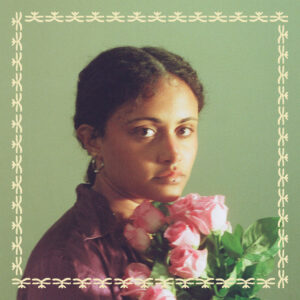
Malummí, the trio founded in 2018, stands or falls with Larissa Rapold. The frontwoman is responsible not only for songwriting but also for her soothing vocals. The lineup is rounded out by multi-instrumentalist Giovanni Vicari, who also serves as the album’s producer, and drummer Lucas Zibulski. With "Damaged By Their Silence", On their third album, the band—named after an imaginary island retreat—remains true to its sound, which blends indie-folk and dreamy pop, and enriches it with deeply personal lyrics. While there was still room for improvisation on their last album, the sound now feels less playful and more focused.
Closeness and Distance
As a result, the nine songs come across as raw and confrontational at times, and calm and airy at others. The album begins with the drawn-out Therapist, a ballad that is as melancholic as it is fragile, with sparkling rhythms and unflinching lyrics delivered with great warmth. The pleasantly humming song Silent Baby, which tells of the parents' worries and the ever-shifting balance between distance and closeness, reveals the singer's otherwise well-hidden rebellious streak. No less direct is the following Adrian. His soft rock sometimes draws inspiration from Joe Dassin's classic chansons Indian Summer —especially since both songs evoke feelings of longing. The three band members prove they also have a soft spot for cinematic pop with the 56-second-long Consumption, which reads like a brief but nearly perfect blend of a 2026 diary entry and Judy Garland's musical classic Over the Rainbow sounds like it's from 1939.
The bottom line? With Damaged by Their Silence With *Malummí*, the artist has created a work that counters omnipresent vulnerability with inner strength and poise. The result is subtle, multi-layered, and downright moving.
Malummí: Damaged By Their Silence. Mouthwatering Records
Experimental Flute Studies
In the two volumes of his «Flute Expedition,» Gergely Ittzés introduces players to advanced playing techniques and unusual sounds. He also builds a bridge to the traditional repertoire.
Claudia Weissbarth
(translation: AI)
- Aug. 31, 2026
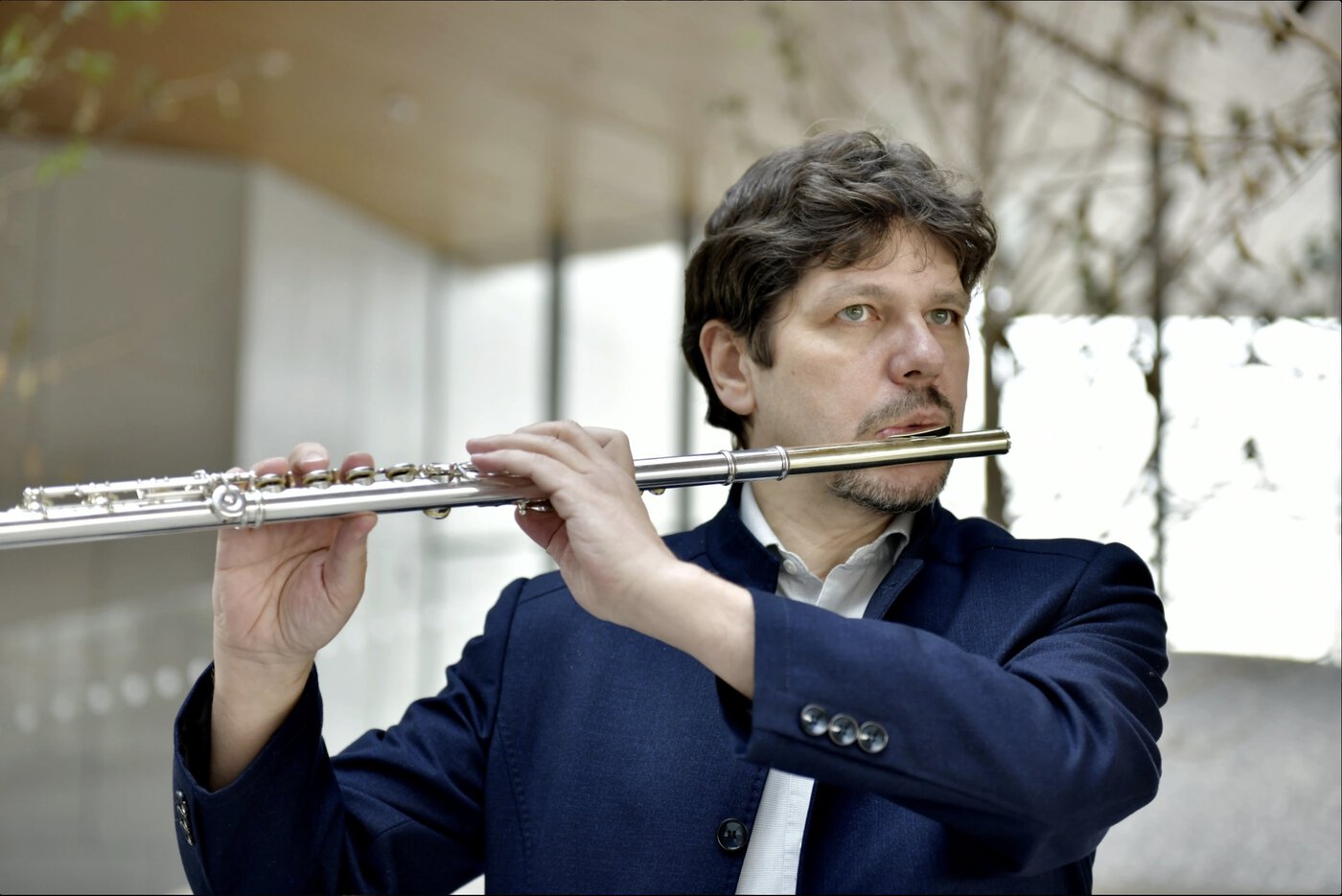
Gergely Ittzés. Photo: Courtesy of the source
The Flute Expedition by Hungarian flutist Gergely Ittzés contains a collection of contemporary etudes designed to encourage exploratory play on the instrument. Particular attention is paid to sounds and playing techniques that, while not part of classical flute playing, are nonetheless part of the instrument’s overall sonic spectrum. With 42 imaginative miniature studies in two volumes, Ittzés offers a step-by-step introduction to techniques such as multiphonics, special breathing effects, glissandos, microtonality, and unusual timbres that push the boundaries of what is possible on this instrument. Each piece includes detailed explanations and notation notes in a comprehensive key.
Ittzés conceived The Flute Expedition as a bridge between traditional flute technique and modern/experimental playing. As he notes in the preface, thanks to this approach, players also gain knowledge that will benefit them—directly or indirectly—when performing traditional works. Rather than treating «normal» and «extended» sounds separately, the work presents them as part of a unified musical language.
«An unusually large number of moves»
The first volume introduces new playing techniques and includes, for example, No. 2 Overtone Prelude and No. 5 Ear-breaker, that alternate between overtones based on the same or different fundamental tones. No. 24 Elegy in C is also based on overtones—those above low C—and uses only intervals that lie within the harmonic structure. In No. 7 Tapping and Plucking Various flutter and pizzicato effects are used. No. 10 is an interesting combination Gregor's Chorale, where voice and «pseudo-multiphonics» are used in octaves to create polyphonic lines reminiscent of Gregorian chant. No. 28 Tremor is dedicated to timbral trills and makes use of microtonal trills and flutter tonguing, while No. 29 Gills introduces the technique of circular breathing.
The author strongly recommends that players not begin the second volume until they have worked through the first volume, as not all explanations are repeated. The second volume requires a transverse flute with open holes and a B-flat footjoint. As he himself writes, Ittzés uses «an unusually large number of fingerings» and several types of fingering notation: in addition to numerical fingering notation, he also employs acoustic fingering notation and graphic fingering notation. Both volumes are suitable for advanced flutists as well as composers seeking to explore the instrument’s sonic possibilities.
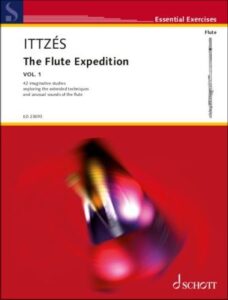
Gergely Ittzes, *The Flute Expedition*, 42 imaginative studies exploring extended techniques and unusual sounds on the flute; Vol. 1, Nos. 1–21, ED 23693; Vol. 2, Nos. 22–42, ED 23843; €29.00 each, Schott, Mainz
An extensive, little-known body of organ music
Among the composers of the first half of the 20th century, Joseph Jongen is not one of the best known. John Scott Whiteley has now published the Belgian composer’s works for organ and harmonium in three volumes.
Tobias Willi
(translation: AI)
- Aug. 30, 2026
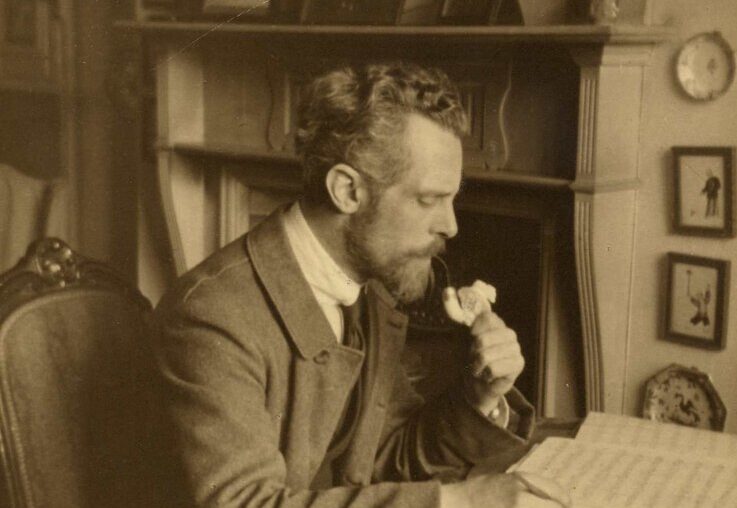
Belgian composer and organist Joseph Jongen. Photo: Royal Conservatory of Brussels
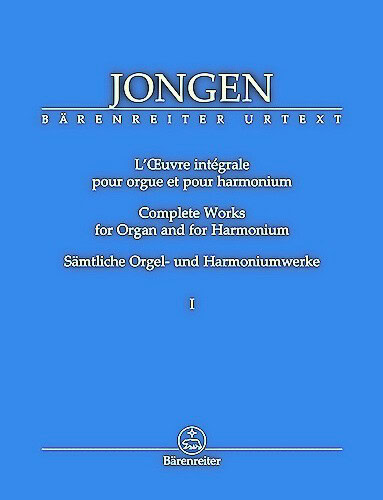
Even though his heavyweight Heroic Sonata (1930) or the Toccata (1937) occasionally appear on organ concert programs, or—with a little luck—one might even hear his Symphonie concertante (1926) for organ and orchestra in a concert hall: The majority of the Belgian composer's works for organ Joseph Jongen (1873–1953) is likely known to only a few specialists. Thanks to this three-volume complete edition, exemplarily edited by Bärenreiter and extensively annotated by John Scott Whiteley, it is now possible to gain a complete overview of Jongen’s organ and harmonium works, which were previously scattered across various publishers (including in the form of reprints or even pirated editions). – The critical introduction provides meticulous information on this.
After excelling in his studies of organ, piano, and composition, Jongen achieved significant success as a composer at an early age (including, in 1897, the Belgian Prix de Rome) and was in contact with many of the great musical figures of his time (including Richard Strauss, with whom he briefly studied composition, as well as Fauré, d’Indy, Arthur Rubinstein, Joseph Joachim, and many others). After initially teaching in Liège, Jongen spent the war years in exile in London and then, beginning in 1920, worked at the Brussels Conservatory, which he later went on to lead as director. His multifaceted compositional output includes a wealth of chamber and orchestral music.
The range of music published in these three volumes is also exceptionally broad: in addition to short verses and préludes (often only a few measures long) and other liturgical pieces, there is a wide variety of character pieces for worship services and concerts at various levels of difficulty, ranging all the way to dazzling virtuosity. While his early works are still stylistically strongly reminiscent of Schumann, Brahms, and, above all, César Franck and his circle, Jongen subsequently develops in a direction that also incorporates influences of Impressionism and ultimately culminates in a musical language that the editor describes in the foreword as «a dreamlike style of abstract, synesthetic color,» to which he has dedicated various publications and about which one would have liked to learn a bit more in this edition as well.
Many of the works include detailed registration instructions and require an organ with the essential timbres of the French Romantic period (strings, voix céleste, hautbois, etc.); the harmonium pieces are registered relatively non-specifically, which allows for easy adaptation to a similar type of organ. Conclusion: Anyone interested in rarely performed organ music from the early 20th century will be delighted by this exemplary complete edition.
Joseph Jongen: Complete Works for Organ and Harmonium, ed. by John Scott Whiteley, 3 volumes, BA11255–11257, €54.00 each, Bärenreiter, Kassel
Fröhlich Violin Sonatas: First Edition
Friedrich Theodor Fröhlich, a Romantic composer from Brugg, composed eight violin sonatas. The last two have now been published for the first time.
Walter Amadeus Ammann
(translation: AI)
- Aug. 28, 2026
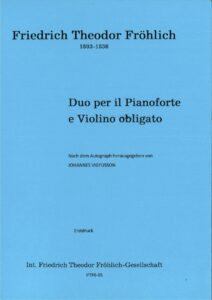
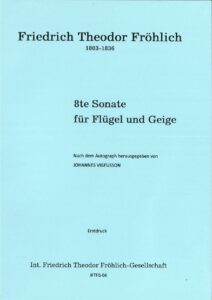
Friedrich Theodor Fröhlich, born in Brugg in 1803, met prominent musicians in Berlin who inspired him to switch from studying law to studying music. Starting in 1826, in addition to choral works, songs, and string quartets, he composed eight violin sonatas; the last two have now been published for the first time. Both are easy to play, well-suited to the instruments, and musically still very much in the classical, school-style tradition: 1st movement: Exposition–Development–Reprise–Coda; Scherzo with Trio; Adagio; Rondo finale. The themes are catchy, featuring many cheerful, virtuosic passages in both instruments. Abrupt key changes feel natural within the context.
The 8th Sonata, composed in June 1826, is very extensive: it took my colleague and me nearly an hour to play through it, and we thoroughly enjoyed it. The scherzo even includes a short fugue. The 7th Sonata, composed in May 1826, is much more compact, with ideas following one another in rapid succession. Instead of a scherzo, there is a march with a lyrical middle section; the transition from the Adagio to the finale is a return to the main theme of the first movement—a comparison with the sonatas of Carl Maria von Weber comes to mind.
The printing of the first editions is clean, but very spread out and does not allow for turning the pages: You have to skip measures to keep moving forward, which works for casual home concerts thanks to the simple structure, but is impossible for performances.
Suicide at age 33to drive
Fröhlich returned to Switzerland in 1830, worked at the Aarau Cantonal School, married Ida von Klitzing, with whom he had two daughters; his many compositions received no recognition, despair, hopelessness, and financial problems led to his suicide in 1836 at the age of 33.
His 700 compositions, almost all of which are manuscripts, are housed in the University Library of Basel. In 2017, the International Friedrich-Theodor-Fröhlich Society and the Fröhlich-Konzerte Brugg Cultural Association were founded in Brugg; these organizations are responsible for publishing his works and organizing public concerts.
Friedrich Theodor Fröhlich: Duo for Piano and Obligato Violin (Violin Sonata No. 7), IFTFG-05, 30.00 Swiss francs, edited by Johannes Vigfusson, first edition, full score and part, Friedrich-Theodor-Fröhlich SocietyCompany, Brugg, mail@froehlich-gesellschaft.comId.: 8th Sonata for Piano and Violin, IFTFG-06, 35.00 francs, froehlich-gesellschaft.com/
A Youth Orchestra in Harmony
The film «Unisono» profiles the Aargau Youth Symphony Orchestra. Anyone who sees it will want to be a part of it themselves.
Fabian Renz
(translation: AI)
- Aug. 27, 2026
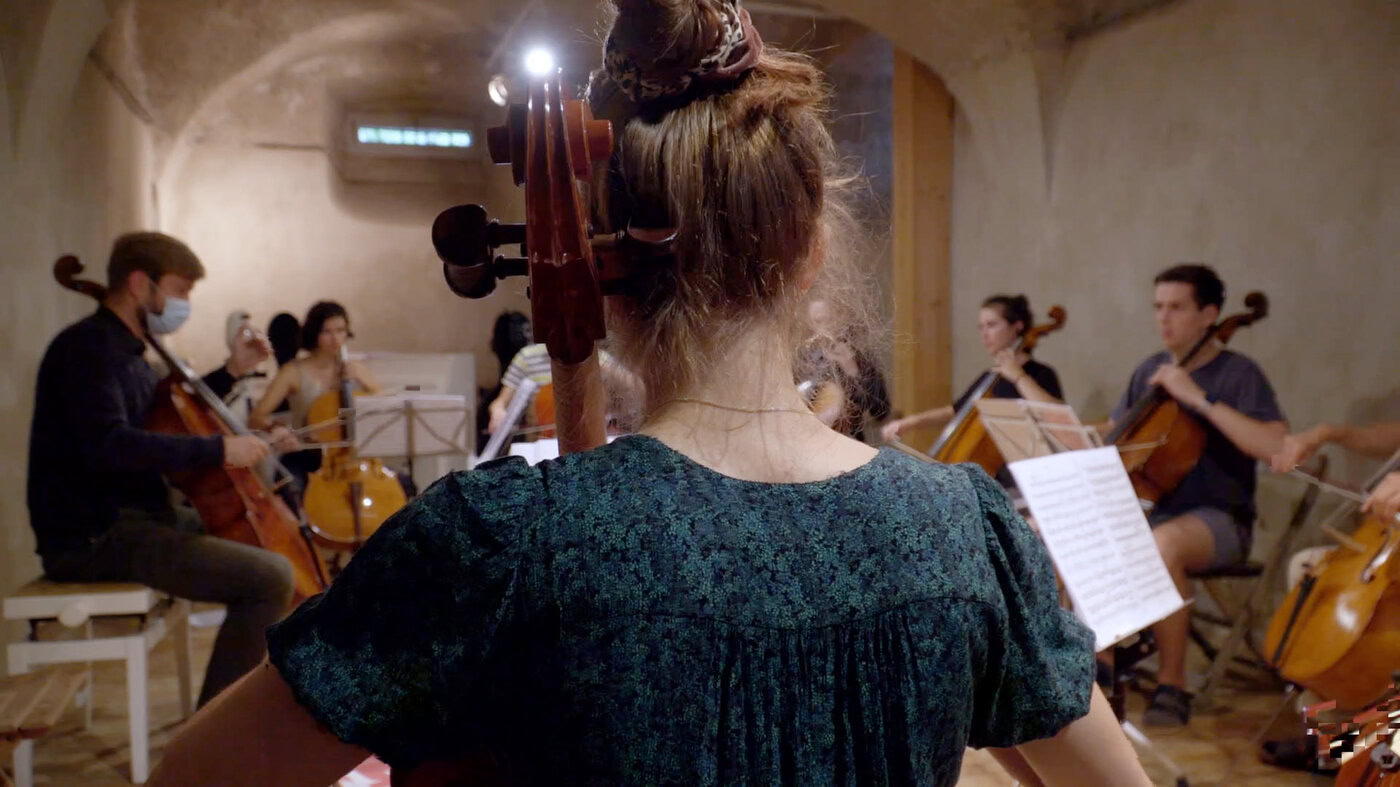
The cello section of the Aargau Youth Symphony Orchestra during rehearsal: A scene from «»In Unison". Photo: Courtesy of
There’s the aspiring professional flutist who’s already dreaming of Vienna, Berlin, and Paris («That’s where the gods are!»). The young violinist who’s happy as an amateur musician with her «super-awesome hobby.» The high school student who might want to study violin, or maybe composition—in any case, «something to do with music.» In the Aargau Youth Symphony Orchestra, such differences don’t matter, as Georges Gachot’s new film impressively shows. Unisono - From the love of music is the title of the one-and-a-half-hour documentary that Gachot produced in the summer of 2020. For one week, the director—now 63 years old, who in his younger years portrayed celebrities such as Martha Argerich and Beat Richner—followed the orchestra’s workshop in Boswil.
From the very first moment, the professionalism and dedication with which the young musicians approach their work are captivating. It is they—and their enthusiastic remarks about music and their work in the orchestra—that Gachot focuses on throughout the entire first half of the film. Even the conductor and artistic director, Hugo Bollschweiler, with his reserved demeanor, comes across as a primus inter pares.
And suddenly, the charismatic soloist appears
The second half of the film marks a turning point in that it introduces the soloist Iiro Rantala: a charismatic artist with immense pianistic skill and decidedly provocative views (Bach’s Goldberg Variations? All improvised and «kindly» written down for us by the composer.) Rantala’s jazz-influenced compositions were part of the challenging program the orchestra worked on that summer. Rantala’s improvisational interludes in spontaneous duets with volunteers from the orchestra are among the most memorable moments in the film.
This film, in turn, largely avoids «private» scenes involving the group of teenagers at camp. Interpersonal tensions—which would, after all, be conceivable in such a setting—are also not an issue: Everything seems, quite literally, in harmony, Unisono - From the love of music takes its title very seriously. For the audience, this means that you’ll want to hear the Aargau Youth Symphony Orchestra perform live. But it also—and perhaps even more so—makes you wish you could be a part of it yourself.
Unisono – A Love of Music. Directed by Georges Gachot. Distributed by Gachot-Films. In theaters starting August 27, 2026.
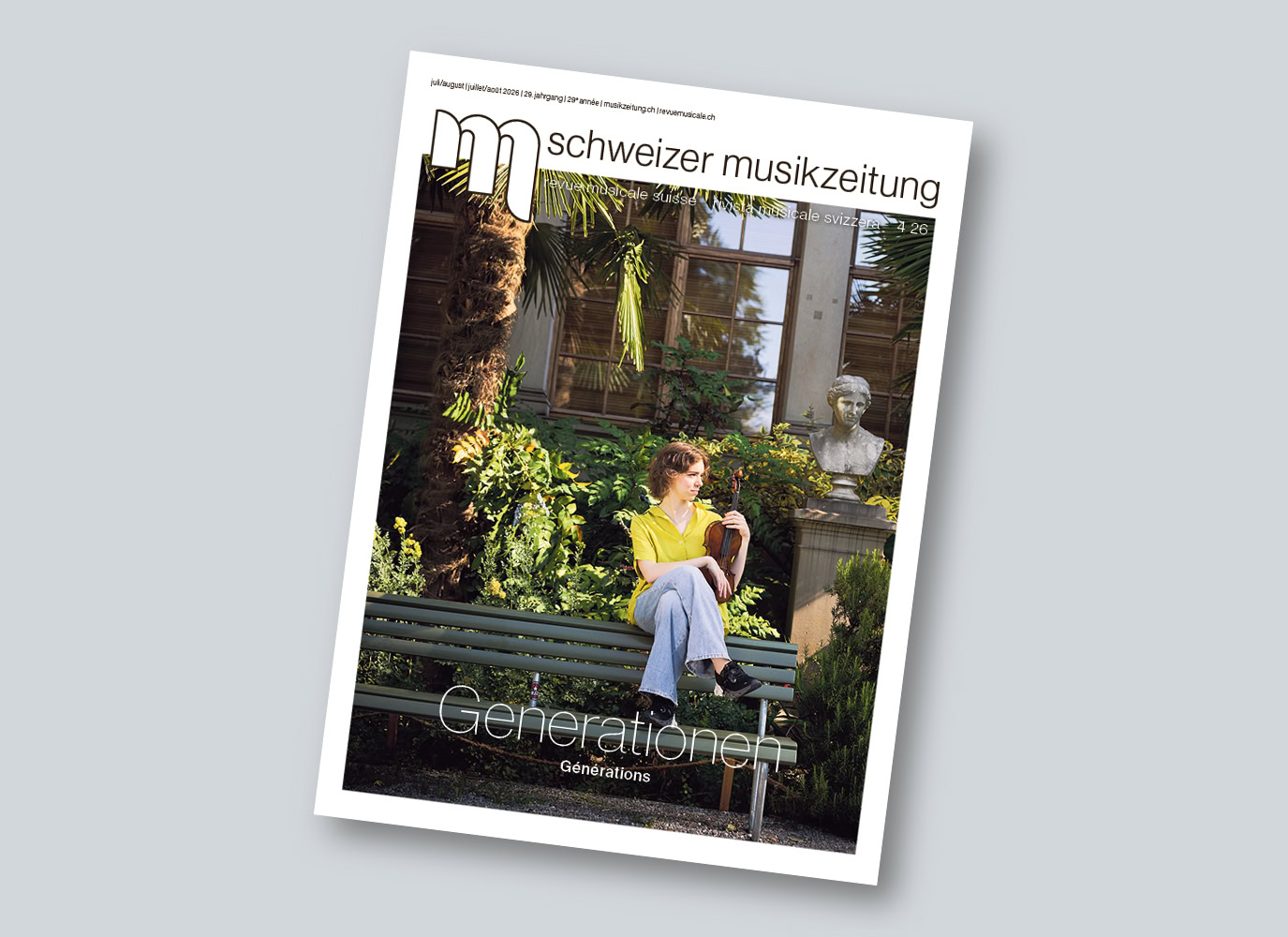
Issue 4/2026 – Focus: «Generations»
SMZ
(translation: AI)
- Aug. 27, 2026
Table of contents
Focus
A Bridge Between Generations Ilva Eigus was already being called a star violinist when she was still a minor. In this in-depth interview, the Zurich-based violinist—born in 2007—reveals how she gets along in her profession with older orchestra musicians and a graying audience—as well as with her father and occasional fellow musician, pianist Nik Bärtsch.
On Tour Through Retirement Homes For the past two years, the young band Léa & the Lions from Vaud has been working on an unusual project: they want to get seniors dancing.
The Curious Evolution of Pop Tastes
Opinions—and, traditionally, the views of different generations—tend to differ on just how great the latest musical craze is. But even in this regard, the Internet has brought about a massive upheaval.
Onward to New Horizons A personal note: SMZ is undergoing a period of transition. Editor Jean-Damien Humair writes about his long-standing collaboration with Editor-in-Chief Katrin Spelinova and Editor Pia Schwab—both of whom are now retiring.
Chat Singer Phanee de Pool discusses the interplay between her professional and family life with her father, who is also her manager.
(italics = summary in German of the original French article)
There is not enough space in the printed edition for all the texts, so they are listed here and linked to the corresponding online articles. Most of these were published before the printed edition appeared.
The End and the Beginning at the Ittingen Charterhouse
The thirtieth Ittingen Whitsun Concerts from May 22 to 25, 2026 were all about «listening». - About the first edition of the festival under the artistic direction of Reto Bieri and verticality in the experience of music.
From whale dances to wildfires, the Anthropocene sets Verbier ablaze
The majestic serenity of the mountains transports us to a sense of eternity and immutability. Yet, in the midst of climate change, the mountains are suffering, the glaciers are melting, and this scorching summer is suffocating us in every corner of the world. The August 1 concert, «Voice of Nature; The Anthropocene,» echoes this reality.
Swiss Sounds at the Vilnius Festival
There are a surprising number of connections between the two small countries, Lithuania and Switzerland. This was also evident at this year’s Vilnius Festival.
In Montreux: 80 Septembers of Music
It is one of the oldest classical music festivals in Switzerland. The Septembre Musical is celebrating its 80th anniversary in Montreux with a mix of new discoveries and established favorites, under the inspired direction of Mischa Damev.
Trying out the creative side
The «Atelier Création», a small festival initiated by the Basel Music Academy and dedicated to creativity at the interface between amateurs and professionals, took place for the first time at Stellwerk Basel at the end of May.