"Funeral Cantata"

Beethoven every Friday: to mark his 250th birthday, we take a look at one of his works every week. Today we look at the cantata on the death of Emperor Joseph II.


Yes, they do exist, the works that have fallen through the cracks of history. The reasons for this are manifold: in the 20th century, it was often political circumstances that caused them to fall through the cracks, before that a wide variety of factors played a role: a lack of initial success, an unusual instrumentation, an unsuccessful text ... When such scores are unexpectedly found or are performed again after decades, there is often talk of an "unjustly forgotten" composition. Whether it then enters the repertoire or at least comes to the attention of the general public remains to be seen. One heretical question always arises: Aren't there also "unjustly forgotten" compositions - such as all-too-early youthful works or even occasional music?

In any case, the mechanisms of the repertoire do not work according to fixed rules. This is also the case with Beethoven and his rich oeuvre, not all of which is equally well known - on the contrary: there is still much to be discovered. So too the Cantata on the death of Emperor Joseph II. WoO 87 (1790), a work commissioned by the Bonner Lese- und Erholungsgesellschaft (which, incidentally, still exists today and has also admitted women as members since 2019). The old minutes of the Executive Committee contain the suggestion that "perform something musical either before or after the speech" was to be performed. However, the cantata was never performed. As it was later said: "from several causes". Perhaps Beethoven had planned the work too extensively (with a playing time of just under three quarters of an hour), perhaps it was completed too late (there were only three weeks between the commission and the memorial service on March 19), and Elector Maximilian, the brother of the deceased and Prorector of the Society, had asked for an hour of silence in the sense of a funeral service.

Beethoven's autograph was lost unplayed. A copy did not reappear until 1884, and the cantata was performed for the first time at a concert of the Gesellschaft der Musikfreunde in Vienna at the suggestion of Eduard Hanslick. Since then it has led a shadowy existence. - Rightly so? Certainly not, because a great deal of the later Beethoven can already be heard here. It is no coincidence that the master later used musical material in other of his works (including the Fidelio) is reused.


Listen in!

Aargau with a new head of culture

The Aargau cantonal government has appointed the former cantonal archaeologist Georg Matter as the new head of the Culture Division in the Department of Education, Culture and Sport (BKS). He succeeds Thomas Pauli-Gabi, who has been appointed Director of the Bern Historical Museum.

Georg Matter (Image: zVg)

Georg Matter has been Deputy Head of the Culture Department since February 2018. Before joining the canton, he was a founding member and member of the management board of ProSpect GmbH in Reinach for ten years.

Georg Matter studied prehistory and early history, medieval archaeology and classical archaeology at the Universities of Basel and Freiburg im Breisgau (Germany). In 2008, he completed his doctorate at the Institut d'Archéologie et des Sciences de l'Antiquité (IASA) at the University of Lausanne. In 2012, he completed a CAS certificate course at the University of Applied Sciences Northwestern Switzerland on the fundamentals of business administration.
 

What the 2021-2024 cultural message can achieve

The latest event of the Parliamentary Group on Music focused on the new cultural message - despite the current major challenge facing the music sector due to Covid-19.

The Federal Palace in Bern, where Parliament meets. Photo: Claudio Schwarz | @purzlbaum on Unsplash

The program of the March meeting of the Parliamentary Group on Music included Explanations on the new Cultural Dispatch 2021-2024. Business as usual, one might have thought. Nevertheless, never before have so many association representatives and members of the National Council and Council of States gathered in the Schmiedstube hall in Bern as this time. It was obvious: there was an elephant in the room - the forced shutdown of the cultural sector due to the coronavirus, which is putting event organizers, freelance musicians, technicians, concert logisticians and ticket providers in financial difficulties. After the presentations by the Federal Office of Culture (FOC) and Pro Helvetia on the cultural strategy for the next four years, there were also emotional votes, with urgent appeals to the councillors to find solutions to limit the devastating economic damage that is looming for the music industry.

Pro Helvetia Director Philippe Bischof felt compelled to remind those present not to confuse the issues. And indeed, there is basically good news to report on national cultural policy. The Federal Council wants to increase spending again. David Vitali, Head of the Culture and Society Section at the BAK, explained where the priorities lie with regard to music.

Musical education

Firstly, there is the Youth+Music (Y+M) program launched with the last dispatch. Following an encouraging evaluation, the training of Y+M instructors is to be "adjusted in terms of content" and certification integrated into the courses of study for music teachers at music universities. A database will make information on the program and course instructors transparently accessible. Performance and impact measurements are also to be expanded. From 2022, the Confederation also plans to offer its own program for the promotion of talented students, which will allow around 1,000 talented students to be identified each year. The core of the program will be a "music talent card", which will "provide access to suitable (cantonal) support services". However, according to Vitali, the idea of a talent card did not meet with universal approval during the consultation process. For this reason, the federal government, cantons and other stakeholders will now work together to develop a framework concept.

According to Vitali, the federal government is also focusing on music school fees. The goal remains "equitable access to music education for all children and young people". An evaluation carried out here has also shown that the differences in fees for adults and young people vary significantly within the education regions. Around an eighth of music schools have no subsidized tariffs up to upper secondary level, around two thirds have no income-based tariff structure and over half have no extended subsidized offers for gifted students. This situation has hardly changed since 2016, Vitali admitted. The Federal Council's proposals on how to tackle this remain rather vague: it wants to further sensitize music school providers to the issue and re-evaluate them.

Measures for musicians

Director Philippe Bischof and Head of the Music Department Andri Hardmeier provided information on the near future of the national arts council Pro Helvetia. According to Bischof, the Arts Council wants to work more specifically to ensure that financial support is increasingly linked to fair pay for creative artists. Pro Helvetia would also like to promote equal opportunities between men and women. In addition, efforts are to be made to establish solid statistics on the cultural sector.

Andri Hardmeier explained that the cultural foundation wanted to take account of the fact that art and cultural forms are changing and merging ever more rapidly. Formats that do not correspond to the concept of works previously applied in the music sector are to be better taken into account in future as part of the promotion of works. Hardmeier mentioned, for example, site-specific or collective works, sound installations and sound art or multimedia works. The promotion of music theater is also to be "consolidated and further developed". Pro Helvetia is also concerned with the cross-cantonal and international dissemination of new works.

This is not enough for the Swiss Music Council. As it writes in a statement, it would like to see "the development of longer-term development strategies for the three genres of folk music, contemporary music (pop, rock, jazz, new classical music) and classical music". The German Initiative Musik gGmbH or the European Agenda of Music (EAM) of the European Music Council could serve as a model here. Furthermore, although the Music Council acknowledges that the visibility of Swiss music abroad has been "substantially improved" in some cases, its members perceive music exports as too fragmented and therefore not powerful enough. In order to improve its effectiveness, the music sector believes that exports need to be more coordinated and better funded.

"Extraordinary situation" due to coronavirus

Stores, restaurants, bars, entertainment and leisure businesses will be closed until April 19 for the time being. The cultural sector is to be supported.

Vulnerable groups should stay at home. Photo: Paweł Czerwiński/unsplash.com

The Federal Council announced today that it now considers the situation in Switzerland to be "extraordinary" in accordance with the Epidemics Act. Among other things, this means that "public and private events (are) prohibited from midnight today. All stores, markets, restaurants, bars and entertainment and leisure facilities such as museums, libraries, cinemas, concert halls and theaters, sports centers, swimming pools and ski resorts will be closed." (...) "The supply of food, medicines and everyday goods to the entire population is guaranteed." Schools will also remain closed until April 19.

The current media release can be viewed here:

https://www.admin.ch/gov/de/start/dokumentation/medienmitteilungen.msg-id-78454.html
 

Cultural sector

The Federal Council already promised support for the sports and cultural sector on Friday, March 13: "The Federal Council also intends to make additional funds available for the cultural sector. In an urgent procedure, the FDHA is drafting a temporary bill for additional economic measures that can be used in addition to other instruments to cushion cases of hardship in the cultural sector. In this way, the Federal Council aims to prevent the existence of recurring cultural events from being threatened and, in particular, to support self-employed and freelance cultural professionals in emergency situations. As part of the drafting of the law, it is also to be examined how the cantons, as those responsible for the cultural sector, can be included in the funding."

The exact nature of this support is being worked out. The Federal Council is endeavoring to find concrete solutions quickly.


Quintet in E flat major

Beethoven every Friday: to mark his 250th birthday, we take a look at one of his works every week. Today it's the quintet for piano, oboe, clarinet, horn and bassoon.

According to Count Waldstein's ideas and wishes, Beethoven was to live in Vienna "Mozart's spirit from Hayden's hands" received. Due to the circumstances (Mozart had died unexpectedly ten months earlier), the classical triad had already been named in 1792, even before Beethoven had been able to develop his own style. This privately imposed obligation on his departure from Bonn was, however, more likely to lead to Beethoven soon exploring his legacy creatively and independently, not always allowing himself to be swayed by the well-meaning Haydn. (Brahms had it with Schumann's prominently printed essay New lanes far more difficult to roll the publicly imposed burden off one's own shoulders).

What Waldstein could not have known in the days of his farewell, of course, and what still amazes him today, is that Beethoven based his Quintet for Piano, Oboe, Clarinet, Horn and Bassoon in E flat major op. 16, which he sketched in Berlin in the spring of 1796, very specifically on a work by Mozart - the Piano Quintet K. 452. "for the best thing I have ever written in my life". It is not only the instrumentation, which was unusual for the time, and the key of E flat major, which was convenient for wind instruments, that are identical, but also the movement sequence and character. Beethoven demonstrates even more in the Andante cantabile pays musical tribute to his role model: the theme plays, recognizable to everyone, on Zerlina's "Batti, batti, o bel Masetto" from the Don Giovanni on. However, an incident handed down by Ferdinand Ries on the occasion of a Viennese performance of the piano quintet shows that Beethoven not only began to fantasize during the cadenzas of his piano concertos, but also knew how to expose himself in other places: "In the last Allegro there is a stop a few times before the theme begins again; during one of these Beethoven suddenly began to fantasize, took the Rondo as his theme and entertained himself and the others for quite some time, which was not the case with the accompanists, however. They were indignant and Mr. Ramm was even very upset. It really looked strange when these gentlemen, who expected to start again at any moment, kept putting their instruments to their mouths and then calmly taking them off again. At last Beethoven was satisfied and fell back into the rondo. The whole company was delighted."


Listen in!

The Swiss cultural sector stands together

The culture and events sector met with the Federal Office of Culture and Pro Helvetia in Bern. It expects swift and effective measures due to Covid-19.

PM/SMZ

In a press release, the Swiss Music Council, Sonart - Music Creators Switzerland and many other associations announced that the cultural and performing arts sector was "delighted with the constructive exchange with the federal authorities" on March 12.

The common goal is to preserve the diverse Swiss cultural landscape as well as its locations, organizers and jobs. To achieve this, all stakeholders must and want to pull together. Quick-acting measures are needed to prevent or at least mitigate the damage caused by the coronavirus crisis, which could have a lasting impact on the industry in particular, but also on the economic development of the country as a whole.

The demands are as follows:

"1. temporary unemployment insurance in the cultural sector for self-employed persons and all those for whom short-time work would not apply now (e.g. sole proprietors, freelancers, management, owners and partners)
2. uncomplicated access to short-time work for all SMEs in the cultural sector
3. compensation for canceled events, including artist compensation
4. emergency fund for cultural professionals and businesses facing existential threats
5. public funding for culture must continue to flow, cultural sponsors (including private ones) should coordinate their efforts
6. continued direct involvement of organizations of creative artists and event organizers in the design and implementation of concrete measures"

Zürcher Tonhalle Gesellschaft becomes AG

The former Tonhalle-Gesellschaft Zürich association has decided to transfer its assets and liabilities as well as all contractual and employment relationships to a newly founded public limited company.

Chief conductor Paavo Järvi visiting the Tonhalle construction site. Photo: Alberto Venzago

Following the transfer of assets, Tonhalle-Gesellschaft Zürich AG intends to carry out an ordinary increase in the share capital of CHF 100,000 to a maximum of CHF 2,650,000 at an Extraordinary General Meeting. The date of the Extraordinary General Meeting can only be set once it is foreseeable that the Municipal Council of the City of Zurich will approve the transfer of the subsidy agreement.

A subsidy agreement exists between the City of Zurich and the Tonhalle-Gesellschaft Zürich association, in which the City of Zurich undertakes to make contributions to the association on a calendar-year basis. As part of the restructuring, the subsidy agreement must be transferred and adapted to Tonhalle-Gesellschaft Zürich AG with the approval of Zurich City Council.

The total nominal amount by which the nominal share capital is to be increased through the issue of a maximum of 25,500 fully paid-up registered shares with a nominal value of CHF 100 is a maximum of CHF 2,550,000. 23,000 registered shares will be offered to the public at an issue price of CHF 400 and 2,500 registered shares will be offered to the City of Zurich at an issue price of CHF 100.

More info: https://tonhalle.ch/ueber-uns/die-liebhaberaktie/

The night worker

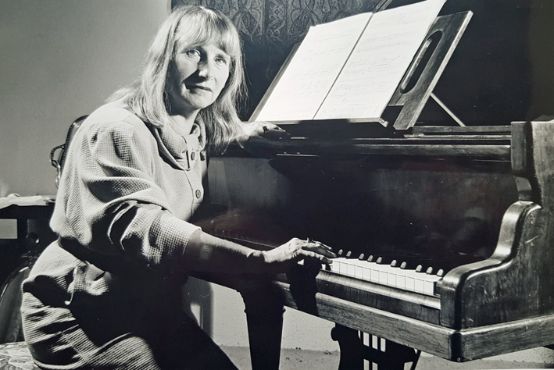
Margrit Zimmermann, composer, conductor, pianist, teacher, born 1927, died 2020.

The Swiss musician at her Erard grand piano. Photo: zVg

Margrit Zimmermann's list of compositions is extensive and covers all musical genres apart from opera. She devoted a great deal of attention to chamber music and chose unusual combinations of instruments and soundscapes. A pianist by training, the piano was close to her throughout her life. Everything was written on it, mainly at night, whether the large orchestral scores, the string quartets or the actual piano compositions. The Erard grand piano in her house in Bern's Schönberg district was her working instrument and place of work, on which she piled up sketches and finished, written compositions. One central work was literally written for the piano: In the Etudes bianchi-neri the black upper keys are set against the white lower keys, as if the keyboard had two manuals.

Margrit Zimmermann described her music as free-atonal and traditional. The latter refers to the notation and the formal structure. Her tonal language moves in the non-tonal, dissonant border area. It is characterized by the horizontal and vertical layering of fourths and sevenths, and consequently also by their inversions, fifths and seconds. The composer used tonal extensions in a playful, improvisational way to create pointed effects and wrote her own signs in the scores with explanations in front of them. A heavy chain rattles along with the piano, forearms have to be rolled over the keys, winds and strings play in quarter tones. She devoted a theoretical work and graphic illustrations to the organization, tuning and use of quarter-tone music.

Margrit Zimmermann's works have found their interpreters, small and large stages, and have won several awards.

Born in Bern in 1927, Margrit Zimmermann trained as a pianist in Bern with the pianist and composer Jeanne Bovet and later in Paris with Alfred Cortot, where she was fortunate enough to attend a composition course with Arthur Honegger for a year. She later trained as a conductor and founded her own orchestra in Berne in 1973. In 1978, she completed eight years of composition studies at the Conservatorio Giuseppe Verdi in Milan with a Diploma di Composizione.

Margrit Zimmermann's catalog raisonné can be viewed at musinfo.chcompositions are available in the library of the Bern University of the Arts. A CD brings together the works Quadriga and Piano Time for piano, Pensieri for tenor, guitar and flute, a string quartet and the Orphic Dances for flute, clarinet, viola, violoncello and piano (available from gerber.iris@gmx.ch). In the book Nachtwerk - Homage to a female composer, published in 2011 by Publisher Zytglogge Oberhofen/BaselIris Gerber Ritter, Margrit Zimmermann's former pupil and interpreter, talks about her life and work.

On February 23 of this year, Margrit Zimmermann passed away after a long illness at the age of ninety-three. Her final resting place will be the Schosshalden cemetery in Bern.
 

Reorientation of the "Days for New Music"

As part of a three-year pilot project, Zurich's "Tage für Neue Musik" festival for contemporary music is to be given a new direction in terms of content. The city's culture department would like a new private sponsor.

The "Tage für Neue Musik" also play in Zurich West. Photo: Yves Moret / unsplash.com

According to its press release, the City of Zurich is looking for a sponsor for the current "Tage für Neue Musik" for the years 2021 to 2023. The aim of this pilot project is to reorganize and reposition the festival in terms of both content and form. A suitable operating and program concept will be selected by a committee of external experts established for this purpose and chaired by the Director of Culture of the City of Zurich.

The city is supporting the festival during the three-year pilot phase with a one-off contribution totaling CHF 850,000. This is divided into an initial contribution of CHF 100,000 in 2020 and operating contributions of CHF 250,000 for each of the years 2021 to 2023. The festival will be evaluated during the pilot phase. Afterwards, further support from the city in the form of annual operating contributions can be reviewed and applied for from the relevant authorities.

The festival for contemporary music has been held annually since 1986. Due to limited financial resources, it was switched to a biennial rhythm in 2016. The reaction of the music scene and the experience with the replacement festival "Focus Contemporary Zurich West" in 2017 showed that an annual festival of contemporary music is highly valued in Zurich. The aim of this pilot project is to examine and evaluate a new direction for the content of the festival.
 

Valais supports organizers

The services of the State of Valais will pay the amounts promised to the organizers of cantonally supported events, even if they have to be cancelled due to the coronavirus epidemic.

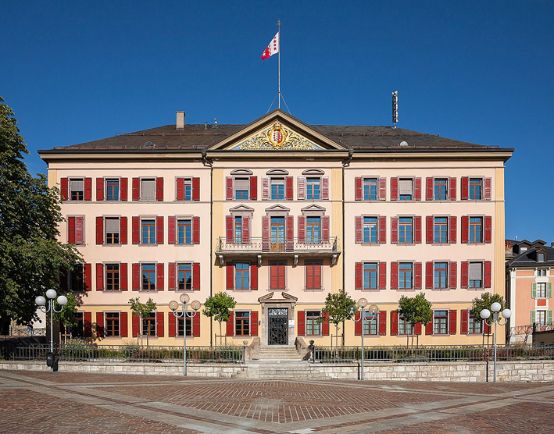
The Valais government building. Photo: Oliver Cossalter (see below for proof)

The costs arising from the postponement of an event are also taken into account according to the canton's avoidance notice. Subsidies for a canceled or postponed event can only be paid in the event of a deficit.

The State of Valais supports numerous events by granting subsidies, particularly in the areas of tourism, culture and sport. It undertakes to maintain the payment of the amounts granted for each event canceled or postponed due to the coronavirus epidemic.

In the event of cancellation, the promised grants will be retained by the beneficiaries, provided they relate to the costs incurred that have already been paid or still have to be paid.

In the event that the event in question is postponed, the amounts committed for the expenditure on the new date will be retained. Expenses incurred for both the originally planned and the postponed edition can be taken into account when proving the costs incurred. However, any losses from previous editions cannot be taken into account.

The departments concerned will make the promised payments, subject to compliance with the official recommendations by the organizers at the time of the decision to cancel or postpone the event. The link between this decision and the coronavirus epidemic must also be clear.
 

Sonata for Piano No. 30

Beethoven every Friday: to mark his 250th birthday, we take a look at one of his works every week. Today it's the Sonata for Piano in E major op. 109.

There are those who are always on time. They deliver their work in an orderly condition ahead of time or on time. And they also leave the impression of a perfectly regular lifestyle. And there are those who simply always take a little longer. It's easy to use the bad word procrastination, but this is a special form of creativity that doesn't savor the allure of the "last moment", but only achieves the very best results under increased pressure. Entire opera overtures have been completed just in time overnight with this widespread creative disposition. But until everything turns out well in the end, there is a lot of postponing, putting off and excusing in the diary.

Beethoven was not one of the most punctual composers either. After he had already informed the Berlin publisher Scottish songs op. 108, the composition of the sonatas op. 109, op. 110 and op. 111, which were not only outwardly understood as a group, was also delayed. On May 31, 1820, he had announced all the works for July - but little had happened. Even the benevolent reminder in August from his friend Franz Oliva was of little help ("on the sonata to Berlin you must think"). Finally, Beethoven felt compelled to provide the publisher with information about the status of the work. With familiar key words and formulations that have hardly changed in such situations over the centuries: "It will go faster with the 3 sonatas as last with op. 108The first is almost finished to the point of correction, and I am now working on the last two without delay."

The wait was certainly worth it. Schlesinger finally received the promised engraver's model at the beginning of 1821, but above all works that represent a conceptual departure at the end of Beethoven's sonata oeuvre. In the case of the E major Sonata op. 109 with a first movement that is not only small-scale, but also alienates itself from the usual structure with its imaginative Adagio interludes, a brisk, through-composed Scherzo in a minor key and a variation movement that soon proves to be the finale with its more or less clear references. It forms the core of the composition, also and especially with its touching expressive content: Full of song with heartfelt emotion.


Listen in!

Cantonal measures to contain the epidemic

Suisseculture has published a list for event organizers showing the measures taken by individual cantons in response to the coronavirus crisis.

Photo: Daniele Levis Pelusi on Unsplash

The regulations are currently handled inconsistently by the various cantons, writes Suisseculture, but in principle it applies almost everywhere that all events (private and public) must be reported to the respective canton and that the public must be informed that no one who has visited the affected areas defined by the FOPH in the last two weeks will be admitted.

The following information on the individual cantons is subject to change. Anyone with questions about a specific event should contact the authorities of the relevant canton. All cantons provide corresponding information and contact addresses on their websites.

Link to the Suissculture compilation:
https://www.suisseculture.ch/index.php?id=23&tx_ttnews%5Byear%5D=2020&tx_ttnews%5Bmonth%5D=03&tx_ttnews%5Btt_news%5D=172&cHash=0f7d764ef005efe2e835fbbec954f755

Musikmesse Frankfurt postponed

Due to the continuing spread of the disease Covid-19 caused by a new coronavirus, Musikmesse 2020 will be postponed. The regional events "Musikmesse Plaza" and "Musikmesse Festival" will take place as planned.

Photo: ål nik / unsplash.com,SMPV

Messe Frankfurt has announced that it has decided to postpone Musikmesse 2020 due to the increasing spread of Covid-19 in Europe. "The health of exhibitors, visitors, partners and employees is Messe Frankfurt's top priority. The new date will be announced shortly. Visitor tickets will remain valid.

From today's perspective, the pop-up experience market 'Musikmesse Plaza' (April 3 and 4) and the 'Musikmesse Festival' (March 31 to April 4, 2020) can take place on the planned dates. These events are primarily aimed at a regional audience from the greater Frankfurt area.

The continued increase in the spread of Covid-19 in Europe required a new assessment of the situation in close coordination with the City of Frankfurt's health department. It should be avoided that participants of the fair come from risk areas and visit the fair with the disease. As these trade fair participants may also be infected with Covid-19, a health check is necessary to counteract the further spread of infection. This is an essential part of the infectiological risk assessment. The necessary implementation cannot be realized by Messe Frankfurt. In addition, there are increasing travel restrictions that make it difficult for potential visitors and exhibitors to participate in the trade fair.

Current information is available at www.musikmesse.com."

Musikmesse 2020 canceled!


Updated on March 13, 2020

Petrenko convinces as a sound organizer

The Berliner Philharmoniker are happy with their new chief conductor Kirill Petrenko. At the Easter Festival in Baden-Baden, they will perform Beethoven and Mahler under his direction.

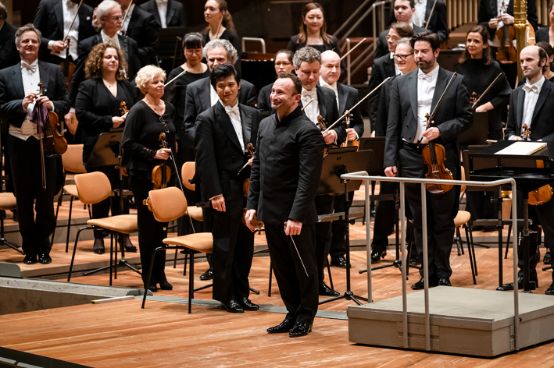
Kirill Petrenko and the Berliner Philharmoniker. Photo: Stephan Rabold

The Berlin Philharmonic Orchestra have long since left the stage when Kirill Petrenko returns because the audience won't stop clapping. The conductor bows and points behind him to the empty chairs. He wants to say that it is not him but the orchestra that deserves the applause, even though the musicians are already enjoying their after-work beers. Then the friendly little man scurries out again with quick steps. The audience in the Berlin Philharmonie has not often seen the new chief conductor since the end of August last year, because Petrenko is still tied up as General Music Director of the Bavarian State Opera in Munich. Beethoven's 9th Symphony at the start of the season, also performed at the Brandenburg Gate, a New Year's Eve concert with soprano Diana Damrau and Gustav Mahler's 6th Symphony were the only programs Petrenko has conducted in Berlin so far.

In this fourth concert, the new chief conductor shows himself in the first part, with Igor Stravinsky's thoroughly brittle Symphony in three movements and Bernd Alois Zimmermann's sensual and groovy ballet suite Alagoanaas a rather sober sound organizer who often conducts with both arms in parallel, always has his head in the score and gives clear cues. Kirill Petrenko is not a zampano, but a craftsman. His markings are functional, not aesthetic: not one squiggle too many. He does not stage himself, but simply does his job. However, Petrenko can also be freer in his conducting and let things take their course, as is the case in the second part, with the perfectly balanced Symphonic dances by Sergei Rachmaninov. He gives the wind solos enough breath, the homogeneity of the strings is delightful. Everything is perfectly coordinated - the team is the star.
 

Very attached to the opera

How precisely Petrenko works on the balance can be observed in the dress rehearsal beforehand. It is not a simple run-through, but a search and discovery of modeled transitions, clear rhythms and subtle dynamic differences. The new conductor speaks in a friendly but firm voice - and the Berliner Philharmoniker prick up their ears. "Kirill Petrenko comes to the rehearsal better prepared than anyone else I know," says cellist and orchestra board member Knut Weber in the subsequent interview. "He always knows exactly what he wants to correct and is very quick to do so. The tension in the orchestra is currently at a level I've never experienced before." At the press conference, there was talk of a long honeymoon and a spell that will last for a long time to come. "We're just getting to know each other," adds Andrea Zietzschmann, the artistic director from Sankt Georgen in the Black Forest. "He's not overly present in the first season. That's also good for this growing relationship."

A shorter tour in the fall with him at the podium has already been completed, with two more to come this season. Above all, however, the Baden-Baden Easter Festival Kirill Petrenko, who has a strong connection to opera and was already General Music Director in Meiningen and at the Komische Oper Berlin before Munich, will open the season on April 4 with Beethoven's Fidelio. Slovenian drama director Mateja Koležnik will stage an opera for the first time in Baden-Baden, expanding Florestan's perception through dreams, reveals Andrea Zietzschmann. "With our Artist in Residence Marlis Petersen, we also have an excellent singer as Leonore."

Knut Weber is very much looking forward to the Easter Festival and promises a "firework display of content". The fact that all 16 of Beethoven's string quartets and the Great Fugue will be performed by 17 different ensembles of the Berliner Philharmoniker at the Kurhaus Baden-Baden is ambitious. "Especially in the chamber concerts, we also appreciate the many personal encounters we have with the audience. This direct contact is something very special in Baden-Baden," he says. In addition to guest conductors Herbert Blomstedt, Tugan Sokhiev and Swiss conductor Lorenzo Viotti, who is standing in for Yannick Nézet-Séguin, Kirill Petrenko can also be heard in the orchestral concerts: with Beethoven's Missa solemnis, exclusively in Baden-Baden, and Mahler's 6th Symphony, with which Simon Rattle bid farewell to the Berliner Philharmoniker.

Zietzschmann would like to market the Easter Festival even more internationally. She counters the recurring rumors that the Berlin Philharmonic would return to Salzburg with a self-confident smile: "We feel at home in Baden-Baden." And announces that Kirill Petrenko will only conduct opera in Baden-Baden from 2022. Not only Salzburg will be disappointed about this. But Baden-Baden can rejoice.

Coronavirus threatens the music industry

While concerts are being canceled all over the country, there is growing concern in the music industry about an economic catastrophe due to the coronavirus.

Photo: Jonas Jacobsson / Unsplash

According to Sonart, the "professional association of freelance musicians", all those involved in concerts that are planned over the next two weeks must expect a major loss of income. If the measures are tightened or extended, i.e. events with fewer than 1,000 people are also canceled, or the state of emergency remains in place beyond 15 March, the losses will grow with each passing day.

As many musicians in ensembles, bands and sometimes orchestras are self-employed, such cancellations hit them particularly hard. This applies to the entire spectrum, from jazz and pop bands to opera and classical productions. Freelancers often earn large parts of their annual income during the short time in which performances take place and therefore have to cross-finance long preparation and rehearsal phases.

When concerts don't take place, the organizers are also directly affected. Canceled individual events are catastrophically affected. Even regular music event organizers often work with few reserves, so that cancellations of just a few weeks can lead to existentially threatening financial holes.

Sonart expects the Federal Council to be aware of the music industry as a whole, alongside the other eligible economic sectors, and to include it when discussing further measures and compensation options.

get_footer();