

Suisseculture welcomes cultural message
Suisseculture, the umbrella organization of professional cultural workers, is pleased and sceptical about the Confederation's new cultural message, including the measures in the area of music education.






In an official press release, Sussculture writes that the Federal Council has made it clear that it intends to maintain the current level of funding during the funding period. The association sees this as a binding promise and hopes that parliament will follow this proposal.
Although Suisseculture considers the cultural expenditure of CHF 222.6 million from 2021 to be sufficient, it also notes that this de facto continuation of the status quo does not allow for any major development steps. This also applies in particular to the welcome measures in the area of music education: Here, an area of education is being supported with cultural funds. Should parliament tighten the budget framework, the association expects the Confederation to examine how other budgets can support these measures.
The whole statement:
Serenade in D major
Beethoven every Friday: to mark his 250th birthday, we take a look at one of his works every week. Today it's the Serenade for flute, violin and viola.

It is far too rarely considered that it was often not the composers who wrote music history with their works, but rather those industrious authors who, on the basis of scores, letters and other documents, created a tangible context and connection in the first place. And the further one goes back through the centuries, the more extensive the interpretations and hypotheses become, on which comprehensive bodies of thought are often based. This happens less with Beethoven - so you feel safe and can sit back and relax.
But far from it! Anyone who only believes in the ideas behind Beethoven's great works will always find themselves in need of an explanation and desperately seek arguments to straighten out the order of thought. This is also the case with the work published in 1802 Serenade op. 25 for flute, violin and viola. The title and instrumentation alone seem strangely peripheral. Had Beethoven not systematically prepared his first string quartets op. 18 on the basis of his opus 1? Had he not long since shed the outdated traditions of the 18th century? Why a composition without a bass? And the tempo marking Allegro disinvolto (cheerfully casual) in the finale? -
How wonderfully convenient it was to simply date the Serenade as a work from the Bonn period (which is not tenable on the basis of sketches) or even to assume that Beethoven merely wanted to help Giovanni Cappi with his newly founded publishing house with the Serenade. Perhaps Cappi himself also added the opus number to the print ...
But why should Beethoven not have written a serenade just because he was preparing to reach for the stars in other genres? Help and clarification can be found one hundred years later in a letter from Max Reger. He had asked for a symphonically dimensioned work in terms of form and texture. String quartet op. 74, the classical style of the work, which contrasts sharply with the Serenade op. 77a (as in Beethoven in D major and with identical instrumentation) on April 22, 1904 with the words:
"Enclosed you will find something very easy, simple and very melodious .... But I ask you very much not to look at this little inconspicuous booklet ... 'from the side', as op. 77a will in any case be suitable for making me many new friends and will finally silence those ignoramuses a little who always claim that I can only write 'complicated' and 'have to' cover up the 'lack of ideas', the 'lack of spirit' with 'clutter and complexity'!"
Listen in!
German music market grows
After a successful first half of the year, the music industry in Germany also recorded a significant increase in sales for 2019 as a whole: revenue from music sales and income from the streaming business grew by 8.2 percent.

In total, revenue amounted to 1.623 billion euros. Following two years of decline in 2017 and 2018, the world's fourth-largest music market thus returned to the positive global trend of recent years in 2019. Several factors contributed to the growth in revenue: the dynamic growth of audio streaming (up 27 percent), a year-on-year decline in CD sales that almost halved (minus 10.5 percent) and a 13.3 percent increase in vinyl records.
As the leading market segment, audio streaming now accounts for 55.1% of total sales, followed by CDs (29%), downloads (6.2%) and vinyl (4.9% share of sales). In total, 64.4 percent of revenue was generated in digital business segments last year (up 20.8 percent) and, correspondingly, 35.6 percent with physical sound carriers (down 8.9 percent).
In terms of the share of certain music genres in sales, pop remained the genre with the highest sales in 2019 at 25.8%. For the first time, however, hip-hop/rap moved into second place with a share of 19.7%, just ahead of rock (19.6%). Children's products (9.8%) and dance (7.3%) are also among the five most successful segments in terms of sales.
Previously unknown Beethoven composer discovered
A previously unknown and unpublished piano piece by Ludwig van Beethoven was found by Jochen Reutter, editor-in-chief of Wiener Urtext Edition, during research in the music collection of the Vienna City Hall Library.
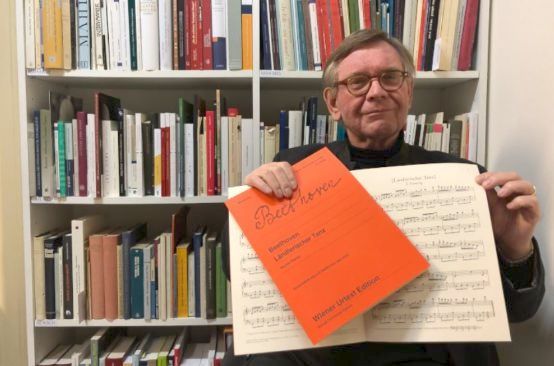
The work is notated on a double sheet of sketches by Ludwig van Beethoven from the years 1790 to 1792. At the end of the fourth page, a piano piece called Andante had already been discovered some time ago among the many different sketches. However, the fact that there is also a complete little piano piece on the first page had remained unknown until now. It has no title and does not begin at the beginning, but only towards the end of a line, immediately following a previous sketch, which makes it difficult to find.
As a previously unknown piece, it does not yet appear in the new catalog of works and has neither an opus number nor a WoO number. The musical character of the 16-bar piece is reminiscent of a Ländler. Beethoven recorded the melody part of his piece without any gaps, even revising it in a few places and notating the accompaniment in abbreviated form. The piece is published as the first edition of the Wiener Urtext Edition (UT 50296).
Ease instead of discomfort
Dispokinesis is based on neurophysiology and deals with the posture, movement, breathing and expression of musicians. The goals are ease of playing motor skills, pain- and discomfort-free music-making, expressive variety and stage competence.


Cornelia Suhner -- To stand on stage and express yourself through your instrument, voice or as a conductor, it is not enough to be relaxed. The body needs support and stability so that playing motor skills feel free and effortless and music-making is accurate. The questions are: where - and how? In order to help musicians discover this, the Dutch pianist and physiotherapist Gerrit Onne v. d. Klashorst developed the so-called "exercises of the primal forms of posture and movement". They form the core of Dispokinesis, which was developed around 1950 especially for musicians and stage artists.
Dispokineters basically teach nothing new. Rather, they are masters both in eliminating artificially learned, inhibiting patterns and in uncovering, eliciting and developing the potential that lies within each individual. The core idea: the "Urgestalten" exercises are used to work through the human straightening process from lying down to crawling, sitting and standing. In the process, incorrect postures can be recognized and changed and the natural posture and straightening reflexes (front foot, legs, pelvis/lower abdomen) can be rediscovered and experienced. In this way, musicians find their way back to the original posture they acquired as a child.
The characteristics of "this" natural posture are dynamic stability in the lower body and, as a result, freedom in the upper body with relaxed shoulders and permeable arms and hands. Such a natural "disposition" is a basic prerequisite for fine motorized, light movements (fingers, lips, tongue), well-functioning breath control or a freely vibrating, brilliant sound.
Two further important areas are added to the exercises of the Urgestalten: in order to maintain a physiologically sensible posture when making music, the instrument is individually adapted to the body with a wide range of ergonomic aids. In addition, Dispokinesis offers special exercises (for all instruments, singing and conducting) to optimize instrumental and artistic skills - such as imagination and learning aids for fine motor playing technique, playing feel, breathing, dosing and differentiation skills and much more. The goals are expressive variety, stage competence and minimal use of force for maximum sonority, lightness and virtuosity.
Dispokinesis is taught both in individual sessions and in smaller groups - so that personal feedback is always possible - as well as in workshops and seminars. If necessary, Dispokineter work together with doctors and other therapists. This way of working is suitable for all those who want to improve their ability to play and express themselves and to exploit their full potential in sound creation. It is used preventively or as a pedagogical concept, but above all also for indications such as postural, movement and breathing disorders, as well as for playing inhibitions (embouchure insecurity, cramps, loss of sound, depressed high register, bow or lip tremors...), pain syndromes, stage fright or loss of control.
Cornelia Suhner
... is a flautist and works as a Dispokineterin, performance, expression and mental coach in Zurich and Bern.
Annual meeting with the KMHS President
In this issue, we would like to look back on the past year with our President Stephan Schmidt and venture a look ahead.

MvO - Stephan Schmidt has held a dual mandate as Director of the FHNW Academy of Music and the Basel Music Academy since 2012. He has been President of the KMHS since 2017.
Stephan Schmidt, when we last spoke in 2017, you mentioned the implementation of Article 67a of the Constitution as an important challenge for the KMHS. What has happened so far?
The implementation of the constitutional article is currently still unsatisfactory. As part of the consultation process for the new 2021-2024 cultural dispatch, we described the implementation to date as "mixed", but we note that the Federal Council seems willing to develop further elements of music promotion, albeit not yet to the extent that would be necessary. In our view, it is particularly urgent to finally create a clear legal basis and funding for the promotion of talented students (including PreCollege).
At the time, it was important to you to educate politicians and society more and better about the realities of the music profession. Has this been more successful in the meantime?
This is certainly an ongoing process, and each conservatoire is individually challenged in its location. Our task of creating acceptance for the music profession permeates all of our areas of activity, especially with regard to "hot potatoes" such as the necessary expansion of low-threshold access to music promotion, the need for musical and pedagogical excellence, the long-term task of making the fundamental internationality and requirements of the music profession understandable and, last but not least, making the profile of teachers mandatory.
What is the status of the Higher Education Funding and Coordination Act (HFKG), which has been in force since January 1, 2015 and has created a uniform legal higher education area for universities, universities of teacher education and universities of applied sciences (with music)? How would you assess this?
Looking back at the development from the municipal/cantonal conservatories to the universities on the basis of the HFKG, it is clear that the development has been positive overall. Thanks to the law, the performance mandate of the conservatoires is based on a stable and sustainable legal basis, which was not the case in the past, and allows for new freedoms and possibilities with regard to the educational system in the long term. At the same time, however, it must also be said that the Swiss solution of subordinating the artistic conservatoires to the type of university of applied sciences is an exception that is difficult to communicate internationally and, in conjunction with the integration into superordinate large university of applied sciences clusters, has also brought disadvantages: many decisions affecting our work are made at higher levels, and it is now more difficult than before for the music sector to make its voice heard in good time as a specialist conference or to influence such decisions. This is because, for example, the KMHS is no longer a direct point of contact for consultations, but only the large higher-level universities of applied sciences as a whole are involved. In future, the KMHS will have to further clarify and sharpen its role as a specialist conference.
From your perspective as KMHS President, what was a highlight of the past year?
Clearly the constructive collaboration with the Swiss Association of Music Schools (vms) and the establishment and anchoring of the PreCollege label. This seems to me to have been very successful, and I see it as a clear strengthening of the music colleges, as well as the VMS, because this cooperation results in meaningful and sustainable developments.
And your personal, musical one?
When I look back on 2019, I'm surprised to see that there were indeed a few highlights, even though I can't be very active artistically at the moment: January saw the new edition and first performance of Alfred Wälchli's "Ballata des Oscen" (1985) in its original version for solo guitar, which was the result of a research project; then I had the pleasure of playing along with Mats Scheidegger in Helmut Lachenmann's "my melodies" with the Berliner Philharmoniker under Simon Rattle, followed by the world premiere of a microtonal composition for guitar by Matthias S. Krüger in Tallinn with a specially built guitar, the performance of Anton Webern's three songs op. 18 with Sarah Maria Sun and Kilian Herold. Finally, I would like to mention the performance and recording of Franz Schubert's Arpeggione Sonata, which I enjoyed performing together with the cellist Christoph Dangel on a specially built copy of a 10-string instrument by Johann Georg Stauffer from around 1823.
What are the key milestones for Swiss music universities this year and in the years to come?
Major challenges always require continuous thematization and discussion over a longer period of time. Currently, these include topics such as the urgent need for nationwide recognition of music mono-subject training in elementary school, which unfortunately only exists in a few cantons at the moment.
Another topical issue is the discussion launched at all universities about the balance between professionalism and interdisciplinarity, which represents quite a challenge for our fairly traditional courses. We are finding that questions about individual and sustainable job profiles are penetrating deep into our study structures and that we need to find answers to demands for additional skills, openness and flexibility in the study structure as well as interdisciplinary connectivity.
Since we are not only supported by our society, but are also part of it, the question naturally arises as to what relevance our work has in society ... it is clear to me that an isolated view of the role of music academies and their forms of education is no longer appropriate.
From a KMHS perspective, how have your expectations regarding the PreCollege been met and where do you still see room for improvement?
In the meantime, the PreCollege has been established as a label and the cooperation with the VMS - as already mentioned - is working very well. However, improvements are needed on the legal side. In connection with this, we will continue to press ahead with the issue of financing this pre-college program.
A new campus will open in Lucerne this year. What does a new building like this mean for the image of music universities in Switzerland?
New buildings are always positive signals of development both internally and externally, opening up new dynamics and thus representing a challenge, risk and opportunity at the same time. Of course, we are all primarily concerned with the content of the training, but this is precisely why the demands on buildings and infrastructure have changed so much in recent years, and it is becoming clear that the classic conservatory buildings, for example, are struggling to meet these new requirements and therefore need to be further developed with new concepts or even replaced. This interesting development will certainly continue at other locations...
Switzerland is always in the spotlight when it comes to European integration. How do you assess the situation of Swiss music academies in a European and global comparison?
In my view, Swiss music universities are in a good position and are very attractive to students. They benefit from and at the same time suffer from the geopolitical situation, as do other institutions - precisely because we have to be primarily internationally oriented institutions. Exclusion and marginalization of any kind make no sense in the music profession, which has been internationalized for thousands of years.
In certain respects, there is even a danger that the music universities in neighboring countries will be able to develop better. For example, I consider the fact that Swiss music universities cannot offer their own third cycle to be a significant and lasting weakening of Switzerland as a university location. It is up to politicians to find better solutions than the current ones so that our country does not miss the boat. Unfortunately, however, the current signals from politicians are not very promising.
We sense that these questions are rapidly gaining in importance.
At the Basel Music Academy/University of Music FHNW, an interdisciplinary working group of students and teaching staff spontaneously formed last semester, which has since contacted the management and is asking clear questions about sustainability and possible improvement measures. The music scene in particular not only feels the ecological relevance, but also the economic relevance that directly affects it. So something is happening, students and lecturers are alert, and that makes me very happy. At the same time, of course, there are major challenges as to which of the many ideas really make sense and can be implemented within a reasonable period of time.
The year 2020 is still young: what do you think are the highlights of this year's conservatoire year?
This year, possibly in 2021, it is expected that all music universities in Switzerland will be institutionally accredited via the HEdA, which is a significant step from an institutional perspective and very pleasing. This will lead to a professionalization of the institutions, but also to more work, which will require new forms of organization and job profiles.
Artistic and educational highlights, which give us meaning and inspiration, carry us with their wings over all institutional issues...
... and then the ELIA Biennial Conference will take place in Zurich in November. What can we expect from this?
Issues such as the balance between disciplinarity, interdisciplinarity and connectivity are burning and central topics for the coming years. The ELIA conference can therefore be a very interesting platform not only to address these topics, but also to drive them forward, which is why the ZHdK seems to me to be a very suitable venue.
The motto of the conference is "Expanding the Arts", and in this respect is perhaps intended to develop from within, while the question of connectivity is an overarching one to which we must pay a great deal of attention in the future.
Clouds
"Hear" clouds? Yes! The term "sound cloud" offers a wide range of interpretations: from music in the cloud to ambient as a musical scent cloud, diffuse acoustic fields to pieces of music with the same name.
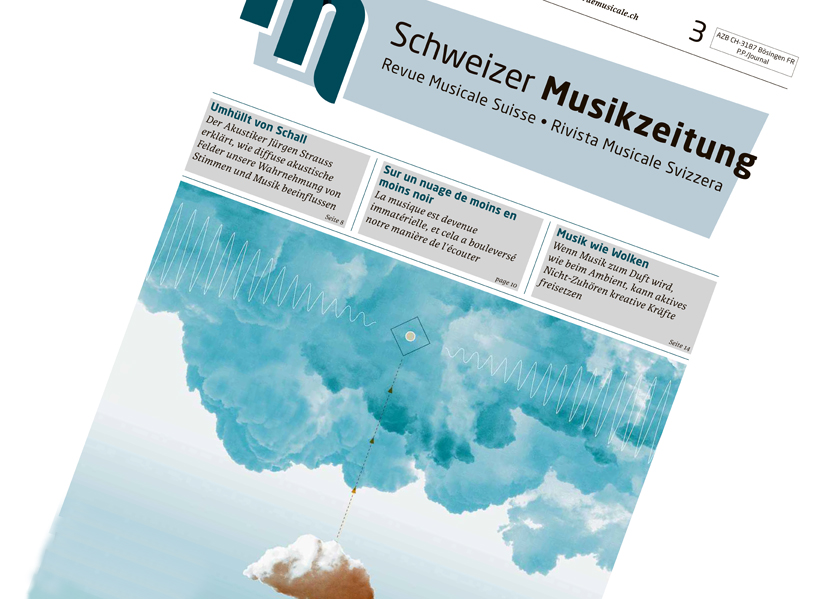
"Hear" clouds? Yes! The term "sound cloud" offers a wide range of interpretations: from music in the cloud to ambient as a musical scent cloud, diffuse acoustic fields to pieces of music with the same name.
All articles marked in blue can be read directly on the website by clicking on them. All other content can only be found in the printed edition or in the e-Paper.
Focus
Enveloped by sound
Interview with acoustician Jürgen Strauss
Sur un nuage de moins en moins noir
La musique dématérialisée dans le nuage
Django Reinhardt's "Nuages"
Music like clouds
Ambient as active non-listening
Just water and air?
Of clouds and mists of sound
... and also
RESONANCE
La musique est-elle politique, abstraite, métaphysique ?
Genevois à lʼhonneur - au program de lʼOrchestre Da Capo
The opera house as a meeting place - Aviel Cahn's first season in Geneva
Prophet in his own land - the Basel Madrigalists with Ammann and Raff
The daughter of the distant beloved - Minona, opera by Jüri Reinvere
The mysterious count and his festival - Scelsi concerts in Basel
Lost in the jungle - Manuel Renggli's "Brass Opera" in Lucerne
Carte blanche for Max Nyffeler
CAMPUS
Primary school pupils next to professionals - Orchestra school Insel and SOB
Entrepreneurship and lobbying as a role model - FMB of the VMS in Baden
Thinking and acting together - Symposium in Feldkirch
The new "Music Dictionary of Switzerland" is online
BASIS
Articles and news from the music associations
Swiss Federal Orchestra Association (EOV) / Société Fédérale des Orchestres (SFO)
ForumMusicalDiversity (FMD) / ForumDiversitéMusicale (FMD)
Konferenz Musikhochschulen Schweiz (KMHS) / Conférence des Hautes Ecoles de Musique Suisse (CHEMS)
Kalaidos University of Music / Kalaidos Haute École de Musique
Swiss Music Council (SMR) / Conseil Suisse de la Musique (CSM) and CHorama
Swiss Society for Music Medicine (SMM) / Association suisse de Médecine de la Musique (SMM)
Swiss Musicological Society (SMG) / Société Suisse de Musicologie (SSM)
Swiss Musicians' Association (SMV) / Union Suisse des Artistes Musiciens (USDAM)
Schweizerischer Musikpädagogischer Verband (SMPV) / Société Suisse de Pédagogie Musicale (SSPM)
SONART - Musicians Switzerland
Swiss Youth Music Competition Foundation (SJMW) and Arosa Culture
SUISA - Cooperative Society of Authors and Publishers of Music
Swiss Association of Music Schools (VMS) / Association Suisse des Écoles de Musique (ASEM)
FINAL
Riddle - Torsten Möller is looking for
Row 9
Since January 2017, Michael Kube has always sat down for us on the 9th of the month in row 9 - with serious, thoughtful, but also amusing comments on current developments and the everyday music business.
Download the current print edition
Here you can download the current issue. Please enter the search term "e-Paper" in the print archive.
The download is free of charge for subscribers.
All other interested parties will receive the PDF of the current issue (or an earlier issue) by e-mail. Costs: Fr. 8.-.
Click here to order the e-paper.
We are also happy to send you the printed version. Costs: Fr. 10.-
Click here to order the printed edition.
Challenging and fresh
In his Beethoven book, Hans-Joachim Hinrichsen explains how important the intellectual climate of the early 19th century is for understanding music.

Beethoven, Ludwig van Beethoven again and again. Volumes have been written about the Bonn master, about this epitome of artistic genius who inspired generations, who gave comfort, who provided piano beginners with pieces as pretty as the Moonlight Sonata or Pour Elise. Anyone who takes a new and intensive look at Beethoven must first say: respect for this Herculean task! Hans-Joachim Hinrichsen, Professor Emeritus of Musicology at the University of Zurich, has not only rummaged through mountains of literature that are almost unmanageable. He also took a pleasantly direct approach to Beethoven by rubbing up against the musical texts as well as some of the commentaries handed down by the "master".
Beethoven's high level of reflection runs through the almost 400-page book like a common thread. Hinrichsen repeatedly emphasizes the intellectual climate of the early 19th century, which was essentially shaped by Immanuel Kant's philosophy. The link between the Enlightenment and Beethoven's music is not new, but it is convincing. Indeed, Kant's motto "Have the courage to use your own understanding" is reflected in an oeuvre that demanded and still demands active listening. Hinrichsen proves this not by listening, but by looking at the musical text. His analysis requires some knowledge of music theory. The interested layman might be put off by this, even the intimate Beethoven connoisseur would have wished for more emotion and enthusiasm in places. A sometimes gripping tone ("enthralling work") unfortunately too often seeps away in sophistical discussions in a convoluted musicological style: "The cadenzas in E minor (twice in the introduction [m. 12, m. 28], once in the fugue [m. 166 ff.]) are structurally counterbalanced by two returns to E flat major in the coda and stretto [m. 210 ff., m. 257 ff.], so that the tonic, similar to the Leonore II and III overtures, appears symmetrically framed by its Grossterz mediants." (S. 258)
The academic perspective also explains the desire to correct widespread, unfortunately also cemented misunderstandings. Hinrichsen rightly criticizes some of Theodor W. Adorno's interpretations of Beethoven as well as the assumption that the even-numbered symphonies are no match for the odd-numbered ones. He also makes the case for some neglected works. The musicologist convincingly demonstrates the exceptional nature of the symphonies - between the great Waldstein Sonata and the Appassionata hidden and "scandalously unknown" - Piano Sonata op. 54 or the second movement of the Rasumovsky Quartet op. 59/1. After the demanding reading, one likes to go to the record shelf and listen to the works again. And what more could Hinrichsen wish for in the end than to arouse curiosity and refresh the listening experience?

Hans-Joachim Hinrichsen: Ludwig van Beethoven. Music for a new age, 386 p., € 39.99, Bärenreiter, Kassel 2019, ISBN 978-3-7618-7091-4
Colorful balloons with a fun factor
Mixed choirs will have a lot of fun with these arranged movie hits from the early days of sound film up to the fifties.

Uli Führe is widely known, among other things for his outstanding voice training canons, which have been published in volumes such as Vocal musicals 1+2 are collected and can enrich every singing session. Bosse-Verlag has now published the collection Buy yourself a colorful balloon with hits from films from the 1930s, 1940s and 1950s. What happens today online through providers such as Vimeo or YouTube happened from the 1930s with the linking of image and sound in films: an enormous popularization.
The collection ranges from the lascivious waltz I am from head to toe about the snappy marching song A friend, a good friend to the nonchalant foxtrot Bel ami. Uli Führe does justice to the different film scores in a very sensitive way, working out their characteristics and transforming them into easily feasible and appealing movements for mixed choir (SATB) without voice parts. A real enrichment for this type of repertoire with a great fun factor for the choirs.

Buy yourself a colorful balloon. Pop songs from films of the 30s, 40s and 50s, arranged for SATB choir by Uli Führe BE 921, € 17.50, Bosse Verlag, Kassel
With blues against the blues
Those who carefully rehearse Mike Cornick's piano pieces in the booklet "Blues in Two and More" will be rewarded.

The slow swing piece Blues in Two was written by Mike Cornick (*1947) in 1994 and has enjoyed great popularity ever since. This very piece opens the new volume Blues in two and moreand eleven new compositions in various jazz styles have been added. I would like to recommend this collection to all those who sometimes have the blues and long for musical variety, whether when teaching or playing themselves.
The twelve appealing compositions cover styles such as blues, swing, ragtime, Latin and calypso. They are perhaps no more difficult than many pieces from the classical intermediate level, but require a completely different playing style in terms of harmony and rhythm. Certain harmonic sequences and rhythmic patterns often feel unfamiliar to players with a classical background and require a great deal of attention. This is precisely why it is worth exploring these fresh and light pieces. They are stimulating, instructive, entertaining and drive away the blues and more.
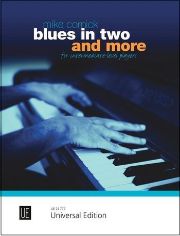
Mike Cornick, Blues in Two and More, for intermediate-level players, for piano solo, UE 21777, € 15.95, Universal-Edition, Vienna 2019
Melodious etudes
The "Capriccios and Exercises for the Violoncello" by Robert Lindley are not only good as etudes.
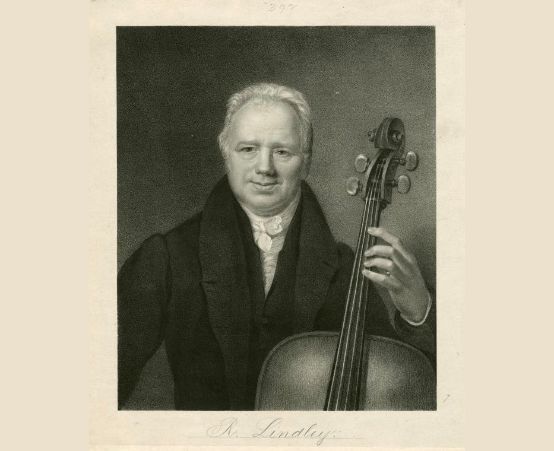
Robert Lindley (1776-1855) was considered the most important cellist in England for over 50 years and was appointed the first professor of cello at the Royal Academy of Music in London in 1822. He wrote mainly for his instrument, including four cello concertos and chamber music. In the etude literature for cellists, his twelve etudes, published in 1826, are among the most important. Capriccios and Exercises for the Violoncello op. 15 is not part of the standard repertoire, wrongly so, as a closer look soon reveals.
Lindley's Capricci are mostly in two movements and, with the exception of numbers 1 and 2, deal with several technical problems in one piece. Numbers 1 to 4 are in the first to fifth positions, from number 5 onwards the thumb attachment is required. Particularly instructive are the diverse and varied double-stop passages, which extend to decimals.
The Urtext edition, edited by Valerie Walden and based on contemporary sources, contains the original fingerings and bowings. Alternative fingerings are consistently placed under the staff, added slurs are printed in dotted lines. The clef notation is adapted to today's standard without octave treble clef. The generously proportioned edition even contains fold-out pages to make leafing through it easier.
Regrettably, the composer did not compose a second cello part, as this would have further enhanced the melodious capricci for concert use.
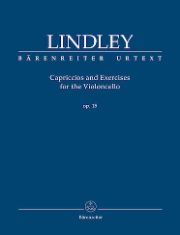
Robert Lindley: Capriccios and Exercises for the Violoncello, op. 15, edited by Valerie Walden, BA 10936, € 16.95, Bärenreiter, Kassel 2019
Four mallets, freely selectable base
In Áskell Másson's "Fo(u)r Mallets", the stage floor or the conductor's podium can be played on. However, the composition is notated very precisely.

In 2015, Evelyn Glennie celebrated her fiftieth birthday, for which the Icelandic film composer Áskell Másson wrote her this gift, which consists of exactly fifty bars.
As the title Fo(u)r Mallets the work is played with four mallets. The rhythm and tempo of the performance are notated very precisely, just as the performance at the beginning and in between is described with centimeter precision: "... bring the hands halfway up to the face and strike the two mallets against each other about one centimeter behind the heads ..." From quarter triplets to 32nd figurations and 2:3 combinations, everything is demanded of the player technically.
The composer leaves the greatest freedom to the instrument. The surface on which the music is played should be freely chosen, e.g. it can be the floor of the stage or the conductor's platform. The player can stand or sit as desired. "Do not play this piece on four different surfaces and absolutely not on e.g. wooden or temple blocks ..." The four mallets should all have a different hardness, which increases from left to right.
The piece has many dynamic changes, is rhythmically quite impulsive and sounds complex due to the repeatedly interwoven single to triple suggestions: a somewhat unusual but very interesting firework! Due to the freely selectable "instrument", it will shine as a unique sound for each artist.
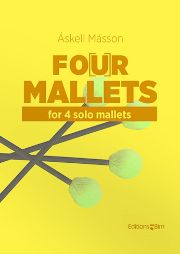
Áskell Másson: Fo(u)r Mallets, for 4 solo mallets, perc 42, Fr. 12.00, Editions Bim, Vuarmarens
Thrilling exoticism
Florian Bramböck has reinterpreted traditional Afro-Latin jazz numbers and added his own: a musical delight with drive for two clarinets.

A Caribbean palm beach with a fishing boat adorns the cover of this duet booklet by Austrian composer and saxophonist Florian Bramböck and thus shows where the musical journey is heading. The 16 tracks - some original compositions, some arrangements of well-known melodies - tell of or originate from Africa, South America, the Caribbean and New Orleans and are as much fun to play as they are to listen to. In terms of the range and keys used, the pieces range from easy to medium difficulty. However, they do present some rhythmic challenges that need to be mastered by clarinettists who are not so experienced in these styles.
Bramböck also knows how to set well-known titles in an exciting and very good-sounding way for the clarinet. Hits in this edition include, for example, the well-known Buena Vista Social Club Chan Chan or Miriam Makebas Pata Pata to be found. But the well-known folk and children's song La Cucaracha by setting it in ¾ time, Florian Bramböck is able to take on completely new and surprising aspects. And so it even appears twice in the booklet: once as an overture and finally as an effective "dramatico" waltz finale - what fun! With titles like Strait, more width (a merengue!) or the cool cruising cha-cha-cha Three Days Off in My Cadillac Bramböck shows his musical humor. Some of the titles are also available in an edition for three clarinets, which is also highly recommended (UE 35568).

Florian Bramböck: Afro-Latin Clarinet Duets, 16 pieces for two clarinets, UE 34535, € 14.95, Universal Edition, Vienna 2019
Melting tome
"Souvenir" by Franz Drdla, originally for violin and piano, here in the viola version.

The widely traveled Czech violinist František Drdla (1868-1944), a theory student of Anton Bruckner at the Vienna Conservatory, wrote over 200 works of light music: in addition to two operettas and a violin concerto, many genre pieces for violin and piano. One of the best known, this melting, harmonically charming little tome, has now also been gratefully arranged for viola. It is as good on the viola in the same key as on the violin.
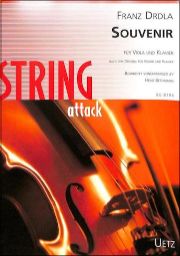
Franz Drdla: Souvenir, for viola and piano arranged by Heinz Bethmann, score and viola part, BU 8194, € 11.00, Musikverlag Bruno Uetz, Halberstadt 2019
Two in Wonderland
Knowing that great duo art is based on a lively exchange of ideas and the creativity of those involved, Daniel Schläppi and Marc Copland prepared themselves accordingly and set to work on their third album. With inspiring results.

His third collaboration with US pianist Marc Copland is also his most mature, bassist Daniel Schläppi says in the documentation for their joint CD Alice's Wonderland know. And duo partner Copland is also full of praise: "Playing with Daniel reminds me of the things I love most about playing jazz: the warmth, the communication and the attempt to share an experience with the listener."
The present work is not least intended to document how the music of the two has developed. Marc Copland (*1948), who has also performed on stage with jazz luminaries such as John Abercrombie and Ralph Towner, once again proves himself to be a master of the chordal and knows how to elicit an ethereal fluid from his piano with a fine touch. Meanwhile, his partner, Daniel Schläppi, 20 years his junior, stands out as a curious bassist with a penchant for groovy sounds. - He also runs a label and is an associated researcher at the Historical Institute of the University of Bern.
The 49-minute, nine-song encounter between the duo on Alice's Wonderland begins with a cover of Cole Porter's Everything I Love. The version by Schläppi and Copland is well-tempered, draws on a broad palette of timbres and is full of emotional power. Although the piece turns out to be stylistically trend-setting for the rest of the album, the two musicians always manage to surprise with their intimate, light playing, improvisation and superb timing. This is also the case on Blue In Greenwhich originates from the Miles Davis songbook. Conclusion: The elegant collaboration between Schläppi & Copland knows how to inspire - from A to Z.
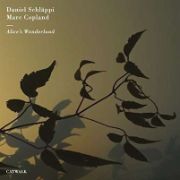
Daniel Schläppi, bass; Marc Copland, piano: Alice's Wonderland. Catwalk CW 190019-2
More info:
www.danielschlaeppi.ch
www.marccopland.com