The daughter of the distant beloved

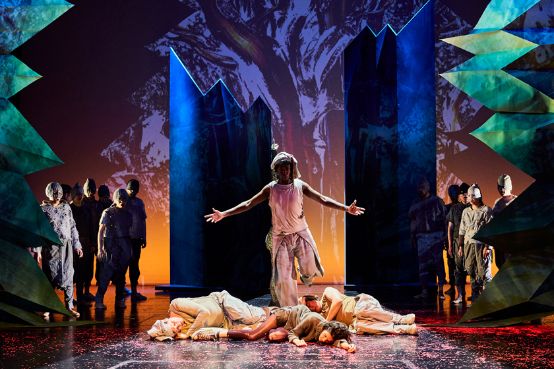
Jüri Reinvere brings a chapter in Beethoven's biography shrouded in mystery to the stage in Regensburg with the opera "Minona".


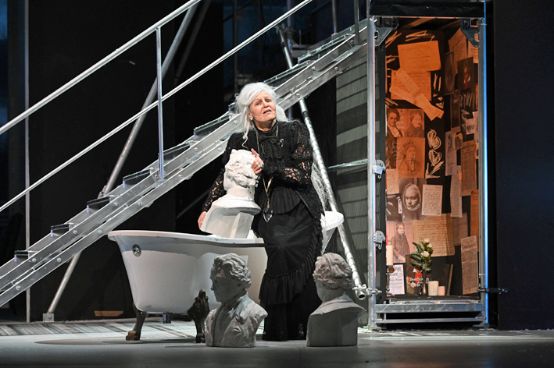
Theodora Varga as Minona. Photo: Jochen Klenk

No, Beethoven as a person does not appear in this opera. His music is also only quoted recognizably once, when towards the end, like a commentary from offstage, the vocal quartet Mir ist so wunderbar from Fidelio can be heard. But the focus is on Beethoven's daughter, and her name is Minona. How could anyone who is even halfway informed about music history think that there is no mention of Beethoven's paternity anywhere in scholarship?

But it is certainly possible. At least that is the thesis of Jüri Reinvere, author of the opera Minonawhich has now been premiered in Regensburg, Bavaria, at the start of the so-called Beethoven Year. The composer, who was born in Estonia in 1971 and has lived in Frankfurt am Main for several years, carried out meticulous research before writing the libretto in order to substantiate his assumption and thus the plot of his opera. Among other things, he found documents in his home town of Tallinn that provide a deep insight into Minona's family history.

The ominous "distant lover"

The pivotal point of the story is the mysterious person to whom Beethoven dedicated his song cycle To the distant beloved of 1816 and who is presumably identical to the "immortal beloved" to whom he addressed a letter in 1812 after a short stay in Prague, but never sent it.

Reinvere suspects that this figure, whose anonymity Beethoven carefully guarded, was the Hungarian Countess Josephine von Brunsvik, married to von Stackelberg; she was Beethoven's piano pupil and he was demonstrably strongly attracted to her. In those July days of 1812, when Beethoven was in Prague, he is said to have met her secretly, according to Reinvere's theory, and that is when it is said to have happened. But there is only circumstantial evidence, no proof that Josephine was in Prague at the time. But there was another woman who was also very close to Beethoven: Antonie Brentano. The biographical fog will probably never be completely cleared.

Historical and artistic truth

Historical research is one thing, artistic freedom is another. Reinvere, who skillfully balances reality and fiction, has stuck to the Brunsvik variant and turned it into a libretto that is eminently suitable for opera: the possible meeting between Beethoven and Josephine in Prague has consequences, and they go by the name of Minona.

In fact - and this is where reality comes into play again - the girl was born exactly nine months after the ominous Prague date and baptized Minona von Stackelberg. However, Josephine and her husband Baron von Stackelberg were already divorced in July 1812 and living separately - honi soit qui mal y pense. In the opera, Countess von Goltz, whom the distraught Josephine tells of her unseemly misstep, recommends the well-known recipe: off to Vienna, to the cold marriage bed! A child from this amorous loner Beethoven would be social ruin.

Two fathers and no identity

This prequel is told in the first two scenes of the opera. The rest of the two-act opera describes the life of the real Minona. She now becomes the main character of the opera. We see her as a young girl and as an old woman, sometimes both in simultaneous scenes. She is a so-called difficult character; like a female Kaspar Hauser, she is on a lifelong search for her identity, a tragic figure caught between two fathers. One, the fighter for high ideals, to whom she inexplicably feels instinctively drawn, is only present in her genes and her subconscious. The other, a Protestant fanatic and tyrannical educator, dominates her real existence with physical and psychological violence. She perishes between these two poles.

Towards the end, Beethoven's love letters to her mother Josephine are handed to her as heiress. She now feels that her suspicions have been confirmed and knows who she is. The figure of Leonore appears, an allegory of ideal love, and a philosophical dialog about the true nature of love ensues. Minona realizes that her feelings have atrophied under the pressure of her pious upbringing and that she has never lived her life: "I never existed ... I don't know where I come from, I don't know who wanted me." Minona, read backwards, means "anonymous". What remains is hopelessness and emptiness. Slightly dazed, you sneak out of the theater.

Brilliant orchestral sound

The two-act play, which is somewhere between a stationary drama and a witty conversation piece, artfully interweaves times and settings. The extensive dialog parts are worked out with great care; an arioso tone, which does not impair the comprehensibility of the words, prevails. The singing is carried by the powerful, flowing orchestral sound. It shines in rich colors, never seems ponderous and surprisingly never drowns out the singing voices, but rather carries them. Several orchestral commentaries provide expressive climaxes, and the one at the beginning of the last scene adds an apocalyptic dimension to the increasingly darkening events. The final section drags on, but overall the musical design provides internal tension both in terms of architecture and detail.

Performance of the Reichsklavier grandmother

The production was not without its weaknesses. This was not due to Marc Weeger's stage. With a metal frame that cleverly structured the space and the revolving stage mechanism, he created the conditions for quick scene changes and expressive decorations. Director Hendrik Müller, however, believed he had to spruce up the play with all sorts of far-fetched ingredients. At the beginning, the Reich piano grandmother Elly Ney ghosts through the scene with solemn gestures, which immediately places Beethoven's music under Nazi suspicion - a popular means of progressive cultural criticism today.

In the Stackelberg picture, the bigoted Protestant milieu is helped along with a little exorcism, and Beethoven's character of Leonore appears at the end as a malicious doctor in a white coat who gives Minona suicide pills and quickly shoots the thieving servants as she passes by. With silencer pistols, of course, just like the Mafiosi. Creative self-realization in honour, but please on the experimental stage and not at the premiere of a full-length opera, where it would be important to first make the outline of the work clear and not to deconstruct it straight away.

Further performances at Theater Regensburg until May 30, 2020

Fantasy in G minor

Beethoven every Friday: to mark his 250th birthday, we take a look at one of his works every week. Today it's his piano fantasy from 1809.

Only very rarely (in fact, almost never) does a pianist today dare to improvise one of those cadenzas that are so emphatically demanded by the orchestra's six-four chord in a piano concerto from the decades around 1800. The art of leading through motifs, themes and keys in an interesting, pleasing and, above all, independent manner, which was still taken for granted at the time, fell into oblivion in just two to three generations. In contrast, elaborate cadenzas came into fashion, which could be freely selected and simply played. Even Beethoven made them on request, later renowned pianists and composers followed suit: Brahms, Bülow, Busoni, Fauré, Godowsky, Liszt, Medtner, Moscheles, Reinecke, Rubinstein, Saint-Saëns, Clara Schumann, to name but a few.

The old spirit of improvisation also speaks from the Fantasy op. 77 - although analysts have often attempted to peel out the smallest motivic references in order to defend the composer against the unpopular work. Yet Beethoven was not only a composer with both far-sighted and profound insights, but also (and this is often overlooked) a practicing pianist for most of his life. Carl Czerny already wrote in his The art of the lecture (1842) explicitly referred to this fact: "This very witty fantasy gives a faithful picture of the way he Beethoven used to improvise when he did not want to carry out a particular theme, and therefore left himself to his genius in inventing ever new motifs." This is by no means contradicted by the fact that sketches for the work can be proven and that the autograph was made in splendid Sunday handwriting: Every good improvisation (even in jazz) should be prepared in some form, even if only mentally. But if we look at the musical context of 1809, Beethoven's Opus 77, with its combination of free fantasia and a short sequence of (figurative) variations, which seems strange today, seems to have been nothing other than at the height of his time. This is again confirmed by Czerny, who in his Instructions for fantasizing (1829) recommends a longer improvisation and considers it advisable, "if there are echoes from the following topic and the whole forms a suitable introduction". Numerous long-forgotten works by other composers also reveal this structure (Hummel, Steibelt ...). In Beethoven's case, however, the (printed) fantasia, like so much else, remained singular.


Listen in!

Music Council presents Music Dictionary of Switzerland

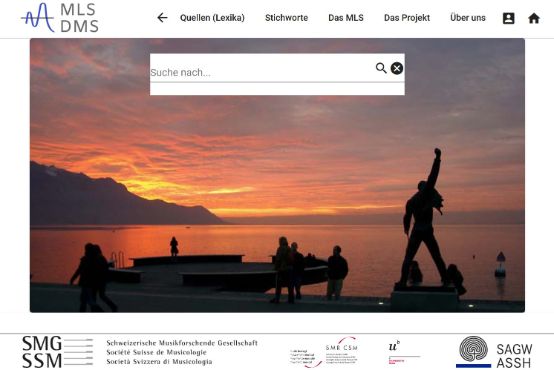
The Swiss Music Council, in collaboration with the University of Bern and the Swiss Academy of Humanities and Social Sciences (SAGW), has launched the beta version of a new music lexicon of Switzerland.

Home page of the Swiss music lexicon. Screenshot: SMZ

The online lexicon is the result of an initiative by musicologist Irène Minder-Jeanneret. She found partners in the Swiss Music Research Society (SMG) and the Swiss Music Council (SMR). The project was initially hampered by a lack of legal foundations and financial resources.

Under the direction of Cristina Urchueguía (University of Bern), Marco Jorio (former director of the Historical Dictionary of Switzerland HLS), Irène Minder-Jeanneret, Pio Pellizzari (former director of the Swiss National Sound Archives), Stefanie Stadler (University of Zurich) and Stefano Kunz (responsible project manager at the Swiss Music Council) worked on a voluntary basis to develop the foundations for the new Swiss Music Dictionary (MLS).

The beta version of the MLS currently comprises the older biographical articles on 6800 people that have appeared in the music encyclopaedias published to date. They form the basis for the second phase: the development of new articles on musicians' biographies, on the history of music in the cantons and larger municipalities, and on music-historical subject articles.

The MLS is published online, is freely accessible free of charge and will be interactive, multilingual and multimedia in the future. An additional benefit compared to the sources used is the dense linking of the articles to freely accessible online lexicons and bibliographic standard data.

As Cristina Urchueguía explained at a media conference on the project, one of the main challenges of the MLS will be to give visibility to the institutions that have shaped Swiss musical life: clubs, societies, foundations, venues and so on, in addition to the traditional articles on individuals.

Beta version of the MLS: https://mls.0807.dasch.swiss/home


Prophet in his own land

The Basel Madrigalists are unearthing a forgotten treasure by the Swiss composer Benno Ammann.

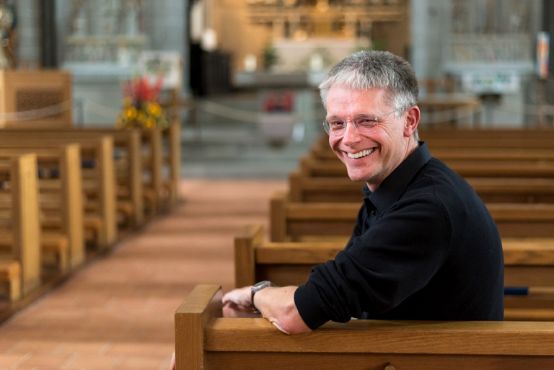
Raphael Immoos, artistic director of the Basler Madrigalisten. Photo: René Reiche

It was a little disconcerting when Raphael Immoos led the singers on February 9 after the Gloria of the Missa "Defensor Pacis" to the front rows of seats in Zurich's St. Peter and Paul Church and reached for the microphone. But what the Basel Madrigalists presented that evening under their conductor and artistic director really did require some explanation. The composer of the work, the musician born in Gersau SZ in 1904, was already in need of an introductory commentary Benno Ammann. He can justifiably be described as a typical representative of those prophets who are more respected abroad than at home. After the Second World War, he enjoyed some international success as a conductor, but this had little resonance in Switzerland. It is unclear why he did not pursue this career at all later on and restricted himself to conducting a few choirs in the Basel region.

It is likely that Ammann needed more time to compose. By the time of his death in Rome in 1986, he had created an extensive oeuvre of around 600 works, whose fascinating stylistic breadth ranged from the late romantic harmony of his Leipzig teacher Sigfrid Karg-Elert to free-tonal and twelve-tone works and serialism. From the 1950s onwards, he concentrated on electro-acoustic music, for the realization of which he travelled to electronic studios from Rome to New York until the end.

The work itself then required further explanation. The Missa "Defensor Pacis" (Defender of Peace) in honour of Niklaus von Flüe was composed immediately after the war and was premiered in the Sistine Chapel on the occasion of Brother Klaus' canonization, which was something of a sensation. Unfortunately, this triumphant beginning was immediately followed by a crash: the work disappeared into oblivion and has only now been resurrected - this year it will receive its Swiss premiere in eight concerts.

Between austerity and sensuality

In the introduction, Raphael Immoos declared the rediscovery of this work to be a sensation, the piece to be as significant as Frank Martin's Mass, which also remained undiscovered for a long time. But even if Immoos has a great deal of experience in dealing with unknown pieces, their research and revival, such a lofty prediction has yet to be confirmed. However, the Zurich concert showed that Ammann's Missa "Defensor Pacis" ad 6-12 voces inaequales is an impressive work that does not need to shy away from comparison with Martin.

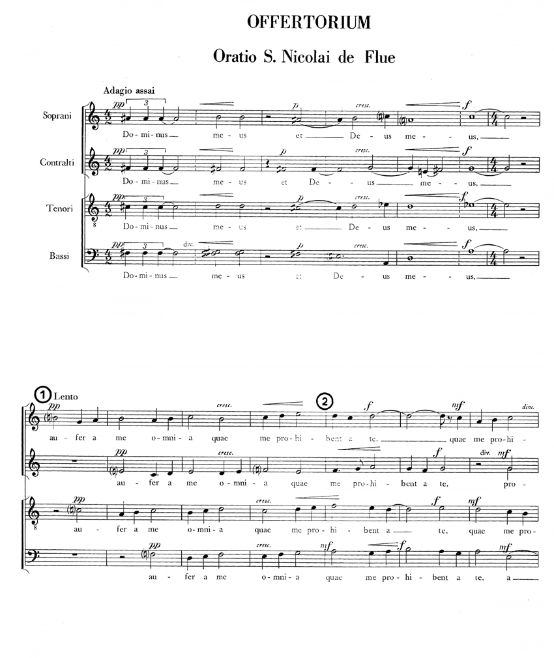
Reminiscent of the Flemish Renaissance and the Palestrina style, it moves in a tonal or modal space, leaving its modernity in the Kyrie and Gloria only flash up in occasional dissonances. Despite all the complex linearity, the voices repeatedly combine to create modern sound surfaces. From the middle of the work, the Offertorythe prayer of St. Niklaus von Flüe, the tone changes. What was previously still austere in places suddenly becomes catchy, more sensual. Almost mythical sounds now dominate the work. Individual voices rise up like invocations from the whole and allow the individual to emerge. Especially the Agnus Dei with his haunting, tranquil and peaceful closing of the work. Dona-nobis-pacem-invocation, left one moved.

Image
Setting of the Latin version of Niklaus von Flüe's widespread prayer "My Lord and my God ..." in the offertory. © by Hug Music Publishers, Zurich. With kind permission. 


The strong effect was also due to the performance of the Basel Madrigalists. They mastered the difficult score, which was peppered with many delicate passages, with masterful rhythm and intonation, remaining clearly audible and comprehensible even in the polyphony. With increasing familiarity, the one or other passage will certainly be mastered a little more smoothly.

The second introduction of the evening was actually dedicated to the work of the composer Joachim Raff, who was born in Lachen in 1822 and whose works included the premiere of a fragment. Immoo's speech, however, turned into a passionate plea for Swiss music, which is given far too little recognition in this country. Raff's work, for example, which was also performed Father Noster is certainly comparable to Verdi's counterpart. And even if one does not entirely share the latter assessment, Immoos' enthusiasm and commitment to the neglected Swiss musical heritage is infectious - beyond the evening! Next year, the Basler Madrigalisten will not only embark on a CD production of Ammann's Mass, but it will also be reissued by Hug Music Publishers and thus made available to other choirs. It would be great if this initiative by a top ensemble could actually help the work to have a broader impact. At least for ambitious amateur choirs, working with the Missa "Defensor Pacis" could be a worthwhile venture.


Primary school pupils next to professionals

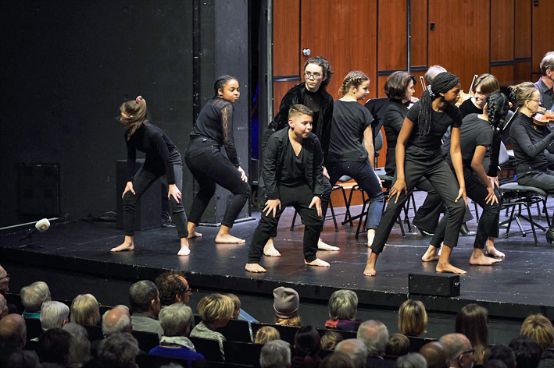
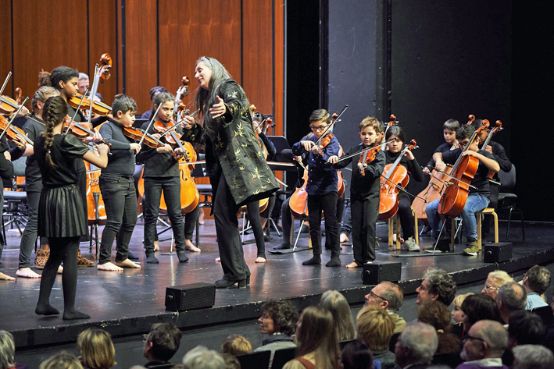
The concert on February 5 at the Musicaltheater Basel was the culmination of many years of development work. Together with children from the Insel orchestra school, the Basel Symphony Orchestra presented a lavish program with some risk potential.

First the Symphony orchestra under chief conductor Ivor Bolton parts from Beethoven's Prometheus-Ballet, to which children of primary school age danced, followed by a few short pieces performed by the youngest members of the Insel orchestra school. And finally, the symphony orchestra "Side-by-Side" played Beethoven's Music for a knight's ballet. The conductor was none other than the world-class pianist Lars Vogt, who has been working with his project Rhapsody in School celebrates successes.

The evening in the well-attended Musicaltheater Basel was the result of a long-standing collaboration between the symphony orchestra and music teacher Dorothee Mariani: seven years ago, she founded an orchestra school in the Insel schoolhouse in Kleinbasel, which is home to a diverse mix of nationalities. Since then, children between the ages of 8 and 12 have been able to learn a string instrument there with the support of the Basel Symphony Orchestra, which regularly sends its violinist László Fogarassy to the school.

At the concert, around fifty children showed off their skills and the concentration they had gained on stage and then in the audience. The meticulousness and sensitivity with which the children performed on stage to the brilliantly played Prometheus-music.

Image

Dance, singing and orchestral playing

Choreographer Rebecca Weingartner, who has been rehearsing with the children since November 2019, has truly pulled off a masterstroke. Depending on the level and age of the children, all dressed in black, there were three groups moving their heads, bodies and arms to the rhythm of the music or "whirling" around the stage. Highly concentrated, following the music and without any "misfires", the young performers completed the choreography, which was peppered with entrances and exits, to the rousing music.

The short Serbian, Albanian, Ukrainian and Scottish pieces played and sung afterwards under the direction of Dorothee Mariani showed how rocky the path is from beginners to advanced players and how much the music-making relaxed after some of the symphony orchestra musicians had mingled with the children. Was this a good or a bad omen for what was to follow?

Artistic Director Hans-Georg Hoffmann, who hosted the evening in a relaxed and witty manner, was already raving about the forthcoming Knight ballet. He had a lively conversation with two musicians, the viola player Fabian and Chukwu Cherem, whose sister Happyness was already in the orchestra on the cello and was concentrating on the "side-by-side" adventure.

Dorothee Mariani had been preparing the most advanced children with the help of László Fogarassy since August 2019. "The children should have contact with string instruments, especially in such a multinational elementary school," said Fogarassy about his involvement. "The discipline required to be able to play high-quality concerts remains in the children's memories."

Lars Vogt, who put the finishing touches to the "Insel-Sinfonieorchester", consisting of the professionals and the children, in two rehearsals, was delighted with the work and the result. It was indeed touching to see the joy and enthusiasm with which the colorful mixed orchestra played Beethoven's Knight ballet-music under his lively direction.

But that was not the end of it, as Vogt then played Beethoven's 5th Piano Concerto together with the Basel Symphony Orchestra, gripping and dramatic, but also lyrical and subtle. A successful finale, which the island children - now in the audience, where many of their relatives were also sitting - listened to with astonishing calm and excitement. The evening lasted almost two hours without a break. A high level of concentration and the successful combination of an education project with the dress rehearsal of the orchestra, which will then go on tour with this program - without children, but with actor Peter Simonischek as narrator.

Image
Orchesterschule Insel under the direction of Dorothee Mariani

Sommets Musicaux honor pianists

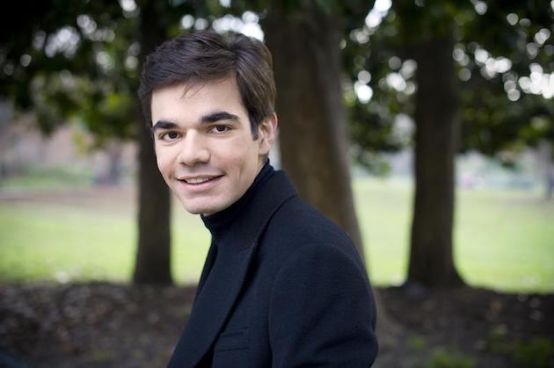
Pianist Jean-Paul Gasparian has been awarded this year's Prix Thierry Scherz of the Sommets Musicaux de Gstaad. The Prix André Hoffmann goes to Aaron Pilsan.

Jean-Paul Gasparian. Photo: Jean-Baptiste Millot

Supported by Renaud Capuçon, the artistic director of the festival, the jury unanimously awarded this year's Prix Thierry Scherz to Jean-Paul Gasparian. The young pianist will record a CD with the Orchestre de chambre de Lausanne and the Claves Records label, which will also be responsible for promotion, in the second half of 2020.

The Prix André Hoffmann aims to raise the profile of contemporary classical music. Each year, a contemporary composer writes a piece for the Sommets Musicaux, which is performed during the festival. The André Hoffmann Foundation finances the composition of the work, which is premiered in Gstaad, as well as the composer's stay.

Camille Pépin, this year's composer in residence in Gstaad, composed the piece "Number 1" for this edition of the festival. Aaron Pilsen won the prize of 5,000 Swiss francs for the best interpretation of this contemporary piece.

Lost in the jungle

Manuel Renggli's "Jungle", which the Lucerne Theater hosted on 8 February, was billed as the world's first "brass opera". However, the music failed to meet the high expectations.

Photo: Ingo Hoehn/dphoto.ch

It is an interesting project initiated by the director of the Lucerne Theater, Benedikt von Peter: A genuinely Lucerne opera in which the Bürgermusik Lucerne brass band, made up of professionals and amateurs, sits in the orchestra pit, conducted by its director Michael Bach. The stage design was created by Lucerne origami artist Sipho Mabona and the majority of the stage crew are members of the ensemble.

The music was provided by Manuel Renggli from Lucerne, who is not only trying his hand at composing music theater for the first time, but is also presenting a "brass opera" as a world premiere. His score requires 25 brass players, four percussionists and a synthesizer player. A daring, "loud" formation in the small Lucerne theater, which is why the performers were equipped with microphones. So more musical than opera?

The text was written by Michael Fehr from Bern, winner of the 2018 Swiss Literature Prize, who describes himself as a storyteller. Jungle is an eloquent example of this: storytelling takes center stage, a modern fairy tale, a parable between the end of the big city and the destruction of the jungle, which he tells in poetic images:

Brahma, a girl living on the street, neglected by her alcoholic mother Raja, grabs a handful of pills from the son of the "Red Baron" and sinks into a world in which reality and hallucination become blurred. She encounters rats, monkeys, a snake, ants and a panther. It is a plot with powerfully colorful images, told in a unique linguistic style that includes rhythm and deliberate redundancies. But it is not a libretto that carries the evening through: no drama, no confrontation or dialog between opponents, no development of the character(s). At the end, Brahma is once again the ragged girl in the big city. The focus is therefore mainly on the inner images and feelings of the sad main character. With Ina Langensand, she is also played by an actress with a haunting performance. And the story is told by the actor Walter Sigi Arnold, who also performs brilliantly as Panther.

Especially for looking

The scene in Lucerne is dominated by Sipho Mabona's abstract origami objects, intoxicating images full of color (lighting: Clemens Gorzella) and bizarre shapes, on which video projections (Rebecca Stofer) suggest the locations of the action. And the music? It should actually develop its own dimension, filling the dream visions with color, drama or elegiac "melodies".

But there is little evidence of this: harmonic processing, exploration of the sonic richness of the brass instruments or rhythmic diversification - nowhere to be found. The music, carried by endlessly repetitive, similar patterns, ripples along. However, this musical monotony is also largely due to the non-libretto, which offers no dramaturgical bite whatsoever.

Changes such as the jazzy syncopations during the monkey dance or the triumphant climax at the end remain the exception. In addition, mutes are often used to avoid drowning out the singers despite the microphone. Jungle is reminiscent of a movie, with images whizzing by accompanied by music. The Bürgermusik, consisting mainly of amateurs, plays well under the accomplished baton of Michael Bach, but is unable to really unfold.

Director Tom Ryser, together with the excellent ensemble, manages the feat of keeping the audience on the edge of their seats. The alternation between seriousness and slapstick is skillful, and the singing and acting cast give their best. Birgit Künzler's set design is ingenious, brilliantly managing the balancing act between a fabulous world portrayed by people.

There is Hubert Wild as a "Feathered Man" modeled on Papageno, who switches between countertenor voice and baritone with virtuosity. The expressive Rebecca Krynski Cox as the drunken Raja also makes her mark. And Diana Schnürpel as the snake Atlanta, with her melismatic, sinuous coloratura, reminds us just how great her Queen of the Night is.

In the program booklet, Manuel Renggli describes the strong linguistic rhythm of Fehr's narrative art as the "crux" of his compositional work. In fact, the solo parts still lack independence. Renggli succeeds in creating exciting moments with pulsating music in the chorus scenes of the monkeys, rats and ants. An evening that is fun to watch. But to listen to?

Further performances until April 3, 2020

Zollikon honors Matthias Ziegler

The flautist and ZHdK lecturer Matthias Ziegler receives the Zolliker Art Prize, endowed with 10,000 francs. The sponsorship prize goes to violinist Julia Schuller.

Matthias Ziegler. Photo: zVg

According to the Dr. K. & H. Hintermeister-Gyger Foundation, Zurich musician Matthias Ziegler, born in 1955, is considered one of the most versatile and innovative flutists of his generation and is equally committed to traditional literature as well as to contemporary composed and improvised music. In his search for new sounds, he has expanded the expressive potential of the traditional flute and the electro-acoustic flute.

Renowned composers such as Michael Jarrell, George Gruntz and Matthias Rüegg have also written flute concertos for Matthias Ziegler. Concert tours have taken him to the USA, Japan, Australia, South America and Israel. Numerous CD recordings document his wide-ranging interests. Matthias Ziegler is also a professor of flute and improvisation at the Zurich University of the Arts.

Julia Schuller, a Zurich violinist born in 1998, receives the 5000 Swiss franc prize. She studied at the Musikschule Konservatorium Zürich (MKZ) in Jens Lohmann's violin class and at the MKZ PreCollege. Since 2019, she has been studying with Mi-Kyung Lee at the University of Music and Performing Arts Munich. Julia Schuller has already won first prize in the final of the Swiss Youth Music Competition three times in a row.

Master's prize for Fabio da Silva

The Ober-Gerwern Society has awarded the Ober-Gerwern Master's Prize for outstanding Master's theses at Bern University of the Arts (HKB) for the fifth time. This year's prize of CHF 20,000 goes to Fabio da Silva, a graduate of the Master's in Music Pedagogy.

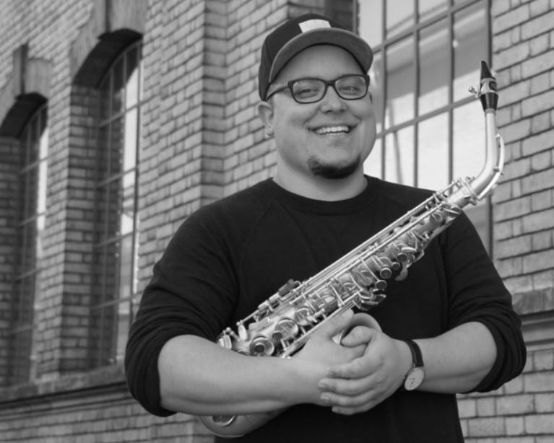
Fabio da Silva (Image: HKB)

Born in 1993, da Silva received the award for his written master's thesis, the saxophone teaching aid "Jerry in New York", and the music education project "Into the Future". He discovered with his own pupils that they made significant progress in their general saxophone playing by using new playing techniques on the instrument.

As most saxophone schools do not take this into account, he decided to write his own saxophone teaching material: "Jerry in New York". This introduces modern playing techniques for the saxophone, mainly using his own compositions. It is intended to provide a playful introduction to contemporary playing techniques as a basis for the further development of one's own general saxophone playing.

Fabio da Silva has been playing the saxophone since childhood. At the beginning of the 2010s, he developed a particular interest in new music. Immediately after graduating from high school, da Silva began his saxophone studies at the HKB in Christian Roellinger's class. He completed his bachelor's degree in 2017 and his Master of Arts in Music Pedagogy last year.

Septet in E flat major

Beethoven every Friday: to mark his 250th birthday, we take a look at one of his works every week. Today it's his Septet in E flat major for clarinet, bassoon, horn, violin, viola, cello and double bass.

It is said that the fool likes to sit between two stools. He falls outside the system, does not feel bound by any norms, looks the people in the mouth and holds up a mirror so that his jokes lead to brooding with an alert mind. This is also the case with Beethoven's Septet in E flat major op. 20, a work whose entertaining wit was already enjoyed by his contemporaries. Admittedly to the annoyance of the composer, who urged the Leipzig publisher Hoffmeister & Kühnel to publish it quickly: "My septet is sending a little faster into the world - because the mob is waiting for it." (April 8, 1802) The sound seemed popular to many, but even more so the sound of the mixed ensemble in 1800 was not only new, but completely innovative.

The instrumentation corresponds neither to a string quartet nor to a wind orchestra, nor does it come close to the small orchestra of a symphony. As late as 1857, Karl Reinhold Köstlich, in his remarks on music (as the third part of Friedrich Theodor Vischer's Aesthetics or the science of beauty) this is the special attraction and challenge for every sound creator: "The mixed set about a septet is a less sharply defined form, the fulfillment of which with a completely accurate content is more difficult to find, a matter of the composer's luck and tact." (Sp. 1056)

The structure of the work, with a total of six movements, also brings it close to the serenade. And indeed, the minuet, the variations and the scherzo in particular have an emphatically cheerful, pleasing tone - although this is preceded by an almost symphonic introduction at the beginning of the first movement; the introduction to the finale even resembles a funeral march. The fact that the technically demanding parts (especially the winds) apparently did not stand in the way of the work's popularity is still surprising today.

In any case, Beethoven himself emphasized to his publishers that the instrumentation was "tutti obligati (I can't write anything non-obligatory because I was born with an obligatory accompaniment)". In doing so, he captured the essence and spirit of every mixed ensemble. His septet quickly became a model. When, only a few years later, the art-loving cloth merchant Johann Tost commissioned a nonet (op. 31) from Louis Spohr, this was already accompanied by the demand that it should be "each of the instruments emerges according to its character and essence".


Listen in!

Death of the conductor Nello Santi

Conductor Nello Santi, the former music director of Zurich Opera House and head of the Basel Radio Symphony Orchestra, has died at the age of 89.

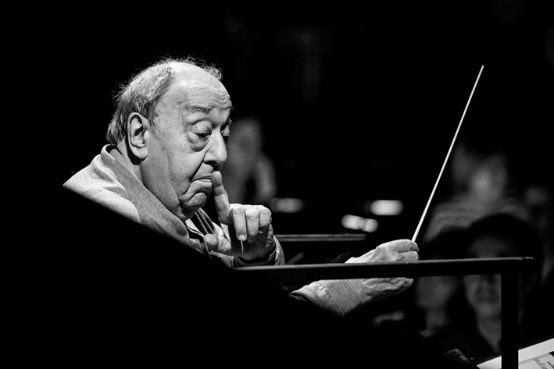
Nello Santi rehearses Lucia di Lammermoor at Zurich Opera House in 2019. Photo: Toni Suter / T+T Photography

Born in 1931 on the Adriatic coast, Santi studied conducting, composition, violin and piano in Padua. He made his debut as a conductor in 1951 at the Teatro Verdi in Padua with Verdi's "Rigoletto". In 1958, he was appointed First Kapellmeister at the Zurich Opera House. From 1986 to 1994, he conducted the Basel Radio Symphony Orchestra.

Santi, who had a photographic memory, primarily cultivated the Italian opera repertoire and was regarded as one of the most important Verdi conductors of our time. He rejected director's theater. Stylistically, Santi was linked to the Italian tradition of his role models Arturo Toscanini, Antonino Votto, Francesco Molinari-Pradelli and Tullio Serafin.

Graubünden cultural concept on track

The Graubünden government has adopted the dispatch on the Graubünden cultural promotion concept for the attention of the Grand Council. The concept, which is available for the first time, sets out objectives and priorities for the years 2021 to 2024.

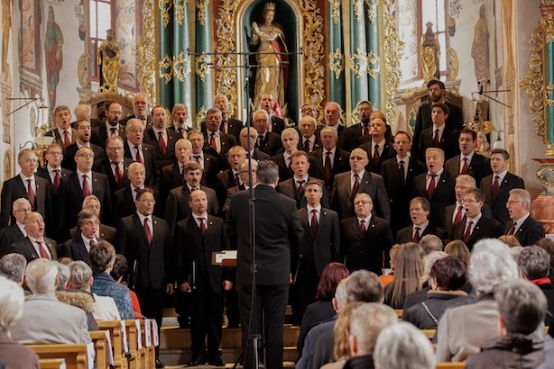
One of the many choirs in Graubünden: Chor viril Surses. Photo: zVg

The Graubünden Cultural Promotion Concept presents the current situation in the various areas of cantonal cultural promotion, defines concrete priorities for the three fields of action of cultural promotion, cultural cultivation and cultural mediation over the next four years and identifies concrete measures to achieve these priorities.

According to the message, music and singing have been a great tradition throughout the canton for generations and are still practiced today. Both professional formations and a large number of music societies as well as adult, youth and children's choirs cultivate different types of music: from traditional folk and brass music to jazz, rock, pop and classical music.

The choral scene is also an important element of cultural life in Graubünden and continues to shape the cultural landscape of Graubünden to this day. From the historically grown tradition of church singing and the secular choral movement of the Romantic period, a high-quality, diverse and lively choral scene has developed in the canton. The trilingualism of the canton and the associated cultural influences would still prove to be a great advantage and enrichment in this respect today.

The message can be found here:
https://www.gr.ch/DE/Medien/Mitteilungen/MMStaka/2020/DokumenteMedien/Botschaft_Kulturfoerdergesetz.pdf

Call for Papers

An International Arnold Schönberg Symposium will take place in Vienna from October 15 to 17, 2020. Proposals for the "Free papers" section can be submitted until February 17.

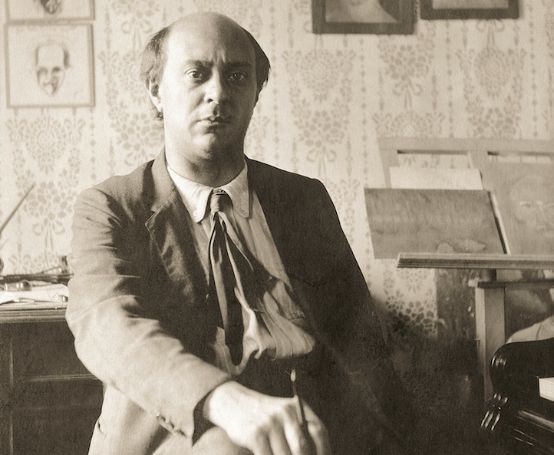
Arnold Schoenberg, 1911 Photo : © Arnold Schönberg Center, Vienna,SMPV

The Arnold Schönberg Center in Vienna is organizing an international symposium from 15 to 17 October 2020 in collaboration with the Arnold Schönberg Science Center and the Vienna School at the Institute for Musicology and Interpretation Research at the University of Music and Performing Arts Vienna.

The symposium will focus on the fragment, its manifestations and contexts. The focus will be on fragments from all of Arnold Schönberg's creative areas, from unfinished compositions and writings to abandoned artistic projects.

For the "Free papers" section, submissions on the main topic as well as on questions of current Schönberg research are welcome.

The symposium offers scientists the opportunity to present the results of their research in a 20-minute lecture. Symposium languages are German and English. A publication of selected contributions and free submissions is planned for the Journal of the Arnold Schönberg Center 18/2021.

Please submit an abstract (approx. 300 words) and short biography by February 17, 2020 to: direktion@schoenberg.at
Arnold Schönberg Center, Schwarzenbergplatz 6, A-1030 Vienna

Information on the acceptance of contributions will be provided in mid-March 2020.
 

When vinyl becomes extremely expensive

The long-dead record is still in circulation, sometimes at extremely high prices. Hendrik Sonnabend from the FernUniversität in Hagen researched the conditions for this.

Photo: Georgios Kaleadis / unsplash.com

Research assistant Hendrik Sonnabend from the FernUniversität in Hagen.
and a British colleague conducted a scientific study to investigate how rarity affects the prices of unusually expensive vinyl collector's items. They collected data on the most expensive sales of a month on a relevant online platform.

The empirical analysis showed that the price increases by around 16% for a one percent reduction in supply. The age of the recording, on the other hand, hardly plays a role. Recordings by artists on the Wikipedia list of best-selling music artists are on average 15 percent more expensive than, for example, black metal records by bands that are less popular. The entry of an album there only brings four percent.

First editions of very popular albums that were produced in small numbers are particularly interesting. The Led Zeppelin debut album with turquoise lettering from 1969, for example, is worth 1000 to 1500 euros, the official repress with red lettering 15 to 30 euros. The increase in value of the all-black Prince album, of which only a few legally produced debut copies exist, was even more extreme.

Shortly before the release, Prince had a spiritual experience in which God told him that the album was evil or sinful. Prince therefore had the entire production destroyed at his own expense in 1987, with only a few remaining.

Original article:
https://www.researchgate.net/publication/336923221_Pricing_the_Groove_Hedonic_equation_estimates_for_rare_vinyl_records

Matthias Bamert extends contract in Japan

The Sapporo Symphony Orchestra will continue its fruitful collaboration with Matthias Bamert for three years.

Photo: © Matthias Bamert / Kim Haln

Matthias Bamert has been Chief Conductor of the Sapporo Symphony Orchestra since April 2018. As the orchestra announced today, his contract has been extended until March 2024. Under Bamert's leadership, the orchestra aims to expand its repertoire and further develop its high standard.

get_footer();