A Caribbean palm beach with a fishing boat adorns the cover of this duet booklet by Austrian composer and saxophonist Florian Bramböck and thus shows where the musical journey is heading. The 16 tracks - some original compositions, some arrangements of well-known melodies - tell of or originate from Africa, South America, the Caribbean and New Orleans and are as much fun to play as they are to listen to. In terms of the range and keys used, the pieces range from easy to medium difficulty. However, they do present some rhythmic challenges that need to be mastered by clarinettists who are not so experienced in these styles.
Bramböck also knows how to set well-known titles in an exciting and very good-sounding way for the clarinet. Hits in this edition include, for example, the well-known Buena Vista Social Club Chan Chan or Miriam Makebas Pata Pata to be found. But the well-known folk and children's song La Cucaracha by setting it in ¾ time, Florian Bramböck is able to take on completely new and surprising aspects. And so it even appears twice in the booklet: once as an overture and finally as an effective "dramatico" waltz finale - what fun! With titles like Strait, more width (a merengue!) or the cool cruising cha-cha-cha Three Days Off in My Cadillac Bramböck shows his musical humor. Some of the titles are also available in an edition for three clarinets, which is also highly recommended (UE 35568).
Florian Bramböck: Afro-Latin Clarinet Duets, 16 pieces for two clarinets, UE 34535, € 14.95, Universal Edition, Vienna 2019
Melting tome
"Souvenir" by Franz Drdla, originally for violin and piano, here in the viola version.
Walter Amadeus Ammann
(translation: AI)
- Feb 25, 2020
Photo: Thomas Max Müller/pixelio.de
The widely traveled Czech violinist František Drdla (1868-1944), a theory student of Anton Bruckner at the Vienna Conservatory, wrote over 200 works of light music: in addition to two operettas and a violin concerto, many genre pieces for violin and piano. One of the best known, this melting, harmonically charming little tome, has now also been gratefully arranged for viola. It is as good on the viola in the same key as on the violin.
Franz Drdla: Souvenir, for viola and piano arranged by Heinz Bethmann, score and viola part, BU 8194, € 11.00, Musikverlag Bruno Uetz, Halberstadt 2019
Two in Wonderland
Knowing that great duo art is based on a lively exchange of ideas and the creativity of those involved, Daniel Schläppi and Marc Copland prepared themselves accordingly and set to work on their third album. With inspiring results.
Michael Gasser
(translation: AI)
- Feb 25, 2020
Photo: Rainer Ortag
His third collaboration with US pianist Marc Copland is also his most mature, bassist Daniel Schläppi says in the documentation for their joint CD Alice's Wonderland know. And duo partner Copland is also full of praise: "Playing with Daniel reminds me of the things I love most about playing jazz: the warmth, the communication and the attempt to share an experience with the listener."
The present work is not least intended to document how the music of the two has developed. Marc Copland (*1948), who has also performed on stage with jazz luminaries such as John Abercrombie and Ralph Towner, once again proves himself to be a master of the chordal and knows how to elicit an ethereal fluid from his piano with a fine touch. Meanwhile, his partner, Daniel Schläppi, 20 years his junior, stands out as a curious bassist with a penchant for groovy sounds. - He also runs a label and is an associated researcher at the Historical Institute of the University of Bern.
The 49-minute, nine-song encounter between the duo on Alice's Wonderland begins with a cover of Cole Porter's Everything I Love. The version by Schläppi and Copland is well-tempered, draws on a broad palette of timbres and is full of emotional power. Although the piece turns out to be stylistically trend-setting for the rest of the album, the two musicians always manage to surprise with their intimate, light playing, improvisation and superb timing. This is also the case on Blue In Greenwhich originates from the Miles Davis songbook. Conclusion: The elegant collaboration between Schläppi & Copland knows how to inspire - from A to Z.
Daniel Schläppi, bass; Marc Copland, piano: Alice's Wonderland. Catwalk CW 190019-2
The Lausanne cellist Constantin Macherel demonstrates his subtle skills in works by Boccherini, Servais, Franchomme and Rossini.
Georg Rudiger
(translation: AI)
- Feb 25, 2020
Constantin Macherel. Photo: zVg
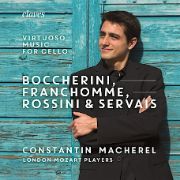
Like Johann Sebastian Bach and later Joseph Haydn, Luigi Boccherini (1743-1805) emancipated the cello from its continuo function and treated it as an instrument for true virtuosos in his twelve concertos. Now the Swiss cellist Constantin Macherel, born in Lausanne in 1991, has chosen Boccherini's Cello Concerto in D major (G 479) for his debut CD with the London Mozart Players (conductor: Sebastian Comberti) alongside other technically demanding, musically catchy pieces. Macherel's slender, flexible, only occasionally somewhat narrow tone is ideal for the spectacular flights of fancy that the Italian composer demands of the performer. His Joseph Hill cello from 1765 sounds as fine as a violin in the high register. The careful, tasteful vibrato and airy phrasing lend the interpretation lightness and esprit. The slow movement is touching in its simplicity. The London Mozart Players are subtle accompanists - only sometimes, as in the finale, one wishes for a stronger profile.
In the imagination Souvenir de Spa op. 2 by Adrien François Servais, the cellist, who studied with Ivan Monighetti in Basel and Raphael Wallfisch in Zurich, demonstrates his subtle bowing technique. Rossini's Une larme, Thème et variations with great cantability. And August-Joseph Franchomme's musical language, which is exciting to a limited extent, is also enhanced by Macherel's fine stylistic flair, as in the Variations sur deux thèmes (russe et écossais) op. The fact that the banal Scottish theme would also fit in well with a Rosamunde Pilcher film is ultimately not the interpreter's fault. Macherel's restraint makes it enjoyable and prevents it from becoming too kitschy.
Virtuoso Music for Cello. Works by Boccherini, Franchomme, Rossini and Servais. Constantin Macherel, violoncello; London Mozart Players, conductor: Sebastian Comberti. Claves 1903
Expressive singing
The two performers, Ursula Büttiker and Minako Matsuura, base their selection of pieces for flute and piano entirely on the French tradition.
Walter Labhart
(translation: AI)
- Feb 24, 2020
Ursula Büttiker. Photo: Venla Kevic
Swiss flautist Ursula Büttiker already attracted attention with her first CD releases. The last student of André Jaunet, she also took singing lessons. So it is no wonder that her flute playing is primarily aimed at expressive cantabile.
The musician champions little-known works with the passion of a discoverer striving for counter-positions. Made the CD Musical Postcards with rarities by Pál Járdányi or Bryan Kelly, the follow-up production, all works for solo flute, stood out with works by Jindřich Feld and Saverio Mercadante.
The CD produced to mark the 150th anniversary of Hector Berlioz's death is entirely in the French tradition shaped by the flute maker and composer Theobald Boehm Élégie - Rêverie - Caprice with pianist Minako Matsuura playing along with a keen ear. At the center is Jules Mouquet, a Rome Prize winner inspired by Greek mythology. In his La Flûte de Pan In her sonata from 1906, impressionistic moods alternate with brilliance and virtuosity in a classical manner just as frequently as the dynamic contrasts. Although she manages with a minimum of vibrato, Ursula Büttiker develops impressive expressivity even in very low registers. Her bravura breathing technique benefits strongly chromaticized runs; the pianist's delicate touch enhances the sound magic of the many delicate echo effects.
Typical French elegance fills both the Cinq Pièces brèves from Mouquet, Chanson et Badinerie by Pierre Camus as well as the Élégie op. 47 by Theobald Boehm and the music crowned by a tarantella Three musical sketches by Wilhelm Bernhard Molique, who shares the same year of death as Berlioz. In Rêverie et Caprice op. 8, Berlioz's only concertante work, thanks to the subtle arrangement for flute and piano by Hans-Wolfgang Riedel, it is impossible to tell that it was originally set for violin and orchestra and is based on sketches for Teresa's cavatina from the opera Benvenuto Cellini based.
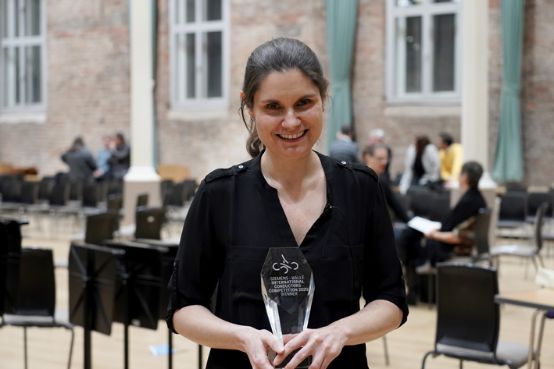
Bulgarian conductor Delyana Lazarova is the winner of the first Siemens Hallé International Conductors Competition. The prize money amounts to 19,000 Swiss francs (15,000 pounds).
PM/Codex flores
(translation: AI)
- Feb 24, 2020
Delayana Lazarova. Photo: Hallé
The award also includes a two-year engagement as Assistant Conductor in Hallé and the position of Musical Director of the Hallé Youth Orchestra.
In 2019, Lazarova won the first conducting competition of the National Radio of Albania and the James Conlon Conducting Prize of the Aspen Music Festival. She is currently studying for a master's degree in conducting with Johannes Schläfli at the ZHdK (Zurich University of the Arts). She has already completed a master's degree in violin at Indiana University (USA), where she graduated with honors.
Her current engagements include conducting the Hungarian National Radio Symphony Orchestra, the Albanian Radio Television Symphony Orchestra and the Italian Solisti Aquilani. Her ZHdK studies also include a debut with Carmen at the Meiningen State Theater in Germany.
Symphony No. 9
Beethoven every Friday: to mark his 250th birthday, we take a look at one of his works every week. Today it's his Symphony No. 9 in D minor.
Michael Kube
(translation: AI)
- Feb 21, 2020
There are probably no more than a dozen compositions of classical music that have found a permanent place in the public consciousness. The reasons for this are extremely varied; they range from their frequent use on official occasions, in radio, film and television to sometimes not-so-local traditions. Hand on heart: who hasn't heard a more or less festive performance of Beethoven's Ninth on New Year's Eve or New Year's Day, at the end of which the singing seems to eclipse everything symphonic? At least in this sublime moment, it is as if - despite many everyday experiences - all people really are brothers. Moreover, this "Ode to Joy" has never been a bad substitute when no national anthem was available or would fit (for example in Rhodesia, in Kosovo or at the former entry of all-German teams at the Olympic Games). In all these cases, however, Friedrich Schiller's visionary verses were not sung, perhaps not even considered. The same applies (unfortunately) to its official use as the European anthem (since 1985). wordless arranged by Herbert von Karajan in the versions for piano, wind orchestra or orchestra.
There was no shortage of arrangements in the 19th century. Even then, the crucial question was how to deal with the text and the vocal parts. Franz Liszt's virtuoso transcription for piano two hands (1853), for example, became a piano reduction in the finale. Years earlier, Carl Czerny had already had reservations about such a performance when he made his own arrangement for piano four hands: Where should the vocal parts have been inserted, since (as is still customary today) the two players are assigned the left and right pages of the open edition respectively? And so the Leipzig publisher Probst finally published a piano volume in landscape format, while the vocal parts were enclosed separately in portrait format. In a letter dated September 3, 1828, Czerny had expressed himself even more pragmatically (and as we know today: with almost clairvoyant abilities): "The future will appreciate the greatness of musical composition so much that it will forget the words."
The Zurich University of the Arts (ZHdK) has appointed Anna Gebert as its new principal violin lecturer.
PM/Codex flores
(translation: AI)
- Feb 21, 2020
Anna Gebert (Image: ZHdK)
From the 2020/21 academic year, Gebert will join the Zurich Violin College with Ilya Gringolts, Andreas Janke, Rudolf Koelman, Sergey Malov and Alexander Sitkovetski. The Polish-Finnish violinist completed her studies at music academies in Europe and the USA. She is just as much in demand internationally as a teacher as she is as a musician in renowned orchestras and at numerous festivals. Her profound knowledge of historical performance practice and contemporary music enriches the ZHdK's existing expertise.
Lüthi and Grimes honored
This year, the Bürgi-Willert Foundation's Culture Prize, endowed with 50,000 Swiss francs, goes in equal parts to the two Bernese musicians Shirley Grimes and Meret Lüthi.
Music newspaper editorial office
(translation: AI)
- Feb 20, 2020
Meret Lüthi (Photo: Guillaume Perret)
Irish-born singer and songwriter Shirley Grimes has been contributing to the cultural life of the Bern region for decades. She has contributed her musical versatility to various bands, but has also realized many of her own projects.
Over the past twelve years, Bernese violinist Meret Lüthi has built up the Bernese early music orchestra "Les Passions de l'Ame" and positioned it on the international music scene. She has discovered and publicly performed or recorded numerous baroque works.
Since 1992, the Bürgi-Willert Foundation has awarded a cultural prize every two years. It is awarded to people who have enriched Bern's cultural life for many years.
Kopatchinskaja is an honorary member of Vienna
Bern-based violinist Patricia Kopatchinskaja and baritone Christian Gerhaher have been appointed honorary members of the Wiener Konzerthausgesellschaft.
Music newspaper editorial office
(translation: AI)
- Feb 19, 2020
Patricia Kopatchinskaja. Photo: zVg
The 1913 statutes of the Wiener Konzerthausgesellschaft, founded in the same year, already provided for the possibility of appointing honorary members. The first use was made of this in 1937, when Felix Stransky, financial officer and member of the management of the Wiener Konzerthausgesellschaft, was appointed the first honorary member, the second being Richard Strauss in 1938.
The Moldovan-born violinist Patricia Kopatchinskaja initially studied violin with Michaela Schlögl, a student of David Oistrakh. In 1989, her family emigrated to Vienna, where she continued her studies at the University of Music and Performing Arts Vienna. At the age of 21, she moved to the conservatory in Bern on a scholarship. She graduated there with distinction in 2000.
After serving as Artistic Partner of the Saint Paul Chamber Orchestra in the USA from 2014 to 2018, she took over the artistic direction of Camerata Bern at the end of 2018, with whom she has since staged the projects "War and Chips" and "Time and Eternity".
Bern, Dresden and Salzburg cooperate
Starting in autumn, the Bern University of the Arts (HKB), together with the music academies in Dresden and Salzburg, will be offering the Master Specialized Music Performance in the specialization "New Music / Création musicale" as an international cooperation Master.
PM/Codex flores
(translation: AI)
- Feb 18, 2020
Photo: Mimi Thian / Unsplash (see below)
Those who want to deepen their knowledge of contemporary music in Bern benefit from transdisciplinarity: studio, live electronics, composition and creative practice, ensembles, sound arts, theater, visual arts, literature, performance, festivals - all connections are possible and are supported by an international team of lecturers and an individual study plan.
From 2020, the HKB's Master Specialized Music Performance course in New Music / Création musicale will be part of an exclusive European institutional network: the international cooperation Master New Music Bern-Dresden-Salzburg. HKB students will also visit one of the other two universities of their choice, develop and realize projects and take them on tour.
The Festivals Strings Lucerne and the ORF Vienna Radio Symphony Orchestra have canceled tours of Asia due to the coronavirus.
Music newspaper editorial office
(translation: AI)
- Feb 18, 2020
Festival Strings Lucerne. Photo: Dennis Yulov
The ORF Vienna Radio Symphony Orchestra was due to tour South Korea and China from March 10 to 21, but the tour under Finnish conductor John Storgards has now been completely canceled. The reason for this is the spread of the coronavirus in China, which is now also affecting cultural life in South Korea.
Initially, the two concerts planned in China were canceled by the organizer at the beginning of February, and a week later one of the organizers also withdrew from Korea. The remaining concerts in Korea can now no longer be performed by the orchestra.
Due to the wave of infections, a long-planned concert tour by Festival Strings Lucerne with Midori, which was to have toured several East Asian countries in March, has also had to be canceled. A shortened tour without the concerts planned in mainland China was also no longer an option due to stricter travel regulations and the shutdown of public life at planned tour venues such as Hong Kong. The canceled concerts are to be rescheduled as soon as possible.
Concerts were planned in Singapore and Seoul as well as in the Chinese cities of Shanghai, Changsha and Zhuhai and a performance at the Hong Kong Arts Festival, where the Festival Strings Lucerne has been a guest performer since 1978. The Hong Kong Arts Festival, one of the most renowned festivals in Asia, was even completely canceled this year with over 120 events. A unique occurrence in the festival's almost 50-year history.
Thinking and acting together
"Music works on three levels: regional, social and individual." This statement in the trailer for the symposium in Feldkirch was the theme of the two-day event.
Anna E. Fintelmann
(translation: AI)
- Feb 17, 2020
Venue Montforthaus in Feldkirch. Photo: Vorarlberg State Conservatory/Victor Marin
The Vorarlberg State Conservatory hosted a symposium for cultural and music professionals on February 4 and 5. The topic of "Music and Society" brought together around 170 participants from the four-country region in the Montforthaus Feldkirch together. In addition to presentations and inputs, there were lively debates in discussion rounds and the first-ever format was used to exchange ideas.
Culture for everyone who wants it
Martin Tröndle (Zeppelin University Friedrichshafen) laid the foundation for the subsequent debates with his report on "non-visitor research": cultural institutions (in the narrower sense of theaters, opera houses and classical concert halls) are known as places where only a small part of society can be found. However, it is still quite unclear who misses out on the many offerings of the classical sector and, above all, for what reasons. A few findings from a study (conducted in Berlin in 2019 with around 1,300 young academics) are briefly mentioned here: the classic feature pages are hardly used as a place for information and preparation, while offline information and friends are the second most important source after the internet.
Lack of time and money are often cited as reasons for not attending traditional events; however, they are not decisive for visitor behavior. Tröndle speaks of 11 % of so-called "never-visitors" who are hopeless to try to attract; it is more worthwhile because it is more promising to get to know the 20 or so % of "not-yet" and "maybe-visitors". Institutions can ask themselves how they can offer "proximity" on all possible levels and how they can make their establishment and their offerings inviting for all those who want culture.
Music and regional development
The Blaibach concert hall in the Bavarian Forest, a local project that has become known beyond the region, was largely financed by urban development programs. The well-known problem of operating costs for programming also exists here, as is the case with many other organizers. In the meantime, public funding has been completely dispensed with here, as it is too insignificant compared to the effort required to obtain it. Artistic Director Thomas E. Bauer passionately argues that there is a right to prominent culture as well as to education and infrastructure - even in rural areas.
The concert series "Montforter Zwischentöne" seeks regional relevance by involving the local communities, playing in urban spaces and having an impact beyond Feldkirch into the Rhine Valley with its 250,000 inhabitants. In its own productions, themes from the region are taken up and artistically processed in new concert formats; participation here means taking "user competence" just as seriously as expertise.
Qualification for sociomusic projects
Christine Rhomberg (Hilti Foundation) provided an example of practical talent promotion with her report on the commitment "Music for social change" and introduced the second major topic of the meeting: How can musicians be empowered to get involved in social contexts while still in training? Creative people and clever collaborations are needed to combine the established music business and socio-musical initiatives such as JeKi or Superar in a sustainable and profitable way.
It is an urgent task to bring music studies and teacher training closer together in order to close the devastating gaps in children's basic musical education. This was also made clear in the presentation by Peter Heiler from the Bregenz Music School: for a "music school in school", music teachers are needed who have the entire spectrum of "educate - learn - play" in mind, as there is less and less support from parents.
Many musical program points enriched the symposium, various ensembles of the Vorarlberg State Conservatory as well as the many-membered Superar Choir (conducted by Magdalena Fingerlos) performed. The final round of the Hugo Competition - an international student competition for new concert formats organized by Montforter Zwischentöne - presented four teams from German-speaking music academies with ideas on the theme of "Taking detours". The XYlit collective from Leipzig won over the jury and audience with their entry "Traumlandschaft"; the Hugo winners received 1000 euros in prize money and can now develop their project with a professional production budget for the Montforter Zwischentöne summer festival.
The symposium was a successful prelude to further exchange between music and society and was cleverly placed: The Landeskonservatorium has just applied for accreditation as a music university. For the artistic director, Jörg Maria Ortwein, his institution and the symposium are equally important as "a source of inspiration for innovative approaches. The aim is to establish the emerging private music university as an ideal platform for the development of artistic personalities with a multi-layered impact on society."
For Jörg Maria Ortwein, Artistic Director of the State Conservatory, networking and innovative educational approaches are important. Photo: Vorarlberg State Conservatory/Victor Marin
The mysterious count and his festival
There are more myths and legends surrounding Giacinto Scelsi's life and work than almost any other composer. A small festival in Basel has been looking after his legacy for a few years now.
Niklaus Rüegg
(translation: AI)
- Feb 17, 2020
The pianist Marianne Schroeder knew Scelsi personally. Photo: Niklaus Rüegg
Born into an aristocratic family in 1905 and raised at Valva Castle near Naples, he bears the title Conte d'Ayala Valva. "Even as a three-year-old, he used to spend hours improvising on the piano with his feet, arms and elbows and did not want to be disturbed under any circumstances," says pianist Marianne Schroeder, who knew Scelsi personally and worked with him.
As a pianist, he was largely self-taught. He later studied composition with three teachers, with Debussy specialist Giacinto Sallustio in Rome, with Egon Köhler, a Scriabin supporter, in Geneva and twelve-tone technique with Schoenberg pupil Walter Klein in Vienna. These studies took place outside the academic world, from which he deliberately kept his distance and was therefore sometimes despised or ridiculed. Marianne Schroeder enthusiastically recounts a 1979 concert in the Hans-Huber-Saal in Basel, in which Jürg Wittenbach performed works by Scelsi. The Japanese soprano and Scelsi specialist Michiko Hirayama was also there. In 2014, Schroeder invited the now 90-year-old singer to her first Scelsi festival at the Gare du Nord. "It was incredible: she sang a one-and-a-half-hour program with the Canti del Capricornothat were dedicated to her."
During the Second World War, Scelsi struggled with nervous problems and became increasingly interested in spiritualism, turning to Far Eastern teachings and practising yoga intensively. He believed that he received his music as messages from the beyond, for example from Hindu deities: "I am only a medium in the service of something much greater than myself," he says in the film portrait The first movement of the unmoved from the year 2018.
He was in search of microtonalities, always looking for frictions, minor seconds and sevenths. In 1965, he stopped improvising on the piano and began working with the Ondiola, the first electronic instrument on which pitches could be set.
"Now I have to play Scelsi"
Marianne Schroeder, a piano teacher at the Basel Music School at the beginning of her career, states: "I only felt happy when I started playing modern music. I was always successful with it". She studied Bartók, Stockhausen, Feldman and Cage. "Scelsi was a logical consequence of this," she is convinced. After the initial experience of the Scelsi concert in Basel, it took another five years before she plucked up the courage to call the master: "In 1984, I was in Darmstadt when it came like a bolt of lightning: now I have to play Scelsi." The following year, she met the master in Rome. He asked three questions: "How old are you? What kind of music do you play? Do you do yoga?" She didn't do yoga, but started soon after Scelsi's death (1988) and still practises it intensively today: "Scelsi was extremely kind and calm, someone who only wanted the best for you." As he always worked at night, you could only meet him after 4 pm. Scelsi often asked: "Did you improvise today?" It was extremely important to him that a musician should let the music emerge from within.
You couldn't listen to his music for more than ten minutes at a time, Scelsi said, it was too eruptive. Today we've moved on, says Schroeder: "There's something emotionally right about Scelsi. There is something natural, fundamental and unaffected about it."
"Now I'm doing a festival"
After a concert in Rome, Schroeder had her second important inspiration: "Now I'm going to do a festival." She found a project manager in Anja Wernicke, and the first three-day edition was successfully staged in January 2014. With the exception of 2015, the festival has always been hosted by Gare du Nord. However, the first day traditionally takes place at Fachwerk Allschwil, as was the case this year on February 2. First on the program was a singing workshop with Amit Sharma, followed by a reading from Scelsi's autobiographical work, Il sogno 101. The music was entirely dedicated to the piano. The following were performed Cinque incantesimi (1953), performed by Marija Skender. These pieces are among the composer's best-known piano works. They were written over several years in nightly improvisations that were recorded on tape. Action Music 1-4 (1955), interpreted by Giusy Caruso, dates from the time when Scelsi was inspired by the action painting of Jackson Pollock, among others, in New York. Marianne Schroeder set the final point with I Capricci di TY, Suite No. 6 (1938-39), which are intended to describe the caprices of his wife Dorothy.
From 7 to 9 May, three more festival days are planned in Allschwil (the Gare du Nord is not available this time for organizational reasons). A masterclass entitled "The Art of Scelsi Singing" with the soprano and student of Michiko Hirayama, Maki Ota, has been confirmed. Marianne Schroeder is bubbling over with enthusiasm and program ideas, but also regrets that she can only make short-term plans at the moment due to her work overload: "A dream would be Scelsi's monumental early works La nascita del verbo with orchestra and choir, but that takes at least two years of preparation."
This year's Culture Prize of the Canton of Zurich, endowed with 50,000 francs, goes to the singer and cabaret artist Dodo Hug, while the two sponsorship prizes go to the Bla*Sh network and the musician duo Eclecta.
Music newspaper editorial office
(translation: AI)
- Feb 17, 2020
Dodo Hug (Photo: Volker Dübener)
Dodo Hug initially appeared on stage with Christoph Marthaler & Pepe Solbach, among others, and later founded her ensemble Mad Dodo. Since 1994 she has been working together with the Sardinian musician and cantautore Efisio Contini, who is also her life partner. She has been a Swiss/Italian dual citizen since 2004.
This year's two sponsorship awards of CHF 30,000 each go to the Bla*sh network and the musician duo Eclecta. Bla*sh - short for Black She - is a network of Black women cultural mediators and artists in German-speaking Switzerland that was founded in Zurich in 2013. The network is committed to the empowerment of black women in a society in which whiteness and masculinity are still considered the norm.
Eclecta stands for a decidedly eclectic, electrifying musical firework display. The musicians Andrina Bollinger (*1991) and Marena Whitcher (*1990) are responsible for this. They sing, rattle, scream and whisper their way into the music. Even broken glockenspiels, defective pianos, balloons or punched papers find their way into the songs. The musicians studied jazz in Zurich and began to shed their musical blinkers early on in their own formations.