

High End - in Munich and Zurich
The audio industry's major showcase will take place in Munich from May 18 to 21, 2017. The "High End Swiss" in Zurich-Regensdorf from November 4 to 5 offers a smaller range, but in the immediate vicinity.


Whether gently glowing tubes, coolly calculating signal processors, artful vinyl players, silently rotating hard disks - the High End integrates all the technologies that transport the musical event unadulterated into the living room. It also builds a bridge to the high-resolution picture.
Launched in 1982 by a handful of pioneers, High End is now in its 36th year and is the largest industry showcase for high-quality consumer electronics. Over 500 exhibitors presenting more than 900 brands offer a complete overview of the market. Manufacturers, importers, distributors, suppliers and dealers from all over the world, small manufacturers as well as the most renowned audio brands meet here.
In addition to the product presentations, the trade fair offers a rich accompanying program with live music, lectures, workshops, music performances and demonstrations. A new focal point is the headphone bar. Here, visitors can become testers themselves by comparing different headphone models with identical music samples.
High End Swiss 2017
Challenges for instrument collections
The annual conference of the CIMCIM (International Committee for Museums and Collections of Music) and the Fourth International Romantic Brass Symposium will take place in Basel and Bern from February 22 to 25, 2017.
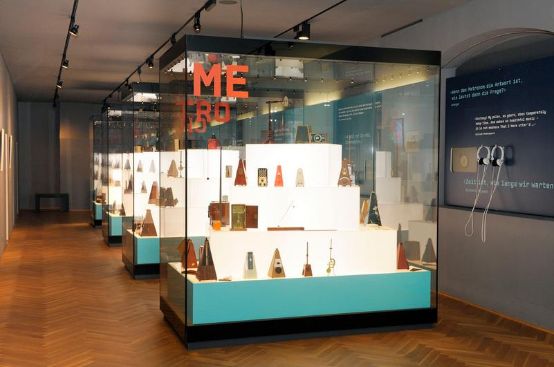
It is hard to imagine musical life today without concerts in historical performance practice. Original instruments play a central role in this, as they are in demand for concerts or for playing attempts at replicas. At the same time, they should be conserved and preserved as witnesses for posterity.
CIMCIM, the International Committee for Museums and Collections of Musical Instruments and as such part of the global umbrella organization of museums ICOM, brings together practitioners, institutions and researchers. Basel and Bern will host its annual congress in 2017: From February 22 to 25, museum directors, conservators, musicians and instrument experts will meet at the Museum of Music, the Schola Cantorum Basiliensis and the Bern University of the Arts.
Under the title "Presentation, Preservation, Interpretation - The Challenges of Musical Instrument Collections in the 21st Century", two challenges in the field of historical instruments will be addressed: How do we collect, preserve and present 20th and 21st century instruments? And how do we preserve historical wind instruments that continue to be played or are played again in concerts?
One focus is the presentation of the results of a Swiss research project on corrosion inside historical brass instruments and its reduction. The Bern University of the Arts, ETH Zurich, the Swiss National Museum and the Paul Scherrer Institute are involved in the project.
The program also includes concerts on historical and experimental instruments, such as excerpts from Stravinsky's Sacre du printemps with a set of historical brass instruments. Visits to collections and exhibitions in Basel, Bern, Bad Krozingen and Bad Säckingen round off the conference, which is supported by the Swiss National Science Foundation.
More info: www.hkb-interpretation.ch/cimcim
Graubünden cultural funding to be revised
The Commission for Education and Culture of the Canton of Graubünden has discussed the total revision of the Culture Promotion Act. Among other things, the contributions to music schools are controversial. The canton has also launched a new portal for audiovisual documents.

According to a statement from the canton, the Grand Council's Commission for Education and Culture has dealt with the government's message on the total revision of the law on the promotion of culture. The committee unanimously approved the bill and passed the draft law - with numerous amendments - for the attention of the Grand Council.
Numerous majority and minority motions were received on the draft bill. In particular, "the increase in cantonal funding for culture by means of a framework credit, the contributions to music schools, the way in which the cultural promotion concept is dealt with, the allocation of tasks to the municipalities or regions, the position of the cultural commission at legislative level and social security for cultural workers" were disputed.
The improvement in the financial situation of museums and regional cultural institutions and the planning security that this would provide remained undisputed by the majority. In addition, other motions were put forward by members of the Commission with the aim of improving the position of culture and cultural professionals in individual areas.
The Office of Culture also makes more than 25,000 electronic data records on collection objects available online: In the cantonal library, 6,500 films, videos and audio documents and over 360,000 catalog entries have been digitized. The data now allows comprehensive information and communication about important cultural assets.
Digital media portal: av-medienportal.gr.ch
Otto Tausk appointed to Vancouver
The Vancouver Symphony Orchestra has appointed Otto Tausk, who is also Principal Conductor of the St.Gallen Symphony Orchestra and Theater St.Gallen, as its new Music Director. He will initially be with the orchestra for four years from the 2018/19 season.

Tausk succeeds Bramwell Tovey in this position. He will also serve as Artistic Advisor to the Vancouver Symphony School of Music and the Vancouver Symphony Orchestral Institute at Whistler.
Tausk studied violin and conducting in the Netherlands and Lithuania. The Dutchman has been chief conductor of the St.Gallen Symphony Orchestra and Theater since the 2012/2013 season. From 2004 to 2006, he was assistant to Valery Gergiev at the Rotterdam Philharmonic Orchestra. Otto Tausk made his debut with the Los Angeles Philharmonic Orchestra in 2011 and with the Concertgebouw Orchestra in 2012.
Founded in 1919, the Vancouver Symphony Orchestra is the third largest orchestra in Canada, with an annual operating budget of 11.2 million Canadian dollars.
A new look at church music
With a portal on "Church Music - Music in Religions", the German Music Information Center (MIZ) is presenting a service that provides information on the situation of church music life in Germany.

The new MIZ information portal sheds light on the importance of music in religious life in all its different facets - from music in church services and the organ as its central instrument, amateur church music-making and sacred music in concerts, to the training and professional practice of church musicians and music in the Orthodox churches, Judaism and Islam.
In addition to specialist articles and statistics, the MIZ also provides topographical representations, for example on amateur church music-making, training facilities or organ building. A compilation of basic information on the work content and fields of activity of institutions and facilities - including associations, research facilities and archives, but also competitions, prizes, festivals with a focus on church music as well as further education and training measures - provides a comprehensive overview of infrastructural aspects of church music.
The portal is supplemented by information on studies, position papers, statements and cultural policy documents as well as literature recommendations, further sources on the Internet and daily news.
The new MIZ information portal can be accessed at http://themen.miz.org/kirchenmusik.
C'est le vent qui fait la musique
A new museum was opened in Bern at the end of January, and a visit is highly recommended for all music lovers: the "Sounding Collection", almost exclusively wind instruments from three centuries, is not only a visual pleasure, but also an acoustic one.

The new museum, which is officially Sounding collection / Center for historical musical instruments has a long history. Karl Burri (1921-2003) from Bern had been running a business selling and repairing wind instruments since 1945. From 1964, he began systematically collecting wind instruments, which he received from customers, bought from manufacturers or found at flea markets. His passion for interesting specimens of all kinds and his knowledge as a wind instrument maker led to an exceptional collection in terms of quantity and quality, which was exhibited in its own museum in Zimmerwald near Bern from 1970. Towards the end of the 20th century, it comprised well over 1000 exhibits, some of them of outstanding importance for the history of instrument making. The 19th century instruments from Switzerland, Germany and France are particularly well documented. However, Burri's collection differed fundamentally from the large collections of instruments in the museums of the European capitals. Most museums keep their treasures well renovated behind glass at constant temperatures, thus preserving them "for eternity", but at the same time removing them from practical musical life. Karl Burri, on the other hand, was always keen to demonstrate his instruments to interested amateurs and experts, or to have them played by musicians. He was even prepared to lend out playable historical instruments for months or even years, a thought that would normally make the hairs on the back of a museum curator's neck stand on end.
Foundation as a lifeline
After Karl Burri's death, his children, now also working in their father's business, initially continued to run the museum in Zimmerwald. In 2008, the instruments were transferred to Bern and stored and exhibited in the basement of the store. However, various factors meant that the continued existence of the collection seemed to be seriously in doubt. There were already more or less concrete purchase offers from abroad, while no Swiss institution was able or willing to raise the funds to take over the collection and display it. However, Karl Burri had been keen to preserve the instrument collection as a whole. In an interview with Claude Delley in 1999, he stated that no rarities should be sold in order not to diminish the value of the collection.
This is where Guy Jaquet comes into play, a renowned doctor and at the same time a "passionate" music lover, both as a concert and opera-goer and as an amateur clarinettist. A visit to Burri's music store drew his attention to the huge collection of instruments and their precarious future rather by chance. From then on, Jaquet saw it as his mission to preserve the collection for Bern and to find a place where it could once again be accessible to the public.
The Burri Instrument Collection Foundation was established in 2014 with the aim of "to save the collection and preserve it as an important cultural asset in Bern". Adrian von Steiger had already done significant preliminary work with his dissertation published in 2013 The Burri instrument collection. Background and challenges which documents the collection and its history, places it in a larger context and deals in detail with the problems of a collection that could serve both practice and research.
Guy Jaquet, Chairman of the Foundation Board, succeeded in finding a main sponsor and other donors who provided the financial means for the acquisition of the collection, its conservation and museum presentation. Adrian von Steiger, a trumpeter and musicologist, is in charge of the collection.
Exhibition on two floors
The location of the new museum, just a few steps from the Zytglogge tower, one of the main sights of the federal city, is an advantage that should not be underestimated. Where until recently furs were cooled, older and newer wind instruments can now be seen on two floors in the basement. The upper floor offers an informative, beautifully designed exhibition entitled C'est le vent qui fait la musique The collection's focal points and some particularly impressive or noteworthy instruments are presented. Among the topics presented are the instruments of Berlioz' Symphonie fantastiquethe instruments and music books of the "Turkish music" from Hundwil in Appenzell, the history of the saxophone, the Hirsbrunner family of wind instrument makers from Sumiswald and Aarau and cyclists' music. Scenographer Martin Birrer was responsible for setting up the museum room, which also contains two "muffled" rondels with curtains in which visitors can blow on specially designed instruments. If you like, you can find out about the instruments on an iPad and watch numerous original films.
-

Bicycle music. Photo: Sounding collection
The lower floor, which can only be visited with a guided tour, houses the rest of the collection. Hundreds of woodwind and brass instruments can be seen in display cases, on shelves or on stands. Those who know their way around or are made aware of them will discover numerous rarities and curiosities: a musette de cour, an oboe by Van Aardenberg from Amsterdam, natural horns by Haas and Haltenhof, keyed trumpets by Schuster and Beyde, a slide trumpet by Courtois, transverse flutes by Grenser and Walch, a Rothfono basso, a Sudrofon or the prototype of an alto saxophone by Sax, to name but a few.
Playback desired
What makes the unmistakable character of Burri's collection and, fortunately, the Sounding collection is the fact that instruments in a good state of preservation can be played by specialists and, in the case of justified requests, can also be borrowed. A list of instruments that can be played on site or borrowed can be found on the museum's homepage (www.klingende-sammlung.ch).
The Sounding collection is located at Kramgasse 66 in Bern (basement) and is open Wednesday to Saturday from 11 am to 5 pm. Guided tours of the collection and workshops on selected themes can now be booked for groups, music societies and school classes (details at www.klingende-sammlung.ch).
The Sounding collectionwhose operating costs are only covered for the next few years, needs further funding to establish the museum in the long term. There are various ways to support the collection: becoming a member of the Friends of the Klingende Sammlung association, sponsoring an instrument to enable it to be cleaned or restored or joining the exclusive Club des Mélomaneswho is the Sounding collection with large annual contributions. Volunteers are also needed to look after the exhibition during opening hours (reception, cash desk, supervision) and can contact the head of the collection, Adrian von Steiger (kontakt@klingende-sammlung.chTel. 031 311 01 37).
-

Brass instruments. Photo: S. v. Allmen/Klingende Sammlung
Risi succeeds Sidler in Obwalden
The Government Council of the Canton of Obwalden has appointed Marius Risi as the new Head of the Office for Culture and Sport with effect from May 1, 2017. He succeeds Christian Sidler.

As of May 1, 2017, the Canton of Obwalden's Office for Culture and Sport will have a new head in Marius Risi. The cantonal government has appointed him as the successor to Christian Sidler, who has resigned from his position as the canton's cultural officer after 17 years and is taking on a new challenge.
The new head of the Office for Culture and Sport is a folklorist and completed his studies with a dissertation on cultural change in Upper Valais. Marius Risi has been working at the Institute for Cultural Research Graubünden in Chur since 2006. In 2009, he took over the management of this humanities research institution. Marius Risi is very familiar with cultural life in Obwalden and Central Switzerland, having managed and worked on various cultural projects.
44-year-old Marius Risi lives with his family in Engelberg.
At the end of time
On "beyond time", the Zurich Ensemble takes on Messiean's "Quatour pour la fin du temps", but begins with contemporary compositions by Fabian Müller and Volker David Kirchner.
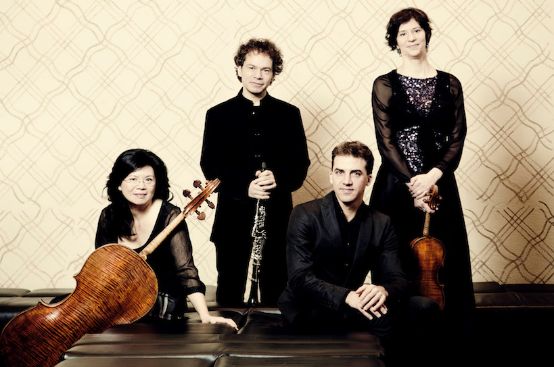
Do difficult circumstances increase the hunger for artistic expression? In a prisoner-of-war camp near Görlitz in 1941, hundreds of inmates listened spellbound to a quartet formed by fellow prisoners. One of them was Olivier Messiaen. The premiere of the piece from his pen, the Quatour pour la fin du temps, is today regarded as one of the most influential chamber music works of the 20th century.
Fabio Di Càsola (clarinet), Kamilla Schatz (violin), Pi-Chin Chien (cello) and Benjamin Engeli (piano) were inspired by this world premiere under extreme conditions and recorded this unprecedented composition on their second CD. The result can lay claim to being a benchmark. The Zurich Quartet's clearly defined approach makes it possible to experience Messiaen's world of ideas up close, sometimes oppressively direct: a maximum of exciting colors is drawn from the excessive use of modal scales and cluster-like harmonies. There are also occasional flashes of the characteristic instrumental rhetoric that Messiaen borrowed from birdsong. Elements from the world's musical cultures are cleverly harnessed for his own cause - just think of the many modal scales played in unison, as we know them from Indian music and as many jazz musicians have been using them since the 1960s.
It seems so weightless and self-evident how these players insistently trace every nuance, no matter how delicately ramified - whether finely chiseled harmonic glissandi in the highest registers or wide melodic lines in the cello or clarinet. And the way in which many an "infinite" melody unfolds its own breath in the long solo parts through accurately dosed vibrato is magnificent. The Quartet from the End of Time reflects states of strong ambivalence. This is the intention of the score, and so the playing, in addition to extensive meditative lines, also features regularly recurring bursts of oppressive energy.
This weighty program item is "preceded" by two contemporary compositions on this CD. Fabian Müller's composition explores the thoroughly humorous border areas between spoken word, song and instrumental music In the beginning - Three attempts to invent the world out. It is reminiscent of an expressionist melodrama in the style of Schönberg, as the soprano Christiane Boesinger attempts to "reinvent the world" in these texts.
Volker David Kirchner's play Exile in turn evokes states of mind similar to those of the Quartet for the end of time are not dissimilar, even if the elegiac, subdued diction of Kirchner's composition from 1995 seems incomparably more fragile.
zurich ensemble (Fabio die Casola, clarinet; Kamilla Schatz, violin; P-Chin Chien, violoncello; Benjamin Engeli, piano; Christiane Boesiger, soprano): beyond time (works by Fabian Müller, Volker David Kirchner, Olivier Messiaen). Ars Production 2016
Twenty years of New Music Theater
The Neukölln Opera pays tribute to 400 years of music theater in Europe with the announcement of the twentieth Berlin Opera Prize. It is calling on composers up to the age of 35 to enter the competition. The motto: Take it or leave it!

Entrants are invited to produce a half-hour piece of musical theater under the motto "Take it or Leave it" - at the expense of the award sponsors and with premiere performances in Berlin. Concepts should be submitted that claim to be the legacy of European musical theater. This explicitly means "all genres of
musical theater between Monteverdi and the Beatles, Zappa
or clever musicals, i.e. also the pop culture field". The closing date for entries is May 1, 2017.
The Berlin Opera Prize, which has been awarded since 1997, is a unique realization competition for music theatre makers in the German-speaking world. It sets an example for competitions that have been launched at other opera houses.
The jury is made up of: Thomas Desi (Festival Director Musiktheatertage Wien), Arash Safaian (composer), Mária Szilágy (Festival Director, Budapest), Wiebke Roloff (Opernwelt), Andreas Altenhof (Directorate Neuköllner Oper, Berlin) and Bernhard Glocksin Artistic Director Neuköllner Oper, Berlin).
Slight losses at the Tonhalle-Gesellschaft
With a slightly expanded program, the Tonhalle-Gesellschaft Zürich increased its visitor numbers in the 2015/16 season to 109,731 admissions.

According to a press release, the Tonhalle Society Zurich staged 140 concerts with 103 different programs in the 2015/16 season, 94 of which took place in the Great Hall, 41 in the Small Hall of the Tonhalle Zurich and five external concerts. The Tonhalle Orchestra Zurich gave an additional nine concerts on its eleven-day European tour under the direction of chief conductor and musical director Lionel Bringuier.
The loss of CHF 44,930 is below budget. This is due to the Tonhalle-Gesellschaft Zürich's own contributions to the renovation of the Tonhalle and investments in the interim venue Tonhalle Maag. With a slightly expanded program, the Tonhalle-Gesellschaft Zürich increased admissions to 109,731.
At CHF 501,000, the additional income from concerts and events developed positively due to longer tours and more guest performances. Income from the 55 subscription concerts in the Great Hall of the Tonhalle Zurich also increased by CHF 210,000 compared to the previous year. Following the clearly positive voting results for the conversion of the Kongresshaus and the renovation of the Tonhalle, the Tonhalle-Gesellschaft Zürich shows pre-investments of CHF 3.56 million in its balance sheet for the construction of the interim venue Tonhalle Maag.
These extensive investments and preparations were mainly made by the Tonhalle-Gesellschaft Zürich itself, not least thanks to donations from third parties. This will also benefit other concert organizers who have been offering concerts in the Tonhalle Zürich and will do so in the Tonhalle Maag in the future. The Tonhalle-Gesellschaft Zürich will operate the Tonhalle Maag itself for three seasons.
Trump's verdict shakes up America's concert life
Trump's draconian entry ban on citizens of several Islamic states has also turned numerous musician trips upside down. The Beijing Chinese Orchestra, for example, has been refused visas at short notice, and Syrian clarinettist Kinan Azmeh, who is currently performing in Lebanon, fears that he will no longer be able to return to the USA.

The Beijing Chinese Orchestra was due to perform in Seattle this month. However, 22 members of the orchestra were denied visas. According to a congressman from Washington state, immigration authorities took the view that their visa applications were not in line with the purpose of their trip. The Syrian clarinettist Kinan Azmeh, who lives in the USA, is currently performing in Lebanon with the cellist Yo-Yo Ma. He feared that he would no longer be able to enter the USA.
The Armenian-Austrian pianist Nareh Arghamanyan, winner of the Montreal competition, has reportedly canceled a tour of the USA and Canada due to visa problems. The young Kazakh violinist Aisha Orazbayeva, who lives in London, has also canceled concerts in the USA. She would feel bad knowing that she is allowed to enter the USA, but Syrian citizens are not. She doesn't see any difference, she writes in a statement. However, she is merely providing entertainment, whereas those who are excluded need help.
New lecturers at the Lucerne School of Music
The Lucerne School of Music has announced five new additions to its teaching staff. These are the jazz guitarists Kalle Kalima and Jesse Van Ruller, the singer Judith Schmid, the tuba player Roland Szentpali and the bassoonist Michael von Schönermark.

The Institute for Jazz and Folk Music at the Lucerne School of Music is losing a long-standing, charismatic jazz guitar lecturer due to the retirement of Christy Doran. Two worthy successors have been found in Kalle Kalima and Jesse Van Ruller. Kalle Kalima will be teaching jazz guitar as a main subject lecturer at Lucerne University of Applied Sciences and Arts from the fall semester 2017/18. The Finn, born in 1973, whose music combines elements of jazz and rock, is one of the most interesting representatives of the European jazz scene.
Jesse Van Ruller (born 1972) will also start as a lecturer in jazz guitar at Lucerne University of Applied Sciences and Arts in fall 2017. The Dutch jazz guitarist and composer completed his studies at the conservatory in Hilversum and was the first European to win the Thelonious Monk Competition in Washington, D.C.
The Lucerne School of Music's Department of Classical and Sacred Music welcomes the following new lecturers: The mezzo-soprano Judith Schmid is a long-standing member of the Zurich Opera House ensemble, and the Hungarian Roland Szentpali is one of the most sought-after tuba soloists in the world. Szentpali has won seven international tuba and brass competitions and prizes in other competitions.
Michael von Schönermark became solo bassoonist with the Konzerthausorchester Berlin at the age of 22. He was awarded the special prize of the Theodor Rogler Foundation at the ARD International Music Competition in Munich and is the winner of the Schleswig-Holstein Music Festival Sponsorship Award.
Swissjazzorama on the way to becoming a foundation
The Swissjazzorama association wants to raise a well-endowed endowment capital in order to transfer its archive of Swiss jazz history into a foundation. The aim is also to raise funds from the federal government.

This spring, the Swissjazzorama archives, including copyright and internet rights, are to be transferred from the current association to a foundation. This change is necessary "because the federal government only wants to consider supra-regionally or nationally active applicants with an established organizational structure when allocating its funds". In order to meet this requirement, the Swissjazzorama association - which will continue to exist as a support association - has set itself the goal of amassing a well-endowed foundation capital.
In early summer 2016, Swissjazzorama was able to concentrate its holdings, which had previously been spread across seven locations, at Ackerstrasse 45 in Uster. Hans Peter Künzle, the long-standing head of the Jazz and Pop department at Zurich University of the Arts, has been in charge of the archive since September 2016. In order to arouse the interest of the younger generation and students in particular, the digitization of the holdings is to be stepped up.
The Jazz Archive was founded in 1989 in Rheinfelden from a private collection and was transferred to Uster nine years later. It collects, catalogs and archives audio and video media, specialist literature and other evidence from the world of jazz. The collection now consists of over 60,000 sound recordings, around 1,000 audio-visual media, 70,000 musicians' records, 4,900 sheet music scores, almost 3,000 posters and around 3,000 books, and is constantly being funded by private donations.
Piano became saxophone
Two jazz musicians with different styles present new albums: While Nicole Johänntgen pays homage to stripped-down grooves from New Orleans on "Henry", the Sarah Chaksad Orchestra is drawn to lush sounds and exploring contrasts with "Windmond".

Nicole Johänntgen, who grew up in Fischbach in Saarland, comes from a strong musical background: her father, an all-round musician and sometimes on the road playing Dixieland jazz, loved to wake the family up with his trombone. As a child, Nicole Johänntgen first tried her hand at the piano, but tired of practicing, she turned to the saxophone at the age of thirteen. It was love at first try. The teenager was particularly taken with the free and groove-oriented playing possibilities. She began to emulate funk saxophonists such as Maceo Parker and Candy Dulfer, later studied at the State University of Music in Mannheim and moved to Zurich in 2005. Six years earlier, she had already recorded her first album - together with her brother Stefan - under the band name Nicole Jo. Since then, Johänntgen has released numerous other albums, including a collaboration with jazz musicians such as Ellen Pettersson and Izabella Effenberg under the title Sisters in Jazz.
For her latest project, Johänntgen traveled to New Orleans, where she recorded seven pieces in the studio that she had composed during a six-month stay in New York. She tracked down her fellow musicians, all from New Orleans, through mutual acquaintances. The result of this collaboration is Henrya tribute to the 35-year-old's family. Tuba, trombone, drums and saxophone take up the traditions of the music city on the Mississippi, but do not insist on them and show a great desire to improvise. The recordings are said to have been completed in just five hours. And coincidence or not: the tracks sound spontaneous, unadorned and have a fine groove. Nola - as the inhabitants of New Orleans call their city - comes up with a relaxed conversation between trombone and saxophone that is sometimes teasing, sometimes heated. The following Slowly on the other hand, initially emerges as contemplative and emphatically slow-moving, only to soon seek new beginnings - and find fulfillment in intense expressivity. A work that not only convinces with its musicality and its mix of shimmering, rumbling and even gurgling moments, but also knows how to charm.

-
Nicole Johänntgen: Henry. www.nicolejohaenntgen.com

Sarah Chaksad and her orchestra. Photo: Fabian von Unwerth Like Johänntgen, Sarah Chaksad (*1983) also found her way to music. She also began with the piano and then switched to the saxophone at the age of nine. She also discovered her passion for composing while studying music at secondary school in Wohlen. After studying at the Bern University of Teacher Education, she enrolled at the Basel University of Music. "During my saxophone studies, I began to focus intensively on arranging and composing," the artist writes on her website. This explains why she studied big band arranging with Lars Lindvall and composition with Guillermo Klein. In 2012, she founded the 15-piece Sarah Chaksad Orchestra, which is based on the tradition of big bands but focuses on contemporary sounds and stands for rich dynamics and individual expression. The CD cover with a painted night sky and song titles such as Waterfall or the title track Wind moon suggest something esoteric, but nothing of the sort. The first piece, Halobegins symphonic and sublime, but quickly changes its colors and soon tends towards Latin rhythms and knows how to come up with scat interjections by Julien Fahrer.
Band leader Sarah Chaksad, who also heads the pop-soul formation Neighborship, prefers a dense sound in which the wind instruments, from saxophone to flugelhorn, take the lead. While Today We Got A New Angel is dark and pensive, behaves Look Back And Laugh moody and playful. The Sarah Chaksad Orchestra succeeds in creating contrasts time and again and never loses sight of the nuances. It swings, it's balladic, it bangs - and is consistently captivating.

Sarah Chaksad Orchestra: Windmond. Neuklang Records NCD4158. www.sarahchaksad.com
The opera as an institution
In his 400-page tome, Michael Walter provides insights into the opera business from the 17th century to the present day. He follows the trail of money.
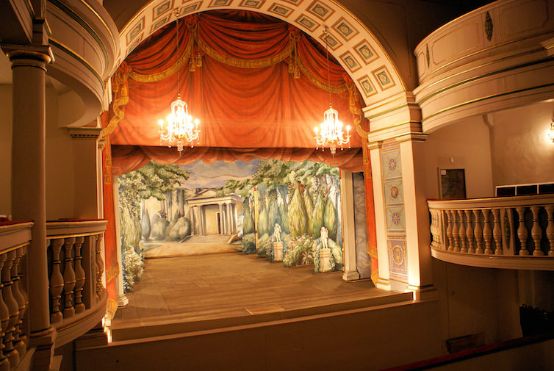
The word institution is not only difficult to pronounce, it is also not easy to define. Michael Walter interprets institution as more than just a place where operas can be experienced. He also examines things that are not usually the focus of attention: for example, the situation of singers from the 17th to the 21st century, the historical and contemporary composition of the audience, the impresario or subsidy system or the role that opera plays in the competition between cities.
Such a broad view is both a blessing and a curse. Walter takes a down-to-earth and sober view of things. The insights into sample conditions in the 18th century are particularly exciting and sometimes funny to read. "Time is money" was already the motto back then. If a more demanding opera required too much preparation, it could quickly happen that a comic opera was performed instead of an opera seria. The advantages of this: Streamlining the rehearsal schedule and, on top of that, a fuller house for longer. According to Walter, money is often a conclusive explanation for institutional issues. Opera divas and heroic tenors were already driving up ticket prices in the 18th and 19th centuries. Walter has meticulously researched fees and can provide concrete figures. At major opera houses such as the Vienna or Berlin Court Opera, the Teatro San Giovanni Grisostomo in Venice or the Royal Academy of Music in London, castrati and top singers sometimes earned 2000-7000 Reichstaler - a formidable sum by the standards of the time. Today, both opera houses and singers have little interest in transparency for fear of (justified) public criticism. Nevertheless, Walter quotes the star tenor Roberto Alagna, who once spoke of a sum of 13,000 euros per performance. That is certainly not a small sum. But nowhere near as much as the 500,000 euros that Luciano Pavarotti demanded and received for heroic performances in football stadiums. (Fortunately, Walter dispels the prejudice that the best performance is worth the highest salary).
The curse of the wide view: Opera - the history of an institution is not a pleasure to read. In an obvious effort to achieve chronological and local completeness, the author jumps from one aspect to the next in a very piecemeal fashion. Walter prefaces his chapters with the headings "Singers", "Legal issues" or "Opera audiences". As a result, he is forced to change topics frequently right from the start, whereby it remains questionable whether American opera conditions can be compared with Russian or European ones at all. Not to mention the conditions at a small German municipal theater and those of a large specialized house such as the New York Metropolitan Opera.
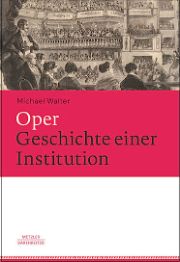
Michael Walter: Opera - History of an Institution, 26 illustrations, 470 p., € 49.95, Bärenreiter/Metzler, Kassel/Stuttgart 2016, ISBN 978-3-476-02563-0