Ute Stoecklin's biography of Schütter was published in 2010. A revised version in English has now been published in England. We are taking this as an opportunity to make Torsten Möller's review from March 2011 publicly available here.
Torsten Möller
(translation: AI)
- 19 Dec 2024
Photo: Meinrad-Schütter-Gesellschaft
"What a piece of work! And who knows anything about it? I think it's something very special. And how different it is from the hustle and bustle that prevails today." In his letter to his colleague and contemporary Meinrad Schütter (1910-2006), Robert Suter captured the essentials in just a few words: On the one hand, his enthusiasm for the rich and unusual oeuvre of a composer who wrote many piano songs, numerous opulent orchestral works, a grand opera called Medea and in the form of a Large trade fair even turned to church music, which had become precarious in the 20th century. On the other hand, Suter's words also mention Schütter as an outsider. Ever since Carl Vogler, with almost unbearable arrogance, refused the young composer admission to the Tonkünstlerverein, Schütter had never really been able to gain a foothold in Swiss musical life. Was it because of his peculiar temperament, the latent unwieldiness of his works or conservative guardians of the Grail such as President Vogler?
This book, written by Ute Stoecklin, Meinrad Schütter's companion of many years, provides answers. Rich in biographical facts, equipped with numerous original documents and photographs, not least with many observations of his work and an impressive catalog raisonné, it succeeds in portraying Schütter from various angles. Perhaps the space Stoecklin gave to many contemporary witnesses, including redundant hymns of praise, could have been better used for differentiated work analyses, perhaps an author with a sober and distanced external perspective would have done the book good - Stoecklin's merit remains untouched by such criticism: Her 230-page, thoroughly edited biography provides the basis for a more in-depth study of a composer who - as an accompanying CD of mainly chamber music proves - has been unjustly neglected.
The new catalog raisonné in the revised edition is by Chris Walton.
"Culture and digitization" - the results
At the suggestion of the Swiss Music Council, the TA-SWISS Foundation commissioned three sub-studies on the topic of "Culture and digitalization". Some of the results were surprising.
Stefano Kunz
(translation: AI)
- Nov 27, 2024
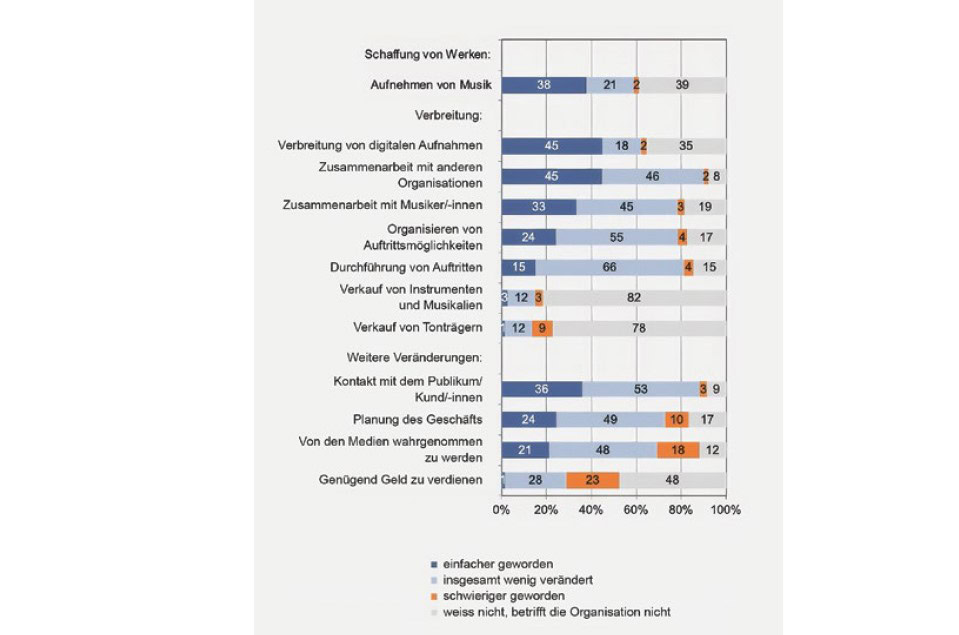
Perceived changes as a result of digitalization, organizations (shares in percent). Number of cases between 201 and 224, depending on the question: TA-SWISS Foundation
Changes in the cultural sector due to digitalization have been on the Swiss Music Council's mind for some time. However, the pandemic drastically demonstrated how quickly entire sectors of the economy can be threatened - and how quickly digitalization can create a replacement, at least in some areas. The question of the opportunities and risks offered by digital developments suddenly became very topical.
Against this backdrop, the TA-SWISS foundation, which investigates the opportunities and risks of new technologies on behalf of the federal government, issued a call for tenders in December 2021 for a study on the topic of "Culture and digitalization". The first section of this call for proposals outlines the topic: "The interdisciplinary study aims to assess the opportunities and risks of the effects of digitalization on culture and our social development. It will attempt to answer technical, legal, social, political, economic, ecological and ethical questions. Due to this diversity, it may also consist of several sub-projects."
Three sub-studies - Digitization in music as an important topic
The Lucerne University of Applied Sciences and Arts HSLU, the Swiss Music Council SMR and the Dezentrum Zürich were awarded the contract. While HSLU dealt with the social, economic, political and legal effects of digitization on various cultural areas, the other two studies focused on art (Dezentrum) and music (Swiss Music Council SMR). The studies are available both in book form and online.[1] The studies should be particularly valuable for professional associations, as they provide information on the extent to which digitization should be a topic in association activities.
The SMR study on the music sector focused on the following questions:
- How do those affected assess digitalization in general? Does the perception of risks predominate or are the opportunities rather emphasized?
- Which digital technologies are used and how are they assessed?
- What effects does digitalization have on various aspects of music creation? For example, what about the organization and staging of concerts, the recording and marketing of music or the opportunities to purchase music?
- What future developments are expected? Here, for example, questions are asked about the development of live performances, music lessons or the diversity of music creation.
- Do those affected see a need for political action - and if so, what kind?
In order to answer these questions, an online survey was conducted to gather the opinions of organizations active in the Swiss music sector as well as music professionals (professional and amateur musicians, teachers, employees of organizations active in the music sector).
Optimism and confidence prevail
The surveys yielded some surprising findings. The fact that only just over 6 percent of music professionals and less than 2 percent of organizations in the music sector see digitalization as predominantly a risk could not have been expected in light of the experiences during the pandemic. Overall, the organizations prove to be slightly more optimistic about digitization than the music creators, among whom the amateurs emphasize the opportunities slightly more often than the professional music creators.
With regard to the use of digital technologies, it is clear that they are widely used by both music professionals and organizations and that there is a remarkable openness to new developments in the future. Against this background, it is not surprising that the respondents perceive digital technologies as making musical life easier rather than more difficult. Figure 2 below shows this finding based on the responses of the organizations.
In many of the aspects surveyed, the organizations have hardly changed, but especially when it comes to recording music, distributing digital recordings and collaborating with other organizations, the proportion of those who note simplifications is considerable. Only in terms of media perception and earning opportunities did around a fifth of the organizations face greater difficulties. The fact that almost half of the organizations did not comment on "earning money" is due to the fact that many clubs and associations took part in the survey for which this objective is not a high priority.
The study focused not only on current developments, but also on future prospects. When music creators and organizations active in the music sector were asked how they assess the future of various parts of the music sector, their overall assessment was rather optimistic. In the perception of a majority of respondents, digitalization will lead to a more diverse music world in which live music will continue to play an important role. However, pessimistic attitudes prevail with regard to the future of music clubs and instrumental lessons, and a significant proportion of music professionals and organizations fear that musical life could become harder in the future.
From the Music Council's perspective, the question of the desirability of political intervention in the context of music and digitalization was important, as exerting influence in Bern is one of the SMR's core tasks. Here, too, the answer was different than expected. The chart below shows that most music professionals and organizations do not see any immediate need for intervention:
However, both the detailed analysis and the many individual comments showed that this finding needs to be differentiated and should not be taken to mean that there is no need for action. This is because digitalization exacerbates existing problem areas both within the value chain (creation, distribution, reception) and in the areas of amateur and professional music creation, music education and the music industry.
Recommendations for action based on the overall study
One of the tasks of the TA-SWISS Foundation is to formulate recommendations for policymakers based on the results of studies. With regard to digitalization in the cultural and music sector, these include
- The cultural sector, together with the public sector and society, must take a proactive approach to digitalization in order to be prepared for further developments. Institutions and associations have an important role to play here.
- Digitization should be placed on the agenda of the National Cultural Dialogue as a multi-year priority.
- The "Fair income conditions in the digital environment" measures provided for in the 2025 - 2028 Culture Dispatch should be implemented quickly.
- Taking a proactive approach to digitalization also means establishing it as an integral part of education and training. The associations can also play an important role here.
- Copyright is a perennial issue, but rapid developments such as in artificial intelligence are giving rise to completely new questions. The legal framework should therefore be constantly reviewed and adapted.
- Amateur clubs, especially in music and culture, form the humus on which musical/cultural life can flourish. They should therefore continue to receive targeted support at all levels of government. In addition, constant monitoring is needed in order to closely observe the development of this important form of social coexistence.
- Music education is already under pressure today due to social developments. Digitalization is intensifying this pressure, which is why music professionals see difficult times ahead for music education. To counteract this, teachers must be enabled to master digital tools and use them in a targeted manner.
Former Federal Councillor Moritz Leuenberger, who chaired the group accompanying the three studies, commented on the subject as follows[2]:
"Digitalization is shaping the way we think and feel. It has become an indispensable servant of our culture, but at the same time has long since taken up the baton. To prevent it from becoming the sole conductor, we are required to sound out its opportunities and dangers and set the pace ourselves."
A special feature of this study is that the central content can be experienced interactively on a platform, with one interactive room per sub-study: https://www.proofofculture.ch/
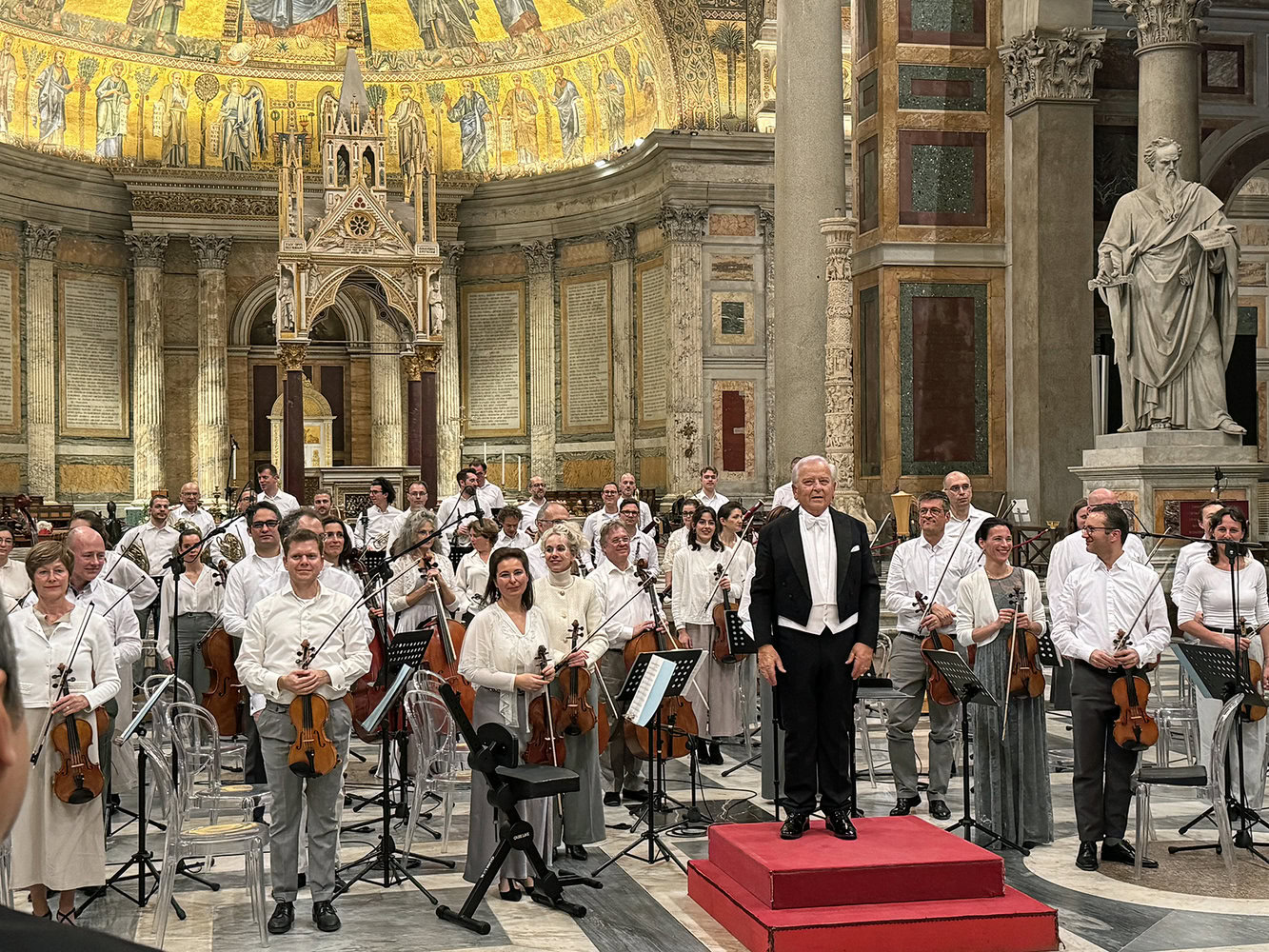
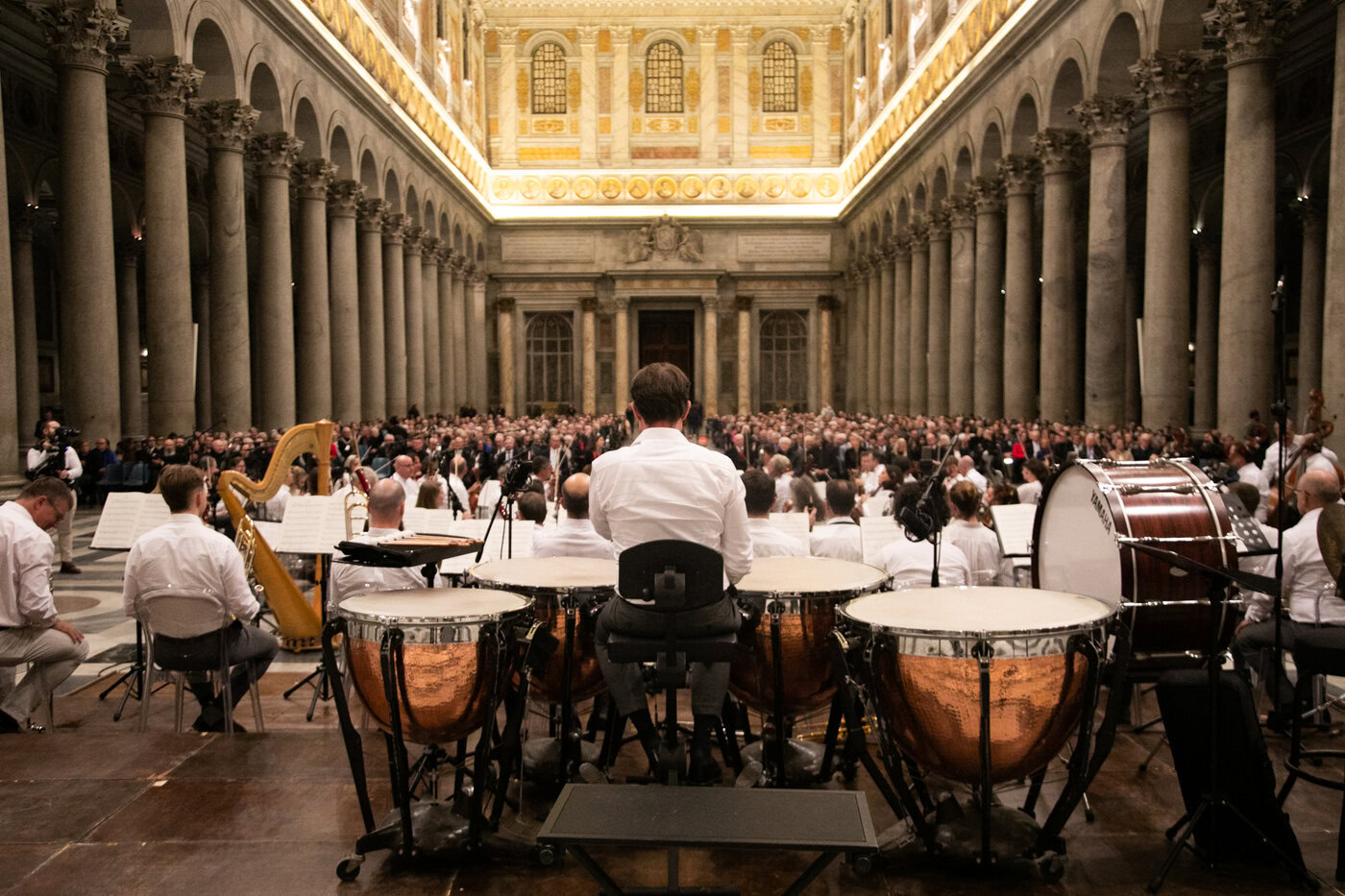
The only suboptimal thing was the acoustics in the huge Basilica of San Paolo fuori le mura in Rome. With more than five seconds of reverberation, even Bruckner, who composed his symphonies with organ practice in mind, had to capitulate in places. Otherwise, the first foreign guest performance by this new orchestra, known as the Swiss National Orchestra, or SNO for short, was a complete success. The concert took place as part of the Vatican-sponsored international festival Musica e Arte Sacra took place. With a certain amount of protocol: according to the organizers, around 2,000 visitors included political celebrities from Italy and Switzerland, including the Swiss ambassadors to Italy and the Vatican.
There's no shortage of symphony orchestras of all kinds, so why found a new one, I thought before my trip to Rome. However, the quiet scepticism with which I looked forward to the performance of the orchestra, which I had previously only heard in ominous press releases, evaporated with the first notes of Puccini's Symphonic Prelude, the second composer with a memorial year of 2024 after Bruckner. A beautifully rounded wind choir, followed by a gently blossoming string tutti - a perfect beginning that immediately captivated and made a basic characteristic of the orchestra clear: the organic interaction of the orchestral groups, carried by a common breath. The delicate opening, intoned with somnambulistic certainty, made us want to hear the orchestra play Wagner's Lohengrin-prelude or with Debussy.
Pleasurably professional
The striking presence of this opening could be heard in the five rehearsals in Basel that preceded the trip to Rome, a credit to the conductor and former Zurich opera director Ralf Weikert. His thorough rehearsals proved particularly effective with Anton Bruckner's Third Symphony, which was performed in its final version from 1889. The orchestra brilliantly fought the latent battle against the over-acoustics, which unfortunately blurred the abrupt dynamic contrasts and repeatedly obscured the structure in the massive tutti - especially in the third movement. As far as could be heard, the precision of the interplay never faltered. In the slow movement, the winds impressed with their finely coordinated playing, the long, composed reverberation of the horns sounded magical; the effect here was exceptionally supported by the acoustics. The fourth movement: a clear-cut presentation of the contrasting musical characters, pure high energy and a striking conclusion to the symphonic events.
The concert in Rome was an artistic success. The reasons for this lie not only in the disciplined preparation, but also in the professionalism and, not least, in the joy of playing and the shared desire of all participants. The fact that they are a motley crew is not noticeable in their performance. The chemistry is right, and anyone who talks to the musicians will get an impression of the high spirits, if not euphoria, that prevails among them. Rahel Cunz, concertmaster of the Musikkollegium Winterthur, sums it up: "This is the first time I've played together with most of them, and I find that absolutely fascinating. They are all here voluntarily and are really enjoying it. I hope you can feel that in the audience too. We take incredible pleasure in interacting with each other. This creates a unique dynamic, and we make our beautiful music with this positive energy."
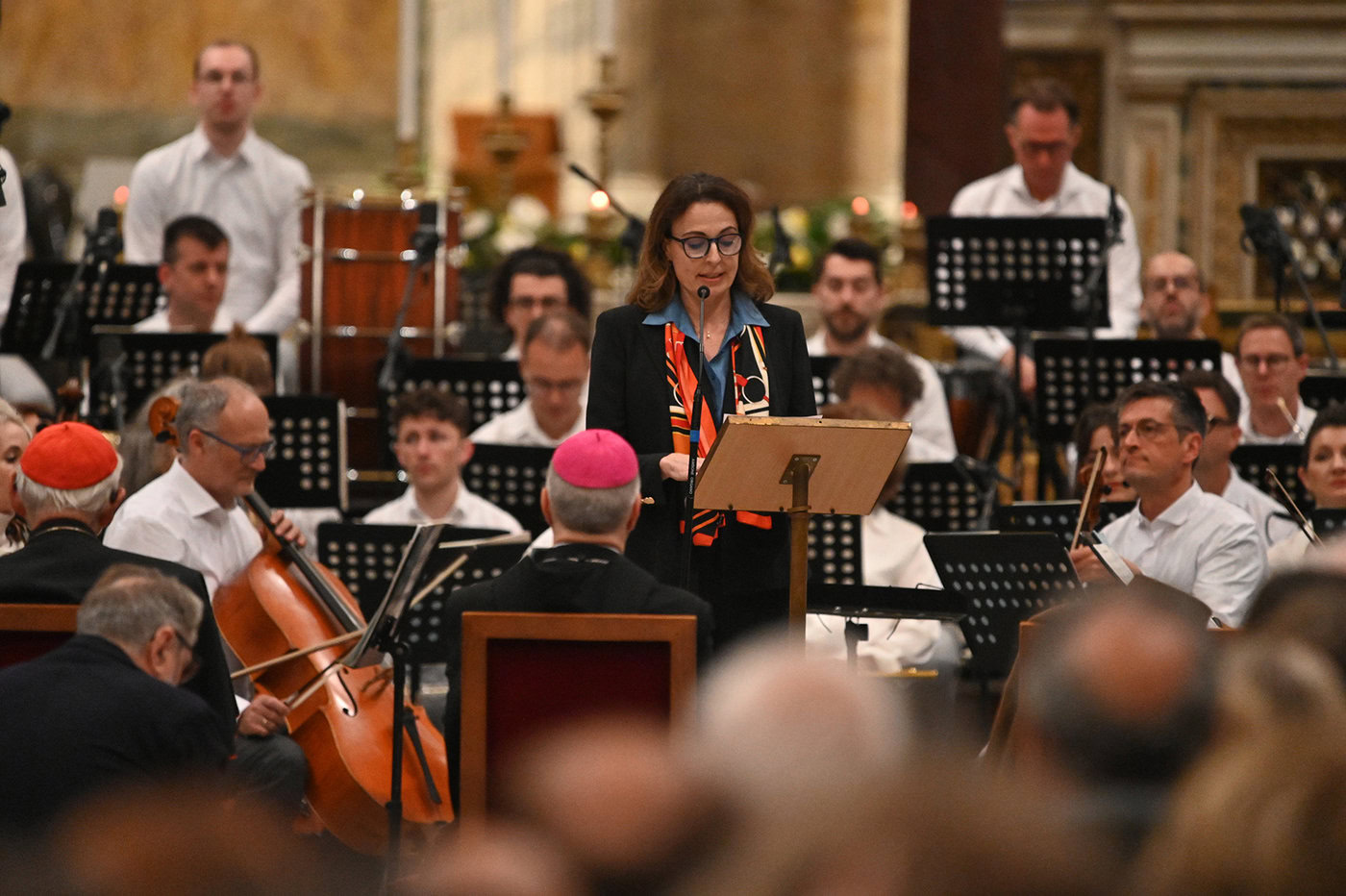
Manuela Leimgruber, Swiss ambassador to the Vatican, during her speech. Photo: Swiss National Orchestra
From local and international orchestras
Swiss National Orchestra: it sounds ambitious, but is based on an idea that is as simple as it is brilliant. The majority of its members are highly qualified Swiss musicians from orchestras in Switzerland and abroad, many of whom hold top positions as soloists and section leaders. In order to give young talent a chance, some talented students are also invited to take part. Among the members of the Swiss orchestras, those from Zurich, Basel, Geneva and Bern are particularly well represented; those working abroad come from the symphony and opera orchestras in Barcelona, Bergen, Lyon, Berlin, Munich and Stockholm, among others.
The beginnings of the SNO date back to 2016, when the Ticino musician and current artistic director Igor Longato made its first attempt at founding the orchestra with a few like-minded people, and after a long start-up period in which the project gradually took shape, it has now gone public in 2024 with two different programs with changing conductors. At the debut concert in Bern on August 1, 2024, it was John Axelrod, in Rome now Weikert.
Privately financed
With its flexible structure, the SNO follows the model of orchestras such as the Chamber Orchestra of Europe, founded in 1981, the Lucerne Festival Orchestra or the special ensembles for early music. In comparison with these orchestras, which are firmly anchored in the international concert scene, it is still in its infancy, but can boast the unique selling point of being "Swiss made". And with the enthusiasm of the newcomers. There are certainly opportunities for the future, not only because of the high quality of the performers, but also because of the obviously secure financial and institutional basis. Thanks to private patrons and foundations who are fully committed to the project, the orchestra is largely independent of public subsidies; the costs of the current project, amounting to a substantial six-figure sum, were also manageable in this way. In addition, there is a good network of personalities and institutions from politics and business, which can significantly expand the orchestra's radius of action both nationally and internationally.
Scoring points with music instead of just Swissness
The path to the SNO's long-term rise to the ranks of international orchestras therefore appears to be paved. However, for an orchestra that does not have a permanent home and, with the exception of the annually scheduled concerts in Bern, performs at constantly changing locations, specific questions of identity also arise. Two aspects in particular are currently important. On the one hand, there is the image. The orchestra's public relations work to date has sold it short; the website is rudimentary, the press releases show little understanding of the genuinely artistic aspects of the company and primarily emphasize the protocol function. Without appropriate communication skills, however, it will be difficult for the orchestra to gain the position in the music business that it deserves.
And then there's the Swiss connection: less ostentatious Swissness would probably bring in more. Comparisons with Swiss branded goods such as watches and national team football obscure the focus on the core business, and that is music. It is not an export product like any other. The desired role of the orchestra as a musical ambassador for Switzerland will be all the more successful the more it can shine artistically. The advertising effect will then be self-evident and does not need to be publicized. The prerequisite is programming that allows it to compete with the big orchestras, as in the case of Bruckner. There should be no shortage of works with a Swiss connection, from Mendelssohn and Brahms to Rachmaninov, Stravinsky and beyond. And unlike the Nati, they are not in a slump.
Around 2000 people attended the concert of the Swiss National Orchestra on November 17, 2024 in the Basilica of San Paolo fuori le mura. Photo: Renato Cerisola/SNO
Transparency notice:
The trip was organized at the invitation of the orchestra.
Website of the Swiss National Orchestra: https://sno.ch
Website of the author Max Nyffeler: https://beckmesser.info
Basel-Stadt: Music initiative "No", ESC "Yes"
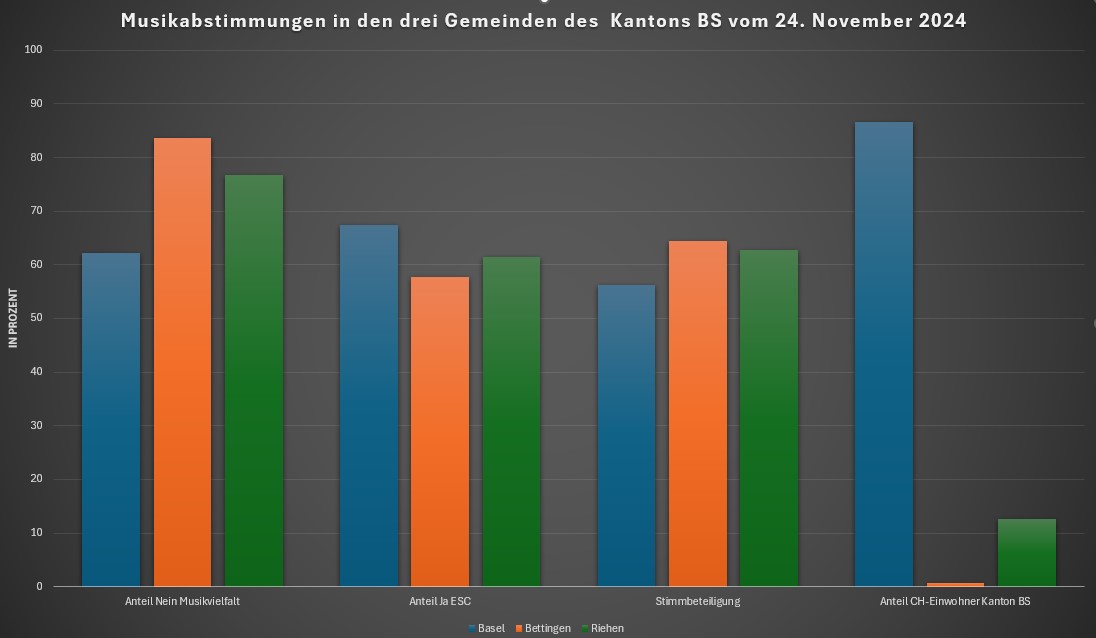
On 24 November, the cantonal initiative "for more musical diversity" was rejected in the canton of Basel-Stadt with a turnout of 57,15% (64,36% no) and the Grand Council resolution of 11 September 2024 regarding the authorization of expenditure for the staging of the Eurovision Song Contest (ESC) 2025 in Basel was approved with 66,57%.
SMZ/ks
(translation: AI)
- Nov 25, 2024
In the small municipality of Bettingen, the initiative was rejected at the highest rate with over 83% and the Grand Council resolution was accepted with just under 58%. The turnout here was also the highest at 64.4TP3T. However, the inhabitants of Bettingen do not even make up 1% of the total population of the canton of Basel-Stadt. In Riehen and Bettingen, rejection of the initiative was higher than approval of the implementation of the ESC. In Basel, the opposite was true.
The exact figures:
Cantonal initiative "for more musical diversity"
Basel: 62.14% No (183,693 inhabitants, of which CH 110,502, share 86.69, turnout 56.26%)
Riehen: 76.77% No (22,683 inhabitants, of which CH 15985, 12.54%, voter turnout 62.82%)
Bettingen: 83.61% No (1306 inhabitants, of which CH 985, share 0.77%, turnout 64.40%)
Organization of the Eurovision Song Contest (ESC) 2025
Basel: 67.49% Yes
Riehen: 61.52% Yes
Bettingen: 57,72% Yes
The Zurich Opera House is presenting an evil nightmare: Alfred Schnittke's opera "Life with an Idiot" in a production by Kirill Serebrennikov.
Thomas Meyer
(translation: AI)
- Nov 20, 2024
Woman: Susanne Elmark; Me: Bo Skovhus; Zurich Opera Chorus. Photo: Frol Podlesnyi/Operhaus Zurich
In the movie The Square (2017) by Swedish director Ruben Östlund, there is a long scene in which a wild, gorilla-like man with a naked upper body, an artist specially hired for the occasion, is supposed to entertain a private viewing party. The audience is amused at first, but becomes increasingly irritated the more aggressive and uninhibited the man behaves, until finally a woman can just about be saved from being raped. What "goes well" once again is in Living with an idiotThe opera, Alfred Schnittke's first and best opera, is a cruel reality, at least in the new Zurich production by Kirill Serebrennikov (who also designed the sets and costumes).
The idiot takes over life
According to the plot, the couple - I (Bo Skovhus) and the woman (Susanne Elmark) - have to take in an idiot from an asylum, apparently because I has done something wrong. Ich chooses someone with whom he believes he can have profound conversations, but all he can come up with is a dull "Awww!". At first it seems quite amusing, but soon the idiot becomes more aggressive. He impregnates the woman, who aborts the fetus, then rapes me. The two live in a love affair, now harassed by the woman, whom the idiot - or is it I? - finally kills. The idiot disappears; Me is interned in an asylum. The roles have been reversed. This asylum is almost constantly present on the bare, white, bare, cold stage, including the magnificent opera house chorus.
Idiot/Double: Campbell Caspary; Me: Bo Skovhus; Woman: Susanne Elmark; Zurich Opera Chorus. Photo: Monika Ritterhaus
From historical to existential interpretation
In the 1980 story of the same name by Viktor Yerofeyev (who also wrote the libretto), this idiot still bore historical traits, namely those of Lenin, as did the 1992 Amsterdam premiere directed by Boris Pokrovsky. Shortly after glasnost and perestroika, this was quite topical and meaningful. In later productions, however, the Idiot was given a different face. Lenin had receded into the distance, overshadowed by a new, self-elected dictator - and Serebrennikov did not want to bring him to the stage. The Russian dream - was it ever one? - is over. The dream is also over elsewhere. The once politically grotesque satire is now being given a broader, more existential interpretation in Zurich.
Aggressive instincts just below the surface
The story passes by for almost two hours without a break: at a steady, restless, almost indifferent pace. One event follows the next, nothing is played out in an operatic manner; the emotions seem stifled. The plot seems blank and unstoppable. We watch in bewilderment - should we still be entertained, laugh at the absurdity or be horrified? Everything seems naked, almost stripped bare. The dancer Campbell Caspary also moves naked and silently through the room as the Idiot. His role is split. Matthew Newlin, the only black-clad figure on stage, takes on the vocal part; he bears the features of the director and at times seems to be directing the action.
It was deeply convincing - and its unbearable nature also brought back memories of that embarrassing and frightening scene from The Square. It is convincing - and exasperating, because the situation is hopeless. Yet it is self-inflicted: "Everyone voluntarily chooses their own idiot, even here and everywhere. We all have our aggressive instincts, and they lie quite close to the surface," Yerofeyev once said in an interview. And that is the cruelly topical aspect of this play and this production, which incidentally does not feature as many shocking scenes as has been reported elsewhere.
The accompaniment falls silent, things just lie there
Yerofeyev and Schnittke tell this story with a sober fantasy that ties in with the Russian tradition of Nikolai Gogol - and thus indirectly with the setting of his Nose through Shostakovich. They shape the plot with numerous flashbacks, actually referencing the whole thing twice and making it an all the more painful experience through this spiral movement. Schnittke's music, played with great agility by the Philharmonia Zurich under Jonathan Stockhammer, is still colorfully polystylistic at the beginning - for which it was famous. Numerous quotations and pseudo-quotations flow in, reminiscent of Mussorgsky's Boris Godunov and the imbeciles who appear there or the International. Over time, however, this musical variety is reduced, the accompaniment falls silent at times, the text (sung in German - a sensible decision) becomes more comprehensible and more insistent. Things are just lying there. Is this not more topical than ever?
Me: Bo Skovhus; Woman: Susanne Elmark; Idiot: Matthew Newlin; Idiot/Double: Campbell Caspary; Chor der Oper Zürich. Photo: Monika Ritterhaus/Opernhaus Zürich
Swimming course for lifelong healthy music-making
On November 9, Swissmedmusica's "National Health Day Music" brought together experts from the fields of medicine and music in Lucerne's Neubad. A report, partly in keywords, with links.
Katrin Spelinova
(translation: AI)
- Nov 18, 2024
Wolfgang Böhler, President of Swissmedmusica, welcomes those present. Photo: SMZ
The mallets ensemble from the Oberer Sempachersee music school (conducted by Martina Balz) provided a harmonious introduction to the conference: children and young people performed three pieces of music in a largely self-organized and highly convincing manner - fulfilling activity, whether professionally or in their free time, just as all musicians wish for the rest of their lives. In the broadest sense, the conference was about healthy performance enhancement and happy music-making thanks to prevention. The location of the meeting was also fitting: the audience, including opinion leaders from the music sector and Pia Bucher, the founder of Swissmedmusica (SMM), sat on blue-cushioned seats in the long-drained pool of Lucerne's Neubad. In the background of the performers were remnants of the active swimming pool, which could certainly be understood symbolically: the diving tower as an image for the personal responsibility to make use of the existing advisory services, and the lifebuoy for intelligent health planning, which can help to ensure lifelong enjoyment of music-making.
Presenter Isabelle Freymond and the mallets ensemble of the Oberer Sempachersee music school. Photo: SMZ
According to the organizers, the "bathing guests" who turned up in "surprisingly large numbers" were able to obtain information at the table fair. In addition to many flyers on various offers, previous SMM conference reports were available, which celebrated an anniversary this year with its 20th symposium. Isabelle Freymond, actress, director and voice artist, moderated the event organized by SMM President Wolfgang Böhler and his team. "National Health Day Music". In a professional and charming manner, she ensured smooth transitions and called the guests back from the breaks to "swimming lessons".
Lesson 1 with Christoph Reich:
Targeted self-management as a key factor for prevention and therapy
The specialist in sports medicine, manual medicine and rheumatology concluded his presentation with the following conclusion:
An overload problem is first and foremost the result of increasing the load too quickly and/or too selectively.
Mechanical and static factors influence the tolerance reserve. They must be determined and adjusted.
A structured load build-up without delayed irritation on the other day is the key to successful treatment - i.e. after "Bank account model".
Christoph Reich runs a practice blog with lots of information on various pain problems: https://www.christophreich.ch
Lesson 2 with Cinzia Cruder (in English): In Tune, not in Pain! - Profiling, preventing, and managing playing-related musculoskeletal disorders among musicians
The musician and health researcher presented the successfully introduced "Health Module" at the Scuola universitaria di Musica of the Conservatorio della Svizzera italiana. She gave insights into her work in the field of Playing-Related Musculoskeletal Disorders (PRMDs) and the research project Rismus - Risk of music students.
Further projects:
MUST: Muscle Stiffness among musicians with and without playing-related musculoskeletal disorders (together with the Department of "Health" at the Zurich University of Applied Sciences and the Orchestra della Svizzera italiana)
Long-term study with all music academies in Switzerland on the development of chronic pain caused by music-making (A longitudinal investigation of risk factors for PRMD chronicity)
Lesson 3 with Dawn Rose (in English):
Empowering Musicians - a program to promote health and well-being in music studies
Lifebuoy and diving platform: taking responsibility for your own health. Pascal Widmer, Marjan Steenbeek and Véronique Putzi present their workshops. Photo: SMZ
Lesson 6
Chamber music from the Amazon with Jessica Sicsu, flute, Michell Pereira, percussion, and André von Steiger Paiva de Figueiredo, guitar
Lesson 7 with :
Prevention and Musical Excellence - Impulses from neuroscience
The singer, trumpeter and Specialist in psychiatry and psychotherapy gave an overview of important contributions from various experts on brain research and formulated the following "interim conclusion on good music teaching":
Good teaching
... does not automatically lead to musical excellence.
... requires teachers who are competent, credible, empathetic and approachable.
... is the result of a successful relationship between teacher and pupils.
... gives learners the expertise for learning. This strengthens intrinsicity.
... takes into account the individual motivational situation at the individual point in time.
... integrates the basic needs of autonomy and belonging.
Learning takes time and repetition.
When musical excellence is the goal, it's exhausting.
Lesson 8:
Panel discussion with Wolfgang Böhler, Nicole Freymond, Philippe Krüttli, Christian Braun, Peer Abilgaard, Gerhard Wolters
Music education in transition - a major challenge for health management
With a gentle gesture, the conductor invites us to play and gently waves us off. It is a loving atmosphere that is created, ritualistic, full of memories, although it is hard to tell what. You can hear beats on slate, individual strings being struck, all quietly. Suddenly, a few simple favorite songs are sung by refugees who have landed in Donaueschingen and are now taking part in Shared Sounds the Frenchwoman Séverine Ballon. Participation, as the title suggests. And there it is again, the dilemma of socially engaged music. The sound space created is not so significant as to say anything more than participation. What do the participants take away? Does it integrate them? Can they express themselves? Or is it more about being together? Lots of questions that don't disavow the intention, and then enthusiastic applause.
Listening into the darkness
It's not the first time that an event like this, in which outsiders, non-professionals and amateurs take part, has been held on a Friday afternoon, just before the festival gets underway. So much so that it's all too easy to forget with all the impressions. How did we take it with us into the following days? Some of it was still noticeable in the orchestral work Age the Frenchwoman Pascale Criton. The soprano soloist Juliet Fraser asked about her situation in the world, about the world itself, to fragile, floating sounds. The piece asked without wanting to give an answer. This resonated again and again: a listening into the darkness of the earth with Carola Bauckholts Double bass piece My Light Lives in the Darkplayed by Florentin Ginot in the twilight castle park.
Double bassist Florentin Ginot in the castle park. Photo: SWR/Ralf Brunner
The most far-reaching piece, now admittedly already beyond concrete questions, in a spiritual realm of mourning, was the piano piece ... blessed is ... from Mark Andre into the instability of existence. With the help of electronics from the SWR experimental studio, Pierre-Laurent Aimard plumbed the depths of the instrument. It was a highlight of this year's festival.
"... blessed is ..." by Marc Andre with Pierre-Laurent Aimard (piano) and the SWR Experimentalstudio. Photo: SWR/Astrid Karger
The aesthetic drill
Such intensity is seldom encountered elsewhere, although the archaic orchestral work Unforeseen dusk: bones into wings from Chaya Czernowin or somewhat more strikingly in Franck Bedrossians Rimbaud setting Feu sur moi - unusual for this composer, who did not quite achieve the oppressive urgency of other pieces here. And if there is one thing in common, it is that technology - live electronics, playback, loudspeakers - played a central role almost everywhere. The "natural" sound was the exception. Which has an impact on the aesthetics. In the case of the Paris-based Italian Claudia Jane Scroccaro one simply experienced a wide-ranging and engaging spatial composition (On the Edge for vocal soloists, choir and electronics). In four new orchestral works, however, the electronic addition achieved a completely new sound.
Roscoe Mitchell in George Lewis' "The Reincarnation of Blind Tom". Photo: SWR/Astrid Karger
George Lewis presented in The Reincarnation of Blind Tom a live soloist (the saxophonist Roscoe Mitchell) alongside the orchestra and an AI-controlled piano - a striking mixture, interesting in detail, but hardly in interaction. As Simon Steen-Andersen however in grosso when the amplified keyboard percussion quartet Yarn/Wire was combined with the SWR Symphony Orchestra, you could hardly hear a "natural" sound any more, but something industrially plasticized. Individual sounds, such as drilling machines, were integrated. As with this composer, it was noticeable - almost exemplary - that he pushed back the conceptual, which was still so en vogue a few years ago, in favor of sonority. So you listened to the drill and hardly thought about what it was doing here. A similar aestheticization also took place with the Chilean Francisco Alvarado takes place. In REW -PLAY - FFWD he picks up on the good old music cassette and its rewinding noises - in a funny way.
Poppy, enjoyable and technically tricky
And finally, there was the hyper-rapid Ding, Dong, Darlingin which Sara Glojnarić their queerness - which immediately faded into the background with these highly virtuosic, ludicrous sequences. Like the aforementioned pieces, this was extremely entertaining, poppy in effect, hardly real, as if plasticized, but certainly vivid, pleasingly cheeky and perhaps a little salacious within this framework. In any case, Glojnarić was awarded the SWR Symphony Orchestra Prize for this work. (Video final concert)
Sara Glojnarić receives this year's SWR Symphony Orchestra Prize from principal horn Peter Bromig. Photo: SWR/Ralf Brunner
It's been a long time since there was so much fun in Donaueschingenand one inevitably wonders about the future of this music: whether it could be successfully transferred to the concert hall. Perhaps a younger audience is waiting there for this kind of sound. This is where the other dilemma arises. The technical demands on the electronics seem to me to be so high that they can rarely be met. The studio equipment is probably still simply too expensive ... We'll see.
Unpoppy drumset
As a PS, the whole thing is now reversed: starting from an element of pop music, the standardized drum set, the Enno Poppe designed a completely different, non-poppy, but very diverse music. Strike (why this title?) requires ten drum sets and correspondingly ten outstanding drummers (here the Percussion Orchestra Cologne). Anyone who thought it was about to start had to wait a long time. It was hardly ever loud, groovy only to a certain extent, you could rather hear the nuances. Wasn't the second beat of all ten a little imprecise, one wondered right at the beginning, to which the further course provided the answer: of course not, but precisely off the mark. Poppe repeatedly built wide-ranging developments on such details, sometimes almost a little didactic because they were enlightening, but nevertheless with an immense wealth of invention over almost an hour.
Enno Poppe's multifaceted music "Streik" with 10 drumsets. Photo: SWR/Astrid Karger
From the archive
Some earlier reports on the Donaueschingen Music Days
New biography and events to mark Klaus Huber's centenary
Klaus Huber would have been 100 years old on November 30. Anniversary concerts are being held at home and abroad around this date. Corinne Holtz has published a new biography.
PM/SMZ
(translation: AI)
- Oct 24, 2024
Klaus Huber. Photo: Harald Rehling
Bern-born Klaus Huber (1924-2017) is one of the outstanding composers of the second half of the 20th and early 21st centuries. Numerous events are being organized in Switzerland and abroad to mark his birthday on 30 November. A detailed agenda is available on the website klaushuber.ch to find. A few events in Switzerland should be mentioned at this point.
Exhibition
In the library of the Academy of Music, the exhibition On the threshold of sound - the composer Klaus Huber (1924-2017). Exhibition on the occasion of his 100th birthday to Klaus Huber as composition teacher (1963 to 1972) and visiting professor at the Hochschule für Musik Basel. Further information: musik-akademie.ch/library
October 24 to December 14, 2024, Location: Vera Oeri Library, Leonhardsstr. 6, 4051 Basel
Book
Corinne Holtz evaluates in World in the work. Klaus Huber. A biography The book presents previously unknown material from archives and portrays the composer and his companions "in the light of the 20th century" (Schwabe publishing house). A review of the volume will follow later in the Swiss Music Newspaper.
Concert reading From the inside on the occasion of the 100th anniversary of Klaus Huber's birth. With works by Klaus Huber and his student Cergio Prudencio. As a lecturer and composer, Klaus Huber helped shape the beginnings of the Rümlingen New Music Festival and was a mentor to numerous composers of a new generation.
Reading by Maria Magdalena Moser: "Our strength carries us forward, women in Bolivia tell us"
October 27, 2024, 5 p.m., Rümlingen Church
November 15, 2024
Homage concert: Chamber music by Klaus Huber and his former students
November 15, 2024, 7.30 pm, New Hall, Basel University of Music FHNW
November 29 and 30, 2024
Heinz Holliger and Raphael Immoos conduct the Basel Madrigalists and the Collegium Novum Zurich in Klaus Hubers Cantiones de Circulo gyrante In this rarely performed work for soloists, choir and instrumentalists, Huber creates a wildly flaming statement against destruction and annihilation based on selected texts by Hildegard von Bingen and Heinrich Böll, according to the Basel Madrigalists. This colorful and multi-layered spatial composition, in which the various vocal and instrumental groups are positioned throughout the room, seems to envelop the audience like a cloak. The Cantiones are complemented by works by Kaija Saariaho and Younghi Pagh-Paan, both of whom studied with Huber.
November 29, 2024, 7.30 p.m., Don Bosco, Basel
November 30, 2024, 7:30 p.m., Grossmünster, Zurich
Concert introduction 6.45 pm: Andri Hardmeier in conversation with Silke Leopold and Joachim Steinheuer
December 12, 2024
Finissage concert with music by Klaus Huber and Wolfgang Rihm, performed by students of the Basel University of Music
December 12, 2024, 6 p.m., Vera Oeri Library
Death of soprano Ursula Zehnder
Her family has announced that the Swiss soprano Ursula Zehnder died in Bern on October 11, 2024 at the age of 92.
PM/SMZ
(translation: AI)
- Oct 21, 2024
Ursula Zehnder ended her career at the age of around 65 and then remained active as a teacher for a relatively long time. Photo: Zehnder family archive
She was a pupil of Jakob Stämpfli, Elisabeth Grümmer and Elsa Cavelti. Between her concert diploma in 1966 and 1995, she was one of the leading Swiss singers of her generation. She has performed as a soloist with all the major Swiss orchestras, the Bamberg Symphony Orchestra and the Leipzig Gewandhaus Orchestra, as well as with numerous choirs in Switzerland and abroad. She has worked with conductors such as Horst Stein, Charles Dutoit, Armin Jordan and Peter Maag.
Her repertoire ranged from Purcell to the present day, with a focus on the great oratorio roles of Beethoven, Mendelssohn, Dvořák, Brahms and Verdi. As a lieder singer, she devoted herself primarily to late romantic and modern lieder and premiered and recorded numerous works by Swiss composers.
For family reasons, Ursula Zehnder only performed in concert in the field of opera. She was the mother of five children and lived in Riggisberg and Bern.
Current funding from the Ernst von Siemens Music Foundation
The Ernst von Siemens Music Foundation has awarded the Ensemble '25 sponsorship prizes and is now offering special funding for children's and youth projects.
PM/SMZ
(translation: AI)
- Oct 17, 2024
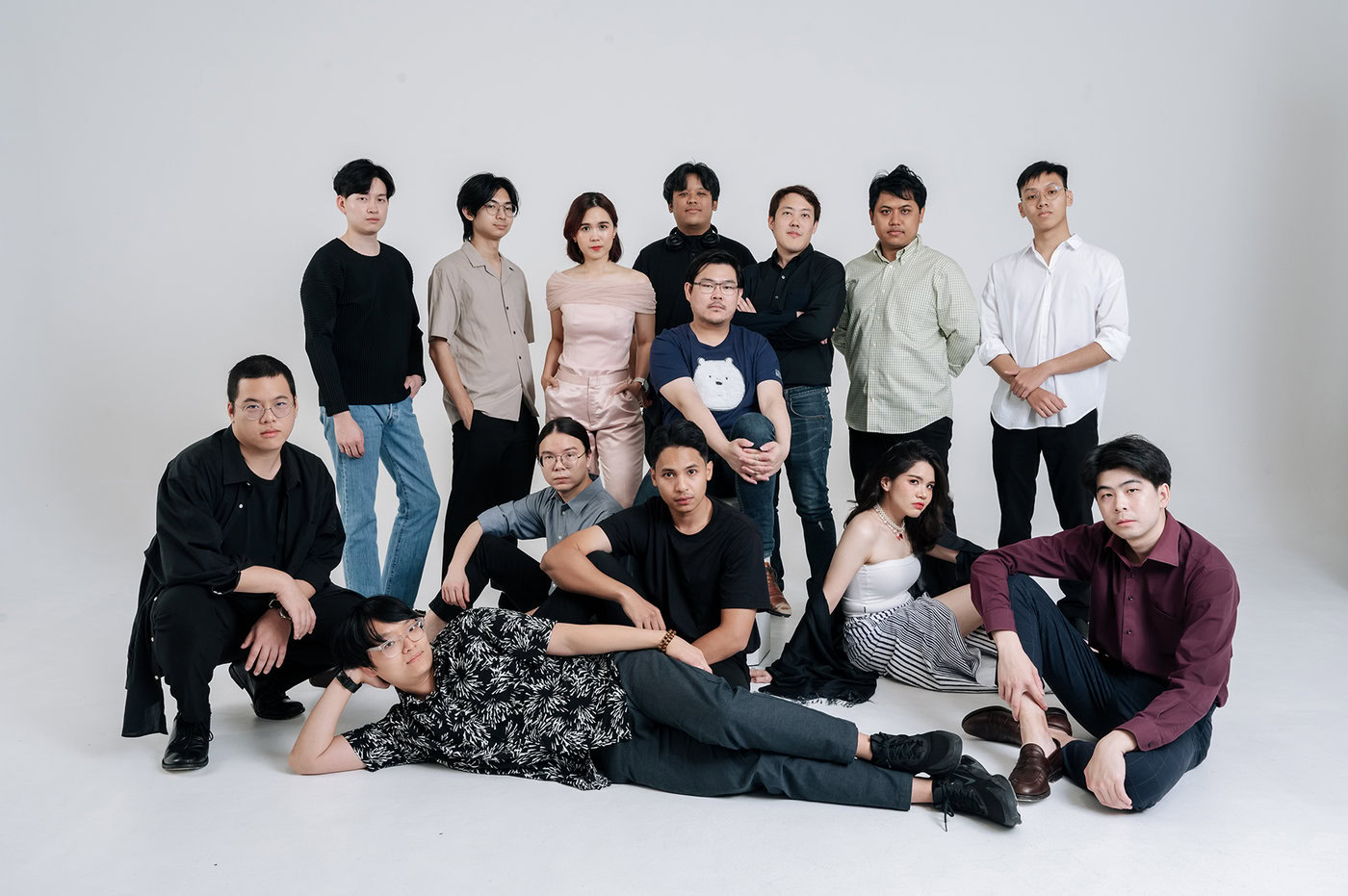
The Tacet(i) ensemble is made up of 14 Thai musicians. Photo: zVg
The Ensemble '25 sponsorship awards go to the collective lovemusic ("a new perspective on new music") from Strasbourg and the Thai ensemble Tacet(i) around the composer Piyawat Louilarpprasert. The two prizes are endowed with 75,000 euros each. The foundation is awarding the prize for the fifth time in 2025. It supports outstanding young ensembles in their artistic and structural development. The ensembles will present themselves at the Beethovenfest in Bonn in the fall of 2025.
The deadline for applications for the Ensemble '26 awards is March 15, 2025.
Promotion of young talent
The Ernst von Siemens Music Foundation is now involved in promoting young musical talent. "The promotion of children and young people should be as broad-based as possible and not just reach participants who already have a musical background," it writes on its Website. It is supporting four educational projects for the 2025/26 concert season with 25,000 euros each. The application period runs from December 10, 2024 to January 31, 2025. Further information on the jury and the funding conditions can be found at published online (Link)
The foundation will also continue to fund projects. The application period for this runs from January 1 to March 1, 2025.
As announced by the Paul Sacher Foundation, it has been awarding scholarships to support research stays in Basel since it opened in 1986. In addition to the previous scholarships on submitted topics, it also provides scholarships for research on specified topics.
The foundation team develops these topics from the collection holdings. They are dedicated to various sub-areas which, in the view of those responsible for the collection, merit in-depth research. This makes it possible to carry out fundamental initial evaluations of collections that have not yet been catalogued or have only been catalogued to a limited extent.
The formulated topics provide an initial framework that can be specified in discussions with interested parties.
The call for applications for the scholarships with detailed information on the proposed topics and the formal guidelines for these scholarships can be found on the foundation's website:
Music criticism and musicology: where do they meet? On September 23 and 24, 2024, a renowned panel of experts discussed this topic at the ZHdK. The topic was the long-term project on the estate of music critic Fritz Muggler.
Katrin Spelinova
(translation: AI)
- Oct 08, 2024
Music criticism helps to "digest" music. Symbolic image: vittore/depositphotos.com
In short, the music criticism conference was intended to provide a context for the academic processing of the archive of Fritz Muggler (1930-2023). The extensive material from his many years of work has been conserved and inventoried at the Zurich University of the Arts (ZHdK) since 2016. The first project is entitled "Heard abroad": Swiss composers and performers at international new music festivals - perspectives from Zurich critic Fritz Muggler. Ivan Denes, Iris Eggenschwiler and project manager Lukas Näf explained the status of the work and illustrated Muggler's working methods using reviews of works by Maurizio Kagel and Klaus Huber.
The aim was therefore to classify music journalistic contributions in terms of music history. The guest lectures and subsequent discussions made it clear how difficult it is to formulate conclusive categories for this. Or, in other words, how the interface between science and journalism could be clearly defined. After all, a music critic is also a music historian and, conversely, a music historian is also a music critic.
The title of the conference was Music criticism in the context of contemporary music since the Second World War. The perspectives of the presentations were somewhat "donaueschingen-heavy" and concentrated mainly on music-philosophical positions from before the turn of the millennium. This is understandable. According to the invitation, the aim was to recognize narrative patterns or entrenched prejudices that influence the evaluation and classification of music in music history. The presentations by Jörn Peter Hiekel (conference chair together with Lukas Näf and Dominik Sackmann), Wolfgang Schreiber, Tobias Schick, Torsten Möller, Leonie Reineke, Björn Gottstein, Martin Kaltenecker and Thomas Meyer testified to their in-depth knowledge. It was impressive how many details the speakers remembered from their visits to Donaueschingen or were refreshed by the presentations.
For who?
Interestingly, the audience or the reader of the reviews played no role in the multi-layered considerations. The influence of editorial work was also only touched on in passing. Did we not have to think about this until the beginning of the 21st century? Perhaps because the cultural significance of (Western) high culture was not yet in doubt back then? Today, in 2024, the media speak the "language of entertainment" (Wolfgang Schreiber) more than ever. Music criticism is being pushed out of the feature pages of the daily press and specialist journals are disappearing, and not just for contemporary music.
The inclusion of younger critics such as Friederike Kenneweg, Hanna Schmidt and many others would have gone beyond the thematic scope of the conference, but would perhaps have provided fresh impetus. After all, classical expert music criticism seems to have lost its significance for the music market. Holger Noltze writes on September 25 in his Van-contribution to the German Record Critics' Award: "But to see an independent work of criticism, the not at all trivial search for artistic quality swept off the table as irrelevant, illuminated the realization in a flash: that the (ever special) relationship between the market and criticism of music has long since become completely decoupled; that the old idea: a good review, possibly a prize helps with sales, hardly plays a role in the reality of modern major marketing." (https://van-magazin.de/mag/schallplattenkritik-marktlogik-musikkritik).
In view of this loss of significance, further (i.e. more important or at least different) questions arise regarding the relationship between musicology and music journalism.
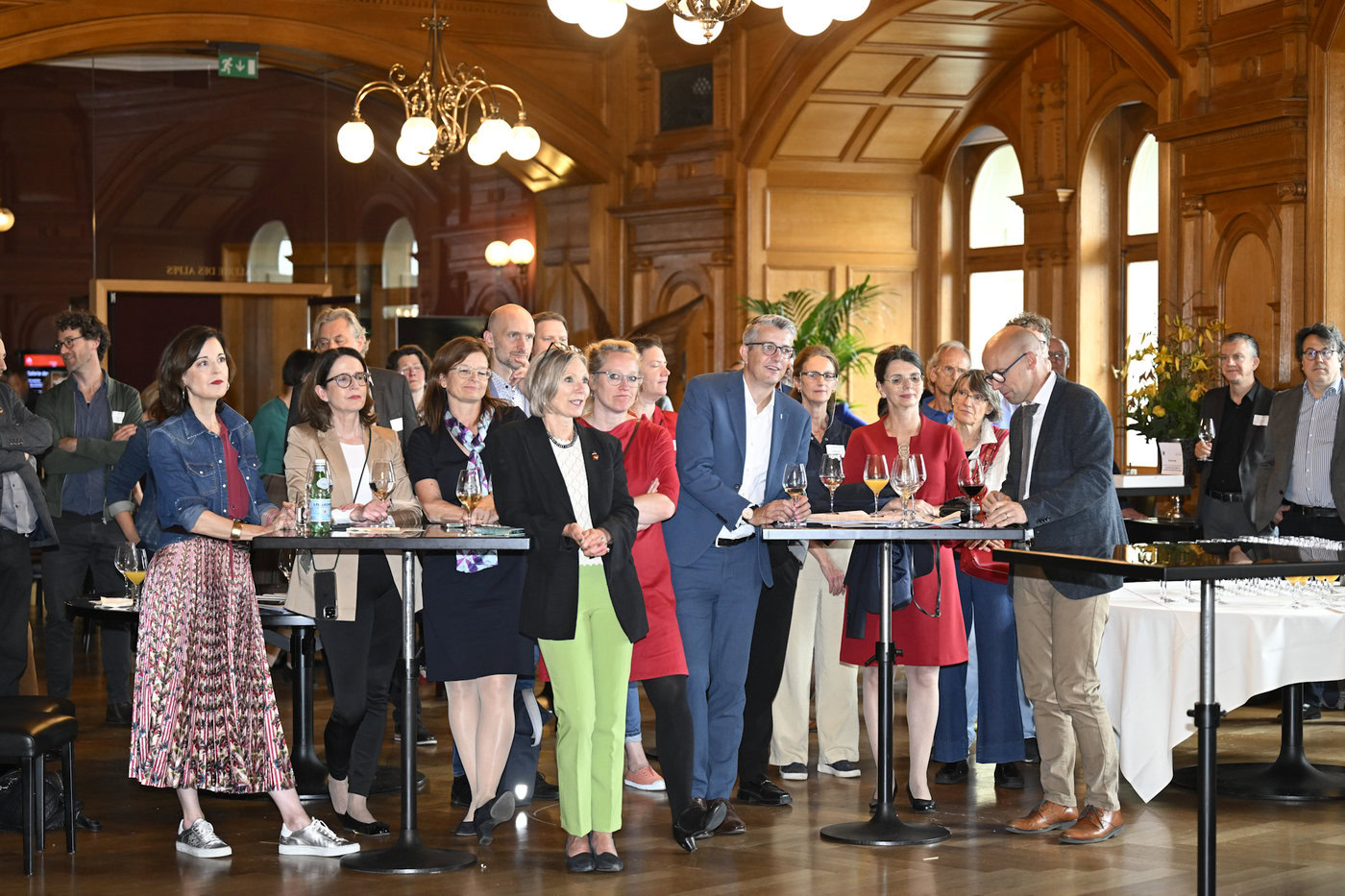
The parliamentary groups "Music" and "Rock/Pop in the Federal Palace" met with members of the music associations. In the Galerie des Alpes of the Federal Palace in Bern, they listened to a lot of live Swiss music.
PM/SMPA/SMR/SMZ
(translation: AI)
- Sep 13, 2024
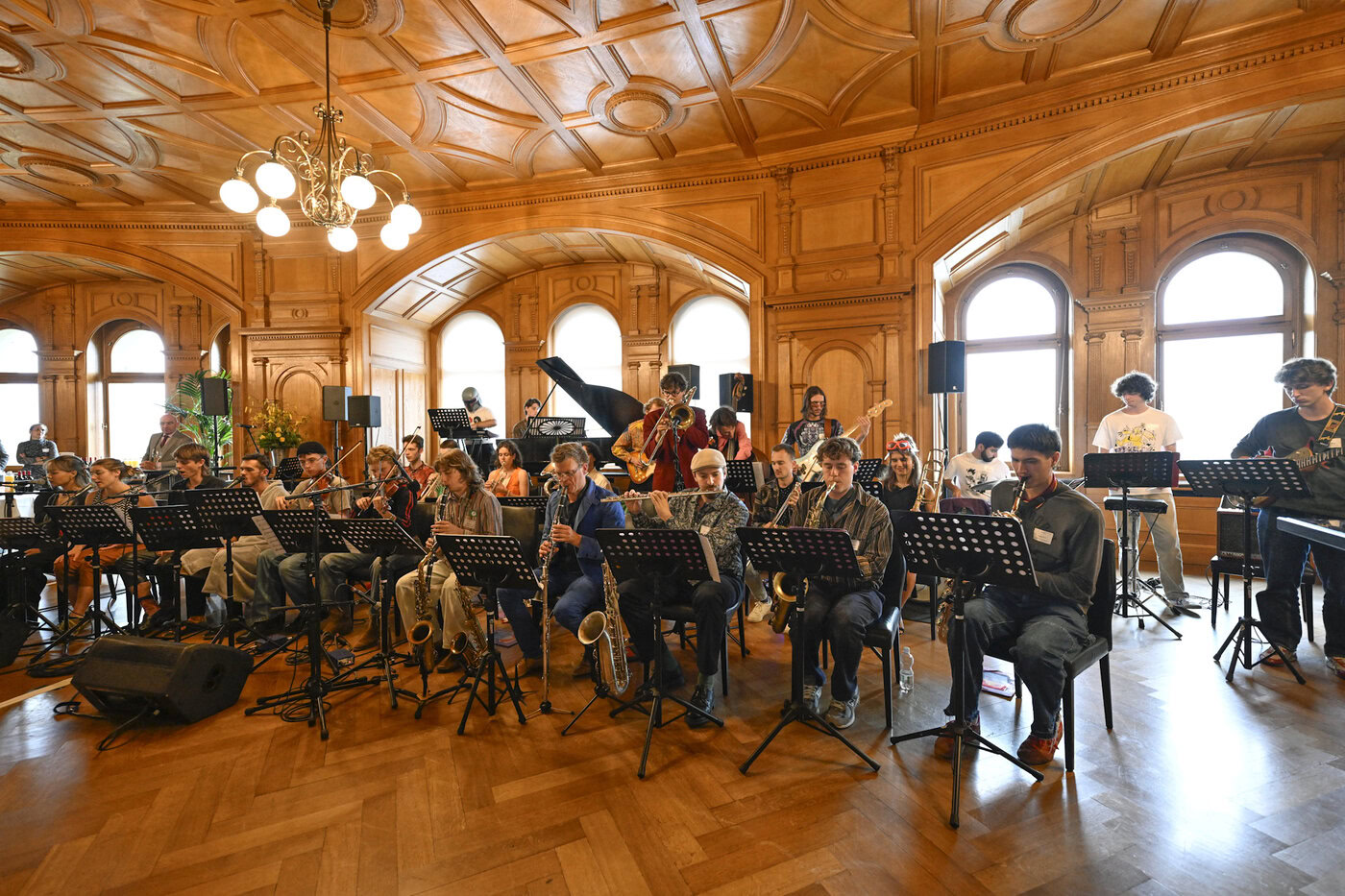
The Jugendjazzorchester.ch was convincing - even with "weird" sounds. Photo: Hans Zogg
One after the other, on September 11, 2024, the YouthJazzOrchestra.ch, Eliane, Noah Veraguth (Pegasus), Marc Sway and Baschi and delighted the more than 120 attendees with their short performances. The invitation from the Swiss Music Council (SMR) and the Swiss Music Promoters Association (SMPA), which run the secretariats of the two parliamentary groups, was accepted by around 50 parliamentarians, representatives of the Federal Office of Culture and numerous representatives of music associations and music professionals.
Major challenges
The exclusive live moments were authentic and intimate. Attendees also became aware of the importance of the Swiss music industry and its coordinated commitment to music. Music is indeed included in the 2025-2028 Cultural Dispatch currently being discussed in parliament. However, the current and future challenges remain great, so that the framework conditions for music creators and event organizers can be maintained or shaped in such a way that the promotion of young talent and the enormous diversity that the Swiss music landscape has to offer can continue to be taken into account.
The National Council's decision on September 11 is currently met with absolute incomprehension. Contrary to the Federal Council's proposal, it wants to cut CHF 6.5 million from Pro Helvetia's budget. It is to be hoped that the Council of States will take countermeasures so that creative artists are not severely affected. In addition to the distribution of funds, it is also generally crucial that the commitment to the music industry, which is characterized by idealism and passion as well as a willingness to take private risks, is not undermined by even more hurdles.
About the SMPA
In the Swiss Music Promoters Association (SMPA) brings together the most important Swiss concert, show and festival organizers. In 2023, the 50 or so members organized over 2,000 major events for around 5 million visitors in all parts of the country, largely at their own risk. The event industry is an important economic factor for Switzerland and secures jobs and apprenticeships. Every year, SMPA members offer around 23,000 volunteers a meaningful leisure activity at their events. In addition, there is a strong commitment to culture: the proportion of Swiss artists booked for events is constantly increasing.
About the Swiss Music Council
The Swiss Music Council (SMR) is the largest and most influential lobbyist for the entire music sector in Switzerland. 55 associations from the entire Swiss music sector are united under its umbrella. It is committed to improving the cultural and educational policy framework for the creation, communication, dissemination and preservation of music in all its diversity. In collaboration with the Parliamentary Group for Music, it organizes one informative event per session for its members on politically relevant topics in the music sector. This exchange is very important both for those involved in the Swiss music industry and for members of parliament.
Parliamentary groups on the subject of music
There are three interest groups in Parliament that take care of music (source: List of members Parliamentary GroupParliamentary Services parliament.chas of September 2, 2024):
Music PGM: President Stefan Müller-Altermatt, Secretariat of the Swiss Music Council, 32 members. Purpose: "Information and discussion on music-related topics with a connection to politics. Exchange with representatives of the Swiss music sector.
Cooperation with the other cultural parliamentary groups."
Rock/Pop in the Federal PalaceCo-Presidency Daniel Jositsch and Sandra Sollberger, Secretariat Swiss Music Promoters Association SMPA, 38 members. Purpose: "To impart know-how in the areas of live entertainment, music, culture and events on topics such as withholding tax, prevention, VAT, copyright/SUISA, secondary ticket market/black market, sound and laser (VNISSG), security/health & safety, training, volunteer work, etc."
Folk culture & folk music: President Priska Wismer-Felder, Secretariat IG Folk Culture, 61 members. Purpose: "Raising awareness of folk culture & folk music"
Photo: Hans Zogg
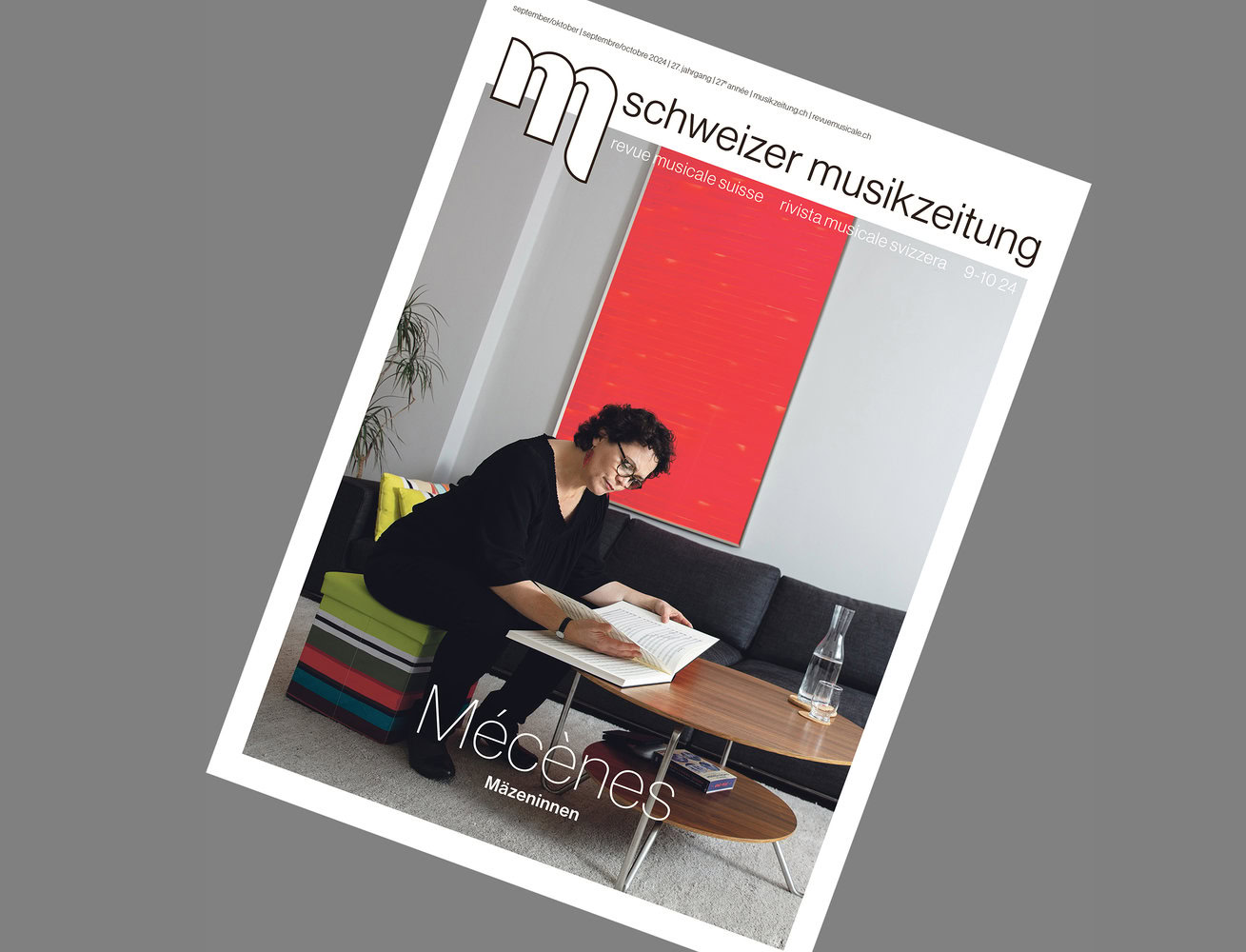
Issue 09_10/2024 - Focus "Women patrons"
SMZ
(translation: AI)
- 04 Sep 2024
Tabea Zimmermann. Photo: Rui Camilo
Table of contents
Focus
Patron of contemporary music
Interview with Tabea Zimmermann, Chairwoman of the Board of Trustees of the Ernst von Siemens Music Foundation
The work of amusic-loving billionaire Aline Foriel-Destezet promotes classical music
My patron and I
Some advice from Elisa Bortoluzzi Dubach
Chatting about ...
... the financing of music projects
Hedy Graber and Timothy Löw
(italics = summary in German of the original French article)